
BuddhistCatholicContemplativeEvangelicalGeneral ChristianHinduJewishLatter-day SaintMuslimNew VisionsProgressive Christian
Beliefs
- Buddhist
- Catholic
- Contemplative
- Evangelical
- General Christian
- Hindu
- Jewish
- Latter-day Saint
- More Voices
- Muslim
- New Visions
- Pagan
- Progressive Christian
Topics
- Religion News
- Food and Religion
- Sports and Religion
- Religious Art
- Religious Music and Entertainment
- Religious Events
- History and Religion
- Style and Religion
- Politics and Religion
- Women in Religion
- Recreation Outdoors and Religion
- Business Finance and Religion
- Careers Workplace and Religion
- Education and Religion
- Family Parenting and Religion
- Health Fitness and Religion
- Home and Religion
- Relationships and Religion
- Technology and Religion
- Travel and Religion
Columnists
- Buddhist Columnists
- Business Finance and Religion Columnists
- Careers Workplace and Religion Columnists
- Catholic Columnists
- Contemplative Columnists
- Education and Religion Columnists
- Evangelists Columnists
- Family Parenting and Religion Columnists
- General Christian Columnists
- Health Fitness and Religion Columnists
- Hindu Columnists
- History and Religion Columnists
- Home and Religion Columnists
- Jewish Columnists
- More Voices Columnists
- Latter Day Columnists
- Muslim Columnists
- New Visions Columnists
- Nonreligious Columnists
- Pagan Columnists
- Politics and Religion Columnists
- Progressive Columnists
- Recreation Outdoors and Religion Columnists
- Relationships and Religion Columnists
- Religion News Columnists
- Religious Art Columnists
- Religious Events Columnists
- Religious Music and Entertainment Columnists
- Sports and Religion Columnists
- Style and Religion Columnists
- Technology and Religion Columnists
- Travel and Religion Columnists
- Women in Religion Columnists
Resource Library
- 2026 Calendar
- Library of World Religions
- The 100 Most Holy Places on Earth
- Patheos Answers
- Podcasts
- Videos
- Faith Leaders Database
- Anglican Episcopalian
- Bahai
- Baptist
- Buddhism
- Christianity
- Confucianism
- Eastern Orthodoxy
- Hinduism
- Holiness and Pentecostal
- ISKCON
- Islam
- Judaism
- Lutheran
- Methodist
- The Church of Jesus Christ of Latter-day Saints
- New Age
- Paganism
- Presbytarian and Reformed
- Protestantism
- Religion Behind the Scenes
- Roman Catholic
- Scientology
- Shia Islam
- Sikhism
- Sufism
- Sunni Islam
- Taoism
- Zen
- See all religions
Research Tools
 Ad-Free & Subscriber Log-In Subscription Support
Ad-Free & Subscriber Log-In Subscription Support
Follow Patheos 

- Trending:
- Forgiveness
- |
- Marriage
- |
- Consciousness
- |
- Death Penalty
- |
- Election
- |
- Halloween

-
About
-
Catholic Apologetics
-
Church History
-
Great Apologists
-
Christian Worldview
-
Protestantism & Misc.
- Home
- Catholic
- History and Religion
- St. Paul’s Word Selection vs. Sola Scriptura
St. Paul’s Word Selection vs. Sola Scriptura
Last updated on: June 6, 2026 at 12:30 am by Dave Armstrong
St. Paul’s Word Selection vs. Sola Scriptura 2026-06-06T00:30:11-04:00 Dave Armstrong
Patheos Explore the world's faith through different perspectives on religion and spirituality! Patheos has the views of the prevalent religions and spiritualities of the world.
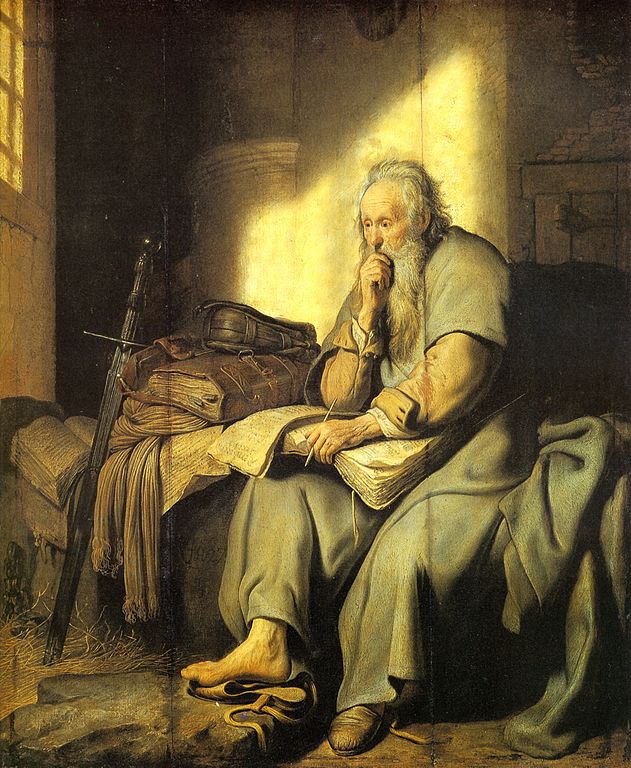
St. Paul in Prison (1627), by Rembrandt (1606-1669) [public domain / Wikimedia Commons]

(4-3-10)
* * * * *
First of all, before I get to my argument, let’s get some preliminaries out of the way. Readers can rest assured that I greatly love and revere Holy Scripture as much as any Protestant does. That’s not at issue. The issue is sola Scriptura: whether Scripture is the only infallible authority. Scripture is a set of divinely inspired books. Sola Scriptura is a principle or rule of faith that has to do with how much authority Scripture has, and its relation to Christian Tradition and the Christian Church. Thus, they are two very distinct things: related, but essentially different.
A fair number of Protestants (especially zealous online apologists) have a very annoying habit of equating sola Scriptura (i.e., the view that Scripture is the only final and infallible authority in the Christian life) and love and reverence for Scripture, as if they were exactly the same thing. For some Protestants, in other words, for a Catholic to deny sola Scriptura automatically means that he is somehow demoting or denigrating or despising Scripture. It’s either Protestantism or the highway. No non-Protestant (according to this mentality of some — not all — Protestants) can love Scripture, by definition or inexorable conclusion, if they also accept the authority of tradition and the Church (both of which are repeatedly asserted in Scripture itself).
One can readily observe both the arrogance and muddleheadedness of such a stance: especially the more one studies what is actually in Scripture. The one who reveres Scripture the most is the one who follows its manifest teachings, and doesn’t pick and choose what he likes and dislikes (“cafeteria Christianity”). Since an authoritative tradition and an authoritative Church are very much part of biblical teaching (as I will demonstrate below), to include them in one’s paradigm of authority is to accept and love Scripture, not to “demote” it. It is taking the Bible at its word.
But because of tunnel vision, wooden, either/or, arrogant, illogical thinking of this sort (sadly, very common), I have to defend my love of Scripture simply because I am a Catholic and deny sola Scriptura. But once in a while it is worth it to set the record straight.
My position, argued many times, is that Scripture is for the most part clear and easy to understand (especially in the major issues), for those willing to follow it where it leads, and led by the Holy Spirit and regenerate. I have long since argued, for example, that the Holy Trinity can easily be defended by Scripture alone. I did this myself 28 years ago, and the argument is just as strong now as it ever was.
The Church is needed not so much because the Bible is unclear, but because the heretical mindset can and will twist and distort the Scripture any number of ways; therefore an authority outside of Scripture is necessary in order to confirm true doctrine and to maintain orthodoxy. The history of Protestantism and all the relativism and doctrinal chaos therein amply illustrates this. Thus, St. Francis de Sales (1567-1622, a Doctor of the Church), writes (thanks to blog regular Ben M. for this):
It is quite true that Holy Scripture contains fully and clearly all doctrines necessary to salvation we do not doubt it; It is also true that it is very useful to interpret Holy Scripture by comparing passages together, and bringing the whole into an analysis of doctrine. But I must always believe and affirm that, notwithstanding the admirable perspicuity of Holy Scripture in all things necessary to our salvation, the human mind does not always find its right meaning but is liable to err, and practically does very often err in interpreting passages which are of great importance to the confirmation of the Faith.
Witness the Lutheran and Calvinistic writers; they, though leaders of the so-called Reformation, are involved in irreconcilable differences as to the meaning of the words of institution of the Holy Eucharist; and while each side maintains that they have diligently and faithfully studied the sense of those words, taking them with the context of Holy Scripture generally, and comparing the whole with the analogy of Faith, nevertheless they come to very different conclusions. The Word of God is clear enough, but our human minds are cloudy, and, like bats, cannot face the light.
(To a Gentleman on the Right Use of Scripture, July 7, 1619; A selection from the spiritual letters of s. Francis de Sales, Bishop and Prince of Geneva, 1880, pp. 162-163)
Now that the nonsense, and flotsam and jetsam is cleared away, we can move ahead and commence our present topic:
Ephesians 4:4-6, 11-16, 21-25 There is one body and one Spirit, just as you were called to the one hope that belongs to your call, [5] one Lord, one faith, one baptism, [6] one God and Father of us all, who is above all and through all and in all. . . . [11] And his gifts were that some should be apostles, some prophets, some evangelists, some pastors and teachers, [12] to equip the saints for the work of ministry, for building up the body of Christ, [13] until we all attain to the unity of the faith and of the knowledge of the Son of God, to mature manhood, to the measure of the stature of the fulness of Christ; [14] so that we may no longer be children, tossed to and fro and carried about with every wind of doctrine, by the cunning of men, by their craftiness in deceitful wiles. [15] Rather, speaking the truth in love, we are to grow up in every way into him who is the head, into Christ, [16] from whom the whole body, joined and knit together by every joint with which it is supplied, when each part is working properly, makes bodily growth and upbuilds itself in love. . . . [21] assuming that you have heard about him and were taught in him, as the truth is in Jesus. [22] Put off your old nature which belongs to your former manner of life and is corrupt through deceitful lusts, [23] and be renewed in the spirit of your minds, [24] and put on the new nature, created after the likeness of God in true righteousness and holiness. [25] Therefore, putting away falsehood, let every one speak the truth with his neighbor, for we are members one of another.
[red = Church theme / blue = truth and falsity and doctrinal motifs / purple = theosis or unity with God or indwelling elements]
I made an analogical argument from Ephesians 4:11-15 above in my book, A Biblical Defense of Catholicism (pp. 15-16), in response to the alleged sola Scriptura prooftext, 2 Timothy 3:16-17. That book was completed in 1996, and parts of it were written as early as 1991. Here is the heart of that argument:
Note that in Ephesians 4:11-15 the Christian believer is “equipped,” “built up,” brought into “unity and mature manhood,” “knowledge” of Jesus, “the fulness of Christ,” and even preserved from doctrinal confusion by means of the teaching function of the Church. This is a far stronger statement of the “perfecting” of the saints than 2 Timothy 3:16-17, yet it doesn’t even mention Scripture.
Therefore, the Protestant interpretation of 2 Timothy 3:16-17 proves too much, since if all nonscriptural elements are excluded in 2 Timothy, then, by analogy, Scripture would logically have to be excluded in Ephesians. It is far more reasonable to synthesize the two passages in an inclusive, complementary fashion, by recognizing that the mere absence of one or more elements in one passage does not mean that they are nonexistent. Thus, the Church and Scripture are both equally necessary and important for teaching. This is precisely the Catholic view. Neither passage is intended in an exclusive sense.
The fact remains that sola Scriptura is nowhere taught in Scripture. I’ve seen the innumerable attempted prooftexts, and have written an entire book about the topic [and now a second one, too]. None of them succeed. It’s merely an assumed, axiomatic viewpoint imposed onto Holy Scripture. Scripture itself gives equal authority to the Church and to Sacred, Apostolic Tradition. And we see that in the text under present consideration.
To expand the original argument regarding Ephesians 4 a bit: Protestants are saying that Scripture is the rule of faith. It is the sole and ultimate criterion for theological doctrine and truth, insofar as it is regarded as the only infallible authority. Therefore, it stands to reason that in a passage talking about truth over and over again, and denouncing falsehood, and referring to “one faith” and “the unity of faith”, that Scripture would likely be mentioned (under the erroneous Protestant premise). It’s not absolutely necessary, but it would be probable, I think.
This would be a logical place for Paul to reiterate that the Scripture is the rule of faith. But he never does that. He refers repeatedly to truth and denounces falsehood, and refers to the Church over and over: “one body”; [listing of Church offices]; “body of Christ”; “the whole body”; “bodily growth”; “members of one another”.
Now, under Catholic assumptions of the “three-legged stool” (Church, Scripture, Tradition), this is perfectly plausible and would be predictable. Not all have to be mentioned in the same context. Any one of them can be (or all of them, or any combination thereof), because they are all authoritative.
In this case, it is the Church that is highlighted (which is why I compared it to 1 Tim 3:15: the Church as the “pillar and bulwark of the truth”). In other places, tradition is synonymous with “truth” or “the gospel” or “the faith” and other synonyms (as I have shown elsewhere).
But granting a view where Scripture, not the Church, is the ground of truth and the only infallible rule of faith, always and necessarily, it strikes me as quite odd that in this passage, filled with allusions to truth and falsity, the Bible is never mentioned. This is not (lest we be witlessly accused of it yet again) “running down the Bible” (!); it is, rather, evidence against the unbiblical doctrine of sola Scriptura.
The words “Scripture” or “Scriptures” appear 51 times in the New Testament. Yet in eight of his thirteen epistles (2 Corinthians, Ephesians, Philippians, Colossians, 1 & 2 Thessalonians, Titus, Philemon) St. Paul (it may be surprising to learn) never uses either of these words. He uses it only 14 times altogether: in Romans (6), 1 Corinthians (2), Galatians (3), 1 Timothy (2), and 2 Timothy (1).
Likewise, “word of God” appears 43 times in the New Testament, and many of these (as in Old Testament prophetic utterances) are intended in the sense of “oral proclamation” rather than “Scripture” (especially apart from the Gospels). St. Paul uses the phrase only ten times, in nine different epistles. And it is by no means certain that any individual instance refers without question specifically to Holy Scripture, rather than to oral proclamation of apostolic tradition. I suspect that it is much more likely the latter sense in most or all cases.
But, to be fair, I won’t include this phrase in my analysis, and will also do the same with regard to “gospel.” In a way that was preaching Scripture (based on OT messianic passages; in another sense it was an oral tradition with radically new elements. I’ll consider both of these a “wash” as to the relation between Scripture and tradition / Church. But respectable arguments could be made either way, I think.
If we survey “Body (of Christ)” in Paul we find 19 appearances:
Romans “body of Christ” [1] (7:4) / “body” [2] (12:4-5)
1 Corinthians “body” [5] (10:17; 12:12-13, 25, 27; + several more times in making analogies to the human body)
Ephesians “his body” [3] (1:23: 5:23, 30) / “body” [3] (3:6; 4:4, 16) / “body of Christ” [1] (4:12)
Colossians “his body” [1] (1:24) / “body” [3] (1:18; 2:19; 3:15)
And here is Paul’s use of “Church” / ekklesia (in more than merely a local sense of congregation or building) in his epistles (20 total times):
1 Corinthians [6] (5:12; 6:4; 10:32; 11:22; 12:28; 15:9)
Galatians [1] (1:13)
Ephesians [9] (1:22; 3:10, 21; 5:23-25, 27, 29, 32)
Philippians [1] (3:6)
Colossians [2] (1:18, 24)
1 Timothy [1] (3:15)
Likewise, here is Paul’s four uses of (apostolic) “tradition(s)” (paradosis):
1 Corinthians [1] (11:2)
Colossians [1] (2:8)
2 Thessalonians [2] (2:15; 3:6)
But the word “tradition” is not the only word Paul uses for this notion, by a long shot. There is also the concept of “receiving” (tradition) and “delivering” or passing it on. Three of the above passages on “tradition” contain this motif. This mention of some sort of tradition passed down (primarily orally; through preaching) can be seen in passages such as 1 Corinthians 11:23; 15:1-2; 15:3; Galatians 1:9, 12; 1 Thessalonians 2:13, 2 Timothy 1:13; 2:2, for eight more instances.
There are at least fifteen other passages that exhibit the notion of apostolic (and oral) tradition, expressed in various different ways (including “word of God,” “preaching,” etc.):
Romans [3] (6:17; 10:8; 16:25)
1 Corinthians [1] (1:18)
2 Corinthians [1] (3:6)
Ephesians [1] (1:13)
Philippians [2] (2:16; 4:9)
Colossians [2] (1:5; 1:6)
1 Thessalonians [1] (1:6)
2 Thessalonians [1] (3:14)
2 Timothy [3] (4:2, 15, 17)
But let us be as fair-minded as we can and anticipate one probable objection. One could plausibly contend that when Paul cited Old Testament Scripture he was, by that action, giving Scripture authority, and this would be the equivalent of mentioning (the word) “Scripture”. I think this is a valid point. St. Paul made 84 such citations (I found a wonderful chart that gives all the OT citations in the NT). Here they are (minus already-recorded instances of “Scripture” being mentioned):
Romans [44] (2:6; 24; 3:4; 10-18; 4:7,8, 17, 18, 22; 8:36; 9:7, 9, 12, 13, 15, 20, 25-26, 27-28, 29, 33; 10:5, 6-8, 13, 15, 16, 18, 19, 20, 21; 11:3, 4, 8, 9, 26-27, 34-35; 12:19, 20; 13:9; 14:11; 15:3, 9, 10, 11, 12, 21)
1 Corinthians [18] (1:19, 31; 2:9, 16; 3:19, 20; 5:13; 6:16; 9:9; 10:7, 26, 28; 14:21; 15:27, 32, 45, 54, 55;
2 Corinthians [8] 4:13, 6:2, 16, 17-18; 8:15; 9:9; 10:17; 13:1
Galatians [7] 3:6, 10, 11, 12, 13; 4:27; 5:14
Ephesians [6] 4:8, 25, 26; 5:14, 31; 6:2-3
Philippians [1] 2:10-11
By the same token, if a citation of the Old Testament is to be regarded as evidence in favor of Paul having Scripture in mind, then I submit that several terms describing the content of the Christian faith without mentioning Scripture are likewise (by this somewhat subjective method) reasonably categorized under “tradition.” Here I would add the following:
Romans “the truth” [1] (2:8) / “the doctrine” [1] (16:17)
1 Corinthians “the truth” [1] (2:13) / “my message” [1] (2:4) / “supernatural Rock which followed them, and the Rock was Christ” [an oral tradition not in the OT; 1] (10:4)
2 Corinthians “the truth” [3] (4:2; 11:10; 13:8) / “message of reconciliation” [1] (5:19) / “ministers of a new covenant, not in a written code but in the Spirit; for the written code kills, but the Spirit gives life” [1] (3:6)
Galatians “the faith” [1] (1:23) / “the truth” [1] (5:7)
Ephesians “the faith” [1] (4:13)
Philippians “the faith” [1] (1:27)
Colossians “the faith” [2] (1:23; 2:7) / “the truth” [1] (1:5)
1 Thessalonians “the truth” [3] (2:10, 12, 13)
1 Timothy “the faith” [7] (1:2; 3:9, 13; 4:1; 5:8; 6:10, 21) / “the truth” [2] (2:4; 4:3) / “the commandment” [1] (6:14) / “doctrine” [1] (4:6) / “teaching” [2] (4:16; 6:1)
2 Timothy “the faith” [1] (4:7) / “the truth” [6] (1:14; 2:18, 25; 3:7, 8; 4:4) / “message” [2] (4:15, 17)
Titus “the faith” [2] (1:13; 3:15) / “the truth” [1] (1:1) / “doctrine” [1] (2:10)
This adds up to 46 more times where Paul mentions tradition / received and passed-down doctrine, using a similar term or concept. In surveying Paul’s thought-world, then, as indicated by his choices of words and notions, in his teaching of the gospel and the content of the Christian faith in his epistles, we arrive at the following tally:
“Scripture(s)”: 14 + 84 citations of OT = 98
“Church” (20) and “Body (of Christ)” (19) = 39
“Tradition” and equivalent terms and concepts: 73
We can see that the tradition and Church legs of the “three-legged stool” are indeed prominent and together make up 53% of the 210 total instances, whereas Scripture appears 47% of the time (112-98). Moreover, I have not included obvious aspects of Church authority such as bishops and elders; the Jerusalem Council, etc. That would add even more non-scriptural authority to the mix. Let’s see how Paul’s word usage breaks down for each of his 13 books (Philemon contains no such references):
Romans “Scripture(s)”: 50 / “Church” and “Body”: 3 / “Tradition” and equivalents: 5
1 Corinthians “Scripture(s)”: 20 / “Church” and “Body”: 11 / “Tradition” and equivalents: 8
2 Corinthians “Scripture(s)”: 8 / “Church” and “Body”: 0 / “Tradition” and equivalents: 6
Galatians “Scripture(s)”: 10 / “Church” and “Body”: 1 / “Tradition” and equivalents: 4
Ephesians “Scripture(s)”: 6 / “Church” and “Body”: 16 / “Tradition” and equivalents: 2
Philippians “Scripture(s)”: 1 / “Church” and “Body”: 1 / “Tradition” and equivalents: 3
Colossians “Scripture(s)”: 0 / “Church” and “Body”: 6 / “Tradition” and equivalents: 6
1 Thessalonians “Scripture(s)”: 0 / “Church” and “Body”: 0 / “Tradition” and equivalents: 5
2 Thessalonians “Scripture(s)”: 0 / “Church” and “Body”: 0 / “Tradition” and equivalents: 3
1 Timothy “Scripture(s)”: 2 / “Church” and “Body”: 1 / “Tradition” and equivalents: 13
2 Timothy “Scripture(s)”: 1 / “Church” and “Body”: 0 / “Tradition” and equivalents: 14
Titus “Tradition” and equivalents: 4
Some (I think) interesting facts drawn from the above survey:
In eight of the twelve epistles above, the combination Church/Tradition appears more than Scripture. In six of these eight, the “tradition” category alone outnumbers Scripture; two by very wide margins (2 Timothy: 14-1; 1 Timothy: 13-2).
In two of the four books with more mention of Scripture, the tally is very close (1 Corinthians: 20-19; 2 Corinthians: 8-6). Only two have lopsided margins (Romans: 50-8; Galatians: 10-5). In both these cases, Church/Tradition still would have prevailed if it weren’t for including OT citations. And in the two books to the Corinthians, without citations, the margins would also have been very wide in favor of non-Scripture.
Colossians, 1 & 2 Thessalonians, Titus, and Philemon neither mention “Scripture” nor cite the OT, and Philippians doesn’t mention the word and makes just one OT citation.
In Ephesians, the Church/Tradition ratio to Scripture is 18-6; other books are similar: Philippians (4-1), Colossians (12-0), 1 Thessalonians (5-0), 2 Thessalonians (3-0), Titus (4-0). Would any sola Scriptura advocate have predicted such an outcome before studying these words? Not likely . . .
If it were not for Paul’s massive citing of the OT in Romans, the figures would be very lopsided indeed, tilting toward Church and tradition. But even in Romans, Church /tradition notions appear eight times, which is more than “Scripture” / OT citations appear in nine epistles, and tied with 2 Corinthians. But citation of the OT is just as consistent with the Catholic “three-legged stool” rule of faith as it is with sola Scriptura, and doesn’t prove the latter at all. All his frequent citations prove is that he wanted to make an elaborate case drawing from old covenant precedent. In any event, we must try to find some objective, fair way to do these word comparisons, and I have done my best.
I conclude, then, that it is implausible for sola Scriptura to be considered the Pauline rule of faith. The biblical facts just don’t add up.
Previous Post

February 21, 2016
Biblical Evidence for an Eternal Hell
Next Post
February 22, 2016 St. Alphonsus de Liguori: Mary-Worshiper & Idolater?
Browse Our Archives
Select a Category & Last Things About Me Anti-Catholicism Atheism & Agnosticism Baptism and Sacramentalism Bible and Tradition Blessed Virgin Mary Books by Dave Armstrong C. S. Lewis Calvinism & General Protestantism Catholic Apologetics Catholic Apologists Catholic conversion Catholic converts Christmas Church (Ecclesiology) Church History Conversion and Converts Development of Doctrine Eastern Orthodoxy Ecumenism & Christian Unity Eucharist & Liturgy Fathers of the Church French Translations G. K. Chesterton Hell Hell & Satan Hell & Satan & Last Things Heresies & Comparative Religion Holistic Health Inquisition & Crusades & Scandals James White Jews & Judaism & Old Testament John Calvin John Henry Newman Liberal / Modernist Theology Life Issues Literary Resume Lutheranism Mariology Martin Luther Music Orthodoxy Papacy & Infallibility Personal Page Philosophy & Science Political & Ethical & Moral Issues Protestant Persecution & Intolerance Protestantism Purgatory Purgatory & Penance Romantic & Imaginative Theology Saints & Purgatory & Penance Salvation Salvation & Justification Satan & Last Things Sexuality and Gender Issues Spanish Translations Traditionalism vs. Radical Catholic Reactionaries Traducciones al español / tradução para português Trinitarianism & Christology Uncategorized Videos
Select a Month October 2026 September 2026 August 2026 July 2026 June 2026 May 2026 April 2026 March 2026 February 2026 January 2026 December 2025 November 2025 October 2025 September 2025 August 2025 July 2025 June 2025 May 2025 April 2025 March 2025 February 2025 January 2025 December 2024 November 2024 October 2024 September 2024 August 2024 July 2024 June 2024 May 2024 April 2024 March 2024 February 2024 January 2024 December 2023 November 2023 October 2023 September 2023 August 2023 July 2023 June 2023 May 2023 April 2023 March 2023 February 2023 January 2023 December 2022 November 2022 October 2022 September 2022 August 2022 July 2022 June 2022 May 2022 April 2022 March 2022 February 2022 January 2022 December 2021 November 2021 October 2021 September 2021 August 2021 July 2021 June 2021 May 2021 April 2021 March 2021 February 2021 January 2021 December 2020 November 2020 October 2020 September 2020 August 2020 July 2020 June 2020 May 2020 April 2020 March 2020 February 2020 January 2020 December 2019 November 2019 October 2019 September 2019 August 2019 July 2019 June 2019 May 2019 April 2019 March 2019 February 2019 January 2019 December 2018 November 2018 October 2018 September 2018 August 2018 July 2018 June 2018 May 2018 April 2018 March 2018 February 2018 January 2018 December 2017 November 2017 October 2017 September 2017 August 2017 July 2017 June 2017 May 2017 April 2017 March 2017 February 2017 January 2017 December 2016 November 2016 October 2016 September 2016 August 2016 July 2016 June 2016 May 2016 April 2016 March 2016 February 2016 January 2016 December 2015 November 2015 October 2015 September 2015 August 2015 July 2015 June 2015 May 2015 April 2015 March 2015 February 2015 January 2015 December 2014 November 2014 October 2014 September 2014 August 2014 July 2014 June 2014 April 2014 March 2014 February 2014 January 2014 December 2013 November 2013 October 2013 September 2013 August 2013 July 2013 June 2013 April 2013 March 2013 February 2013 January 2013 December 2012 November 2012 October 2012 September 2012 August 2012 July 2012 June 2012 May 2012 April 2012 March 2012 February 2012 January 2012 December 2011 November 2011 October 2011 September 2011 August 2011 July 2011 June 2011 April 2011 March 2011 February 2011 October 2010 September 2010 August 2010 July 2010 April 2010 March 2010 December 2009 October 2009 August 2009 July 2009 June 2009 May 2009 March 2009 February 2009 October 2008 September 2008 April 2008 March 2008 February 2008 January 2008 December 2007 November 2007 October 2007 May 2007 March 2007 February 2007 January 2007 November 2006 October 2006 September 2006 August 2006 July 2006 June 2006 May 2006 April 2006 March 2006 February 2006 October 2005 June 2005 April 2005 February 2005 July 2004 May 2004 April 2004
Follow Us!
TAKE THE
Religious Wisdom Quiz
Proverbs warns against what kind of woman as a symbol of temptation?
Select your answer to see how you score.
Widow Mother-in-law Queen Adulterous woman
Books by This Author Books by Dave Armstrong
Related posts from Biblical Evidence for Catholicism

A Few "Worst" & "Best" Arguments vs. Protestantism
Biblical Evidence for Catholicism

Jerusalem Council vs. James White & Sola Scriptura
Biblical Evidence for Catholicism

Biblical Perspicuity: Absurd Anti-Catholic "Defense"
Biblical Evidence for Catholicism

50 Biblical Disproofs of "Evident Clearness" of the...
Biblical Evidence for Catholicism
TRENDING AT PATHEOS Catholic

The Sermon on the Mount, Part I: Matthew...
The Sermon on the Mount, Part I (Matthew 4:12-5:12) St. Matthew moves...

What's up from Crossway: Reviewing some of their latest A few weeks...

Janie Learns the Way of the Cross: A...
Teaching children about Jesus' Passion can be challenging. Many parents and educators...

Looking For Good Catholic Writing - October 2026
He alone extends the heavens, and he walks upon the waves of...

In "Irreplaceable," our book on vocation and technology, Trevor Sutton and I...

I was strolling through the top floor of the brand new Parthenon...
view all Catholic blogs
Ad-Free & Subscriber Log-In Subscription Support
- About Us
- 2026 Calendar
- Videos
- Podcasts
- Library of World Religions
- Faith In Media Tracker
- Advertise With Us
- Write for Us
- Privacy Policy
- Terms of Service
- Do Not Sell My Data
- Contact Us
- Radiant Digital
- Manage Newsletter Subscriptions
- Unsubscribe From Notifications
- Sitemap
Copyright 2008-2026, Patheos. All rights reserved.
Subscription Support Ad-Free & Subscriber Log-In
Follow Patheos