
BuddhistCatholicContemplativeEvangelicalGeneral ChristianHinduJewishLatter-day SaintMuslimNew VisionsProgressive Christian
Beliefs
- Buddhist
- Catholic
- Contemplative
- Evangelical
- General Christian
- Hindu
- Jewish
- Latter-day Saint
- More Voices
- Muslim
- New Visions
- Pagan
- Progressive Christian
Topics
- Religion News
- Food and Religion
- Sports and Religion
- Religious Art
- Religious Music and Entertainment
- Religious Events
- History and Religion
- Style and Religion
- Politics and Religion
- Women in Religion
- Recreation Outdoors and Religion
- Business Finance and Religion
- Careers Workplace and Religion
- Education and Religion
- Family Parenting and Religion
- Health Fitness and Religion
- Home and Religion
- Relationships and Religion
- Technology and Religion
- Travel and Religion
Columnists
- Buddhist Columnists
- Business Finance and Religion Columnists
- Careers Workplace and Religion Columnists
- Catholic Columnists
- Contemplative Columnists
- Education and Religion Columnists
- Evangelists Columnists
- Family Parenting and Religion Columnists
- General Christian Columnists
- Health Fitness and Religion Columnists
- Hindu Columnists
- History and Religion Columnists
- Home and Religion Columnists
- Jewish Columnists
- More Voices Columnists
- Latter Day Columnists
- Muslim Columnists
- New Visions Columnists
- Nonreligious Columnists
- Pagan Columnists
- Politics and Religion Columnists
- Progressive Columnists
- Recreation Outdoors and Religion Columnists
- Relationships and Religion Columnists
- Religion News Columnists
- Religious Art Columnists
- Religious Events Columnists
- Religious Music and Entertainment Columnists
- Sports and Religion Columnists
- Style and Religion Columnists
- Technology and Religion Columnists
- Travel and Religion Columnists
- Women in Religion Columnists
Resource Library
- 2026 Calendar
- Library of World Religions
- The 100 Most Holy Places on Earth
- Patheos Answers
- Podcasts
- Videos
- Faith Leaders Database
- Anglican Episcopalian
- Bahai
- Baptist
- Buddhism
- Christianity
- Confucianism
- Eastern Orthodoxy
- Hinduism
- Holiness and Pentecostal
- ISKCON
- Islam
- Judaism
- Lutheran
- Methodist
- The Church of Jesus Christ of Latter-day Saints
- New Age
- Paganism
- Presbytarian and Reformed
- Protestantism
- Religion Behind the Scenes
- Roman Catholic
- Scientology
- Shia Islam
- Sikhism
- Sufism
- Sunni Islam
- Taoism
- Zen
- See all religions
Research Tools
 Ad-Free & Subscriber Log-In Subscription Support
Ad-Free & Subscriber Log-In Subscription Support
Follow Patheos 

- Trending:
- Forgiveness
- |
- Marriage
- |
- Consciousness
- |
- Death Penalty
- |
- Election
- |
- Halloween

-
About
-
Catholic Apologetics
-
Church History
-
Great Apologists
-
Christian Worldview
-
Protestantism & Misc.
- Home
- Catholic
- History and Religion
- Sacrifice of the Mass and Hebrews 8 (vs. James White)
Sacrifice of the Mass and Hebrews 8 (vs. James White)
Last updated on: June 6, 2026 at 12:29 am by Dave Armstrong
Sacrifice of the Mass and Hebrews 8 (vs. James White) 2026-06-06T00:29:51-04:00 Dave Armstrong
Patheos Explore the world's faith through different perspectives on religion and spirituality! Patheos has the views of the prevalent religions and spiritualities of the world.
(31 March 2004)
* * *
Reply to a post from James White’s website.
* * * * *
“A Comparison of Exegesis”
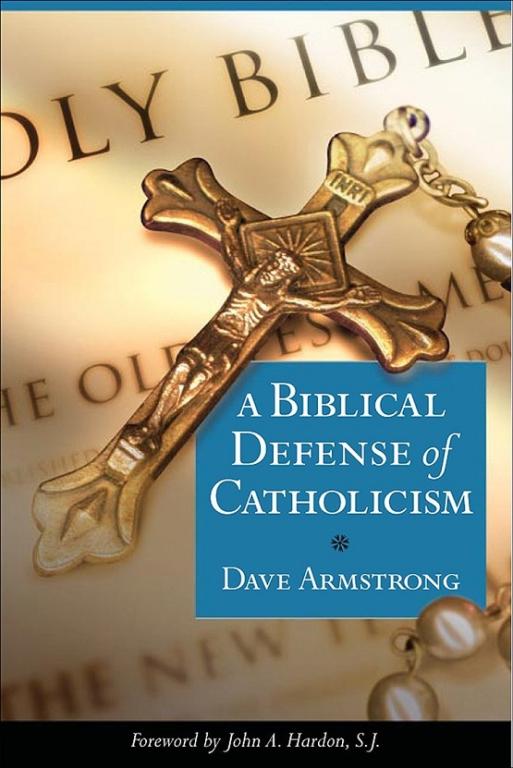
Bishop James White quoted from my book, A Biblical Defense of Catholicism (first edition, published by 1stBooks Library, 2001, from Chapter Five: “The Sacrifice of the Mass: ‘A Lamb . . . Slain'”), pp. 69-70 (pp. 97-98 in Sophia Institute Press edition, 2003):
The theme of the Epistle to the Hebrews is Christ as our High Priest. As such, the “priestly” verses are very numerous (for example, 2:17, 3:1, 4:14-16, 5:1-10, 6:20, 7:1-28, 8:1-6, 9:11-15, 24-28, 10:19-22). The teaching here acquires much more meaning within Catholic Eucharistic theology, whereas, in evangelical, non-sacramental Protestant interpretation, it is necessarily “spiritualized” away. For nearly all Protestants, Jesus Christ is a Priest only insofar as He dies sacrificially as the “Lamb” and does away with the Old Testament notion of animal sacrifice. This is not false but it is a partial truth. Generally speaking, for the Catholic, there is much more of a sense of the ever-present Sacrifice of Calvary, due to the nature of the Mass, rather than considering the Cross a past event alone.
In light of the repeated references in Hebrews to Melchizedek as the prototype of Christ’s priesthood (5:6,10, 6:20, 7:1-3,17,20), it follows that this priesthood is perpetual (for ever), not one time only. For no one would say, for example, that Christ is King (present tense) if in fact He were only King for a short while in the past. This (Catholic) interpretation is borne out by explicit evidence in Hebrews 7:24-25:
He holds his priesthood permanently, because he continues for ever. Consequently he is able for all time to save those who draw near to God through him, since he always lives to make intercession for them.
If Jesus perpetually intercedes for us, why should He not also permanently present Himself as Sacrifice to His Father? The connecting word, consequently, appears to affirm this scenario. The very notion, fundamental to all strains of Christian theology, that the Cross and the Blood are efficacious here and now for the redemption of sinners, presupposes a dimension of “presentness” to the Atonement.
Granting that premise, it only remains to deny that God could, would, or should truly and actually re-present this one Sacrifice in the Mass. God certainly can do this, since He is omnipotent. He wills to do this because Jesus commanded the observance of the Lord’s Supper (Luke 22:19). Lastly, one can convincingly contend that He should do this in order to graphically “bring home” to Christians His Passion, Crucifixion, and Resurrection, and to impart grace in a real and profound way in Communion. The One Propitiatory Atonement of Calvary is a past event, but the appropriation of its spiritual benefits to Christians is an ongoing process, in which the Mass plays a central role.
The Sacrifice of the Mass, like the Real Presence in the Eucharist, is an extension of the Incarnation. Accordingly, there is no rational a priori objection (under monotheistic premises) to the concept of God transcending time and space in order to present Himself to His disciples. Nor is there any denying that the Sacrifice of Calvary is always present to God the Father and to Jesus Christ, God the Son. How then, can anyone deny that God could make the Cross sacramentally present to us as well?
Now let’s examine Mr. White’s reading of Hebrews 8 (his words will be in blue; to read his statement by itself, follow the above link; I have moved the footnotes to where they occur in the text).
James White, introductory exegetical comments prior to deeper exegesis of Hebrews 8:6ff.
The immediately preceding argument, leading to the key presentation of the new covenant in Heb. 8:6-13, flows from the identification of Christ with the superior priesthood of Melchizedek (Psalm 110:4, cited in Heb. 7:17, 21), leading to the description of Christ as the e;gguoj (guarantee/guarantor)[1]
[1] e;gguoj is a hapax legomena in the NT, appearing only in the Apocryphal books of Sirach and 2 Maccabees prior to this. It has semantic connections to avrrabw.n (down payment) in Eph. 1:14, for in common secular usage it refers to providing security or a guarantee, normally in a financial or business transaction. The guarantee then of the better covenant is introduced here within the context of Christ’s superior priesthood, His indestructible life, and divine ability to save to the uttermost (7:24-35).
Nothing to quibble with here . . .
of the new covenant, and also bringing the first use of krei,ttonoj diaqh,khj, better covenant, in 7:22, “so much the more also Jesus has become the guarantee of a better covenant.” Heb. 7:23-8:5 comprises a demonstration of the basis for the apologetic assertion that the new covenant is, in fact, a better covenant (part and parcel of the purpose of the letter), one that flows from the priestly nature of Christ’s work. 7:23-25 proves this by the contrast of the mortal priests with the one priest, Jesus Christ; and 7:26-28 does so in light of the sinfulness of the many priests and hence their repeated sacrifices versus the singular sacrifice of the innocent, undefiled Christ.
This is uncontroversial as well (as far as it goes). But of course White does not here deal with my own particular argument, that Jesus holds a perpetual priesthood (“He holds his priesthood permanently, because he continues forever” — 7:24; not just a one-time priestly sacrifice of Himself that has no application to His priesthood beyond the time it occurred in history).
Yes, we agree that Jesus sacrificed Himself once on the Cross (7:27). But that is a one-time act, in history. Why, then, does 7:26 continue to refer to Jesus as a “high priest” in the present tense, “exalted above the heavens”? It is this paradoxical interplay between the one act and the “present-ness” of Jesus’ priesthood that suggests a timeless nature of the sacrifice: precisely what Catholics claim is occurring at the Mass: the one-time sacrifice is being made present to us, because Jesus is a priest “forever.”
8:1-6, then, provides first a summary statement of the preceding arguments (i.e., our one high priest has entered into the heavenlies) and then provides the thesis statement for the description of the superiority of the new covenant from Jeremiah 31 with the assertion that Christ has obtained “a more excellent ministry” than that of the old priests, that He is the mediator (in contrast, in context, to Moses, v. 5, Gal. 3:19, John 1:17) of a “better covenant” enacted on “better promises.” Some brief comments should be offered exegetically on these texts.
Again, no significant disagreement, if at all. Of course the new covenant is better, and Jesus surpasses Moses, etc.
First, Christ’s role as singular and never dying high priest, and the resulting assurance of the perfection of His work, is seen by the writer as part of the demonstration of why the covenant of which He is the guarantee is “better” (7:23-25). While our English translations normally say something like, “The former priests existed in greater numbers” at 7:23, the literal reading is simply, “the priests,” contrasting[2]
[2] Using the common me.n/de. form translated “on the one hand/on the other hand.”
the plural with the singular “he” (oi` vs. o`) in v. 24. The work of the many priests is, of necessity, imperfect, for they are “prevented by death” from “continuing” or “abiding.” But, in contrast, He “abides forever,” He is no longer subject to death. Hence, He, unlike the old priests under the old covenant, holds His priesthood (which has been shown to be superior in the preceding arguments) avpara,baton, permanently, or, in some sources, without successor. Both translations fit the context, for He never lays aside this priesthood, hence, it is “permanent” in contrast to the former priests. But likewise He has no successor in His office. The entire concept is meant to be in contrast to the old priests and their inherently temporary nature. As a result of the permanence of His priestly position,[3]
[3] o[qen, “for which reason.”
Sure, but this doesn’t rule out the Catholic claim with regard to Jesus’ priesthood. It makes little sense to me to keep referring to Jesus as a “priest” in the present tense when He is (according to most Protestants) no longer doing at all what a priest does (sacrifice). Jesus sacrificed Himself as the Lamb of God. That was His priestly act (this is stated explicitly in 7:27, so it cannot be doubted).
But if that was strictly a past tense and not perpetual, why keep calling Him a priest after He is glorified in heaven? It would seem much more sensible to refer to His one-time priestly act, rather than continuing to call Him something denoting a characteristic activity that He is no longer performing.
Christ has an ability the old priests did not possess. He is able to save. The profundity of the words may deflect proper attention. The permanence of His life and position as high priest grants to Him the ability to save. He is active in saving, and He is capable of so doing.
If He is actively saving men — present and future tense — (as is undoubtedly true), but is doing so as a priest then He is presently saving by the sacrifice of Himself (i.e., the priestly act) which is an act made eternally “now”. Thus we are right to the heart of the Sacrifice of the Mass, which is the same concept. Jesus saves us as a priest. The sacrifice is of both an ongoing and salvific nature. This is the Mass! It’s heartening to see that James White can present it so clearly from the Bible despite his own lack of belief in it.
As noted above, the soteriological content of the superiority of Christ’s work as high priest and of the new covenant cannot be dismissed or overlooked.
I agree 100% That’s why I go to Mass every Sunday and partake of the body and blood of the once-for-all-sacrificed Lamb of God, my Lord and Savior Jesus Christ, made sacramentally present by the sublime miracle of transubstantiation, because this sacrifice is my salvation. It’s not often that I get excited about the Mass based on the arguments of an anti-Catholic Baptist who detests the very concept. :-)
The extent of His salvific work is noted by the phrase eivj to. pantele.j, which can be translated “forever” in the sense of permanence, or “to the uttermost” in the sense of completely, similar, in fact, to avpara,baton above. Owen noted the propriety of seeing both senses in the text:
[John Owen] “Take the word in the first sense, and the meaning is, that he will not effect or work out this or that part of our salvation, do one thing or another that belongs unto it, and leave what remains unto ourselves or others; but ‘he is our Rock, and his work is perfect.’ Whatever belongs unto our entire, complete salvation, he is able to effect it. The general notion of the most that are called Christians lies directly against this truth….That this salvation is durable, perpetual, eternal… and there is nothing hinders but that we may take the words in such a comprehensive sense as to include the meaning of both these interpretations. He is able to save completely as to all parts, fully as to all causes, and for ever in duration.”[4]
[4] John Owen, An Exposition of the Epistle to the Hebrews, Hebrews 6:1-7:28, in The Works of John Owen, William Goold, ed. (Ages Digital Library, 2000), pp. 646-647.
Of course Jesus is “able to save completely.” We Catholics adhere to sola gratia just as much as Protestants do. But that doesn’t mean that the Eucharist is irrelevant as a sacramental means to receive this salvation that was accomplished at the cross. Jesus showed this when He gave His exposition recorded in John 6. He makes it clear that what He means by “bread” is His body:
. . . the bread which I shall give for the life of the world is my flesh. (John 6:51)
In this verse, even White has to concede that bread = flesh. Otherwise, it would mean that what won our salvation on the cross was literally a chunk of bread, rather than the precious body of our Savior and Redeemer. So He means this quite literally: the bread is His body. That’s why He states two verses later:
. . . unless you eat the flesh of the Son of man and drink his blood, you have no life in you; he who eats my flesh and drinks my blood has eternal life . . . (John 6:53-54)
And four verse later, He reverts back to speaking of “bread” as His body:
This is the bread which came down from heaven, not such as the fathers ate and died [i.e., not merely natural bread]; he who eats this bread will live for ever. (John 8:58)
It’s very clear (it could not be any clearer than it is):
- Bread = Jesus’ flesh (Jn 6:51)
- Eating Jesus’ flesh and blood gives eternal life (Jn 6:53-54)
- Bread = Jesus’ body; which, partaken, causes one to live forever (Jn 8:58)
So the equation of Jesus’ body and the bread is stated outright (Jn 6:51) and then by inexorable simple deduction:
A. Jesus’ Flesh and Blood give eternal life.
B. Bread gives eternal life.
C. Therefore, Bread = Jesus’ Flesh and Blood (for how can mere bread cause one to attain eternal life?).
Just as the Father’s will for the Son revealed in John 6:38-39 demands perfection in His role as Savior, so too here the very same soteriological perfection and completion is central to the work of the eternal high priest. This is brought out with strong force in the rest of the verse, for the author indicates both the object of the salvific work and the basis thereof, and both are intensely “priestly” statements. The singular priest saves “those who draw near to God through Him.” This clearly harkens back to the people who drew near in worship to God in the temple, and their representative, the high priest on the day of atonement. There is specificity to the salvific work of the priest. He does not make a general plan of salvation available, He saves a specific people (cf. Matt. 1:21). And secondly, “He always lives to make intercession for them” points to the same perfection of the high priest. His indestructible life means He never lays aside His priestly role, hence, since the high priest interceded (evntugca,nein, Rom 8:34) for those for whom He offered sacrifice, Christ ever lives to make intercession for those who draw near to God through Him, resulting in the perfection of their salvation. The work of intercession guarantees the salvation of a specific people in this passage. This is vital to remember as we look at the key text in Hebrews 8.
No quibble here; Jesus saves utterly as a result of His sacrifice on the cross.
Similar themes appear in 7:26-28, including the perfect character of the high priest (v. 26), which establishes another element of His supremacy over the old priests, for He does not have to offer sacrifice for His own sins, and then the sins of the people. But here also appears a concept that will be expanded upon greatly at a later point, for the author says, “because this He did once for all when He offered up Himself.” Self-offering is yet another aspect of what sets the priesthood of Christ apart, for obvious reasons, from the priesthood of old. The high priest presents the offering in His own body, a concept expanded upon in chapter nine. But He did so “once for all.” The sacrifice is a singularity in time, for the author uses the temporal adverb, evfa,pax, to strongly emphasize this concept. The old priests sacrificed often for themselves, while Christ offered one sacrifice (Himself) for the people.
No disagreement to speak of here. The sacrifice was once and for all, historically-speaking. But for God, it is still “now” and there is a sense expressed in the Bible that it is constantly made “present” to us. It was intended to be a perpetual rite and remembrance, because Jesus commanded us to observe the Lord’s Supper. Paul, too, recounts a eucharistic tradition that he “received” and “delivered” (1 Cor 11:23). He noted that Jesus said, “This cup is the new covenant in my blood” (1 Cor 11:24; cf. Lk 22:20, Mk 14:24, Matthew 26:28). Martin Luther made an excellent exegetical argument pertaining to these verses:
[T]his spirit will not believe what the Word of God says, but only what he sees and feels. What a fine faith . . . The text is too clear and too powerful . . . For this word more forcefully and powerfully than any before requires that the blood is in the sacrament . . . this word of Luke and Paul is clearer than sunlight and more overpowering than thunder. First, no one can deny that he speaks of the cup, since he says, “This is the cup.” Secondly, he calls it the cup of the new testament. This is overwhelming, for it could not be a new testament by means and on account of wine alone.
(Against the Heavenly Prophets in the Matter of Images and Sacraments, 1525; Luther’s Works [LW], 40, 216-217)
In the same work, Luther makes a fascinating argument that a symbolic Eucharist turns the sacrament into a futile work of man rather than a grace and blessing from God:
He thinks one does not see that out of the word of Christ he makes a pure commandment and law which accomplishes nothing more than to tell and bid us to remember and acknowledge him. Furthermore, he makes this acknowledgment nothing else than a work that we do, while we receive nothing else than bread and wine.
(Ibid., LW, 40, 206)
Jesus’ sacrifice is not only present to us on earth, but also in heaven. In the next section of the same chapter in my book, I noted that an “altar” is mentioned as in heaven, in the book of Revelation many times (6:9, 8:3,5, 9:13, 11:1, 14:18, 16:7). Why is this, if altars and priesthood ceased with the one sacrifice of Jesus? This is after Jesus’ resurrection and ascension. Nor is it just Jesus at this altar in heaven. We are told that the “prayers of the saints” are being offered there (5:8-9, 8:3-4). Altars are also mentioned elsewhere in the New Testament.
St. Paul in 1 Corinthians 10:14-22, in an explicitly eucharistic passage, uses language suggesting that he sees the Eucharist as a sacrifice involving an altar (hence priesthood, hence the Sacrifice of the Mass): He mentions the “altar” of the Old Covenant in 10:18 and makes a direct analogy with the altar of the new covenant in 10:21:
You cannot drink of the cup of the Lord and the cup of demons. You cannot partake of the table of the Lord and the table of demons.
Even Baptists like James White (and many other Protestants) have not completely avoided the language of priestly sacrifice, since they still speak of the “Lord’s table” and even an “altar call.” What altar? That is the language of priesthood and sacrifice. So even non-sacramental Protestants can’t help retaining a remnant of New Testament eucharistic and sacrificial, priestly talk. Hebrews 13:10 states that “we have an altar.” Again, why, if the old system of priesthood is gone and the only priesthood of the New Covenant is that of Christ at Calvary? This is the New Covenant!
Lastly, I will close with the final words of the chapter here considered, from my first book, showing, I think, that the Sacrifice of the Mass is in perfect accord with the New Testament indications, and that James White has a lot of explaining to do.
He is welcome to do so. I have agreed with much of his presentation because it does not conflict with Catholic teaching (it is simply incomplete; purged of all clear-as-day New Testament sacramentalism). But he would disagree with much of my exposition above. We don’t know why he would unless he tells us.
[T]he climactic scene of this entire glorious portrayal of heaven occurs in Rev 5:1-7. Verse 6 describes a Lamb standing as though it had been slain. Since the Lamb (Jesus, of course) is revealed as sitting in the midst of God’s throne (5:6, 7:17, 22:1,3; cf. Matthew 19:28, 25:31, Hebrews 1:8), which is in front of the golden altar (8:3), then it appears that the presentation of Christ to the Father as a Sacrifice is an ongoing (from God’s perspective, timeless) occurrence, precisely as in Catholic teaching. Thus the Mass is no more than what occurs in heaven, according to the clear revealed word of Scripture. When Hebrews speaks of a sacrifice made once (7:27), this is from a purely human, historical perspective (which Catholicism acknowledges in holding that the Mass is a “re-presentation” of the one sacrifice at Calvary). However, there is a transcendent aspect of the Sacrifice as well.
Jesus is referred to as the Lamb 28 times throughout Revelation (compared to four times in the rest of the New Testament: John 1:29,36, Acts 8:32, 1 Peter 1:19). Why, in Revelation (of all places), if the Crucifixion is a past event, and the Christian’s emphasis ought to be on the resurrected, glorious, kingly Jesus, as is stressed in Protestantism (as evidenced by a widespread disdain for, crucifixes)? Obviously, the heavenly emphasis is on Jesus’ Sacrifice, which is communicated by God to John as present and “now” (Revelation 5:6; cf. Hebrews 7:24). The very notion of lamb possesses inherent sacrificial and priestly connotations in the Bible.
If this aspect is of such paramount importance even in the afterlife, then certainly it should be just as real and significant to us. The Sacrifice of the Mass bridges all the gaps of space and time between our Crucified Savior on the Cross and ourselves. Therefore, nothing at all in the Mass is improper, implausible, or unscriptural, which is why this doctrine was virtually unanimously accepted until the 16th century.
In conclusion, then, it is, I think, evident that the Book of Hebrews and the scenes in heaven in the Book of Revelation are suffused with a worldview and “atmosphere” which is very “Catholic.” The Mass, rightly understood, fulfills every aspect of the above passages, most particularly in the sense of Christ as the ultimate Priest for whom the earthly priest “stands in,” and in the timeless and transcendent character of the Sacrifice “made present” at Mass, but never deemed to be an addition to, or duplication of, the one bloody Sacrifice of our Lord at Calvary.
(p. 71 in 1stBooks edition; pp. 99-100 in Sophia edition)
Previous Post
February 10, 2016
Bible on Submission to Church and Apostolic Tradition
Next Post

February 11, 2016 Martin Luther on Absolution and Private Confession
Browse Our Archives
Select a Category & Last Things About Me Anti-Catholicism Atheism & Agnosticism Baptism and Sacramentalism Bible and Tradition Blessed Virgin Mary Books by Dave Armstrong C. S. Lewis Calvinism & General Protestantism Catholic Apologetics Catholic Apologists Catholic conversion Catholic converts Christmas Church (Ecclesiology) Church History Conversion and Converts Development of Doctrine Eastern Orthodoxy Ecumenism & Christian Unity Eucharist & Liturgy Fathers of the Church French Translations G. K. Chesterton Hell Hell & Satan Hell & Satan & Last Things Heresies & Comparative Religion Holistic Health Inquisition & Crusades & Scandals James White Jews & Judaism & Old Testament John Calvin John Henry Newman Liberal / Modernist Theology Life Issues Literary Resume Lutheranism Mariology Martin Luther Music Orthodoxy Papacy & Infallibility Personal Page Philosophy & Science Political & Ethical & Moral Issues Protestant Persecution & Intolerance Protestantism Purgatory Purgatory & Penance Romantic & Imaginative Theology Saints & Purgatory & Penance Salvation Salvation & Justification Satan & Last Things Sexuality and Gender Issues Spanish Translations Traditionalism vs. Radical Catholic Reactionaries Traducciones al español / tradução para português Trinitarianism & Christology Uncategorized Videos
Select a Month October 2026 September 2026 August 2026 July 2026 June 2026 May 2026 April 2026 March 2026 February 2026 January 2026 December 2025 November 2025 October 2025 September 2025 August 2025 July 2025 June 2025 May 2025 April 2025 March 2025 February 2025 January 2025 December 2024 November 2024 October 2024 September 2024 August 2024 July 2024 June 2024 May 2024 April 2024 March 2024 February 2024 January 2024 December 2023 November 2023 October 2023 September 2023 August 2023 July 2023 June 2023 May 2023 April 2023 March 2023 February 2023 January 2023 December 2022 November 2022 October 2022 September 2022 August 2022 July 2022 June 2022 May 2022 April 2022 March 2022 February 2022 January 2022 December 2021 November 2021 October 2021 September 2021 August 2021 July 2021 June 2021 May 2021 April 2021 March 2021 February 2021 January 2021 December 2020 November 2020 October 2020 September 2020 August 2020 July 2020 June 2020 May 2020 April 2020 March 2020 February 2020 January 2020 December 2019 November 2019 October 2019 September 2019 August 2019 July 2019 June 2019 May 2019 April 2019 March 2019 February 2019 January 2019 December 2018 November 2018 October 2018 September 2018 August 2018 July 2018 June 2018 May 2018 April 2018 March 2018 February 2018 January 2018 December 2017 November 2017 October 2017 September 2017 August 2017 July 2017 June 2017 May 2017 April 2017 March 2017 February 2017 January 2017 December 2016 November 2016 October 2016 September 2016 August 2016 July 2016 June 2016 May 2016 April 2016 March 2016 February 2016 January 2016 December 2015 November 2015 October 2015 September 2015 August 2015 July 2015 June 2015 May 2015 April 2015 March 2015 February 2015 January 2015 December 2014 November 2014 October 2014 September 2014 August 2014 July 2014 June 2014 April 2014 March 2014 February 2014 January 2014 December 2013 November 2013 October 2013 September 2013 August 2013 July 2013 June 2013 April 2013 March 2013 February 2013 January 2013 December 2012 November 2012 October 2012 September 2012 August 2012 July 2012 June 2012 May 2012 April 2012 March 2012 February 2012 January 2012 December 2011 November 2011 October 2011 September 2011 August 2011 July 2011 June 2011 April 2011 March 2011 February 2011 October 2010 September 2010 August 2010 July 2010 April 2010 March 2010 December 2009 October 2009 August 2009 July 2009 June 2009 May 2009 March 2009 February 2009 October 2008 September 2008 April 2008 March 2008 February 2008 January 2008 December 2007 November 2007 October 2007 May 2007 March 2007 February 2007 January 2007 November 2006 October 2006 September 2006 August 2006 July 2006 June 2006 May 2006 April 2006 March 2006 February 2006 October 2005 June 2005 April 2005 February 2005 July 2004 May 2004 April 2004
Follow Us!
TAKE THE
Religious Wisdom Quiz
Which Old Testament book is entirely written as a dialogue between God and a prophet?
Select your answer to see how you score.
Zechariah Malachi Amos Habakkuk
Books by This Author Books by Dave Armstrong
Related posts from Biblical Evidence for Catholicism

Three More Anti-Catholic Lies About Catholicism (#6-4)
Biblical Evidence for Catholicism

Top Ten Anti-Catholic Lies (#10-7)
Biblical Evidence for Catholicism

Jerusalem Council vs. James White & Sola Scriptura
Biblical Evidence for Catholicism

The Mass & Development of Doctrine (vs. Wes...
Biblical Evidence for Catholicism
TRENDING AT PATHEOS Catholic

In "Irreplaceable," our book on vocation and technology, Trevor Sutton and I...

I was strolling through the top floor of the brand new Parthenon...

What Does Gêvâh Mean For Kimberley Guifoyle &...
This week, a lot of the news is focused on Kimberly Guilfoyle....

INNER CIRCLE: Profound Mystery (Of Christ In All...
Ephesians 5:31-32 “For this reason, a man will leave his father and...

Do Not Rejoice When Your Enemy Falls: The...
Turning an execution into a public spectacle is a disturbing expression of...

'The Chosen' S6 Trailer: The Passion Gets Very...
Not many watching 'The Chosen' worry about spoilers, but just because they...
view all Catholic blogs
Ad-Free & Subscriber Log-In Subscription Support
- About Us
- 2026 Calendar
- Videos
- Podcasts
- Library of World Religions
- Faith In Media Tracker
- Advertise With Us
- Write for Us
- Privacy Policy
- Terms of Service
- Do Not Sell My Data
- Contact Us
- Radiant Digital
- Manage Newsletter Subscriptions
- Unsubscribe From Notifications
- Sitemap
Copyright 2008-2026, Patheos. All rights reserved.
Subscription Support Ad-Free & Subscriber Log-In
Follow Patheos