
BuddhistCatholicContemplativeEvangelicalGeneral ChristianHinduJewishLatter-day SaintMuslimNew VisionsProgressive Christian
Beliefs
- Buddhist
- Catholic
- Contemplative
- Evangelical
- General Christian
- Hindu
- Jewish
- Latter-day Saint
- More Voices
- Muslim
- New Visions
- Pagan
- Progressive Christian
Topics
- Religion News
- Food and Religion
- Sports and Religion
- Religious Art
- Religious Music and Entertainment
- Religious Events
- History and Religion
- Style and Religion
- Politics and Religion
- Women in Religion
- Recreation Outdoors and Religion
- Business Finance and Religion
- Careers Workplace and Religion
- Education and Religion
- Family Parenting and Religion
- Health Fitness and Religion
- Home and Religion
- Relationships and Religion
- Technology and Religion
- Travel and Religion
Columnists
- Buddhist Columnists
- Business Finance and Religion Columnists
- Careers Workplace and Religion Columnists
- Catholic Columnists
- Contemplative Columnists
- Education and Religion Columnists
- Evangelists Columnists
- Family Parenting and Religion Columnists
- General Christian Columnists
- Health Fitness and Religion Columnists
- Hindu Columnists
- History and Religion Columnists
- Home and Religion Columnists
- Jewish Columnists
- More Voices Columnists
- Latter Day Columnists
- Muslim Columnists
- New Visions Columnists
- Nonreligious Columnists
- Pagan Columnists
- Politics and Religion Columnists
- Progressive Columnists
- Recreation Outdoors and Religion Columnists
- Relationships and Religion Columnists
- Religion News Columnists
- Religious Art Columnists
- Religious Events Columnists
- Religious Music and Entertainment Columnists
- Sports and Religion Columnists
- Style and Religion Columnists
- Technology and Religion Columnists
- Travel and Religion Columnists
- Women in Religion Columnists
Resource Library
- 2026 Calendar
- Library of World Religions
- The 100 Most Holy Places on Earth
- Patheos Answers
- Podcasts
- Videos
- Faith Leaders Database
- Anglican Episcopalian
- Bahai
- Baptist
- Buddhism
- Christianity
- Confucianism
- Eastern Orthodoxy
- Hinduism
- Holiness and Pentecostal
- ISKCON
- Islam
- Judaism
- Lutheran
- Methodist
- The Church of Jesus Christ of Latter-day Saints
- New Age
- Paganism
- Presbytarian and Reformed
- Protestantism
- Religion Behind the Scenes
- Roman Catholic
- Scientology
- Shia Islam
- Sikhism
- Sufism
- Sunni Islam
- Taoism
- Zen
- See all religions
Research Tools
 Ad-Free & Subscriber Log-In Subscription Support
Ad-Free & Subscriber Log-In Subscription Support
Follow Patheos 

- Trending:
- Forgiveness
- |
- Marriage
- |
- Consciousness
- |
- Death Penalty
- |
- Election
- |
- Halloween

-
About
-
Catholic Apologetics
-
Church History
-
Great Apologists
-
Christian Worldview
-
Protestantism & Misc.
- Home
- Catholic
- History and Religion
- John Calvin Believed in the Perpetual Virginity of Mary
John Calvin Believed in the Perpetual Virginity of Mary
Last updated on: November 22, 2021 at 3:51 pm by Dave Armstrong
John Calvin Believed in the Perpetual Virginity of Mary 2021-11-22T15:51:01-04:00 Dave Armstrong
Patheos Explore the world's faith through different perspectives on religion and spirituality! Patheos has the views of the prevalent religions and spiritualities of the world.
. . . Confirmed by Reformed Scholars (Dialogue with a Presbyterian Elder)
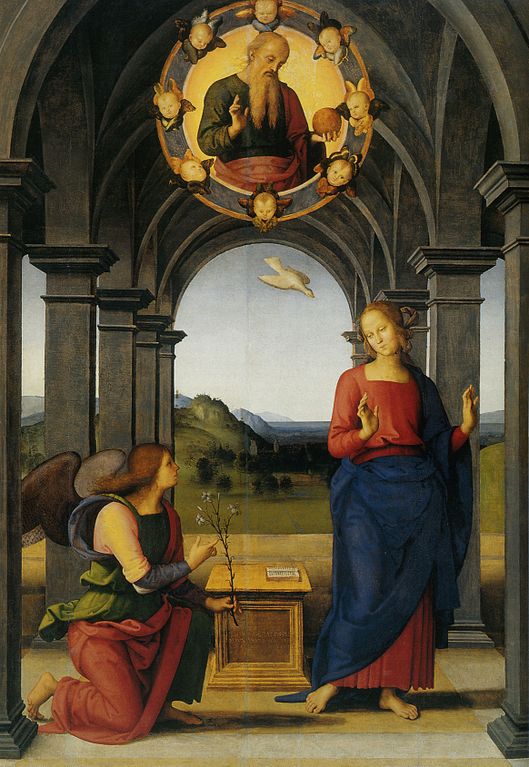
Annunciation (c. 1489), by Pietro Perugino (1448-1523) [public domain / Wikimedia Commons]

* * *
(6-17-10)
* * * * *
This dialogue occurred in a combox on the Reformed Protestant-dominated Green Baggins website (starting at comment #314). Jeff Cagle is a Presbyterian elder (PCA). His words will be in blue. John Calvin’s words will be in red.
* * * * *
It strikes me that Catholic magisterial authority appears to function in the same fashion. To take one of the most vexing doctrines for me, Perpetual Virginity, the normal rules of hermeneutics, when applied in any reasonable manner, cannot possibly conclude that what Matthew and Luke are really trying to tell us is that Joseph and Mary were married, but celibate; or that Jesus’ brothers were really cousins. Nothing in the text supports that conclusion by any objective measure or reading.
*
Both Luther and Calvin thought so (were they hermeneutical dolts, too? Maybe you think so and will be fair-minded enough to include them in your disdain for lousy Bible exegesis :-):
And in fact, no Catholic interpreter has ever tried to make that positive case; the discussions of PV are all reduced to defensive plays, trying to show that the Scripture doesn’t necessarily require disbelief in PV. But regardless of the rules of hermeneutics, Church authority has declared that the text of Scripture means PV, so PV it is. In that sense, it appears to me that the RCC authority creates truth. Regardless of hermeneutical physics, what the Church says is what is true. Regardless of Matthew and Luke’s intent, as observed by the evidence of their writing, this is what the text means.
I have thirteen posted papers on the perpetual virginity of Mary on my Mary web page, with many “positive arguments” included (if you desire further discussion on that). You can read them, challenge what I set forth, and I will be happy to counter-reply (either here or on my blog). Luther, Calvin, Zwingli, and Bullinger all believed it, along with many later Protestants such as John Wesley. The widespread denial among Protestants today is mostly a product of higher criticism and post-Enlightenment skepticism. It certainly was not a feature of the early Protestant movement. You can believe that all these Protestants had no scriptural reason whatever to believe as they did, and it was mere “holdover” from Catholicism, etc. (the stock reply), but I don’t find that plausible. Bullinger even made a very strong statement about the Assumption of Mary, etc.
LUTHER
Christ . . . was the only Son of Mary, and the Virgin Mary bore no children besides Him . . . I am inclined to agree with those who declare that “brothers” really mean “cousins” here, for Holy Writ and the Jews always call cousins brothers. (Luther’s Works, vol. 22:214-15 / Sermons on John, chaps. 1-4 [1539] )
When Matthew [1:25] says that Joseph did not know Mary carnally until she had brought forth her son, it does not follow that he knew her subsequently; on the contrary, it means that he never did know her . . . This babble . . . is without justification . . . he has neither noticed nor paid any attention to either Scripture or the common idiom. (Luther’s Works, vol. 45:212-213 / That Jesus Christ was Born a Jew [1523] )
CALVIN
Helvidius displayed excessive ignorance in concluding that Mary must have had many sons, because Christ’s “brothers” are sometimes mentioned.
(Harmony of Matthew, Mark and Luke, sec. 39 [Geneva, 1562], vol. 2 / From Calvin’s Commentaries, translated by William Pringle, Grand Rapids, Michigan: Eerdmans, 1949, p.215; on Matthew 13:55)
[On Matt 1:25:] The inference he [Helvidius] drew from it was, that Mary remained a virgin no longer than till her first birth, and that afterwards she had other children by her husband . . . No just and well-grounded inference can be drawn from these words . . . as to what took place after the birth of Christ. He is called “first-born”; but it is for the sole purpose of informing us that he was born of a virgin . . . What took place afterwards the historian does not inform us . . . No man will obstinately keep up the argument, except from an extreme fondness for disputation. (Pringle, ibid., vol. I, p. 107)
Under the word “brethren” the Hebrews include all cousins and other relations, whatever may be the degree of affinity. (Pringle, ibid., vol. I, p. 283 / Commentary on John, [7:3] )
Point of fact: Luther (and Zwingli) believed in Perpetual Virginity; Calvin was agnostic on the issue. Here is Calvin’s quote in full:
This passage afforded the pretext for great disturbances, which were introduced into the Church, at a former period, by Helvidius. The inference he drew from it was, that Mary remained a virgin no longer than till her first birth, and that afterwards she had other children by her husband. Jerome, on the other hand, earnestly and copiously defended Mary’s perpetual virginity. Let us rest satisfied with this, that no just and well-grounded inference can be drawn from these words of the Evangelist, as to what took place after the birth of Christ. — Calv Comm Matt 1.25 [linked]
I’m sure you would agree that it is important to go no further than the facts allow; and this is what Calvin is saying here. In researching Perpetual Virginity, I noticed several Catholic sites claiming Calvin in defense of the belief. But in fact, he cannot be pressed quite so far; he goes only so far as to criticize Helvidius for going beyond necessary inference. I trust that you will help your Catholic brothers to be factually accurate on this point.
*
Okay, so (given your strong remarks on the exegetical considerations), you think Luther and Zwingli were dolts on the matter, and that Calvin missed the absolute clarity of Scripture to the extent that he was (oddly enough, from the strength of your claims above about how manifestly obvious Scripture is on this) an agnostic.
I think the claim that Calvin was an agnostic is possible to be made, because of the scarcity of the evidence (it’s not an unserious or frivolous opinion, I don’t think), but for myself, I’m inclined to think he did believe in the dogma, from what we have. I’m not alone. Many Protestant scholars agree.
David F. Wright, in his book, Chosen by God: Mary in Evangelical Perspective (London: Marshall Pickering, 1989, pp. 173, 175), stated:
. . . his more careful biblicism could insist on only Mary’s refraining from intercourse before the birth of Jesus (i.e., her virginity ante partum). On the other hand, he never excluded as untenable the other elements in her perpetual virginity, and may be said to have believed it himself without claiming that Scripture taught it. . . . [Calvin] commonly speaks of Mary as “the holy Virgin” (and rarely as simply as “Mary” preferring “the Virgin”, etc.).
That would be my exact position on the matter, too.
*
Thomas Henry Louis Parker, in his Calvin: an Introduction to his Thought (Westminster John Knox Press, 1995), concurs:
. . . the Virgin Birth, which Calvin holds, together with the perpetual virginity of Mary. (p. 66)
He is the author of several books about Calvin, such as John Calvin: A Biography (Westminster John Knox Press, 2007), and Oracles Of God: An Introduction To The Preaching Of John Calvin (Lutterworth Press, 2002), Calvin’s New Testament Commentaries (S.C.M. Press, 1971), Calvin’s Preaching (Westminster John Knox Press, 1992), Calvin’s Old Testament Commentaries (Westminster John Knox Press, 1993), and several other Calvin-related volumes, and translator of Calvin’s Harmony of the Gospels in its 1995 Eerdmans edition.
*
The article “Mary” (by David F. Wright) in theEncyclopedia of the Reformed Faith (edited by Donald K. McKim, Westminster John Knox Press,1992, p. 237), proclaims:
Calvin was likewise less clear-cut than Luther on Mary’s perpetual virginity but undoubtedly favored it. Notes in the Geneva Bible (Matt. 1:18, 25; Jesus’ “brothers”) defend it, as did Zwingli and the English reformers . . .
Donald G. Bloesch, in his Jesus Christ: Savior and Lord (Downers Grove, Illinois: InterVarsity Press, 2006, p. 87), joins the crowd:
Protestantism . . . remained remarkably open to the idea of Mary’s perpetual virginity. Among others, Luther, Calvin, Zwingli, Wollebius, Bullinger and Wesley claimed that Mary was ever-virgin (semper virgo). The Second Helvetic Confession and the Geneva Bible of the Reformed faith and the Schmalkald Articles of the Lutheran churches affirm it.
Geoffrey W. Bromiley in his article, “Mary the Mother of Jesus” in International Standard Bible Encyclopedia: K-P (edited by Bromiley, revised edition of 1994 published by Eerdmans [Grand Rapids, Michigan], p. 269), wrote:
The post-partum or perpetual virginity concept is held by some Protestants and was held by many Reformers (e.g., Calvin in his sermon on Mt. 1:22-25) . . .
Calvin’s successor Theodore Beza argued that Catholics and Protestants agreed on the perpetual virginity of Mary, at the Colloquy of Poissy in 1561 (see William A. Dyrness, Reformed Theology and Visual Culture: the Protestant Imagination from Calvin to Edwards, [Cambridge University Press, 2004], pp. 86-87).
*
I trust that you will help your Catholic brothers to be factually accurate on this point.
*
I’ll be glad (indeed, more than happy) to inform my Catholic (and Protestant and Orthodox) brothers and sisters in Christ that there are Protestant scholars (even reputable, renowned Reformed Protestant scholars of Calvin and encyclopedias of Calvinism) who hold that Calvin did indeed accept Mary’s perpetual virginity. If they do so, then we Catholics who are of the same opinion cannot be charged with being dishonest with Calvin texts (without the same charge landing on the heads of Parker, Wright, Bloesch, Bromiley, and indirectly to McKim).
*
Thanks so much for challenging me to clarify this. The case from Protestant opinion as to Calvin’s belief on this point is a lot stronger than I had heretofore realized.
*
Again, being careful on the facts here, I don’t think that either Luther or Calvin was a dolt.
*
I would encourage you not to rush to enlist Calvin to your cause until you have weighed what he says concerning Matt 1.25 with his commentary on 1 Cor 7. His criticism of Helvidius in the commentary on Matt 1.25 is a common criticism that he makes of many folk of going beyond the evidence. It is common for Calvin to criticize this or that commentator on those grounds, sometimes while agreeing with their conclusions in the main (here, he does not express agreement with Helvidius).
*
Meanwhile, his criticism of Jerome’s views of virginity in the commentary on 1 Cor 7 are quite strong, and Calvin undercuts Jerome’s entire support for PV at a stroke. So if indeed Calvin held to PV as a private opinion (and that’s logically possible), he did so on grounds much different from the RCC and from Jerome in particular.
*
With regard to Calvin scholars: I’m sure you realize that credible secondary sources do carry some weight, but are not definitive. Without any primary source backing, the quotes that you provide are intriguing, but neither you nor I should simply take their word for it.
*
If primary source writing turns up in which Calvin expresses positive support for PV, then I’ll change my tune. But until then, it seems that we should not claim that “Calvin supported PV” or “Calvin believed in PV” unless we have a primary source in hand showing that he supported or believed in PV. Right? (Ditto for Bullinger. I’m seeing a lot of secondary sources claiming Bullinger’s support of PV, but I can’t find it in the primary sources. I’ll keep looking.)
*
But the most important point is the difference between Luther and Zwingli, and the RCC doctrine. Both men affirmed the proposition that Mary remained a virgin all her days. But no Reformer ever affirmed PV as a dogma, a belief necessary for salvation. This is the key point. You may believe in PV all your life, and I might disagree with you all my life, but we have the freedom in Christ to disagree on that matter. PV is not a doctrine taught in Scripture; and if it were necessary for salvation, the apostles would have written it down. So says Irenaeus, and he’s right.
*
So we want to be careful here about what’s being challenged. I’m not challenging the proposition that Mary remained virgin. I have my doubts; I think that 1 Cor 7 is decisive about what godly marriage should look like. But I can be wrong. Clearly, men whom I admire as thinkers and scholars (Luther in particular) disagreed with me.
*
What I’m challenging is the elevation of PV to the status of dogma, a doctrine without which one cannot be saved, a doctrine whose denial makes one liable to anathema. (or “made one liable”, prior to the redefinition of anathema.)
*
And in so challenging, I’m getting to the heart of sola scriptura: we may hold all manner of pious opinions; but we as elders may only authoritatively require belief of those opinions taught by good and necessary consequence from Scripture. To turn a phrase, sola scriptura is not so much about formal sufficiency of Scripture, but the formal necessity of Scripture for doctrine. In formal language:
*
The Formal Necessity of Scripture: Good and necessary inference from the Scriptural text is the necessary warrant for dogmatic proclamation.
*
Or to go back to our umpire analogy: the good umpire will only stand by decisions that can be scrutinized when we roll the tape and look at the play in slow motion. The point behind “good and necessary inference” is the requirement that all calls meet the scrutiny test: we can roll the tape and defend the doctrine from the Scriptural evidence.
*
Let’s go back to your original claim of just two days ago (#314), to refresh readers’ memories:
. . . the normal rules of hermeneutics, when applied in any reasonable manner, cannot possibly conclude that what Matthew and Luke are really trying to tell us is that Joseph and Mary were married, but celibate; or that Jesus’ brothers were really cousins. Nothing in the text supports that conclusion by any objective measure or reading. . . . Regardless of hermeneutical physics, what the Church says is what is true. Regardless of Matthew and Luke’s intent, as observed by the evidence of their writing, this is what the text means.
To summarize what you were saying then (as opposed to now, under challenge), and my replies:
- “Normal rules of hermeneutics, when applied in any reasonable manner, cannot possibly” lead us to the PVM (including Jesus’ “brothers” being cousins).
- “Nothing in the text supports that conclusion by any objective measure or reading.”
- The Catholic Church (strong implication: outrageously so) declares the dogma, despite the clear intent of “normal, reasonable, objective” hermeneutics and in the teeth of original intent.
- I reply that Luther, Calvin (with documentation) and many other Protestants also believe in the PVM.
- (Luther and) Calvin did not accept Catholic infallible authority.
- Therefore, if Calvin accepted the PVM, he must have done so on scriptural basis only (or tradition understood in a non-binding fashion, excluding apostolic succession as traditionally understood).
- This being the case, it follows that Calvin was a “hermeneutical dolt” (so was Luther) — as I colorfully described it, since he fell prey to all these things you criticize the Catholic Church for: neglect of normal, reasonable, objective hermeneutics, in the teeth of original intent.
- Therefore, your original criticism of Catholic hermeneutics here also applies to Calvin.
- But now you want to deny the logic of it, by saying, “I don’t think that either Luther or Calvin was a dolt.”
- You also tried to deny that Calvin believed in the PVM.
- I produced much documentation from Protestant sources (mostly Reformed) holding that he did in fact accept it.
- One can legitimately differ on whether he did or not, as I have already stated, but I think what I have established is that your characterization of how clear-cut the hermeneutical issue is (supposedly against the PVM) is unwarranted. The issue is not nearly as simple as you made out.
- Thus, you should either modify your original strong, critical statements against Catholic hermeneutics or apply the ire equally to Luther and Calvin (or at least Luther: whom you yourself admit did accept the PVM). The tendency in so much of the Protestant critique of Catholicism (even irenic, reasonable, thoughtful ones such as yours) is to have one standard for Catholics and another for Protestants who believe the same thing in particulars. we’re blasted for unreasonableness or excessive arbitrary dogmatism, while important Protestants who agree in particulars are given a pass (or else it is not known in the first place that they agree with us).
I would encourage you not to rush to enlist Calvin to your cause until you have weighed what he says concerning Matt 1.25 with his commentary on 1 Cor 7. His criticism of Helvidius in the commentary on Matt 1.25 is a common criticism that he makes of many folk of going beyond the evidence. It is common for Calvin to criticize this or that commentator on those grounds, sometimes while agreeing with their conclusions in the main (here, he does not express agreement with Helvidius).
Meanwhile, his criticism of Jerome’s views of virginity in the commentary on 1 Cor 7 are quite strong, and Calvin undercuts Jerome’s entire support for PV at a stroke.
That logic doesn’t follow. You are equating things that don’t equate. I looked up the commentary on the CCEL site. So. e.g., at 1 Cor 7:1, Calvin states:
Now we must observe what he means by the word good, when he declares that it is good to abstain from marriage, that we may not conclude, on the other hand, that the marriage connection is therefore evil — a mistake which Jerome has fallen into . . .
If in fact Jerome believed that (and he may not have; I always have a healthy suspicion of what Calvin says Catholics believe, having recently written a book about him), he was obviously wrong. Calvin is right in condemning such a view. Catholics believe marriage is a sacrament and gives grace, so obviously we don’t think it is evil. It was Martin Luther who thought even marital intercourse remained evil in every instance:
Intercourse is never without sin; but God excuses it by his grace because the estate of marriage is his work, and he preserves in and through the sin all that good which he has implanted and blessed in marriage. (The Estate of Marriage [1522]; translated by Walther I. Brandt; pp. 17-49 in Luther’s Works, Volume 45 [Philadelphia: Muhlenberg Press, 1962], p. 49)
Likewise, commenting on 7:7, Calvin writes:
Nor has the error as to this matter been confined to the common people and illiterate persons; for even the most eminent doctors, devoting themselves unreservedly to the commendation of virginity, and forgetting human infirmity, have overlooked this admonition of Paul — nay rather, of Christ himself. Jerome, blinded by a zeal, I know not of what sort, does not simply fall, but rushes headlong, into false views. Virginity, I acknowledge, is an excellent gift; but keep it in view, that it is a gift. Learn, besides, from the mouth of Christ and of Paul, that it is not common to all, but is given only to a few. Guard, accordingly, against rashly devoting what is not in your own power, and what you will not obtain as a gift, if forgetful of your calling you aspire beyond your limits.
And for 7:8:
The sum is this, that an unmarried life has many advantages, and that these are not to be despised, provided every one measures himself according to his own size and measure. Hence, though virginity should be extolled even to the third heavens, this, at the same time, always remains true — that it does not suit all, but only those who have a special gift from God.
Exactly right. Exactly the Catholic view (I have argued in the same exact way many times in my apologetics, using this very passage in 1 Corinthians). This doesn’t rule out the PVM at all. She would simply be one of the “few” who had the “gift” — just as Calvin would say was true of Paul, John the Baptist and other celibate disciples and apostles and past figures such as the prophet Jeremiah. He resumes criticism of Jerome’s alleged or real views at 7:33:
Let us always, however, bear in mind, that these evils do not belong to marriage, but proceed from the depravity of men. Hence the calumnies of Jerome, who scrapes together all these things for the purpose of bringing marriages into disrepute, fall. For, were any one to condemn agriculture, merchandise, and other modes of life, on this ground, that amidst so many corruption’s of the world, there is not one of them that is exempt from certain evils, who is there that would not smile at his folly? Observe, then, that whatever evil there is in marriage, has its origin somewhere else . . .
Also, at 7:36:
As to Jerome’s making a handle of the expression sinneth not, for reviling marriage, with a view to its disparagement, as if it were not a praiseworthy action to dispose of a daughter in marriage, it is quite childish.
Again, we agree wholeheartedly with this reasoning. It is Martin Luther who would disagree: who thinks that marriage and especially marital sex, necessarily retain evil by nature. And again, this has no bearing on Mary’s perpetual virginity or whether Calvin believed in it.
*
Therefore citing Calvin’s commentary here has no direct bearing on the question of Mary unless Calvin says something specific along those lines. Perhaps I have missed that and you can direct me to it. This was all I could find about Jerome in the entire 1 Corinthians 7 section of his commentaries.
So if indeed Calvin held to PV as a private opinion (and that’s logically possible), he did so on grounds much different from the RCC and from Jerome in particular.
Yes; he did it on hermeneutical grounds, which is precisely my point: your condemnation of the supposedly profoundly erroneous heremeneutics involved redounds upon Calvin (if he believed in the PVM) and Luther also.
With regard to Calvin scholars: I’m sure you realize that credible secondary sources do carry some weight, but are not definitive.
You are one such source, but you are not a Calvin scholar like several of these men are (I don’t know if you are a scholar at all). Therefore, their scholarly opinion (especially Parker’s) carries far more weight than yours (or my own mere layman’s opinion). As I respect scholarship, I prefer to accept their word over yours. It’s not an absolute proposition, but I think the plausibility and seeming scholarly consensus lie with my position: that Calvin believed in the PVM.
Without any primary source backing, the quotes that you provide are intriguing, but neither you nor I should simply take their word for it.
I’m not taking their word for it. I was simply making the case that many Reformed scholars agree with my take. I think that is significant. They are interpreting the little (somewhat ambiguous) data we have, just as you and I are doing, but isn’t it interesting that you disagree with your own reformed scholars, and I agree with them in this instance? That’s what makes debate fun! They look at it and conclude as they do (in agreement with my opinion); you look at the same data and conclude that only the most mangled, unreasonable hermeneutics could possibly conclude such a thing.
I think you should learn from this to tone down and moderate your statements about such honest disagreements in the future, since it has boomeranged back upon your head.
If primary source writing turns up in which Calvin expresses positive support for PV, then I’ll change my tune.
These men think it does exist. They were not tentative; they feel fairly certain about it.
But until then, it seems that we should not claim that “Calvin supported PV” or “Calvin believed in PV” unless we have a primary source in hand showing that he supported or believed in PV. Right?
No; the evidence is sufficient to form a reasoned opinion; at the same I have acknowledged that reasonable men can differ. I am being as honest and fair-minded as I can on the question. I have no stake in the matter either way. Whether Calvin believed it or not is nothing that has any effect on myself or my beliefs. But you seem to have a stake in his not believing it. You would think he was being unreasonably “Catholic” if he did so, right? :-)
(Ditto for Bullinger. I’m seeing a lot of secondary sources claiming Bullinger’s support of PV, but I can’t find it in the primary sources. I’ll keep looking.)
Let me know if you find something! Donald Bloesch, for some odd reason, thinks that he did, and I am assuming he (being a scholar) must have some reason for thinking that, if he put it in a published book.
But the most important point is the difference between Luther and Zwingli, and the RCC doctrine.
I know there may very well be differences; that is beside my point. You want to stress difference; I want to stress common ground and examine why it is there in the first place.
Both men affirmed the proposition that Mary remained a virgin all her days. But no Reformer ever affirmed PV as a dogma, a belief necessary for salvation.
That’s correct. But they did plenty of similar things. Luther, e.g., concluded that Zwingli was damned because he denied consubstantiation. Other fellow “reformers” concluded that Luther was damned. So in effect, it is the same thing: folks were excluded from the fold for denying something other than the plain gospel: no different from Catholic thought.
*
Anti-Catholics do the same thing today: I and other Catholics are supposedly outside the fold of the Body of Christ because we believe things that Protestants don’t agree with: also stuff that has no direct bearing on the gospel or even (in many cases) soteriology.
*
Just today on my blog I had a guy (self-defined Anabaptist / Brethren) say that Catholicism isn’t Christian insofar as the communion of saints is believed in (what he falsely called “saint worship”).
This is the key point. You may believe in PV all your life, and I might disagree with you all my life, but we have the freedom in Christ to disagree on that matter.
You have the freedom to disbelieve in God and choose to go to hell, too. We all have a free choice to believe what we will. The Catholic Church makes judgments about what is orthodox and what isn’t: no different from any other Christian group: the only difference is in degree and scope.
PV is not a doctrine taught in Scripture; and if it were necessary for salvation, the apostles would have written it down. So says Irenaeus, and he’s right.
There is all sorts of evidence in Scripture and early Christian tradition. As I mentioned, I have 13 papers about it that I have written myself.
So we want to be careful here about what’s being challenged. I’m not challenging the proposition that Mary remained virgin. I have my doubts; I think that 1 Cor 7 is decisive about what godly marriage should look like.
It doesn’t rule out a possible celibate marriage in extraordinary circumstances. Jesus said that a disciple could even leave a wife in some situations, for His sake. We know that Peter was married, but seemingly voluntarily separated from his wife: a scenario not unlike voluntary celibacy.
*
Whatever Calvin stated in his commentary of 1 Corinthians 7, somehow many Protestant scholars believe he accepted the PVM. Your task is to understand why they think that, seeing that you think the truth is so obviously different, and that Scripture gives no warrant for believing in it.
But I can be wrong.
Indeed! :-) I think this is one such instance!
Clearly, men whom I admire as thinkers and scholars (Luther in particular) disagreed with me.
Yep. And that should cause us to moderate our critical language a bit, no? But I’m a straight shooter myself, so I really can’t talk much about that . . .
What I’m challenging is the elevation of PV to the status of dogma, a doctrine without which one cannot be saved, a doctrine whose denial makes one liable to anathema. (or “made one liable”, prior to the redefinition of anathema.)
The Catholic Church takes a strong stand as to what is true; hence the abundance of dogmas. This particular dogma goes all the way back to the Council of Ephesus and was accepted from the 5th century onwards: from the time before many non-Catholics think that there was a [‘Roman’] ‘Catholic Church’ at all: as we know and love her today (since many Protestants seem to think that papal supremacy began only with Pope Leo the Great [440-461] or even as late as Gregory the Great [590-604] ). Therefore, this is early Church dogma, not the dreaded “Tridentine dogma” etc.
And in so challenging, I’m getting to the heart of sola scriptura: we may hold all manner of pious opinions; but we as elders may only authoritatively require belief of those opinions taught by good and necessary consequence from Scripture.
But this belief is itself not in Scripture. Secondly, we contend that PVM does have sufficient scriptural support. It’s not explicit; it is indirect and deductive, but so are many other Christian beliefs that even Protestants hold. Moreover, you hold things that are not in Scripture at all (sola Scriptura and the canon, denominationalism and many other errors).You simply substitute Protestant man-made traditions for biblical, apostolic, patristic ones in those cases.
To turn a phrase, sola scriptura is not so much about formal sufficiency of Scripture, but the formal necessity of Scripture for doctrine. In formal language:
The Formal Necessity of Scripture: Good and necessary inference from the Scriptural text is the necessary warrant for dogmatic proclamation.
Yep.
Or to go back to our umpire analogy: the good umpire will only stand by decisions that can be scrutinized when we roll the tape and look at the play in slow motion. The point behind “good and necessary inference” is the requirement that all calls meet the scrutiny test: we can roll the tape and defend the doctrine from the Scriptural evidence.
Indeed. We do so. I do so. But not everything has to be explicit in Scripture. I believe in material sufficiency, but I also believe that doctrines present in Scripture can undergo much development and that Scripture is not the be-all and end-all of all relevant evidence.
*
First, it is entirely possible to believe that Luther was quite brilliant, yet mistaken on one point or another. Google for Linus Pauling and Vitamin C.
*
I think the problem, really, is with the colorful characterization of “dolt.” One mistake does not a dolt make. If you replace the term “dolt” with “mistaken”, then I’ll probably agree with you.
*
Second, it is possible also to examine Luther’s argument for PV and ask the question, Is he appealing to Scripture as the ground for PV, OR is he appealing to some other ground? We can walk through Luther’s argument and see whether it follows the principle of sola scriptura or not.
*
As you read his argument, how would you characterize it? Is he defending PV from Scripture or from some other ground?
*
Third:
You also tried to deny that Calvin believed in the PVM.
I produced much documentation from Protestant sources (mostly Reformed) holding that he did in fact accept it.
Yes to both. Specifically, I find in Calvin’s treatment of Matt 1.25 a reluctance to come down on one side or the other. I’m surprised that you disagree on this point.
- One can legitimately differ on whether he did or not, as I have already stated, but I think what I have established is that your characterization of how clear-cut the hermeneutical issue is (supposedly against the PVM) is unwarranted. The issue is not nearly as simple as you made out.
What is not clear-cut is Calvin’s own view of the matter. What is clear-cut is the status of PV as dogma: NONE of the Reformers made it into a dogma. And that’s really what I’ve been arguing about. What is further clear-cut is that claiming Calvin as a supporter of PV is tenuous based on the evidence so far on the table. Which brings us to …
With regard to Calvin scholars: I’m sure you realize that credible secondary sources do carry some weight, but are not definitive.
You are one such source, but you are not a Calvin scholar like several of these men are (I don’t know if you are a scholar at all). Therefore, their scholarly opinion (especially Parker’s) carries far more weight than yours (or my own mere layman’s opinion). As I respect scholarship, I prefer to accept their word over yours. It’s not an absolute proposition, but I think the plausibility and seeming scholarly consensus lie with my position: that Calvin believed in the PVM.
You have no need to be limited by the secondaries. Each of these sources you have cited will, presumably, footnote their sources in the primary writings of Calvin, which are for the most part freely available. Ad fontes! (“To the Bat-sources!”) Evaluate the state of affairs for yourself, instead of relying solely on the judgment of others. It’s not my word against theirs — I’m just some guy on the ‘Net — it’s their word against the evidence. Before you accept their word (especially since you consider Reformed sources a generally unreliable barometer!), check their work.
*
Or if you don’t have time for that (being a busy guy), it is a simple matter to qualify your claim as “some Reformed scholars claim that Calvin held to PV, but I haven’t been able to verify it myself.” As I said, I’m happy to change my mind in the face of primary source evidence. I just haven’t seen any so far that confirms your claim. The claim that Calvin believed in PV appears to be too strong and unsupported by direct (i.e. primary) evidence.
I want to stress common ground and examine why it is there in the first place.
Both men affirmed the proposition that Mary remained a virgin all her days. But no Reformer ever affirmed PV as a dogma, a belief necessary for salvation.
That’s correct. But they did plenty of similar things. Luther, e.g., concluded that Zwingli was damned because he denied consubstantiation. Other fellow “reformers” concluded that Luther was damned. So in effect, it is the same thing: folks were excluded from the fold for denying something other than the plain gospel: no different from Catholic thought.
Quite different from Catholic thought, actually. There is a similar-looking conclusion (Lack of salvation, “You have a different Spirit!”), but a quite different ground for it.
Let’s take the Confession. The Confession lays out doctrines that it believes to be necessary for salvation (and some not necessary for salvation, also). But it book-ends itself with these two statements:
1.10. The supreme judge by which all controversies of religion are to be determined, and all decrees of councils, opinions of ancient writers, doctrines of men, and private spirits, are to be examined, and in whose sentence we are to rest, can be no other but the Holy Spirit speaking in the Scripture.
31.2. It belongeth to synods and councils, ministerially to determine controversies of faith, and cases of conscience; to set down rules and directions for the better ordering of the public worship of God, and government of His Church; to receive complaints in cases of maladministration, and authoritatively to determine the same: which decrees and determinations, if consonant to the Word of God, are to be received with reverence and submission; not only for their agreement with the Word, but also for the power whereby they are made, as being an ordinance of God appointed thereunto in His Word.
- All synods or councils, since the Apostles’ times, whether general or particular, may err; and many have erred. Therefore they are not to be made the rule of faith, or practice; but to be used as a help in both.
Note the important difference here: whereas the RCC anathematizes deniers of PV on the ground that they have rejected tradition and therefore rejected the authority of the church (“The Faith”), the Confession declares an objective standard for the faith, and then carefully states that the Confession itself is not the ultimate rule of faith, but rather Scripture is.
*
So what? This: The difference is the ground for the anathema. Ultimately, the Church anathematizes on the ground of rejection of Church authority and teaching. The Confession pronounces no anathemas, but to the extent that it promulgates doctrines necessary for salvation, it does so on the principle of good and necessary inference from Scripture. The Confession is careful not to place itself in the seat of the Word of God.
*
And this gets back to the issue of recognizing v. creating truth. Augustine did not believe the Apocrypha to be fully canonical. Trent anathematizes all those who do not receive the Apocrypha in their entirety as fully canonical (Session 4) Why is Augustine not therefore considered heretical? Because, goes the reasoning, the doctrine of the canon was not yet fully defined.
*
But as we agreed, the church does not create truth, or create the canon; it recognizes it. Thus, if disbelieving the canon was pernicious to faith after Trent, it must have been equally pernicious to the faith prior to Trent.
*
UNLESS
*
(1) The truth changes. Hope no-one wants to defend that!, OR
*
(2) The real damnable crime with heresy is not the belief itself, but rejecting the church’s authoritative declaration.
*
This is clearly a significant difference between the WCoF and the magisterium. On the Confession’s account, heresy is objectively heresy, as proved in the Scripture. A denial of the Trinity is a pernicious heresy because it conflicts with saving faith.
*
On the magisterium’s account, heresy in one era is not heresy in another; and the difference is the stance one takes towards the Church authority. This is why the recurring charge from Rome is one of schism. More later.
*
You can have the last word on these particular discussions. I continue to disagree (surprise!). Mostly I think you are reiterating now. It has to end somewhere. By saying this, I’m not saying that there is nothing worthwhile above to respond to (in your posts there always is), but that it is mostly stuff now that has already been discussed and pretty much beaten to death in our exchange.
*
I have neither time nor desire to now start on a lengthy comparison of the methodologies of the WCF vs. the Catholic Church. To me it is another rabbit trail, . . .
*
My overall emphasis was to try to show (with some analogies, that I always love to bring into play) that we’re not nearly as different and radical as you are making us out to be, and that there are many similarities all down the line.
*
Not to minimize any real difference (I never want to do that), but I think it is important to establish common ground where it is supposed or argued that there is not. That is my ecumenical impulse that is always present alongside my apologetic one.
*
Lastly, I have looked at the relevant Calvin texts (though, no doubt, not with the rigor that a Calvin scholar or professional historian or theologian would bring to them) and came to the conclusion I presently have. You should cut me some slack on this, since I already agreed above (#345) with David F. Wright. He stated that Calvin “believed it [PVM] himself without claiming that Scripture taught it.” I agreed, by saying, “That would be my exact position on the matter, too.”
*
You brought up his commentary on 1 Corinthians 7, but after examining it I found nothing that had any direct bearing on the topic of PVM at all, as argued above. Apples and oranges. So that is not even a relevant text. I think you created a fallacious association there, simply because the estate of virginity was being discussed.
*
Also, Calvin habitually calling Mary “the virgin” or “holy virgin” (as Calvin scholar T.H.L. Parker noted), is further evidence, since that had always been understood in Church history (I’m pretty sure) as a belief in perpetual virginity, and was clearly understood as such in Calvin’s time. Examples:
Institutes of the Christian Religion
II, 10:4 . . . the blessed Virgin . . . [footnote: “Beata Virgo.” French, “la Vierge Marie;”—the Virgin Mary]
II, 13:3 . . . being descended of the Virgin; . . . nourished to maturity in the Virgin’s womb. . . . Matthew does not here describe the Virgin . . .
II, 13:4 . . . conceived miraculously in the Virgin’s womb . . .
II, 14:1 . . . he made choice of the Virgin’s womb as a temple in which he might dwell.
II, 14:4 . . . the name of the Son of God is given to him who is born of a Virgin, and the Virgin herself is called the mother of our Lord (Luke 1:32, 43).
II, 14:5 . . . he was begotten in the womb of the Virgin by the Holy Spirit. . . . We indeed acknowledge that the Mediator who was born of the Virgin is properly the Son of God.
II, 14:6 . . . He who was born of a Virgin, . . .
II, 14:8 . . . he was conceived in the womb of the Virgin by the Holy Spirit . .
Harmony of the Gospels
Matthew 1:18 . . . the virgin . . .
Matthew 1:19 . . . the virgin . . .
Matthew 1:22 . . . the virgin . . . [twice]
Matthew 1:23 . . . the virgin . . .
Matthew 2:16 . . . the virgin . . .
Matthew 5:6 . . . the Virgin . . .
Luke 1:26 . . . the virgin . . .
Luke 1:28 . . . the virgin . . .
Luke 1:30 The holy virgin . . .
Luke 1:31 . . . the virgin . . . [twice]
Luke 1:32 . . . the holy virgin . . .
Luke 1:34 The holy virgin appears to confine the power of God . . . the mind of the virgin,. . . the holy virgin . . . the virgin . . . the virgin . . .
[Calvin in the same section denies that this passage suggests a vow of perpetual virginity made by Mary]
Luke 1:35 He only leads the virgin . . .
Luke 1:36 . . . the mother of the holy virgin . . .
Luke 1:38 . . . the holy virgin . . . [three times]
Luke 1:39 . . . the Virgin . . .
Luke 1:46 . . . the holy virgin . . . [twice]
Luke 1:48 . . . the holy virgin . . .
Luke 1:49 . . . the holy virgin . . .
Luke 2:34 The holy virgin . . .
Luke 2:35. . . the holy virgin . . .
Luke 2:48 . . . the holy virgin . . . [twice]
This is not simply referring to the Virgin Birth. Think about it. We don’t call women who are married now and sexually active, “virgins” their whole lives and thereafter. That would make no sense, since they ceased being virgins. It is as illogical as calling them “children” when they are adults. They’re not lifetime eunuchs or celibates or virgins. They were simply one thing and then another, by virtue of getting older and passing into the state of marriage. They did not have the gift of celibacy that Calvin acknowledged, per clear Pauline teaching.
*
Calvin didn’t even use the phraseology of Theotokos ‘”Mother of God”] (as Luther and many other Protestants — even in some confessions — did), so I think that if he continued to use “holy virgin” that it is more plausible to believe that he retained the traditional view than that he did not. Otherwise, it stands to reason that he would cease using that title for her, too, since he was well familiar with historical usage and patristic teachings.
*
Therefore this is another relevant evidence of Calvin’s position, by both linguistic and commonsense criteria, and it is direct: not a non sequitur, like your alleged connection of his commentary on 1 Corinthians 7. I think that would influence the determination of scholars like Parker and Wright and Bloesch and Bromiley to conclude as they did. You can write to them and ask them yourself, if you want to learn more. I’d love to hear what they would say, too.
***
*
Practical Matters: Perhaps some of my 3,900+ free online articles (the most comprehensive “one-stop” Catholic apologetics site) or fifty books have helped you (by God’s grace) to decide to become Catholic or to return to the Church, or better understand some doctrines and why we believe them.
*
Or you may believe my work is worthy to support for the purpose of apologetics and evangelism in general. If so, please seriously consider a much-needed financial contribution. I’m always in need of more funds: especially monthly support. “The laborer is worthy of his wages” (1 Tim 5:18, NKJV). 1 December 2021 was my 20th anniversary as a full-time Catholic apologist, and February 2022 marked the 25th anniversary of my blog.
*
PayPal donations are the easiest: just send to my email address: [email protected]. You’ll see the term “Catholic Used Book Service”, which is my old side-business. To learn about the different methods of contributing, including 100% tax deduction, etc., see my page: About Catholic Apologist Dave Armstrong / Donation Information. Thanks a million from the bottom of my heart!
*
***
Stay in touch! Like Biblical Evidence for Catholicism on Facebook:
Calvin and perpetual virginity of mary
Previous Post

February 3, 2016
Luther Favored the Death Penalty for Anabaptists
Next Post
February 4, 2016 John Calvin: Capital Punishment for "Heretics" (Anabaptists, Etc.)
Browse Our Archives
Select a Category & Last Things About Me Anti-Catholicism Atheism & Agnosticism Baptism and Sacramentalism Bible and Tradition Blessed Virgin Mary Books by Dave Armstrong C. S. Lewis Calvinism & General Protestantism Catholic Apologetics Catholic Apologists Catholic conversion Catholic converts Christmas Church (Ecclesiology) Church History Conversion and Converts Development of Doctrine Eastern Orthodoxy Ecumenism & Christian Unity Eucharist & Liturgy Fathers of the Church French Translations G. K. Chesterton Hell Hell & Satan Hell & Satan & Last Things Heresies & Comparative Religion Holistic Health Inquisition & Crusades & Scandals James White Jews & Judaism & Old Testament John Calvin John Henry Newman Liberal / Modernist Theology Life Issues Literary Resume Lutheranism Mariology Martin Luther Music Orthodoxy Papacy & Infallibility Personal Page Philosophy & Science Political & Ethical & Moral Issues Protestant Persecution & Intolerance Protestantism Purgatory Purgatory & Penance Romantic & Imaginative Theology Saints & Purgatory & Penance Salvation Salvation & Justification Satan & Last Things Sexuality and Gender Issues Spanish Translations Traditionalism vs. Radical Catholic Reactionaries Traducciones al español / tradução para português Trinitarianism & Christology Uncategorized Videos
Select a Month October 2026 September 2026 August 2026 July 2026 June 2026 May 2026 April 2026 March 2026 February 2026 January 2026 December 2025 November 2025 October 2025 September 2025 August 2025 July 2025 June 2025 May 2025 April 2025 March 2025 February 2025 January 2025 December 2024 November 2024 October 2024 September 2024 August 2024 July 2024 June 2024 May 2024 April 2024 March 2024 February 2024 January 2024 December 2023 November 2023 October 2023 September 2023 August 2023 July 2023 June 2023 May 2023 April 2023 March 2023 February 2023 January 2023 December 2022 November 2022 October 2022 September 2022 August 2022 July 2022 June 2022 May 2022 April 2022 March 2022 February 2022 January 2022 December 2021 November 2021 October 2021 September 2021 August 2021 July 2021 June 2021 May 2021 April 2021 March 2021 February 2021 January 2021 December 2020 November 2020 October 2020 September 2020 August 2020 July 2020 June 2020 May 2020 April 2020 March 2020 February 2020 January 2020 December 2019 November 2019 October 2019 September 2019 August 2019 July 2019 June 2019 May 2019 April 2019 March 2019 February 2019 January 2019 December 2018 November 2018 October 2018 September 2018 August 2018 July 2018 June 2018 May 2018 April 2018 March 2018 February 2018 January 2018 December 2017 November 2017 October 2017 September 2017 August 2017 July 2017 June 2017 May 2017 April 2017 March 2017 February 2017 January 2017 December 2016 November 2016 October 2016 September 2016 August 2016 July 2016 June 2016 May 2016 April 2016 March 2016 February 2016 January 2016 December 2015 November 2015 October 2015 September 2015 August 2015 July 2015 June 2015 May 2015 April 2015 March 2015 February 2015 January 2015 December 2014 November 2014 October 2014 September 2014 August 2014 July 2014 June 2014 April 2014 March 2014 February 2014 January 2014 December 2013 November 2013 October 2013 September 2013 August 2013 July 2013 June 2013 April 2013 March 2013 February 2013 January 2013 December 2012 November 2012 October 2012 September 2012 August 2012 July 2012 June 2012 May 2012 April 2012 March 2012 February 2012 January 2012 December 2011 November 2011 October 2011 September 2011 August 2011 July 2011 June 2011 April 2011 March 2011 February 2011 October 2010 September 2010 August 2010 July 2010 April 2010 March 2010 December 2009 October 2009 August 2009 July 2009 June 2009 May 2009 March 2009 February 2009 October 2008 September 2008 April 2008 March 2008 February 2008 January 2008 December 2007 November 2007 October 2007 May 2007 March 2007 February 2007 January 2007 November 2006 October 2006 September 2006 August 2006 July 2006 June 2006 May 2006 April 2006 March 2006 February 2006 October 2005 June 2005 April 2005 February 2005 July 2004 May 2004 April 2004
Follow Us!
TAKE THE
Religious Wisdom Quiz
What does Paul offer to do if Onesimus owes Philemon anything?
Select your answer to see how you score.
Have the church pay it Pay it back himself Forgive the debt Pray for resolution
Books by This Author Books by Dave Armstrong
Related posts from Biblical Evidence for Catholicism

Holy Ground: Why Mary Had NO Other Children...
Biblical Evidence for Catholicism
Protestant Confessions & "Ever-Virgin" Mary
Biblical Evidence for Catholicism

Mary Wife of Clopas (Jn 19:25): Mary's Sister-in-Law?
Biblical Evidence for Catholicism

Jesus Had Four Brothers? The Bible Sez No!
Biblical Evidence for Catholicism
TRENDING AT PATHEOS Catholic

I was strolling through the top floor of the brand new Parthenon...

What Does Gêvâh Mean For Kimberley Guifoyle &...
This week, a lot of the news is focused on Kimberly Guilfoyle....

INNER CIRCLE: Profound Mystery (Of Christ In All...
Ephesians 5:31-32 “For this reason, a man will leave his father and...

Do Not Rejoice When Your Enemy Falls: The...
Turning an execution into a public spectacle is a disturbing expression of...

'The Chosen' S6 Trailer: The Passion Gets Very...
Not many watching 'The Chosen' worry about spoilers, but just because they...

The purpose-driven labor priest
A labor activist reads Rick Warren and it gets me wondering about...
view all Catholic blogs
Ad-Free & Subscriber Log-In Subscription Support
- About Us
- 2026 Calendar
- Videos
- Podcasts
- Library of World Religions
- Faith In Media Tracker
- Advertise With Us
- Write for Us
- Privacy Policy
- Terms of Service
- Do Not Sell My Data
- Contact Us
- Radiant Digital
- Manage Newsletter Subscriptions
- Unsubscribe From Notifications
- Sitemap
Copyright 2008-2026, Patheos. All rights reserved.
Subscription Support Ad-Free & Subscriber Log-In
Follow Patheos