
BuddhistCatholicContemplativeEvangelicalGeneral ChristianHinduJewishLatter-day SaintMuslimNew VisionsProgressive Christian
Beliefs
- Buddhist
- Catholic
- Contemplative
- Evangelical
- General Christian
- Hindu
- Jewish
- Latter-day Saint
- More Voices
- Muslim
- New Visions
- Pagan
- Progressive Christian
Topics
- Religion News
- Food and Religion
- Sports and Religion
- Religious Art
- Religious Music and Entertainment
- Religious Events
- History and Religion
- Style and Religion
- Politics and Religion
- Women in Religion
- Recreation Outdoors and Religion
- Business Finance and Religion
- Careers Workplace and Religion
- Education and Religion
- Family Parenting and Religion
- Health Fitness and Religion
- Home and Religion
- Relationships and Religion
- Technology and Religion
- Travel and Religion
Columnists
- Buddhist Columnists
- Business Finance and Religion Columnists
- Careers Workplace and Religion Columnists
- Catholic Columnists
- Contemplative Columnists
- Education and Religion Columnists
- Evangelists Columnists
- Family Parenting and Religion Columnists
- General Christian Columnists
- Health Fitness and Religion Columnists
- Hindu Columnists
- History and Religion Columnists
- Home and Religion Columnists
- Jewish Columnists
- More Voices Columnists
- Latter Day Columnists
- Muslim Columnists
- New Visions Columnists
- Nonreligious Columnists
- Pagan Columnists
- Politics and Religion Columnists
- Progressive Columnists
- Recreation Outdoors and Religion Columnists
- Relationships and Religion Columnists
- Religion News Columnists
- Religious Art Columnists
- Religious Events Columnists
- Religious Music and Entertainment Columnists
- Sports and Religion Columnists
- Style and Religion Columnists
- Technology and Religion Columnists
- Travel and Religion Columnists
- Women in Religion Columnists
Resource Library
- 2026 Calendar
- Library of World Religions
- The 100 Most Holy Places on Earth
- Patheos Answers
- Podcasts
- Videos
- Faith Leaders Database
- Anglican Episcopalian
- Bahai
- Baptist
- Buddhism
- Christianity
- Confucianism
- Eastern Orthodoxy
- Hinduism
- Holiness and Pentecostal
- ISKCON
- Islam
- Judaism
- Lutheran
- Methodist
- The Church of Jesus Christ of Latter-day Saints
- New Age
- Paganism
- Presbytarian and Reformed
- Protestantism
- Religion Behind the Scenes
- Roman Catholic
- Scientology
- Shia Islam
- Sikhism
- Sufism
- Sunni Islam
- Taoism
- Zen
- See all religions
Research Tools
 Ad-Free & Subscriber Log-In Subscription Support
Ad-Free & Subscriber Log-In Subscription Support
Follow Patheos 

- Trending:
- Forgiveness
- |
- Marriage
- |
- Consciousness
- |
- Death Penalty
- |
- Election
- |
- Halloween

-
About
-
Catholic Apologetics
-
Church History
-
Great Apologists
-
Christian Worldview
-
Protestantism & Misc.
- Home
- Catholic
- History and Religion
- Biblical Evidence for Penitential Mortification (E.g., Sackcloth)
Biblical Evidence for Penitential Mortification (E.g., Sackcloth)
Last updated on: February 26, 2019 at 4:09 pm by Dave Armstrong
Biblical Evidence for Penitential Mortification (E.g., Sackcloth) 2019-02-26T16:09:53-04:00 Dave Armstrong
Patheos Explore the world's faith through different perspectives on religion and spirituality! Patheos has the views of the prevalent religions and spiritualities of the world.
. . . of the Flesh (Sackcloth / Hair Shirts, Etc.)
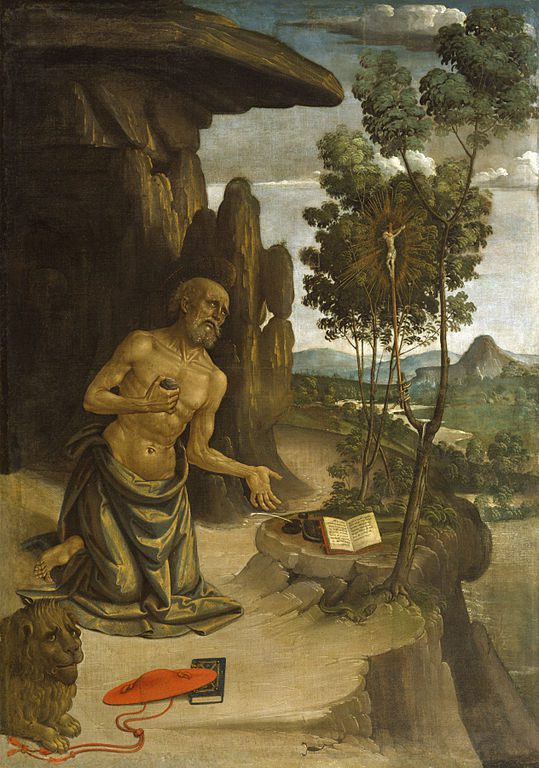
Saint Jerome in the Wilderness, by Pinturicchio (1454-1513). The saint spent four years in the Syrian desert as a hermit, mortifying his flesh and elevating his spirit through study [public domain / Wikimedia Commons]

* * *
(2-19-10)
* * * * *
*
Lately, a great deal of controversy has occurred with regard to the information that has come about concerning Pope St. John Paul II’s penitential practices and self-mortification. Mortification has a long history of use in the Catholic Church, as most people are aware. But is there any biblical justification for such a thing?
*
The answer (as usual) is yes. The most obvious parallel is the common biblical motif of sackcloth (Hebrew, saq; Greek, sakkos). What was this? Was it simply a burlap bag, such as the kind that holds potatoes? Not quite. It is much more like the “hair shirt” that is often thought of as synonymous with this sort of penitence.
Let’s consult a well-known Protestant reference: The New Bible Dictionary (edited by J. D. Douglas, Grand Rapids, Michigan: Wm. B. Eerdmans Pub. Co., 1962, “Sackcloth,” p. 1112), for our basic introduction to biblical sackcloth:
A coarse cloth . . . usually made of goat’s hair . . . Sackcloth was worn as a sign of mourning for the dead . . . , or of mourning for personal or national disaster . . . or of penitence for sins (1 Ki. 21:27; Ne. 9:1; Jon. 3:5; Mt. 11:21), or of special prayer for deliverance . . .
The form of the symbolic sackcloth was often a band or kilt tied around the waist . . . it was usually worn next to the skin (2 Ki. 6:30; Jb. 16:15; 2 Macc. 3:19), and was sometimes kept on all night (1 Ki. 21:27; Joel 1:13) . . . Sometimes the sackcloth was spread out to lie on (2 Sa. 21:10; Is. 58:5) . . .
Prophets sometimes wore it as a symbol of the repentance which they preached (Is. 20:2; Rev. 11:3).
Theological Dictionary of the New Testament (edited by Gerhard Kittel and Gerhard Friedrich and translated and abridged in one volume by Geoffrey W. Bromiley; Grand Rapids, Michigan: Wm. B. Eerdmans Pub. Co., 1985, pp. 995-996, “sakkos [sackcloth]”) elaborates:
The word originally means “haircloth,” i.e., the coarse fabric, mostly of goat’s hair, out of which tents, sails, carpets, etc. are made . . .
In the Semitic world sackcloth is from early days the garb of mourning and penitence. It is also prophetic garb in the OT. Originally perhaps a mere loincloth, it becomes a lower garment fastened with a cord or girdle and worn over the naked body. . . .
It signifies self-abasement (along with ashes and sometimes self-disfigurement) either before God (2 Kgs. 19:1) or others (1 Kgs. 20:31 ff.). It is also worn at night (1 Kgs. 21:27). Personal crises (Ps. 30:11) and times of national emergency (Esth. 4:1-2) or imminent eschatological destruction (Joel 1:13) are occasions for its penitential use. It has become a rite in Neh. 9:1 etc. . . . Fasting often accompanies it (Ps. 35:13). . . .
sakkos is a sign of conversion and penitence in the saying in Mt. 11:21 and Lk. 10:13, whether in the sense of the garment or the penitential mat. Jesus perhaps has Jon. 3:4 ff. in mind; but clearly conversion itself, not the external sign, is what matters.
For a brief overview of the use of the hair shirt in the early Church, based on the above background, see the article on same in The Catholic Encyclopedia.
Anti-Catholic Steve Hays and one of his buddies tried to make the argument that sackcloth was simply a Semitic custom of those times (using the secularist, anti-supernaturalist “anthropological” approach that theological liberals are notorious for), or that it was for mourning only, and in no sense prescribed by God. Hence, Hays asserted:
Dave fails to draw some rudimentary distinctions between what the Bible describes, prescribes, proscribes, and permits. . . . the Bible frequently describes ANE customs. . . . there’s nothing inherently holy, much less prescriptive, about the use of sackcloth. . . . Armstrong’s failure to distinguish between Biblical descriptions and Biblical prescriptions . . . Mourners often engage in irrational or self-destructive behavior . . . grief-stricken Jews sometimes forgot these prohibitions. In the heat of the moment they reverted to the social customs of the day. . . .
[A]s usual, you engage in a bait-and-switch. . . . you also disregard all of the specific arguments in my post. Not that you’re ever capable of interacting with somebody’s arguments at a serious level.
How odd, then, that the prophet Isaiah, speaking on behalf of God (as prophets are wont to do), recommends (“prescribes”?) the wearing of sackcloth (Is 32:11). The prophet Jeremiah does the same (Jer 4:8; 6:26). Ahab’s use of sackcloth, fasting, etc., is seen by God Himself as evidence of his humility before God (1 Ki 21:27-29), as is the similar behavior of the Ninevites, when they repented (Jonah 3:5-10). Isaiah reports (Is 22:12) that God Himself prescribed sackcloth and other similar customs: “In that day the Lord GOD of hosts called to . . . baldness and girding with sackcloth.”
Likewise, Jeremiah has God proclaiming, “Gird yourselves with sackcloth” (Jer 49:3). The prophet Joel brings the following “word of the LORD” (Joel 1:1): “Lament like a virgin girded with sackcloth . . . Gird on sackcloth and lament, O priests” (Joel 1:8, 13). The prophet Amos quotes God in the same vein: “I will bring sackcloth upon all loins” (Amos 8:10). This all sounds awful prescriptive to me (not just permissive).
Likewise, it is God (not mere Babylonian or Assyrian or Persian custom) Who commands the prophet Ezekiel to lay on his left side for 390 days, so as to “bear” the “punishment” of Israel (Ezek 4:4-5), and then on his right side for another 40 days, to “bear the punishment” of Judah (Ezek 4:6). Then God (masochist and “pain-freak” that He is) tells him: “I will put cords upon you, so that you cannot turn from one side to the other” (Ezek 4:8). I guess that God needs to attend the Steve Hays School of Elementary Spirituality to get up to speed and learn that all these terrible things aren’t necessary at all.
Even much later, at the outset of the New Covenant, our Lord casually refers to sackcloth in association with repentance, with no hint of condemnation (Matt 11:21; Lk 10:13). Jesus knew the Old Testament well. He knew that the prophets Isaiah, Jeremiah, and Joel had all prescribed and condoned the practice, as had God Himself, as reported by Isaiah, Jeremiah, and Amos. Any Jew worth his salt knew this. It is only anti-Catholic Bible students today who can’t see the obvious.
Finally, St. John reports in inspired Scripture that God says in a period near the end of the age: “I will grant my two witnesses power to prophesy for one thousand two hundred and sixty days, clothed in sackcloth” (Rev 11:3). How utterly strange that God would again prescribe an ancient custom several thousand years after it began. Could it be that (as usual) the anti-Catholics just don’t get it? That certainly could be the case!
Having been called on his bankrupt eisegetical “arguments,” Hays reverted back to his usual smart-alecky, garden-variety anti-Catholic mode (on the level of Jack Chick or “Maria Monk” et al):
You can also see this externalized piety in the purely decorative use of Scripture in Catholic apologetics. There’s no serious effort to ascertain the actual meaning of the prooftext in context. No, it’s just so much pretty wallpaper. And the more reams of wallpaper a Catholic apologist can roll out, the more impressive the argument. . . . This surface-level piety also blinds them to the obvious.
(“Breach of etiquette”, 2-29-10)
Catholicism substitutes fetishism for real grace. It fetishises “holy” persons, buildings, paintings, furniture, relics, &c.; . . . Protestants are supposed to defer to Catholic fetishism. Catholics wax indignant of you dare to treat their ascriptively holy persons as ordinary men and women like you and me because, deep down, there is no depth to Catholic piety. In practice, externals are all they’ve got. So they cling to their externals for dear life. . . . for them, ascriptive holiness trumps actual holiness.. . .
(“Catholic fetishism,” 2-19-10)
Please pray and do penance for this poor deluded soul who is leading many astray. Among anti-Catholics, he is considered one of the best critics of the Catholic Church.
Let’s now look at what the Bible (RSV) teaches us about sackcloth and closely related practices:
Use of Sackcloth as a Sign of Repentance or Penitence
* * *
Matthew 11:21 Woe to you, Chora’zin! woe to you, Beth-sa’ida! for if the mighty works done in you had been done in Tyre and Sidon, they would have repented long ago in sackcloth and ashes.
*
Luke 10:13 Woe to you, Chora’zin! woe to you, Beth-sa’ida! for if the mighty works done in you had been done in Tyre and Sidon, they would have repented long ago, sitting in sackcloth and ashes.
1 Kings 20:31-32 And his servants said to him, “Behold now, we have heard that the kings of the house of Israel are merciful kings; let us put sackcloth on our loins and ropes upon our heads, and go out to the king of Israel; perhaps he will spare your life.” [32] So they girded sackcloth on their loins, and put ropes on their heads, and went to the king of Israel and said, “Your servant Ben-ha’dad says, `Pray, let me live.'” And he said, “Does he still live? He is my brother.”
1 Kings 21:27-29 And when Ahab heard those words, he rent his clothes, and put sackcloth upon his flesh, and fasted and lay in sackcloth, and went about dejectedly. [28] And the word of the LORD came to Eli’jah the Tishbite, saying, [29] “Have you seen how Ahab has humbled himself before me? Because he has humbled himself before me, I will not bring the evil in his days; but in his son’s days I will bring the evil upon his house.”
2 Kings 19:1-4 When King Hezeki’ah heard it, he rent his clothes, and covered himself with sackcloth, and went into the house of the LORD. [2] And he sent Eli’akim, who was over the household, and Shebna the secretary, and the senior priests, covered with sackcloth, to the prophet Isaiah the son of Amoz. [3] They said to him, “Thus says Hezeki’ah, This day is a day of distress, of rebuke, and of disgrace; children have come to the birth, and there is no strength to bring them forth. [4] It may be that the LORD your God heard all the words of the Rab’shakeh, whom his master the king of Assyria has sent to mock the living God, and will rebuke the words which the LORD your God has heard; therefore lift up your prayer for the remnant that is left.” (cf. Is 37:1-2)
Nehemiah 9:1-2 Now on the twenty-fourth day of this month the people of Israel were assembled with fasting and in sackcloth, and with earth upon their heads. [2] And the Israelites separated themselves from all foreigners, and stood and confessed their sins and the iniquities of their fathers.
Esther 4:1-4 When Mor’decai learned all that had been done, Mor’decai rent his clothes and put on sackcloth and ashes, and went out into the midst of the city, wailing with a loud and bitter cry; [2] he went up to the entrance of the king’s gate, for no one might enter the king’s gate clothed with sackcloth. [3] And in every province, wherever the king’s command and his decree came, there was great mourning among the Jews, with fasting and weeping and lamenting, and most of them lay in sackcloth and ashes. [4] When Esther’s maids and her eunuchs came and told her, the queen was deeply distressed; she sent garments to clothe Mor’decai, so that he might take off his sackcloth, but he would not accept them.
Job 16:15 I have sewed sackcloth upon my skin, and have laid my strength in the dust.
Psalm 69:7-11 For it is for thy sake that I have borne reproach, that shame has covered my face. [8] I have become a stranger to my brethren, an alien to my mother’s sons. [9] For zeal for thy house has consumed me, and the insults of those who insult thee have fallen on me. [10] When I humbled my soul with fasting, it became my reproach. [11] When I made sackcloth my clothing, I became a byword to them.
Isaiah 32:11 Tremble, you women who are at ease, shudder, you complacent ones; strip, and make yourselves bare, and gird sackcloth upon your loins.
Jeremiah 4:8 For this gird you with sackcloth, lament and wail; for the fierce anger of the LORD has not turned back from us.
Jeremiah 6:26 O daughter of my people, gird on sackcloth, and roll in ashes; make mourning as for an only son, most bitter lamentation; for suddenly the destroyer will come upon us.
Ezekiel 7:16-18 And if any survivors escape, they will be on the mountains, like doves of the valleys, all of them moaning, every one over his iniquity. [17] All hands are feeble, and all knees weak as water. [18] They gird themselves with sackcloth, and horror covers them; shame is upon all faces, and baldness on all their heads.
Jonah 3:5-6 And the people of Nin’eveh believed God; they proclaimed a fast, and put on sackcloth, from the greatest of them to the least of them. [6] Then tidings reached the king of Nin’eveh, and he arose from his throne, removed his robe, and covered himself with sackcloth, and sat in ashes.
*
Use of Sackcloth in Conjunction With Prayer and Supplication
* * *
*
1 Chronicles 21:14-17 So the LORD sent a pestilence upon Israel; and there fell seventy thousand men of Israel. [15] And God sent the angel to Jerusalem to destroy it; but when he was about to destroy it, the LORD saw, and he repented of the evil; and he said to the destroying angel, “It is enough; now stay your hand.” And the angel of the LORD was standing by the threshing floor of Ornan the Jeb’usite. [16] And David lifted his eyes and saw the angel of the LORD standing between earth and heaven, and in his hand a drawn sword stretched out over Jerusalem. Then David and the elders, clothed in sackcloth, fell upon their faces. [17] And David said to God, “Was it not I who gave command to number the people? It is I who have sinned and done very wickedly. But these sheep, what have they done? Let thy hand, I pray thee, O LORD my God, be against me and against my father’s house; but let not the plague be upon thy people.”*
Psalm 30:8, 10-11 To thee, O LORD, I cried; and to the LORD I made supplication: . . . [10] Hear, O LORD, and be gracious to me! O LORD, be thou my helper!” [11] Thou hast turned for me my mourning into dancing; thou hast loosed my sackcloth and girded me with gladness,
Psalm 35:13 But I, when they were sick — I wore sackcloth, I afflicted myself with fasting. I prayed with head bowed on my bosom,
Daniel 9:3 Then I turned my face to the Lord God, seeking him by prayer and supplications with fasting and sackcloth and ashes.
Jonah 3:7-9 And he made proclamation and published through Nin’eveh, “By the decree of the king and his nobles: Let neither man nor beast, herd nor flock, taste anything; let them not feed, or drink water, [8] but let man and beast be covered with sackcloth, and let them cry mightily to God; yea, let every one turn from his evil way and from the violence which is in his hands. [9] Who knows, God may yet repent and turn from his fierce anger, so that we perish not?”
2 Maccabees 3:18-19 People also hurried out of their houses in crowds to make a general supplication because the holy place was about to be brought into contempt. [19] Women, girded with sackcloth under their breasts, thronged the streets. Some of the maidens who were kept indoors ran together to the gates, and some to the walls, while others peered out of the windows.
2 Maccabees 10:25 As he drew near, Maccabeus and his men sprinkled dust upon their heads and girded their loins with sackcloth, in supplication to God.
Use of Sackcloth in Mourning
* * *
Genesis 37:34 Then Jacob rent his garments, and put sackcloth upon his loins, and mourned for his son many days.
*
2 Samuel 3:31 Then David said to Jo’ab and to all the people who were with him, “Rend your clothes, and gird on sackcloth, and mourn before Abner.” And King David followed the bier.
2 Samuel 21:10 Then Rizpah the daughter of Ai’ah took sackcloth, and spread it for herself on the rock, from the beginning of harvest until rain fell upon them from the heavens; and she did not allow the birds of the air to come upon them by day, or the beasts of the field by night. (cf. Is 58:5)
2 Kings 6:30 When the king heard the words of the woman he rent his clothes — now he was passing by upon the wall — and the people looked, and behold, he had sackcloth beneath upon his body —
Isaiah 15:3 in the streets they gird on sackcloth; on the housetops and in the squares every one wails and melts in tears.
Isaiah 22:12 In that day the Lord GOD of hosts called to weeping and mourning, to baldness and girding with sackcloth;
Jeremiah 48:37 For every head is shaved and every beard cut off; upon all the hands are gashes, and on the loins is sackcloth.
Jeremiah 49:3 “Wail, O Heshbon, for Ai is laid waste! Cry, O daughters of Rabbah! Gird yourselves with sackcloth, lament, and run to and fro among the hedges! For Milcom shall go into exile, with his priests and his princes.
Lamentations 2:10 The elders of the daughter of Zion sit on the ground in silence; they have cast dust on their heads and put on sackcloth; the maidens of Jerusalem have bowed their heads to the ground.
Ezekiel 27:31 they make themselves bald for you, and gird themselves with sackcloth, and they weep over you in bitterness of soul, with bitter mourning.
Joel 1:8 Lament like a virgin girded with sackcloth for the bridegroom of her youth.
Joel 1:13 Gird on sackcloth and lament, O priests, wail, O ministers of the altar. Go in, pass the night in sackcloth, O ministers of my God! Because cereal offering and drink offering are withheld from the house of your God.
Amos 8:10 I will turn your feasts into mourning, and all your songs into lamentation; I will bring sackcloth upon all loins, and baldness on every head; I will make it like the mourning for an only son, and the end of it like a bitter day.
*
Deliberate Self-Infliction of Deprivation for Spiritual / Intercessory Purposes
* * *
*
Exodus 17:9-12 And Moses said to Joshua, “Choose for us men, and go out, fight with Am’alek; tomorrow I will stand on the top of the hill with the rod of God in my hand.” [10] So Joshua did as Moses told him, and fought with Am’alek; and Moses, Aaron, and Hur went up to the top of the hill. [11] Whenever Moses held up his hand, Israel prevailed; and whenever he lowered his hand, Am’alek prevailed. [12] But Moses’ hands grew weary; so they took a stone and put it under him, and he sat upon it, and Aaron and Hur held up his hands, one on one side, and the other on the other side; so his hands were steady until the going down of the sun.
*
2 Samuel 12:16-17 David therefore besought God for the child; and David fasted, and went in and lay all night upon the ground. [17] And the elders of his house stood beside him, to raise him from the ground; but he would not, nor did he eat food with them.
[Anti-Catholic Steve Hays retorted: “And what was God’s response to David’s prayer and prostration and fasting? The child died.” I replied:
And what was God the Father’s response to Jesus’ prayer and prostration and sweating blood in the Garden of Gethsemane? He was crucified.
Therefore, it is shown that Jesus shouldn’t have prayed in such a manner.
And what was God’s response to Jeremiah’s prayer and prostration and endless preaching to the apostate Jews? The destruction of Jerusalem.
Therefore, it is proven that Jeremiah shouldn’t have done what he did.
Is this a new school of exegesis? How compelling . . .]
Ezra 9:1-8 After these things had been done, the officials approached me and said, “The people of Israel and the priests and the Levites have not separated themselves from the peoples of the lands with their abominations, from the Canaanites, the Hittites, the Per’izzites, the Jeb’usites, the Ammonites, the Moabites, the Egyptians, and the Amorites. [2] For they have taken some of their daughters to be wives for themselves and for their sons; so that the holy race has mixed itself with the peoples of the lands. And in this faithlessness the hand of the officials and chief men has been foremost.” [3] When I heard this, I rent my garments and my mantle, and pulled hair from my head and beard, and sat appalled. [4] Then all who trembled at the words of the God of Israel, because of the faithlessness of the returned exiles, gathered round me while I sat appalled until the evening sacrifice. [5] And at the evening sacrifice I rose from my fasting, with my garments and my mantle rent, and fell upon my knees and spread out my hands to the LORD my God, [6] saying: “O my God, I am ashamed and blush to lift my face to thee, my God, for our iniquities have risen higher than our heads, and our guilt has mounted up to the heavens. [7] From the days of our fathers to this day we have been in great guilt; and for our iniquities we, our kings, and our priests have been given into the hand of the kings of the lands, to the sword, to captivity, to plundering, and to utter shame, as at this day. [8] But now for a brief moment favor has been shown by the LORD our God, to leave us a remnant, and to give us a secure hold within his holy place, that our God may brighten our eyes and grant us a little reviving in our bondage. (cf. Jer 48:37)
Jeremiah 41:5 eighty men arrived from Shechem and Shiloh and Sama’ria, with their beards shaved and their clothes torn, and their bodies gashed, bringing cereal offerings and incense to present at the temple of the LORD.
Ezekiel 4:1-8 “And you, O son of man, take a brick and lay it before you, and portray upon it a city, even Jerusalem; [2] and put siegeworks against it, and build a siege wall against it, and cast up a mound against it; set camps also against it, and plant battering rams against it round about. [3] And take an iron plate, and place it as an iron wall between you and the city; and set your face toward it, and let it be in a state of siege, and press the siege against it. This is a sign for the house of Israel. [4] “Then lie upon your left side, and I will lay the punishment of the house of Israel upon you; for the number of the days that you lie upon it, you shall bear their punishment. [5] For I assign to you a number of days, three hundred and ninety days, equal to the number of the years of their punishment; so long shall you bear the punishment of the house of Israel. [6] And when you have completed these, you shall lie down a second time, but on your right side, and bear the punishment of the house of Judah; forty days I assign you, a day for each year. [7] And you shall set your face toward the siege of Jerusalem, with your arm bared; and you shall prophesy against the city. [8] And, behold, I will put cords upon you, so that you cannot turn from one side to the other, till you have completed the days of your siege.”
Luke 2:36-37 And there was a prophetess, Anna, the daughter of Phan’u-el, of the tribe of Asher; she was of a great age, having lived with her husband seven years from her virginity, [37] and as a widow till she was eighty-four. She did not depart from the temple, worshiping with fasting and prayer night and day.
1 Corinthians 9:27 but I pommel my body and subdue it, lest after preaching to others I myself should be disqualified.
[cf. NIV, Beck: “beat”; NEB: “bruise”; Williams: “beating and bruising”; Barclay: “batter”; NASB: “buffet”; NRSV: “punish”; NKJV: “discipline”; Wuest: “I beat my body black and blue and make it my abject slave”; Amplified: “I buffet my body — handle it roughly, discipline it by hardships — and subdue it”; Goodspeed: “I beat and bruise my body and make it my slave”; Moffatt: “I maul and master my body” — there is considerable dispute among commentators as to what exactly St. Paul means, and the Catholic position does not absolutely require only one interpretation of this passage. In any event, even if this is metaphorical in some sense, it fits into the overall scriptural theme of self-sacrifice, as outlined above; therefore it is expressing some sort of asceticism; however one specifically interprets it]
[Fasting is also obviously an example of bodily deprivation for a spiritual purpose. See: Ex 34:28 and Deut 9:9 (Moses went forty days without even water); Deut 9:18 (Moses again fasts forty days without “bread” or “water” on behalf of the Israelites, after the sin of the idolatry of the golden calf); 1 Sam 30:12 (three days without water); 1 Sam 31:13 (seven days); 2 Sam 1:12; 1 Ki 19:8 (forty days); 1 Chron 10:12 (seven days); 2 Chron 20:3; Ezra 8:21-23; 10:6; Neh 1:4; 9:1; Esther 4:3; 4:16 (three days without food and water); 9:31; Ps 69:10 (“humbled my soul with fasting”); Ps 109:24 (“My knees are weak through fasting; my body has become gaunt”); Jer 36:9; Dan 6:18; Joel 1:14; 2:12, 15; Jon 3:5, 7; Zech 7:3, 5; 8:19; Matt 4:2 (Jesus’ forty days of fasting in the wilderness); Matt 6:16-18; 9:14-15 (cf. Mk 2:18-20; Lk 5:33-35; 18:12); Lk 7:33 (cf. Matt 11:18; Lk 1:15); Acts 13:2-3; 14:23]
Prophets’ Wearing of Sackcloth
* * *
2 Kings 1:8 They answered him, “He wore a garment of haircloth, with a girdle of leather about his loins.” And he said, “It is Eli’jah the Tishbite.”
*
Isaiah 20:2 at that time the LORD had spoken by Isaiah the son of Amoz, saying, “Go, and loose the sackcloth from your loins and take off your shoes from your feet,”
Revelation 11:3 And I will grant my two witnesses power to prophesy for one thousand two hundred and sixty days, clothed in sackcloth. (cf. John the Baptist and “camel’s hair”: Matt 3:4; Mk 1:6; possibly a continuation of the same ascetic tradition)
Stay in touch! Like Biblical Evidence for Catholicism on Facebook:
Previous Post
February 9, 2016
Biblical Evidence for Lent
Next Post

February 10, 2016 "Neo-Catholic" (Silly Radical Catholic Reactionary Term)
Browse Our Archives
Select a Category & Last Things About Me Anti-Catholicism Atheism & Agnosticism Baptism and Sacramentalism Bible and Tradition Blessed Virgin Mary Books by Dave Armstrong C. S. Lewis Calvinism & General Protestantism Catholic Apologetics Catholic Apologists Catholic conversion Catholic converts Christmas Church (Ecclesiology) Church History Conversion and Converts Development of Doctrine Eastern Orthodoxy Ecumenism & Christian Unity Eucharist & Liturgy Fathers of the Church French Translations G. K. Chesterton Hell Hell & Satan Hell & Satan & Last Things Heresies & Comparative Religion Holistic Health Inquisition & Crusades & Scandals James White Jews & Judaism & Old Testament John Calvin John Henry Newman Liberal / Modernist Theology Life Issues Literary Resume Lutheranism Mariology Martin Luther Music Orthodoxy Papacy & Infallibility Personal Page Philosophy & Science Political & Ethical & Moral Issues Protestant Persecution & Intolerance Protestantism Purgatory Purgatory & Penance Romantic & Imaginative Theology Saints & Purgatory & Penance Salvation Salvation & Justification Satan & Last Things Sexuality and Gender Issues Spanish Translations Traditionalism vs. Radical Catholic Reactionaries Traducciones al español / tradução para português Trinitarianism & Christology Uncategorized Videos
Select a Month October 2026 September 2026 August 2026 July 2026 June 2026 May 2026 April 2026 March 2026 February 2026 January 2026 December 2025 November 2025 October 2025 September 2025 August 2025 July 2025 June 2025 May 2025 April 2025 March 2025 February 2025 January 2025 December 2024 November 2024 October 2024 September 2024 August 2024 July 2024 June 2024 May 2024 April 2024 March 2024 February 2024 January 2024 December 2023 November 2023 October 2023 September 2023 August 2023 July 2023 June 2023 May 2023 April 2023 March 2023 February 2023 January 2023 December 2022 November 2022 October 2022 September 2022 August 2022 July 2022 June 2022 May 2022 April 2022 March 2022 February 2022 January 2022 December 2021 November 2021 October 2021 September 2021 August 2021 July 2021 June 2021 May 2021 April 2021 March 2021 February 2021 January 2021 December 2020 November 2020 October 2020 September 2020 August 2020 July 2020 June 2020 May 2020 April 2020 March 2020 February 2020 January 2020 December 2019 November 2019 October 2019 September 2019 August 2019 July 2019 June 2019 May 2019 April 2019 March 2019 February 2019 January 2019 December 2018 November 2018 October 2018 September 2018 August 2018 July 2018 June 2018 May 2018 April 2018 March 2018 February 2018 January 2018 December 2017 November 2017 October 2017 September 2017 August 2017 July 2017 June 2017 May 2017 April 2017 March 2017 February 2017 January 2017 December 2016 November 2016 October 2016 September 2016 August 2016 July 2016 June 2016 May 2016 April 2016 March 2016 February 2016 January 2016 December 2015 November 2015 October 2015 September 2015 August 2015 July 2015 June 2015 May 2015 April 2015 March 2015 February 2015 January 2015 December 2014 November 2014 October 2014 September 2014 August 2014 July 2014 June 2014 April 2014 March 2014 February 2014 January 2014 December 2013 November 2013 October 2013 September 2013 August 2013 July 2013 June 2013 April 2013 March 2013 February 2013 January 2013 December 2012 November 2012 October 2012 September 2012 August 2012 July 2012 June 2012 May 2012 April 2012 March 2012 February 2012 January 2012 December 2011 November 2011 October 2011 September 2011 August 2011 July 2011 June 2011 April 2011 March 2011 February 2011 October 2010 September 2010 August 2010 July 2010 April 2010 March 2010 December 2009 October 2009 August 2009 July 2009 June 2009 May 2009 March 2009 February 2009 October 2008 September 2008 April 2008 March 2008 February 2008 January 2008 December 2007 November 2007 October 2007 May 2007 March 2007 February 2007 January 2007 November 2006 October 2006 September 2006 August 2006 July 2006 June 2006 May 2006 April 2006 March 2006 February 2006 October 2005 June 2005 April 2005 February 2005 July 2004 May 2004 April 2004
Follow Us!
TAKE THE
Religious Wisdom Quiz
What does "Eden" mean in Hebrew?
Select your answer to see how you score.
Peace Gift Delight Paradise
Books by This Author Books by Dave Armstrong
Related posts from Biblical Evidence for Catholicism

Bible & Catholicism on Mortal Sin (vs. John...
Biblical Evidence for Catholicism

Does Catholic Intercession of Saints Require Omniscience?
Biblical Evidence for Catholicism

Capabilities of Heavenly Saints: Protestant Commentaries
Biblical Evidence for Catholicism

Revelation 5 & 8 (Intercession of Saints &...
Biblical Evidence for Catholicism
TRENDING AT PATHEOS Catholic

The Iron Gates and the Lion of the...
Yesterday, I didn't finish my report about, well, yesterday. So I'll...

Dolly Parton’s Last Song Wins Dove Award with...
Bluegrass band The Grascals, speaking on the red carpet at the 57th...

The Image: On the Horror of Capitalism and...
The Image Then went the Pharisees, and took counsel how they might...

We are approaching the date of our new American national holiday: October...

Letters on Living the Faith by C.S. Lewis
Most of us met C.S. Lewis as a public intellectual. Mere Christianity....

When Halloween Unmasks Married Hearts
Written by Dr. David K. Ewen from Eternal Truth Bible College Behind...
view all Catholic blogs
Ad-Free & Subscriber Log-In Subscription Support
- About Us
- 2026 Calendar
- Videos
- Podcasts
- Library of World Religions
- Faith In Media Tracker
- Advertise With Us
- Write for Us
- Privacy Policy
- Terms of Service
- Do Not Sell My Data
- Contact Us
- Radiant Digital
- Manage Newsletter Subscriptions
- Unsubscribe From Notifications
- Sitemap
Copyright 2008-2026, Patheos. All rights reserved.
Subscription Support Ad-Free & Subscriber Log-In
Follow Patheos