
BuddhistCatholicContemplativeEvangelicalGeneral ChristianHinduJewishLatter-day SaintMuslimNew VisionsProgressive Christian
Beliefs
- Buddhist
- Catholic
- Contemplative
- Evangelical
- General Christian
- Hindu
- Jewish
- Latter-day Saint
- More Voices
- Muslim
- New Visions
- Pagan
- Progressive Christian
Topics
- Religion News
- Food and Religion
- Sports and Religion
- Religious Art
- Religious Music and Entertainment
- Religious Events
- History and Religion
- Style and Religion
- Politics and Religion
- Women in Religion
- Recreation Outdoors and Religion
- Business Finance and Religion
- Careers Workplace and Religion
- Education and Religion
- Family Parenting and Religion
- Health Fitness and Religion
- Home and Religion
- Relationships and Religion
- Technology and Religion
- Travel and Religion
Columnists
- Buddhist Columnists
- Business Finance and Religion Columnists
- Careers Workplace and Religion Columnists
- Catholic Columnists
- Contemplative Columnists
- Education and Religion Columnists
- Evangelists Columnists
- Family Parenting and Religion Columnists
- General Christian Columnists
- Health Fitness and Religion Columnists
- Hindu Columnists
- History and Religion Columnists
- Home and Religion Columnists
- Jewish Columnists
- More Voices Columnists
- Latter Day Columnists
- Muslim Columnists
- New Visions Columnists
- Nonreligious Columnists
- Pagan Columnists
- Politics and Religion Columnists
- Progressive Columnists
- Recreation Outdoors and Religion Columnists
- Relationships and Religion Columnists
- Religion News Columnists
- Religious Art Columnists
- Religious Events Columnists
- Religious Music and Entertainment Columnists
- Sports and Religion Columnists
- Style and Religion Columnists
- Technology and Religion Columnists
- Travel and Religion Columnists
- Women in Religion Columnists
Resource Library
- 2026 Calendar
- Library of World Religions
- The 100 Most Holy Places on Earth
- Patheos Answers
- Podcasts
- Videos
- Faith Leaders Database
- Anglican Episcopalian
- Bahai
- Baptist
- Buddhism
- Christianity
- Confucianism
- Eastern Orthodoxy
- Hinduism
- Holiness and Pentecostal
- ISKCON
- Islam
- Judaism
- Lutheran
- Methodist
- The Church of Jesus Christ of Latter-day Saints
- New Age
- Paganism
- Presbytarian and Reformed
- Protestantism
- Religion Behind the Scenes
- Roman Catholic
- Scientology
- Shia Islam
- Sikhism
- Sufism
- Sunni Islam
- Taoism
- Zen
- See all religions
Research Tools
 Ad-Free & Subscriber Log-In Subscription Support
Ad-Free & Subscriber Log-In Subscription Support
Follow Patheos 

- Trending:
- Forgiveness
- |
- Marriage
- |
- Consciousness
- |
- Death Penalty
- |
- Election
- |
- Halloween

-
About
-
Catholic Apologetics
-
Church History
-
Great Apologists
-
Christian Worldview
-
Protestantism & Misc.
- Home
- Catholic
- History and Religion
- St. Augustine’s Eucharistic Doctrine
St. Augustine’s Eucharistic Doctrine
Last updated on: April 3, 2017 at 4:32 pm by Dave Armstrong
St. Augustine’s Eucharistic Doctrine 2017-04-03T16:32:37-04:00 Dave Armstrong
Patheos Explore the world's faith through different perspectives on religion and spirituality! Patheos has the views of the prevalent religions and spiritualities of the world.
Simultaneous Assertion of Realism and Symbolism
[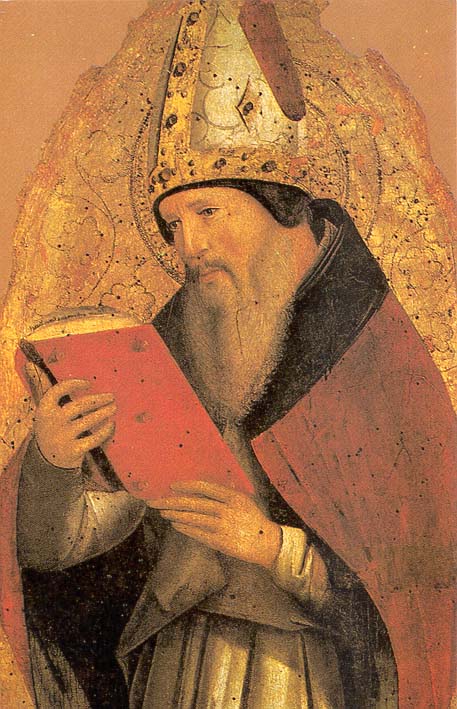
[public domain]
(2-17-11)
The great Church father (who lived from 354-430) made many statements about the Eucharist that have been traditionally seized upon as evidence of his adoption of either a purely symbolic (Zwinglian) or Calvinistic notion of the Lord’s Supper.
These are often unfortunately interpreted within the framework of what has been called the “dichotomous tendency” in Protestantism, whereby things are set against each other and opposed, when they need not be. Catholic theologian Ludwig Ott explains:
The Eucharistic doctrine expounded by St. Augustine is interpreted in a purely spiritual way by most Protestant writers on the history of dogmas. Despite his insistence on the symbolical explanation he does not exclude the Real Presence. In association with the words of institution he concurs with the older Church tradition in expressing belief in the Real Presence . . .
When in the Fathers’ writings, especially those of St. Augustine, side by side with the clear attestations of the Real Presence, many obscure symbolically-sounding utterances are found also, the following points must be noted for the proper understanding of such passages: (1) The Early Fathers were bound by the discipline of the secret, which referred above all to the Eucharist (cf. Origen, In Lev. hom. 9, 10); (2) The absence of any heretical counter-proposition often resulted in a certain carelessness of expression, to which must be added the lack of a developed terminology to distinguish the sacramental mode of existence of Christ’s body from its natural mode of existence once on earth; (3) The Fathers were concerned to resist a grossly sensual conception of the Eucharistic Banquet and to stress the necessity of the spiritual reception in Faith and in Charity (in contradistinction to the external, merely sacramental reception); passages often refer to the symbolical character of the Eucharist as ‘the sign of unity’ (St. Augustine); this in no wise excludes the Real Presence.
(Ott, 377-378)
Other patristic scholars (including Protestant ones) concur:
His thought [on the sacraments] has been widely studied but has not always been expounded in an unequivocal manner. Here as in other instances, it is necessary to keep in mind the various aspects of the dogma which he illustrates and defends. Thus . . . his insistence on the ecclesiological symbolism of the Eucharist does not obscure his explicit affirmations of the real presence (the bread is the Body of Christ and the wine is the Blood of Christ: Serm. 227; 272; In ps. 98, 9; 33, 1, 10) and of the sacrificial nature of the Eucharist (De civ. Dei 10, 19-20; Conf. 9, 12, 32; 13-36).
(Johannes Quasten, vol. 4; St. Augustine chapter (VI) written by Agostino Trape, 449-450)
There are certainly passages in his writings which give a superficial justification to all these interpretations, but a balanced verdict must agree that he accepted the current realism . . . One could multiply texts . . . which show Augustine taking for granted the traditional identification of the elements with the sacred body and blood. There can be no doubt that he shared the realism held by almost all his contemporaries and predecessors.
(J. N. D. Kelly, 446-447)
[Augustine] at the same time holds fast the real presence of Christ in the Supper . . . He was also inclined, with the Oriental fathers, to ascribe a saving virtue to the consecrated elements.
(Philip Schaff, History of the Church, vol. 3, chapter 7)
Schaff (the renowned Protestant historian, who was certainly no partisan of transubstantiation!) had in the previous two pages just shown how St. Augustine referred to symbolism in the Eucharist as well, but he honestly admits that the great father accepted the Real Presence “at the same time.”
This is precisely what Catholics maintain. Facts about Christian doctrinal history, and who believed what, are facts, whether we agree with them or not. Schaff (as always) is honest enough to present them, even when he (as a Protestant) disagrees on a doctrinal level.
Kelly also noted that this state of affairs was generally true of the Church fathers (not just Augustine):
It must not be supposed, of course, that this ‘symbolical’ language implied that the bread and wine were regarded as mere pointers to, or tokens of, absent realities. Rather were they accepted as signs of realities which were somehow actually present though apprehended by faith alone.
(Kelly, 442)
St. Augustine’s symbolic language can be synthesized with his “realistic” language, because realism can co-exist with symbol while retaining its realism. The symbolic language can also (and indeed often does in Augustine) refer to other, more communal aspects of the Eucharist that complement (but are not contrary to) the “Real Presence” aspect of it. So there are at least two ways in which this can be explained as consistent with Catholic theology.
The simple fact of the matter is that Augustine speaks in both ways. But we can harmonize them as complementary, not contradictory, because Catholics, like Augustine himself, think in terms of “both/and” rather than the “either/or” outlook so prevalent in Protestantism. Thus, when some Augustinian symbolic Eucharistic utterance is found, it is seized upon as “proof” that he thereby denied the Real Presence.
This is neither logically compelling, nor scholarly, since there are also a great many of his statements that clearly indicate his belief in the literal, real physical presence of Christ in the Eucharist, and the Sacrifice of the Mass, and the priesthood: all of which makes no sense without sacrifice, and the efficacy of the Mass (as well as other prayers) for the aid of the dead in purgatory, etc.
Either St. Augustine contradicted himself, changed his mind, or else the Catholic “take” on the situation is correct. The communal (“symbolic” if you will) aspects of the Sacrifice of the Mass, to which Augustine refers, are totally consonant with Catholic theology, and are discussed in the Catechism of the Catholic Church (#1359-61, #1372, #2643).
The Bible takes the same approach. For example, Jesus refers to the “sign of Jonah,” comparing Jonah’s time in the belly of the fish to His own burial (Matthew 12:38-40; Lk 11:29-30). In other words, both events, although described as “signs,” were literally real events. Jesus also uses the same terminology in connection with His Second Coming (Matthew 24:30-31): a thing that is believed by all Christians to be a literal, not a symbolic occurrence.
Moreover, Jesus’ language of “sign” is very literalistic when He describes “terrors and great signs from heaven” (Lk 21:11), in the context of “earthquakes” and “famines and pestilences,” and when He refers to “signs in sun and moon and stars” (Lk 21:25).
In the Jewish and biblical understanding signs are not merely symbolic and abstract; they are concretely real (e.g., Jn 2:23: “they saw the signs”) and visible (Jn 4:48: “Unless you see signs and wonders you will not believe”; Lk 17:20: “signs to be observed”). They are usually something that one does (Mk 13:22; Lk 23:8; Jn 2:11, 23; 3:2; 4:54; 6:2, 14; 9:16; 11:47; 12:18, 37, etc.).
Likewise, this holds true in St. Augustine’s eucharistic thinking. The language of “sign” and “symbol” does not nullify his eucharistic realism.
St. Augustine also believed in adoration of the host and the Sacrifice of the Mass, causing further conundrums for the Calvinist who seeks to claim his as a forerunner:
Commenting on the Psalmist’s bidding that we should adore the footstool of His feet, he pointed out that this must be the earth. But since to adore the earth would be blasphemous, he concluded that the word must mysteriously signify the flesh which Christ took from the earth and which He gave us to eat. Thus it was the eucharistic body which demanded adoration.
(Kelly, 447)
As to the adoration of the consecrated elements: This follows with logical necessity from the doctrine of transubstantiation, and is the sure touchstone of it. . . . Ambrose speaks of the flesh of Christ “which we to-day adore in the mysteries,” [Ps 98,9] and Augustine, of an adoration preceding the participation of the flesh of Christ.
(Schaff, History of the Church, Vol. 3, Chapter 7)
The self-same Christ Who was slain there is in a real sense slaughtered daily by the faithful, so that the sacrifice which was offered once for all in bloody form is sacramentally renewed upon our altars with the oblation of His body and blood.
(Kelly, 454; further sources: Ep. 98:9; cf. C. Faust, 20,18; 20:21)
John Calvin, in his 1537 treatise, On Shunning the Unlawful Rites of the Ungodly, and Preserving the Purity of the Christian Religion (in Beveridge and Bonnet, vol. 3, 383, 386-387, 393), thought eucharistic adoration was “abominable Idolatry,” where “bread is pretended to assume Divinity, and raised aloft as God,” “atrocious and insulting,” “all prostrate themselves in stupid amazement,” like “worship of the Statue at Babylon,” a “sink of pollution and sacrilege,” and an example of being “enchanted by a kind of dull and magical murmur!” He offered equally scathing criticisms of the Sacrifice of the Mass:
[T]he mere name of Sacrifice (as the priests of the Mass understand it) both utterly abolishes the cross of Christ, and overturns his sacred Supper which he consecrated as a memorial of his death. For both, as we know, is the death of Christ utterly despoiled of its glory, unless it is held to be the one only and eternal Sacrifice; and if any other Sacrifice still remains, the Supper of Christ falls at once, and is completely torn up by the roots . . .
Will it still be denied to me that he who listens to the Mass with a semblance of Religion, every time these acts are perpetrated, professes before men to be a partner in sacrilege, whatever his mind may inwardly declare to God?
. . . Taking the single expression which gives the essence of all the invectives which the Apostle had uttered against Idolatry — that we could not at once be partakers at the table of Christ and the table of demons — who can deny its applicability to the Mass? Its altar is erected by overthrowing the Table of Christ . . . In the Mass Christ is traduced, his death is mocked, an execrable idol is substituted for God — shall we hesitate, then, to call it the table of demons? Or shall we not rather, in order justly to designate its monstrous impiety, try, if possible, to devise some new term still more expressive of detestation? Indeed, I exceedingly wonder how men, not utterly blind, can hesitate for a moment to apply the name “Table of Demons” to the Mass, seeing they plainly behold in the erection and arrangement of it the tricks, engines, and troops of devils all combined . . . I have long been maintaining on the strongest grounds that Christian men ought not even to be present at it!
. . . will you represent the Supper under the image of a diabolical Mass? Will you persuade us that in an act in which you ignominiously travesty the death of the Lord, you observe his Supper, in which he distinctly exhorts us to shew forth his death?
(Ibid., 383, 386-388)
Since St. Augustine believed in these things, these accusations all to apply to him as well. Yet Calvin and many of his followers maintain the pretense that it is not the case. Calvin always wants to lambast the Catholic Church. He refrains from “scolding” and condemning all the Church fathers who believe basically the same. All we can do is document the actual state of affairs.
Adoration is precisely directed towards the consecrated Host; otherwise it can be directed towards the non-physical Father in heaven at any time. Eucharistic adoration is specifically that directed towards the Incarnate Christ substantially present in the consecrated elements: the “eucharistically substantiated” Christ.
By definition it involves, then, a host that was bread and wine that was wine, but which are both transubstantiated into the Body and Blood of Christ. St. Augustine makes this crystal-clear (downright undeniable). Here is the key passage, from his Exposition on Psalm 99:8 (“NPNF 1,” vol. 8):
“O magnify the Lord our God” (ver. 5). Magnify Him truly, magnify Him well. Let us praise Him, let us magnify Him who has wrought the very righteousness which we have; who wrought it in us, Himself. For who but He who justified us, wrought righteousness in us? For of Christ it is said, “who justifies the ungodly.” Romans 4:5 . . . “And fall down before His footstool: for He is holy.” What are we to fall down before? His footstool. What is under the feet is called a footstool, . . . in Latin Scabellum or Suppedaneum. But consider, brethren, what he commands us to fall down before. In another passage of the Scriptures it is said, “The heaven is My throne, and the earth is My footstool.” Isaiah 66:1 Doth he then bid us worship the earth, since in another passage it is said, that it is God’s footstool? How then shall we worship the earth, when the Scripture says openly, “You shall worship the Lord your God”? Deuteronomy 6:13 Yet here it says, “fall down before His footstool:” and, explaining to us what His footstool is, it says, “The earth is My footstool.” I am in doubt; I fear to worship the earth, lest He who made the heaven and the earth condemn me; again, I fear not to worship the footstool of my Lord, because the Psalm bids me, “fall down before His footstool.” I ask, what is His footstool? and the Scripture tells me, “the earth is My footstool.” In hesitation I turn unto Christ, since I am herein seeking Himself: and I discover how the earth may be worshipped without impiety, how His footstool may be worshipped without impiety. For He took upon Him earth from earth; because flesh is from earth, and He received flesh from the flesh of Mary. And because He walked here in very flesh, and gave that very flesh to us to eat for our salvation; and no one eats that flesh, unless he has first worshipped: we have found out in what sense such a footstool of our Lord’s may be worshipped, and not only that we sin not in worshipping it, but that we sin in not worshipping.
The entire thrust of his argument has to do with “what is the footstool that God says we can worship?” It is clearly something physical, having to do with the earth. But Augustine notes that we are not to worship the earth. So Augustine brilliantly connects God to the earth by noting the incarnation: “For He took upon Him earth from earth; because flesh is from earth, and He received flesh from the flesh of Mary.”
Then he says that Jesus gave us “that very flesh to us to eat for our salvation” and concludes that the footstool is the eucharistic elements that become Christ’s body and blood; therefore can be worshiped as God, even though they have an earthly connection, precisely because of the incarnation.
Then he denies that it is a sin to so worship and adore, and goes further and says it is a sin if we do not. Therefore, it is unarguable that this is unmistakably eucharistic adoration: the very thing that Calvin detested as an idolatrous abomination.
There can be no middle ground on this matter: St. Augustine must be accepted as a full-fledged Catholic or not at all. But Protestants (particularly Calvinists) want to ignore or overlook these “outrageous” Catholic elements in Augustine’s doctrine and make out that he was almost like a Calvin in the 4th century, with regard to the Eucharist. It’s not true; it is manifestly, plainly untrue.
Catholics, too, think that the Eucharist is a sign, just as Augustine did (Catechism of the Catholic Church: #1333-1336, 1412), and a memorial (CCC #1099, 1362-1366), even, indeed, a foretaste or sign of the Resurrection (CCC #1000) and an analogy to the Paschal meal of the risen Jesus (CCC #1347). Obviously, then, the notion of “sign” is not, for us, as for Augustine, intrinsically contrary to substantive presence, as if it wipes it out, like the relationship of water to fire, etc., or a zero-sum game.
We can explain Augustine’s language of both signs and his more literal language, as a harmonious package. Calvinists (who want to claim him as one of their own in this regard) cannot. They must deny or “spiritualize away” his more literal, substantive, “Catholic-sounding” statements. And so on and on the debate goes, with this sort of dynamic almost always present.
Calvinists may disagree with St. Augustine because of these “Catholic” beliefs and admit that Calvin wrongly includes him among the non-idolater “real Christians” — or else continue to futilely maintain that Augustine was more like Calvin in this regard than like St. Thomas Aquinas. If it is contended that Augustine had a mystical / spiritual-only view of the Eucharist, his views on adoration and sacrifice must still be faced.
Eucharistic adoration has no place in the Calvinist system. If Augustine believed in that, then he should be rejected as any sort of precursor to Calvin at all. But Calvin nevertheless believed that Augustine did not accept either the Sacrifice of the Mass or adoration of the consecrated Host, or some sort of close precursor to transubstantiation. He claimed that St. Augustine was completely on his side:
Since the advocates of this spurious dogma are not ashamed to honour it with the suffrages of the ancients, and especially of Augustine, how perverse they are in the attempt I will briefly explain. Pious and learned men have collected the passages, and therefore I am unwilling to plead a concluded cause: any one who wishes may consult their writings. I will not even collect from Augustine what might be pertinent to the matter, but will be contented to show briefly, that without all controversy he is wholly ours. The pretence of our opponents, when they would wrest him from us, that throughout his works the flesh and blood of Christ are said to be dispensed in the Supper—namely, the victim once offered on the cross, is frivolous, seeing he, at the same time, calls it either the eucharist or sacrament of the body. . . . For by interposing the expression, in a manner, he declares that he was not really or truly included under the bread. . . . in comparing the presence of the flesh to the sign of the cross, he sufficiently shows that he has no idea of a twofold body of Christ, one lurking concealed under the bread, and another sitting visible in heaven.
(Institutes, IV, 17, 28)
[I]f the question relates to the approval of the fiction of sacrifice, as imagined by Papists in the mass, there is nothing in the Fathers to countenance the sacrilege. They indeed use the term sacrifice, but they, at the same time, explain that they mean nothing more than the commemoration of that one true sacrifice which Christ, our only sacrifice (as they themselves everywhere proclaim), performed on the cross. . . . Hence Augustine himself, in several passages (Ep. 120, ad Honorat. Cont. Advers. Legis.), explains, that it is nothing else than a sacrifice of praise. In short, you will find in his writings, passim, that the only reason for which the Lord’s Supper is called a sacrifice is, because it is a commemoration, an image, a testimonial of that singular, true, and only sacrifice by which Christ expiated our guilt.
(Institutes, IV, 18, 10)
It’s an uphill battle to try to maintain such a view, as it was for Martin Luther and Philip Melanchthon, who eventually ceased co-opting St. Augustine for their purposes because they realized that their views differed from his.
BIBLIOGRAPHY
Beveridge, Henry and Jules Bonnet, editors, Selected Works of John Calvin: Tracts and Letters, Vol. 3: Tracts, Part 3, Grand Rapids, Michigan: Baker Book House, 1983.
Calvin, John, Institutes of the Christian Religion, translated by Henry Beveridge for the Calvin Translation Society in 1845, from the 1559 Latin edition; reprinted by William B. Eerdmans Publishing Company (Grand Rapids, Michigan), 1995; available online.
Kelly, J. N. D., Early Christian Doctrines, San Francisco: Harper, revised edition of 1978.
Ott, Ludwig, Fundamentals of Catholic Dogma, edited in English by James Canon Bastible; 4th edition, translated by Patrick Lynch, Rockford, Illinois: TAN Books and Publishers, 1974; originally 1952 in German.
Quasten, Johannes, Patrology, four volumes; fourth volume edited by Angelo di Berardino and translated by Placid Solari; Allen, Texas: Christian Classics, 1950.
Schaff, Philip, editor, Early Church Fathers: Nicene & Post-Nicene Fathers Series 1 (“NPNF 1”), 14 volumes, originally published in Edinburgh, 1889, available online.
Schaff, Philip, History of the Christian Church, New York: Charles Scribner’s sons, 1910, eight volumes; available online.
Protestantism & the Church Fathers
Previous Post

January 9, 2016
St. Augustine Accepted All Seven Catholic Sacraments
Next Post

January 10, 2016 John Henry Newman on Papal Infallibility Prior to 1870
Browse Our Archives
Select a Category & Last Things About Me Anti-Catholicism Atheism & Agnosticism Baptism and Sacramentalism Bible and Tradition Blessed Virgin Mary Books by Dave Armstrong C. S. Lewis Calvinism & General Protestantism Catholic Apologetics Catholic Apologists Catholic conversion Catholic converts Christmas Church (Ecclesiology) Church History Conversion and Converts Development of Doctrine Eastern Orthodoxy Ecumenism & Christian Unity Eucharist & Liturgy Fathers of the Church French Translations G. K. Chesterton Hell Hell & Satan Hell & Satan & Last Things Heresies & Comparative Religion Holistic Health Inquisition & Crusades & Scandals James White Jews & Judaism & Old Testament John Calvin John Henry Newman Liberal / Modernist Theology Life Issues Literary Resume Lutheranism Mariology Martin Luther Music Orthodoxy Papacy & Infallibility Personal Page Philosophy & Science Political & Ethical & Moral Issues Protestant Persecution & Intolerance Protestantism Purgatory Purgatory & Penance Romantic & Imaginative Theology Saints & Purgatory & Penance Salvation Salvation & Justification Satan & Last Things Sexuality and Gender Issues Spanish Translations Traditionalism vs. Radical Catholic Reactionaries Traducciones al español / tradução para português Trinitarianism & Christology Uncategorized Videos
Select a Month October 2026 September 2026 August 2026 July 2026 June 2026 May 2026 April 2026 March 2026 February 2026 January 2026 December 2025 November 2025 October 2025 September 2025 August 2025 July 2025 June 2025 May 2025 April 2025 March 2025 February 2025 January 2025 December 2024 November 2024 October 2024 September 2024 August 2024 July 2024 June 2024 May 2024 April 2024 March 2024 February 2024 January 2024 December 2023 November 2023 October 2023 September 2023 August 2023 July 2023 June 2023 May 2023 April 2023 March 2023 February 2023 January 2023 December 2022 November 2022 October 2022 September 2022 August 2022 July 2022 June 2022 May 2022 April 2022 March 2022 February 2022 January 2022 December 2021 November 2021 October 2021 September 2021 August 2021 July 2021 June 2021 May 2021 April 2021 March 2021 February 2021 January 2021 December 2020 November 2020 October 2020 September 2020 August 2020 July 2020 June 2020 May 2020 April 2020 March 2020 February 2020 January 2020 December 2019 November 2019 October 2019 September 2019 August 2019 July 2019 June 2019 May 2019 April 2019 March 2019 February 2019 January 2019 December 2018 November 2018 October 2018 September 2018 August 2018 July 2018 June 2018 May 2018 April 2018 March 2018 February 2018 January 2018 December 2017 November 2017 October 2017 September 2017 August 2017 July 2017 June 2017 May 2017 April 2017 March 2017 February 2017 January 2017 December 2016 November 2016 October 2016 September 2016 August 2016 July 2016 June 2016 May 2016 April 2016 March 2016 February 2016 January 2016 December 2015 November 2015 October 2015 September 2015 August 2015 July 2015 June 2015 May 2015 April 2015 March 2015 February 2015 January 2015 December 2014 November 2014 October 2014 September 2014 August 2014 July 2014 June 2014 April 2014 March 2014 February 2014 January 2014 December 2013 November 2013 October 2013 September 2013 August 2013 July 2013 June 2013 April 2013 March 2013 February 2013 January 2013 December 2012 November 2012 October 2012 September 2012 August 2012 July 2012 June 2012 May 2012 April 2012 March 2012 February 2012 January 2012 December 2011 November 2011 October 2011 September 2011 August 2011 July 2011 June 2011 April 2011 March 2011 February 2011 October 2010 September 2010 August 2010 July 2010 April 2010 March 2010 December 2009 October 2009 August 2009 July 2009 June 2009 May 2009 March 2009 February 2009 October 2008 September 2008 April 2008 March 2008 February 2008 January 2008 December 2007 November 2007 October 2007 May 2007 March 2007 February 2007 January 2007 November 2006 October 2006 September 2006 August 2006 July 2006 June 2006 May 2006 April 2006 March 2006 February 2006 October 2005 June 2005 April 2005 February 2005 July 2004 May 2004 April 2004
Follow Us!
TAKE THE
Religious Wisdom Quiz
What city did David capture and make the capital of Israel?
Select your answer to see how you score.
Bethlehem Samaria Jerusalem Hebron
Books by This Author Books by Dave Armstrong
Related posts from Biblical Evidence for Catholicism

17 Church Fathers on Purgatory (Esp. 1 Cor...
Biblical Evidence for Catholicism

Deuterocanon & Javier Perdomo's Straw Men
Biblical Evidence for Catholicism

St. Athanasius & the Deuterocanon (vs. Javier Perdomo)
Biblical Evidence for Catholicism
Chrysostom vs. Faith Alone (vs. Lutheran Will Weedon)
Biblical Evidence for Catholicism
TRENDING AT PATHEOS Catholic

I was strolling through the top floor of the brand new Parthenon...

What Does Gêvâh Mean For Kimberley Guifoyle &...
This week, a lot of the news is focused on Kimberly Guilfoyle....

INNER CIRCLE: Profound Mystery (Of Christ In All...
Ephesians 5:31-32 “For this reason, a man will leave his father and...

Do Not Rejoice When Your Enemy Falls: The...
Turning an execution into a public spectacle is a disturbing expression of...

'The Chosen' S6 Trailer: The Passion Gets Very...
Not many watching 'The Chosen' worry about spoilers, but just because they...

The purpose-driven labor priest
A labor activist reads Rick Warren and it gets me wondering about...
view all Catholic blogs
Ad-Free & Subscriber Log-In Subscription Support
- About Us
- 2026 Calendar
- Videos
- Podcasts
- Library of World Religions
- Faith In Media Tracker
- Advertise With Us
- Write for Us
- Privacy Policy
- Terms of Service
- Do Not Sell My Data
- Contact Us
- Radiant Digital
- Manage Newsletter Subscriptions
- Unsubscribe From Notifications
- Sitemap
Copyright 2008-2026, Patheos. All rights reserved.
Subscription Support Ad-Free & Subscriber Log-In
Follow Patheos