
BuddhistCatholicContemplativeEvangelicalGeneral ChristianHinduJewishLatter-day SaintMuslimNew VisionsProgressive Christian
Beliefs
- Buddhist
- Catholic
- Contemplative
- Evangelical
- General Christian
- Hindu
- Jewish
- Latter-day Saint
- More Voices
- Muslim
- New Visions
- Pagan
- Progressive Christian
Topics
- Religion News
- Food and Religion
- Sports and Religion
- Religious Art
- Religious Music and Entertainment
- Religious Events
- History and Religion
- Style and Religion
- Politics and Religion
- Women in Religion
- Recreation Outdoors and Religion
- Business Finance and Religion
- Careers Workplace and Religion
- Education and Religion
- Family Parenting and Religion
- Health Fitness and Religion
- Home and Religion
- Relationships and Religion
- Technology and Religion
- Travel and Religion
Columnists
- Buddhist Columnists
- Business Finance and Religion Columnists
- Careers Workplace and Religion Columnists
- Catholic Columnists
- Contemplative Columnists
- Education and Religion Columnists
- Evangelists Columnists
- Family Parenting and Religion Columnists
- General Christian Columnists
- Health Fitness and Religion Columnists
- Hindu Columnists
- History and Religion Columnists
- Home and Religion Columnists
- Jewish Columnists
- More Voices Columnists
- Latter Day Columnists
- Muslim Columnists
- New Visions Columnists
- Nonreligious Columnists
- Pagan Columnists
- Politics and Religion Columnists
- Progressive Columnists
- Recreation Outdoors and Religion Columnists
- Relationships and Religion Columnists
- Religion News Columnists
- Religious Art Columnists
- Religious Events Columnists
- Religious Music and Entertainment Columnists
- Sports and Religion Columnists
- Style and Religion Columnists
- Technology and Religion Columnists
- Travel and Religion Columnists
- Women in Religion Columnists
Resource Library
- 2026 Calendar
- Library of World Religions
- The 100 Most Holy Places on Earth
- Patheos Answers
- Podcasts
- Videos
- Faith Leaders Database
- Anglican Episcopalian
- Bahai
- Baptist
- Buddhism
- Christianity
- Confucianism
- Eastern Orthodoxy
- Hinduism
- Holiness and Pentecostal
- ISKCON
- Islam
- Judaism
- Lutheran
- Methodist
- The Church of Jesus Christ of Latter-day Saints
- New Age
- Paganism
- Presbytarian and Reformed
- Protestantism
- Religion Behind the Scenes
- Roman Catholic
- Scientology
- Shia Islam
- Sikhism
- Sufism
- Sunni Islam
- Taoism
- Zen
- See all religions
Research Tools
 Ad-Free & Subscriber Log-In Subscription Support
Ad-Free & Subscriber Log-In Subscription Support
Follow Patheos 

- Trending:
- Forgiveness
- |
- Marriage
- |
- Consciousness
- |
- Death Penalty
- |
- Election
- |
- Halloween

-
About
-
Catholic Apologetics
-
Church History
-
Great Apologists
-
Christian Worldview
-
Protestantism & Misc.
- Home
- Catholic
- History and Religion
- Papal Succession and the Bible: An Exchange
Papal Succession and the Bible: An Exchange
Last updated on: March 29, 2017 at 2:57 pm by Dave Armstrong
Papal Succession and the Bible: An Exchange 2017-03-29T14:57:18-04:00 Dave Armstrong
Patheos Explore the world's faith through different perspectives on religion and spirituality! Patheos has the views of the prevalent religions and spiritualities of the world.
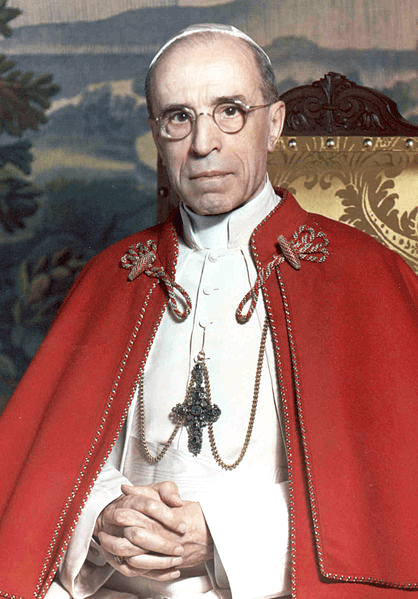
Venerable Pope Pius XII (r. 1939-1958) [public domain / Wikimedia Commons]

***
(1-27-12)
***
[from a Facebook discussion. My opponent‘s words will be in blue ]
* * * * *
Yet it always hinges on “interpretation” – the keys to Peter is scripturally clear . . . the passing of those keys as an “office” in perpetuity is an interpretation based on human thought rather than scripture . . . perhaps not unreasonable thought, but nevertheless not scriptural.
*
It is not explicitly scriptural (passing on of the office), but it doesn’t have to be. I would argue that it is common sense and straightforward deduction from other passages in the Bible about offices and succession. Peter is constantly portrayed in the Bible as the leader of the apostles.
There is a succession of Church offices: they are said to be perpetual in the Church. Judas defects and they choose Matthias to continue his function. Paul appears to pass on his office to Timothy (2 Tim 4:1-6).
Now, if Peter is given these keys, and it has the meaning as suggested by all these commentators in my paper, then it is simply common sense to assume that this was intended to be a permanent office in the Church. You could argue that this lone office of all offices discussed in Scripture was strictly temporary: confined to Peter alone, but I don’t think it makes any sense. Why would there be a leader of the Church for Peter’s lifetime only, and then there is to be no leader for all of the rest of history? I made a more extensive argument for papal succession elsewhere.
The only problem with assuming “common sense’ in application of revealed realities is that common sense doesn’t always fit or apply: for example, the true presence in the Holy Eucharist – it defies and even seems in opposition to “common sense” yet is the reality . . . it required divine revelation to know this . . . so one can’t rely on common sense as always having validity in things of Jesus. :)
I don’t think that objection works because the Eucharist is an acknowledged mystery that goes beyond reason (without contradicting it). The papacy is an office, and not a mystery in terms of not being able to fully be rationally understood. It takes faith to believe in the office, just like anything else in the Bible, but common sense applies to how the office was to be “worked out” through history. People often reject the papacy not because it isn’t understood, but because it is understood and they don’t like the notion of being in submission to a final authority in matters of faith.
It’s like the scenario in John 6: some disciples thought it was too difficult to accept Real, Substantial, Bodily Presence and so they split. They didn’t simply misunderstand it; they rejected it. They lacked faith in Jesus; no longer totally trusted Him.
If you disagree with my rationale for common sense as an argument in favor of papal succession, then by all means try to overthrow my reasoning. Simply saying that the Eucharist is a mystery sidesteps the point and is not a sufficient analogy, I humbly submit. We see succession in several ways in Scripture. The only thing that remains is to determine if and how that also applies to the papal office.
How the Christians worked it out through history certainly suggests that they thought the papacy was a perpetual office.
Dave, I never said that your thoughts about the succession of the office was unreasonable . . . nor illogical . . . just that it isn’t scripture mandate, but a human application within the context of the “human aspect of the Church” rather than Divine directives. nothing wrong with that . . . just not an absolute based on Divine teaching.*
Why do you require that it has to be explicitly scriptural in the first place? It does not. To require such a thing is pure Protestant sola Scriptura reasoning (itself massively unbiblical and unreasonable) What is it in my reasoning that is implausible as an interpretation of the scriptural data we do have?
It’s not a merely human mandate if it is the perpetuation of an office divinely established (Matthew 16), by analogy to the perpetuation of all other offices in Scripture. I’m asking why anyone would make a special case for the papacy and assume it is to cease, while all other offices continue?
One either believes that God established the office of the papacy to lead the Church at all times or not. Many lack the faith to believe that; they disbelieve in that dogma of the Church: based on the biblical data. If someone disbelieves it, I think they run into many serious problems in the Bible itself: some of which I am briefly enumerating here.
This is, of course, also one of the Orthodox arguments that are made: the papacy was a mere human happenstance rather than a divinely mandated office: intended by God to be perpetual. I don’t buy it. I think it fails to take into account many considerations such as the cross-referencing in my post above.
The Divine bestowal of the office says explicitly: you are Peter! . . . Jesus does not add, “and your successors as well” . . . my only point is that one must always distinguish between what is explicitly from Jesus and what is not . . . always dangerous to confuse the two.*
It is implicit in Scripture by massive analogy. You have to take into account the analogy of Scripture with regard to other offices.
What do you personally believe? Was the papacy instituted by God or not? If not, you deny Matthew 16.
If you say it was established by God in Matthew 16 and Jesus’ commissioning of Peter, but it was not perpetual (because you don’t find that to be plausible based on lack of explicit Scripture: which is a Protestant methodology), you have to explain the seeming absurdity of God establishing a Church office, only to have it die an early death with the death of Peter. That makes no sense to me at all.
If it makes sense to anyone, I’d like to understand how they conceptualize such a thing in their heads, given what we see in the Bible. I have always found the anti-papal arguments based on the Bible rather weak and inexplicable and desperate.
I don’t argue against the papacy . . . I simply observe that taking the office beyond Peter is a human reasoning within the institution . . . one that is not unreasonable . . . yet also one not able to show a direct teaching of it by Jesus . . . that’s all I point out . . . it is more than open to evolution, change and even devolution as it has been such since the death of Peter . . . who knows where it will go in the future for the sake of ecumenical inter-communion . . . most relevant in these days where secular/social culture is anti-all-religion.
As an example of analogical argument, it was argued in the paper above by many Protestant commentators, that Jesus was hearkening back to the earlier office of prime minister to the king. That office did indeed have succession.
In effect, then, it would be like saying, “I am establishing, with you as the first office-holder, an office that is akin to the monarchy of England.”
In American culture, we know what the English monarchy is, and was, and that it is an office of succession. That is understood in the very notion of the thing. Likewise, the Jews understood His reference to the keys, because it was a thing in their own Scripture, that they were familiar with.
If the direct analogy understood in the commission refers to an office itself inherently possessing succession, as a matter of historical fact, then it follows straightforwardly that the analogical office presently being established is also one of succession. That’s not even just common sense (there are two distinct arguments to be made here). It is purely logical and based on facts concerning the thing that is the basis of the analogy.
And in that sense it is even strictly explicit in Scripture. Only the analogy is not explicit, but it is very clear and strong, which is why all these commentators are all talking about it, as the “key” to understand the passage in the context of its ancient Hebrew / OT background (pun intended).
I have just shown, I think, that it indeed was a “direct teaching of Jesus” by a compelling inescapable analogy to what he was referring to in the OT office that was the keyholder. So I disagree with you about the fact of it.
You seem to not grasp how analogical, scriptural cross-reference / exegetical reasoning applies in this case, because you keep sidestepping my various biblical arguments.
All I’m doing (ironically) is following the reasoning of the Protestant scholars. Obviously they have no stake in the papacy. They are just calling it as they see it, as Bible commentators and exegetes. That’s why the argument is so strong, because it’s not based on Catholic dogma; it’s based on Protestant biblical exegesis: sort of a “hostile witness” scenario.
Again, it is a human assumption/interpretation that Jesus was hearkening back to the earlier office of prime minister to king . . . again, a human understanding and possibly then a misunderstanding. my point again is to not confuse the human thinking with Divine. Catholic human thinking / Protestant human thinking . . . still not divine mandate.*
I leave my reasoning to other readers who will see what I’m arguing (and accept it), I think.
Dave . . . the reality is I am not arguing against the papacy at all. :)
Right. You simply redefine it. I know the game well . . .
Dave, the papacy has been re-defined often in its 2000 year history . . . and not by “me” . . . but even by Rome itself.
*
. . . in the sense of consistent development of dogma, not inconsistent evolution of dogmas (that you referred to), which has been condemned by the Church.
Clearly it is something very different from what it was at the time of Saint Peter. It definitely evolved . . .
*
It developed, with complete consistency; two completely different things. Evolution of dogma was condemned by the Church. Pope St. Pius X commended Newman’s view of development at the same time he condemned evolution of dogma. I had a whole debate about it with an anti-Catholic Calvinist, who claimed that the two views are identical. Wrong!
Yeah; it’s different: in the way an oak tree is different from an acorn, or you and I are different from what we were one minute after we were conceived.
David, what you say about its “development: is pure human rationalization . . . nothing divine about it . . . the world developed and the structure of the papacy and the church has more in common with the Roman Empire of the caesars than scriptural schematic . . . what you say is true: the papacy was redefined and changed from what it originally was with Peter. Just a as a final “p.s.” note; according to Vatican I – the authority of The Pope rests in himself and is not able to be delegated – yet it is delegated universally across the entire Catholic Church . . . so quite a change even from the Vatican Council which defined the papacy. anyway . . you are free to understand or misunderstand it as you see it to be . . . have a great night.
*
Nothing essential in the papacy is changed at all. Vatican II: Lumen Gentium, III, 22 states:
But the college or body of bishops has no authority unless it is understood together with the Roman Pontiff, the successor of Peter as its head. The pope’s power of primacy over all, both pastors and faithful, remains whole and intact. In virtue of his office, that is as Vicar of Christ and pastor of the whole Church, the Roman Pontiff has full, supreme and universal power over the Church. And he is always free to exercise this power. The order of bishops, which succeeds to the college of apostles and gives this apostolic body continued existence, is also the subject of supreme and full power over the universal Church, provided we understand this body together with its head the Roman Pontiff and never without this head. This power can be exercised only with the consent of the Roman Pontiff. For our Lord placed Simon alone as the rock and the bearer of the keys of the Church, and made him shepherd of the whole flock; . . .
And in III, 25:
And this infallibility with which the Divine Redeemer willed His Church to be endowed in defining doctrine of faith and morals, extends as far as the deposit of Revelation extends, which must be religiously guarded and faithfully expounded. And this is the infallibility which the Roman Pontiff, the head of the college of bishops, enjoys in virtue of his office, when, as the supreme shepherd and teacher of all the faithful, who confirms his brethren in their faith, by a definitive act he proclaims a doctrine of faith or morals. And therefore his definitions, of themselves, and not from the consent of the Church, are justly styled irreformable, since they are pronounced with the assistance of the Holy Spirit, promised to him in blessed Peter, and therefore they need no approval of others, nor do they allow an appeal to any other judgment. For then the Roman Pontiff is not pronouncing judgment as a private person, but as the supreme teacher of the universal Church, in whom the charism of infallibility of the Church itself is individually present, he is expounding or defending a doctrine of Catholic faith.
The pope works together with bishops and Councils; of course; but He is the supreme head in a way in which they are not. “. . . therefore his definitions, of themselves, and not from the consent of the Church, are justly styled irreformable . . .”
It’s the same old conciliarist claptrap: to try to deny this and pretend that the Council or a vote of bishops is on a par with the pope. They are not. Vatican II is completely consistent with Vatican I: it merely developed the role of the Council and the layperson more. Both are consistent with Trent; and all three councils with the Bible.
Development of doctrine is a completely biblical concept, as I have demonstrated in many papers (one / two / three).
Just always remember to distinguish between his “infallibility” in dogmatic proclamations and his “authority” – two separate things altogether . . . dogmatic proclamations are so rare . . . yet the exercise of ‘authority’ which is in his person is applied daily . . . yet by delegation, which is in itself not true papal authority.*
So the pope delegates; so what? That is no disproof of his supreme authority at all, since God Himself delegates. Jesus delegated His apostles to represent Him directly. Does that mean He had less authority in so doing? Nope. “He who receives you receives me” (Matt 10:40; cf. Jn 13:20). “He that hears you hears me” (Lk 10:16). “. . . we are ambassadors for Christ . . .” (2 Cor 5:20).
But it does matter . . . for his authority to remain: “papal authority”; it cannot be delegated . . . it rests in his person . He must be present where he exercises it . . . can’t be in Rome exercising authority in New York. That’s not my version of it. That is Vatican I. But that might limit him so, Vatican I is ignored except for the part that states his infallibility and authority. I find that interesting in the ‘evolution’ of the papacy.
*
That’s not true, Michael. Historically, papal legates were at most ecumenical councils. The pope need not be present to have authority. He has it by virtue of being pope. Period. This is neither inconsistent with Vatican I or II nor the historic Church all the way back to Nicaea.
Now you are not debating “me” but Vatican I’s definition of papal authority. So take it up with those long deceased council fathers and pope.
Sheer nonsense. I have backed up everything I have said, with Scripture, reason, and Church documents. But you keep giving simply your own opinion backed up by nothing. Readers may decide where the truth lies.
Sheer nonsense is what you are proffering . . . I simply stated Vat. I teaching on Papal authority . . . you do not accept it . . . and I agree it is largely ignored by even the pope. It is not my opinion . . . it is simply the way it is. The institutional structure rests more on the old Roman Empire and emperor than on Jesus . . . I am not implying that the gospel does, but the ecclesial structure does . . . but as I said, you can see it as you wish to.
I may indeed. And I see it as an orthodox, faithful Catholic, who accepts all that the Church teaches me, and who wishes to think with the Mind of the Church rather than cultural happenstance or the fashionable finger-in-the-wind zeitgeist.
I have no dispute with that. I am an Orthodox believer myself . . . I just comment on the human aspects and gravitate toward the Christ ones more . . .
You are Eastern Orthodox?
[no reply]
***
Previous Post
January 14, 2016
Defending Mary (Revelation 12 and Her Assumption)
Next Post
January 14, 2016 Orthodox & Catholic Ecclesiology: Possible Synthesis?
Browse Our Archives
Select a Category & Last Things About Me Anti-Catholicism Atheism & Agnosticism Baptism and Sacramentalism Bible and Tradition Blessed Virgin Mary Books by Dave Armstrong C. S. Lewis Calvinism & General Protestantism Catholic Apologetics Catholic Apologists Catholic conversion Catholic converts Christmas Church (Ecclesiology) Church History Conversion and Converts Development of Doctrine Eastern Orthodoxy Ecumenism & Christian Unity Eucharist & Liturgy Fathers of the Church French Translations G. K. Chesterton Hell Hell & Satan Hell & Satan & Last Things Heresies & Comparative Religion Holistic Health Inquisition & Crusades & Scandals James White Jews & Judaism & Old Testament John Calvin John Henry Newman Liberal / Modernist Theology Life Issues Literary Resume Lutheranism Mariology Martin Luther Music Orthodoxy Papacy & Infallibility Personal Page Philosophy & Science Political & Ethical & Moral Issues Protestant Persecution & Intolerance Protestantism Purgatory Purgatory & Penance Romantic & Imaginative Theology Saints & Purgatory & Penance Salvation Salvation & Justification Satan & Last Things Sexuality and Gender Issues Spanish Translations Traditionalism vs. Radical Catholic Reactionaries Traducciones al español / tradução para português Trinitarianism & Christology Uncategorized Videos
Select a Month October 2026 September 2026 August 2026 July 2026 June 2026 May 2026 April 2026 March 2026 February 2026 January 2026 December 2025 November 2025 October 2025 September 2025 August 2025 July 2025 June 2025 May 2025 April 2025 March 2025 February 2025 January 2025 December 2024 November 2024 October 2024 September 2024 August 2024 July 2024 June 2024 May 2024 April 2024 March 2024 February 2024 January 2024 December 2023 November 2023 October 2023 September 2023 August 2023 July 2023 June 2023 May 2023 April 2023 March 2023 February 2023 January 2023 December 2022 November 2022 October 2022 September 2022 August 2022 July 2022 June 2022 May 2022 April 2022 March 2022 February 2022 January 2022 December 2021 November 2021 October 2021 September 2021 August 2021 July 2021 June 2021 May 2021 April 2021 March 2021 February 2021 January 2021 December 2020 November 2020 October 2020 September 2020 August 2020 July 2020 June 2020 May 2020 April 2020 March 2020 February 2020 January 2020 December 2019 November 2019 October 2019 September 2019 August 2019 July 2019 June 2019 May 2019 April 2019 March 2019 February 2019 January 2019 December 2018 November 2018 October 2018 September 2018 August 2018 July 2018 June 2018 May 2018 April 2018 March 2018 February 2018 January 2018 December 2017 November 2017 October 2017 September 2017 August 2017 July 2017 June 2017 May 2017 April 2017 March 2017 February 2017 January 2017 December 2016 November 2016 October 2016 September 2016 August 2016 July 2016 June 2016 May 2016 April 2016 March 2016 February 2016 January 2016 December 2015 November 2015 October 2015 September 2015 August 2015 July 2015 June 2015 May 2015 April 2015 March 2015 February 2015 January 2015 December 2014 November 2014 October 2014 September 2014 August 2014 July 2014 June 2014 April 2014 March 2014 February 2014 January 2014 December 2013 November 2013 October 2013 September 2013 August 2013 July 2013 June 2013 April 2013 March 2013 February 2013 January 2013 December 2012 November 2012 October 2012 September 2012 August 2012 July 2012 June 2012 May 2012 April 2012 March 2012 February 2012 January 2012 December 2011 November 2011 October 2011 September 2011 August 2011 July 2011 June 2011 April 2011 March 2011 February 2011 October 2010 September 2010 August 2010 July 2010 April 2010 March 2010 December 2009 October 2009 August 2009 July 2009 June 2009 May 2009 March 2009 February 2009 October 2008 September 2008 April 2008 March 2008 February 2008 January 2008 December 2007 November 2007 October 2007 May 2007 March 2007 February 2007 January 2007 November 2006 October 2006 September 2006 August 2006 July 2006 June 2006 May 2006 April 2006 March 2006 February 2006 October 2005 June 2005 April 2005 February 2005 July 2004 May 2004 April 2004
Follow Us!
TAKE THE
Religious Wisdom Quiz
Who fell out of a window and was restored to life by Paul?
Select your answer to see how you score.
Silas Barnabas Eutychus Timothy
Books by This Author Books by Dave Armstrong
Related posts from Biblical Evidence for Catholicism

Was Peter "Any Old" Apostle? 10 Anti-Papal Arguments
Biblical Evidence for Catholicism

Jesus Founded the [Catholic] Church. If Not Him,...
Biblical Evidence for Catholicism

11 Protestant Objections to Papal Authority Debunked
Biblical Evidence for Catholicism

Matthew 16 & the Papacy (vs. Patrick O'Brien)
Biblical Evidence for Catholicism
TRENDING AT PATHEOS Catholic

In "Irreplaceable," our book on vocation and technology, Trevor Sutton and I...

I was strolling through the top floor of the brand new Parthenon...

What Does Gêvâh Mean For Kimberley Guifoyle &...
This week, a lot of the news is focused on Kimberly Guilfoyle....

INNER CIRCLE: Profound Mystery (Of Christ In All...
Ephesians 5:31-32 “For this reason, a man will leave his father and...

Do Not Rejoice When Your Enemy Falls: The...
Turning an execution into a public spectacle is a disturbing expression of...

'The Chosen' S6 Trailer: The Passion Gets Very...
Not many watching 'The Chosen' worry about spoilers, but just because they...
view all Catholic blogs
Ad-Free & Subscriber Log-In Subscription Support
- About Us
- 2026 Calendar
- Videos
- Podcasts
- Library of World Religions
- Faith In Media Tracker
- Advertise With Us
- Write for Us
- Privacy Policy
- Terms of Service
- Do Not Sell My Data
- Contact Us
- Radiant Digital
- Manage Newsletter Subscriptions
- Unsubscribe From Notifications
- Sitemap
Copyright 2008-2026, Patheos. All rights reserved.
Subscription Support Ad-Free & Subscriber Log-In
Follow Patheos