
BuddhistCatholicContemplativeEvangelicalGeneral ChristianHinduJewishLatter-day SaintMuslimNew VisionsProgressive Christian
Beliefs
- Buddhist
- Catholic
- Contemplative
- Evangelical
- General Christian
- Hindu
- Jewish
- Latter-day Saint
- More Voices
- Muslim
- New Visions
- Pagan
- Progressive Christian
Topics
- Religion News
- Food and Religion
- Sports and Religion
- Religious Art
- Religious Music and Entertainment
- Religious Events
- History and Religion
- Style and Religion
- Politics and Religion
- Women in Religion
- Recreation Outdoors and Religion
- Business Finance and Religion
- Careers Workplace and Religion
- Education and Religion
- Family Parenting and Religion
- Health Fitness and Religion
- Home and Religion
- Relationships and Religion
- Technology and Religion
- Travel and Religion
Columnists
- Buddhist Columnists
- Business Finance and Religion Columnists
- Careers Workplace and Religion Columnists
- Catholic Columnists
- Contemplative Columnists
- Education and Religion Columnists
- Evangelists Columnists
- Family Parenting and Religion Columnists
- General Christian Columnists
- Health Fitness and Religion Columnists
- Hindu Columnists
- History and Religion Columnists
- Home and Religion Columnists
- Jewish Columnists
- More Voices Columnists
- Latter Day Columnists
- Muslim Columnists
- New Visions Columnists
- Nonreligious Columnists
- Pagan Columnists
- Politics and Religion Columnists
- Progressive Columnists
- Recreation Outdoors and Religion Columnists
- Relationships and Religion Columnists
- Religion News Columnists
- Religious Art Columnists
- Religious Events Columnists
- Religious Music and Entertainment Columnists
- Sports and Religion Columnists
- Style and Religion Columnists
- Technology and Religion Columnists
- Travel and Religion Columnists
- Women in Religion Columnists
Resource Library
- 2026 Calendar
- Library of World Religions
- The 100 Most Holy Places on Earth
- Patheos Answers
- Podcasts
- Videos
- Faith Leaders Database
- Anglican Episcopalian
- Bahai
- Baptist
- Buddhism
- Christianity
- Confucianism
- Eastern Orthodoxy
- Hinduism
- Holiness and Pentecostal
- ISKCON
- Islam
- Judaism
- Lutheran
- Methodist
- The Church of Jesus Christ of Latter-day Saints
- New Age
- Paganism
- Presbytarian and Reformed
- Protestantism
- Religion Behind the Scenes
- Roman Catholic
- Scientology
- Shia Islam
- Sikhism
- Sufism
- Sunni Islam
- Taoism
- Zen
- See all religions
Research Tools
 Ad-Free & Subscriber Log-In Subscription Support
Ad-Free & Subscriber Log-In Subscription Support
Follow Patheos 

- Trending:
- Forgiveness
- |
- Marriage
- |
- Consciousness
- |
- Death Penalty
- |
- Election
- |
- Halloween

-
About
-
Catholic Apologetics
-
Church History
-
Great Apologists
-
Christian Worldview
-
Protestantism & Misc.
- Home
- Catholic
- History and Religion
- Orthodox & Catholic Ecclesiology: Possible Synthesis?
Orthodox & Catholic Ecclesiology: Possible Synthesis?
Last updated on: March 29, 2017 at 2:55 pm by Dave Armstrong
Orthodox & Catholic Ecclesiology: Possible Synthesis? 2017-03-29T14:55:07-04:00 Dave Armstrong
Patheos Explore the world's faith through different perspectives on religion and spirituality! Patheos has the views of the prevalent religions and spiritualities of the world.
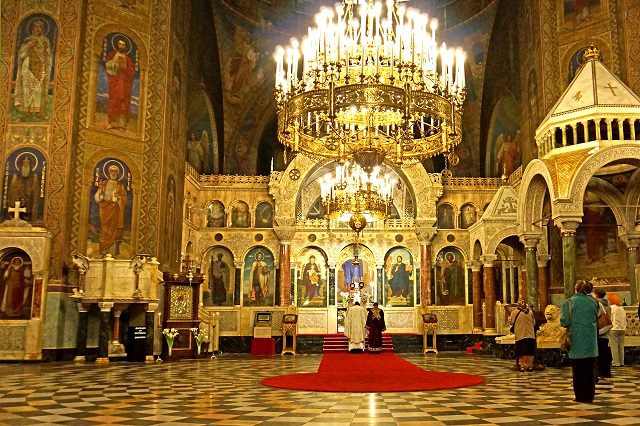
St. Alexander Nevsky Cathedral, Bulgaria. Photo by Dennis Jarvis, 13 June 2013 [Flickr / CC BY-SA 2.0 license]
(11-23-11)
* * *
Some Orthodox Christians have proposed something like the following scenario for a healing of the breach between Orthodoxy and Catholicism:
Bishops ought to do nothing of consequence without the consent of the pope.
The pope cannot do anything of momentous significance without the consent of the consensus of the bishops and the totality of the Church.
If the pope, however, can only do what is consented to by the council or the whole body of the faithful, in all particulars, then the group truly sets the standard and that is pure conciliarism (because the pope has no more authority than the collective), which has been condemned as heresy by the Catholic Church. He would merely become one bishop among many, with little or nothing distinguishing him in authority. If there is no real distinction in power and jurisdiction (mere “primacy of honor” logically reduces to that, in my opinion), then this is Orthodoxy, and hardly a compromise “solution.”
The group doing what the pope consents to sounds more “Catholic” to me, so I have little problem with #1; it is #2 that I think runs into problems. Making #1 and #2 equal in application simply reduces to conciliarism / Gallicanism, in which case our ecclesiology is hardly distinguishable from Orthodox ecclesiology (not to mention, contrary to Vatican I and II).
In practice, of course, both are usually held together, and there need not be mutual hostility or competition at all, but there is still theoretically, or dogmatically, at least, papal headship or supremacy, in which the pope can act alone. I would contend that this occurred, e.g., with Humanae Vitae in 1968 (which is an infallible document, far as I can determine), though that didn’t involve a council.
Virtually all of the pope’s advisers (if not all) argued against the continuing ban on contraception, but that was false to the history of Catholic teaching (reiterated in 1931), so the pope acted on his own and reinforced it. If he had to agree with that group, let alone a council, then evil may have been promulgated as good, as in Anglicanism after 1930, in virtually all other Protestant groups, and increasingly in practice (to my great distress), even in Orthodoxy.
This is one of the three main reasons I am Catholic rather than Orthodox. I wanted the morality of the Apostles and early Church, and since the Orthodox were compromising on contraception (e.g., three successive editions of Metr. Kallistos Ware’s book, The Orthodox Church have increasingly weaker statements on it), I concluded that Orthodoxy was non-apostolic in that regard, and there was no question of joining them, since that issue was the first major issue in which I changed my mind.
I would say that the solution to the different conceptions of the relationship of pope and Church is for the Orthodox to grant the pope dogmatic singularity and supremacy, with the pope, for his part, making every effort to act directly in concert with councils and bishops, with the understanding that he voluntarily does so but is not duty-bound or required to do so, at least in some cases.
We know, e.g., that there were great inquiries sent out to bishops before the definitions of the Immaculate Conception and Assumption, so they were by no means isolated papal decisions.
A Catholic can never say that the pope does not have supremacy in some sense. If all he can do is agree with councils and bishops and be a mere figurehead (sort of like the Queen of England, with all the “Byzantine” pomp and circumstance), that is not Catholicism; it is Orthodoxy; in which case it is no compromise at all. I wouldn’t expect ecumenical Orthodox to disregard all of our distinctives anymore than I would want to neglect their biggest concerns.
My proposal basically boils down to the day-to-day function and practice of the pope being essentially in accord with Orthodox conceptions, with the principle of the thing (supremacy, papal infallibility) being more “Catholic.” If the pope has no final say in some real, concrete sense (as he did in the first millennium, in many instances), he is not a pope.
I think my proposal for how a reunited papacy would work is quite ecumenical and respectful of Orthodox concerns (I believe it is a true compromise), and in line with what I have read from Blessed Pope John Paul II. It was just off the top of my head, too. I’m sure I could hone and refine it further upon more reflection.
I agree totally with “the law of love” in how the papacy operates and “gives orders,” and I think the present Holy Father and his Blessed predecessor followed that to an extraordinary degree. I oppose all strong-arm tactics of any sort and am in favor of “subsidiarity” economically, politically, and ecclesiastically. In fact, I detest all “Church politics” so much that I have very little to do with it.
Accordingly, I was in favor of freedom of all Catholics to worship at a Tridentine Mass if they so chose, long before this was decreed by Pope Benedict XVI. I’ve attended a (historically German) parish that has always offered a Latin Mass: never stopped (Novus Ordo and sometimes Tridentine). We were the only cluster in the Detroit archdiocese that did so, when it was rare, and there are still very few even now, after it has been allowed. I think freedom of rite and custom is crucial to preserve, provided it is all orthodox.
The fact remains that without the papacy (as we conceive it), the East (by Newman’s reasoning) would have likely gone into complete heresy in the first Millennium. As it was, the East was rife with Monophysitism and Monothelitism (and also to a lesser extent, Nestorianism) for many centuries: infiltrating the patriarchates in alarming proportion (and we see a clear example of that in 449).
Some argue that the proliferation of those heresies and also rampant iconoclasm, led directly to so many large regions falling rapidly to Islam. The road was paved with these heresies.
The East was in schism five times before 1054, as I have noted, and in all five instances (in the judgment of both sides) they were on the wrong side. Rome was right every time, with regard to these five schisms. I think that speaks volumes. Rome determines orthodoxy. History plainly reveals this. The five schisms are:
The Arian schisms (343-98)
The controversy over St. John Chrysostom (404-415)
The Acacian schism (484-519)
Concerning Monothelitism (640-681)
Concerning Iconoclasm (726-87 and 815-43)
This adds up to 231 out of 500 years in schism: out of communion with Rome (46% of the time). Orthodox agree that all five of these schisms were in error, according to present Orthodox teaching. The Orthodox eventually rejected Arianism and Monothelitism and Iconoclasm. They think St. John Chrysostom is a good guy (Rome defended him then, just as with St. Athanasius). The Acacian schism had to do with Monophysitism.
Orthodoxy is not under the pope now. That changed in the eleventh century. The very fact that the more ecumenical Orthodox see it as preferable to somehow be back in communion with the pope, itself proves that Orthodoxy has lost a key proponent of historic Catholic Christianity. Otherwise, Orthodoxy would be complete in itself, and in need of no component from another Christian communion, as we view ourselves to be. Orthodoxy wouldn’t need “our” pope; it would already have one of its own, or deny that it needs one at all (even in the lesser Orthodox sense). But that is not possible in Orthodoxy because of competing jurisdictions.
People who know much more about the situation than I do tell me there are many Eastern Catholics (as opposed to Eastern Orthodox) who are dissidents on the question of papal supremacy, headship, and infallibility. Whether an Eastern Catholic chooses to abide by this or not is their choice. This is the problem in the Catholic Church as a whole: cafeteria, pick-and-choose Catholics. If a Catholic doesn’t like some Catholic dogmas, then to be honest, he should not be a Catholic, because he or she is not in full obedience on that point. That doesn’t change the fact of what we teach. They would then simply be “Catholics” who are really Orthodox at heart. What else is new? Lots of folks don’t consistently follow their own ostensible affiliation. Yet the 1990 Eastern Code of Canons states:
Canon 44 – §1. The Roman Pontiff obtains full and supreme power in the Church by means of legitimate election accepted by him together with episcopal consecration; . . .
Canon 45 – §1. The Roman Pontiff, by virtue of his office (munus), not only has power over the entire Church but also possesses a primacy of ordinary power over all the eparchies and groupings of them by which the proper, ordinary and immediate power which bishops possess in the eparchy entrusted to their care is both strengthened and safeguarded.
§2. The Roman Pontiff, in fulfilling the office (munus) of the supreme pastor of the Church is always united in communion with the other bishops and with the entire Church; however, he has the right, according to the needs of the Church, to determine the manner, either personal or collegial, of exercising this function.
§3. There is neither appeal nor recourse against a sentence or decree of the Roman Pontiff.
A lot of the problems in the Catholic Church (even including very much the sex scandal) came about (I dare say) due to spineless bishops who have been lax in their duty (just as in the Arian crisis and other scandals and low points in the history of the Church). Many bishops followed the model of apostate (or at least wimpish, ineffectual) priests that the prophets were constantly complaining about in the Old Testament. Modernism and liturgical mediocrity or corruption flourishes in many parishes because of this.
But (I would contend) papal encyclicals and acts have been the big force for a reform of both liturgy and orthodoxy. It is Rome that disciplines dissidents, and has provided strong leadership (the Catechism; many superb encyclicals). Thus, it seems to me that the “top-down” model works better for preserving orthodoxy and good morals (e.g., Humanae Vitae again).
In Orthodoxy, in large part because of no such central authority and final say, something like contraception now increasingly takes hold, even though the Orthodox traditionally opposed it as a grave sin, just as we continue to do. The difference? We had a pope who spoke out strongly on the matter in 1968, and it is infallible moral teaching that won’t change.
Orthodox argue that Pope St. Leo the Great in the Council of Chalcedon in 451 did not “rule” or have the final say, but rather, that his Tome was deliberated upon and then ratified by the assembly. I heard Metr. Kallistos Ware make this argument in a lecture in Detroit.
Granting that description, this would be, in my view, an instance of the papacy being at an earlier stage of development. It was still developing at this relatively early date. Christianity had only been legal for 138 years. This accounted in large part for a slow earlier development of the papacy, as Cardinal Newman argued.
Even Christology had much more development to go through at that time. The canon of the Bible had only been established for two generations. Mariology was still developing quite a bit, and also the doctrine of the saints. The iconoclasm issue (tying into communion of saints and the incarnation) was not resolved till several centuries after that.
So it is not unusual to hold, as I do, that the doctrine (and operation and function) of the papacy was also developing, which is why infallibility was not declared till 1870. Orthodox will rail against Vatican I but they can’t deny that it was the result of a very slow development that took 18 centuries. Hence, if that developed slowly, all the more would we expect a much more primitive papacy in 451, which is very early. At that point things were relatively more “conciliarist” — though, I suspect, not as much as what Orthodox think, judging from very strong papal statements I have read in Pope St. Leo the Great (some of which seem to go even further than Pope St. Gregory the Great 150 years later).
Now, some Orthodox I have debated will argue that it is development of doctrine that is the bugaboo and where Rome went so wrong. I think that is nonsense (sorry for my overly subtle terminology). In my book on Orthodoxy, I argued that Orthodoxy has developments, too, just as Catholicism does. Here is a portion of what I wrote:
Orthodox often seem to disparage development of doctrine, or argue that Orthodox development (insofar as it occurs at all) is essentially different from Catholic development. As an example, let us consider hesychasm. One can trace it back in kernel form to St. Gregory Nyssa, St. Basil the Great, or Origen, yet it was not fully developed until St. Gregory Palamas (1296-1359). So this seems to me to also be a “development of a category” (a type of prayer and devotion, and — especially — the corresponding theology), since it has to do with the nature and essence of God, and a distinction between essence and energy. As such, it is hardly distinguishable (philosophically speaking) from similar refinements of category such as the homoousios, Theotokos, transubstantiation, or procession within the Godhead.
It was not formally adopted (relating it to the Divine Energies and Uncreated Light), until the Councils of Constantinople in 1341, 1347, and 1351, when it then became, according to the Oxford Dictionary of the Christian Church, “an accepted part of Orthodox tradition.” I don’t see how this is any different (chronologically or essentially) from, for example, Catholic developments of transubstantiation or the Immaculate Conception (both fully developed one or two hundred years before hesychasm was) [or the papacy]. Can Orthodox claim that hesychasm and related concepts existed in their developed form all the way back to the early centuries of the Church? I think not.
Papal infallibility cannot be rolled back. It is a de fide dogma. By its very nature it is permanent. How the inherent power is exercised, however, can be discussed, and has been in high-level talks. And this is how Vatican II complemented Vatican I. Once papal infallibility was established once and for all and “out of the way,” then the road was set for a fuller development of a still-supreme pope working more directly in concert with councils and bishops.
Vatican II gave the strongest statement of conciliar infallibility in the history of he Church: but it is conciliar infallibility in cooperation (always) with the pope, and with his approval, which is what sets it apart from orthodox conciliarism. That’s why the papal decree came first, then more development on conciliar ecclesiology.
I believe in papal ecclesiology because I think it is also modeled in the Bible, on Petrine primacy. Peter had prerogatives that no one else had, or had only in concert: exactly as in our ecclesiology. Peter was the leader, whereas in Orthodoxy, Peter, John, James, and Paul or some such would all be leaders, with no one having final say in cases of disagreement, leading to separate jurisdictions (and sometimes, historically, heresy as a result).
The Jerusalem Council worked the same way. St. Peter’s words seem to have been decisive, and he acted as Leo the Great did in 451. St. James also played a key role, being the resident bishop. It had final authority. St. Paul went around declaring its binding decrees (Acts 16:4).
We are operating the same way the early Church did: just more developed. We still have popes; we still have councils. Orthodoxy has no popes and rarely holds councils; certainly not ecumenical ones, as they were in the first millennium and after, in terms of drawing from bishops all over the world.
But there were several mostly Eastern ecumenical councils then, too, so even if some of ours in the last 1000 years were mostly Western (that would be part of the Orthodox critique), that would be no different in essence from the early mostly Eastern ones: just “balancing the score a bit.”
***
Previous Post
January 14, 2016
Papal Succession and the Bible: An Exchange
Next Post
January 14, 2016 Dialogue with a Lutheran on Ecclesiology & OT Indefectibility Analogies
Browse Our Archives
Select a Category & Last Things About Me Anti-Catholicism Atheism & Agnosticism Baptism and Sacramentalism Bible and Tradition Blessed Virgin Mary Books by Dave Armstrong C. S. Lewis Calvinism & General Protestantism Catholic Apologetics Catholic Apologists Catholic conversion Catholic converts Christmas Church (Ecclesiology) Church History Conversion and Converts Development of Doctrine Eastern Orthodoxy Ecumenism & Christian Unity Eucharist & Liturgy Fathers of the Church French Translations G. K. Chesterton Hell Hell & Satan Hell & Satan & Last Things Heresies & Comparative Religion Holistic Health Inquisition & Crusades & Scandals James White Jews & Judaism & Old Testament John Calvin John Henry Newman Liberal / Modernist Theology Life Issues Literary Resume Lutheranism Mariology Martin Luther Music Orthodoxy Papacy & Infallibility Personal Page Philosophy & Science Political & Ethical & Moral Issues Protestant Persecution & Intolerance Protestantism Purgatory Purgatory & Penance Romantic & Imaginative Theology Saints & Purgatory & Penance Salvation Salvation & Justification Satan & Last Things Sexuality and Gender Issues Spanish Translations Traditionalism vs. Radical Catholic Reactionaries Traducciones al español / tradução para português Trinitarianism & Christology Uncategorized Videos
Select a Month October 2026 September 2026 August 2026 July 2026 June 2026 May 2026 April 2026 March 2026 February 2026 January 2026 December 2025 November 2025 October 2025 September 2025 August 2025 July 2025 June 2025 May 2025 April 2025 March 2025 February 2025 January 2025 December 2024 November 2024 October 2024 September 2024 August 2024 July 2024 June 2024 May 2024 April 2024 March 2024 February 2024 January 2024 December 2023 November 2023 October 2023 September 2023 August 2023 July 2023 June 2023 May 2023 April 2023 March 2023 February 2023 January 2023 December 2022 November 2022 October 2022 September 2022 August 2022 July 2022 June 2022 May 2022 April 2022 March 2022 February 2022 January 2022 December 2021 November 2021 October 2021 September 2021 August 2021 July 2021 June 2021 May 2021 April 2021 March 2021 February 2021 January 2021 December 2020 November 2020 October 2020 September 2020 August 2020 July 2020 June 2020 May 2020 April 2020 March 2020 February 2020 January 2020 December 2019 November 2019 October 2019 September 2019 August 2019 July 2019 June 2019 May 2019 April 2019 March 2019 February 2019 January 2019 December 2018 November 2018 October 2018 September 2018 August 2018 July 2018 June 2018 May 2018 April 2018 March 2018 February 2018 January 2018 December 2017 November 2017 October 2017 September 2017 August 2017 July 2017 June 2017 May 2017 April 2017 March 2017 February 2017 January 2017 December 2016 November 2016 October 2016 September 2016 August 2016 July 2016 June 2016 May 2016 April 2016 March 2016 February 2016 January 2016 December 2015 November 2015 October 2015 September 2015 August 2015 July 2015 June 2015 May 2015 April 2015 March 2015 February 2015 January 2015 December 2014 November 2014 October 2014 September 2014 August 2014 July 2014 June 2014 April 2014 March 2014 February 2014 January 2014 December 2013 November 2013 October 2013 September 2013 August 2013 July 2013 June 2013 April 2013 March 2013 February 2013 January 2013 December 2012 November 2012 October 2012 September 2012 August 2012 July 2012 June 2012 May 2012 April 2012 March 2012 February 2012 January 2012 December 2011 November 2011 October 2011 September 2011 August 2011 July 2011 June 2011 April 2011 March 2011 February 2011 October 2010 September 2010 August 2010 July 2010 April 2010 March 2010 December 2009 October 2009 August 2009 July 2009 June 2009 May 2009 March 2009 February 2009 October 2008 September 2008 April 2008 March 2008 February 2008 January 2008 December 2007 November 2007 October 2007 May 2007 March 2007 February 2007 January 2007 November 2006 October 2006 September 2006 August 2006 July 2006 June 2006 May 2006 April 2006 March 2006 February 2006 October 2005 June 2005 April 2005 February 2005 July 2004 May 2004 April 2004
Follow Us!
TAKE THE
Religious Wisdom Quiz
Who was the tax collector who climbed a tree to see Jesus?
Select your answer to see how you score.
Zacchaeus Nicodemus Philip Matthew
Books by This Author Books by Dave Armstrong
Related posts from Biblical Evidence for Catholicism

Was Peter "Any Old" Apostle? 10 Anti-Papal Arguments
Biblical Evidence for Catholicism

Jesus Founded the [Catholic] Church. If Not Him,...
Biblical Evidence for Catholicism

Jerusalem Council vs. James White & Sola Scriptura
Biblical Evidence for Catholicism

11 Protestant Objections to Papal Authority Debunked
Biblical Evidence for Catholicism
TRENDING AT PATHEOS Catholic

Swimfan: Forgotten Aughts Pleasures
This is a recovery effort. In 2002, My Big Fat Greek Wedding...

Top Three Anti-Catholic Lies About Catholicism
This is my initial transcript for the video, "THE 3 WORST...

Pope Leo Celebrates Mass for Nurses & Docs...
I don't have any idea how he did it, but Pope Leo...

The Sermon on the Mount, Part I: Matthew...
The Sermon on the Mount, Part I (Matthew 4:12-5:12) St. Matthew moves...

What's up from Crossway: Reviewing some of their latest A few weeks...

Janie Learns the Way of the Cross: A...
Teaching children about Jesus' Passion can be challenging. Many parents and educators...
view all Catholic blogs
Ad-Free & Subscriber Log-In Subscription Support
- About Us
- 2026 Calendar
- Videos
- Podcasts
- Library of World Religions
- Faith In Media Tracker
- Advertise With Us
- Write for Us
- Privacy Policy
- Terms of Service
- Do Not Sell My Data
- Contact Us
- Radiant Digital
- Manage Newsletter Subscriptions
- Unsubscribe From Notifications
- Sitemap
Copyright 2008-2026, Patheos. All rights reserved.
Subscription Support Ad-Free & Subscriber Log-In
Follow Patheos