
BuddhistCatholicContemplativeEvangelicalGeneral ChristianHinduJewishLatter-day SaintMuslimNew VisionsProgressive Christian
Beliefs
- Buddhist
- Catholic
- Contemplative
- Evangelical
- General Christian
- Hindu
- Jewish
- Latter-day Saint
- More Voices
- Muslim
- New Visions
- Pagan
- Progressive Christian
Topics
- Religion News
- Food and Religion
- Sports and Religion
- Religious Art
- Religious Music and Entertainment
- Religious Events
- History and Religion
- Style and Religion
- Politics and Religion
- Women in Religion
- Recreation Outdoors and Religion
- Business Finance and Religion
- Careers Workplace and Religion
- Education and Religion
- Family Parenting and Religion
- Health Fitness and Religion
- Home and Religion
- Relationships and Religion
- Technology and Religion
- Travel and Religion
Columnists
- Buddhist Columnists
- Business Finance and Religion Columnists
- Careers Workplace and Religion Columnists
- Catholic Columnists
- Contemplative Columnists
- Education and Religion Columnists
- Evangelists Columnists
- Family Parenting and Religion Columnists
- General Christian Columnists
- Health Fitness and Religion Columnists
- Hindu Columnists
- History and Religion Columnists
- Home and Religion Columnists
- Jewish Columnists
- More Voices Columnists
- Latter Day Columnists
- Muslim Columnists
- New Visions Columnists
- Nonreligious Columnists
- Pagan Columnists
- Politics and Religion Columnists
- Progressive Columnists
- Recreation Outdoors and Religion Columnists
- Relationships and Religion Columnists
- Religion News Columnists
- Religious Art Columnists
- Religious Events Columnists
- Religious Music and Entertainment Columnists
- Sports and Religion Columnists
- Style and Religion Columnists
- Technology and Religion Columnists
- Travel and Religion Columnists
- Women in Religion Columnists
Resource Library
- 2026 Calendar
- Library of World Religions
- The 100 Most Holy Places on Earth
- Patheos Answers
- Podcasts
- Videos
- Faith Leaders Database
- Anglican Episcopalian
- Bahai
- Baptist
- Buddhism
- Christianity
- Confucianism
- Eastern Orthodoxy
- Hinduism
- Holiness and Pentecostal
- ISKCON
- Islam
- Judaism
- Lutheran
- Methodist
- The Church of Jesus Christ of Latter-day Saints
- New Age
- Paganism
- Presbytarian and Reformed
- Protestantism
- Religion Behind the Scenes
- Roman Catholic
- Scientology
- Shia Islam
- Sikhism
- Sufism
- Sunni Islam
- Taoism
- Zen
- See all religions
Research Tools
 Ad-Free & Subscriber Log-In Subscription Support
Ad-Free & Subscriber Log-In Subscription Support
Follow Patheos 

- Trending:
- Forgiveness
- |
- Marriage
- |
- Consciousness
- |
- Death Penalty
- |
- Election
- |
- Halloween

-
About
-
Catholic Apologetics
-
Church History
-
Great Apologists
-
Christian Worldview
-
Protestantism & Misc.
- Home
- Catholic
- History and Religion
- Mary’s Immaculate Conception: A Biblical Argument
Mary’s Immaculate Conception: A Biblical Argument
Last updated on: June 6, 2026 at 12:29 am by Dave Armstrong
Mary’s Immaculate Conception: A Biblical Argument 2026-06-06T00:29:32-04:00 Dave Armstrong
Patheos Explore the world's faith through different perspectives on religion and spirituality! Patheos has the views of the prevalent religions and spiritualities of the world.
. . . from Analogy and Plausibility
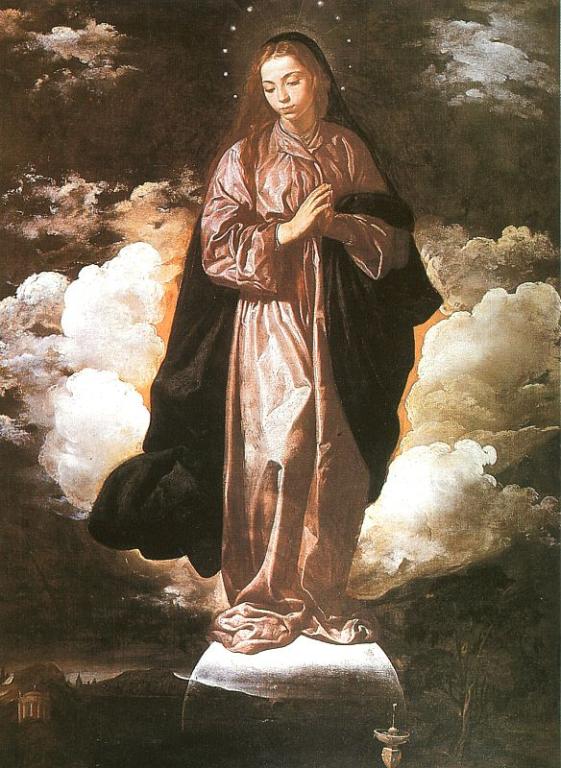
Immaculate Conception (c. 1618), by Diego Velázquez (1599–1660) [public domain / Wikimedia Commons]

From my book, “The Catholic Mary”: Quite Contrary to the Bible?
* * * * *
Neither the notion nor the fact of a sinless created being is impossible. The angels (excepting the fallen ones, or demons) are sinless and always have been. They never sinned. They never rebelled against God. They’re creatures as we are, with a free will to sin or not sin. Adam and Eve were originally sinless and could have remained so had they not rebelled against God’s commands.
Babies in the womb are without actual sin (though not without original sin), and even after birth they cannot sin mortally (with full subjective awareness necessary for mortal sin) for quite some time, until they attain the age of reason.
The Immaculate Conception was not, strictly speaking, absolutely necessary for God to do. God could possibly have gone about things a different way, just as He could have saved mankind with just His word, without a bloody cross and Jesus’ agonizing suffering, had He chosen to do that.
That is freely granted in Catholic (as well as in most non-Catholic Christian) theology. That said, we contend that the Immaculate Conception is a completely plausible act of God, and most fitting and proper and should not be at all “surprising,” in light of several analogous variables in Scripture.
Another biblical argument can be made from the “proximity to God”: in other words, “the closer one gets to God, the more holy one must be.” I developed this at some length in my first book, A Biblical Defense of Catholicism (pp. 178-185). The presence of God imparts holiness (Deuteronomy 7:6; 26:19; Jeremiah 2:3). The temple site was sacred and holy (Isaiah 11:9; 56:7; 64:10), and the Holy of Holies where God was specially present above the ark of the covenant (Exodus 25:22), was the holiest place of all within the temple. When we are ultimately with God in heaven, sin is abolished once and for all (1 John 3:3-9; Revelation 14:5; 21:27).
In order to be such a magnificent vessel for the Incarnate God Himself, it stands to reason that God would make the Blessed Virgin Mary an exceptional human being: not only full of grace and therefore sinless (Luke 1:28), but ordained as completely free from original sin, from the moment of her conception: to be preserved by a special act of grace from God, from all sin whatever: original and actual.
Now, the challenge at this point is to show how and why one would posit the Immaculate Conception, based on the biblical data alone (since our Protestant brethren put the highest emphasis on Scripture, and regard it as the only infallible authority in Christianity). Is it possible to do that? Can some semblance of an argument be made from the Bible: if not directly (as we grant), at least from analogy, plausibility, and indirect deduction? I think so.
A sinless Mary is a completely biblical concept: even a fairly explicit one: once one examines Luke 1:28 very closely (the meaning of the Greek word involved: kecharitomene) and realizes the inexorable deductions based on the nature of grace and its relation to sin (about which the Bible has much to say). I made this argument in my book, The Catholic Verses (pp. 181-190), and consider it a rather strong one. In a nutshell, the reasoning works as follows:
1) Grace saves us.
2) Grace is the antithesis of sin and gives us the power to be holy and righteous and without sin.
3) To be full of the grace (Luke 1:28) which gives us the power to be holy and righteous and without sin, is to be fully without sin, by that same grace.
Now we must make some connection between Mary’s conception or (failing that) at least sanctity from the womb, to provide some biblical rationale for her Immaculate Conception. The Bible doesn’t directly reveal anything in this respect about Mary. It informs us (through the mouth of the angel Gabriel) that she is “full of grace” and that this state was present at the time of the Annunciation.
From that information alone, however, we can’t tell how long Mary had been full of grace and without sin. Therefore, that particular aspect has to be argued from analogy and plausibility. And I think that can be done as well.
It’s fairly easy to find examples of holy people who have been sanctified or made righteous from the womb, and even (in terms of God’s foreordination or predestination) from before they were ever conceived. The Bible does refer to holiness being imparted even before birth; indeed, even before conception.
Before we pursue that line of thought, let’s step back a bit and note that the biblical writers are fully aware of the notion of conception itself. And this presupposes that a person (with a soul; otherwise he or she is no person) is in existence from that time (e.g., Genesis 25:21; Numbers 5:28; 2 Samuel 11:5; Job 3:3; Psalm 51:5; Song of Solomon 8:2; Luke 2:21; Romans 9:10).
Does the Bible, moreover, refer to people being called from the womb for His purposes? Yes; Samson was one such person:
Judges 16:17 (RSV) And he told her all his mind, and said to her, “A razor has never come upon my head; for I have been a Nazirite to God from my mother’s womb. If I be shaved, then my strength will leave me, and I shall become weak, and be like any other man.”
A Nazirite was a person who separated himself and was specially consecrated to God: one who made special vows that went beyond the ordinary requirements of the Law. But we know that Samson was not without sin, so his example suffices only to show that being called by God before birth is not unknown in Holy Scripture. The same notion occurs in relation to Isaiah the prophet:
Isaiah 49:1, 5 . . . The LORD called me from the womb, . . . [5] And now the LORD says, who formed me from the womb to be his servant, to bring Jacob back to him, and that Israel might be gathered to him, for I am honored in the eyes of the LORD, and my God has become my strength –
We find the same in the book of Job:
Job 31:15, 18 Did not he who made me in the womb make him? And did not one fashion us in the womb? . . . (for from his youth I reared him as a father, and from his mother’s womb I guided him);
We also observe in Sacred Scripture that God has plans for His servants from even before they were conceived (God being out of time in the first place):
Psalm 139:13-16 For thou didst form my inward parts, thou didst knit me together in my mother’s womb. [14] I praise thee, for thou art fearful and wonderful. Wonderful are thy works! Thou knowest me right well; [15] my frame was not hidden from thee, when I was being made in secret, intricately wrought in the depths of the earth. [16] Thy eyes beheld my unformed substance; in thy book were written, every one of them, the days that were formed for me, when as yet there was none of them.
Thus, the idea that a person is somehow spiritually formed and molded by God and called from the very time of their conception (and before) is an explicit biblical concept. But we can produce even more than that: having to do also with holiness. The prophet Jeremiah reported the Lord’s revelation to him (as confirmed by another writer of Scripture):
Jeremiah 1:5 “Before I formed you in the womb I knew you, and before you were born I consecrated you; I appointed you a prophet to the nations.” (KJV: “sanctified thee”)
Sirach 49:7 . . . he had been consecrated in the womb as prophet, . . .
“Consecrated” or “sanctified” in Jeremiah 1:5 is the Hebrew word quadash (Strong’s word #6942). According to Gesenius’ Hebrew-Chaldee Lexicon of the Old Testament (Grand Rapids, Michigan: Baker Book House, 1979 reprint, p. 725), in this instance it meant “to declare any one holy.” Gesenius applies this particular meaning also to the temple:
1 Kings 9:3 And the LORD said to him, “I have heard your prayer and your supplication, which you have made before me; I have consecrated this house which you have built, and put my name there for ever; my eyes and my heart will be there for all time.”
Here are a few more related appearances of the word:
Exodus 29:42-43 . . . the door of the tent of meeting before the LORD, where I will meet with you, to speak there to you. [43] There I will meet with the people of Israel, and it shall be sanctified by my glory;
Isaiah 5:16 But the LORD of hosts is exalted in justice, and the Holy God shows himself holy in righteousness.
Ezekiel 20:12 Moreover I gave them my sabbaths, as a sign between me and them, that they might know that I the LORD sanctify them.
Jeremiah was thus consecrated or sanctified from the womb; possibly from conception (the text is somewhat vague as to the exact time). This is fairly analogous to the doctrine of the Immaculate Conception. It approximates it. We know Jeremiah was a very holy man. Was he sinless, though? Perhaps he was. I don’t recall reading accounts of Jeremiah sinning.
We know, after all, that the Bible is very frank about exposing sins where they existed (David’s adultery, Noah’s drunkenness, Moses’ murder, Isaiah’s “unclean lips,” Elijah’s and Jonah’s lapses of faith, Doubting Thomas, Peter’s betrayals, Paul’s persecutions, etc.). Therefore, though the lack of such an account of sin does not prove sinlessness, it is consistent with its possibility.
The retort at this point might be that there is a lack of such a notion in the New Testament. But that’s not true. We have the example of John the Baptist:
Luke 1:15 for he will be great before the Lord, and he shall drink no wine nor strong drink, and he will be filled with the Holy Spirit, even from his mother’s womb.
Luke 1:41, 44 And when Elizabeth heard the greeting of Mary, the babe leaped in her womb; and Elizabeth was filled with the Holy Spirit. . . For behold, when the voice of your greeting came to my ears, the babe in my womb leaped for joy.
We know that John the Baptist was also a very holy man. Was he sinless? We can’t know that for sure from the biblical data. I don’t recall any mention of a sin from John the Baptist, in Scripture. St. Catherine of Siena, for one, believed that he never sinned (A Treatise of Prayer). But we know that he was sanctified from the womb. And that forms some plausible analogy to the Immaculate Conception. Lastly, St. Paul refers to being called before he was born:
Galatians 1:15 . . . he who had set me apart before I was born, and had called me through his grace,
Therefore, by analogy and plausibility, based on many biblical cross-references, we can and may conclude that it is “biblical” and reasonable to believe in faith that Mary was immaculately conceived. Nothing in the Bible contradicts this belief. And there is much that suggests various elements of it, as we have seen. It does require faith, of course, but based on the biblical data alone it is not an unreasonable or “unbiblical” belief at all.
Her sinlessness is taught in Luke 1:28, so we need only extrapolate the sinlessness back into the womb (which is easy to do), and with regard to original sin as well (not as easy, assuredly, but not impossible to imagine, either).
If God calls and predestines people for a specific purpose from all eternity, from before they were ever born, as David states and as Jeremiah strongly implies, then what inherent difficulty is there in His sanctifying a very important person in salvation history, centrally involved in the Incarnation, from conception?
The possibility simply can’t be ruled out. And if God can call Jeremiah and John the Baptist from the womb and (possibly) from conception, why not Mary as well? The one case is no less plausible than the other, and so we believe it, by analogy.
It’s not foreign to biblical thinking, and makes perfect sense. According to the Catholic Church, God restored to Mary the innocence of Eve before the Fall, and filled her with grace, in order to prepare her for her unspeakably sublime, sanctified task as the Mother of God the Son. Why should He not do so?
Previous Post
January 6, 2016
Pitting Paul Against Peter (Pathetic, Pitiful Pedantry)
Next Post
January 7, 2016 Mary Mediatrix: A Biblical Explanation
Browse Our Archives
Select a Category & Last Things About Me Anti-Catholicism Atheism & Agnosticism Baptism and Sacramentalism Bible and Tradition Blessed Virgin Mary Books by Dave Armstrong C. S. Lewis Calvinism & General Protestantism Catholic Apologetics Catholic Apologists Catholic conversion Catholic converts Christmas Church (Ecclesiology) Church History Conversion and Converts Development of Doctrine Eastern Orthodoxy Ecumenism & Christian Unity Eucharist & Liturgy Fathers of the Church French Translations G. K. Chesterton Hell Hell & Satan Hell & Satan & Last Things Heresies & Comparative Religion Holistic Health Inquisition & Crusades & Scandals James White Jews & Judaism & Old Testament John Calvin John Henry Newman Liberal / Modernist Theology Life Issues Literary Resume Lutheranism Mariology Martin Luther Music Orthodoxy Papacy & Infallibility Personal Page Philosophy & Science Political & Ethical & Moral Issues Protestant Persecution & Intolerance Protestantism Purgatory Purgatory & Penance Romantic & Imaginative Theology Saints & Purgatory & Penance Salvation Salvation & Justification Satan & Last Things Sexuality and Gender Issues Spanish Translations Traditionalism vs. Radical Catholic Reactionaries Traducciones al español / tradução para português Trinitarianism & Christology Uncategorized Videos
Select a Month October 2026 September 2026 August 2026 July 2026 June 2026 May 2026 April 2026 March 2026 February 2026 January 2026 December 2025 November 2025 October 2025 September 2025 August 2025 July 2025 June 2025 May 2025 April 2025 March 2025 February 2025 January 2025 December 2024 November 2024 October 2024 September 2024 August 2024 July 2024 June 2024 May 2024 April 2024 March 2024 February 2024 January 2024 December 2023 November 2023 October 2023 September 2023 August 2023 July 2023 June 2023 May 2023 April 2023 March 2023 February 2023 January 2023 December 2022 November 2022 October 2022 September 2022 August 2022 July 2022 June 2022 May 2022 April 2022 March 2022 February 2022 January 2022 December 2021 November 2021 October 2021 September 2021 August 2021 July 2021 June 2021 May 2021 April 2021 March 2021 February 2021 January 2021 December 2020 November 2020 October 2020 September 2020 August 2020 July 2020 June 2020 May 2020 April 2020 March 2020 February 2020 January 2020 December 2019 November 2019 October 2019 September 2019 August 2019 July 2019 June 2019 May 2019 April 2019 March 2019 February 2019 January 2019 December 2018 November 2018 October 2018 September 2018 August 2018 July 2018 June 2018 May 2018 April 2018 March 2018 February 2018 January 2018 December 2017 November 2017 October 2017 September 2017 August 2017 July 2017 June 2017 May 2017 April 2017 March 2017 February 2017 January 2017 December 2016 November 2016 October 2016 September 2016 August 2016 July 2016 June 2016 May 2016 April 2016 March 2016 February 2016 January 2016 December 2015 November 2015 October 2015 September 2015 August 2015 July 2015 June 2015 May 2015 April 2015 March 2015 February 2015 January 2015 December 2014 November 2014 October 2014 September 2014 August 2014 July 2014 June 2014 April 2014 March 2014 February 2014 January 2014 December 2013 November 2013 October 2013 September 2013 August 2013 July 2013 June 2013 April 2013 March 2013 February 2013 January 2013 December 2012 November 2012 October 2012 September 2012 August 2012 July 2012 June 2012 May 2012 April 2012 March 2012 February 2012 January 2012 December 2011 November 2011 October 2011 September 2011 August 2011 July 2011 June 2011 April 2011 March 2011 February 2011 October 2010 September 2010 August 2010 July 2010 April 2010 March 2010 December 2009 October 2009 August 2009 July 2009 June 2009 May 2009 March 2009 February 2009 October 2008 September 2008 April 2008 March 2008 February 2008 January 2008 December 2007 November 2007 October 2007 May 2007 March 2007 February 2007 January 2007 November 2006 October 2006 September 2006 August 2006 July 2006 June 2006 May 2006 April 2006 March 2006 February 2006 October 2005 June 2005 April 2005 February 2005 July 2004 May 2004 April 2004
Follow Us!
TAKE THE
Religious Wisdom Quiz
What is the longest Gospel?
Select your answer to see how you score.
Matthew Luke Mark John
Books by This Author Books by Dave Armstrong
Related posts from Biblical Evidence for Catholicism

Holy Ground: Why Mary Had NO Other Children...
Biblical Evidence for Catholicism
Protestant Confessions & "Ever-Virgin" Mary
Biblical Evidence for Catholicism

Mary Wife of Clopas (Jn 19:25): Mary's Sister-in-Law?
Biblical Evidence for Catholicism

Jesus Had Four Brothers? The Bible Sez No!
Biblical Evidence for Catholicism
TRENDING AT PATHEOS Catholic

Letters on Living the Faith by C.S. Lewis
Most of us met C.S. Lewis as a public intellectual. Mere Christianity....

When Halloween Unmasks Married Hearts
Written by Dr. David K. Ewen from Eternal Truth Bible College Behind...

Aristotle. He’s been called the father of logic, the father of the...

Methodist Central Hall and Westminster Abbey
Situated on the same square is Methodist Central Hall and Westminster Abbey. ...

57th Dove Awards Honor Dolly Parton, Crown New...
On gospel music’s biggest night, the 57th annual GMA Dove Awards honored...

The First Eucharistic Controversy: Christ’s Real Presence
For Catholics, the Eucharist is the source and summit of the Christian...
view all Catholic blogs
Ad-Free & Subscriber Log-In Subscription Support
- About Us
- 2026 Calendar
- Videos
- Podcasts
- Library of World Religions
- Faith In Media Tracker
- Advertise With Us
- Write for Us
- Privacy Policy
- Terms of Service
- Do Not Sell My Data
- Contact Us
- Radiant Digital
- Manage Newsletter Subscriptions
- Unsubscribe From Notifications
- Sitemap
Copyright 2008-2026, Patheos. All rights reserved.
Subscription Support Ad-Free & Subscriber Log-In
Follow Patheos