
BuddhistCatholicContemplativeEvangelicalGeneral ChristianHinduJewishLatter-day SaintMuslimNew VisionsProgressive Christian
Beliefs
- Buddhist
- Catholic
- Contemplative
- Evangelical
- General Christian
- Hindu
- Jewish
- Latter-day Saint
- More Voices
- Muslim
- New Visions
- Pagan
- Progressive Christian
Topics
- Religion News
- Food and Religion
- Sports and Religion
- Religious Art
- Religious Music and Entertainment
- Religious Events
- History and Religion
- Style and Religion
- Politics and Religion
- Women in Religion
- Recreation Outdoors and Religion
- Business Finance and Religion
- Careers Workplace and Religion
- Education and Religion
- Family Parenting and Religion
- Health Fitness and Religion
- Home and Religion
- Relationships and Religion
- Technology and Religion
- Travel and Religion
Columnists
- Buddhist Columnists
- Business Finance and Religion Columnists
- Careers Workplace and Religion Columnists
- Catholic Columnists
- Contemplative Columnists
- Education and Religion Columnists
- Evangelists Columnists
- Family Parenting and Religion Columnists
- General Christian Columnists
- Health Fitness and Religion Columnists
- Hindu Columnists
- History and Religion Columnists
- Home and Religion Columnists
- Jewish Columnists
- More Voices Columnists
- Latter Day Columnists
- Muslim Columnists
- New Visions Columnists
- Nonreligious Columnists
- Pagan Columnists
- Politics and Religion Columnists
- Progressive Columnists
- Recreation Outdoors and Religion Columnists
- Relationships and Religion Columnists
- Religion News Columnists
- Religious Art Columnists
- Religious Events Columnists
- Religious Music and Entertainment Columnists
- Sports and Religion Columnists
- Style and Religion Columnists
- Technology and Religion Columnists
- Travel and Religion Columnists
- Women in Religion Columnists
Resource Library
- 2026 Calendar
- Library of World Religions
- The 100 Most Holy Places on Earth
- Patheos Answers
- Podcasts
- Videos
- Faith Leaders Database
- Anglican Episcopalian
- Bahai
- Baptist
- Buddhism
- Christianity
- Confucianism
- Eastern Orthodoxy
- Hinduism
- Holiness and Pentecostal
- ISKCON
- Islam
- Judaism
- Lutheran
- Methodist
- The Church of Jesus Christ of Latter-day Saints
- New Age
- Paganism
- Presbytarian and Reformed
- Protestantism
- Religion Behind the Scenes
- Roman Catholic
- Scientology
- Shia Islam
- Sikhism
- Sufism
- Sunni Islam
- Taoism
- Zen
- See all religions
Research Tools
 Ad-Free & Subscriber Log-In Subscription Support
Ad-Free & Subscriber Log-In Subscription Support
Follow Patheos 

- Trending:
- Forgiveness
- |
- Marriage
- |
- Consciousness
- |
- Death Penalty
- |
- Election
- |
- Halloween

-
About
-
Catholic Apologetics
-
Church History
-
Great Apologists
-
Christian Worldview
-
Protestantism & Misc.
- Home
- Catholic
- History and Religion
- Mary Mediatrix: A Biblical Explanation
Mary Mediatrix: A Biblical Explanation
Last updated on: April 3, 2017 at 4:43 pm by Dave Armstrong
Mary Mediatrix: A Biblical Explanation 2017-04-03T16:43:56-04:00 Dave Armstrong
Patheos Explore the world's faith through different perspectives on religion and spirituality! Patheos has the views of the prevalent religions and spiritualities of the world.
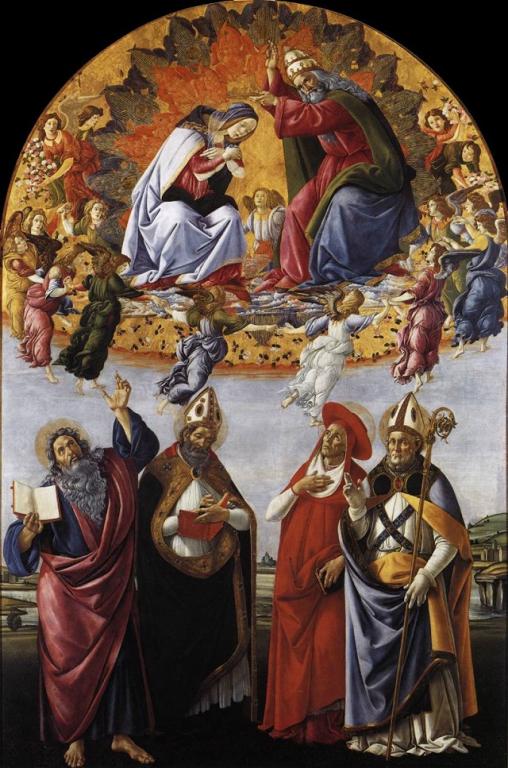
Coronation of the Virgin (1490-1492), by Sandro Botticelli (1445-1510) [public domain / Wikimedia Commons]

* * *
(written in 1999)* * * * *
A woman on my discussion list asked the following question:
Alright, in the midst of this disagreement, I have a few questions…. (forgive me if I seem ignorant on some points. I am not yet Catholic – a year from this Easter, hopefully – and so I am still learning the finer points of Catholicism).
As we all are. No one need be ashamed at learning or asking good questions, as you do. The only “dumb question” is the unasked question that should be asked.
The quotes you (Dave) offered make it clear that as Co-Redemptrix Mary was not equal in Jesus’ role…obviously not, since she was not God incarnate. I am confused, however, as to the role to which she did perform… see her as the one human to be honored above all others, but I do not see how we owe our redemption to her – OTHER than the honor due to her as the Mother of God. Isn’t she a vessel, more than a participant?? I can understand how she participated, at least, was involved, simply by her pain at seeing her Son so treated and so full of pain… but I don’t see how that could make her part of the redemption in any other way. Could you please tell me what I got right? (and wrong!) I feel as if I almost understand this, but not quite there. Help? Thanks!
Perhaps the simplest way to explain it (and rest assured that I don’t fully understand this, either, of course – it is just like many complex and deep areas of theology that no man fully understands), is by direct analogy. I hope I do this sublime subject justice:
1) In becoming man, God chose to involve a human being, Mary.
2) God didn’t have to do so – He could have appeared at 30 years old to be baptized by John the Baptist if He so wished. He could have appeared as a grown man just like Adam did.
3) But God chose to involve human “mediation” in the Incarnation, by “including” Mary and human reproductive biology (i.e., in terms of a uterus and uterine development of a child, but not in terms of sexual intercourse). Mary was a real mother, not just a biological “conduit,” so to speak. This is the sublime marvel of the whole thing: God could choose and use a human mother in order to come to earth and take on human flesh!
4) Now, an ancient theme in the Fathers is Mary as the “Second Eve.” Eve said “no” to God and so caused (along with Adam) the Fall of Man. Mary, on the other hand, said “yes” to God at the Annunciation and so caused (along with Christ – but in an essentially lesser, and non-necessary, non-sufficient fashion) the Redemption of Man. We “get” Christ – the incarnate Man, the God-Man with a human nature – through Mary. He received His human body through Mary. He didn’t have to, but He did. Hence we honor Mary above all other creatures as the Theotokos – the “God-bearer” – as well we should. Protestant theology is way off the mark here, and inconsistent with the strong Mariology of its founder, Martin Luther (he even accepted the Immaculate Conception – long before it was defined Catholic dogma).
5) So Mary is Mediatrix in that way, but there is also a further sense, which involves the notion of Co-Redemptrix and the sacrifice of our Lord Jesus Christ at Calvary. As His mother, Mary offered up (with full consent of the will) Jesus on Calvary, with faith that it was all God’s purpose; that this horrible event (humanly speaking) was predestined for the salvation of the human race. In doing so she did what all Catholics do at every Mass; we offer up Jesus (pay close attention to the eucharistic prayers) in His one sacrifice at Calvary, re-presented (i.e., made present, as opposed to another sacrifice) through the miracle of transubstantiation.
6) Mary participates objectively in the Redemption of humanity just as we participate objectively in our own individual salvation, through our free will (though it is all ultimately caused by God and His grace). We must willingly follow Jesus and keep His commandments, remain faithful and vigilant, and – precisely because we have free will – we may lose the graces of God which are necessary for us to obtain eschatological salvation (i.e., actual transformational salvation when we die – not the abstract “I am saved now” notion of Protestantism).
7) So, just as we are allowed the unfathomable privilege of participating in our own redemption, likewise God willed that the Blessed Virgin Mary, the Theotokos, the Immaculate one, the perpetual Virgin, the Second Eve, would play a part in the Redemption of all, by consenting to the Sacrifice on the Cross of her Son, who was God in the flesh. She doesn’t (solely and sufficiently) cause the Redemption any more than we (solely and sufficiently) cause our own redemption. Her role is to freely assent and to bear the suffering in her immaculate heart that Jesus bore in His Sacred Heart (hence those two devotions in Catholic theology).
8) “Co” in Latin does not mean “equal”; it merely means “with” or “alongside.” We see this even in English. If you have a “co-pay” with regard to health insurance, that doesn’t mean that you always pay equally with your insurance provider (I sure hope not!). “Co-Pilot” sometimes means “equal” but usually not. Etc. But because the term Co-Redemptrix is so misunderstood, it has fallen out of use in the last 50 years or so. But nevertheless, Pope John Paul II has used it at least five times, as Dr. Miravelle notes.
9) This was God’s marvelous plan – to involve a creature and a woman at every step of the way, so as to achieve a certain “balance” – if I may properly speak in such a way. Eve brought down the human race, acting with Adam; Mary helped to raise it, acting in concert with Jesus Christ, her Son, the second Adam (as Paul describes Him). If Satan could cause the fall of the human race through the frailty of Woman and Man, why is it not plausible that God could in turn bring about the Redemption of the human race in part through the Immaculate Mary, the Second Eve, the Theotokos? To me it all makes eminent sense. It is contrary neither to Scripture nor to common sense and reason.
10) There is no necessary reason – a priori – for thinking that God couldn’t or wouldn’t have done such a thing (many Protestants and Orthodox, and questioning Catholics seem to regard these notions as intrinsically impossible, excessive, idolatrous, and unbiblical). Nothing in these concepts is contrary to Scripture or Tradition. God clearly uses human beings as mediators. We pray for each other. Paul speaks of “having saved some” in the process of his ministry. Moses interceded and “atoned” for the Jews, and God decided not to destroy them, etc. We do good works of charity and are (hopefully) vessels of God’s love and the gospel, helping others to see the light which we carry as believers indwelt with the Holy Spirit. It all comes down to free will, and bearing God’s image within us.
11) All that being the case, it is nothing so unbelievable or extraordinary that God chose to involve Mary in the Redemption of mankind and the distribution of graces. God can do whatever He wants! We seem, oftentimes, to foolishly think (on an unconscious level, of course) that God can only do what we think He should do! :-) It is said in the Psalms and Prophets that God could raise up a rock or a tree to sing His praises, if stubborn men refuse to do so. God used a donkey (Balaam’s ass) to speak and express His will once. He can use babies, or infants, and the most “unlikely,” unexpected human beings. He appeared in a burning bush and in a cloud. He told Isaiah to walk around naked, and to describe men’s actions as menstrual rags (that is the literal meaning of Isaiah 64:6). Why should anything He does or chooses to do surprise us?? The ending of Job makes this clear enough. We should never lose the sense of wonder and initial shock when it comes to God, and presume to judge what He “shouldn’t” or “wouldn’t” do. His thoughts are as far above ours as the stars are above the earth (Isaiah 55:8-9).
12) So, then, what is the a priori objection to His choice to use Mary in such a fashion, in order to parallel Eve’s disobedience with obedience; to help redeem the human race, so that a human being among us has helped raise us to where we were always meant to be? When God took on human flesh, He raised it to heights unknown since before the Fall. We were all meant to be sinless and immaculate. Now we are to believe that God couldn’t or wouldn’t raise one solitary human being to a sinless state before they get to heaven (where sin has no entrance)? Or to help redeem the human race out of that glorious bounty of sinlessness and holiness and love for all men?
13) Therefore, God chose to use Mary for the purpose of redeeming mankind. She willed the Sacrifice on Calvary just as we will that someone ought to be redeemed or to repent, through prayer. We can merit graces given to ourselves or others by means of our own sufferings and penances (another aspect of this). There is such a thing as redemptive suffering, and we all can participate in that – how much more Mary, being sinless and not heir to even original sin?
14) Mary, being immaculate and the Theotokos, was in a unique position to help redeem all mankind by “joining in” (in purpose and will) with Christ on Calvary. She can obtain far more than any of us from God, on the basis of the Scripture, “the prayer of the righteous man availeth much” (James 5:16). So God willed it so, and Mary complied. God chose to involve both the God-Man in salvation (essentially, sufficiently) and the Woman, the Second Eve (in collaboration, as a “fellow-laborer” with God, as Paul describes disciples). We participate in our own salvation by consent and obedience; Mary participates in the salvation of all who are saved by her consent and obedience to Calvary. In a sense, then, the difference between ourselves and the Blessed Virgin is only quantitative, not qualitative. God was pleased to do this, because it involved human beings, and He always desires for human beings to act freely in accord with His will.
15) Likewise, God chooses to distribute all graces through Mary. She is our Advocate and Supreme Intercessor, because she is so holy, and is the Mother of God. How is that in any way unbiblical? It is not! If Moses could successfully intercede on behalf of an entire sinful and disobedient group (the Jews in the wilderness), if Abraham’s prayer could spare his nephew Lot (and Sodom and Gomorrah also, if enough righteous men had been found there) why is it so remarkable that God would choose to involve Mary in intercession and distribution of graces to an entire sinful and disobedient group (mankind)? If one thing can occur, so can the other.
16) The biblical evidence for all this (as Protestants will no doubt demand) is in kernel form. It stems from Mary’s Immaculate Conception (full of grace – kecharitomene – Lk 1:28) and the New Eve concept above all, and has been consistently developed through the centuries by the Church. Catholics believe in such a thing as the “mind of the Church.” When a consensus is reached by clergy and laity, popes and Councils, liturgy and pious practice, on a certain issue, we believe this is a legitimate part of Tradition, since we believe that God continually guides His Church, en masse, by means of the Holy Spirit, Who “teaches us all things.” Protestants may scoff at this, but they have their own problems with the unbiblical and self-defeating nature of sola Scriptura (Scripture Alone as the Rule of Faith). Our overall system is far more biblical and self-consistent than theirs is. We need not “fear” the Bible in the least. Quite the contrary.
I hope and pray that I have done justice to this topic, and that I have helped others to understand this better. I am not a theologian, and have no formal theological training. But perhaps that is good, since (hopefully) I can express these points on a more popular level (assuming I do have correct beliefs concerning them). The academicians and theologians tend to write to each other and to become overly technical (not that that is a bad thing); hence they are not quite as useful for the larger population as they might otherwise be.
Previous Post

January 7, 2016
Mary's Immaculate Conception: A Biblical Argument
Next Post

January 8, 2016 Were Vernacular Bibles Unknown Before Luther?
Browse Our Archives
Select a Category & Last Things About Me Anti-Catholicism Atheism & Agnosticism Baptism and Sacramentalism Bible and Tradition Blessed Virgin Mary Books by Dave Armstrong C. S. Lewis Calvinism & General Protestantism Catholic Apologetics Catholic Apologists Catholic conversion Catholic converts Christmas Church (Ecclesiology) Church History Conversion and Converts Development of Doctrine Eastern Orthodoxy Ecumenism & Christian Unity Eucharist & Liturgy Fathers of the Church French Translations G. K. Chesterton Hell Hell & Satan Hell & Satan & Last Things Heresies & Comparative Religion Holistic Health Inquisition & Crusades & Scandals James White Jews & Judaism & Old Testament John Calvin John Henry Newman Liberal / Modernist Theology Life Issues Literary Resume Lutheranism Mariology Martin Luther Music Orthodoxy Papacy & Infallibility Personal Page Philosophy & Science Political & Ethical & Moral Issues Protestant Persecution & Intolerance Protestantism Purgatory Purgatory & Penance Romantic & Imaginative Theology Saints & Purgatory & Penance Salvation Salvation & Justification Satan & Last Things Sexuality and Gender Issues Spanish Translations Traditionalism vs. Radical Catholic Reactionaries Traducciones al español / tradução para português Trinitarianism & Christology Uncategorized Videos
Select a Month October 2026 September 2026 August 2026 July 2026 June 2026 May 2026 April 2026 March 2026 February 2026 January 2026 December 2025 November 2025 October 2025 September 2025 August 2025 July 2025 June 2025 May 2025 April 2025 March 2025 February 2025 January 2025 December 2024 November 2024 October 2024 September 2024 August 2024 July 2024 June 2024 May 2024 April 2024 March 2024 February 2024 January 2024 December 2023 November 2023 October 2023 September 2023 August 2023 July 2023 June 2023 May 2023 April 2023 March 2023 February 2023 January 2023 December 2022 November 2022 October 2022 September 2022 August 2022 July 2022 June 2022 May 2022 April 2022 March 2022 February 2022 January 2022 December 2021 November 2021 October 2021 September 2021 August 2021 July 2021 June 2021 May 2021 April 2021 March 2021 February 2021 January 2021 December 2020 November 2020 October 2020 September 2020 August 2020 July 2020 June 2020 May 2020 April 2020 March 2020 February 2020 January 2020 December 2019 November 2019 October 2019 September 2019 August 2019 July 2019 June 2019 May 2019 April 2019 March 2019 February 2019 January 2019 December 2018 November 2018 October 2018 September 2018 August 2018 July 2018 June 2018 May 2018 April 2018 March 2018 February 2018 January 2018 December 2017 November 2017 October 2017 September 2017 August 2017 July 2017 June 2017 May 2017 April 2017 March 2017 February 2017 January 2017 December 2016 November 2016 October 2016 September 2016 August 2016 July 2016 June 2016 May 2016 April 2016 March 2016 February 2016 January 2016 December 2015 November 2015 October 2015 September 2015 August 2015 July 2015 June 2015 May 2015 April 2015 March 2015 February 2015 January 2015 December 2014 November 2014 October 2014 September 2014 August 2014 July 2014 June 2014 April 2014 March 2014 February 2014 January 2014 December 2013 November 2013 October 2013 September 2013 August 2013 July 2013 June 2013 April 2013 March 2013 February 2013 January 2013 December 2012 November 2012 October 2012 September 2012 August 2012 July 2012 June 2012 May 2012 April 2012 March 2012 February 2012 January 2012 December 2011 November 2011 October 2011 September 2011 August 2011 July 2011 June 2011 April 2011 March 2011 February 2011 October 2010 September 2010 August 2010 July 2010 April 2010 March 2010 December 2009 October 2009 August 2009 July 2009 June 2009 May 2009 March 2009 February 2009 October 2008 September 2008 April 2008 March 2008 February 2008 January 2008 December 2007 November 2007 October 2007 May 2007 March 2007 February 2007 January 2007 November 2006 October 2006 September 2006 August 2006 July 2006 June 2006 May 2006 April 2006 March 2006 February 2006 October 2005 June 2005 April 2005 February 2005 July 2004 May 2004 April 2004
Follow Us!
TAKE THE
Religious Wisdom Quiz
What did Jesus do for Lazarus in Bethany?
Select your answer to see how you score.
Healed his blindness Turned him invisible Raised him from the dead Fed him
Books by This Author Books by Dave Armstrong
Related posts from Biblical Evidence for Catholicism

Holy Ground: Why Mary Had NO Other Children...
Biblical Evidence for Catholicism
Protestant Confessions & "Ever-Virgin" Mary
Biblical Evidence for Catholicism

Mary Wife of Clopas (Jn 19:25): Mary's Sister-in-Law?
Biblical Evidence for Catholicism

Jesus Had Four Brothers? The Bible Sez No!
Biblical Evidence for Catholicism
TRENDING AT PATHEOS Catholic

Janie Learns the Way of the Cross: A...
Teaching children about Jesus' Passion can be challenging. Many parents and educators...

Looking For Good Catholic Writing - October 2026
He alone extends the heavens, and he walks upon the waves of...

In "Irreplaceable," our book on vocation and technology, Trevor Sutton and I...

I was strolling through the top floor of the brand new Parthenon...

What Does Gêvâh Mean For Kimberley Guifoyle &...
This week, a lot of the news is focused on Kimberly Guilfoyle....

INNER CIRCLE: Profound Mystery (Of Christ In All...
Ephesians 5:31-32 “For this reason, a man will leave his father and...
view all Catholic blogs
Ad-Free & Subscriber Log-In Subscription Support
- About Us
- 2026 Calendar
- Videos
- Podcasts
- Library of World Religions
- Faith In Media Tracker
- Advertise With Us
- Write for Us
- Privacy Policy
- Terms of Service
- Do Not Sell My Data
- Contact Us
- Radiant Digital
- Manage Newsletter Subscriptions
- Unsubscribe From Notifications
- Sitemap
Copyright 2008-2026, Patheos. All rights reserved.
Subscription Support Ad-Free & Subscriber Log-In
Follow Patheos