
BuddhistCatholicContemplativeEvangelicalGeneral ChristianHinduJewishLatter-day SaintMuslimNew VisionsProgressive Christian
Beliefs
- Buddhist
- Catholic
- Contemplative
- Evangelical
- General Christian
- Hindu
- Jewish
- Latter-day Saint
- More Voices
- Muslim
- New Visions
- Pagan
- Progressive Christian
Topics
- Religion News
- Food and Religion
- Sports and Religion
- Religious Art
- Religious Music and Entertainment
- Religious Events
- History and Religion
- Style and Religion
- Politics and Religion
- Women in Religion
- Recreation Outdoors and Religion
- Business Finance and Religion
- Careers Workplace and Religion
- Education and Religion
- Family Parenting and Religion
- Health Fitness and Religion
- Home and Religion
- Relationships and Religion
- Technology and Religion
- Travel and Religion
Columnists
- Buddhist Columnists
- Business Finance and Religion Columnists
- Careers Workplace and Religion Columnists
- Catholic Columnists
- Contemplative Columnists
- Education and Religion Columnists
- Evangelists Columnists
- Family Parenting and Religion Columnists
- General Christian Columnists
- Health Fitness and Religion Columnists
- Hindu Columnists
- History and Religion Columnists
- Home and Religion Columnists
- Jewish Columnists
- More Voices Columnists
- Latter Day Columnists
- Muslim Columnists
- New Visions Columnists
- Nonreligious Columnists
- Pagan Columnists
- Politics and Religion Columnists
- Progressive Columnists
- Recreation Outdoors and Religion Columnists
- Relationships and Religion Columnists
- Religion News Columnists
- Religious Art Columnists
- Religious Events Columnists
- Religious Music and Entertainment Columnists
- Sports and Religion Columnists
- Style and Religion Columnists
- Technology and Religion Columnists
- Travel and Religion Columnists
- Women in Religion Columnists
Resource Library
- 2026 Calendar
- Library of World Religions
- The 100 Most Holy Places on Earth
- Patheos Answers
- Podcasts
- Videos
- Faith Leaders Database
- Anglican Episcopalian
- Bahai
- Baptist
- Buddhism
- Christianity
- Confucianism
- Eastern Orthodoxy
- Hinduism
- Holiness and Pentecostal
- ISKCON
- Islam
- Judaism
- Lutheran
- Methodist
- The Church of Jesus Christ of Latter-day Saints
- New Age
- Paganism
- Presbytarian and Reformed
- Protestantism
- Religion Behind the Scenes
- Roman Catholic
- Scientology
- Shia Islam
- Sikhism
- Sufism
- Sunni Islam
- Taoism
- Zen
- See all religions
Research Tools
 Ad-Free & Subscriber Log-In Subscription Support
Ad-Free & Subscriber Log-In Subscription Support
Follow Patheos 

- Trending:
- Forgiveness
- |
- Marriage
- |
- Consciousness
- |
- Death Penalty
- |
- Election
- |
- Halloween

-
About
-
Catholic Apologetics
-
Church History
-
Great Apologists
-
Christian Worldview
-
Protestantism & Misc.
- Home
- Catholic
- History and Religion
- Interview with Dale Ahlquist Regarding “The Wisdom of Mr. Chesterton”
Interview with Dale Ahlquist Regarding “The Wisdom of Mr. Chesterton”
Last updated on: June 6, 2026 at 12:29 am by Dave Armstrong
Interview with Dale Ahlquist Regarding “The Wisdom of Mr. Chesterton” 2026-06-06T00:29:32-04:00 Dave Armstrong
Patheos Explore the world's faith through different perspectives on religion and spirituality! Patheos has the views of the prevalent religions and spiritualities of the world.
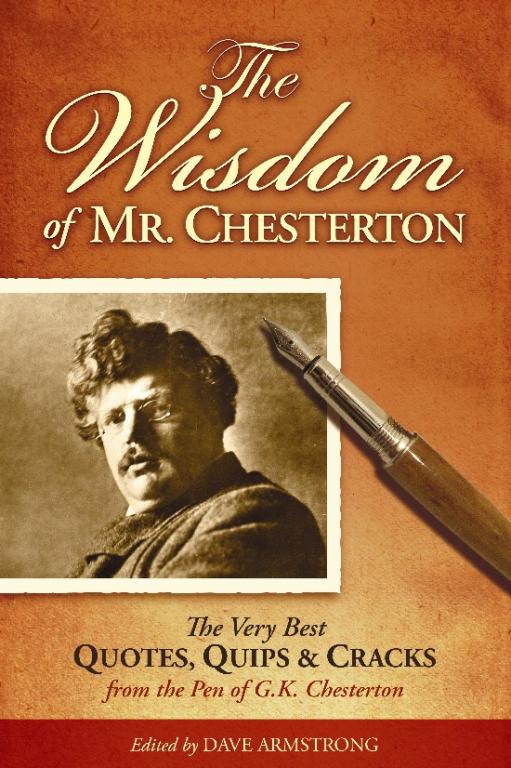
[see the info-page for this book]
(6-16-10)
From Gilbert Magazine (Vol. 13, No. 5, March 2010, pp. 14-17; entitled, “‘Can I Get a Quote on That?’: An Interview With Dave Armstrong”). This periodical is published by the American Chesterton Society.
Dale Ahlquist is one of the leading experts on Chesterton today. He has written a few GKC books, did the delightful EWTN television shows about him, and is president of the American Chesterton Society. His words below will be in blue. Portions in green were not included in the final magazine edit of the interview.
* * * * *
Dave, you’ve been promoting Chesterton even longer than the American Chesterton Society. I recall when we put up our Web page, your Chesterton site was one of our first links.
***
Isn’t that something! I don’t recall mine being even older than your wonderful, “gold standard” Web site (that I have made many scores of links to through the years). I was honored also to find that my page was occasionally mentioned by the evangelical Protestant flagship magazine Christianity Today as a resource. It meant a lot to me because of my own evangelical past to be mentioned there at all.
This was back in the days of gasoline-powered computers.
Even before that: I had to ride a bike that was connected to a generator, to power my computer. Saved money on gasoline . . . good exercise too. :-)
When did you start your Web site?
I first put up my Web site (“Biblical Evidence for Catholicism”) in February 1997. The Chesterton page was there from the beginning.
Ours went up in November of that year.
Along with the Chesterton page, there were C. S. Lewis and Cardinal Newman pages, and they remain to this day. I had photographs of all three at the top of my home page. My intention from the start was to provide a sort of “storehouse of apologetic information.” These “author pages” constituted a big part of that goal of comprehensive links having to do with the great apologists of the past. I wanted to make clear the tradition of “reasoned Christianity” that I’ve sought to be a part of in my meager efforts.
I love the “instant information access” capability of the Internet, and used to spend many many hours collecting any links I could find about Chesterton (back when Yahoo was the big search engine: long before Google), and the others. I still will search the Internet for some new GKC material. I always enjoy it, and it is all in service to the Great Man: to share him with as many others as I can.
How did you first get interested in Chesterton?
I believe I first heard of him as a result of my interest in C. S. Lewis, who has been my favorite writer for over thirty years (though Chesterton may very well be now, after doing this book: it’s a close call!). He is often associated with Lewis, and, as you know, is widely regarded as the greatest Christian apologist in the first third of the 20th century, with Lewis being a sort of successor to him in the second third of the century. I remember an evangelical Protestant teacher at the non-denominational church I used to attend in the early 80s — ironically, no big admirer of the Catholic Church at all –, who more than once mentioned Orthodoxy as a wonderful book. I obtained a library copy around 1983 or so, and I enjoyed it quite a bit.
Lewis had also mentioned in his autobiography that The Everlasting Man was the book that influenced him the most. That was more than enough recommendation for me. I had read portions of that book in the mid-80s, but I actually didn’t read the whole thing (strangely enough) until just a few years ago. That was a good thing, though, because the elaborate analogical reasoning he uses in the book probably would have been partially inexplicable to me if I had read it in the early 80s.
I think Orthodoxy is the best introductory book because it is very straightforward and basic: almost the near-Catholic equivalent (in a way) of Lewis’ Mere Christianity, but with the object of explaining the necessity of tradition and orthodoxy. As such, it would have been the first thing I ever read specifically devoted to the notion of apostolic tradition: considered apart from a strictly biblical context. In retrospect, it probably laid the very first groundwork for my later conversion.
Did any of Chesterton’s other books play a role in your conversion?
Yes. I read several of Chesterton’s later-period Catholic books (The Thing, The Well and the Shallows, St. Thomas Aquinas, St. Francis, The Catholic Church and Conversion) right before and just after my becoming convinced of Catholicism in October 1990. That was perfect timing, too, because they were great introductions to the “Catholic Mind,” so to speak.
Besides the obvious effect Chesterton had on your faith, what other kind of effect did he have on your thinking…and on your life?
Chesterton (in any and all of his writing) always affects me in the same way: the consciousness of the merging of reason and faith: all done in a witty, ingratiating, challenging style. Reason and faith are in exactly the right balance (he’s a lot like St. Thomas Aquinas in that respect, which is why he wrote such a great book about that great Doctor). The intellect need yield nothing in our walk with God, and the faith doesn’t have to be held without intellectual confidence, or with the tension of logical incoherence.
The other theme that I am very aware of whenever reading Chesterton is the simultaneous manifestation of both innocence and wisdom. It’s a rare combination. Usually the more we know, the more cynical we become. Knowledge obtained in particulars seems to not lead to wisdom, but rather, to pride or to various errors and false rationalizations. But Chesterton managed to attain to wisdom while maintaining his Christian idealism and innocence (seen above all, perhaps, in his great love of children and fairy-tales and romanticism). It’s quite extraordinary. These characteristics, along with his great humor and style, make him very appealing to read and learn from: not just the strength of his ideas and arguments, but the appeal of his person.
This is (however poorly I am expressing it) how he influences both my thinking and my life.
You are known as a Catholic apologist. Do you use Chesterton in your apologetics?
He is a wonderful model, particularly, for apologists like myself. Our task is to defend the faith while doing so with love and a certain style that can have appeal alongside the true message that we (hopefully) are seeking to spread far and wide. Chesterton is an inspiration to me also in the sense that he was a “popular level” apologist (as was C. S. Lewis). By that I mean that he wrote to and for the masses, not to scholars or academics. Indeed, he never obtained a college degree and took no formal courses in theology that I am aware of. Yet on the other hand, scholars like the renowned Thomist Etienne Gilson were almost at a loss for words in expressing their unbounded admiration for his deep wisdom and insights.
When I am accused by folks who think little of apologetics, of being “pretentious,” etc. because I’m not a scholar — never claimed to be!: I have a B.A. in sociology –, I invariably appeal to his example. Apologetics is not the equivalent of academics. It can be, and the more scholars and priests who do it, the merrier, but that is not the ultimate point of it; nor is it strictly necessary. It is in the service of everyday people trying to live out their faith, in greater understanding and confidence. The layman and the non-scholar can and should do apologetics alongside the scholar. The Church encourages it, and it is nothing new.
Generally, when I actually utilize Chesterton in my apologetics, it is because some pithy quotation or idea of his spontaneously comes to mind while I am writing. Then I will incorporate it (even if only in paraphrase form). For example, in a dialogue I was involved in just a few weeks ago, I utilized one of my favorite word-pictures of Chesterton. Here is how I expressed it:
We should all attempt to be objective; on the other hand, the nature of dogma restricts us, so that we can’t go in unlimited, unrestrained directions.
I follow Chesterton’s philosophy. He compared orthodoxy to a fence around a high hill, with steep cliffs on all sides. When it is there, the children feel more free to play because they don’t have to worry about falling off. Without it, they are not really free, because they could either fall off or else worry so much about doing so that they can’t have any fun. Thus, orthodoxy and dogmatic restriction frees the mind to be truly free, and itself.
This was derived by memory from Orthodoxy, chapter 9. The citation I used in my book appears under “Dogma (Catholic)”, on page 95:
Catholic doctrine and discipline may be walls; but they are the walls of a playground.
I decided to use all short quotations, single sentences in my book. But here’s the entire context of that aphorism, in a far better style than my expression of his basic idea:
Those countries in Europe which are still influenced by priests, are exactly the countries where there is still singing and dancing and coloured dresses and art in the open-air. Catholic doctrine and discipline may be walls; but they are the walls of a playground. Christianity is the only frame which has preserved the pleasure of Paganism. We might fancy some children playing on the flat grassy top of some tall island in the sea. So long as there was a wall round the cliff’s edge they could fling themselves into every frantic game and make the place the noisiest of nurseries. But the walls were knocked down, leaving the naked peril of the precipice. They did not fall over; but when their friends returned to them they were all huddled in terror in the centre of the island; and their song had ceased.
This thought had become part of my worldview, and so I could pull it out when I needed it, to illustrate a point I was making. This is generally how Chesterton influences my own apologetic method.
Another example of how I have used Chesterton in my apologetics I did the same thing occurred the other night when I had an exchange with a Catholic who was arguing that if he had ruled out Catholicism as true, he would sooner be an Arian than a Protestant. I strongly disagreed, on the grounds that Protestants (unlike Arians) were also trinitarians. I told him that Chesterton compared Protestants to Robinson Crusoe: always going back to the ship to get more stuff, so that they can survive. But at least they are borrowing from the right source. This idea came from the chapter [33] “The Idols of Scotland” in The Thing:
Whether it be called a Catholic tendency or no, all the movements of all the sects of late have been in the direction of trying to put together again those separate pieces that were pulled apart in the sixteenth century. The main feature of our time has been the fact that one person after another has recovered one piece after another, and added it to the new scheme by borrowing it from the old. There is one sufficient proof that there has indeed been a shipwreck. And that is that Robinson Crusoe has, ever since, been continually going back to get things from the wreck.
It was in my mind, and I could pull it up for use as an illustration of what I was trying to argue. Part of that passage also made it into my book [page 284, under “Reformation, Protestant”].
So, we finally get to the quotations. Chesterton is many things, but he is nothing if not good quotations. And yet some people just don’t seem to get that. Even in his own time he was dismissed by some as a mere epigrammatist. And now, some people are almost suspicious of any line that comes off as pithy. Why do you suppose that is?
Great question. I’ve never thought much about it, but here is what immediately comes to mind. Shakespeare is the source of the most well-known “quotations” in English, and he certainly isn’t dismissed simply because of that. Use of quotations of a writer suggests that he truly has something important to offer. I think the suspicion now is because wit has been mostly disconnected from wisdom. One-liners are the province of comedians rather than Solomon-like purveyors of wisdom, and the comedians are often cynical and hostile to traditional values. There is less love of truth: less seeking after it, and truth is often best expressed in short sayings. The less we truly believe in truth, the less we will admire the short, pithy, expression of it. In fact, one might argue that in a relativistic culture, such proverbial expression is almost passe, because everything is considered so complex and nuanced — sophistry and obfuscation often rule the day –, and lacking universal application, there remains no place for them. Chesterton perhaps touched upon some of these same notions in writing:
But no English school-boy is ever taught to tell the truth, for the very simple reason that he is never taught to desire the truth.
(What’s Wrong With the World, IV-11; p. 337 in my book)
There hasn’t been a good compilation of Chesterton quotes – especially short Chesterton quotes – for a long time. How did you go about putting together your book The Wisdom of Mr. Chesterton?
It was made vastly easier by the presence of virtually all of Chesterton’s writings online. I simply read most of the non-fiction books, or heavily skimmed them, at any rate, and selected sentences that I thought had general observational application (almost analogous to someone like Confucius), and cut-and-pasted. I love to organize and categorize, so it was an easy process for me. I didn’t find it difficult or tedious at all. I was determined not to rely on previous similar books, so that it would be an original compilation and not a derivative one. Once I start a project like this, I am self-motivated and a have a great desire to be as comprehensive as I can, so I just kept going and going till it was finished.
Did the topics choose themselves, or did you choose the topics?
More so the former. As I was collecting quotations, I categorized them as I went along, trying to be as briefly descriptive as I could of the contents. I love to do that as well. The art of being a Webmaster is similar in many ways to what goes into compiling a quotations book, so in that sense I had a lot of previous experience.
How large is your collection of Chesterton quotes that you did not use?
Not too large. Most of them were from the later books that I discovered were actually still under copyright in some countries; I didn’t know that when I began. I had to abide by “fair use” restrictions. But I discovered this early on so that most of the unused quotations were from Orthodoxy and The Everlasting Man, and also the Illustrated London News. I did retain these on Web pages, so the work was not in vain. Estimating roughly, there are about 200.
Give us one that didn’t make the final cut.
Here is one extraordinary long sentence about the Catholic Church, from The Everlasting Man (II-4). It is perhaps the best succinct description I’ve ever seen:
That is the only explanation I can find of a thing from the first so detached and so confident, condemning things that looked so like itself, refusing help from powers that seemed so essential to its existence, sharing on its human side all the passions of the age, yet always at the supreme moment suddenly rising superior to them, never saying exactly what it was expected to say and never needing to unsay what it had said; I can find no explanation except that, like Pallas from the brain of Jove, it had indeed come forth out of the mind of God, mature and mighty and armed for judgement and for war.
What I would give to write like that! Chesterton’s writing always seems to have an outward or implicit poetic aspect. That helps, no doubt, to make him so quotable.
I notice that other than the Illustrated London News, you haven’t tapped the uncollected writings at all.
I drew from the online (non-fiction) materials — virtually all of his books — and the six paperback copies of The Collected Works that I had in my own personal library. If finances weren’t an issue (apologists not being exactly a wealthy class), I probably would have purchased whatever else was available for the sake of greater comprehensiveness. But I did what I could with what I had.
Have you been a reader of Gilbert Magazine? If so, why haven’t you stolen quotes from us? If not, how can you look at your face in the mirror?
[chuckling] Actually, I don’t subscribe to any magazines, for lack of time. It’s enough to try to read my own books (some 2500 or so) and do the research I need to do for my various apologetic projects. I subscribed to it for a while. It’s excellent, as is everything connected with the American Chesterton Society.
Surely I could have drawn many quotes from your fine organization and Web site, but it was my desire, as I said before, not to be derivative at all: to come to it totally fresh, with no outside input. That precluded such a thing from the outset. I also did not use George Marlin’s 1986 book, The Quotable Chesterton.
Okay, I’ll come up with an appropriate punishment. In the meantime, what’s next for Dave Armstrong?
The next book coming up is a reply to the arguments of John Calvin, whose 500th birthday came in 2009. I wanted to give him a present. From April to December I replied section-by-section to the entire Book IV of his Institutes of the Christian Religion, itself about 500 pages. These replies will be abridged and edited into a more compact, readable form, for use as an apologetics tool; I’ve already written a book about Martin Luther. After that I’ll be putting together new volumes about the Blessed Virgin Mary and the justification / salvation issue, drawn from existing writings. The main writing is done; it’s all editing now. Then the task is to find a “real” publisher for them. I was fortunate enough to have this current book picked up in less than a year by Saint Benedict Press (recently merged with TAN Books).
Previous Post

January 10, 2016
John Henry Newman on Papal Infallibility Prior to 1870
Next Post

January 11, 2016 Apologia for the New (Pauline) Mass
Browse Our Archives
Select a Category & Last Things About Me Anti-Catholicism Atheism & Agnosticism Baptism and Sacramentalism Bible and Tradition Blessed Virgin Mary Books by Dave Armstrong C. S. Lewis Calvinism & General Protestantism Catholic Apologetics Catholic Apologists Catholic conversion Catholic converts Christmas Church (Ecclesiology) Church History Conversion and Converts Development of Doctrine Eastern Orthodoxy Ecumenism & Christian Unity Eucharist & Liturgy Fathers of the Church French Translations G. K. Chesterton Hell Hell & Satan Hell & Satan & Last Things Heresies & Comparative Religion Holistic Health Inquisition & Crusades & Scandals James White Jews & Judaism & Old Testament John Calvin John Henry Newman Liberal / Modernist Theology Life Issues Literary Resume Lutheranism Mariology Martin Luther Music Orthodoxy Papacy & Infallibility Personal Page Philosophy & Science Political & Ethical & Moral Issues Protestant Persecution & Intolerance Protestantism Purgatory Purgatory & Penance Romantic & Imaginative Theology Saints & Purgatory & Penance Salvation Salvation & Justification Satan & Last Things Sexuality and Gender Issues Spanish Translations Traditionalism vs. Radical Catholic Reactionaries Traducciones al español / tradução para português Trinitarianism & Christology Uncategorized Videos
Select a Month October 2026 September 2026 August 2026 July 2026 June 2026 May 2026 April 2026 March 2026 February 2026 January 2026 December 2025 November 2025 October 2025 September 2025 August 2025 July 2025 June 2025 May 2025 April 2025 March 2025 February 2025 January 2025 December 2024 November 2024 October 2024 September 2024 August 2024 July 2024 June 2024 May 2024 April 2024 March 2024 February 2024 January 2024 December 2023 November 2023 October 2023 September 2023 August 2023 July 2023 June 2023 May 2023 April 2023 March 2023 February 2023 January 2023 December 2022 November 2022 October 2022 September 2022 August 2022 July 2022 June 2022 May 2022 April 2022 March 2022 February 2022 January 2022 December 2021 November 2021 October 2021 September 2021 August 2021 July 2021 June 2021 May 2021 April 2021 March 2021 February 2021 January 2021 December 2020 November 2020 October 2020 September 2020 August 2020 July 2020 June 2020 May 2020 April 2020 March 2020 February 2020 January 2020 December 2019 November 2019 October 2019 September 2019 August 2019 July 2019 June 2019 May 2019 April 2019 March 2019 February 2019 January 2019 December 2018 November 2018 October 2018 September 2018 August 2018 July 2018 June 2018 May 2018 April 2018 March 2018 February 2018 January 2018 December 2017 November 2017 October 2017 September 2017 August 2017 July 2017 June 2017 May 2017 April 2017 March 2017 February 2017 January 2017 December 2016 November 2016 October 2016 September 2016 August 2016 July 2016 June 2016 May 2016 April 2016 March 2016 February 2016 January 2016 December 2015 November 2015 October 2015 September 2015 August 2015 July 2015 June 2015 May 2015 April 2015 March 2015 February 2015 January 2015 December 2014 November 2014 October 2014 September 2014 August 2014 July 2014 June 2014 April 2014 March 2014 February 2014 January 2014 December 2013 November 2013 October 2013 September 2013 August 2013 July 2013 June 2013 April 2013 March 2013 February 2013 January 2013 December 2012 November 2012 October 2012 September 2012 August 2012 July 2012 June 2012 May 2012 April 2012 March 2012 February 2012 January 2012 December 2011 November 2011 October 2011 September 2011 August 2011 July 2011 June 2011 April 2011 March 2011 February 2011 October 2010 September 2010 August 2010 July 2010 April 2010 March 2010 December 2009 October 2009 August 2009 July 2009 June 2009 May 2009 March 2009 February 2009 October 2008 September 2008 April 2008 March 2008 February 2008 January 2008 December 2007 November 2007 October 2007 May 2007 March 2007 February 2007 January 2007 November 2006 October 2006 September 2006 August 2006 July 2006 June 2006 May 2006 April 2006 March 2006 February 2006 October 2005 June 2005 April 2005 February 2005 July 2004 May 2004 April 2004
Follow Us!
TAKE THE
Religious Wisdom Quiz
Who asked Jesus, "What is truth?"
Select your answer to see how you score.
Caiaphas Pilate Nicodemus Herod
Books by This Author Books by Dave Armstrong
Related posts from Biblical Evidence for Catholicism

Book: Martin Luther: Dissenter and Defender
Biblical Evidence for Catholicism
"Martin Luther: Dissenter & Defender": Introduction
Biblical Evidence for Catholicism
Introducing "Faith Alone: The 'Theological Novum'”
Biblical Evidence for Catholicism
Faith Alone: The "Theological Novum" (Dave Armstrong Book)
Biblical Evidence for Catholicism
TRENDING AT PATHEOS Catholic

I was strolling through the top floor of the brand new Parthenon...

What Does Gêvâh Mean For Kimberley Guifoyle &...
This week, a lot of the news is focused on Kimberly Guilfoyle....

INNER CIRCLE: Profound Mystery (Of Christ In All...
Ephesians 5:31-32 “For this reason, a man will leave his father and...

Do Not Rejoice When Your Enemy Falls: The...
Turning an execution into a public spectacle is a disturbing expression of...

'The Chosen' S6 Trailer: The Passion Gets Very...
Not many watching 'The Chosen' worry about spoilers, but just because they...

The purpose-driven labor priest
A labor activist reads Rick Warren and it gets me wondering about...
view all Catholic blogs
Ad-Free & Subscriber Log-In Subscription Support
- About Us
- 2026 Calendar
- Videos
- Podcasts
- Library of World Religions
- Faith In Media Tracker
- Advertise With Us
- Write for Us
- Privacy Policy
- Terms of Service
- Do Not Sell My Data
- Contact Us
- Radiant Digital
- Manage Newsletter Subscriptions
- Unsubscribe From Notifications
- Sitemap
Copyright 2008-2026, Patheos. All rights reserved.
Subscription Support Ad-Free & Subscriber Log-In
Follow Patheos