
BuddhistCatholicContemplativeEvangelicalGeneral ChristianHinduJewishLatter-day SaintMuslimNew VisionsProgressive Christian
Beliefs
- Buddhist
- Catholic
- Contemplative
- Evangelical
- General Christian
- Hindu
- Jewish
- Latter-day Saint
- More Voices
- Muslim
- New Visions
- Pagan
- Progressive Christian
Topics
- Religion News
- Food and Religion
- Sports and Religion
- Religious Art
- Religious Music and Entertainment
- Religious Events
- History and Religion
- Style and Religion
- Politics and Religion
- Women in Religion
- Recreation Outdoors and Religion
- Business Finance and Religion
- Careers Workplace and Religion
- Education and Religion
- Family Parenting and Religion
- Health Fitness and Religion
- Home and Religion
- Relationships and Religion
- Technology and Religion
- Travel and Religion
Columnists
- Buddhist Columnists
- Business Finance and Religion Columnists
- Careers Workplace and Religion Columnists
- Catholic Columnists
- Contemplative Columnists
- Education and Religion Columnists
- Evangelists Columnists
- Family Parenting and Religion Columnists
- General Christian Columnists
- Health Fitness and Religion Columnists
- Hindu Columnists
- History and Religion Columnists
- Home and Religion Columnists
- Jewish Columnists
- More Voices Columnists
- Latter Day Columnists
- Muslim Columnists
- New Visions Columnists
- Nonreligious Columnists
- Pagan Columnists
- Politics and Religion Columnists
- Progressive Columnists
- Recreation Outdoors and Religion Columnists
- Relationships and Religion Columnists
- Religion News Columnists
- Religious Art Columnists
- Religious Events Columnists
- Religious Music and Entertainment Columnists
- Sports and Religion Columnists
- Style and Religion Columnists
- Technology and Religion Columnists
- Travel and Religion Columnists
- Women in Religion Columnists
Resource Library
- 2026 Calendar
- Library of World Religions
- The 100 Most Holy Places on Earth
- Patheos Answers
- Podcasts
- Videos
- Faith Leaders Database
- Anglican Episcopalian
- Bahai
- Baptist
- Buddhism
- Christianity
- Confucianism
- Eastern Orthodoxy
- Hinduism
- Holiness and Pentecostal
- ISKCON
- Islam
- Judaism
- Lutheran
- Methodist
- The Church of Jesus Christ of Latter-day Saints
- New Age
- Paganism
- Presbytarian and Reformed
- Protestantism
- Religion Behind the Scenes
- Roman Catholic
- Scientology
- Shia Islam
- Sikhism
- Sufism
- Sunni Islam
- Taoism
- Zen
- See all religions
Research Tools
 Ad-Free & Subscriber Log-In Subscription Support
Ad-Free & Subscriber Log-In Subscription Support
Follow Patheos 

- Trending:
- Forgiveness
- |
- Marriage
- |
- Consciousness
- |
- Death Penalty
- |
- Election
- |
- Halloween

-
About
-
Catholic Apologetics
-
Church History
-
Great Apologists
-
Christian Worldview
-
Protestantism & Misc.
- Home
- Catholic
- History and Religion
- Epistemology of My Catholic Conversion
Epistemology of My Catholic Conversion
Last updated on: June 6, 2026 at 12:29 am by Dave Armstrong
Epistemology of My Catholic Conversion 2026-06-06T00:29:32-04:00 Dave Armstrong
Patheos Explore the world's faith through different perspectives on religion and spirituality! Patheos has the views of the prevalent religions and spiritualities of the world.
+ My (Protestant) Letter to Karl Keating in 1990 / How I Became an Apologist
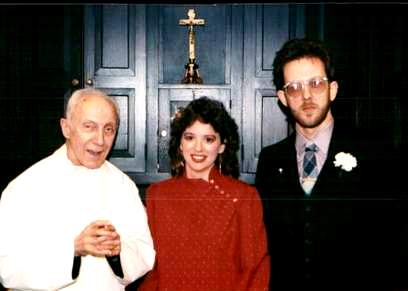
With wife Judy and Servant of God Fr. John A. Hardon, S. J., on the day I was received into the Church: 8 February 1991
(4-25-04)
This is probably the primary written document I have, pertaining to my opinions of Catholicism, as I was just starting to seriously study it. It also strongly puts the lie to claims that I wasn’t a “real” Protestant (James White) or that I never correctly understood sola Scriptura and perspicuity. I did in 1990 and earlier, and was citing Hodge and Calvin.
* * * * *
EL Hamilton (evangelical Protestant) is asking the questions (in blue):
I’d be interested in knowing what teaching(s) of Catholicism you found hardest to embrace during your conversion-study period.
***
Papal and conciliar infallibility.
I don’t necessarily mean historical “scandals” (“this Pope was corrupt”, or “the Crusades were too violent”), but actual dogmatic teachings.
***
That stuff was highly offensive to me as well. I wrote a letter to Karl Keating complaining about all that. Here are some excerpts from it. It was dated 25 February 1990, which was near the beginning of my serious study of Catholicism (initially purely out of curiosity). I had begun my ecumenical group discussions only the month before and this was before I changed my mind on contraception. This is the first time I have ever cited this since my conversion. It may provide some insights to people who wonder how I was thinking when I was a Protestant considering Catholicism:
I am an evangelical with growing and sincere respect for Roman Catholics, largely due to my increased communion with them by virtue of the Operation Rescue movement . . . I consider Catholicism as a fully Christian faith . . . I am, with you, disgusted and scandalized by works such as Boettner’s and Jack Chick’s and all such ilk, which, if any works deserve to be censored, certainly qualify in the highest degree.
I then proceeded to a lengthy exposition on my disagreement with Keating’s constant use of the term “fundamentalist” on the grounds that it paints with too broad a brush, and wrongly included many ecumenical evangelical Protestants (like myself at that time) in its sweeping scope. I argued that this was setting up a straw man and was, though on a much lesser scale, what the anti-Catholics did to Catholics in their literature. I suggested that he use “evangelical” or “Protestant” instead. I wrote, “I’m concerned with being lumped in with people I have very little affinity with.”
After that, I objected to a subtle insinuation Keating made, that Jehovah’s Witnesses were a species of Protestant, and made an argument that if they were similar to any Christian groups, it was Catholicism. I concluded:
The idea of sola Scriptura and individual conscience and study would release thousands of JW’s from their spiritual bondage to false and deceitful leaders. But if it’s so clear that a JW should “check up” on the validity of his leaders by reading the Bible, why should this not be the case with Catholics?
I then strongly objected to an article by William Reichert, entitled “I will be where Peter is,” in This Rock, January 1990 (in retrospect this was really hitting a nerve). I responded to two paragraphs which I described as “logically outrageous,” “rather foolish,” and guilty of “unfounded and illogical conclusions.” I stated that Riechert “betrayed a fundamental misunderstanding of what exactly perspicuity is.” To show what it was, I cited Charles Hodge, backed up with two citations each from St. John Chrysostom and St. Augustine. I wrote:
Therefore, differences over “minor” matters not necessary to salvation do not cast doubt on the concept of perspicuity by definition. Protestants are merely allowing freedom of diversity on matters such as church government, modes of baptism, views on the Lord’s Supper, worship style and liturgy, etc. On central doctrines, we are indeed unified (God , Man, Salvation, Biblical Authority). So we have unity as Christians, at the same time allowing for differences of opinion on non-crucial items, and we all mutually-recognize one another as part of the Body of Christ — something Catholics cannot comprehend because of their different view that the Church is equivalent to an ecclesiastical organization — i.e., Roman Catholicism.
The falsity of that view is well dealt with by Calvin in Book IV of his Institutes. Although it is unfortunate that denominations (usually smaller ones) do split over much more trivial matters than those mentioned above (die to sin, to be sure, on someone’s part), I still prefer this state of affairs to the purely formal “unity” Catholics have.
In theory, no diversity on doctrine is allowed, but in practice, you well know (and I’m familiar with enough Church History) that there is much dissension held privately — notable examples today being widespread Catholic dissent concerning contraception, abortion, and even fornication, but particularly the first, because it is so summarily and disobediently broken. Likewise, theological liberalism looms large in Catholicism, despite this supposed “unity” you claim.
Human nature is everywhere the same, and there will be diversity of opinion, whether due to illogic, different perspectives, evil, conscience, or whatever. We recognize it and allow for its expression, within certain bounds, whereas you attempt to deny and suppress it, which only causes it to flourish and become rebellious in spirit (I see this in countless young former Catholics whose questions were ignored).
Further, it is true that many will differ due to ignorance (Hodge: “things hard to understand”) or evil (Hodge: “all men need the guidance of the Holy Spirit”). These are not incredible assertions nor are they peculiar to Protestants, and they are quite consistent with perspicuity rightly understood, as opposed to the caricature of it by Reichert. The least one can do in “refuting” a position is to portray it accurately (another “straw man”).
Catholics recognize the same two factors in their distinction between formal and material heresy, denoting evil and ignorant differences from catholic Dogma respectively. I can’t resist mentioning in passing the case of Galileo, whose views which were condemned as heresy were neither ignorant nor evil — far from either, whereas his accusers were obviously ignorant and arguably evil as well.
. . . for us, unity is not “a joke.” For the invisible Church is a far more profound unity than a merely formal, artificial, organizational unity, as it is comprised of those truly in Christ, including those now with the Lord — somewhat like your “communion of saints.” You might say we value individual conscience and standing under God more than the unity you aspire to — in fact, we regard separation from a group with which we cannot agree as a duty, not as a dreaded “schism” — far preferable to the spectre of millions of Catholics refusing to honestly acknowledge that they are not “true” or “good” Catholics.
Lastly . . . I would like to see how you would respond to the material enclosed. Are you familiar with a book: The Infallibility of the Church, by George Salmon, Baker Book House, Grand Rapids, MI (orig. 1888)? It is very good (from my perspective!). The photocopies are from a work very well-written and worthwhile (Salmon) — it is not at all stylistically like Boettner. Salmon is an Anglican with much respect for Catholicism.
The fundamental disagreement between Catholics and Protestants is, I believe, the issue of Apostolic Succession, Tradition, and its corollary, Infallibility. Therefore, I’ve set out to show that Catholicism has in fact not been infallible historically, by means of clear logical contradictions and instances of undoubted heresy. If this is shown, then the whole edifice collapses, and you are on the same ground as we are. I think that such an utterly extraordinary and remarkable claim as Infallibility must be prepared to meet objections of example seemingly contradictory to that claim. Thus, out of motives of sincere inquiry and interest, I seek your assistance on that score. Thanks so much for your time.
With respect and sincerity,
Dave Armstrong
And did you resolve that opposition more by 1) convincing yourself that your objections were unfounded, or 2) just deciding to submit to the authority of the church even when you didn’t understand it?
***
Both, but more so, the first. The first thing I changed my mind on was contraception, so that could be classified under “moral theology” or “the moral argument.” But it also related to the history of dogma because I was shocked to discover that all Christians opposed contraception until 1930 (and Church history and doctrinal precedent were highly important to me. I had a strong “historical sense”). In my own developing moral theology (especially all the “sexual” issues which are always controversial — for some odd reason), I had arrived on my own at positions that were invariably held by the Catholic Church all along. I increasingly felt that “here was the place where someone (at last) got it all right — the traditional Christian moral teachings are all firmly in place.”
As for infallibility, I was studying all the “usual suspects”: people like Hans Kung, Johann Joseph Ignaz von Döllinger, and George Salmon (precisely as the anti-Catholics do today: people like William Webster and Jason Engwer and David T. King: those who concentrate on historical critiques). I even worked up a long paper of 95 Feces, containing difficult “problems” of Catholic history and alleged contradictions and so forth, to torment my Catholic friends with, in the discussion meetings I was having at my house. So I was behaving very much like the big bad (cynically chuckling) “Catholic-slayer” and gadfly, who brings up all the “embarrassing” facts of the scandalous history of the Beast (though I was never anti-Catholic, I hasten to add; just thoroughly Protestant, through and through).
Anyway, while I was doing that, I was also fair-minded enough (at first out of sheer curiosity; never thinking I would possibly convert) to read Catholic works, like Karl Adam’s The Spirit of Catholicism, and Chesterton, and Thomas Howard, and Thomas Merton, and Alan Schreck’s Catholic and Christian. And then I took to studying the Protestant Reformation from a Catholic perspective. I discovered that my hero, Martin Luther, was not this perfectly noble guy who was merely bringing the “gospel” back from darkness, etc., and that the actual facts of what happened during that volatile time were immensely more complex than I had been led to believe as a Protestant: hearing only one side all those years.
At length, I read Newman’s Essay on the Development of Christian Doctrine, which brought about a paradigm shift in my thinking. he explained all the facts of doctrinal development in a way far more plausible than I had ever heard before. It was simply a brilliant historical and analogical argument, and I found myself unable to refute it. I was honest enough with myself to admit that I could not, and had to admit that this was a huge problem for me to resolve.
My conversion, then, was a combination af the cumulative effect of three different “strands” of evidences, all pointing in the same direction. This was perfectly consistent (epistemologically) with my apologetic outlook that I had developed over nine years: the idea of cumulative probability or what might be called “plausibility structures.”
So I converted (apart from God’s grace; I am talking specifically about my thought processes — not denying God’s role) because I was convinced on all three grounds. The Catholic arguments were better than the ones I had been setting forth previously. I was simply ignorant about early Protestant history (I accepted what might be called “the Protestant myth of origins” uncritically); I had come to agree on my own with Catholic moral teaching, and the historical arguments of Newman blew Salmon and Kung and all their ilk out of the water, revealing them to be mostly special pleaders or sophists with an axe to grind (which is the way I myself had been acting in my arguments about papal infallibility).
All this stuff led me to the notion that the Catholic Church had a unique status, and so I accepted its authority in faith. Of course, I hadn’t answered every jot and tittle of the arguments I had myself produced (no one ever answers everything; it is unreasonable to think that they can), but I had seen more than enough to come to a place where I was more than rationally justified to accept the authority of the Catholic Church and to reject the Protestant rule of faith (private judgment and sola Scriptura).
So there is faith involved; of course, just as in any religious view. I keep saying: “Christianity is not philosophy.” But at the same time, I was following the direction that my mind and thinking had led me. I would never adopt a view which was contrary to my reason or thinking. Since then, I have become always more convinced, as I keep defending the Catholic faith and observing how weak or nonexistent the opposing arguments are. I didn’t, for example, do all the “biblical Catholicism” stuff I do now, before my conversion. I started that right after my conversion, in an attempt to justify my change of mind to my Protestant friends, and to strengthen my own newfound, fledgling faith. It is then that I learned how very strong the Catholic biblical “case” is.
The version of my conversion that goes into the above dynamics the most, would be: “How Newman Convinced me to Become a Catholic”.
Do you think one of those two approaches is better than the other, with respect to either Catholicism in particular or “mere Christian” apologetics in general?
***
I don’t think we have to choose; consistent with my long-term apologetic outlook. One ought to always have a reasonable faith, supported by as much evidence as one can find (I thoroughly oppose fideism or “pietism” — which attempt to remove reason from the equation). We accept in faith what appears most plausible and likely to be true from our reasoning and examination of competing hypotheses and worldviews. We are intellectually “duty-bound” to embrace the outlook that has been demonstrated (to our own satisfaction, anyway) to be superior to another competing view.
Is that absolute proof? No, of course not. I think “absolute proof” in a strict, rigorous philosophical sense is unable to be obtained about virtually anything. But one accepts Catholicism in and with faith, based on interior witness of the Holy Spirit and outward witness of facts and reason and history; much like one accepts Christianity in general or how the early disciples accepted the Resurrection and the claims of Jesus.
* * * * *
I have been doing apologetics since 1981 (initially influenced by C. S. Lewis, Josh McDowell, and Walter Martin). I was a full-time campus missionary as a Protestant from 1985-1987 and then part-time till 1989. After I converted in late 1990 I kept writing, but had no intention to publish at first (I was writing strictly for my Protestant friends, then, in order to explain / defend my conversion). I happened to meet Fr. Peter Stravinskas in Steubenville at the Defending the Faith Conference in 1992, and gave him copies of some of my writings on Martin Luther. He liked them a lot, and so an article on Luther in his magazine, The Catholic Answer, in 1993, was my first published piece as a Catholic.
So I kept on writing and seeking publication. I got my conversion story in This Rock in late ’93 and then in Surprised by Truth in 1994. The latter, of course, gave me much name exposure (though not one penny in royalties), as it has sold some 200,000 copies.
It is really the Internet that has made so much possible for me. The first, much larger draft of my first book (about 750 pages), A Biblical Defense of Catholicism, was completed in 1994. Fr. John A. Hardon, one of the most respected and orthodox catechists in America, whom I had met in 1990 and with whom I attended many “Ignatian Catechist” courses, recommended it and wrote a foreword. Of course that was a big boost and vote of confidence.
I went online in March 1996 and was active in the Compuserve Religion Forum (where I had the pleasure of meeting the winsome anti-Catholic, David T. King). I started posting excerpts from my book, and shorter articles there. In February 1997 I began my website, where a virtual explosion of writing was able to be promulgated. People like Scott Hahn and Marcus Grodi were saying nice things about my writing, which confirmed to me that I was doing the right thing. After that I just worked worked worked!
My first book (revised, shorter version) was done in May 1996 but was turned down by five publishers. One had actually accepted it (I had a signed contract and an advance), but then business problems set in and they never published it. So — exasperated and absolutely disgusted with publishers — I decided to do it myself with 1stBooks Library in October 2001. It sold well, so that eventually I convinced Sophia Institute Press to pick it up, in 2003. So basically it took me seven years to get published by a “real” publisher.
I lost my delivery job in December 2001 through no fault of my own (they went out of business), — a month after my daughter was born –and so I decided to see if it was feasible for me to be a full-time apologist (which is all I had really wanted to do with my life, since 1981). I was getting good royalties from my book (perfect timing!) and received many donations when I announced what had happened on my website. So I have succeeded as a full-time apologist since then. I’ve also tried to network with virtually all the apologists I know of, by sending out my monthly updates, and keeping in touch, making links, meeting them at Steubenville and other conferences, etc.
I’ve gotten to the place where I am through endless hard work — much of it without any remuneration at all — (basically, I had to wait 20 years to really be able to devote myself totally to my calling in life), determination, and a spiritual assurance that this is my vocation. I have tried to simply do my writing and let whatever value it has speak for itself, with a bare minimum of “begging.”
But I do need contributors badly, and I hope whoever reads this and whoever likes my work, or has been helped by it in some fashion, will prayerfully consider becoming a monthly supporter or one-time contributor, or buying one or more of my books. I have to feed my family, and the Bible says that “the laborer is worthy of his wage.” By contributing, you help to make possible, conversions and a rejuvenated faith-life for many people (I know, because I get letters from folks saying how their lives have been changed, by God’s grace, helped in some small way by this unworthy vessel). Thanks!
***
Previous Post
January 11, 2016
Dialogue on the Woman of Revelation 12 (Mary?)
Next Post
January 12, 2016 My Earliest Catholic Apologetics (1990-1995)
Browse Our Archives
Select a Category & Last Things About Me Anti-Catholicism Atheism & Agnosticism Baptism and Sacramentalism Bible and Tradition Blessed Virgin Mary Books by Dave Armstrong C. S. Lewis Calvinism & General Protestantism Catholic Apologetics Catholic Apologists Catholic conversion Catholic converts Christmas Church (Ecclesiology) Church History Conversion and Converts Development of Doctrine Eastern Orthodoxy Ecumenism & Christian Unity Eucharist & Liturgy Fathers of the Church French Translations G. K. Chesterton Hell Hell & Satan Hell & Satan & Last Things Heresies & Comparative Religion Holistic Health Inquisition & Crusades & Scandals James White Jews & Judaism & Old Testament John Calvin John Henry Newman Liberal / Modernist Theology Life Issues Literary Resume Lutheranism Mariology Martin Luther Music Orthodoxy Papacy & Infallibility Personal Page Philosophy & Science Political & Ethical & Moral Issues Protestant Persecution & Intolerance Protestantism Purgatory Purgatory & Penance Romantic & Imaginative Theology Saints & Purgatory & Penance Salvation Salvation & Justification Satan & Last Things Sexuality and Gender Issues Spanish Translations Traditionalism vs. Radical Catholic Reactionaries Traducciones al español / tradução para português Trinitarianism & Christology Uncategorized Videos
Select a Month October 2026 September 2026 August 2026 July 2026 June 2026 May 2026 April 2026 March 2026 February 2026 January 2026 December 2025 November 2025 October 2025 September 2025 August 2025 July 2025 June 2025 May 2025 April 2025 March 2025 February 2025 January 2025 December 2024 November 2024 October 2024 September 2024 August 2024 July 2024 June 2024 May 2024 April 2024 March 2024 February 2024 January 2024 December 2023 November 2023 October 2023 September 2023 August 2023 July 2023 June 2023 May 2023 April 2023 March 2023 February 2023 January 2023 December 2022 November 2022 October 2022 September 2022 August 2022 July 2022 June 2022 May 2022 April 2022 March 2022 February 2022 January 2022 December 2021 November 2021 October 2021 September 2021 August 2021 July 2021 June 2021 May 2021 April 2021 March 2021 February 2021 January 2021 December 2020 November 2020 October 2020 September 2020 August 2020 July 2020 June 2020 May 2020 April 2020 March 2020 February 2020 January 2020 December 2019 November 2019 October 2019 September 2019 August 2019 July 2019 June 2019 May 2019 April 2019 March 2019 February 2019 January 2019 December 2018 November 2018 October 2018 September 2018 August 2018 July 2018 June 2018 May 2018 April 2018 March 2018 February 2018 January 2018 December 2017 November 2017 October 2017 September 2017 August 2017 July 2017 June 2017 May 2017 April 2017 March 2017 February 2017 January 2017 December 2016 November 2016 October 2016 September 2016 August 2016 July 2016 June 2016 May 2016 April 2016 March 2016 February 2016 January 2016 December 2015 November 2015 October 2015 September 2015 August 2015 July 2015 June 2015 May 2015 April 2015 March 2015 February 2015 January 2015 December 2014 November 2014 October 2014 September 2014 August 2014 July 2014 June 2014 April 2014 March 2014 February 2014 January 2014 December 2013 November 2013 October 2013 September 2013 August 2013 July 2013 June 2013 April 2013 March 2013 February 2013 January 2013 December 2012 November 2012 October 2012 September 2012 August 2012 July 2012 June 2012 May 2012 April 2012 March 2012 February 2012 January 2012 December 2011 November 2011 October 2011 September 2011 August 2011 July 2011 June 2011 April 2011 March 2011 February 2011 October 2010 September 2010 August 2010 July 2010 April 2010 March 2010 December 2009 October 2009 August 2009 July 2009 June 2009 May 2009 March 2009 February 2009 October 2008 September 2008 April 2008 March 2008 February 2008 January 2008 December 2007 November 2007 October 2007 May 2007 March 2007 February 2007 January 2007 November 2006 October 2006 September 2006 August 2006 July 2006 June 2006 May 2006 April 2006 March 2006 February 2006 October 2005 June 2005 April 2005 February 2005 July 2004 May 2004 April 2004
Follow Us!
TAKE THE
Religious Wisdom Quiz
Who prayed in a den of lions?
Select your answer to see how you score.
Elijah Noah Daniel David
Books by This Author Books by Dave Armstrong
Related posts from Biblical Evidence for Catholicism

On Protestant Explanations of Catholic Conversion
Biblical Evidence for Catholicism

Why Wes Huff (and Everyone) Should Be Catholic
Biblical Evidence for Catholicism

100 Motown Stars: Info. & Links / My...
Biblical Evidence for Catholicism

Invocation of Saints: Catholic Scholars vs. Me? Nope!
Biblical Evidence for Catholicism
TRENDING AT PATHEOS Catholic

Swimfan: Forgotten Aughts Pleasures
This is a recovery effort. In 2002, My Big Fat Greek Wedding...

Top Three Anti-Catholic Lies About Catholicism
This is my initial transcript for the video, "THE 3 WORST...

Pope Leo Celebrates Mass for Nurses & Docs...
I don't have any idea how he did it, but Pope Leo...

The Sermon on the Mount, Part I: Matthew...
The Sermon on the Mount, Part I (Matthew 4:12-5:12) St. Matthew moves...

What's up from Crossway: Reviewing some of their latest A few weeks...

Janie Learns the Way of the Cross: A...
Teaching children about Jesus' Passion can be challenging. Many parents and educators...
view all Catholic blogs
Ad-Free & Subscriber Log-In Subscription Support
- About Us
- 2026 Calendar
- Videos
- Podcasts
- Library of World Religions
- Faith In Media Tracker
- Advertise With Us
- Write for Us
- Privacy Policy
- Terms of Service
- Do Not Sell My Data
- Contact Us
- Radiant Digital
- Manage Newsletter Subscriptions
- Unsubscribe From Notifications
- Sitemap
Copyright 2008-2026, Patheos. All rights reserved.
Subscription Support Ad-Free & Subscriber Log-In
Follow Patheos