
BuddhistCatholicContemplativeEvangelicalGeneral ChristianHinduJewishLatter-day SaintMuslimNew VisionsProgressive Christian
Beliefs
- Buddhist
- Catholic
- Contemplative
- Evangelical
- General Christian
- Hindu
- Jewish
- Latter-day Saint
- More Voices
- Muslim
- New Visions
- Pagan
- Progressive Christian
Topics
- Religion News
- Food and Religion
- Sports and Religion
- Religious Art
- Religious Music and Entertainment
- Religious Events
- History and Religion
- Style and Religion
- Politics and Religion
- Women in Religion
- Recreation Outdoors and Religion
- Business Finance and Religion
- Careers Workplace and Religion
- Education and Religion
- Family Parenting and Religion
- Health Fitness and Religion
- Home and Religion
- Relationships and Religion
- Technology and Religion
- Travel and Religion
Columnists
- Buddhist Columnists
- Business Finance and Religion Columnists
- Careers Workplace and Religion Columnists
- Catholic Columnists
- Contemplative Columnists
- Education and Religion Columnists
- Evangelists Columnists
- Family Parenting and Religion Columnists
- General Christian Columnists
- Health Fitness and Religion Columnists
- Hindu Columnists
- History and Religion Columnists
- Home and Religion Columnists
- Jewish Columnists
- More Voices Columnists
- Latter Day Columnists
- Muslim Columnists
- New Visions Columnists
- Nonreligious Columnists
- Pagan Columnists
- Politics and Religion Columnists
- Progressive Columnists
- Recreation Outdoors and Religion Columnists
- Relationships and Religion Columnists
- Religion News Columnists
- Religious Art Columnists
- Religious Events Columnists
- Religious Music and Entertainment Columnists
- Sports and Religion Columnists
- Style and Religion Columnists
- Technology and Religion Columnists
- Travel and Religion Columnists
- Women in Religion Columnists
Resource Library
- 2026 Calendar
- Library of World Religions
- The 100 Most Holy Places on Earth
- Patheos Answers
- Podcasts
- Videos
- Faith Leaders Database
- Anglican Episcopalian
- Bahai
- Baptist
- Buddhism
- Christianity
- Confucianism
- Eastern Orthodoxy
- Hinduism
- Holiness and Pentecostal
- ISKCON
- Islam
- Judaism
- Lutheran
- Methodist
- The Church of Jesus Christ of Latter-day Saints
- New Age
- Paganism
- Presbytarian and Reformed
- Protestantism
- Religion Behind the Scenes
- Roman Catholic
- Scientology
- Shia Islam
- Sikhism
- Sufism
- Sunni Islam
- Taoism
- Zen
- See all religions
Research Tools
 Ad-Free & Subscriber Log-In Subscription Support
Ad-Free & Subscriber Log-In Subscription Support
Follow Patheos 

- Trending:
- Forgiveness
- |
- Marriage
- |
- Consciousness
- |
- Death Penalty
- |
- Election
- |
- Halloween

-
About
-
Catholic Apologetics
-
Church History
-
Great Apologists
-
Christian Worldview
-
Protestantism & Misc.
- Home
- Catholic
- History and Religion
- Clerical Celibacy: Dialogue with John Calvin
Clerical Celibacy: Dialogue with John Calvin
Last updated on: April 3, 2017 at 5:06 pm by Dave Armstrong
Clerical Celibacy: Dialogue with John Calvin 2017-04-03T17:06:10-04:00 Dave Armstrong
Patheos Explore the world's faith through different perspectives on religion and spirituality! Patheos has the views of the prevalent religions and spiritualities of the world.
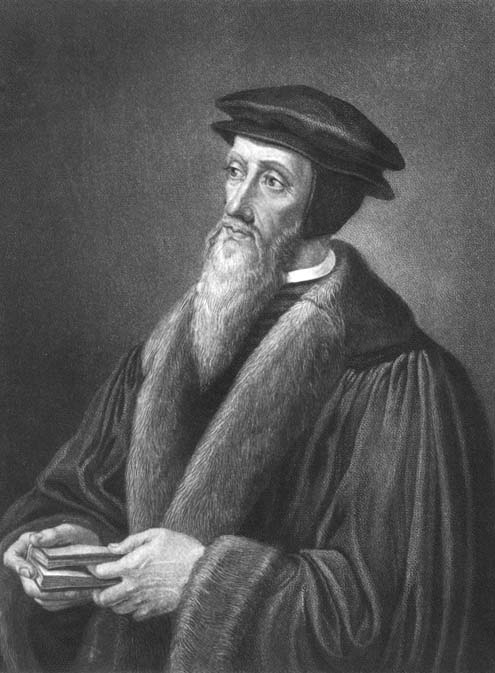
Portrait of John Calvin (1509-1564 ) from the 16th century (unknown) [public domain / Wikimedia Commons]

* * *
(9-17-09)
* * *
This paper deals with John Calvin’s arguments in Institutes of the Christian Religion, Book IV, 12:23-28 (using the online public domain version). I’ve abridged his portions in a few portions for the sake of better flow of dialogue. Anyone wishing to read all his words or see the complete context can consult the online version. Calvin’s words will be in blue.
* * * * *
23. Of the celibacy of priests, in which Papists place the whole force of ecclesiastical discipline. This impious tyranny refuted from Scripture. An objection of the Papists disposed of.
In one thing they are more than rigid and inexorable—in not permitting priests to marry. It is of no consequence to mention with what impunity whoredom prevails among them, and how, trusting to their vile celibacy, they have become callous to all kinds of iniquity.
***
Sure, there was a lot of corruption in that time. But that calls for reform of the thing (the virtue of celibacy), and spiritual revival, not destruction of a practice good in and of itself, and altogether biblical (1 Corinthians 7).
***
The prohibition, however, clearly shows how pestiferous all traditions are, since this one has not only deprived the Church of fit and honest pastors, but has introduced a fearful sink of iniquity, and plunged many souls into the gulf of despair.
***
Anyone who is not called to celibacy should avoid it, and get married. Is this not utterly obvious? Priests are not pressed into service at gunpoint, or involuntarily castrated. One wearies of the continual nonsense that is spouted by Protestants in their detestation of a wonderfully pious practice.
***
Certainly, when marriage was interdicted to priests, it was done with impious tyranny, not only contrary to the word of God, but contrary to all justice.
***
All institutions in life have requirements. Why should the Catholic Church be any different? It’s not required of everyone; only those who wish to be priests, by God’s calling.
***
First, men had no title whatever to forbid what God had left free;
***
Then why did Calvin rule Geneva with such a dictatorial hand, if he was so intensely concerned with personal freedom?
***
secondly, it is too clear to make it necessary to give any lengthened proof that God has expressly provided in his Word that this liberty shall not be infringed. I omit Paul’s injunction, in numerous passages, that a bishop be the husband of one wife;
***
Sure; if a bishop is married at all. He should not be guilty of bigamy or divorce and “remarriage”! That doesn’t mean that the Church has no jurisdiction to require celibacy if she so desires.
***
but what could be stronger than his declaration, that in the latter days there would be impious men “forbidding to marry”? (1 Tim. 4:3)
Catholics do not forbid anyone to marry, strictly speaking. The Church simply says that she (and not even in its entirety, as Eastern Catholics allow married priests) wishes to draw for her priests exclusively from that portion of men who are already called by God to celibacy (1 Cor 7:17), in order to secure an undistracted devotion to the Lord (1 Cor 7:32, 35). The Church is not approaching a man who wants to be married and forbidding him to do so (i.e., going against his existing vocation and station in life); rather, she is receiving men who voluntarily follow the divine vocation of celibacy and who are voluntarily following a call by God to be priests.
Why this is the least bit controversial has always been a complete puzzle to me. I can only chalk it up to good old prejudice. It’s a way to lie about and bash the Catholic Church, and it is an emotional subject, so it is used for propaganda, with little regard for reason or biblical rationale. It plays well to the crowds. It’s demagoguery, pure and simple.
***
Such persons he calls not only impostors, but devils.
Yes, but Calvin simply assumes this is applying to a practice such as that of the Catholic Church, rather than pseudo-ascetic extreme sects like the Manichees and Gnostics and (later) Albigensians and suchlike. The Catholic Church is following the advice of St. Paul in 1 Corinthians 7. If Calvin doesn’t like that, he needs to attack the Apostle Paul directly. That is his burden. Many Protestant commentaries agree with my assessment of 1 Timothy 4:3, over against Calvin’s anti-Catholic fantasies:
The ascetic tendencies indicated by these prohibitions developed earlier than these Epistles among the Essenes . . . who repudiated marriage except as a necessity for preserving the race, and allowed it only under protest and under stringent regulations . . . The prohibitions above named were imposed by the later Gnosticism of the second century.
(Marvin Vincent, Word Studies in the New Testament, Grand Rapids, Michigan: Eerdmans, 1980 [originally 1887], Vol. IV, 245)
See Col. 2:16, 21f., where Paul condemns the ascetic practices of the Gnostics. The Essenes, Therapeutae and other oriental sects forbade marriage. In 1 Cor. 7 Paul does not condemn marriage.
(A. T. Robertson, Word Pictures in the New Testament, Nashville, Tennessee: Broadman Press, 1931, Vol. IV, 578)
The assertions of these verses are significant when studied in relation to the Gnostic and dualistic views that matter is evil and not created by God.
(The Eerdmans Bible Commentary, edited by D. Guthrie et al, Grand Rapids, Michigan: Eerdmans, 3rd edition, 1970, 1173)
***
We have therefore a prophecy, a sacred oracle of the Holy Spirit, intended to warn the Church from the outset against perils, and declaring that the prohibition of marriage is a doctrine of devils.
We agree, and we deny that this applies to the Catholic position. Calvin — perhaps because of his rush to condemn Catholicism from top to bottom — doesn’t grasp the fundamental distinctions involved.
***
They think that they get finely off when they wrest this passage, and apply it to Montanus, the Tatians, the Encratites, and other ancient heretics. These (they say) alone condemned marriage; we by no means condemn it, but only deny it to the ecclesiastical order, in whom we think it not befitting.
Much better. This approaches a position of actually understanding that which he opposes.
***
As if, even granting that this prophecy was primarily fulfilled in those heretics, it is not applicable also to themselves;
But it’s not, because our position (rightly understood) is also St. Paul’s. If Calvin wants to attack it, he should, to be consistent, go after Paul too. But of course he does not. He’d rather play sophistical games.
***
or, as if one could listen to the childish quibble that they do not forbid marriage, because they do not forbid it to all. This is just as if a tyrant were to contend that a law is not unjust because its injustice presses only on a part of the state.
I repeat: all institutions impose rules and regulations. All organizations have entrance requirements. It is a part of life and reality. The Catholic Church has a perfect right and liberty under God to have this restriction, based on the teachings of St. Paul. I don’t think it is even arguable. This discussion is often conducted on a purely irrational, emotional plane.
***
24. An argument for the celibacy of priests answered.
They object that there ought to be some distinguishing mark between the clergy and the people; as if the Lord had not provided the ornaments in which priests ought to excel.
St. Paul seemed to think that celibacy was a desired spiritual state, as long as one is called to it. Jesus was single. All of His disciples appear to have been also (Peter seems to have agreed with his wife to separate for the sake of ministry). We treasure celibacy and we treasure marriage (making it a sacrament, whereas Calvin and Luther removed sacramentality from it). This is the biblical, Pauline, both/and. But Calvin has no place for Paul’s extolling of celibacy for the sake of greater service to the Lord, in his system. So which outlook is more biblical and well-rounded? Is it not utterly obvious? What would Calvin do with, for example, the following passage from the lips of our Lord and Savior Jesus Christ?:
Luke 18:28-20 And Peter said, “Lo, we have left our homes and followed you.” [29] And he said to them, “Truly, I say to you, there is no man who has left house or wife or brothers or parents or children, for the sake of the kingdom of God, [30] who will not receive manifold more in this time, and in the age to come eternal life.”
Why should we Catholics disagree with Jesus? The Catholic Church is not even requiring this much. She doesn’t command a man to leave his wife or children or parents. Rather, she accepts men who have already felt the call or vocation of celibacy. Again, Calvin’s beef is with Jesus Himself, Who sanctioned far more of a “deprivation of liberty” or “imprisoning conscience” than the Catholic Church ever supposedly did.
***
Thus they charge the apostle with having disturbed the ecclesiastical order, and destroyed its ornament, when, in drawing the picture of a perfect bishop, he presumed to set down marriage among the other endowments which he required of them.
At times there have been married bishops, because this is a disciplinary matter, not a dogmatic one. It’s neither here nor there.
***
I am aware of the mode in which they expound this—viz. that no one was to be appointed a bishop who had a second wife. This interpretation, I admit, is not new; but its unsoundness is plain from the immediate context, which prescribes the kind of wives whom bishops and deacons ought to have. Paul enumerates marriage among the qualities of a bishop; . . .
***
We have married priests today in the Eastern Rites, and there have been married bishops in the past. Both/and. But Calvinism and general Protestantism sure don’t have much of a tradition of single pastors, do they? They accept one-half of Paul’s teaching and not the other, and this is the problem.
***
Let every one consider with himself from what forge these things have come. Christ deigns so to honour marriage as to make it an image of his sacred union with the Church. What greater eulogy could be pronounced on the dignity of marriage?
None, but it is irrelevant to the point at hand.
***
How, then, dare they have the effrontery to give the name of unclean and polluted to that which furnishes a bright representation of the spiritual grace of Christ?
***
The same way that Jesus Himself (along with Paul) does:
Matthew 19:10-12 The disciples said to him, “If such is the case of a man with his wife, it is not expedient to marry.” [11] But he said to them, “Not all men can receive this saying, but only those to whom it is given. [12] For there are eunuchs who have been so from birth, and there are eunuchs who have been made eunuchs by men, and there are eunuchs who have made themselves eunuchs for the sake of the kingdom of heaven. He who is able to receive this, let him receive it.”
Obviously, then, Calvin and many Protestants are among those who can’t “receive” this plain teaching of Jesus. That’s not our problem, that they are so unwilling to accept certain parts of inspired divine revelation. We show no such reluctance and lack of faith and trust in God’s designs.
***
25. Another argument answered.
Though their prohibition is thus clearly repugnant to the word of God,
Really? I should think that the truth is clearly quite the opposite, once all the relevant biblical data is examined, and clear thinking brought to bear, rather than irrational emotionalism and a slanderous anti-Catholic motivation.
***
they, however, find something in the Scriptures to defend it. The Levitical priests, as often as their ministerial course returned, behoved to keep apart from their wives, that they might be pure and immaculate in handling sacred things; and it were therefore very indecorous that our sacred things, which are more noble, and are ministered every day, should be handled by those who are married: as if the evangelical ministry were of the same character as the Levitical priesthood. . . . the apostle declares distinctly, without reservation, “Marriage is honourable in all, and the bed undefiled; but whoremongers and adulterers God will judge” (Heb. 13:4). And the apostles showed, by their own example, that marriage is not unbefitting the holiness of any function, however excellent; for Paul declares, that they not only retained their wives, but led them about with them (1 Cor. 9:5).
***
Why is 1 Corinthians 7 overlooked throughout the entire section of Calvin’s wrongheaded, unbiblical rantings against celibacy? The Levitical priests offer one analogy, but Calvin neglects to see it based on sweeping bigotry [a portion of the deleted portion above]: “ecclesiastical pastors do not sustain this character in the present day.” This is hardly intellectually impressive.
***
26. Another argument answered.
Then how great the effrontery when, in holding forth this ornament of chastity as a matter of necessity, they throw the greatest obloquy on the primitive Church, which, while it abounded in admirable divine erudition, excelled more in holiness. For if they pay no regard to the apostles (they are sometimes wont strenuously to contemn them),
Who is not paying attention? Calvin has ignored 1 Corinthians 7, and he has ignored the fact of Paul’s and the twelve disciples’ celibacy and separation from wives in some cases, for the sake of ministry.
***
what, I ask, will they make of all the ancient fathers, who, it is certain, not only tolerated marriage in the episcopal order, but also approved it?
Nothing, as it is irrelevant: celibacy being a matter of discipline, not dogma.
***
They, forsooth, encouraged a foul profanation of sacred things when the mysteries of the Lord were thus irregularly performed by them. In the Council of Nice, indeed, there was some question of proclaiming celibacy: as there are never wanting little men of superstitious minds, who are always devising some novelty as a means of gaining admiration for themselves.
St. Paul’s express teachings are superstitious novelties? That is an odd (beyond bizarre) thing for a Protestant to imply.
***
What was resolved? The opinion of Paphnutius was adopted, who pronounced legitimate conjugal intercourse to be chastity (Hist. Trip. Lib. 2 c. 14). The marriage of priests, therefore, continued sacred, and was neither regarded as a disgrace, nor thought to cast any stain on their ministry.
***
They were less conformed to the Pauline model in those days, but that doesn’t mean the Pauline model cannot be followed should the Church decide to make it normative.
***
27. An argument drawn from the commendation of virginity as superior to marriage. Answer.
In the times which succeeded, a too superstitious admiration of celibacy prevailed. Hence, ever and anon, unmeasured encomiums were pronounced on virginity, so that it became the vulgar belief that scarcely any virtue was to be compared to it. And although marriage was not condemned as impurity, yet its dignity was lessened, and its sanctity obscured;
No; only from Calvin’s dichotomous “either/or” mentality does this follow. Catholics think in “both/and” terms.
***
so that he who did not refrain from it was deemed not to have a mind strong enough to aspire to perfection.
We can strive for perfection in whatever state of life God has called us to.
***
Hence those canons which enacted, first, that those who had attained the priesthood should not contract marriage; and, secondly, that none should be admitted to that order but the unmarried, or those who, with the consent of their wives, renounced the marriage-bed.
That is, just as Jesus Himself sanctioned (Luke 18:29).
***
These enactments, as they seemed to procure reverence for the priesthood, were, I admit, received even in ancient times with great applause. But if my opponents plead antiquity, my first answer is, that both under the apostles, and for several ages after, bishops were at liberty to have wives: that the apostles themselves, and other pastors of primitive authority who succeeded them, had no difficulty in using this liberty, and that the example of the primitive Church ought justly to have more weight than allow us to think that what was then received and used with commendation is either illicit or unbecoming.
Scripture itself: the words of our Lord and the Apostle Paul carry as much weight in the scheme of things as the prevailing practices of the early Church (assuming for the sake of argument that it was as Calvin describes).
***
My second answer is, that the age, which, from an immoderate affection for virginity, began to be less favourable to marriage, did not bind a law of celibacy on the priests, as if the thing were necessary in itself, but gave a preference to the unmarried over the married.
Hence, the Western, Latin Rites in Catholicism take one path, and the Eastern Rites another. Both/and. But Protestantism mostly teaches Only, only. Celibacy is frowned upon, especially in pastors, and this is an unbiblical, un-Pauline attitude.
***
28. The subject of celibacy concluded. This error not favoured by all ancient writers.
Therefore, as often as the defenders of this new tyranny appeal to antiquity in defence of their celibacy, so often should we call upon them to restore the ancient chastity of their priests, to put away adulterers and whoremongers, . . .
***All good Christians desire such a reform in the clergy and in all Christians; indeed all men, if it were possible.
***
. . . the better-hearted may understand the effrontery of our enemies in employing the name of antiquity to defame the holy marriage of priests. In regard to the Fathers, whose writings are extant, none of them, when they spoke their own mind, with the exception of Jerome, thus malignantly detracted from the honour of marriage.
That’s what I have been contending: Catholics think very highly of marriage!
***
We will be contented with a single passage from Chrysostom, because he being a special admirer of virginity, cannot be thought to be more lavish than others in praise of matrimony. Chrysostom thus speaks: “The first degree of chastity is pure virginity; the second, faithful marriage. Therefore, a chaste love of matrimony is the second species of virginity” (Chrysost. Hom. de Invent. Crucis.).
Chastity is not confined to the unmarried, because it is ultimately a state of heart and mind.
Previous Post
January 4, 2016
Mandatory Priestly Celibacy: New (?) Argument
Next Post

January 5, 2016 Sacred / Immaculate Heart Devotions and the Bible
Browse Our Archives
Select a Category & Last Things About Me Anti-Catholicism Atheism & Agnosticism Baptism and Sacramentalism Bible and Tradition Blessed Virgin Mary Books by Dave Armstrong C. S. Lewis Calvinism & General Protestantism Catholic Apologetics Catholic Apologists Catholic conversion Catholic converts Christmas Church (Ecclesiology) Church History Conversion and Converts Development of Doctrine Eastern Orthodoxy Ecumenism & Christian Unity Eucharist & Liturgy Fathers of the Church French Translations G. K. Chesterton Hell Hell & Satan Hell & Satan & Last Things Heresies & Comparative Religion Holistic Health Inquisition & Crusades & Scandals James White Jews & Judaism & Old Testament John Calvin John Henry Newman Liberal / Modernist Theology Life Issues Literary Resume Lutheranism Mariology Martin Luther Music Orthodoxy Papacy & Infallibility Personal Page Philosophy & Science Political & Ethical & Moral Issues Protestant Persecution & Intolerance Protestantism Purgatory Purgatory & Penance Romantic & Imaginative Theology Saints & Purgatory & Penance Salvation Salvation & Justification Satan & Last Things Sexuality and Gender Issues Spanish Translations Traditionalism vs. Radical Catholic Reactionaries Traducciones al español / tradução para português Trinitarianism & Christology Uncategorized Videos
Select a Month October 2026 September 2026 August 2026 July 2026 June 2026 May 2026 April 2026 March 2026 February 2026 January 2026 December 2025 November 2025 October 2025 September 2025 August 2025 July 2025 June 2025 May 2025 April 2025 March 2025 February 2025 January 2025 December 2024 November 2024 October 2024 September 2024 August 2024 July 2024 June 2024 May 2024 April 2024 March 2024 February 2024 January 2024 December 2023 November 2023 October 2023 September 2023 August 2023 July 2023 June 2023 May 2023 April 2023 March 2023 February 2023 January 2023 December 2022 November 2022 October 2022 September 2022 August 2022 July 2022 June 2022 May 2022 April 2022 March 2022 February 2022 January 2022 December 2021 November 2021 October 2021 September 2021 August 2021 July 2021 June 2021 May 2021 April 2021 March 2021 February 2021 January 2021 December 2020 November 2020 October 2020 September 2020 August 2020 July 2020 June 2020 May 2020 April 2020 March 2020 February 2020 January 2020 December 2019 November 2019 October 2019 September 2019 August 2019 July 2019 June 2019 May 2019 April 2019 March 2019 February 2019 January 2019 December 2018 November 2018 October 2018 September 2018 August 2018 July 2018 June 2018 May 2018 April 2018 March 2018 February 2018 January 2018 December 2017 November 2017 October 2017 September 2017 August 2017 July 2017 June 2017 May 2017 April 2017 March 2017 February 2017 January 2017 December 2016 November 2016 October 2016 September 2016 August 2016 July 2016 June 2016 May 2016 April 2016 March 2016 February 2016 January 2016 December 2015 November 2015 October 2015 September 2015 August 2015 July 2015 June 2015 May 2015 April 2015 March 2015 February 2015 January 2015 December 2014 November 2014 October 2014 September 2014 August 2014 July 2014 June 2014 April 2014 March 2014 February 2014 January 2014 December 2013 November 2013 October 2013 September 2013 August 2013 July 2013 June 2013 April 2013 March 2013 February 2013 January 2013 December 2012 November 2012 October 2012 September 2012 August 2012 July 2012 June 2012 May 2012 April 2012 March 2012 February 2012 January 2012 December 2011 November 2011 October 2011 September 2011 August 2011 July 2011 June 2011 April 2011 March 2011 February 2011 October 2010 September 2010 August 2010 July 2010 April 2010 March 2010 December 2009 October 2009 August 2009 July 2009 June 2009 May 2009 March 2009 February 2009 October 2008 September 2008 April 2008 March 2008 February 2008 January 2008 December 2007 November 2007 October 2007 May 2007 March 2007 February 2007 January 2007 November 2006 October 2006 September 2006 August 2006 July 2006 June 2006 May 2006 April 2006 March 2006 February 2006 October 2005 June 2005 April 2005 February 2005 July 2004 May 2004 April 2004
Follow Us!
TAKE THE
Religious Wisdom Quiz
According to 1 John, what does perfect love do?
Select your answer to see how you score.
Never fails Covers a multitude of sins Drives out fear Fulfills all the law
Books by This Author Books by Dave Armstrong
Related posts from Biblical Evidence for Catholicism

Top Ten Anti-Catholic Lies (#10-7)
Biblical Evidence for Catholicism

Jesus Founded the [Catholic] Church. If Not Him,...
Biblical Evidence for Catholicism

Jerusalem Council vs. James White & Sola Scriptura
Biblical Evidence for Catholicism

Apostolic Succession: 40 Biblical Arguments
Biblical Evidence for Catholicism
TRENDING AT PATHEOS Catholic

The Sermon on the Mount, Part I: Matthew...
The Sermon on the Mount, Part I (Matthew 4:12-5:12) St. Matthew moves...

What's up from Crossway: Reviewing some of their latest A few weeks...

Janie Learns the Way of the Cross: A...
Teaching children about Jesus' Passion can be challenging. Many parents and educators...

Looking For Good Catholic Writing - October 2026
He alone extends the heavens, and he walks upon the waves of...

In "Irreplaceable," our book on vocation and technology, Trevor Sutton and I...

I was strolling through the top floor of the brand new Parthenon...
view all Catholic blogs
Ad-Free & Subscriber Log-In Subscription Support
- About Us
- 2026 Calendar
- Videos
- Podcasts
- Library of World Religions
- Faith In Media Tracker
- Advertise With Us
- Write for Us
- Privacy Policy
- Terms of Service
- Do Not Sell My Data
- Contact Us
- Radiant Digital
- Manage Newsletter Subscriptions
- Unsubscribe From Notifications
- Sitemap
Copyright 2008-2026, Patheos. All rights reserved.
Subscription Support Ad-Free & Subscriber Log-In
Follow Patheos