
BuddhistCatholicContemplativeEvangelicalGeneral ChristianHinduJewishLatter-day SaintMuslimNew VisionsProgressive Christian
Beliefs
- Buddhist
- Catholic
- Contemplative
- Evangelical
- General Christian
- Hindu
- Jewish
- Latter-day Saint
- More Voices
- Muslim
- New Visions
- Pagan
- Progressive Christian
Topics
- Religion News
- Food and Religion
- Sports and Religion
- Religious Art
- Religious Music and Entertainment
- Religious Events
- History and Religion
- Style and Religion
- Politics and Religion
- Women in Religion
- Recreation Outdoors and Religion
- Business Finance and Religion
- Careers Workplace and Religion
- Education and Religion
- Family Parenting and Religion
- Health Fitness and Religion
- Home and Religion
- Relationships and Religion
- Technology and Religion
- Travel and Religion
Columnists
- Buddhist Columnists
- Business Finance and Religion Columnists
- Careers Workplace and Religion Columnists
- Catholic Columnists
- Contemplative Columnists
- Education and Religion Columnists
- Evangelists Columnists
- Family Parenting and Religion Columnists
- General Christian Columnists
- Health Fitness and Religion Columnists
- Hindu Columnists
- History and Religion Columnists
- Home and Religion Columnists
- Jewish Columnists
- More Voices Columnists
- Latter Day Columnists
- Muslim Columnists
- New Visions Columnists
- Nonreligious Columnists
- Pagan Columnists
- Politics and Religion Columnists
- Progressive Columnists
- Recreation Outdoors and Religion Columnists
- Relationships and Religion Columnists
- Religion News Columnists
- Religious Art Columnists
- Religious Events Columnists
- Religious Music and Entertainment Columnists
- Sports and Religion Columnists
- Style and Religion Columnists
- Technology and Religion Columnists
- Travel and Religion Columnists
- Women in Religion Columnists
Resource Library
- 2026 Calendar
- Library of World Religions
- The 100 Most Holy Places on Earth
- Patheos Answers
- Podcasts
- Videos
- Faith Leaders Database
- Anglican Episcopalian
- Bahai
- Baptist
- Buddhism
- Christianity
- Confucianism
- Eastern Orthodoxy
- Hinduism
- Holiness and Pentecostal
- ISKCON
- Islam
- Judaism
- Lutheran
- Methodist
- The Church of Jesus Christ of Latter-day Saints
- New Age
- Paganism
- Presbytarian and Reformed
- Protestantism
- Religion Behind the Scenes
- Roman Catholic
- Scientology
- Shia Islam
- Sikhism
- Sufism
- Sunni Islam
- Taoism
- Zen
- See all religions
Research Tools
 Ad-Free & Subscriber Log-In Subscription Support
Ad-Free & Subscriber Log-In Subscription Support
Follow Patheos 

- Trending:
- Forgiveness
- |
- Marriage
- |
- Consciousness
- |
- Death Penalty
- |
- Election
- |
- Halloween

-
About
-
Catholic Apologetics
-
Church History
-
Great Apologists
-
Christian Worldview
-
Protestantism & Misc.
- Home
- Catholic
- History and Religion
- Catholic Compassion and Beggars on the Street
Catholic Compassion and Beggars on the Street
Last updated on: March 29, 2017 at 3:09 pm by Dave Armstrong
Catholic Compassion and Beggars on the Street 2017-03-29T15:09:56-04:00 Dave Armstrong
Patheos Explore the world's faith through different perspectives on religion and spirituality! Patheos has the views of the prevalent religions and spiritualities of the world.
What is Our Responsibility? / Analysis of Poverty and Its Causes and Solutions
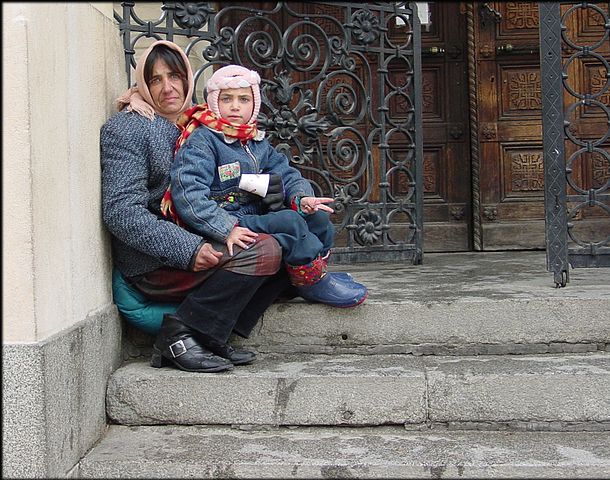
Mother and child on the steps of the Russian Orthodox Church in Sofia, Bulgaria (2-14-06) [Wikimedia Commons / Creative Commons Attribution 2.0 Generic license]

***
(12-30-11)
* * * * *
My friend Brent Robbins sent me the following “self-examination” of sorts and made a request that I write about it, if possible:
I get panhandled all the time by supposed homeless people while walking down the streets of Seattle. There is a person on a street corner holding up a cardboard sign at every stop light as well. I even get panhandled at church after mass! It’s kind of epidemic. In all honesty, my reaction is pretty standardized when someone approaches me, “NO! Leave me alone!”
I assume they are alcoholics, drug addicts, potential muggers looking for an opening or legitimate people needing help. I can’t tell their true intentions so I treat them all the same. Honestly, if I stopped and truly tried to help each person that panhandled me, I literally would never make an appointment or even make it anywhere. Plus, sometimes I fear for my safety or fear being put in a bad position. Anyone that lives in a large city would know what I’m talking about.
With all that, I have questioned my technique and don’t think Jesus would do that. On the flip side, I’m not God, so I give myself slack. I am a big supporter of donating and volunteering at homeless shelters and food kitchens, but I have taken a hard stance against panhandling, but am questioning if what I do is in the mind of the Church.
If you could answer these questions:
As Christians, what are we obligated to do towards panhandlers?
As Christians, what should we do towards panhandlers, assuming we want to maximize holiness and minimize purgatory time for ourselves?
If we are obligated to do something more than tell panhandlers to go away like myself, could you give an example of how that conversation may play out?
Does it make a difference on if you get the feeling the purpose is lying to you?
Thanks for any help!!
This issue is a very good one to ponder, and can get quite complicated ethically in one sense, while it might be said to be simple in another. It’s what could be called a “large and lumpy” topic. Holy Scripture is abundantly clear (beyond all argument) in teaching that we have an obligation to help the poor, insofar as we are able to do so. That is so obvious I don’t think I need to even cite Bible passages, for those of us (most of my readers, I think) familiar with the Bible. But the first one that immediately came into my mind was Luke 3:11 (RSV, as throughout): “He who has two coats, let him share with him who has none; and he who has food, let him do likewise.”
For a biblical survey of the general topic of “The Poor”, see related Scripture passages, arranged by sub-topics, from Nave’s Topical Bible. To pick out just one of many, here is Matthew 5:42: “Give to him who begs from you, and do not refuse him who would borrow from you.” The Catholic Church and most Christian communions I know of would concur in a general sense: that this is a Christian obligation incumbent upon all.
The question before us is practical application of the biblical commands to help the poor, to be beneficent and caring and compassionate for the plight of people less fortunate than we are: to be our brother’s keeper. This is where complexity and confusion enters in. We need to clarify in our minds (Brent’s sense of obligation and guilt that I think most of us can relate to) and for the sake of the poor and needy. Riches are to be shared, not hoarded solely for ourselves, etc. What do we do about it? We may have the very best of intentions: the biggest heart of gold in the world, but despite that, may go about it in an unwise way.
It doesn’t follow, we need to note, that there can be no one at all who has possessions or savings in the bank or investments, or that all nice things (houses, cars, pools, big book or music collections [ahem!], fine clothes, etc.) are forbidden. Not everyone is called to give up everything they own, like the disciples and the rich young ruler (Luke 18:22). It’s not a command binding upon all, to “Sell all that you have.” Riches had become an idol for this particular man, and Jesus stated what was necessary in his specific case. In other instances, such as ordained / religious who take a vow of poverty, or the early Franciscans, it is a case of following the evangelical counsels. Scripture refers specifically to this:
Jeremiah 35:8-10 We have obeyed the voice of Jon’adab the son of Rechab, our father, in all that he commanded us, to drink no wine all our days, ourselves, our wives, our sons, or our daughters, [9] and not to build houses to dwell in. We have no vineyard or field or seed; [10] but we have lived in tents, and have obeyed and done all that Jon’adab our father commanded us.
St. Francis de Sales, in his Catholic Controversy, commented on this passage as follows:
So the Rechabites are magnificently praised in Jeremiah 35, because they obeyed their father Jonadab in things very hard and extraordinary, in which he had no authority to oblige them, . . . Fathers certainly may not so tightly fasten the hands of their posterity, unless they voluntarily consent thereto. The Rechabites, however, are praised and blessed by God in approval of this voluntary obedience, by which they had renounced themselves with an extraordinary and more perfect renunciation. . . .
If everybody runs after money and possessions, to whom will that word of Our Lord [Matt 6:19] be addressed: “Lay not up for yourselves treasures on earth, “or that other [Matt 19:21]: “Go, sell all, give to the poor”? If every one will govern in his turn, where shall be found the practice of that most solemn sentence (Luke 9:23): “He who will come after me let him deny himself”? . . . [it] would be vain and useless if in the true Church all these parts are not made use of.
But the rest of us who are not bound by personal choice and divine calling, to follow the evangelical counsels, are nevertheless called to be good stewards of what God has blessed us with. How do we help the poor? What do we do when approached by beggars and panhandlers; ostensibly destitute sign holders who appeal to the good will and good-heartedness of the average American person who is very well-to-do, by the world’s standards, and especially by the historical criteria of “possessions”? Let’s take a closer look at this.
I grew up in Detroit (till age 17), in an old, almost inner-city working class neighborhood (my house was built in 1916); went to all Detroit public schools, including Cass Technical High School and Wayne State University, both just outside downtown. I attend church in a parish (St. Joseph’s) close to downtown, and have for twenty years, and lived in Detroit again from 1988-1999. Thus, I am very familiar with panhandlers and the destitute. There are plenty of them in Detroit, as is well-known.
Our parish actually states in its church bulletin, to not give money to beggars outside the church. We are told to direct them to our food outreach that occurs at certain times. This is the prudential judgment of our pastors, as to what is best, and we ought to be in subjection to our own priests. My own family brings food to contribute to this charitable work, every Sunday.
The last time I was approached by such a person outside our church (about four weeks ago), I said (quite truthfully) that I had no money on me. Oftentimes, I literally have no or very little extra money beyond my bills (as a full-time apologist of very meager income, with a family of six to provide for). Other times, I have some in the bank, but don’t have cash, preferring the ATM debit card. This person had asked in the usual manner, then when I said I had no money, I noticed that she went off grumbling and (from what I could tell) putting me down.
Perhaps she (a black woman) thought I was racist, and had a stereotype of what she thought was the typical white suburbanite, unconcerned about African-Americans in Detroit (which does indeed oftentimes hold true, and the highly segregated neighborhoods of metro Detroit reinforce it). Thus (if so), I was falsely deemed to be an uncaring person. My heart was judged.
I have often had one or more of the following thoughts:
- Many (who knows how many, but a lot) of such beggars and panhandlers are drug abusers or alcoholics, who will take the money given them and immediately go buy more drugs or drinks. They are almost never, however, violent. It’s not a “mugging” scenario, though there is often the “con game” aspect to it. Very few beggars — in my experience, none — are muggers.
Assuming #1 is the case, it is far better to physically go with the person to eat at a restaurant, so that the money is used for healthy purposes. This way, we know that the money was used properly. While eating with them, we can also share Christianity and become more personally involved.
It is better to teach a man to fish rather than giving him fish to eat (“hand up” rather than a handout, which is the motto of a local charity called Joy of Jesus).
I think these are all relevant factors. There is much more going on than simply a person who has a need, and our obligation to help them in an immediate circumstance of begging. And there are more ways of assisting them than giving money on the spot. There are underlying, immediate and remote causes for their plight; both personal and societal senses of causation; closely related factors such as moral and familial issues, and personal responsibility. For every case of a truly “hard-luck” scenario, I suspect that there are five or more where the person under consideration has made wrong choices and is primarily responsible for his or her plight. I don’t know the ratios, but these are all important considerations.
It doesn’t necessarily follow that we don’t help the person if we deem that they have largely brought about their own misery (I’m not saying that; mercy and charity includes compassion for these wrong life choices), but it gets to the question of underlying causes, and what to do about them, in order to effect long-term solutions to human deprivation and misery.
We know that there are many causes for poverty and homelessness (my major was sociology): drugs, family breakdown (in turn closely related to immoral sexual practices that lend themselves to divorce and broken homes), poor government programs such as the “Great Society” (the well-intentioned “war on the poor” begun by LBJ, that is a demonstrable failure), racism, economic conditions (here in Detroit the auto companies are extremely important), bad laws, lousy schools, negative influences of media and entertainment, music, or unsavory products of the Internet, etc.
How do we apply all that to the panhandling situation? I have tried to make a determination of whether the person who is soliciting was being truthful or not. One time I encountered a man who gave the usual story (I’ve heard it well over 100 times) of his car breaking down, and just needing $10 or $20 for gas. I decided to test it out. This particular person (I recall general details), who did not outwardly look like a “bum” or homeless person, said he had some money at home, and all he had to do was get there and would then be happy to pay me back. He swore that this was the case over and over. I gave him the money, and a way to get back to me. He never did. He was never heard from again.
I considered that a test case. I wanted to help and have the proper compassion, but not to be gullible, and not to be a stooge for a con. We are obligated to help less fortunate people, but we are not obligated to help liars and manipulators and con men, for in doing so, we are being bad stewards ourselves, not showing good judgment, and actually contributing to the ongoing personal problem by feeding into the sin; helping to enable it, in other words. If everyone falls for the con and gives money, they will go on doing this indefinitely, and lying is a serious sin.
Oftentimes, the beggar is a liar, who has honed his or her craft by cynically developing heart-grabbing tactics that have proven successful. They know what works, and they milk the tactics for all they are worth. We are not obliged to help liars of this sort: at least not in the form of immediate cash on the spot. We should take them out to eat. Then we’re not taken advantage of. We freely share with them the necessities of life and show Christian love.
Once when I was in high school I ran into a guy outside the library I used to go to, who wanted a ride. He said he would give me some tickets to a concert in return. I was completely taken in by this con man. I drove him around for several hours, often waiting out in the car, and scared my mother half to death, by not letting her know where I was (I still cringe thinking about it, even after some 35 years). He was a liar. I was utterly used. He took advantage of my good intentions, and even my mother had to suffer as a result of my naive and gullible stupidity.
On another occasion, my wife and I ran into a young woman who was in a very bad situation. We actually took her into our home for a few days, and then arranged to have her go stay at a temporary Salvation Army shelter (that coincidentally was the same place where I was born: it used to be a hospital). We tried to help her gain a footing and make a new start. Sure enough, once at the shelter for a day or two, we got a phone call from her. She said she had broken the curfew there and wanted to stay with us. We refused, on the grounds that she was not willing to help herself and be responsible; therefore, there was nothing further we could do.
I dimly recall a fourth incident where I tried to work with a man in the same manner. He said he had skills as a baker. Nothing came of it. It was a fiasco, just like the other three instances. I think these things have to be dealt with on a grand scale: with moral teaching, education, avoidance of broken homes and divorce. As our society rejects traditional Judaeo-Christian values, things get worse and worse. We see it all around us, and the inner cities are the worst.
I don’t want to get “too political,” but my own opinion as a Christian is that the root cause is the loss of these traditional moral values and the breakdown of the home and basic sexual morality. As a political conservative, I also critique the “Great Society” and welfare and more liberal social engineering for actually bringing about the misery through a series of complex causes, that they intended to alleviate. These efforts were socially naive (to put it mildly) and historically and morally shortsighted.
Families in the inner cities are far more broken down than they were before the 60s and all these massive social programs, designed to eliminate poverty. It has been said that the black family survived even the horrors of slavery, but couldn’t withstand the deleterious effects of the Great Society. Children from unmarried African-American mothers in 2008 accounted for 72.3% of all births in that sub-group. Among white women it was 28.7%.
For unmarried white women, aged 15 to 44 in 1966 (just as the Great Society was kicking into high gear), the birth rate was 16 out of 1000 or 3%. Thus, the rate had exponentially exploded, to over nine times as much in 44 years: one biblical generation. And that is despite the fact that some one out of three pregnancies end in childkilling (aka abortion). The rate for “nonwhite” women under the same criteria, from 1966, was 12%, whereas now it is 72.3% among black women, or about six times higher.
These are momentous, massive societal problems, and we know from many sociological studies that illegitimacy and broken homes are perhaps the leading indicators of further poverty or a life of crime. A broken home (which usually means without a father) is a greater predictor of a life of crime, than even poverty itself. It perpetuates poverty in great proportion, too. Nor can racism be blamed as the primary culprit.
It is well-known now that the vast majority of black people who are murdered, are killed by other black people; not by racist whites (with figures as high as 90%). Rev. Dr. Martin Luther King was murdered by a white man (I visited the site in 2007), but Malcolm X was not. His widow, Betty Shabazz, died in 1997 of burn injuries as a result of her grandson setting fire to her apartment. Violence and deaths among African-Americans have gone far, far beyond racist white persecution.
Another illustration of this is the case of an incident involving Rosa Parks: the civil rights giant. I met her once; visited the spot where she refused to move to the back of the bus (in Montgomery), and have sat in the bus itself. The Wikipedia article on Parks states:
On August 30, 1994, Joseph Skipper, an African-American drug addict, attacked 81-year-old Parks in her home. The incident sparked outrage throughout the United States. After his arrest, Skipper said that he had not known he was in Parks’ home but recognized her after entering. Skipper asked, “Hey, aren’t you Rosa Parks?” to which she replied, “Yes.” She handed him $3 when he demanded money, and an additional $50 when he demanded more. Before fleeing, Skipper struck Parks in the face. Skipper was arrested and charged with various breaking and entering offenses against Parks and other neighborhood victims. He admitted guilt and, on August 8, 1995, was sentenced to eight to 15 years in prison. Suffering anxiety upon returning to her too small central Detroit house following the ordeal, she moved into Riverfront Towers, a secure high rise apartment building where she lived for the rest of her life.
One article on black-on-black crime noted:
The Reverend Damon Lynch III says the family unit is suffering and therefore, so is the community at large.
“The biggest challenge is restoring the family unit,” said Rev. Lynch. “The destruction of the black family is the main cause – the root cause – for all of these ailments that we see in our community. The violence, the teenage pregnancy. The infant mortality rate in our community – and people watching this – many of them know the history. In 1920, 90 percent of black families had a father in the house. In 1960, 80 percent of black families had a father in the house. In 2011, it’s only 30 percent. Three out of 10.”
I digress into these stories to show that neither poverty nor crime are primarily due to racism. They are huge societal problems that have very complex causality (including a close relation to the breakdown of the family and traditional Christian values), and therefore, are not resolved in a simple fashion, by giving money out to a panhandler.
Therefore, in my opinion, the problem of poverty must be dealt with on a grand scale, not a small scale, but with a very different model than the failed Great Society: going back to the self-help, learn-a-vocation philosophy of Booker T. Washington. What we need is a Christian-informed capitalism; not socialism. The former is a proven success: the latter rarely if ever is. Rather than giving a beggar a fish that helps him for a half-hour, we teach him how to fish, which helps him survive for a lifetime. Non-metaphorically, this means teaching him an occupation (and to make one available by fostering a thriving economy), so that he can support himself and not have to beg.
That isn’t accomplished by giving a person $20 on the street, that will likely be transformed into drugs or another drink. We do have models of successful programs to help the poor: usually private, faith-based enterprises, such as Joy of Jesus, here in Detroit, or the widely-praised Focus Hope: another local organization that was led by a Catholic priest, the late Fr. William Cunningham. Charleszetta “Mother” Waddles (d. 2001) was a legendary figure in Detroit charitable works. Her organization now primarily donates cars to poor people. We have donated one of ours to it. Faith-based charities always seem to be far more effective than government programs.
There are some government (bipartisan) incentives to economic development that actually work. Free enterprise zones, promoted by Robert Kennedy and Jack Kemp, are quite effective to create opportunity. Mexicantown in Detroit, a mile from where I grew up (Springwells Village), was a great recipient of this benefit in recent years.
We must teach traditional values, too. If a preacher talks about concern for the poor, but ignores the known factors (other than racism) that create poverty: bad social programs, crime, broken homes, promiscuous sex, then he does nothing to alleviate the problem in the long run. He puts a small, temporary band-aid on a gaping wound. We must have good schools for everyone. For years, school choice (a proven method to improve quality) and teacher pay based on merit have been rejected by the teacher unions, so public schools (and the poorer the neighborhood, the worse) continue to crank out kids who can’t read, and thus, won’t be able to get a job. I was privileged to attend the best public high school in Detroit, and one of the very best in the country, but Detroit high schools today on the whole are a disaster, with widespread illiteracy and atrocious non-graduation rates.
It is a known fact that schools can succeed, even in the inner-city, with the right techniques and devotion. An example in Detroit is the Cornerstone Schools. Good education, like strong families and hopeful economic opportunities and faith and religious observance, defeat poverty. Merely throwing money at the problem without sensible longterm solutions (Great Society) doesn’t help things; it makes them worse. This is now demonstrable fact, once we get past all the posturings and rationalizations and mere partisan bickering: always blaming the other guy or race or social class.
Another entire discussion could be had about creating economic opportunity (meaning, bottom line: decent-paying jobs available for all). This existed under both Republican (Reagan, both Bushes) and Democratic (JFK, LBJ, Clinton) presidencies, while in presidencies under both parties (Nixon, Carter, Obama), bad economic conditions have dominated. The thing to do is to put into place policies that will help alleviate poverty by creating widespread opportunity through availability of jobs, solid education, and promotion of traditional family and sexual and communitarian values.
To go beyond a quick $20 bill handout and provide some lasting solutions, which is really where love and compassion “get practical and prudent”, we have to take into account these larger causal factors. The best way to truly assist such a person is to direct him to a church that teaches traditional doctrines and morality, a good school, and a faith-based social program with a proven track record (if needed), to help get him on his feet and established and self-sufficient.
By supporting the appropriate (most effective) institutions and charitable organizations financially, we help the poor in a tangible, effective way. Our taxes also go to governmental assistance programs like food stamps or unemployment insurance. Our donations in the Catholic Church go partially to a wide variety of social programs. We’re already providing some solutions to the beggar’s plight just from taxes and church donations, as well as other charitable works that we support. I may not directly aid a beggar outside my church with a ten dollar bill, but I have put food in the offering basket, and donate to the church that in turn offers a food pantry for the area’s poor. So I have helped them: just in a different way.
I think all of this necessary analysis lies behind the proverbial scene of being confronted by a beggar. If someone feels led at the time to give them money on the spot, that’s fine and great, and good as far as it goes, but it is not going to help alleviate the poor person’s problem as a final solution. It works for a few minutes. The best way, as I stated above (if we want to help right now), would be to take them out to eat right at that time, if possible. If a beggar’s family or other personal influences have let him down or led him to these straits, the Church can be his family. There is hope.
But the first thing necessary is to not keep repeating the same old society-wide mistakes and folly that have led to the tragic, truly alarming and troubling situation as it is now. Good life-choices set the stage for the progression of the quality of our life. And there are many things we can do and promote in order to ensure that solid life-choices are made on a wide scale. We can’t solve every social problem, but there is an awful lot we can do if we will closely examine what actually works and what has abysmally failed and led to sad results the opposite of the original good and charitable intentions. We must apply our minds to come up with effective solutions, and not just our hearts. Both together create acts of profound love that surpass the often guilt-laden urge to give money to the panhandler on the spot.
***
Political & Ethical & Moral Issues
Previous Post

January 13, 2016
Debate on Deportation of Illegal Immigrants
Next Post

January 13, 2016 Biblical Argumentation is NOT "Sola Scriptura"
Browse Our Archives
Select a Category & Last Things About Me Anti-Catholicism Atheism & Agnosticism Baptism and Sacramentalism Bible and Tradition Blessed Virgin Mary Books by Dave Armstrong C. S. Lewis Calvinism & General Protestantism Catholic Apologetics Catholic Apologists Catholic conversion Catholic converts Christmas Church (Ecclesiology) Church History Conversion and Converts Development of Doctrine Eastern Orthodoxy Ecumenism & Christian Unity Eucharist & Liturgy Fathers of the Church French Translations G. K. Chesterton Hell Hell & Satan Hell & Satan & Last Things Heresies & Comparative Religion Holistic Health Inquisition & Crusades & Scandals James White Jews & Judaism & Old Testament John Calvin John Henry Newman Liberal / Modernist Theology Life Issues Literary Resume Lutheranism Mariology Martin Luther Music Orthodoxy Papacy & Infallibility Personal Page Philosophy & Science Political & Ethical & Moral Issues Protestant Persecution & Intolerance Protestantism Purgatory Purgatory & Penance Romantic & Imaginative Theology Saints & Purgatory & Penance Salvation Salvation & Justification Satan & Last Things Sexuality and Gender Issues Spanish Translations Traditionalism vs. Radical Catholic Reactionaries Traducciones al español / tradução para português Trinitarianism & Christology Uncategorized Videos
Select a Month October 2026 September 2026 August 2026 July 2026 June 2026 May 2026 April 2026 March 2026 February 2026 January 2026 December 2025 November 2025 October 2025 September 2025 August 2025 July 2025 June 2025 May 2025 April 2025 March 2025 February 2025 January 2025 December 2024 November 2024 October 2024 September 2024 August 2024 July 2024 June 2024 May 2024 April 2024 March 2024 February 2024 January 2024 December 2023 November 2023 October 2023 September 2023 August 2023 July 2023 June 2023 May 2023 April 2023 March 2023 February 2023 January 2023 December 2022 November 2022 October 2022 September 2022 August 2022 July 2022 June 2022 May 2022 April 2022 March 2022 February 2022 January 2022 December 2021 November 2021 October 2021 September 2021 August 2021 July 2021 June 2021 May 2021 April 2021 March 2021 February 2021 January 2021 December 2020 November 2020 October 2020 September 2020 August 2020 July 2020 June 2020 May 2020 April 2020 March 2020 February 2020 January 2020 December 2019 November 2019 October 2019 September 2019 August 2019 July 2019 June 2019 May 2019 April 2019 March 2019 February 2019 January 2019 December 2018 November 2018 October 2018 September 2018 August 2018 July 2018 June 2018 May 2018 April 2018 March 2018 February 2018 January 2018 December 2017 November 2017 October 2017 September 2017 August 2017 July 2017 June 2017 May 2017 April 2017 March 2017 February 2017 January 2017 December 2016 November 2016 October 2016 September 2016 August 2016 July 2016 June 2016 May 2016 April 2016 March 2016 February 2016 January 2016 December 2015 November 2015 October 2015 September 2015 August 2015 July 2015 June 2015 May 2015 April 2015 March 2015 February 2015 January 2015 December 2014 November 2014 October 2014 September 2014 August 2014 July 2014 June 2014 April 2014 March 2014 February 2014 January 2014 December 2013 November 2013 October 2013 September 2013 August 2013 July 2013 June 2013 April 2013 March 2013 February 2013 January 2013 December 2012 November 2012 October 2012 September 2012 August 2012 July 2012 June 2012 May 2012 April 2012 March 2012 February 2012 January 2012 December 2011 November 2011 October 2011 September 2011 August 2011 July 2011 June 2011 April 2011 March 2011 February 2011 October 2010 September 2010 August 2010 July 2010 April 2010 March 2010 December 2009 October 2009 August 2009 July 2009 June 2009 May 2009 March 2009 February 2009 October 2008 September 2008 April 2008 March 2008 February 2008 January 2008 December 2007 November 2007 October 2007 May 2007 March 2007 February 2007 January 2007 November 2006 October 2006 September 2006 August 2006 July 2006 June 2006 May 2006 April 2006 March 2006 February 2006 October 2005 June 2005 April 2005 February 2005 July 2004 May 2004 April 2004
Follow Us!
TAKE THE
Religious Wisdom Quiz
Who denied Jesus three times before the rooster crowed?
Select your answer to see how you score.
Paul John Peter Judas
Books by This Author Books by Dave Armstrong
Related posts from Biblical Evidence for Catholicism

Free Speech & Inquiry Are Great!: Some of...
Biblical Evidence for Catholicism

SCOTUS Decision on Homelessness: Highlights
Biblical Evidence for Catholicism

Trump, Sham Trials, & Misunderstood Analogies
Biblical Evidence for Catholicism

Secularization & Tolerance: Heart 2 Heart w Atheist
Biblical Evidence for Catholicism
TRENDING AT PATHEOS Catholic

The Sermon on the Mount, Part I: Matthew...
The Sermon on the Mount, Part I (Matthew 4:12-5:12) St. Matthew moves...

What's up from Crossway: Reviewing some of their latest A few weeks...

Janie Learns the Way of the Cross: A...
Teaching children about Jesus' Passion can be challenging. Many parents and educators...

Looking For Good Catholic Writing - October 2026
He alone extends the heavens, and he walks upon the waves of...

In "Irreplaceable," our book on vocation and technology, Trevor Sutton and I...

I was strolling through the top floor of the brand new Parthenon...
view all Catholic blogs
Ad-Free & Subscriber Log-In Subscription Support
- About Us
- 2026 Calendar
- Videos
- Podcasts
- Library of World Religions
- Faith In Media Tracker
- Advertise With Us
- Write for Us
- Privacy Policy
- Terms of Service
- Do Not Sell My Data
- Contact Us
- Radiant Digital
- Manage Newsletter Subscriptions
- Unsubscribe From Notifications
- Sitemap
Copyright 2008-2026, Patheos. All rights reserved.
Subscription Support Ad-Free & Subscriber Log-In
Follow Patheos