
BuddhistCatholicContemplativeEvangelicalGeneral ChristianHinduJewishLatter-day SaintMuslimNew VisionsProgressive Christian
Beliefs
- Buddhist
- Catholic
- Contemplative
- Evangelical
- General Christian
- Hindu
- Jewish
- Latter-day Saint
- More Voices
- Muslim
- New Visions
- Pagan
- Progressive Christian
Topics
- Religion News
- Food and Religion
- Sports and Religion
- Religious Art
- Religious Music and Entertainment
- Religious Events
- History and Religion
- Style and Religion
- Politics and Religion
- Women in Religion
- Recreation Outdoors and Religion
- Business Finance and Religion
- Careers Workplace and Religion
- Education and Religion
- Family Parenting and Religion
- Health Fitness and Religion
- Home and Religion
- Relationships and Religion
- Technology and Religion
- Travel and Religion
Columnists
- Buddhist Columnists
- Business Finance and Religion Columnists
- Careers Workplace and Religion Columnists
- Catholic Columnists
- Contemplative Columnists
- Education and Religion Columnists
- Evangelists Columnists
- Family Parenting and Religion Columnists
- General Christian Columnists
- Health Fitness and Religion Columnists
- Hindu Columnists
- History and Religion Columnists
- Home and Religion Columnists
- Jewish Columnists
- More Voices Columnists
- Latter Day Columnists
- Muslim Columnists
- New Visions Columnists
- Nonreligious Columnists
- Pagan Columnists
- Politics and Religion Columnists
- Progressive Columnists
- Recreation Outdoors and Religion Columnists
- Relationships and Religion Columnists
- Religion News Columnists
- Religious Art Columnists
- Religious Events Columnists
- Religious Music and Entertainment Columnists
- Sports and Religion Columnists
- Style and Religion Columnists
- Technology and Religion Columnists
- Travel and Religion Columnists
- Women in Religion Columnists
Resource Library
- 2026 Calendar
- Library of World Religions
- The 100 Most Holy Places on Earth
- Patheos Answers
- Podcasts
- Videos
- Faith Leaders Database
- Anglican Episcopalian
- Bahai
- Baptist
- Buddhism
- Christianity
- Confucianism
- Eastern Orthodoxy
- Hinduism
- Holiness and Pentecostal
- ISKCON
- Islam
- Judaism
- Lutheran
- Methodist
- The Church of Jesus Christ of Latter-day Saints
- New Age
- Paganism
- Presbytarian and Reformed
- Protestantism
- Religion Behind the Scenes
- Roman Catholic
- Scientology
- Shia Islam
- Sikhism
- Sufism
- Sunni Islam
- Taoism
- Zen
- See all religions
Research Tools
 Ad-Free & Subscriber Log-In Subscription Support
Ad-Free & Subscriber Log-In Subscription Support
Follow Patheos 

- Trending:
- Forgiveness
- |
- Marriage
- |
- Consciousness
- |
- Death Penalty
- |
- Election
- |
- Halloween

-
About
-
Catholic Apologetics
-
Church History
-
Great Apologists
-
Christian Worldview
-
Protestantism & Misc.
- Home
- Catholic
- History and Religion
- Biblical Canon vs. Protestant “Sola Scriptura”
Biblical Canon vs. Protestant “Sola Scriptura”
Last updated on: April 3, 2017 at 5:00 pm by Dave Armstrong
Biblical Canon vs. Protestant “Sola Scriptura” 2017-04-03T17:00:17-04:00 Dave Armstrong
Patheos Explore the world's faith through different perspectives on religion and spirituality! Patheos has the views of the prevalent religions and spiritualities of the world.
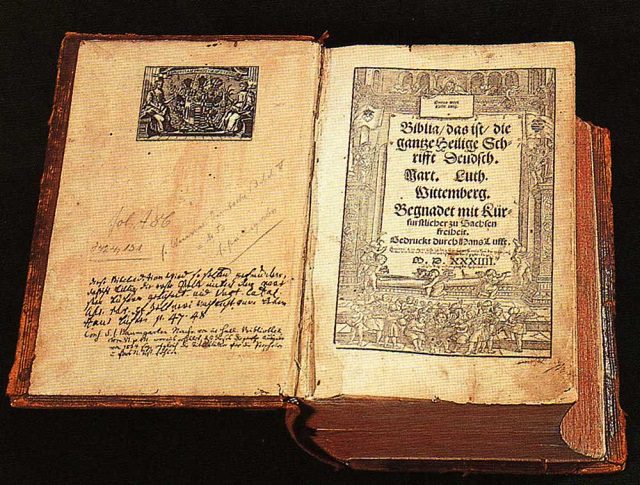
Martin Luther’s German translation of the Bible; 1534 edition, from his house in Wittenberg, Germany [public domain / Wikimedia Commons]

(6-5-10)
These remarks and dialogues occurred in a combox on the Reformed Protestant-dominated Green Baggins website (starting at comment #259). Paige Britton’s words are in blue, rfwhite‘s in green, Jeff Cagle’s in purple. The words of anti-Catholic polemicist Ron DiGiacomo (who entered the discussion blasting with the obligatory repeated personal attacks that I won’t bore readers with below and almost immediately became a parody of himself and of a lousy Protestant apologist), will be in red.
* * * * *
If the Catholic church merely affirms what has always been canonical, does this mean that the Apocryphal books have “always” been canonical (and “authored by God”) just like the rest of the OT & NT?
* * *
Of course, since from our perspective (in line with the Septuagint and the early Church), we regard them as canonical along with the rest. What is truly Scripture is so inherently, being God-breathed. We all agree on that. We disagree on certain books.
* * *
My argument would be to say that Church authority has to necessarily settle that, since the Bible itself does not, and that this has always been a thorny question for Protestants to deal with, since they don’t like binding, infallible Church authority, and a fallible collection of infallible biblical books just don’t cut it.
* * *
…Which is why I raised the original question about church authority in relation to the canon. Maybe there are some good reasons why Protestants reject the Apocryphal books (or at least reasons we think are pretty good). Whitaker gets into these in Ch. 4 of the work Lane has coaxed us to read (there is a link to the Google version at the beginning of the post that heads this thread). But the discussion always spins back around to how God set up the universe — fallible ministers, or infallible magisterium? That “fallible collection of infallible biblical books” line sounds laughable,
* * *
I agree. It was popularized by [Calvinist] R. C. Sproul (in case anyone was unaware of that).
* * *
but if, as we believe (with Luther, that heretic!), we’re in a “fallible minister” universe, then even the wisest of councils can’t give us what Jeff Cagle calls “mathematical certainty,” whether about the canon or about doctrine. But if this is the case, we should expect sufficient certainty in these areas, so that “fallible” does not necessarily always equal “wrong.” So I’ll bite the bullet and accept the “fallible collection of infallible books.”
* * *
Protestants can play games with epistemology and “mathematical certainty” if they like. I’ve heard those tired arguments a hundred times. That was never what Christianity was about, anyway, because it is a religion that requires faith, not mathematics or philosophy.[i.e., as I clarified later under strong, utterly wrongheaded criticism: “I was saying (a variant of what I have stated 100 times on my blog, though I could have stated it more precisely) that religion is not philosophy; Christianity is not philosophy. It can’t be reduced to that. It requires faith. I was not at all saying that there is no such thing as Christian philosophy: a thing I passionately love and use all the time.”]
* * *
Without strong, binding Church authority, it is quite likely that the canon question would have gone on being controversial for a long time, quite possibly up to our present day. [I have here changed some of my words, for the sake of greater precision, compared to my original post] It is a question of knowing what the Bible is in the first place, which is a necessary precursor for sola Scriptura to be able to be practiced at all (to even attempt to practice it).
* * *
Sproul recognizes the conundrum for what it is. One has to have infallible binding authority in order to get to a place where sola Scriptura (the belief that holds that only Scripture is the final, infallible authority) can get off the ground: even theoretically. But since the original premise is directly, expressly contradictory to the new one built upon it, we see that the whole procedure is viciously circular.
* * *
I’ve never seen a decent Protestant argument that resolves this, and I don’t expect to see it here. Perhaps someone will give me a big surprise. I won’t hold my breath.
* * *
One, what must the nature of the church’s authority be for its recognition of the canon to be infallible?
* * *
Obviously, I think, a binding (we would say, apostolic) authority; otherwise, what good is the proclamation? It is no better than you or I saying which books are Scripture. It is clear from Scripture itself that the Church has such authority. We see it most clearly in the Jerusalem Council (Acts 15:28: RSV: “For it has seemed good to the Holy Spirit and to us to lay upon you no greater burden than these necessary things”).
* * *
Even Paul and Timothy proclaimed this binding authoritative pronouncement: “As they went on their way through the cities, they delivered to them for observance the decisions which had been reached by the apostles and elders who were at Jerusalem” (Acts 16:4).
* * *
“Infallibility” is simply another way of saying that something is true (and in this case, protected by the assistance of the Holy Spirit). It is because Protestants often now accept theological relativism or relativistic latitude on a host of issues, that they disparage certitude and infallibility. In other words, since y’all can’t resolve your never-ending internal differences, you relegate large areas of Christianity to mere personal choice.
* * *
That approach is, with all due respect, post-Enlightenment, postmodernist gobbledygook, not biblical or historic Christianity, nor even the Christianity of Luther and Calvin, who felt quite certain of their own beliefs and even damned those who differed from it (e.g., Luther’s opinion of Zwingli, or Calvin calling Lutheranism an “evil”).
* * *
Two, does infallibility apply to the component parts of the canon only or does it extend to the collection as a whole also?
* * *
Catholics believe that all Scripture is infallible (in its manuscripts). We also believe that the proclamation of the canon is an infallible one, since it was finalized at Trent in a dogmatic fashion.
* * *
How can the RCC authoritatively declare that certain books are God-breathed and authoritative, without undercutting their authority by playing the king-maker?
* * *
The same way it could declare that circumcision was no longer necessary for Gentiles, in the Jerusalem council. The same way it could determine that Matthias was a successor to Judas; hence an apostle (hence an operation of apostolic succession), recorded in Holy Scripture itself. It does so because it is the “pillar and foundation of the truth”.
* * *
I’d like to address some of the (rather interesting and thoughtful) questions from Jeff (from #270) that I didn’t have time for up till now.
* * *
. . . this central question has arisen:
* * *
Does the church create truth or recognize truth?
* * *
Obviously the latter in terms of the canon (or indeed, anything, I would say). The truth is what it is. The Catholic Church can create dogmas (just as the Calvinist communion creates the dogma of TULIP) but not truths themselves. And the Church can do neither out of thin air, as we are often charged. I addressed this above in one of my remarks (#254), and cited Vatican I and II to prove that this is in fact what we assert regarding the canon (contrary to many contra-Catholic myths to the contrary).
* * *
Sean’s response (#126):
* * *
Your question, “Does the church create truth or recognize truth?” leaves out a third option: “Does the Church authoritatively declare truth?”
* * *
And so now the question on the table is, What does that third option mean? What is the difference between authoritatively declaring truth and either recognizing truth (as scientists attempt to do) or creating truth (as baseball umpires do).
* * *
I think it is mainly a question of semantics and clarification. I won’t speak for Sean. That is for him to do (being the world’s greatest expert on the thoughts and intentions in his own head). But I have my own thoughts.
* * *
The Church doesn’t “create” the canon in the most technical sense because it is what it is: God-inspired revelation: a thing that is separate from and prior to the Catholic Church (or anyone) recognizing it for what it is. So we can lay that to rest. It makes no sense once we understand what Holy Scripture inherently is, and it is not our claim anyway. So bye-bye, pseudo-objection and false stereotype . . . it comes from the Protestant either/or speculation that the Catholic Church is always trying to place itself above Scripture. That is not our position at all, as I also explained in the same post above (#254).
* * *
I would say that declaring and recognizing truth are basically the same thing. Using either word in a sentence regarding a truth or a fact amounts to essentially the use of what are synonyms. But to use the terminology of “authoritatively declare” as Sean did, brings in the additional element of proclamation of a dogma, which is a different thing.
* * *
This is why I myself use the phraseology of saying that there needed to be a binding, authoritative proclamation of the biblical canon, to settle the question once and for all. It was not completely settled spontaneously in history. There was a significant consensus, granted (especially for the gospels and Pauline epistles), but there were lots of doubts about other books, and many eminent fathers thought books not now included, were Scripture.
* * *
I would disagree, by the way, that a baseball umpire “creates truth.” He does not. If anything, he creates a “dogma”: a certain pitch is now to be regarded dogmatically as a strike or a ball and a play as an out or not or a ball fair or foul, etc. The things involved are what they are: truths, prior to the umpire making a decision on them. In fact, any given thrown pitch was either a strike or not. The umpire may be correct in his assessment or incorrect. But he doesn’t create anything. He declares.
* * *
Conveniently, this was graphically brought home in the recent Detroit Tigers game where our pitcher was deprived of a perfect game because of a clearly blown umpire’s call. Replays revealed that the last base runner was in fact out. But the umpire had created the “dogma” that he was safe. He did not create a new “truth” that he was safe, because in fact he was not safe. Even the umpire knows this now. The commissioner of baseball has decided to uphold the “dogma.”
* * *
In relationship to the canon, that’s what Paige is getting at. What is the difference between “infallibly recognizing the canon” and “infallibly authoritatively declaring the canon”?
* * *
We have established that no one is “creating” anything. Now you are using the word “infallibly.” I don’t see much difference in recognizing vs. declaring. The real question is infallibility, authority, and a binding decree or dogma. Our position is consistent. We believe in the three-legged stool as our rule of faith: Scripture, Church, Tradition. None is “above” the other. They are all of a piece.
* * *
The canon is above all a practical matter: how can the Christian know which books are indeed God-breathed Scripture? The early Christians disagreed too much and couldn’t fully settle it. So the Church did, and did so authoritatively. But Protestants accept no infallible Church declaration, since their only final infallible authority is Scripture. So they are left with a radical circularity and vicious circle: they must adopt, in effect, an infallible Church authority (which they cannot do) in order to have their infallible Scripture, which they make alone the infallible authority in all Matters Christian.
* * *
If the Church was in fact, fallible when it made the decision (and Protestants do actually think this when it comes to the deuterocanon), then Protestants are left with an open canon, and cannot know with the certitude of faith what are indeed the legitimate New Testament books. A fallible collection of infallible books is a contradiction in terms.
* * *
I don’t view this at all as a game, but as the central question surrounding RC authority:
* * *
Good. It is a very serious discussion indeed, with momentous consequences, depending on how one comes down on the question.
* * *
how can the RCC make the claims that it does about authority, without usurping God’s own authority?
* * *
It is not doing so at all, because the Church was given its authority by God, and is guided by the Holy Spirit (Jn 14:26; 15:26; 16:13). Jesus commissioned Peter as the head of the Church (tons of Scriptures for Petrine primacy, that even many Protestant scholars now recognize). Paul was commissioned by the Church and possessed apostolic authority, as did the other apostles. The Jerusalem Council (Acts 15) exercised profound binding, infallible authority, as I have mentioned. Paul went around proclaiming these binding decrees (Acts 16:4). Bishops had a strong authority. Matthias was an apostle in replacement of Judas: thus showing apostolic succession in the Bible itself. The Church has the power to anathematize (Matt 18:17) and bind and loose (Matt 16:19; 18:18; Jn 20:23), forgive sins, and pronounce absolution and penances. Personal infallibility, such as we believe popes possess in certain circumstances, was already foreseen to an even greater extent in the prophets, infallible (and even inspired) Bible writers, and the apostles. It is no novel thing at all. 1 Timothy 3:15 alone, as I have argued, is sufficient to establish a sublime Church authority.
* * *
I have collected literally many hundreds of Bible passages demonstrating all these things. The Tradition, Church, and Papacy chapters of my book, Bible Proofs for Catholic Truths take up its first 161 pages: and it is 95% simply listed Scripture, like Nave’s Topical Bible.
* * *
All this, yet you can’t see ecclesiastical authority in Scripture, and feel as if any such authority must needs be in conflict with God, in classic Protestant “either/or” fashion?
* * *
Reformed churches have authority, too, you know, on a lesser scale than us, but they still do. How does that not usurp God, just as you claim our authority does?
* * *
Allow me to try further to understand your position. You write,
* * *
If the Church was in fact, fallible when it made the decision (and Protestants do actually think this when it comes to the deuterocanon), then Protestants are left with an open canon, and cannot know with the certitude of faith what are indeed the legitimate NT books….
* * *
My question: is it your position that for the church’s recognition of the canon to be infallible, the nature of the church’s authority must be infallible? If so, why does this follow?
* * *
Fair question. It’s not strictly necessary, of course (your word “must”), for some Christian body to make a declaration (even a binding one) in an infallible way. So broadly speaking, no.
* * *
What I’m arguing is that in order to have certainty that the Bible as we know it (leaving off the question of the deuterocanon for now, and sticking to the 66 books we all agree on) contains certain books, we need a strong authority to proclaim this, so as to put the vexed question to an end and for the sake or unity and theological order.
* * *
This doesn’t have to be infallible authority, but our claim is that the Catholic proclamation was indeed that, because that is how our authority works.
* * *
The problem for you and all Protestants is dealing with this state of affairs. Even assuming such authority was not infallible (as indeed you do), this does not get you out of your epistemological conundrum because you are still relying on the ecclesiastical authority to arrive at your conclusion of the nature and parameters of the biblical canon.
* * *
So, assuming it is a non-infallible proclamation, you are still (for some reason) adhering to it, save for the seven disputed books. If one steps back and ponders that, it is a rather odd state of affairs. If it was not an infallible pronouncement, then Protestants, by the very nature of their own system and rule of faith, would have the “right” to dissent against it. Yet they rarely do. Apart from some wild mostly early statements from Luther about several books and a few liberals, by and large, there has been no dispute. This means that the authoritative proclamation was in effect, accepted, even though it is regarded as itself fallible.
* * *
Logically, if there is no binding and infallible declaration, we should see a lot more latitude of opinion among Protestants. Martin Luther was arguably more consistent on this score than almost all Protestants subsequently.
* * *
Paul Althaus, in his Theology of Martin Luther (Philadelphia: Fortress Press, 1966, pp. 85, 336) opined:
* * *
He thereby established the principle that the early church’s formation and limitation of the canon is not exempt from re-examination . . . the canon is only a relative unity, just as it is only relatively closed. Therewith Luther has in principle abandoned every formal approach to the authority of the Bible. It is certainly understandable that Luther’s prefaces were no longer printed in German Bibles.
One may characterize his attitude in this way: The canon itself was, as far as Luther was concerned, a piece of ecclesiastical tradition and therefore subject to criticism on the basis of God’s word.
* * *
Lutheran Mark F. Bartling (WELS), in his informative paper, “Luther and James: Did Luther Use the Historical-Critical Method?” [no longer online at the URL I found], although unwilling to grant that Luther’s view amounted to subjectivism, arbitrariness, and liberal higher criticism, nevertheless, stated:
* * *
It must be admitted that Luther did develop a personal criterion of canonicity that took its place along side of apostolicity and universality (those books unanimously accepted by the early church, homologoumena) . . . It was, of all people, Carlstadt who condemned Luther for this criterion. Carlstadt said: “One must appeal either to known apostolic authorship or to universal historical acceptance as to the test of a book’s canonicity, not to internal doctrinal considerations.” [De Canonicis Scripturis libellus, Wittenberg, 1520, p. 50]. This position of Carlstadt was also the position of Martin Chemnitz and of C. F. W. Walther [Compendium Theologiae Positivae, Vol. I. p. 149].
* * *
Brooke Foss Westcott (1825-1901), the great biblical scholar, strongly disagreed with Luther, too:
* * *
The freshness and power of Luther’s judgments on the Bible, the living sense of fellowship with the spirit which animates them, the bold independence and self-assertion which separate them from all simply critical conclusions, combined to limit their practical acceptance to individuals. Such judgments rest on no definite external evidence. They cannot be justified by the ordinary rule and measure of criticism or dogma. No Church could rest on a theory which makes private feeling the supreme authority as to doctrine and the source of doctrine. As a natural consequence the later Lutherans abandoned the teaching of their great master on the written Word.
(A General Survey of the History of the Canon of the New Testament, 6th edition, 1889; reprinted by Baker Book House: Grand Rapids, Michigan, 1980, 483-484)
* * *
Luther was wrong, but he was self-consistent. For much, much more on Luther’s view of the canon, see my paper: “Luther’s Outrageous Assertions About Certain Biblical Books (Protestant Scholars’ Opinions and “Debate” With John Warwick Montgomery).”
* * *
I argue that Protestants are right (excepting the Deuterocanon) but for the wrong reasons, and inconsistent, because their notions of the canon clash with their rule of faith, sola Scriptura.
* * *
I would say that most Protestants (who, I strongly suspect, never think much about the issue, just as I didn’t much when I was a Protestant) accept it uncritically. Basically, they buy a Bible and certain books are in there and they accept that without further thought.
* * *
Those who do ponder and grapple with it, have not, I think, come up with an acceptable solution to the dilemma. Either flimsy, implausible arguments for a provisional, temporary Church authority are set forth, or they anachronistically apply our present “certainty” back to the early Church, or adopt the position that all biblical books are self-attesting (which has its own host of problems, and even if true, did not lead all early Christians to agreement on the canon).
* * *
Along with the irritating fact that sola Scriptura cannot be proven from Scripture Alone (which it has to be in order to sensibly hold as worthy of belief), the canon issue makes it a double whammy against the Protestant rule of faith: a position that has more logical holes in it than a pin cushion.
* * *
Couldn’t resist turning the tables:
* * *
the fallible cannot know it has identified and received the infallible. . . . After all, if the fallible cannot identify and receive the infallible and know it has done so, then Dave (being fallible) cannot know that the Roman communion is indeed infallible on matters of faith and practice.
* * *
[first of all, this is not my position in the first place, as can readily be seen above, particularly when I plainly answered the re-cited question “no”. My view has been distorted by Ron, as usual. The man can’t get it right where I am concerned, to save his life]
* * *
the fallible cannot know it has identified and received the infallible (let alone the inspired, which is a greater characteristic) . . . . After all, if the fallible cannot identify and receive the infallible (or the inspired) and know it has done so, then Protestants (being fallible) cannot know that Holy Scripture is indeed infallible on matters of faith and practice, and all matters, let alone inspired (God-breathed).
* * *
And this amounts to the theologically liberal position: the Scriptures are fallible and full of errors, therefore we shall pick and choose from it what we deem to be true and reject what we decide is false, outdated, a later textual addition, etc.
* * *
This is what one gets when they epistemologically (for the moment) reduce Christianity and Christian faith to mere philosophy. Protestant fundamentals fall right alongside Catholic ones, should these false and wrongheaded premises be adopted.
Previous Post

January 5, 2016
Sacred / Immaculate Heart Devotions and the Bible
Next Post
January 5, 2016 Christian Ecclesiology: Dialogue with a Mennonite
Browse Our Archives
Select a Category & Last Things About Me Anti-Catholicism Atheism & Agnosticism Baptism and Sacramentalism Bible and Tradition Blessed Virgin Mary Books by Dave Armstrong C. S. Lewis Calvinism & General Protestantism Catholic Apologetics Catholic Apologists Catholic conversion Catholic converts Christmas Church (Ecclesiology) Church History Conversion and Converts Development of Doctrine Eastern Orthodoxy Ecumenism & Christian Unity Eucharist & Liturgy Fathers of the Church French Translations G. K. Chesterton Hell Hell & Satan Hell & Satan & Last Things Heresies & Comparative Religion Holistic Health Inquisition & Crusades & Scandals James White Jews & Judaism & Old Testament John Calvin John Henry Newman Liberal / Modernist Theology Life Issues Literary Resume Lutheranism Mariology Martin Luther Music Orthodoxy Papacy & Infallibility Personal Page Philosophy & Science Political & Ethical & Moral Issues Protestant Persecution & Intolerance Protestantism Purgatory Purgatory & Penance Romantic & Imaginative Theology Saints & Purgatory & Penance Salvation Salvation & Justification Satan & Last Things Sexuality and Gender Issues Spanish Translations Traditionalism vs. Radical Catholic Reactionaries Traducciones al español / tradução para português Trinitarianism & Christology Uncategorized Videos
Select a Month October 2026 September 2026 August 2026 July 2026 June 2026 May 2026 April 2026 March 2026 February 2026 January 2026 December 2025 November 2025 October 2025 September 2025 August 2025 July 2025 June 2025 May 2025 April 2025 March 2025 February 2025 January 2025 December 2024 November 2024 October 2024 September 2024 August 2024 July 2024 June 2024 May 2024 April 2024 March 2024 February 2024 January 2024 December 2023 November 2023 October 2023 September 2023 August 2023 July 2023 June 2023 May 2023 April 2023 March 2023 February 2023 January 2023 December 2022 November 2022 October 2022 September 2022 August 2022 July 2022 June 2022 May 2022 April 2022 March 2022 February 2022 January 2022 December 2021 November 2021 October 2021 September 2021 August 2021 July 2021 June 2021 May 2021 April 2021 March 2021 February 2021 January 2021 December 2020 November 2020 October 2020 September 2020 August 2020 July 2020 June 2020 May 2020 April 2020 March 2020 February 2020 January 2020 December 2019 November 2019 October 2019 September 2019 August 2019 July 2019 June 2019 May 2019 April 2019 March 2019 February 2019 January 2019 December 2018 November 2018 October 2018 September 2018 August 2018 July 2018 June 2018 May 2018 April 2018 March 2018 February 2018 January 2018 December 2017 November 2017 October 2017 September 2017 August 2017 July 2017 June 2017 May 2017 April 2017 March 2017 February 2017 January 2017 December 2016 November 2016 October 2016 September 2016 August 2016 July 2016 June 2016 May 2016 April 2016 March 2016 February 2016 January 2016 December 2015 November 2015 October 2015 September 2015 August 2015 July 2015 June 2015 May 2015 April 2015 March 2015 February 2015 January 2015 December 2014 November 2014 October 2014 September 2014 August 2014 July 2014 June 2014 April 2014 March 2014 February 2014 January 2014 December 2013 November 2013 October 2013 September 2013 August 2013 July 2013 June 2013 April 2013 March 2013 February 2013 January 2013 December 2012 November 2012 October 2012 September 2012 August 2012 July 2012 June 2012 May 2012 April 2012 March 2012 February 2012 January 2012 December 2011 November 2011 October 2011 September 2011 August 2011 July 2011 June 2011 April 2011 March 2011 February 2011 October 2010 September 2010 August 2010 July 2010 April 2010 March 2010 December 2009 October 2009 August 2009 July 2009 June 2009 May 2009 March 2009 February 2009 October 2008 September 2008 April 2008 March 2008 February 2008 January 2008 December 2007 November 2007 October 2007 May 2007 March 2007 February 2007 January 2007 November 2006 October 2006 September 2006 August 2006 July 2006 June 2006 May 2006 April 2006 March 2006 February 2006 October 2005 June 2005 April 2005 February 2005 July 2004 May 2004 April 2004
Follow Us!
TAKE THE
Religious Wisdom Quiz
Who was Jacob's first wife?
Select your answer to see how you score.
Rachel Dinah Leah Rebekah
Books by This Author Books by Dave Armstrong
Related posts from Biblical Evidence for Catholicism

A Few "Worst" & "Best" Arguments vs. Protestantism
Biblical Evidence for Catholicism

Deuterocanon & Javier Perdomo's Straw Men
Biblical Evidence for Catholicism

St. Athanasius & the Deuterocanon (vs. Javier Perdomo)
Biblical Evidence for Catholicism

Jerusalem Council vs. James White & Sola Scriptura
Biblical Evidence for Catholicism
TRENDING AT PATHEOS Catholic

The Sermon on the Mount, Part I: Matthew...
The Sermon on the Mount, Part I (Matthew 4:12-5:12) St. Matthew moves...

What's up from Crossway: Reviewing some of their latest A few weeks...

Janie Learns the Way of the Cross: A...
Teaching children about Jesus' Passion can be challenging. Many parents and educators...

Looking For Good Catholic Writing - October 2026
He alone extends the heavens, and he walks upon the waves of...

In "Irreplaceable," our book on vocation and technology, Trevor Sutton and I...

I was strolling through the top floor of the brand new Parthenon...
view all Catholic blogs
Ad-Free & Subscriber Log-In Subscription Support
- About Us
- 2026 Calendar
- Videos
- Podcasts
- Library of World Religions
- Faith In Media Tracker
- Advertise With Us
- Write for Us
- Privacy Policy
- Terms of Service
- Do Not Sell My Data
- Contact Us
- Radiant Digital
- Manage Newsletter Subscriptions
- Unsubscribe From Notifications
- Sitemap
Copyright 2008-2026, Patheos. All rights reserved.
Subscription Support Ad-Free & Subscriber Log-In
Follow Patheos