
BuddhistCatholicContemplativeEvangelicalGeneral ChristianHinduJewishLatter-day SaintMuslimNew VisionsProgressive Christian
Beliefs
- Buddhist
- Catholic
- Contemplative
- Evangelical
- General Christian
- Hindu
- Jewish
- Latter-day Saint
- More Voices
- Muslim
- New Visions
- Pagan
- Progressive Christian
Topics
- Religion News
- Food and Religion
- Sports and Religion
- Religious Art
- Religious Music and Entertainment
- Religious Events
- History and Religion
- Style and Religion
- Politics and Religion
- Women in Religion
- Recreation Outdoors and Religion
- Business Finance and Religion
- Careers Workplace and Religion
- Education and Religion
- Family Parenting and Religion
- Health Fitness and Religion
- Home and Religion
- Relationships and Religion
- Technology and Religion
- Travel and Religion
Columnists
- Buddhist Columnists
- Business Finance and Religion Columnists
- Careers Workplace and Religion Columnists
- Catholic Columnists
- Contemplative Columnists
- Education and Religion Columnists
- Evangelists Columnists
- Family Parenting and Religion Columnists
- General Christian Columnists
- Health Fitness and Religion Columnists
- Hindu Columnists
- History and Religion Columnists
- Home and Religion Columnists
- Jewish Columnists
- More Voices Columnists
- Latter Day Columnists
- Muslim Columnists
- New Visions Columnists
- Nonreligious Columnists
- Pagan Columnists
- Politics and Religion Columnists
- Progressive Columnists
- Recreation Outdoors and Religion Columnists
- Relationships and Religion Columnists
- Religion News Columnists
- Religious Art Columnists
- Religious Events Columnists
- Religious Music and Entertainment Columnists
- Sports and Religion Columnists
- Style and Religion Columnists
- Technology and Religion Columnists
- Travel and Religion Columnists
- Women in Religion Columnists
Resource Library
- 2026 Calendar
- Library of World Religions
- The 100 Most Holy Places on Earth
- Patheos Answers
- Podcasts
- Videos
- Faith Leaders Database
- Anglican Episcopalian
- Bahai
- Baptist
- Buddhism
- Christianity
- Confucianism
- Eastern Orthodoxy
- Hinduism
- Holiness and Pentecostal
- ISKCON
- Islam
- Judaism
- Lutheran
- Methodist
- The Church of Jesus Christ of Latter-day Saints
- New Age
- Paganism
- Presbytarian and Reformed
- Protestantism
- Religion Behind the Scenes
- Roman Catholic
- Scientology
- Shia Islam
- Sikhism
- Sufism
- Sunni Islam
- Taoism
- Zen
- See all religions
Research Tools
 Ad-Free & Subscriber Log-In Subscription Support
Ad-Free & Subscriber Log-In Subscription Support
Follow Patheos 

- Trending:
- Forgiveness
- |
- Marriage
- |
- Consciousness
- |
- Death Penalty
- |
- Election
- |
- Halloween

-
About
-
Catholic Apologetics
-
Church History
-
Great Apologists
-
Christian Worldview
-
Protestantism & Misc.
- Home
- Catholic
- History and Religion
- Biblical Argumentation is NOT “Sola Scriptura”
Biblical Argumentation is NOT “Sola Scriptura”
Last updated on: June 6, 2026 at 12:29 am by Dave Armstrong
Biblical Argumentation is NOT “Sola Scriptura” 2026-06-06T00:29:51-04:00 Dave Armstrong
Patheos Explore the world's faith through different perspectives on religion and spirituality! Patheos has the views of the prevalent religions and spiritualities of the world.
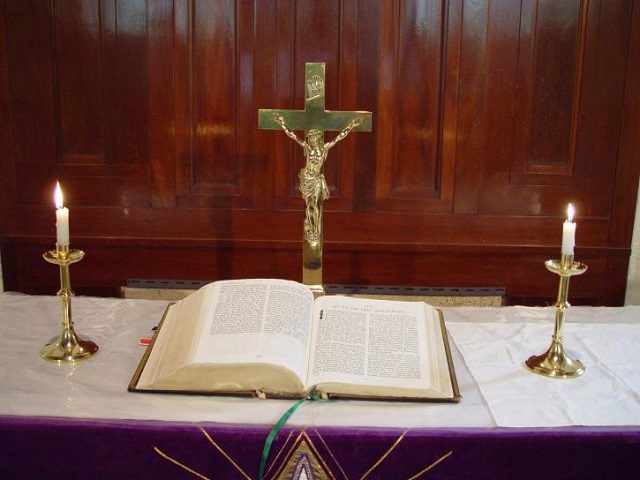
[from Public Domain Images]***
(5-28-12)***
This was on a public Facebook discussion thread on a friend’s Facebook page, underneath mention of a review of the above book of mine by Devin Rose. Greg Still describes himself as a “”skeptical Pentecostal” and is a former Catholic. His words will be in blue.
* * *
I have a Lutheran “friend” who insists that The Church (meaning his church) is the ultimate interpreter of scripture. He thinks that an individual cannot properly read/understand scripture without the aid of The Church and its creeds.
Oddly, he also believes in Sola Scriptura. (He cannot be accused of being consistent)
This is perfectly consistent. Most Protestants don’t deny the usefulness; even necessity of the Church and creeds. They only deny that any church or tradition is infallible. Only the Bible is that. This is what sola Scriptura means: “the Bible is the only infallible and final authority.” But of course in practice that means: “I am the final authority, since I ultimately interpret the infallible Bible as I see fit and can dissent against any church if necessary to preserve truth as I see it.” That is filled with difficulties and self-contradictions, as I show in my book. Luther himself appealed to Church tradition and authority. The only problem is that he reserved the right to disagree with what the Church says. Protestantism is always [in the final analysis] a self-defeating proposition, in terms of authority, anyway you slice it.
*
When dealing with Tradition, I must point out that the RCC uses ” bait and switch”. Yes, the Bible speaks of the “traditions” of the apostles and elders. But the RCC adds to these the accumulated traditions of 2000 years, some of which I find to be simply distracting, and some I find to be anti-biblical. So here’s the “rub”. Someone might respond to this post attempting to use the Bible to prove that the traditions of the RCC are reliable reflections of apostolic faith. They will expect me, an individual, to be able to discern from scripture the truth of the RCC – which brings us back to the same argument – whether or not an individual can discern from scripture which teachings and/or traditions are an accurate reflection of apostolic doctrine.
We do, after all, have the words of the Apostles. It seems that their letters should be given the most weight over any ecclesiastical tradition.
Lots of issues here I don’t have time [at the moment] to delve into fully. My specialty is “biblical evidence for Catholicism” and I have writings on my blog (over 1600 posts) about all the major bones of contention. Nothing is “anti-biblical.” For example, Mary’s Assumption is not directly asserted in Scripture. Yet it is not contrary to anything in Scripture, and indeed there are parallels in some respects: Enoch being translated to heaven; Elijah going to heaven in a chariot, Apostle Paul being taken up to the third heaven; possibly in body. In other words, an assumption (or a bodily resurrection after death) is entirely possible and consistent with what we know in Scripture.
But sola Scriptura is directly contradicted in Scripture, and there are things (like the canon of Scripture) that are not present in the Bible at all. Zip, zero, zilch, nada.
Strictly speaking, this book of mine is not doing “biblical evidence for Catholicism”. Rather, it is critiquing one of the pillars of Protestantism: sola Scriptura, and showing how it is not biblical. I make reference to tradition and so forth, but within this larger context and purpose. Several other books of mine show how Catholic tradition is completely harmonious with, and usually (not always) directly or explicitly supported by the Bible. In other words, this book is saying, “we don’t believe your system of sola Scriptura because it is unbiblical, and we’re showing you why.” It’s purpose is not, “we believe in x, y, z Catholic doctrines because of biblical passages a, b, c, etc.” Other books of mine do the latter.
The irony of your book is that you use the Bible as your ultimate authority to defend the Catholic teaching that the Church, not the Bible, is the ultimate authority.
Do you see the problem here?
Yes: in your comment, which is neither factual, nor logical. First of all, I’m not using the Bible as the “ultimate authority”; only as an authority that Protestants and Catholics agree upon. It is smart in dialogue to start with a common premise and then move on to disagreements. I do that here, and often elsewhere. I show that the Bible does not teach sola Scriptura. I could do that if I were an atheist. My own beliefs have no necessary connection to the logic of that at all. I could argue that “the Koran doesn’t teach that elephants fly through the air.” To say that shows nothing [necessarily] about what I believe.
Nor is “Catholic teaching” what might be called sola ecclesia. It is not at all. Our view is that Bible-Church-Tradition are all of a piece: a “three-legged stool” of authority. But the Bible is inspired, whereas Church and tradition are infallible, so in that sense the Bible is “higher”; but in terms of authority all three are in play, and harmonious. You simply miscomprehend the Catholic view of the Bible and authority. You’re not alone; many millions do so.
I was raised Catholic – went to parochial school, and considered being a priest. Sorry, but I know Catholicism, and it cannot be supported Biblically. It must rely on the supposed “authority” or “infallibility” of the Church.
Sorry, you clearly don’t: at least not in these respects, because you have made a number of factual errors. Of course it can be supported biblically. I show that again and again in my writings. Not only can it be shown, but it can be demonstrated that Catholicism is far more in harmony with all of Scripture than any form of Protestantism.
The whole “authority/infallibility” argument fails with two words, WHICH CHURCH?
I agree that one must ask “which Church is the one true Church mentioned in the Bible?” We can demonstrate that the Catholic Church goes historically back to Christ, and has consistently espoused true Christian doctrine. We’re the ones who keep apostolic morality: things like no divorce and no contraception. No other major body has done so. If you want apostolic morality and doctrine, you have one choice. That’s a major reason why I became a Catholic, by the way. I was sick of Protestant compromise on crucial moral issues.
Or let us address your argument (in your book) that Peter had authority over Paul at the Jerusalem council. It NEVER says anything like that. This is made of whole cloth. Both Peter and Paul gave testimony, but it was James who stood and gave the final word, not Peter.
*
You want to bring up one of the arguments in my book. Very well, then. Rather than cynically portray what I said, and denying it with no substance, let’s let readers see what I actually wrote. Here is the entire argument #74 (a few minor differences from the book since this is from my last manuscript):
74. Paul’s Apostolic Calling Was Subordinated to the Larger Church and Was in Harmony with Peter
Paul’s ministry was not “self-validating.” He was initially commissioned by Peter, James, and John (Gal 2:9) to preach to the Gentiles. After his conversion, he went to Jerusalem specifically to see Peter (Gal 1:18). In Acts 15:2-3 we are told that “Paul and Barnabas and some of the others were appointed to go up to Jerusalem to the apostles and the elders about this question. So, being sent their way by the church,” they went off on their assignment.
That is hardly consistent with the idea of Paul being the “pope” or leading figure in the hierarchy of authority; he was directed by others, as one under orders. When we see Paul and Peter together in the Council of Jerusalem (Acts 15:6-29), we observe that Peter wields an authority that Paul doesn’t possess.
We learn that “after there was much debate, Peter rose” to address the assembly (15:7). The Bible records his speech, which goes on for five verses. Then it reports that “all the assembly kept silence” (15:12). Paul and Barnabas speak next, not making authoritative pronouncements, but confirming Peter’s exposition, speaking about “signs and wonders God had done through them among the Gentiles” (15:12). Then when James speaks, he refers right back to what “Simeon [Peter] has related” (15:14). Why did James skip right over Paul’s comments and go back to what Peter said? Paul and his associates are subsequently “sent off” by the Council, and they “delivered the letter” (15:30; cf. 16:4).
None of this seems consistent with the notion that Paul was above or even equal to Peter in authority. But it’s perfectly consistent with Peter’s having a preeminent authority. Paul was under the authority of the council, and Peter (along with James, as the Bishop of Jerusalem) presided over it. Paul and Barnabas were sent by “the church” (of Antioch: see 14:26). Then they were sent by the Jerusalem Council (15:25, 30) which was guided by the Holy Spirit (15:28), back to Antioch (15:30).
You make bald statements of denial; I make solid biblical arguments.
You, of course, know that Paul withstood Peter to his face for his hypocrisy on this very issue. Obviously Paul did not recognize Peter as having “papal” authority over him.
The Peter vs. Paul hypocrisy argument proves nothing because it is irrelevant (hypocrisy being distinct from authority). A person can have full authority and be a flaming hypocrite. For example, Republican ads against President Obama show him to be a hypocrite in a number of ways regarding what he has promised and what he has done. Assuming their correctness, they show he is a hypocrite, but they have no effect on his authority. He remains the President, and has that authority till we vote him out of office (or his term expires). Apples and oranges.
I note in this paper that Jesus upheld the authority of the Pharisees, even though they were hypocrites (Matthew 23:2). This flimsy, misguided objection proves nothing whatever regarding Peter’s primacy or supposed lack thereof.
Certainly, if Mary had been assumed, the Bible would have mentioned something about it.
By Protestant reasoning, “certainly, if sola Scriptura were true, the Bible would have mentioned something about it“. But it never does, which is the topic of my book. That doesn’t stop Protestants from making an entirely non-biblical, anti-biblical concept the very foundation and bedrock and pillar of their authority structure. They do it anyway. Then, having done that, they demand that we adopt the same illogical reasoning with regard to Catholic distinctives like Mary’s Assumption.
We never claimed that absolutely everything has to be explicitly laid out in Scripture, precisely because the Bible never teaches this. That is your game, and thus your burden to defend, not ours.
Your statement above is classic. You believe this firmly, yet the Bible never states such a thing. Thus, you supposedly appeal to the Bible itself with a completely non-biblical idea that can’t be found there. Then you try to bind Catholics to this silly notion: so now you are arbitrarily applying an arbitrary tradition of men to us, as if we have to play by those rules . . . We think logically and biblically, so no dice!
Previous Post

January 13, 2016
Catholic Compassion and Beggars on the Street
Next Post
January 14, 2016 Defending Mary (Revelation 12 and Her Assumption)
Browse Our Archives
Select a Category & Last Things About Me Anti-Catholicism Atheism & Agnosticism Baptism and Sacramentalism Bible and Tradition Blessed Virgin Mary Books by Dave Armstrong C. S. Lewis Calvinism & General Protestantism Catholic Apologetics Catholic Apologists Catholic conversion Catholic converts Christmas Church (Ecclesiology) Church History Conversion and Converts Development of Doctrine Eastern Orthodoxy Ecumenism & Christian Unity Eucharist & Liturgy Fathers of the Church French Translations G. K. Chesterton Hell Hell & Satan Hell & Satan & Last Things Heresies & Comparative Religion Holistic Health Inquisition & Crusades & Scandals James White Jews & Judaism & Old Testament John Calvin John Henry Newman Liberal / Modernist Theology Life Issues Literary Resume Lutheranism Mariology Martin Luther Music Orthodoxy Papacy & Infallibility Personal Page Philosophy & Science Political & Ethical & Moral Issues Protestant Persecution & Intolerance Protestantism Purgatory Purgatory & Penance Romantic & Imaginative Theology Saints & Purgatory & Penance Salvation Salvation & Justification Satan & Last Things Sexuality and Gender Issues Spanish Translations Traditionalism vs. Radical Catholic Reactionaries Traducciones al español / tradução para português Trinitarianism & Christology Uncategorized Videos
Select a Month October 2026 September 2026 August 2026 July 2026 June 2026 May 2026 April 2026 March 2026 February 2026 January 2026 December 2025 November 2025 October 2025 September 2025 August 2025 July 2025 June 2025 May 2025 April 2025 March 2025 February 2025 January 2025 December 2024 November 2024 October 2024 September 2024 August 2024 July 2024 June 2024 May 2024 April 2024 March 2024 February 2024 January 2024 December 2023 November 2023 October 2023 September 2023 August 2023 July 2023 June 2023 May 2023 April 2023 March 2023 February 2023 January 2023 December 2022 November 2022 October 2022 September 2022 August 2022 July 2022 June 2022 May 2022 April 2022 March 2022 February 2022 January 2022 December 2021 November 2021 October 2021 September 2021 August 2021 July 2021 June 2021 May 2021 April 2021 March 2021 February 2021 January 2021 December 2020 November 2020 October 2020 September 2020 August 2020 July 2020 June 2020 May 2020 April 2020 March 2020 February 2020 January 2020 December 2019 November 2019 October 2019 September 2019 August 2019 July 2019 June 2019 May 2019 April 2019 March 2019 February 2019 January 2019 December 2018 November 2018 October 2018 September 2018 August 2018 July 2018 June 2018 May 2018 April 2018 March 2018 February 2018 January 2018 December 2017 November 2017 October 2017 September 2017 August 2017 July 2017 June 2017 May 2017 April 2017 March 2017 February 2017 January 2017 December 2016 November 2016 October 2016 September 2016 August 2016 July 2016 June 2016 May 2016 April 2016 March 2016 February 2016 January 2016 December 2015 November 2015 October 2015 September 2015 August 2015 July 2015 June 2015 May 2015 April 2015 March 2015 February 2015 January 2015 December 2014 November 2014 October 2014 September 2014 August 2014 July 2014 June 2014 April 2014 March 2014 February 2014 January 2014 December 2013 November 2013 October 2013 September 2013 August 2013 July 2013 June 2013 April 2013 March 2013 February 2013 January 2013 December 2012 November 2012 October 2012 September 2012 August 2012 July 2012 June 2012 May 2012 April 2012 March 2012 February 2012 January 2012 December 2011 November 2011 October 2011 September 2011 August 2011 July 2011 June 2011 April 2011 March 2011 February 2011 October 2010 September 2010 August 2010 July 2010 April 2010 March 2010 December 2009 October 2009 August 2009 July 2009 June 2009 May 2009 March 2009 February 2009 October 2008 September 2008 April 2008 March 2008 February 2008 January 2008 December 2007 November 2007 October 2007 May 2007 March 2007 February 2007 January 2007 November 2006 October 2006 September 2006 August 2006 July 2006 June 2006 May 2006 April 2006 March 2006 February 2006 October 2005 June 2005 April 2005 February 2005 July 2004 May 2004 April 2004
Follow Us!
TAKE THE
Religious Wisdom Quiz
Who succeeded Moses as the leader of Israel?
Select your answer to see how you score.
Caleb Samuel Aaron Joshua
Books by This Author Books by Dave Armstrong
Related posts from Biblical Evidence for Catholicism

A Few "Worst" & "Best" Arguments vs. Protestantism
Biblical Evidence for Catholicism

Jerusalem Council vs. James White & Sola Scriptura
Biblical Evidence for Catholicism

Biblical Perspicuity: Absurd Anti-Catholic "Defense"
Biblical Evidence for Catholicism

50 Biblical Disproofs of "Evident Clearness" of the...
Biblical Evidence for Catholicism
TRENDING AT PATHEOS Catholic

Methodist Central Hall and Westminster Abbey
Situated on the same square is Methodist Central Hall and Westminster Abbey. ...

57th Dove Awards Honor Dolly Parton, Crown New...
On gospel music’s biggest night, the 57th annual GMA Dove Awards honored...

The First Eucharistic Controversy: Christ’s Real Presence
For Catholics, the Eucharist is the source and summit of the Christian...

What a Stop Sign Can Teach Us About...
How to Make a Decision When You Can't Hear God Main point:...

Archdiocese Hosts Military Marriage Retreat in Germany
RASTATT, Germany — The transient military lifestyle, with its frequent deployments and...

Nearly every morning, I make the drive to Detroit with my high-school-age...
view all Catholic blogs
Ad-Free & Subscriber Log-In Subscription Support
- About Us
- 2026 Calendar
- Videos
- Podcasts
- Library of World Religions
- Faith In Media Tracker
- Advertise With Us
- Write for Us
- Privacy Policy
- Terms of Service
- Do Not Sell My Data
- Contact Us
- Radiant Digital
- Manage Newsletter Subscriptions
- Unsubscribe From Notifications
- Sitemap
Copyright 2008-2026, Patheos. All rights reserved.
Subscription Support Ad-Free & Subscriber Log-In
Follow Patheos