
BuddhistCatholicContemplativeEvangelicalGeneral ChristianHinduJewishLatter-day SaintMuslimNew VisionsProgressive Christian
Beliefs
- Buddhist
- Catholic
- Contemplative
- Evangelical
- General Christian
- Hindu
- Jewish
- Latter-day Saint
- More Voices
- Muslim
- New Visions
- Pagan
- Progressive Christian
Topics
- Religion News
- Food and Religion
- Sports and Religion
- Religious Art
- Religious Music and Entertainment
- Religious Events
- History and Religion
- Style and Religion
- Politics and Religion
- Women in Religion
- Recreation Outdoors and Religion
- Business Finance and Religion
- Careers Workplace and Religion
- Education and Religion
- Family Parenting and Religion
- Health Fitness and Religion
- Home and Religion
- Relationships and Religion
- Technology and Religion
- Travel and Religion
Columnists
- Buddhist Columnists
- Business Finance and Religion Columnists
- Careers Workplace and Religion Columnists
- Catholic Columnists
- Contemplative Columnists
- Education and Religion Columnists
- Evangelists Columnists
- Family Parenting and Religion Columnists
- General Christian Columnists
- Health Fitness and Religion Columnists
- Hindu Columnists
- History and Religion Columnists
- Home and Religion Columnists
- Jewish Columnists
- More Voices Columnists
- Latter Day Columnists
- Muslim Columnists
- New Visions Columnists
- Nonreligious Columnists
- Pagan Columnists
- Politics and Religion Columnists
- Progressive Columnists
- Recreation Outdoors and Religion Columnists
- Relationships and Religion Columnists
- Religion News Columnists
- Religious Art Columnists
- Religious Events Columnists
- Religious Music and Entertainment Columnists
- Sports and Religion Columnists
- Style and Religion Columnists
- Technology and Religion Columnists
- Travel and Religion Columnists
- Women in Religion Columnists
Resource Library
- 2026 Calendar
- Library of World Religions
- The 100 Most Holy Places on Earth
- Patheos Answers
- Podcasts
- Videos
- Faith Leaders Database
- Anglican Episcopalian
- Bahai
- Baptist
- Buddhism
- Christianity
- Confucianism
- Eastern Orthodoxy
- Hinduism
- Holiness and Pentecostal
- ISKCON
- Islam
- Judaism
- Lutheran
- Methodist
- The Church of Jesus Christ of Latter-day Saints
- New Age
- Paganism
- Presbytarian and Reformed
- Protestantism
- Religion Behind the Scenes
- Roman Catholic
- Scientology
- Shia Islam
- Sikhism
- Sufism
- Sunni Islam
- Taoism
- Zen
- See all religions
Research Tools
 Ad-Free & Subscriber Log-In Subscription Support
Ad-Free & Subscriber Log-In Subscription Support
Follow Patheos 

- Trending:
- Forgiveness
- |
- Marriage
- |
- Consciousness
- |
- Death Penalty
- |
- Election
- |
- Halloween

-
About
-
Catholic Apologetics
-
Church History
-
Great Apologists
-
Christian Worldview
-
Protestantism & Misc.
- Home
- Catholic
- History and Religion
- Baptizing the Dead? (Odd Verse 1 Corinthians 15:29)
Baptizing the Dead? (Odd Verse 1 Corinthians 15:29)
Last updated on: December 27, 2018 at 12:20 pm by Dave Armstrong
Baptizing the Dead? (Odd Verse 1 Corinthians 15:29) 2018-12-27T12:20:32-04:00 Dave Armstrong
Patheos Explore the world's faith through different perspectives on religion and spirituality! Patheos has the views of the prevalent religions and spiritualities of the world.
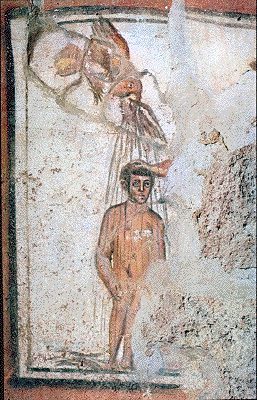
Baptism: fresco on the catacomb of Saints Marcellinus and Peter, Via Labicana, Rome, Italy [public domain / Wikimedia Commons]

***
Uploaded on 5 June 2002.
**
This discussion took place on a public Internet bulletin board, with six Protestants. Their words will appear in various colors, with my primary opponent’s words in blue.
* * * * *
How does a Protestant interpret this verse?:
1 Corinthians 15:29 (RSV) Otherwise, what do people mean by being baptized on behalf of the dead? If the dead are not raised at all, why are people baptized on their behalf?
Footnote from my New Geneva Study Bible:
Apparently some in Corinth were being baptized on behalf of others who had already died. This practice is not mentioned elsewhere in the Bible or in other ancient writings. Numerous explanations of the practice have been proposed, all of them speculative and none persuasive. Paul mentions the rite only to show the logical inconsistency of his opponent’s position.
I don’t see how that last sentence follows. I think the entire context falsifies it. Paul’s statement — whatever it means — is used as a rhetorical argument favoring the resurrection of the dead, not as an anomalous, incongruous example within the context of a positive affirmation of resurrection. The entire chapter 15 is about Jesus’ Resurrection and that of His followers.
Paul’s point is that the Christian life of toil and suffering is pointless if there is no resurrection, and if Jesus didn’t rise again (15:14, 17, 19), and that if this were the case, we might as well be hedonists (15:32). After he makes his statement in 15:29, he proclaims in the next verse: “Why am I in peril every hour?” In other words, “why do I go through what I go through, if not for the hope of the resurrection and eternal life?” (cf. 15:32).
So his example of baptism is one of several practices which only make sense if there is a resurrection. By analogy, then, it is not presented as an inconsistency at all, but as an acceptable practice in light of the resurrection, just like his “peril” and dying “every day” (15:31). On the contrary, if he wished to condemn such a practice, it seems to me that here was his opportunity to make it clear that it was not only “logically inconsistent” but wicked and forbidden in the Church Age / New Covenant period.
Paul certainly made no bones about other Corinthian faults in his two letters to them. So I say that Paul is supporting the practice, and that this has to be harmonized with Christian theology in some fashion.
I don’t think Protestants would likely see this passage much differently than Roman Catholics.
I don’t think they “see” it at all. :-) Or if they do they wrongly interpret it, in my opinion, just as the commentary above does, with recourse to special pleading and avoidance of the crystal-clear context. And there is other Scripture or ancient writing similar to this, which I will bring in in due course.
As you may know LDS [Mormons] use this passage to try to proof-text their practice of baptism for the dead.
Yes. I think they are wrongly interpreting as well.
Perhaps they were baptized for the sake of those who had died. Meaning, because of the testimony of believers that had been perhaps slain for the faith, these people were now becoming believers and being baptized. I always thought that “huper” could be like “because of.” I dunno. One thing is for sure, you can’t build a doctrine out of one verse.
There was a cult near Corinth in which the members were baptized on behalf of dead friends and relatives. Thus cult also happened to believe in a resurrection.
Paul was telling the believers how futile life is if there is no resurrection (“if the dead are not raised…let us eat, drink, and be merry, for tomorrow we die”). Interestingly, that particular saying was popular among the Epicureans. Paul is drawing on the teachings and practices of pagan religions to give support to his argument! It is along these lines that Paul also appeals to the practice of the cult (I have forgotten their name) that practiced baptism on behalf of the dead; the reason that those people practiced this was because they believed in a coming resurrection. Paul is saying, “Why does that group that baptizes people on behalf of the dead do what they’re doing if there is no resurrection?” He is pointing out that even among pagans, a belief or disbelief in the resurrection guides their ways of life. In the case of the Epicureans, their disbelief resulted in a debauched lifestyle. In the case of the Corinthian cult, their belief resulted in a practice of baptizing members on behalf of the dead. Likewise, as Christians our belief in the resurrection should produce a certain response in us; namely, we should be willing to fight with wild beasts (v. 32), die as martyrs, and live holy lives (v. 34).
Could I ask where you found this historical information (because others have denied it)?
There is nothing to support that Corinthian believers were being baptized for their dead relatives or friends. The note derives its existence from pure speculation and is contrary to Paul’s larger message delivered through the testimony of his epistles.
Well, then this is a big difference of opinion. The above commentary said the practice may have occurred but that Paul opposed it. You say there is no evidence that it occurred, and that Paul is talking about something entirely different. I say Paul is upholding the practice also, but I would interpret it differently (and I am withholding my opinion till other opinions are on the table, because I want to see what they are).
Baptism is the identifying with someone or something. In this case Paul is speaking of identification as a dead person. It means the Corinthian believers were baptized or identified with Jesus Christ who had died for them. They were dead to the world but were alive to Christ. See the contrast of this idea in Gal. 2:20.
Considering Paul is about to launch in the program and pattern of the resurrection Paul was saying that if there is no resurrection then we have been baptized for a dead man (Jesus Christ). Paul here, I believe, equivocates the denial of the believers resurrection as a denial of the resurrection of Jesus Christ.
Clever, but I don’t buy it, for two reasons. First, 15:29 does not say we were baptized in Christ or with Him, as other baptism passages suggest; rather, it says people are baptized “on behalf” of the dead: an entirely different concept. Obviously, our Lord Jesus needs nothing done on His behalf.
Secondly, “the dead” seems to me to be a corporate term, not referring to Jesus alone. If you are right, this is an exceedingly strange way to refer to Jesus, as “the dead.” And apart from the strange idiom and style, it is contradicted throughout chapter 15, because when Paul is referring to Jesus, He says so in no uncertain terms, repeatedly, by using the title, “Christ” (15:3-4,12-17,20), whereas “the dead” clearly refers to the resurrection of us poor, miserable created human beings, in contradistinction to the Resurrection of Jesus Christ, as in, e.g., 15:12-13,15-16,52. The distinction between the two couldn’t be more clear, with Paul often contrasting them in the very same verse.
Therefore, I believe your interpretation utterly collapses.
Actually it does work with the Greek. All you need to do is look at what Paul talks about in the proceding verse:
1 Cor. 15:28 And when all things shall be subdued unto him, then shall the Son also himself be subject unto him that put all things under him, that God may be all in all. 29 Else what shall they do which are baptized for the dead, if the dead rise not at all? why are they then baptized for the dead?
In verse 29, Paul is contrasting the thought laid out in verses 24-28 which is the end of human history and after the judgement when even sin and death are defeated and God’s kingdom encompasses everything having defeated all enemies through the Son. Paul is basically saying in verse 29, “If these things (vv. 24-29) are not to be, then what is the point of being baptized for a dead man (Jesus Christ)?” It is a rhetorical question. Follow my line of thinking?
No, for reasons explained above.
St. Francis de Sales:
This passage properly understood evidently shows that it was the custom of the primitive Church to watch, pray, fast, for the souls of the departed. For, firstly, in the Scriptures to be baptized is often taken for afflictions and penances; as in Luke 12:50 . . . and in St. Mark 10:38-9 . . . — in which places Our Lord calls pains and afflictions baptism [cf. Matthew 3:11, 20:22-3, Luke 3:16].
This then is the sense of that Scripture: if the dead rise not again, what is the use of mortifying and afflicting oneself, of praying and fasting for the dead? And indeed this sentence of St. Paul resembles that of 2 Maccabees 12:44: “It is superfluous and vain to pray for the dead if the dead rise not again. . . .” Now it was not for those in Paradise [heaven], who had no need of it, nor for those in hell, who could get no benefit from it; it was, then, for those in Purgatory. Thus did St. Ephraim [d.373] expound it.
The “penance” interpretation is supported contextually by the next three verses, where the Apostle speaks of being in peril every hour, and dying every day. St. Paul certainly doesn’t condemn the practice, whatever it is (his question being merely rhetorical). Given these facts, and the striking resemblance to 2 Maccabees 12:44, the traditional Catholic interpretation seems the most plausible.
Furthermore, Paul prays for the dead man Onesiphorus in 2 Tim 1:16-18 (“. . . may the Lord grant him to find mercy from the Lord on that Day . . .” — cf. 4:19). The New Bible Commentary admits that Onesiphorus is likely dead, and that Paul is praying (but somehow not for the dead). A.T. Robertson, in his Word Pictures of the NT, states: “Apparently Onesiphorus is now dead as implied by the wish in 1:18.”
Conclusion?:
- The guy is dead.
- Paul is praying for him.
- Therefore, prayers for the dead are taught (and practiced) by Paul.
- Since Paul’s writings are part of inspired revelation, prayer for the dead is NT and orthodox Christian teaching.
1 Corinthians 15:29 merely extends that spiritual principle by sanctioning penances for the dead (secondary usage of “baptism” — and the similarity to 2 Macc 12:44). Penance, just like prayer, has the effect of aiding another person.
I anticipated your conclusion. as I stated above, such teaching is based purely upon commentators’ speculation. In a nutshell your thesis is begging the question (for those reading along: begging the question is the name given to an informal fallacy of argumentation which occurs when one assumes inadequate premises provide adequate support for a conclusion. It normally comes from: (1) leaving out a key premise (2) when a premise states the conclusion in some way (3) circular reasoning).
Well, that’s easy to say and sounds quite impressive, but the problem is that you have simply made an assertion and not demonstrated (by carefully taking apart my exegesis) how my argument has done any such thing. On the other hand, I replied to your exegetical argument point-by-point, and I believe I demonstrated that it made no sense in the entire contextual passage (though I agree that this doesn’t prove my view — it merely shows yours to be implausible). You have not yet counter-replied (I hope you will).
I gave all sorts of different arguments for my interpretation, but no one has yet grappled with them, apart from simply stating disagreement, which is, of course, philosophically and exegetically unimpressive, and no reason for anyone to be persuaded otherwise. So you disagree with prayers for the dead . . . fine; I already knew that, but there is still a text to be dealt with here.
In review of your thesis your conclusion is reached by speculating upon earlier commentators’ speculation. Therefore you forwarded no argument because your thesis is begging the question. In my thesis I forwarded biblical theology and prefaced my conclusion that I believe that Paul was equivocating a denial of the resurrection to a denial of Christ’s resurrection. I stated my opinion based upon biblical theology. Opinions are what you asked for, and what I presented to you. The problem is when you shift from opinions to facts by attempting to become dogmatic upon your opinion you then are committing a formal fallacy of affirming the consequent. Examples of the fallacy of affirming the consequent:
If Paul was hammering against baptizing for the dead, then David is right.
David is right.
Therefore, Paul was hammering against baptizing for the dead.
If you were a gorilla, you’d have two legs.
You have two legs.
Therefore, you must be a gorilla
If P then Q
Q
Therefore, P
Once the formal fallacy is spotted one need not continue to examine the argument. Since you have shifted from opinion to fact and I have noted the fallacy, there is no need for this apologist to further demonstrate why the argument is incorrect.
I don’t buy it at all, but shoot yourself.
Are you at least willing to reply to my critique of your interpretation, if you won’t respond directly (i.e., exegetically) to mine? We keep getting further and further away from the text itself, which is the really interesting thing in this discussion, not your descriptions of various logical fallacies wrongly applied to my analysis . . .
Look at the big idea that chapter 15 lays out and ask yourself why Paul is going through the trouble of presenting his counsel concerning the resurrection?
Fact of Christ’s resurrection (1-11)
Importance of Christ’s resurrection (12-19)
Order of resurrection (20-28)
Moral implications of Christ’s resurrection (29-34)
Bodies of the resurrected dead (35-50)
Bodies of the translated living (51-58)
Considering Paul had been handed a shopping list of problems and questions, what problem or question do you suppose he was answering? What fits the text better? A denial of the believers resurrection or baptism for the dead?
My notion fits in perfectly well with the schema of the chapter because Paul was making a rhetorical argument having to do with the fact that there are folks who are resurrected and alive in the afterlife. Paraphrase of his rhetorical question: “why do something for their sakes if they aren’t there in the first place?” That makes perfect sense to me.
You, on the other hand, have suggested a strange, eccentric reading of the phrase “the dead” and tried to apply it to Jesus’ Resurrection, whereas Paul everywhere else in the chapter (since you agree, of course, that context is relevant and important) uses it as a term for the general dead, and contrasts it to Christ several times. I think this indicates exegetical desperation on your part, to latch onto such an exceedingly weak and implausible thesis.
My problem with the way you are proceeding in this discussion is your ignoring of both my particular exegetical arguments (which are various) and my critiques of yours. In my opinion, there is no dialogue unless you or someone else does that (we’re just talking past each other).
Failing that, I will simply assume that my interpretation is unchallenged (and, I believe, the most plausible of the choices presented), and that my critique of yours is successful, because you are unwilling to even attempt to overthrow it. Why would I think otherwise? Sometimes silence speaks volumes. And it is golden. :-)
Certainly you are capable of better than that.
Basically, I’m not challenging your opinion because it hasn’t registered as an argument.
That’s a clever way to avoid a discussion. I’ll have to remember that one. :-)
What I’m saying is that quoting people’s speculation, and then adding your own speculation in the end is still just opinion.
Well, I’m not going to argue this other than to deny that I did it, or to say — granting that I was merely “speculating” –, that you are doing nothing different. Else, why do you yourself write below: ” I would point out that Calvin’s commentary on 1 Cor. 15:29-34 tends to support my opinion.”
So you quote Calvin’s speculations, add your own, and offer “just an opinion” in the end, but that is okay, whereas my effort somehow is not? Strange. Or is it because Calvin is a big shot, so then the procedure transcends your alleged logical difficulties and then becomes proper and quite appropriate?
I submit that your real problem seems to be my presupposition that penances and prayers for the dead are not ruled out from the outset; so I incorporate them into my interpretation of the passage. Of course, everyone brings a theological framework and paradigm to commentary (so it is nothing extraordinary that I do the same from my Catholic belief).
Our choice, then, in doing comparative exegesis, is to either merely put down the other view as “just speculation” or “just opinion” because we don’t like it, or to actually interact with it point-by-point (i.e., make a counter-argument) and show (giving our own opinions and speculations) how it is incorrect or implausible.
That sticks to the text, and is actually exegesis, as opposed to polemics and grandiose statements about the supposed fallacies in the other guy’s opinion. And I often wonder why it is so difficult to get people to do that. It’s really fun, and one learns so much by delving deeply into any given biblical text. I know I always learn something.
Calvin is widely read by many people and not at all obscure.
So are Marx, Freud, Darwin, Nietzsche, etc. So what? But I do agree with his comments against another false interpretation, and will cite them below.
To opinions, I say, great, good for you!
And to you! Cheers (offering a toast to your mere opinions).
Within the context Paul is making certain that people know about the resurrection of the dead in Christ. Again, this chapter is parked within an epistle that is relating the apostle’s answers to a shopping list of questions and problems. Because of this the exegete would seek to understand that nature of the question or problem Paul is responding to. I have suggested that there were those within Corinth that were denying the resurrection of the dead. I would argue that the context of the chapter supports this approach, as does the larger context of the epistle.
We’ve been through that, and it is not at issue.
Further, the thesis I present, although still my opinion, blends well within Paul’s theology.
Opinion? But I thought that is what you were objecting to in my posts????
Nevertheless, to support your thesis, you need to present something concrete showing that the church of Corinth had fallen into the heterodox practice of baptizing for the dead. To the best of my knowledge no such evidence exists other than speculation.
This has nothing to do with my opinion. I have no idea why you would think that it does. I’m not even interpreting Paul’s reference to “baptism” as referring to water baptism.
To the charge that mine, is “a strange, eccentric reading,” I would point out that Calvin’s commentary on 1 Cor. 15:29-34 tends to support my opinion.
He doesn’t say that “the dead” refers to Christ. That is what I was specifically saying was “strange, eccentric” in your view. And you have consistently refused to defend it and respond to my contextual critique. That’s your right, but it doesn’t impress me, and I dare say that it won’t impress an impartial reader.
His commentary gives the “Corinthian Church baptized for the dead” position a thorough plummeting, if you are interested in reading it.
Yes, it was very interesting. Thanks for that link. I totally agree with him when he critiques that particular view (and made a shorter version of his argument myself, above). I disagree with his own positive interpretation, though. I would like to cite the portion of his commentary that I agree with:
Before expounding this passage, it is of importance to set aside the common exposition, which rests upon the authority of the ancients, and is received with almost universal consent. Chrysostom, therefore, and Ambrose, who are followed by others, are of opinion that the Corinthians were accustomed, when any one had been deprived of baptism by sudden death, to substitute some living person in the place of the deceased — to be baptized at his grave. They at the same time do not deny that this custom was corrupt, and full of superstition, but they say that Paul, for the purpose of confuting the Corinthians, was contented with this single fact, that while they denied that there was a resurrection, they in the mean time declared in this way that they believed in it. For my part, however, I cannot by any means be persuaded to believe this, . . .
Granting, however, that the argument was conclusive, can we suppose that, if such a corruption as this had prevailed among the Corinthians, the Apostle, after reproving almost all their faults, would have been silent as to this one? He has censured above some practices that are not of so great moment. He has not scrupled to give directions as to women’s having’ the head covered, and other things of that nature. Their corrupt administration of the Supper he has not merely reproved, but has inveighed against it with the greatest keenness. Would he in the meantime have uttered not a single word in reference to such a base profanation of baptism, which was a much more grievous fault? He has inveighed with great vehemence against those who, by frequenting the banquets of the Gentiles, silently counte-nanced their superstitions. Would he have suffered this horrible superstition of the Gentiles to be openly carried on in the Church itself under the name of sacred baptism? But granting that he might have been silent, what shall we say when he expressly makes mention of it? Is it, I pray you, a likely thing that the Apostle would bring forward in the shape of an argument a sacrilege by which baptism was polluted, and converted into a mere magical abuse, and yet not say even one word in condemnation of the fault? When he is treating of matters that are not of the highest importance, he introduces nevertheless this parenthesis, that he speaks as a man. (Romans 3:5; Romans 6:19; Galatians 3:15.) Would not this have been a more befitting and suitable place for such a parenthesis? Now from his making mention of such a thing without any word of reproof, who would not understand it to be a thing that was allowed? For my part, I assuredly understand him to speak here of the right, use of baptism, and not of an abuse of it of that nature.
I would disagree with your interpretation of the verse.
That’s fine, but why? No one has replied to my interpretation, or to my counter-replies to their interpretation. Mine takes into account context, style, the different meanings of “baptism” in Scripture, and the parallel with Maccabees. No one has touched any of these elements thus far. Maybe they will yet.
Paul brings this verse seemingly out of nowhere to illustrate a point about the resurrection of the dead. It’s obvious that the practice was known to the Corinthian believers in some way,
*
I agree, whatever the practice actually is. Everyone is assuming that Paul is referring to water baptism, when it is not necessary to do so simply by virtue of the word “baptism,” which has a few different meanings in Scripture. Biblically (and in Catholicism), it is nonsensical to be water-baptized for someone else, because (for Catholics, Orthodox, and several species of Protestants such as Lutherans, Anglicans, Church of Christ, etc.) it confers regeneration, and a dead person is either regenerate or not. No “proxy baptism” will change that fact after they are dead. Even if one denies baptismal regeneration, “proxy baptism” makes no sense because the baptism applies only to the one receiving it.
*
because Paul would’ve probably shed more light on it if it was a new practice or an essential point in Christian doctrine.
*
What makes sense is the “penitential” interpretation, because that easily harmonizes with the parallel passage in Maccabees about prayer for the dead. The problem here is that Protestant theology has no place for such thought, and so it is ruled out from the outset; thus the text remains mysterious for Protestants because of the (in this instance) false preconception they bring to it.
My thought about it is that he was illustrating a practice from another religon to illustrate a truth about the resurrection.
*
I don’t find that plausible. Why talk momentarily about baptism in another religion, in the context of a thoroughly Christian discussion about the resurrection? But bringing in the notion of penance and prayers for the dead makes perfect sense in the context of the Christian theology of the general resurrection.
The reason: my NIV says “…what will those do who are baptized for the dead?” which sounds like it is directed toward people outside of the Corinthian church. Honestly, unless anyone can time-travel back to the 1st century the passage will always remain obscure.
*
Only for Protestants, because their theology disallows the (in my opinion) most plausible and sensible interpretation of the verse. It is somewhat obscure for Catholics too, but — with all due respect — I think we at least offer some sort of plausible explanation of it.
Here’s what the text note to my NIV Study Bible says if you’re curious.
*
Sure.
. . . because Paul does not give any more information about the practice, many attempts have been made to interpret the concept. Three of these are: 1. Living believers were being baptized for believers who died before they were baptized, so that they too, in a sense, would not miss out on baptism.
That makes no sense in any Christian system I am aware of, including Catholicism. The direct effect of a sacrament only applies to the one receiving it. We have the notion of “baptism of desire” for a person who was not baptized for some reason, but would do so if he could (such as the thief on the cross). That very concept and “loophole” — so to speak — presupposes that no one can be water-baptized for anyone else.
- Christians were being baptized in anticipation of the resurrection of the dead.
This violates the text, because the baptism is on behalf of the dead.
- New converts were being baptized to fill the ranks of Christians that had died.
Stretching it. This doesn’t deal with the text itself, but strikes me as desperate special pleading. Again, it ignores the element of “behalf”.
At any rate, Paul mentions the custom almost in passing,
*
Whether it is in passing or not, it has to be explained in some fashion. Better for Protestants to simply admit ignorance, than to special plead, in order to avoid at all costs a “Catholic” interpretation.
using its arguments substantiating the resurrection of the dead, but without necessarily approving the practice.”
*
There is no hint in the passage that I can see, that Paul disapproves of it. As I wrote earlier, if he did, it stands to reason that he would show his disagreement when he mentions it. That would be his responsibility as an Apostle and Christian teacher, responsible for his flock.
My problem with your exegesis is that:
1: How do we know that the guy [Onesiphorus] is even dead? It doesn’t seem totally certain.
Because Paul refers to the “household of Onesiphorus” twice. If I were writing to you, I don’t think I would say “I send greetings to the household of [name] . . . ” No, I would say, “Greetings to you and your house,” or “I hope you and yours are well,” as I often do. But you would be mentioned in it. That’s why some commentators think he was dead. E.g., The International Standard Bible Encyclopedia (vol. 4, 2195, “Onesiphorus”) states:
It is not clear whether Onesiphorus was living, or whether he had died, before Paul wrote the epistle. Different opinions have been held on the subject. The way in which Paul refers to ‘the household . . . of Onesiphorus,’ makes it possible that Onesiphorus himself had died . . . but certainty is impossible.
2: Is Paul praying or simply expressing a wish?
Well, I think this attempted distinction is stretching it a bit too far. The Protestant, in his necessity to escape the implication of prayers for the dead, comes up with this business of Paul “wishing” (as several commentators do). In any event, his words read exactly like a prayer: “may the Lord grant him to find mercy on that Day” (2 Tim 1:18; RSV). What is the difference between, e.g., “I pray that God will bless you” and “I wish that God will bless you”? The sentiment is pretty much the same one.
To jump from that to the claim that praying for the dead is Biblical seems more like a leap — it is not certain enough for that kind of commitment.
I wasn’t making a full-fledged argument for prayers for the dead. I do that elsewhere. I just mentioned it as a cross-reference to the discussion on “baptism for the dead,” because Paul appears to have a verse from Maccabees in mind, where prayer for the dead is explicitly taught (and that shows it was indeed Jewish practice, whatever one thinks of the canonicity of that particular book). It’s fun to throw these things out to see what Protestants try to do with them. :-)
Thanks for your feedback, and my wish, hope, desire (prayer?) is that God will be merciful to you on that Day! :-)
Stay in touch! Like Biblical Evidence for Catholicism on Facebook:
Previous Post

January 16, 2016
Mary: Ark of the New Covenant (Biblical Evidences)
Next Post

January 18, 2016 Paul Prayed for Dead Onesiphorus (Protestant Commentaries)
Browse Our Archives
Select a Category & Last Things About Me Anti-Catholicism Atheism & Agnosticism Baptism and Sacramentalism Bible and Tradition Blessed Virgin Mary Books by Dave Armstrong C. S. Lewis Calvinism & General Protestantism Catholic Apologetics Catholic Apologists Catholic conversion Catholic converts Christmas Church (Ecclesiology) Church History Conversion and Converts Development of Doctrine Eastern Orthodoxy Ecumenism & Christian Unity Eucharist & Liturgy Fathers of the Church French Translations G. K. Chesterton Hell Hell & Satan Hell & Satan & Last Things Heresies & Comparative Religion Holistic Health Inquisition & Crusades & Scandals James White Jews & Judaism & Old Testament John Calvin John Henry Newman Liberal / Modernist Theology Life Issues Literary Resume Lutheranism Mariology Martin Luther Music Orthodoxy Papacy & Infallibility Personal Page Philosophy & Science Political & Ethical & Moral Issues Protestant Persecution & Intolerance Protestantism Purgatory Purgatory & Penance Romantic & Imaginative Theology Saints & Purgatory & Penance Salvation Salvation & Justification Satan & Last Things Sexuality and Gender Issues Spanish Translations Traditionalism vs. Radical Catholic Reactionaries Traducciones al español / tradução para português Trinitarianism & Christology Uncategorized Videos
Select a Month October 2026 September 2026 August 2026 July 2026 June 2026 May 2026 April 2026 March 2026 February 2026 January 2026 December 2025 November 2025 October 2025 September 2025 August 2025 July 2025 June 2025 May 2025 April 2025 March 2025 February 2025 January 2025 December 2024 November 2024 October 2024 September 2024 August 2024 July 2024 June 2024 May 2024 April 2024 March 2024 February 2024 January 2024 December 2023 November 2023 October 2023 September 2023 August 2023 July 2023 June 2023 May 2023 April 2023 March 2023 February 2023 January 2023 December 2022 November 2022 October 2022 September 2022 August 2022 July 2022 June 2022 May 2022 April 2022 March 2022 February 2022 January 2022 December 2021 November 2021 October 2021 September 2021 August 2021 July 2021 June 2021 May 2021 April 2021 March 2021 February 2021 January 2021 December 2020 November 2020 October 2020 September 2020 August 2020 July 2020 June 2020 May 2020 April 2020 March 2020 February 2020 January 2020 December 2019 November 2019 October 2019 September 2019 August 2019 July 2019 June 2019 May 2019 April 2019 March 2019 February 2019 January 2019 December 2018 November 2018 October 2018 September 2018 August 2018 July 2018 June 2018 May 2018 April 2018 March 2018 February 2018 January 2018 December 2017 November 2017 October 2017 September 2017 August 2017 July 2017 June 2017 May 2017 April 2017 March 2017 February 2017 January 2017 December 2016 November 2016 October 2016 September 2016 August 2016 July 2016 June 2016 May 2016 April 2016 March 2016 February 2016 January 2016 December 2015 November 2015 October 2015 September 2015 August 2015 July 2015 June 2015 May 2015 April 2015 March 2015 February 2015 January 2015 December 2014 November 2014 October 2014 September 2014 August 2014 July 2014 June 2014 April 2014 March 2014 February 2014 January 2014 December 2013 November 2013 October 2013 September 2013 August 2013 July 2013 June 2013 April 2013 March 2013 February 2013 January 2013 December 2012 November 2012 October 2012 September 2012 August 2012 July 2012 June 2012 May 2012 April 2012 March 2012 February 2012 January 2012 December 2011 November 2011 October 2011 September 2011 August 2011 July 2011 June 2011 April 2011 March 2011 February 2011 October 2010 September 2010 August 2010 July 2010 April 2010 March 2010 December 2009 October 2009 August 2009 July 2009 June 2009 May 2009 March 2009 February 2009 October 2008 September 2008 April 2008 March 2008 February 2008 January 2008 December 2007 November 2007 October 2007 May 2007 March 2007 February 2007 January 2007 November 2006 October 2006 September 2006 August 2006 July 2006 June 2006 May 2006 April 2006 March 2006 February 2006 October 2005 June 2005 April 2005 February 2005 July 2004 May 2004 April 2004
Follow Us!
TAKE THE
Religious Wisdom Quiz
What tree were Adam and Eve told not to eat from?
Select your answer to see how you score.
Olive Tree Tree of Life Tree of Knowledge of Good and Evil Fig Tree
Books by This Author Books by Dave Armstrong
Related posts from Biblical Evidence for Catholicism

Bible & Catholicism on Mortal Sin (vs. John...
Biblical Evidence for Catholicism

Does Catholic Intercession of Saints Require Omniscience?
Biblical Evidence for Catholicism

Capabilities of Heavenly Saints: Protestant Commentaries
Biblical Evidence for Catholicism

Revelation 5 & 8 (Intercession of Saints &...
Biblical Evidence for Catholicism
TRENDING AT PATHEOS Catholic

The First Eucharistic Controversy: Christ’s Real Presence
For Catholics, the Eucharist is the source and summit of the Christian...

What a Stop Sign Can Teach Us About...
How to Make a Decision When You Can't Hear God Main point:...

Archdiocese Hosts Military Marriage Retreat in Germany
RASTATT, Germany — The transient military lifestyle, with its frequent deployments and...

Nearly every morning, I make the drive to Detroit with my high-school-age...

The Real AI Story Is Adoption Without Trust
Artificial intelligence has crossed a political threshold. It is no longer a...

A new article, written by Jeff Lindsay and Gale L. Pooley,...
view all Catholic blogs
Ad-Free & Subscriber Log-In Subscription Support
- About Us
- 2026 Calendar
- Videos
- Podcasts
- Library of World Religions
- Faith In Media Tracker
- Advertise With Us
- Write for Us
- Privacy Policy
- Terms of Service
- Do Not Sell My Data
- Contact Us
- Radiant Digital
- Manage Newsletter Subscriptions
- Unsubscribe From Notifications
- Sitemap
Copyright 2008-2026, Patheos. All rights reserved.
Subscription Support Ad-Free & Subscriber Log-In
Follow Patheos