
BuddhistCatholicContemplativeEvangelicalGeneral ChristianHinduJewishLatter-day SaintMuslimNew VisionsProgressive Christian
Beliefs
- Buddhist
- Catholic
- Contemplative
- Evangelical
- General Christian
- Hindu
- Jewish
- Latter-day Saint
- More Voices
- Muslim
- New Visions
- Pagan
- Progressive Christian
Topics
- Religion News
- Food and Religion
- Sports and Religion
- Religious Art
- Religious Music and Entertainment
- Religious Events
- History and Religion
- Style and Religion
- Politics and Religion
- Women in Religion
- Recreation Outdoors and Religion
- Business Finance and Religion
- Careers Workplace and Religion
- Education and Religion
- Family Parenting and Religion
- Health Fitness and Religion
- Home and Religion
- Relationships and Religion
- Technology and Religion
- Travel and Religion
Columnists
- Buddhist Columnists
- Business Finance and Religion Columnists
- Careers Workplace and Religion Columnists
- Catholic Columnists
- Contemplative Columnists
- Education and Religion Columnists
- Evangelists Columnists
- Family Parenting and Religion Columnists
- General Christian Columnists
- Health Fitness and Religion Columnists
- Hindu Columnists
- History and Religion Columnists
- Home and Religion Columnists
- Jewish Columnists
- More Voices Columnists
- Latter Day Columnists
- Muslim Columnists
- New Visions Columnists
- Nonreligious Columnists
- Pagan Columnists
- Politics and Religion Columnists
- Progressive Columnists
- Recreation Outdoors and Religion Columnists
- Relationships and Religion Columnists
- Religion News Columnists
- Religious Art Columnists
- Religious Events Columnists
- Religious Music and Entertainment Columnists
- Sports and Religion Columnists
- Style and Religion Columnists
- Technology and Religion Columnists
- Travel and Religion Columnists
- Women in Religion Columnists
Resource Library
- 2026 Calendar
- Library of World Religions
- The 100 Most Holy Places on Earth
- Patheos Answers
- Podcasts
- Videos
- Faith Leaders Database
- Anglican Episcopalian
- Bahai
- Baptist
- Buddhism
- Christianity
- Confucianism
- Eastern Orthodoxy
- Hinduism
- Holiness and Pentecostal
- ISKCON
- Islam
- Judaism
- Lutheran
- Methodist
- The Church of Jesus Christ of Latter-day Saints
- New Age
- Paganism
- Presbytarian and Reformed
- Protestantism
- Religion Behind the Scenes
- Roman Catholic
- Scientology
- Shia Islam
- Sikhism
- Sufism
- Sunni Islam
- Taoism
- Zen
- See all religions
Research Tools
 Ad-Free & Subscriber Log-In Subscription Support
Ad-Free & Subscriber Log-In Subscription Support
Follow Patheos 

- Trending:
- Forgiveness
- |
- Marriage
- |
- Consciousness
- |
- Death Penalty
- |
- Election
- |
- Halloween

-
About
-
Catholic Apologetics
-
Church History
-
Great Apologists
-
Christian Worldview
-
Protestantism & Misc.
- Home
- Catholic
- History and Religion
- Augustine’s “Confessions”: Model for Conversion Stories
Augustine’s “Confessions”: Model for Conversion Stories
Last updated on: March 29, 2017 at 2:21 pm by Dave Armstrong
Augustine’s “Confessions”: Model for Conversion Stories 2017-03-29T14:21:10-04:00 Dave Armstrong
Patheos Explore the world's faith through different perspectives on religion and spirituality! Patheos has the views of the prevalent religions and spiritualities of the world.
(6-10-09)* * * * *
1) St. Augustine critiqued many belief-systems and practices in his famous spiritual autobiography. He critiqued, for example, astrology:
I then turned my thoughts to those that are born twins, who generally come out of the womb so near the one to the other that the short interval between them–whatever importance they may ascribe to it in the nature of things — cannot be noted by human observation or expressed in those tables which the astrologer uses to examine when he undertakes to pronounce the truth. But such pronouncements cannot be true. For looking into the same horoscopes, he must have foretold the same future for Esau and Jacob . . . (Book VII, Chapter 6; Outler translation, as throughout)
2) The Manichaeans, as we would expect, are strongly criticized by Augustine:
Thus I fell among men, delirious in their pride, carnal and voluble, whose mouths were the snares of the devil — a trap made out of a mixture of the syllables of thy name and the names of our Lord Jesus Christ and of the Paraclete. These names were never out of their mouths, but only as sound and the clatter of tongues, for their heart was empty of truth. Still they cried, “Truth, Truth,” and were forever speaking the word to me. But the thing itself was not in them. Indeed, they spoke falsely not only of thee — who truly art the Truth — but also about the basic elements of this world, thy creation. (Book III, Chapter 6)
3) He spoke of discovering particular objective truths in Catholicism; for example, concerning substance:
As I increased in years, the worse was my vanity. For I could not conceive of any substance but the sort I could see with my own eyes. I no longer thought of thee, O God, by the analogy of a human body. Ever since I inclined my ear to philosophy I had avoided this error — and the truth on this point I rejoiced to find in the faith of our spiritual mother, thy Catholic Church. (Book VII, Chapter 1)
4) He makes general statements about “the truth”:
. . . though I had not yet grasped the truth, I was rescued from falsehood. (Book VI, Chapter 1)
Such perplexities I revolved in my wretched breast, overwhelmed with gnawing cares lest I die before I discovered the truth. (Book VII, Chapter 5)
I should have more readily doubted that I am alive than that the Truth exists — the Truth which is “clearly seen, being understood by the things that are made.” (Book VII, Chapter 10)
For when I inquired how it was that I could appreciate the beauty of bodies, both celestial and terrestrial; and what it was that supported me in making correct judgments about things mutable; and when I concluded, “This ought to be thus; this ought not” — then when I inquired how it was that I could make such judgments (since I did, in fact, make them), I realized that I had found the unchangeable and true eternity of truth above my changeable mind. (Book VII, Chapter 17)
I have had experience with many who wished to deceive, but not one who wished to be deceived. Where, then, did they ever know about this happy life, except where they knew also what the truth is? For they love it, too, since they are not willing to be deceived. And when they love the happy life, which is nothing else but joy in the truth, then certainly they also love the truth. (Book X, Chapter 23)
Thus, thus, truly thus: the human mind so blind and sick, so base and ill-mannered, desires to lie hidden, but does not wish that anything should be hidden from it. And yet the opposite is what happens — the mind itself is not hidden from the truth, but the truth is hidden from it. Yet even so, for all its wretchedness, it still prefers to rejoice in truth rather than in known falsehoods. It will, then, be happy only when without other distractions it comes to rejoice in that single Truth through which all things else are true. (Book X, Chapter 23)
For where I found Truth, there found I my God, who is the Truth. (Book X, Chapter 24)
In this discord of true opinions let Truth itself bring concord, . . . (Book XII, Chapter 30)
5) He distinguishes Catholic truth from the errors of philosophers and other false teachers on various subjects:
. . . I had no hope of finding in thy Church the truth from which they had turned me aside, . . . (Book V, Chapter 10)
I felt quite ashamed because during the long time I had been deluded and deceived by the [Manichean] promises of certainties, I had, with childish petulance, prated of so many uncertainties as if they were certain. That they were falsehoods became apparent to me only afterward. However, I was certain that they were uncertain and since I had held them as certainly uncertain I had accused thy Catholic Church with a blind contentiousness. I had not yet discovered that it taught the truth, but I now knew that it did not teach what I had so vehemently accused it of. (Book VI, Chapter 4)
For myself, I must confess that it was even later that I learned how in the sentence, “The Word was made flesh,” the Catholic truth can be distinguished from the falsehood of Photinus. (Book VII, Chapter 19)
6) He condemns heresies:
But when he later learned that this was the error of the Apollinarian heretics, he rejoiced in the Catholic faith and accepted it. . . . For the refutation of heretics makes the tenets of thy Church and sound doctrine to stand out boldly. “For there must also be heresies [factions] that those who are approved may be made manifest among the weak.” (Book VII, Chapter 19)
Let them perish from thy presence, O God, as vain talkers, and deceivers of the soul perish, who, when they observe that there are two wills in the act of deliberation, go on to affirm that there are two kinds of minds in us: one good, the other evil. They are indeed themselves evil when they hold these evil opinions — and they shall become good only when they come to hold the truth and consent to the truth . . . (Book VIII, Chapter 10)
Else they must be converted to the truth, and no longer deny that when anyone deliberates there is one soul fluctuating between conflicting wills. (Book VIII, Chapter 10)
For he was not yet a Christian, and had fallen into the pit of deadly error, believing that the flesh of thy Son, the Truth, was a phantom. Yet he had come up out of that pit and now held the same belief that we did. (Book IX, Chapter 3)
For it was only about a year — not much more — since Justina, the mother of the boy-emperor Valentinian, had persecuted thy servant Ambrose on behalf of her heresy, in which she had been seduced by the Arians. (Book IX, Chapter 7)
7) He acknowledges partial truth in other belief-systems:
For he did not create them, and then go away. They are of him and in him. Behold, there he is, wherever truth is known. He is within the inmost heart, yet the heart has wandered away from him. Return to your heart, O you transgressors, and hold fast to him who made you. Stand with him and you shall stand fast. Rest in him and you shall be at rest. Where do you go along these rugged paths? Where are you going? The good that you love is from him, and insofar as it is also for him, it is both good and pleasant. (Book IV, Chapter 12)
So I began, and I found that whatever truth I had read [in the Platonists] was here combined with the exaltation of thy grace. (Book VII, Chapter 21)
And though he was not as yet initiated in any of the sacraments of thy Church, he was a most earnest inquirer after truth. (Book IX, Chapter 3)
8) He deliberately aims to persuade others, based on his own odyssey:
But, because “love believes all things” — at least among those who are bound together in love by its bonds — I confess to thee, O Lord, so that men may also hear; for if I cannot prove to them that I confess the truth, yet those whose ears love opens to me will believe me. (Book X, Chapter 3)
Why, then, does truth generate hatred, and why does thy servant who preaches the truth come to be an enemy to them who also love the happy life, which is nothing else than joy in the truth — unless it be that truth is loved in such a way that those who love something else besides her wish that to be the truth which they do love. (Book X, Chapter 23)
For if anyone arrogates to himself what thou hast bestowed on all to enjoy, and if he desires something for his own that belongs to all, he is forced away from what is common to all to what is, indeed, his very own — that is, from truth to falsehood. (Book XII, Chapter 25)
And yet, O my God, thou exaltation of my humility and rest of my toil, who hearest my confessions and forgivest my sins, since thou commandest me to love my neighbor as myself, I cannot believe that thou gavest thy most faithful servant Moses a lesser gift than I should wish and desire for myself from thee, if I had been born in his time, and if thou hadst placed me in the position where, by the use of my heart and my tongue, those books might be produced which so long after were to profit all nations throughout the whole world — from such a great pinnacle of authority — and were to surmount the words of all false and proud teachings. If I had been Moses — and we all come from the same mass, and what is man that thou art mindful of him? — if I had been Moses at the time that he was, and if I had been ordered by thee to write the book of Genesis, I would surely have wished for such a power of expression and such an art of arrangement to be given me, that those who cannot as yet understand how God createth would still not reject my words as surpassing their powers of understanding. And I would have wished that those who are already able to do this would find fully contained in the laconic speech of thy servant whatever truths they had arrived at in their own thought; and if, in the light of the Truth, some other man saw some further meaning, that too would be found congruent to my words. (Book XII, Chapter 26)
For just as a spring dammed up is more plentiful and affords a larger supply of water for more streams over wider fields than any single stream led off from the same spring over a long course — so also is the narration of thy minister: it is intended to benefit many who are likely to discourse about it and, with an economy of language, it overflows into various streams of clear truth, from which each one may draw out for himself that particular truth which he can about these topics–this one that truth that one another truth, by the broader survey of various interpretations. (Book XII, Chapter 27)
9) He joins objective and subjective truth together:
Indeed, it actually speaks to all, but only they understand it who compare the voice received from without with the truth within. (Book X, Chapter 6)
It is not because they are godly men and have seen in the heart of thy servant what they say, but rather they are proud men and have not considered Moses’ meaning, but only love their own — not because it is true but because it is their own. Otherwise they could equally love another true opinion, as I love what they say when what they speak is true — not because it is theirs but because it is true, and therefore not theirs but true. And if they love an opinion because it is true, it becomes both theirs and mine, since it is the common property of all lovers of the truth. . . . And therefore, O Lord, thy judgments should be held in awe, because thy truth is neither mine nor his nor anyone else’s; but it belongs to all of us whom thou hast openly called to have it in common; and thou hast warned us not to hold on to it as our own special property, for if we do we lose it. (Book XII, Chapter 25)
My Confessions, in thirteen books, praise the righteous and good God as they speak either of my evil or good, and they are meant to excite men’s minds and affections toward him. At least as far as I am concerned, this is what they did for me when they were being written and they still do this when read. What some people think of them is their own affair [ipse viderint]; but I do know that they have given pleasure to many of my brethren and still do so. (From the Retractations, II, 6; written in A.D. 427)
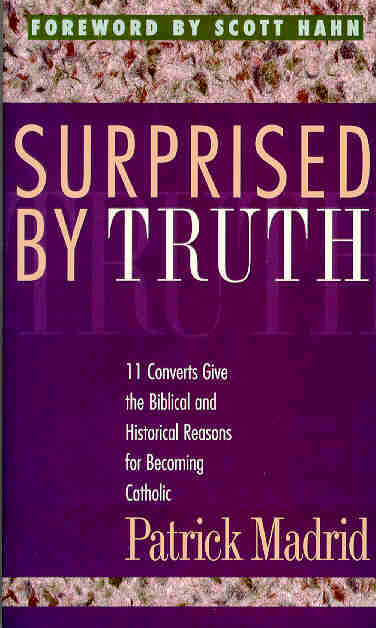
Catholic conversion stories (including my own and especially those in the Surprised by Truth series) exhibit all these things. If people don’t care for that, then they should also condemn St. Augustine for committing all the same “transgressions.”
St. Augustine espoused the notions of possessing a greater measure of truth and attempting, out of charitable motives, to pass it on to someone else. His very famous book has continued to do this these past 16 centuries, and many Catholic converts (particularly the apologetics-minded) try to do the same today.
***
Stay in touch! Like Biblical Evidence for Catholicism on Facebook:
Previous Post

January 18, 2016
Deconversion of Dave Van Allen (ExChristian.Net)
Next Post

January 19, 2016 Michigander Defends the Confederate Flag
Browse Our Archives
Select a Category & Last Things About Me Anti-Catholicism Atheism & Agnosticism Baptism and Sacramentalism Bible and Tradition Blessed Virgin Mary Books by Dave Armstrong C. S. Lewis Calvinism & General Protestantism Catholic Apologetics Catholic Apologists Catholic conversion Catholic converts Christmas Church (Ecclesiology) Church History Conversion and Converts Development of Doctrine Eastern Orthodoxy Ecumenism & Christian Unity Eucharist & Liturgy Fathers of the Church French Translations G. K. Chesterton Hell Hell & Satan Hell & Satan & Last Things Heresies & Comparative Religion Holistic Health Inquisition & Crusades & Scandals James White Jews & Judaism & Old Testament John Calvin John Henry Newman Liberal / Modernist Theology Life Issues Literary Resume Lutheranism Mariology Martin Luther Music Orthodoxy Papacy & Infallibility Personal Page Philosophy & Science Political & Ethical & Moral Issues Protestant Persecution & Intolerance Protestantism Purgatory Purgatory & Penance Romantic & Imaginative Theology Saints & Purgatory & Penance Salvation Salvation & Justification Satan & Last Things Sexuality and Gender Issues Spanish Translations Traditionalism vs. Radical Catholic Reactionaries Traducciones al español / tradução para português Trinitarianism & Christology Uncategorized Videos
Select a Month October 2026 September 2026 August 2026 July 2026 June 2026 May 2026 April 2026 March 2026 February 2026 January 2026 December 2025 November 2025 October 2025 September 2025 August 2025 July 2025 June 2025 May 2025 April 2025 March 2025 February 2025 January 2025 December 2024 November 2024 October 2024 September 2024 August 2024 July 2024 June 2024 May 2024 April 2024 March 2024 February 2024 January 2024 December 2023 November 2023 October 2023 September 2023 August 2023 July 2023 June 2023 May 2023 April 2023 March 2023 February 2023 January 2023 December 2022 November 2022 October 2022 September 2022 August 2022 July 2022 June 2022 May 2022 April 2022 March 2022 February 2022 January 2022 December 2021 November 2021 October 2021 September 2021 August 2021 July 2021 June 2021 May 2021 April 2021 March 2021 February 2021 January 2021 December 2020 November 2020 October 2020 September 2020 August 2020 July 2020 June 2020 May 2020 April 2020 March 2020 February 2020 January 2020 December 2019 November 2019 October 2019 September 2019 August 2019 July 2019 June 2019 May 2019 April 2019 March 2019 February 2019 January 2019 December 2018 November 2018 October 2018 September 2018 August 2018 July 2018 June 2018 May 2018 April 2018 March 2018 February 2018 January 2018 December 2017 November 2017 October 2017 September 2017 August 2017 July 2017 June 2017 May 2017 April 2017 March 2017 February 2017 January 2017 December 2016 November 2016 October 2016 September 2016 August 2016 July 2016 June 2016 May 2016 April 2016 March 2016 February 2016 January 2016 December 2015 November 2015 October 2015 September 2015 August 2015 July 2015 June 2015 May 2015 April 2015 March 2015 February 2015 January 2015 December 2014 November 2014 October 2014 September 2014 August 2014 July 2014 June 2014 April 2014 March 2014 February 2014 January 2014 December 2013 November 2013 October 2013 September 2013 August 2013 July 2013 June 2013 April 2013 March 2013 February 2013 January 2013 December 2012 November 2012 October 2012 September 2012 August 2012 July 2012 June 2012 May 2012 April 2012 March 2012 February 2012 January 2012 December 2011 November 2011 October 2011 September 2011 August 2011 July 2011 June 2011 April 2011 March 2011 February 2011 October 2010 September 2010 August 2010 July 2010 April 2010 March 2010 December 2009 October 2009 August 2009 July 2009 June 2009 May 2009 March 2009 February 2009 October 2008 September 2008 April 2008 March 2008 February 2008 January 2008 December 2007 November 2007 October 2007 May 2007 March 2007 February 2007 January 2007 November 2006 October 2006 September 2006 August 2006 July 2006 June 2006 May 2006 April 2006 March 2006 February 2006 October 2005 June 2005 April 2005 February 2005 July 2004 May 2004 April 2004
Follow Us!
TAKE THE
Religious Wisdom Quiz
What did Isaiah say about Egypt's future in his oracles?
Select your answer to see how you score.
It would conquer Israel It would be conquered It would prosper It would rule Persia
Books by This Author Books by Dave Armstrong
Related posts from Biblical Evidence for Catholicism

On Protestant Explanations of Catholic Conversion
Biblical Evidence for Catholicism

17 Church Fathers on Purgatory (Esp. 1 Cor...
Biblical Evidence for Catholicism

Deuterocanon & Javier Perdomo's Straw Men
Biblical Evidence for Catholicism

St. Athanasius & the Deuterocanon (vs. Javier Perdomo)
Biblical Evidence for Catholicism
TRENDING AT PATHEOS Catholic

In "Irreplaceable," our book on vocation and technology, Trevor Sutton and I...

I was strolling through the top floor of the brand new Parthenon...

What Does Gêvâh Mean For Kimberley Guifoyle &...
This week, a lot of the news is focused on Kimberly Guilfoyle....

INNER CIRCLE: Profound Mystery (Of Christ In All...
Ephesians 5:31-32 “For this reason, a man will leave his father and...

Do Not Rejoice When Your Enemy Falls: The...
Turning an execution into a public spectacle is a disturbing expression of...

'The Chosen' S6 Trailer: The Passion Gets Very...
Not many watching 'The Chosen' worry about spoilers, but just because they...
view all Catholic blogs
Ad-Free & Subscriber Log-In Subscription Support
- About Us
- 2026 Calendar
- Videos
- Podcasts
- Library of World Religions
- Faith In Media Tracker
- Advertise With Us
- Write for Us
- Privacy Policy
- Terms of Service
- Do Not Sell My Data
- Contact Us
- Radiant Digital
- Manage Newsletter Subscriptions
- Unsubscribe From Notifications
- Sitemap
Copyright 2008-2026, Patheos. All rights reserved.
Subscription Support Ad-Free & Subscriber Log-In
Follow Patheos