
BuddhistCatholicContemplativeEvangelicalGeneral ChristianHinduJewishLatter-day SaintMuslimNew VisionsProgressive Christian
Beliefs
- Buddhist
- Catholic
- Contemplative
- Evangelical
- General Christian
- Hindu
- Jewish
- Latter-day Saint
- More Voices
- Muslim
- New Visions
- Pagan
- Progressive Christian
Topics
- Religion News
- Food and Religion
- Sports and Religion
- Religious Art
- Religious Music and Entertainment
- Religious Events
- History and Religion
- Style and Religion
- Politics and Religion
- Women in Religion
- Recreation Outdoors and Religion
- Business Finance and Religion
- Careers Workplace and Religion
- Education and Religion
- Family Parenting and Religion
- Health Fitness and Religion
- Home and Religion
- Relationships and Religion
- Technology and Religion
- Travel and Religion
Columnists
- Buddhist Columnists
- Business Finance and Religion Columnists
- Careers Workplace and Religion Columnists
- Catholic Columnists
- Contemplative Columnists
- Education and Religion Columnists
- Evangelists Columnists
- Family Parenting and Religion Columnists
- General Christian Columnists
- Health Fitness and Religion Columnists
- Hindu Columnists
- History and Religion Columnists
- Home and Religion Columnists
- Jewish Columnists
- More Voices Columnists
- Latter Day Columnists
- Muslim Columnists
- New Visions Columnists
- Nonreligious Columnists
- Pagan Columnists
- Politics and Religion Columnists
- Progressive Columnists
- Recreation Outdoors and Religion Columnists
- Relationships and Religion Columnists
- Religion News Columnists
- Religious Art Columnists
- Religious Events Columnists
- Religious Music and Entertainment Columnists
- Sports and Religion Columnists
- Style and Religion Columnists
- Technology and Religion Columnists
- Travel and Religion Columnists
- Women in Religion Columnists
Resource Library
- 2026 Calendar
- Library of World Religions
- The 100 Most Holy Places on Earth
- Patheos Answers
- Podcasts
- Videos
- Faith Leaders Database
- Anglican Episcopalian
- Bahai
- Baptist
- Buddhism
- Christianity
- Confucianism
- Eastern Orthodoxy
- Hinduism
- Holiness and Pentecostal
- ISKCON
- Islam
- Judaism
- Lutheran
- Methodist
- The Church of Jesus Christ of Latter-day Saints
- New Age
- Paganism
- Presbytarian and Reformed
- Protestantism
- Religion Behind the Scenes
- Roman Catholic
- Scientology
- Shia Islam
- Sikhism
- Sufism
- Sunni Islam
- Taoism
- Zen
- See all religions
Research Tools
 Ad-Free & Subscriber Log-In Subscription Support
Ad-Free & Subscriber Log-In Subscription Support
Follow Patheos 

- Trending:
- Forgiveness
- |
- Marriage
- |
- Consciousness
- |
- Death Penalty
- |
- Election
- |
- Halloween

-
About
-
Catholic Apologetics
-
Church History
-
Great Apologists
-
Christian Worldview
-
Protestantism & Misc.
- Home
- Catholic
- History and Religion
- Justification is NOT by Faith Alone, and is Ongoing
Justification is NOT by Faith Alone, and is Ongoing
Last updated on: June 5, 2026 at 11:43 pm by Dave Armstrong
Justification is NOT by Faith Alone, and is Ongoing 2026-06-05T23:43:24-04:00 Dave Armstrong
Patheos Explore the world's faith through different perspectives on religion and spirituality! Patheos has the views of the prevalent religions and spiritualities of the world.
Romans 4, James 2, and Abraham’s Multiple Justifications
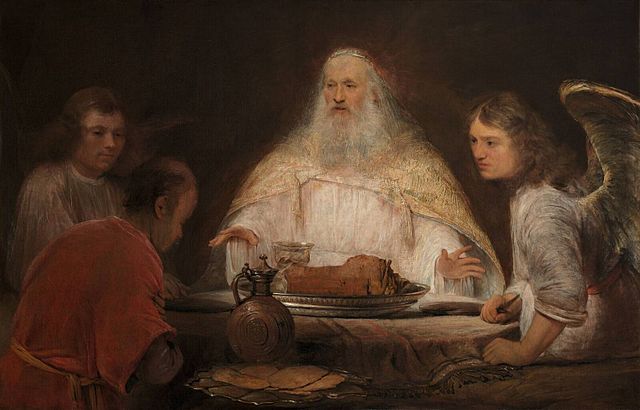
Abraham and the Angels (1680-1685), by Aert de Gelder (1645-1727) [public domain / Wikimedia Commons]

* * *
(10-15-11)
[the following is a large portion of the longer paper, “Dialogue with Lutheran Nathan Rinne, Regarding My Critiques of Lutheran Theologian Martin Chemnitz (1522-1586), Part Three: Soteriology and Miscellany”; just a little bit of additional material has been added. All Bible passages are from RSV]
* * * * *
Catholics believe in Jesus Christ and His all-sufficient saving work on the cross (ours to receive by Grace Alone), just as Protestants do. We only deny an extreme Faith Alone position (which does not deny Grace Alone, since they are distinct).
St. Paul opposes grace and/or faith to works in Scripture, only in a particular sense: the “works” of Jewish ritualism by which the Jews gained their unique identity (e.g., circumcision). This is the crux of the new perspective on Paul, by Protestant scholars like James D. G. Dunn, E. P. Sanders, and N. T. Wright. The Wikipedia article on the movement gives a description of the central motif:
Paul’s letters contain a substantial amount of criticism of “works of the law”. The radical difference in these two interpretations of what Paul meant by “works of the law” is the most consistent distinguishing feature between the two perspectives. The old perspective interprets this phrase as referring to human effort to do good works in order to meet God’s standards (Works Righteousness). In this view, Paul is arguing against the idea that humans can merit salvation from God by their good works (note the New Perspective agrees that we cannot merit salvation- the issue is what exactly Paul is addressing).
By contrast, new perspective scholars see Paul as talking about “badges of covenant membership” or criticizing Gentile believers who had begun to rely on the Torah to reckon Jewish kinship.
The Apostle Paul doesn’t oppose grace, faith, and works, and in fact, constantly puts them together, in harmony, as I have shown, with 50 of his passages and color-coding, to make it easy to spot each conceptual category. A few examples:
1 Corinthians 15:10 But by the grace of God I am what I am, and his grace toward me was not in vain. On the contrary, I worked harder than any of them, though it was not I, but the grace of God which is with me.
2 Corinthians 6:1 Working together with him, then, we entreat you not to accept the grace of God in vain.
Grace and works are for Paul, quite hand-in-hand, just as faith and works are. The new perspective on Paul “gets” this. I’m glad to see it. We Catholics have maintained something like this for 2000 years, and have refused to dichotomize grace, works, and faith. We only pit grace against works insofar as we deny (with Protestants) Pelagianism: man cannot save himself. Trent is very clear on that. We don’t teach works-salvation (we vigorously deny it), despite what the Lutheran confessions, Calvin, etc. wrongly (and frequently) assert about us.
Scripture doesn’t teach faith alone at all; thus the fathers do not, either. In fact, the only time the phrase appears in the Bible, it is expressly denied:
James 2:24 You see that a man is justified by works and not by faith alone.
Paul states:
Romans 3:28 For we hold that a man is justified by faith apart from works of law. (cf. 3:20; 3:24: “justified by his grace as a gift”)
But saying “justified by faith” is different from saying “justified by faith alone“. The “works of the law” he refers to here are not all works, but things like circumcision. In other words, we are saved apart from Jewish rituals required under Mosaic Law. Paul makes clear that this is what he has in mind, in referencing circumcision in 3:1, asking rhetorically, “Are we Jews any better off? No, not at all” (3:9), multiple references to “the law” (3:19-21, 28, 31), and the following statement:
Romans 3:29-30 Or is God the God of Jews only? Is he not the God of Gentiles also? Yes, of Gentiles also, [30] since God is one; and he will justify the circumcised on the ground of their faith and the uncircumcised through their faith.
Paul is not against all “works” per se; he tied them directly to salvation, after all, in the previous chapter:
Romans 2:6-8 For he will render to every man according to his works: [7] to those who by patience in well-doing seek for glory and honor and immortality, he will give eternal life; [8] but for those who are factious and do not obey the truth, but obey wickedness, there will be wrath and fury.(cf. 2:13: “the doers of the law who will be justified”)
* * *
Romans 4:5 And to one who does not work but trusts him who justifies the ungodly, his faith is reckoned as righteousness.
The Catholic interpretation is similar in many ways to the Lutheran; different in some other ways. Here is what the Navarre Commentary states about this passage:
The act of faith is the first step towards obtaining justification (= salvation). The Magisterium of the Church teaches that, usually, those who are making their way towards faith predispose themselves in this sense: moved and helped by divine grace they freely direct themselves towards God because they believe in the truth of Revelation and, above all, believe that God, in his grace, justifies the sinner “through the redemption which is in Christ Jesus” (Rom 3:24). This first act of faith moves the person to recognize and repent of his sins; to put his trust in God’s mercy and to love him above all things; and to desire the sacraments and resolve to live a holy life (cf. Council of Trent, De iustificatione, chap. 6). God reckons this faith “as righteousness,” that is to say, as something which deserves to be rewarded. It is not, therefore, good works that lead to justification; rather, justification renders works good and meritorious of eternal life. Faith opens up for us new perspectives. [bolding my own]
Paul uses the example of Abraham in Romans 4, in emphasizing faith, over against the Jewish works of circumcision as a supposed means of faith and justification (hence, he mentions circumcision in 4:9-12, and salvation to the Gentiles as well as Jews in 4:13-18).
Regular contributor to my blog, “Adomnan” offered some very helpful commentary on Romans 4:5:
. . . “the one who does not work but believes — I would translate “believes” rather than “trusts” here — him who justifies the ungodly” is not a generalization about all who believe, but refers specifically to Abraham. Paul sees Abraham at this point as typical of all Gentiles who believe, or perhaps as their exemplar or “father.” However, Abraham is the sole person being spoken of.
[Dave’s note: “trusts” in RSV for Romans 4:5 is pisteuo (Strong’s word #4100), which is translated in the KJV “believe” or “believer” (1) or “believing” (1) 238 times out of 246 total appearances, or 97% of the time (“trust” also a few times) ]
When Paul says that Abraham “does not work,” he isn’t saying that Abraham has not done good works. In fact, Abraham had been justified since he responded to God’s self-revelation in Ur and had done many good works worthy of being reckoned as righteous. Romans 4:5 is describing but one instance of a good work (an act of faith) that was reckoned as righteous.
In context, “does not work” means “is not doing the works of the Law:” that is, Abraham has not yet been circumcised and is still a Gentile. He does not do works of Jewish Law, works of Torah.
In Greek the phrase “the one who does not work” could be translated — clumsily — as “the non-working one,” non-working not in the sense of not doing good works but in the sense of not doing works of Torah. Paul’s use of the definite pronoun suggests he has a definite person in mind (Abraham).
In the second part, “believes on him who justifies the ungodly,” the word “ungodly,” in context, does not mean wicked. Abraham was not wicked at this stage in his life. He was already justified. It means “Gentile.” “Ungodly” in Greek is asebes, a word that refers to the sphere of religious observance, and not to evil in a wider moral sense. Essentially, it means “non-observant” of the Jewish Law, or “impious” from the point of view of the Jewish Law (which would be the point of view of the Judaizers). We have no adequate word to render this concept in modern English, but “Gentile” comes closest.
Paul is saying that someone — Abraham in this case — could be “impious” from the point of view of the Jewish Law (i.e., a Gentile), but righteous from the point of view of God. “Justifies the ungodly” thus amounts to “regards the Gentile Abraham as righteous.”
In sum, Paul is saying that God reckoned righteousness to Abraham (not for the first time!) while he was still a Gentile. And this is the same point that Paul makes throughout Romans 3 and 4; i.e., Gentiles don’t have to become Jews to be judged righteous by God. They only have to respond to God’s revelation with faith, as Abraham did while still as Gentile.
Or, to paraphrase all of Romans 4:5: “And to Abraham before he had done any works of Torah but still believed in Him who regards the Gentile as righteous, his belief was credited as an act of righteousness.”
Abraham’s justification is also discussed in James 2, and there it is explicitly tied in with works, thus providing a perfect complementary (very “Catholic”) balance with Romans 4:
James 2:20-26 Do you want to be shown, you shallow man, that faith apart from works is barren? [21] Was not Abraham our father justified by works, when he offered his son Isaac upon the altar? [22] You see that faith was active along with his works, and faith was completed by works, [23] and the scripture was fulfilled which says, “Abraham believed God, and it was reckoned to him as righteousness”; and he was called the friend of God. [24] You see that a man is justified by works and not by faith alone. [25] And in the same way was not also Rahab the harlot justified by works when she received the messengers and sent them out another way? [26] For as the body apart from the spirit is dead, so faith apart from works is dead.
This is a wonderful cross-reference to Romans 4 in another respect: both cite the same Old Testament passage (Gen 15:6: seen in Rom 4:3 and James 2:23; also Gal 3:6). James, however, gives an explicit interpretation of the Old Testament passage, by stating, “and the scripture was fulfilled which says, . . .” (2:23). The previous three verses were all about justification, faith, and works, all tied in together, and this is what James says “fulfilled” Genesis 15:6. The next verse then condemns distinctive Protestant and Lutheran soteriology by disagreeing the notion of “faith alone” in the clearest way imaginable.
Scripture has to be interpreted as a harmonious whole. We Catholics can easily do that with these two passages: Roman 4 shows that the specific works of the Law that Jews lived by were not absolutely necessary for salvation, and that Abraham’s faith was the key, while James 2 is discussing the organic connection between faith and works (in a general sense, using the willingness to sacrifice Issac as an example), thus showing how “faith alone” is a meaningless and unscriptural concept: faith can never be totally separated from works, except in initial justification, since (in Catholic teaching as well as Protestant) no work we do can bring us initially to justification: that is all God’s grace.
James 2 is usually applied by Protestants to sanctification, but that is not what the passage says. It mentions “justified” (dikaioo: Strong’s word #1344) three times (2:21, 24-25): the same Greek word used in Romans 4:2, as well as 2:13; 3:20, 24, 28; 5:1, 9; 8:30; 1 Corinthians 6:11; Galatians 2:16-17; 3:11, 24; 5:4; and Titus 3:7. If James actually meant sanctification, on the other hand, he could have used one of two Greek words ( hagiazo / hagiasmos: Strong’s #37-38) that appear (together) 38 times in the New Testament (the majority of times by Paul himself).
Catholic apologist Jimmy Akin offers some great commentary about Abraham, and the multiple instances of his justification, as seen in these passages and others in Genesis:
But however attractive the single, once-for-all view of justification may be to some, there are serious exegetical considerations weighing against it. This may be seen by looking at how the New Testament handles the story of Abraham.
One of the classic Old Testament texts on justification is Genesis 15:6. This verse, which figures prominently in Paul’s discussion of justification in Romans and Galatians, states that when God gave the promise to Abraham that his descendants would be as the stars of the sky (Gen. 15:5, cf. Rom. 4:18-22) Abraham “believed God and it was reckoned to him as righteousness” (Rom. 4:3). This passage clearly teaches us that Abraham was justified at the time he believed the promise concerning the number of his descendants.
Now, if justification is a once-for-all event, rather than a process, then that means that Abraham could not receive justification either before or after Genesis 15:6. However, Scripture indicates that he did both. First, the book of Hebrews tells us that “By faith Abraham obeyed when he was called to set out for a place that he was to receive as an inheritance, not knowing where he was going.” (Hebrews 11:8) Every Protestant will passionately agree that the subject of Hebrews 11 is saving faith—the kind that pleases God and wins his approval (Heb. 11:2, 6)—so we know that Abraham had saving faith according to Hebrews 11.
But when did he have this faith? The passage tells us: Abraham had it “when he was called to go out to the place he would afterward receive.” The problem for the once-for-all view of justification is that the call of Abraham to leave Haran is recorded in Genesis 12:1-4—three chapters before he is justified in 15:6. We therefore know that Abraham was justified well before (in fact, years before) he was justified in Gen. 15:6.
But if Abraham had saving faith back in Genesis 12, then he was justified back in Genesis 12. Yet Paul clearly tells us that he was also justified in Genesis 15. So justification must be more than just a once-for-all event.
But just as Abraham received justification before Genesis 15:6, he also received it afterwards, for the book of James tells us, “Was not our ancestor Abraham justified by works when he offered his son Isaac on the altar? You see that faith was active along with his works, and faith was brought to completion by the works. Thus the scripture was fulfilled that says, ‘Abraham believed God, and it was reckoned to him as righteousness,’ and he was called the friend of God.” (James 2:21-23)
James thus tells us “[w]as not our ancestor Abraham justified … when he offered his son Isaac on the altar?” In this instance, the faith which he had displayed in the initial promise of descendants was fulfilled in his actions (see also Heb. 11:17-19), thus bringing to fruition the statement of Genesis 15:6 that he believed God and it was reckoned to him as righteousness.
Abraham therefore received justification—that is, a fuller fruition of justification—when he offered Isaac. The problem for the once-for-all view is that the offering of Isaac is recorded in Gen. 22:1-18—seven chapters after Gen. 15:6. Therefore, just as Abraham was justified before 15:6 when he left Haran for the promised land, so he was also justified again when he offered Isaac after 15:6.
Therefore, we see that Abraham was justified on at least three different occasions: he was justified in Genesis 12, when he first left Haran and went to the promised land; he was justified in Genesis 15, when he believed the promise concerning his descendants; and he was justified in Genesis 22, when he offered his first promised descendant on the altar.
As a result, justification must be seen, not as a once-for-all event, but as a process which continues throughout the believer’s life.
[Footnote: Protestants often object to this understanding of James 2, claiming that in that passage Abraham was said to be justified before men rather than before God. There are abundant exegetical reasons why this is not the case. Abraham was justified before God by offering Isaac, as will be shown in our chapter on progressive justification. But once the Protestant recognizes that the Bible teaches in Hebrews 11:8 that Abraham was already justified before he was justified in Genesis 15:6, there is not nearly so much motive to try to twist James 2:21-23 into meaning something else. Hebrews 11:8 already showed that justification is a process, and James 2:21-23 merely confirms that fact.]
(Salvation Past, Present, and Future; a somewhat expanded printed version of this argument occurs in his book, The Salvation Controversy [San Diego: Catholic Answers, 2001], 19-21)
As for Romans 7 (another common Protestant prooftext for their view of justification): the human difficulties with sin described there find their solution in the redemption through Jesus that Paul describes in Romans 8: one of the most fabulous chapters in the Bible. And at the climax of that chapter Paul makes reference to necessary works:
Romans 8:16-17 it is the Spirit himself bearing witness with our spirit that we are children of God, [17] and if children, then heirs, heirs of God and fellow heirs with Christ, provided we suffer with him in order that we may also be glorified with him.
We have to be willing to undergo voluntary suffering in order to receive this justification and salvation, which is a work. It’s not doing nothing whatsoever besides accepting the free gift; otherwise all the words after “provided” wouldn’t be there, because they make no sense: talking about doing something when it is a completely free gift. Other passages in the chapter imply works as well: “walk not according to the flesh” (8:4), “those who live according to the Spirit” (8:5), and “if by the Spirit you put to death the deeds of the body you will live” (8:13). Being an heir of Christ and glorification is conditional upon the suffering (“provided we suffer . . .”); therefore it is not faith alone; it is tied directly to a work (of sorts) and sanctification.
This is all in accord with judgment passages. I found 50. All of them without exception discuss works as the criterion for eternal life and salvation, while faith alone is never mentioned. Faith occurs a few times, but always in conjunction with works.
Justification is described in the Bible as having a past (Rom 5:1-2, 1 Cor 6:11), present (Rom 5:9; Phil 2:12), and future orientation (Rom 2:13; 3:20; Gal 5:5). Protestants generally contend that it is “a one-time event”. We say it is not a one-time event because it is multiple and perpetual. If Scripture refers to it in three tenses, then multiple occurrence is the most plausible interpretation.
***
Previous Post
December 12, 2015
Biblical Arguments & Evidences for Papal Succession
Next Post
December 14, 2015 Annunciation: Was Mary Already Sublimely Graced?
Browse Our Archives
Select a Category & Last Things About Me Anti-Catholicism Atheism & Agnosticism Baptism and Sacramentalism Bible and Tradition Blessed Virgin Mary Books by Dave Armstrong C. S. Lewis Calvinism & General Protestantism Catholic Apologetics Catholic Apologists Catholic conversion Catholic converts Christmas Church (Ecclesiology) Church History Conversion and Converts Development of Doctrine Eastern Orthodoxy Ecumenism & Christian Unity Eucharist & Liturgy Fathers of the Church French Translations G. K. Chesterton Hell Hell & Satan Hell & Satan & Last Things Heresies & Comparative Religion Holistic Health Inquisition & Crusades & Scandals James White Jews & Judaism & Old Testament John Calvin John Henry Newman Liberal / Modernist Theology Life Issues Literary Resume Lutheranism Mariology Martin Luther Music Orthodoxy Papacy & Infallibility Personal Page Philosophy & Science Political & Ethical & Moral Issues Protestant Persecution & Intolerance Protestantism Purgatory Purgatory & Penance Romantic & Imaginative Theology Saints & Purgatory & Penance Salvation Salvation & Justification Satan & Last Things Sexuality and Gender Issues Spanish Translations Traditionalism vs. Radical Catholic Reactionaries Traducciones al español / tradução para português Trinitarianism & Christology Uncategorized Videos
Select a Month October 2026 September 2026 August 2026 July 2026 June 2026 May 2026 April 2026 March 2026 February 2026 January 2026 December 2025 November 2025 October 2025 September 2025 August 2025 July 2025 June 2025 May 2025 April 2025 March 2025 February 2025 January 2025 December 2024 November 2024 October 2024 September 2024 August 2024 July 2024 June 2024 May 2024 April 2024 March 2024 February 2024 January 2024 December 2023 November 2023 October 2023 September 2023 August 2023 July 2023 June 2023 May 2023 April 2023 March 2023 February 2023 January 2023 December 2022 November 2022 October 2022 September 2022 August 2022 July 2022 June 2022 May 2022 April 2022 March 2022 February 2022 January 2022 December 2021 November 2021 October 2021 September 2021 August 2021 July 2021 June 2021 May 2021 April 2021 March 2021 February 2021 January 2021 December 2020 November 2020 October 2020 September 2020 August 2020 July 2020 June 2020 May 2020 April 2020 March 2020 February 2020 January 2020 December 2019 November 2019 October 2019 September 2019 August 2019 July 2019 June 2019 May 2019 April 2019 March 2019 February 2019 January 2019 December 2018 November 2018 October 2018 September 2018 August 2018 July 2018 June 2018 May 2018 April 2018 March 2018 February 2018 January 2018 December 2017 November 2017 October 2017 September 2017 August 2017 July 2017 June 2017 May 2017 April 2017 March 2017 February 2017 January 2017 December 2016 November 2016 October 2016 September 2016 August 2016 July 2016 June 2016 May 2016 April 2016 March 2016 February 2016 January 2016 December 2015 November 2015 October 2015 September 2015 August 2015 July 2015 June 2015 May 2015 April 2015 March 2015 February 2015 January 2015 December 2014 November 2014 October 2014 September 2014 August 2014 July 2014 June 2014 April 2014 March 2014 February 2014 January 2014 December 2013 November 2013 October 2013 September 2013 August 2013 July 2013 June 2013 April 2013 March 2013 February 2013 January 2013 December 2012 November 2012 October 2012 September 2012 August 2012 July 2012 June 2012 May 2012 April 2012 March 2012 February 2012 January 2012 December 2011 November 2011 October 2011 September 2011 August 2011 July 2011 June 2011 April 2011 March 2011 February 2011 October 2010 September 2010 August 2010 July 2010 April 2010 March 2010 December 2009 October 2009 August 2009 July 2009 June 2009 May 2009 March 2009 February 2009 October 2008 September 2008 April 2008 March 2008 February 2008 January 2008 December 2007 November 2007 October 2007 May 2007 March 2007 February 2007 January 2007 November 2006 October 2006 September 2006 August 2006 July 2006 June 2006 May 2006 April 2006 March 2006 February 2006 October 2005 June 2005 April 2005 February 2005 July 2004 May 2004 April 2004
Follow Us!
TAKE THE
Religious Wisdom Quiz
What did God provide for meat for Israel in the desert?
Select your answer to see how you score.
Fish Quail Beef Goat
Books by This Author Books by Dave Armstrong
Related posts from Biblical Evidence for Catholicism

Bible & Catholicism on Mortal Sin (vs. John...
Biblical Evidence for Catholicism

Dialogue on Eternal Security / Absolute Assurance
Biblical Evidence for Catholicism

"Faith Alone" Dialogue with a Calvinist
Biblical Evidence for Catholicism

Exegesis of 75 NT Faith [Alone?] & Works...
Biblical Evidence for Catholicism
TRENDING AT PATHEOS Catholic

In "Irreplaceable," our book on vocation and technology, Trevor Sutton and I...

I was strolling through the top floor of the brand new Parthenon...

What Does Gêvâh Mean For Kimberley Guifoyle &...
This week, a lot of the news is focused on Kimberly Guilfoyle....

INNER CIRCLE: Profound Mystery (Of Christ In All...
Ephesians 5:31-32 “For this reason, a man will leave his father and...

Do Not Rejoice When Your Enemy Falls: The...
Turning an execution into a public spectacle is a disturbing expression of...

'The Chosen' S6 Trailer: The Passion Gets Very...
Not many watching 'The Chosen' worry about spoilers, but just because they...
view all Catholic blogs
Ad-Free & Subscriber Log-In Subscription Support
- About Us
- 2026 Calendar
- Videos
- Podcasts
- Library of World Religions
- Faith In Media Tracker
- Advertise With Us
- Write for Us
- Privacy Policy
- Terms of Service
- Do Not Sell My Data
- Contact Us
- Radiant Digital
- Manage Newsletter Subscriptions
- Unsubscribe From Notifications
- Sitemap
Copyright 2008-2026, Patheos. All rights reserved.
Subscription Support Ad-Free & Subscriber Log-In
Follow Patheos