
BuddhistCatholicContemplativeEvangelicalGeneral ChristianHinduJewishLatter-day SaintMuslimNew VisionsProgressive Christian
Beliefs
- Buddhist
- Catholic
- Contemplative
- Evangelical
- General Christian
- Hindu
- Jewish
- Latter-day Saint
- More Voices
- Muslim
- New Visions
- Pagan
- Progressive Christian
Topics
- Religion News
- Food and Religion
- Sports and Religion
- Religious Art
- Religious Music and Entertainment
- Religious Events
- History and Religion
- Style and Religion
- Politics and Religion
- Women in Religion
- Recreation Outdoors and Religion
- Business Finance and Religion
- Careers Workplace and Religion
- Education and Religion
- Family Parenting and Religion
- Health Fitness and Religion
- Home and Religion
- Relationships and Religion
- Technology and Religion
- Travel and Religion
Columnists
- Buddhist Columnists
- Business Finance and Religion Columnists
- Careers Workplace and Religion Columnists
- Catholic Columnists
- Contemplative Columnists
- Education and Religion Columnists
- Evangelists Columnists
- Family Parenting and Religion Columnists
- General Christian Columnists
- Health Fitness and Religion Columnists
- Hindu Columnists
- History and Religion Columnists
- Home and Religion Columnists
- Jewish Columnists
- More Voices Columnists
- Latter Day Columnists
- Muslim Columnists
- New Visions Columnists
- Nonreligious Columnists
- Pagan Columnists
- Politics and Religion Columnists
- Progressive Columnists
- Recreation Outdoors and Religion Columnists
- Relationships and Religion Columnists
- Religion News Columnists
- Religious Art Columnists
- Religious Events Columnists
- Religious Music and Entertainment Columnists
- Sports and Religion Columnists
- Style and Religion Columnists
- Technology and Religion Columnists
- Travel and Religion Columnists
- Women in Religion Columnists
Resource Library
- 2026 Calendar
- Library of World Religions
- The 100 Most Holy Places on Earth
- Patheos Answers
- Podcasts
- Videos
- Faith Leaders Database
- Anglican Episcopalian
- Bahai
- Baptist
- Buddhism
- Christianity
- Confucianism
- Eastern Orthodoxy
- Hinduism
- Holiness and Pentecostal
- ISKCON
- Islam
- Judaism
- Lutheran
- Methodist
- The Church of Jesus Christ of Latter-day Saints
- New Age
- Paganism
- Presbytarian and Reformed
- Protestantism
- Religion Behind the Scenes
- Roman Catholic
- Scientology
- Shia Islam
- Sikhism
- Sufism
- Sunni Islam
- Taoism
- Zen
- See all religions
Research Tools
 Ad-Free & Subscriber Log-In Subscription Support
Follow Patheos 

- Trending:
- Advent
- |
- Forgiveness
- |
- Thanksgiving
- |
- Election
- |
- Seasonal Holidays
- |
- Marriage

-
About
-
Catholic Apologetics
-
Church History
-
Great Apologists
-
Christian Worldview
-
Protestantism & Misc.
- Home
- Catholic
- History and Religion
- John Calvin’s Objection to the Term, “Mother of God”
John Calvin’s Objection to the Term, “Mother of God”
Last updated on: June 3, 2017 at 12:54 pm by Dave Armstrong
John Calvin’s Objection to the Term, “Mother of God” 2017-06-03T12:54:42-04:00 Dave Armstrong
Patheos Explore the world's faith through different perspectives on religion and spirituality! Patheos has the views of the prevalent religions and spiritualities of the world.
. . . and Anti-Catholic James Swan’s Related Vapid Swipes at Catholic Apologists
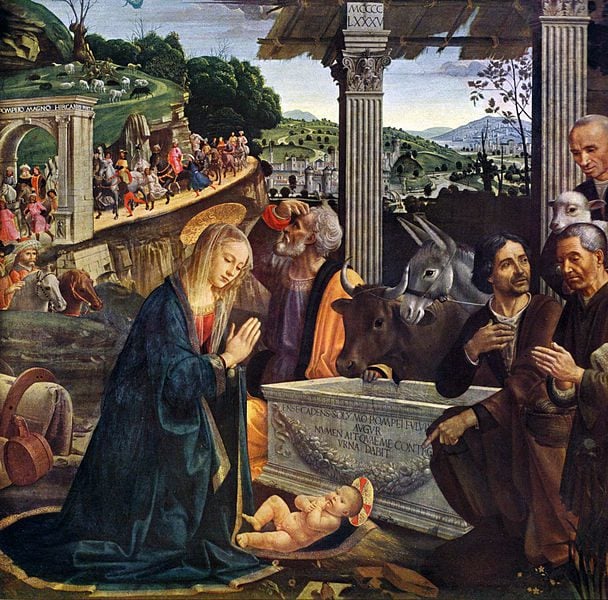
Adoration of the Shepherds (1485), by Domenico Ghirlandaio (1449-1494) [public domain / Wikimedia Commons]

***
(5-19-13)
* * * * *
The Catholic / patristic tradition regarding Mother of God or Theotokos (“God-Bearer”) requires a little bit of thought, but it’s not rocket science. Let’s run through a quick version of the rationale:
Luke 1:43 (RSV) And why is this granted me, that the mother of my Lord (kurios) should come to me?
John 20:28 Thomas answered him, “My Lord (kurios) and my God (theos)!”
“Lord (kurios) God (theos)”: Lk 1:6, 32, 68; 4:8, 12; 10:27; 20:37.
Therefore, “Lord (kurios) equals God (theos).
Jesus is called both in John 20:28.
Mary is mother of the Lord (Lk 1:43).
Therefore, she is the mother of God, since Lord=God.
Case closed.
Moreover, we don’t say of mothers that they are the mother of their child’s body, but of the child, and the child has a body and a soul. They didn’t create the soul; God did.
Likewise, with Jesus, Mary was the mother of Jesus, Who is God the Son. Thus, she is the Mother of God. It’s wrong and even illogical to say she was the mother of His body. No; she was the mother of the Divine Person, Jesus, Who had a human nature and also a Divine Nature (that she had nothing to do with). But she is still the mother of the Person, regardless of that, as any mother is the mother of a person who has a soul directly created by God.
Most of the early Protestant leaders understood this and retained the terminology, but John Calvin (the one most influential on later Protestantism) did not. He gives his reasoning in a letter of 27 September 1552 to the French Church in London:
. . . to deal with you with brotherly frankness, I cannot conceal that that title being commonly attributed to the Virgin in sermons is disapproved, and, for my own part I cannot think such language either right, or becoming, or suitable. Neither will any sober-minded people do so, for which reason I cannot persuade myself that there is any such usage in your church, for it is just as if you were to speak of the blood, of the head, and of the death of God. You know that the Scriptures accustom us to a different style; but there is something still worse about this particular instance, for to call the Virgin Mary the mother of God, can only serve to confirm the ignorant in their superstitions. And he that would take a pleasure in that, shews clearly that he knows not what it is to edify the Church.
Just before this, he admitted that some of the objection (among Protestants) wasn’t justified, and based in a degree of ignorance:
. . . I doubt not but there may have been somewhat of ignorance in their reproving the way of speaking of the Virgin Mary as the mother of God, and together with ignorance, it is possible that there may have been rashness and too much forwardness, for, as the old proverb says, The most ignorant are ever the boldest.
Ironically, however, it is Calvin himself who shows some degree of ignorance, as to the history of the term (which he knew full well, as a student of the Church fathers and early Church, was used to counter the heresy of Nestorianism). He himself explains it in a way that is perfectly in accord with the Catholic and Orthodox understanding:
She [Elizabeth] calls Mary the mother of her Lord This denotes a unity of person in the two natures of Christ; as if she had said, that he who was begotten a mortal man in the womb of Mary is, at the same time, the eternal God. For we must bear in mind, that she does not speak like an ordinary woman at her own suggestion, but merely utters what was dictated by the Holy Spirit. This name Lord strictly belongs to the Son of God “manifested in the flesh,” (1 Timothy 3:16,) who has received from the Father all power, and has been appointed the highest ruler of heaven and earth, that by his agency God may govern all things. Still, he is in a peculiar manner the Lord of believers, who yield willingly and cheerfully to his authority; for it is only of “his body” that he is “the head,” (Ephesians 1:22, 23.) And so Paul says, “though there be lords many, yet to us,” that is, to the servants of faith, “there is one Lord,” (1 Corinthians 8:5, 6.) By mentioning the sudden movement of the babe which she carried in her womb, (ver. 44,) as heightening that divine favor of which she is speaking, she unquestionably intended to affirm that she felt something supernatural and divine.
(Harmony of the Synoptic Gospels, comment under Luke 1:43; Calvini Opera, ibid., vol. 45, 35)
Simple deductive reasoning . . . Thus, in my opinion, he really has no excuse for his objection. There are only so many grounds to object to Mother of God:
If one believes that Jesus isn’t God, Mother of God wouldn’t apply to His mother. This is not true of Calvin, because, as we plainly see above and in many other of his statements, he holds to the divinity or deity or Godhood of Jesus Christ: God the Son: the second Person of the Holy Trinity.
“God” can only refer to the Father and not to Jesus (a variation of #1, thus not applicable to Calvin, either). Since Scripture shows Jesus being called God in several places, it’s a moot point for all who believe that the Bible is inspired revelation.
One can believe that Mary is only the mother of Jesus’ human nature, not of a Divine Person with Two Natures (divine and human). This is the heresy of Nestorianism. Calvin would seem to deny it also in the above comment, though some sections of his writings elsewhere strongly smack of it: at least in some respects.
Lastly, an objection can be made that derives from the fear or concern of Mother of God being misunderstood. This is Calvin’s rationale. I think it fails, though, because Christianity is the sort of thing that has many elements that people can easily misunderstand or not comprehend correctly in the first place. The Holy Trinity is the most obvious example of that. We don’t stop using the term “Trinity” because ignorant people will misunderstand it as three gods or a “three-headed god” (as the Jehovah’s Witnesses mock it). Calvin certainly doesn’t do so. We don’t avoid using the term Hypostatic Union (the Two Natures of Christ), because it is a difficult notion and not all that easy to fully grasp.
Yet when it comes to Mother of God, Calvin changes his mind and advocates the cessation of its use, even though it is perfectly legitimate in and of itself, and he himself understands it to be so.
Furthermore, some of the reasoning he brings to bear for why he thinks so, is immediately suspect. He claims that Mother of God isn’t “right, or becoming, or suitable,” so that “sober-minded people” should avoid it. And why is that? He provides some reasoning for his assertion: bringing Holy Scripture into it: “for it is just as if you were to speak of the blood, of the head, and of the death of God.”
Alright; let’s examine this for a moment. Is it completely true? It’s correct (as far as I know; I’m pretty sure) that the Bible doesn’t refer directly to the “death of God.” Yet Jesus is God and Jesus died. It follows (simple logic) that God (the Son) died. It’s just one Person of the Trinity, but He did die and He was God. The reasoning is similar to Mother of God.
Scripture also refers to the “head” of God, but in non-literal or metaphorical ways: either anthropomorphically or, in another sense, relationally, such as in 1 Corinthians 11:3: “the head of Christ is God.” God the Father is a spirit. But that is not, almost certainly, what Calvin was referring to.
The place where Calvin plainly stumbles badly in providing biblical disanalogies to Mother of God is in his reference to God’s blood: as if that is an unbiblical usage. In fact, it certainly is, as I immediately recalled, from some of my own past apologetics work.
I’ve found 15 major translations of Acts 20:28 that refer precisely to the “blood” in reference to God the Father. Now, God the Father doesn’t have a mother, as Jesus has (nor does the Holy Spirit). Yet, Mother of God was used in Church history, as referring to Jesus alone. Mary bore God, because Jesus was God. It doesn’t mean she is greater than God or a second God, or eternal, or any similar such nonsense, because it refers only to the Incarnation.
Mary was a creature. Catholics know this, but many Protestants (largely of the anti-Catholic sort) casually think we are too dumb and stupid to comprehend these simple things (which is a large part of the problem). Calvin also thinks many Protestants will be too dumb to grasp it, too, so he thinks it is better to avoid using Mother of God altogether.
Yet, by analogy, if the Bible refers to God’s blood (also, in context — quite remarkably — , the Holy Spirit’s “blood”), when this is not literally true, why can’t we use Mother of God, when that is definitely true of one Person of the Godhead? Here is the passage (Acts 20:28):
NIV Keep watch over yourselves and all the flock of which the Holy Spirit has made you overseers. Be shepherds of the church of God, which he bought with his own blood.
KJV . . . feed the church of God, which he hath purchased with his own blood.
NKJV / NASB . . . the church of God which He purchased with His own blood.
ASV / Moffatt . . . the church of the Lord which he purchased with his own blood.
Phillips . . . at the cost of his own blood.
Jerusalem . . . bought with his own blood.
NEB / REB. . . by his own blood.
Williams / Beck . . . bought with His own blood.
Amplified . . . with his own blood.
Wuest . . . which He bought for Himself through the agency of the blood, the blood which is His own unique blood, possessed by Himself alone.
Goodspeed . . . church of God which he got at the cost of his own life.
Goodspeed actually expresses directly the notion of the “death of God” or “God died” — by referring to the “cost of his own life”: referring to “God” as the subject in the same sentence.
The only major exceptions to this predominant view I found were RSV / NRSV (“blood of his own Son”) and Barclay (“blood of his own One”). 15 out of 18 translations (or, 83% of them) thus refer to the “blood” of God the Father (even though He literally doesn’t have blood). What’s the big problem and beef, then, with Mother of God? There is no problem: not scripturally speaking. Calvin is all wet. His argument fails; it falls flat (a not uncommon thing where he is concerned: believe me, I know, having refuted his Institutes line by line in two books.
This also recalls to my mind, Zechariah 12:10, in which God says, “they shall look upon me whom they have pierced” (KJV; cf. NASB, NIV, ASV, etc.). It’s God the Son Who was literally pierced, but here it is referred to the Father as well, which in turn reflects Jesus’ language of “he who has seen me has seen the father” (Jn 14:9).
As usual, then, the arguments against Catholic tradition (biblical or otherwise) do not succeed. If Calvin argues, “don’t use this terminology x because Scripture doesn’t use analogically similar terminology y, yet y is shown to indeed be a biblical usage, then x is established by analogy as biblical and therefore completely permissible, no matter how much it may be misunderstood by ignorant and uneducated folks that every Christian communion is blessed with in abundance.
* * *
James Swan, an anti-Catholic Presbyterian polemicist, wrote a paper about this, in which he cited a paper of mine, unattributed as usual, referring to me as “One Roman apologist” and not providing a link, so that people can read my remarks in context. I wrote in his combox:
Calvin is the one who shows himself quite ignorant of both historic and biblical usage of terms, as I will show later today (after a softball game).
Thanks for the Calvin citation! Now he can hang himself . . . [with a link to this paper]
In a rare instance of magnanimity and actual fairness, Swan decided to leave up my comment (he has routinely deleted them for some time now: ah, but see my note near the end . . . ). Then he replied as follows (in his usual contemptuous fashion):
One of the major points of my blog entry was to demonstrate that a number of Roman polemicists have incorrectly used Calvin’s comments on Luke 1:43. I believe I’ve proven my case, once again, that Roman polemicists veer towards propaganda at times rather than actually going deep into history.
Swan carps on and on in his article about how Catholics have misquoted Calvin. It’s true that Calvin appears not to have used the phrase Mother of God, for the inadequate reasons he has provided. For this reason I qualified my comments in the paper of mine that was cited:
. . . early Protestant leaders Luther, Calvin, Zwingli, and Bullinger all used the term ‘Mother of God’ (or at least described the same concept in slightly different terms).
In the more important sense of concept and actual meaning (as in the parenthetical remark above), however, Calvin acknowledges exactly what Catholics assert, as I have shown above. In the following comment of his, he essentially asserts that Mary is the Mother of God: by the logical thrust of the words:
She [Elizabeth] calls Mary the mother of her Lord. This denotes a unity of person in the two natures of Christ; as if she had said, that he who was begotten a mortal man in the womb of Mary is, at the same time, the eternal God.
This is how the other Catholics he cites also argue it. Swan cites one Catholic, John Pasquini, writing, “Calvin recognized the reality of Mary as the Mother of God.” This is a true statement. Calvin did do that, as I have shown. This has to do with concept, not terminology per se*.* Swan cites Dr. Robert Schihl, who does exactly the same thing, by arguing that Calvin’s comment on Luke 1:43, amounts to the same thing, with slightly different wording: Lord instead of God, but then noting that Jesus was God in the very next sentence.
Swan then cites some article (written by who knows who) called, “The Protestant Reformers on Mary.” When we go there, we find that it doesn’t refer to Mother of God at all when discussing Calvin’s views on Mary: even his views of Mary as the mother of Jesus. The same thing is applicable to Scott Windsor’s cited article as well. Then I am cited anonymously, and we have seen how I argued it in the same fashion. It’s much ado about nothing (as usual with Swan: he sees what he wants to see: who cares about actual facts?).
The gist of his paper was (for the umpteenth time) to run down Catholic apologists and apologetics, yet nowhere does he establish his central assertion, that he stated today: “a number of Roman polemicists have incorrectly used Calvin’s comments on Luke 1:43. . . . Roman polemicists veer towards propaganda at times rather than actually going deep into history.”
This is simply not the case, as I just demonstrated. All they did was cite Calvin’s commentary on Luke 1:43, where he says, “mother of her Lord” and in the next sentence calls Jesus “the eternal God.” He expresses the concept, while not using Mother of God, and none of the Catholic apologists cited state anything differently (much as Swan would have wished, for his smearing purposes).
After all of this perfectly irrelevant, non sequitur citation, not proving his case in the slightest, Swan asserts:
These Roman Catholic documents make bold assertions in regard to Calvin’s comments on Luke 1:43.
Nothing is bold at all about it! They simply present the facts of what Calvin’s view was. He didn’t like the terminology, but expressed the same concept as what Catholics mean. It’s not difficult for anyone to grasp. But when one puts on polemical blinders for the purpose of smearing, one can’t see the obvious, right in front of them. Protestant scholar Timothy George, Dean of Beeson Divinity School, affirms this:
The third title of Mary to consider is Theotokos, the “God-Bearer,” a title for Mary as the Mother of God. Evangelicals can and should join Catholics in celebrating the Virgin Mary this way. In the Reformation, Calvin (unlike Luther and Zwingli) balked at the title Mother of God but not at the doctrinal truth it was intended to convey. Barth, however, was faithful to the deepest intention of Reformed Christology when he acknowledged that Mother of God is “sensible, permissible, and necessary as an auxiliary Christological proposition.”
Although the conceptual genesis of Theotokos is very early-Ignatius of Antioch can say “Our God, Jesus Christ, was carried in Mary’s womb” (Ephesians 18:2), the debates leading up to the Council of Ephesus were not concerned in the first instance with the status of Mary but rather with the unity of divinity and humanity in her son. The Church was right to reject Nestorius’ preferred title for Mary, Christotokos, “mother of Christ,” as an inadequate description of Mary’s role in the mystery of the Incarnation. We are not at liberty to construct a merely human Christ, cut off from the reality of his entire person.
(“Evangelicals and the Mother of God,” First Things, February 2007)
It’s a remarkable instance of a complete non-argument, or complete absence of an actual argument or demonstration, utterly failing in its purpose. None of Swan’s examples document Catholic apologists claiming that Calvin liked the phrase Mother of God (only that he taught the concept in different terms). Nor does the Wikipedia article on Calvin’s view of Mary that he is obsessed about make any such claim, let alone document it. So Swan ends up with nothing whatsoever. He talks a good game (like all propagandists do) but his supposed, alleged “argument” is like the proverbial onion that is peeled and peeled until the peeler finds that there is nothing in the middle of it.
Oops! I just checked again, and Swan, true to form, has deleted my comment on his blog. I was foolish enough to actually believe for a few minutes that he had the courage of his convictions and would allow free speech. But no such luck.
Fortunately, he can’t prevent me from refuting his lying nonsense on my blog and Facebook page. I have done so.
Thus we observe two completely different emphases and approaches and goals:
1) James Swan: engage in hyper-uncharitable polemics, seeking to show that Catholic apologists are, once again (as always) dumbbells, who deliberately cite out of context for their nefarious ends (and lying about them and what they argued in order to supposedly “prove” this).
2) Dave Armstrong: engage in apologetics and amateur historiography, in order to determine the actual facts of what Calvin believed about Mother of God: whether he believed the concept (yes, with support from a great Protestant scholar), whether he liked that particular term (no), and whether his rationale from the Bible for why he doesn’t like to use the term, Mother of God holds water (no).
* * * * *
Previous Post
December 22, 2015
Shunning Unrepentant or Contentious Sinners: Biblical?
Next Post
December 23, 2015 "Patterns of Evidence: Exodus": Superb Pop Archaeology
Browse Our Archives
Select a Category & Last Things About Me Anti-Catholicism Atheism & Agnosticism Baptism and Sacramentalism Bible and Tradition Blessed Virgin Mary Books by Dave Armstrong C. S. Lewis Calvinism & General Protestantism Catholic Apologetics Catholic Apologists Catholic conversion Catholic converts Christmas Church (Ecclesiology) Church History Conversion and Converts Development of Doctrine Eastern Orthodoxy Ecumenism & Christian Unity Eucharist & Liturgy Fathers of the Church French Translations G. K. Chesterton Hell Hell & Satan Hell & Satan & Last Things Heresies & Comparative Religion Holistic Health Inquisition & Crusades & Scandals James White Jews & Judaism & Old Testament John Calvin John Henry Newman Liberal / Modernist Theology Life Issues Literary Resume Lutheranism Mariology Martin Luther Music Orthodoxy Papacy & Infallibility Personal Page Philosophy & Science Political & Ethical & Moral Issues Protestant Persecution & Intolerance Protestantism Purgatory Purgatory & Penance Romantic & Imaginative Theology Saints & Purgatory & Penance Salvation Salvation & Justification Satan & Last Things Sexuality and Gender Issues Spanish Translations Traditionalism vs. Radical Catholic Reactionaries Traducciones al español / tradução para português Trinitarianism & Christology Uncategorized Videos
Select a Month November 2026 October 2026 September 2026 August 2026 July 2026 June 2026 May 2026 April 2026 March 2026 February 2026 January 2026 December 2025 November 2025 October 2025 September 2025 August 2025 July 2025 June 2025 May 2025 April 2025 March 2025 February 2025 January 2025 December 2024 November 2024 October 2024 September 2024 August 2024 July 2024 June 2024 May 2024 April 2024 March 2024 February 2024 January 2024 December 2023 November 2023 October 2023 September 2023 August 2023 July 2023 June 2023 May 2023 April 2023 March 2023 February 2023 January 2023 December 2022 November 2022 October 2022 September 2022 August 2022 July 2022 June 2022 May 2022 April 2022 March 2022 February 2022 January 2022 December 2021 November 2021 October 2021 September 2021 August 2021 July 2021 June 2021 May 2021 April 2021 March 2021 February 2021 January 2021 December 2020 November 2020 October 2020 September 2020 August 2020 July 2020 June 2020 May 2020 April 2020 March 2020 February 2020 January 2020 December 2019 November 2019 October 2019 September 2019 August 2019 July 2019 June 2019 May 2019 April 2019 March 2019 February 2019 January 2019 December 2018 November 2018 October 2018 September 2018 August 2018 July 2018 June 2018 May 2018 April 2018 March 2018 February 2018 January 2018 December 2017 November 2017 October 2017 September 2017 August 2017 July 2017 June 2017 May 2017 April 2017 March 2017 February 2017 January 2017 December 2016 November 2016 October 2016 September 2016 August 2016 July 2016 June 2016 May 2016 April 2016 March 2016 February 2016 January 2016 December 2015 November 2015 October 2015 September 2015 August 2015 July 2015 June 2015 May 2015 April 2015 March 2015 February 2015 January 2015 December 2014 November 2014 October 2014 September 2014 August 2014 July 2014 June 2014 April 2014 March 2014 February 2014 January 2014 December 2013 November 2013 October 2013 September 2013 August 2013 July 2013 June 2013 April 2013 March 2013 February 2013 January 2013 December 2012 November 2012 October 2012 September 2012 August 2012 July 2012 June 2012 May 2012 April 2012 March 2012 February 2012 January 2012 December 2011 November 2011 October 2011 September 2011 August 2011 July 2011 June 2011 April 2011 March 2011 February 2011 October 2010 September 2010 August 2010 July 2010 April 2010 March 2010 December 2009 October 2009 August 2009 July 2009 June 2009 May 2009 March 2009 February 2009 October 2008 September 2008 April 2008 March 2008 February 2008 January 2008 December 2007 November 2007 October 2007 May 2007 March 2007 February 2007 January 2007 November 2006 October 2006 September 2006 August 2006 July 2006 June 2006 May 2006 April 2006 March 2006 February 2006 October 2005 June 2005 April 2005 February 2005 July 2004 May 2004 April 2004
Follow Us!
TAKE THE
Religious Wisdom Quiz
Who saw a plumb line in a vision, symbolizing judgment?
Select your answer to see how you score.
Micah Amos Obadiah Joel
Books by This Author Books by Dave Armstrong
Related posts from Biblical Evidence for Catholicism
Top Three Anti-Catholic Lies About Catholicism
Biblical Evidence for Catholicism
Three More Anti-Catholic Lies About Catholicism (#6-4)
Biblical Evidence for Catholicism
Top Ten Anti-Catholic Lies (#10-7)
Biblical Evidence for Catholicism
Holy Ground: Why Mary Had NO Other Children...
Biblical Evidence for Catholicism
TRENDING AT PATHEOS Catholic

Thomas Paine, the Smiths, the apostles in England,...
I'm pleased to announce that the Becoming Brigham Black Friday Sale,...

CatholicTV Series: Six Black Catholics on Path to...
WATERTOWN, Mass., November 9, 2026 – In recognition of Black Catholic History...

New Advent Journal Invites Catholics to Be Pilgrims
Florissant, MO, November 16, 2026— What if Advent were more than a...

INNER CIRCLE: John's Quantum Gospel
INTRODUCTION In this next Inner Circle series, which I anticipate will...
"Three B's" of My Apologetics Ministry (+ VIDEO)
In early December 2026 (less than a week from the time...
James Ishmael Ford's books on Zen
James Ishmael Ford's Official Website provides the most complete annotated list of...
view all Catholic blogs
Ad-Free & Subscriber Log-In Subscription Support
- About Us
- 2026 Calendar
- Videos
- Podcasts
- Library of World Religions
- Faith In Media Tracker
- Advertise With Us
- Write for Us
- Privacy Policy
- Terms of Service
- Do Not Sell My Data
- Contact Us
- Radiant Digital
- Manage Newsletter Subscriptions
- Unsubscribe From Notifications
- Sitemap
Copyright 2008-2026, Patheos, part of the Radiant Digital network of media brands. All rights reserved.
Subscription Support Ad-Free & Subscriber Log-In
Follow Patheos