
BuddhistCatholicContemplativeEvangelicalGeneral ChristianHinduJewishLatter-day SaintMuslimNew VisionsProgressive Christian
Beliefs
- Buddhist
- Catholic
- Contemplative
- Evangelical
- General Christian
- Hindu
- Jewish
- Latter-day Saint
- More Voices
- Muslim
- New Visions
- Pagan
- Progressive Christian
Topics
- Religion News
- Food and Religion
- Sports and Religion
- Religious Art
- Religious Music and Entertainment
- Religious Events
- History and Religion
- Style and Religion
- Politics and Religion
- Women in Religion
- Recreation Outdoors and Religion
- Business Finance and Religion
- Careers Workplace and Religion
- Education and Religion
- Family Parenting and Religion
- Health Fitness and Religion
- Home and Religion
- Relationships and Religion
- Technology and Religion
- Travel and Religion
Columnists
- Buddhist Columnists
- Business Finance and Religion Columnists
- Careers Workplace and Religion Columnists
- Catholic Columnists
- Contemplative Columnists
- Education and Religion Columnists
- Evangelists Columnists
- Family Parenting and Religion Columnists
- General Christian Columnists
- Health Fitness and Religion Columnists
- Hindu Columnists
- History and Religion Columnists
- Home and Religion Columnists
- Jewish Columnists
- More Voices Columnists
- Latter Day Columnists
- Muslim Columnists
- New Visions Columnists
- Nonreligious Columnists
- Pagan Columnists
- Politics and Religion Columnists
- Progressive Columnists
- Recreation Outdoors and Religion Columnists
- Relationships and Religion Columnists
- Religion News Columnists
- Religious Art Columnists
- Religious Events Columnists
- Religious Music and Entertainment Columnists
- Sports and Religion Columnists
- Style and Religion Columnists
- Technology and Religion Columnists
- Travel and Religion Columnists
- Women in Religion Columnists
Resource Library
- 2026 Calendar
- Library of World Religions
- The 100 Most Holy Places on Earth
- Patheos Answers
- Podcasts
- Videos
- Faith Leaders Database
- Anglican Episcopalian
- Bahai
- Baptist
- Buddhism
- Christianity
- Confucianism
- Eastern Orthodoxy
- Hinduism
- Holiness and Pentecostal
- ISKCON
- Islam
- Judaism
- Lutheran
- Methodist
- The Church of Jesus Christ of Latter-day Saints
- New Age
- Paganism
- Presbytarian and Reformed
- Protestantism
- Religion Behind the Scenes
- Roman Catholic
- Scientology
- Shia Islam
- Sikhism
- Sufism
- Sunni Islam
- Taoism
- Zen
- See all religions
Research Tools
 Ad-Free & Subscriber Log-In Subscription Support
Ad-Free & Subscriber Log-In Subscription Support
Follow Patheos 

- Trending:
- Forgiveness
- |
- Marriage
- |
- Consciousness
- |
- Death Penalty
- |
- Election
- |
- Halloween

-
About
-
Catholic Apologetics
-
Church History
-
Great Apologists
-
Christian Worldview
-
Protestantism & Misc.
- Home
- Catholic
- History and Religion
- Christmas Carols & Songs: A Comprehensive Catalogue
Christmas Carols & Songs: A Comprehensive Catalogue
Last updated on: June 5, 2026 at 11:43 pm by Dave Armstrong
Christmas Carols & Songs: A Comprehensive Catalogue 2026-06-05T23:43:05-04:00 Dave Armstrong
Patheos Explore the world's faith through different perspectives on religion and spirituality! Patheos has the views of the prevalent religions and spiritualities of the world.
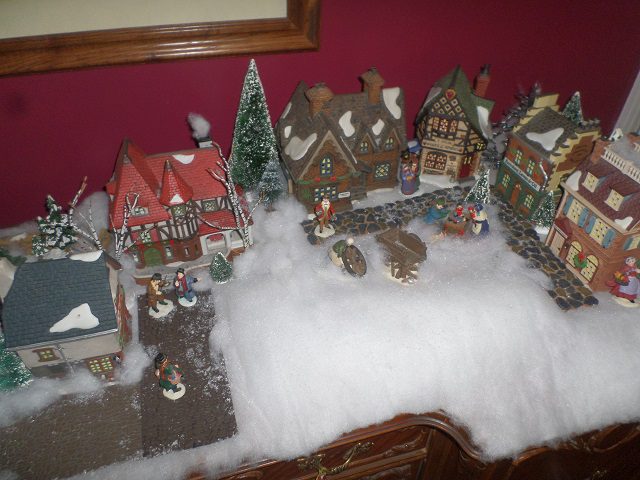
Part of our Dept. 56 “Dickens Village” (2013)
* * *
Compiled in December 2005.
Primary (But Not Exclusive) Sources:
The Hymns and Carols of Christmas
(remarkable website from Douglas D. Anderson; all fact sheets and midi sound files are linked to from this site. Web page most used: The Hymns and Carols)
MusicExpert.com: Christmas: Complete Lyrics for 200 Songs —– red-colored songs = secular or not overtly-Christian in theme —–
—– current number of carols and songs: 135 —–
Master Alphabetical Listing
Ah, Bleak and Chill the Wintry Wind (American Alfred S. Burt / lyrics by Bates G. Burt) [1945] | mp3 sample |
All I Want for Christmas Is My Two Front Teeth(Donald Yetter Gardner) [1946] | lyrics and audio file |
Spike Jones introduced it in 1948.
All on A Christmas Morning (American Alfred S. Burt / lyrics by Bates G. Burt) [1946] | mp3 sample |
Angels From The Realms Of Glory (music: Englishman: Henry Thomas Smart, 1867 / words: Scotsman James Montgomery, 1816) | fact sheet | midi | amazon wma sample with Fred Waring and the Pennsylvanians |
Angels We Have Heard On High (18th century French carol; possibly originally from Lorraine. It achieved rapid popularity in France and Quebec in the 1840s, and was translated into English by Englishman Bishop James Chadwick; popular from the 1860s in England) | fact sheet | midi | amazon wma sample with Fred Waring and the Pennsylvanians |
Ave Maria (music by Austrian Franz Schubert: 1797-1828 / alternate version by Frenchman Charles Gounod: 1818-1893) | fact sheet | amazon wma sample with Stevie Wonder (Schubert) | amazon wma sample with Barbra Streisand (Gounod) |
Away In A Manger (music [version 1]: American James Ramsey Murray, 1887 / music [version 2]: American William J. Kirkpatrick, late 19th c.? / words: unknown: Philadelphia: 1885 and verse 3: John T. McFarland, 1887) | fact sheet | midi #1 | midi #2 | amazon wma sample with Nat King Cole |
The alleged composition of this carol by Martin Luther is almost certainly untrue. The words surfaced in an American Lutheran setting.
Blue Christmas (Billy Hayes and Jay W. Johnson) [1948] | lyrics | amazon wma sample with Elvis Presley |
Boar’s Head Carol, The (English Trad. / Queens College Version, Oxford, England; First published 1521) | fact sheet | midi |
From fact sheet: “One of the first carols to be printed (in 1521). It was probably created about a century earlier, anonymously, and probably in Oxford, England. The presumption of its fifteenth-century Oxford origins is founded on the custom of singing the song in Christmas celebrations at Queen’s College, Oxford, for well over 500 years.”
Bring A Torch, Jeannette, Isabella (music: French trad.: 14th c. / words: Emile Blemont, c. 1901) | fact sheet | midi | amazon wma sample with Fred Waring and the Pennsylvanians |
Carol, Brothers Carol (W. A. Muhlenberg; collected in 1916) | fact sheet| midi |
Carol of the Bells (music: Ukrainian composer Mykola Dmytrovich Leontovich, based on an old Ukrainian melody, 1916 / adaptation and lyrics by Czech-American Peter J. Wilhousky, 1936) | fact sheet | amazon wma sample with Robert Shaw Chorale |
Caroling, Caroling (American Alfred S. Burt / lyrics by Wihla Hutson) [1954] | mp3 sample | amazon wma sample with Nat King Cole |
Cherry Tree Carol (Trad. English; Herefordshire, c. 1400) | fact sheet | amazon wma sample with Peter, Paul, and Mary |
Children, go where I send thee (African-American trad., collected by Jean Ritchie in Kentucky; possibly three centuries old) | fact sheet | midi | amazon wma sample with The Weavers|
From fact sheet: “It has been collected in the southern mountains, the north atlantic states, Ohio, Michigan, and in Canada. These versions trace back to Cornwall and the west country of England, where it was popular as a Christmas carol and as a harvest song . . . Another version of this same carol also exists, thought to have been brought to the United States by Cornishmen who worked in the copper mines along Lake Superior.”
Chipmunk Song (Christmas Don’t Be Late) (Ross Bagdasarian [David Seville] ) [1958] | lyrics and audio file |
Christ in the Stranger’s Guise (American Alfred E. Burt / lyrics: An Old English Rune of Hospitality) [1948] | mp3 sample |
Christmas (Baby Please Come Home) (Americans Phil Spector, Ellie Greenwich, Jeff Barry) [1963] | lyrics | amazon wma sample with Darlene Love |
Christmas Cometh Caroling (American Alfred S. Burt / lyrics by Fr. Andrew) [1942] | mp3 sample |
Christmas In Killarney (Words and Music by John Redmond, James Cavanaugh and Frank Weldon) [1950] | amazon wma sample with Bing Crosby |
Christmas Song (Chestnuts Roasting On An Open Fire) (Robert Wells and Mel Torme) [1945] | fact sheet | amazon wma sample with Nat King Cole |
Christmas Time Is Here (Vince Guaraldi and Lee Mendelson) [1965] | amazon wma sample with Vince Guaraldi Trio |
From television special, A Charlie Brown Christmas; performed by the Vince Guaraldi Trio.
Christmas Waltz, The (Jule Styne and Sammy Cahn) [1954] | lyrics | amazon wma sample with Frank Sinatra |
Come, Dear Children (American Alfred S. Burt / lyrics by Wihla Huston) [1952] | mp3 sample |
Come, Thou Long-Expected Jesus (music: German? Christian Friedrich Witt, 1715 / words: Charles Wesley, 1744) | fact sheet | midi |
Coventry Carol, The (Words Attributed to Robert Croo, 1534 / English Melody, 1591) | fact sheet | amazon wma sample with Robert Shaw Chorale |
It is named after the city of Coventry, England, where the 15th Century Pageant of the Shearmen and Tailors depicted Herod’s slaughter of the innocents, told in the lyrics.
Cradle In Bethlehem, A (Lawrence Stock and Al Bryan) [1952] | lyrics | amazon wma sample with Nat King Cole |
Deck The Hall (Welsh trad., prob. 16th century) | fact sheet | midi | amazon wma sample with Mormon Tabernacle Choir |
Ding Dong! Merrily On High (music: French trad., collected in 1588 / English lyrics: Englishman? George Ratcliffe Woodward, early 20th c.) | fact sheet | midi | amazon wma file with Taverner Consort |
Do You Hear What I Hear? (Gloria Shayna and Noel Regney) [1962] | lyrics | amazon wma sample with Bing Crosby | amazon wma sample with Andy Williams |
Feliz Navidad (Jose Feliciano) [1970] | lyrics | amazon wma sample with Jose Feliciano |
First Noel, The (Trad. English: 16th century; possibly dating from as early as the 13th Century. This tune and the present lyrics were first published in 1833). | fact sheet | midi | amazon wma sample with Mormon Tabernacle Choir |
From the facts sheet: “The usual and typical impression derived is that the carol is of French origin. But such an inference is thoroughly and unequivocally incorrect . . . All the historical evidence points clearly to the carol’s being English, and probably from the remote Cornwall region in southwest England. Although the words were not published until 1823 and the tune not until 1833, a sixteenth-century date is reasonably certain. The song as we know it today, however, acquired a crucial alteration during the nineteenth century. When first published, part of the tune of the refrain was different. By the 1870s the notes for the words “Born is the King” had been changed, thus developing the version we are familiar with now. The person responsible for the inspired modification is unknown, but it is conceivable that Englishman John Stainer (1840-1901) could have been the rearranger.”
“The song is probably the oldest popular carol in the English language, handed down by custom over the centuries.”
For Unto Us a Child Is Born (German-English composer Georg Frederic Handel, from The Messiah) [1717] | fact sheet | midi | amazon wma sample with Mormon Tabernacle Choir |
Frosty The Snowman (music: Steve Edward Nelson; lyrics: Walter E. “Jack” Rollins) [1950] | fact sheet | amazon wma sample with Gene Autry |
Recorded by Gene Autry in 1951.
Gesu Bambino (“The Infant Jesus”) (written in 1917 by Pietro Alessandro Yon while he was musical director and organist at St. Patrick’s Cathedral in New York City; English text by Frederick H. Martens) | lyrics | wma sound file |
Gifts They Gave, The | lyrics | amazon wma sample with Harry Belafonte |
Go Tell It On The Mountain (adapted by American John W. Work, Jr., 1907, based on an African-American Spiritual, probably early 1800s) | fact sheet | midi | amazon wma sample with Blind Boys of Alabama |
God Rest Ye Merry, Gentlemen (Trad. English: 18th c.) | fact sheet | midi | amazon wma sample with Nat King Cole |
Good Christian Men, Rejoice (Latin, In Dulci Jubilo) (Words: Attributed to Heinrich Suso: c. 1295-1366; freely translated from Latin to English by Englishman John Mason Neale in 1853 / music: In Dulci Jubilo, 14th Century German melody) | fact sheet: notes | fact sheet: English lyrics | fact sheet: Latin lyrics | midi |
Good King Wenceslas (Words: Englishman John Mason Neale, 1853 / music: 13th c., quite possibly Scandinavian) | fact sheet | midi|
Hallelujah Chorus (German-English composer Georg Frederic Handel, from The Messiah) [1717] | fact sheet | midi | amazon wma sample with Mormon Tabernacle Choir |
Happy Birthday, Jesus (Estelle Levitt and Lee Pockriss) [1977] | lyrics | amazon wma file with Alabama |
Happy Holiday (Jewish-American Irving Berlin) [1941] | lyrics | amazon wma sample with Bing Crosby |
Happy Xmas (War Is Over) (Yoko Ono and John Lennon) [1971] | lyrics | amazon wma file with John Lennon |
Hark! The Herald Angels Sing (Words: Charles Wesley, 1739; amended by George Whitfield, 1753 and Martin Madan, 1760; other changes occurred in 1782, 1810, and 1861 / music: German Felix Mendelssohn, 1840; arranged by Englishman William Hayman Cummings and first presented Christmas Day, 1855) | fact sheet | midi | amazon wma sample with Mormon Tabernacle Choir
Have Yourself a Merry Little Christmas (Words: Ralph Blane / music: Hugh Martin) [1943] | amazon wma sample with Perry Como | amazon wma sample with Tony Bennett |
From the film, Meet Me in St. Louis (1944); performed by Judy Garland.
Here Comes Santa Claus (Gene Autry and Oakley Haldeman) [1946] | lyrics | amazon wma sample with Gene Autry |
Here We Come A-Caroling (aka Here We Come A-Wassailing orThe Wassail Song) (Trad. English: 17th c.) | fact sheet | midi | amazon wma sample with Fred Waring and the Pennsylvanians |
Holly And The Ivy, The (Trad. English: c. 1700; possibly from an ancient carol of French? origin; possibly from the Gloucestershire region; printed at Birmingham in 1710) | fact sheet | midi |
Holly Jolly Christmas, A (Johnny Marks) [1962] | lyrics | amazon wma sample with Burl Ives |
From the television special, Rudolph the Red Nosed Reindeer (1962); performed by Burl Ives.
(There’s No Place Like) Home For The Holidays (music: Robert Allen / words: Al Stillman) [1954] | lyrics | amazon wma sample with Perry Como |
Recorded by Perry Como in 1954.
Huron Carol, The (Fr. Jean de Brebeuf, 1640 from an old French tune; English translation by J. E. Middleton [d. 1960] ) | fact sheet | midi |
From fact sheet: “. . . originally written in the Huron Indian language in 1640 [near the eastern shores of Lake Huron in Ontario] . . . In retelling the story of the Nativity, Father Brebeuf used symbols and figures that could be understood by the Hurons, and the hymn entered the tribe’s oral tradition. It was sung by the Hurons in Ontario until 1649, when the Iroquois killed Father Brebeuf, wiped out the Jesuit mission and drove the Hurons from their home. In Quebec, to which many of the Hurons escaped, the carol re-emerged and was translated into English and French. This version is still sung today throughout Canada and is considered a national treasure . . . “
I Believe In Father Christmas (Greg Lake and Peter Sinfield) [1975] | lyrics | amazon page | wma sample |
I Heard The Bells On Christmas Day (Words: American Henry Wadsworth Longfellow, Christmas Eve, 1863; music: Englishman John Baptiste Calkin, 1872) | fact sheet | midi |
An alternate melody which has become popular in recent years, was written by Johnny Marks in 1956 (listen to an amazon wma sample with Frank Sinatra).
I Saw Mommy Kissing Santa Claus (Tommie Connor) [1952] | lyrics | amazon wma sample with Ronettes |
I Saw Three Ships (Trad. English: 17th c.; possibly from Derbyshire) | fact sheet | midi | amazon wma sample with Nat King Cole |
I Want A Hippopotamus For Christmas (John Rox) [1953] {performed by Gayla Peevey} | lyrics | FAQ page | wav music file of Peevey record |
I Wonder As I Wander (Words and Music collected by John Jacob Niles in Murphy, North Carolina in 1933; it is uncertain how old the folk tune is) [1933] | fact sheet | midi | amazon wma sample with Barbra Streisand |
From fact sheet: “John Jacob Niles, the singer and collector of folk songs, said that he based his “I Wonder As I Wander” on a line or two of haunting music that he heard sung by a young girl in a small North Carolina town. He asked her to sing the few notes over and over, paying her a few pennies each time, until he had jotted it all down in his notebook. So close was the finished song to its Appalachian inspiration that Niles is often cited as arranger of the tune rather than its creator.”
Niles himself wrote: “After eight tries, all of which are carefully recorded in my notes, I had only three lines of verse, a garbled fragment of melodic material–and a magnificent idea. With the writing of additional verses and the development of the original melodic material, “I Wonder As I Wander” came into being. I sang it for five years in my concerts before it caught on. Since then, it has been sung by soloists and choral groups wherever the English language is spoken and sung.”
Il Est Ne, Le Divin Enfant (He Is Born, The Divine Christ Child) (Trad. French; possibly from an old Normandy hunting tune; collected by 1862) | fact sheet | midi | amazon wma file with Taverner Consort |
I’ll Be Home For Christmas (music by American Walter Kent / words by American James Kimball Gannon; also Buck Ram) [1943; revised in 1948] | lyrics | amazon wma sample with Bing Crosby | amazon wma sample with The Carpenters |
From fact sheet: ” ‘I’ll Be Home For Christmas’ proves that songs need not be complex to stir the affects of the public. This little gem, perfectly suited for Crosby’s rolling baritone, is Bing’s third most successful Christmas song, behind ‘White Christmas’ and ‘Silent Night.’ He recorded it Oct. 4, 1943, backed by the John Scott Trotter Orchestra, and within two months the song was on the charts, where it stayed for 7 weeks, eclipsing ‘White Christmas.’ The recording hit the charts again in December 1944 and earned Bing his fifth gold record.”
In the Bleak Midwinter (Words: Englishwoman Christina Georgina Rossetti, 1872; music: Englishman Gustav Holst, specifically for the text, 1906) | fact sheet | midi |
From fact sheet: “Harold Darke’s well-regarded setting was written in 1911 and published by Stainer and Bell, London. It was originally made famous by the Choir of King’s College, Cambridge.”
Irish Carol (Music: Irish folk carol, 16th or 17th Century / words: possibly by Fr. Willian Devereaux (c. 1728); translator possibly Dr. W. H. Grattan Flood) | fact sheet | midi |
It Came Upon The Midnight Clear (Words: American Edmund Hamilton Sears, 1849; music: American Richard Storrs Willis, 1850) | fact sheet | midi | amazon wma sample with Frank Sinatra |
From a bio page: Composer Willis was born in 1819 in Boston, studied in Germany, and was a personal friend of Felix Mendelssohn. He moved to Detroit (where I grew up) in 1861, and died there in 1900.
It’s Beginning To Look a Lot Like Christmas (Meredith Willson) [1951] | lyrics | amazon wma sample with Perry Como | amazon wma sample with Bing Crosby
Recorded by Perry Como in 1951.
It’s Christmas Time (Stevie Wonder) [1970] | amazon wma sample with Smokey Robinson & the Miracles |
It’s the Most Wonderful Time Of The Year (George Wyle and Eddie Pola) [1963] | lyrics | amazon wma sample with Andy Williams |
Jehovah The Lord Will Provide | lyrics | amazon wma sample with Harry Belafonte |
Jesu Parvule (“Poor little Jesus”) (American Alfred S. Burt / lyrics by Bates G. Burt) [1943] | mp3 sample |
Jesus, Jesus, Rest Your Head (Kentucky folk carol; collected by John Jacob Niles: 1912-1913 and 1932-1934) | fact sheet | midi | amazon wma sample with Mormon Tabernacle Choir |
Jingle Bell Rock (Joseph Carleton Beal and James Ross Boothe) [1957] | lyrics | amazon wma sample with Brenda Lee |
Jingle Bells (American James Lord Pierpont [a Unitarian], 1857) | fact sheet | amazon wma sample with Barbra Streisand |
Jolly Old St. Nick (Anonymous; second half of 19th c. or early 20th c. – see notes for Up on the Housetop) | lyrics and audio file |
Joy To The World (Words: Englishman Isaac Watts: 1719 / Music: American Lowell Mason, 1848) | fact sheet | midi | amazon wma sample with Mormon Tabernacle Choir |
Musicologists now largely agree that the music was not derived from Handel, as formerly widely believed.
King Jesus Hath a Garden (Heer Jesus heeft een Hofken) (Trad. Dutch, 17th c.) |fact sheet| midi |
Let It Snow! Let It Snow! Let It Snow! (music: Jule Styne / words: Sammy Cahn) [1945] | lyrics | amazon wma sample with Andy Williams |
Linus and Lucy (Vince Guaraldi and Lee Mendelson) [1965] | amazon wma sample with Vince Guaraldi Trio |
From television special, A Charlie Brown Christmas; performed by the Vince Guaraldi Trio.
Little Drummer Boy, The (Katherine K. Davis, Henry V. Onorati and Harry Simeone; adapted from a Czech carol) [1941; charted in the US in 1958] | brief history | amazon wma sample with Harry Simeone Chorale |
Little Saint Nick (Brian Wilson and Mike Love) [1963] | lyrics | amazon wma sample with The Beach Boys |
Lo, How A Rose E’er Blooming (Words: 15th c. German carol; translated by American Theodore Baker, 1894; music: Anonymous, 16th Century; arr. by German composer Michael Praetorius, 1609) | fact sheet | midi | amazon wma sample with Robert Shaw Chorale |
Marshmallow World, A (Music: Peter De Rose / words: Carl Sigman) [1949] | lyrics | amazon wma sample with Brenda Lee | amazon wma sample with Darlene Love |
Mary Had a Baby (19th c. spiritual from St. Helena Island, off of South Carolina) | fact sheet | midi |
Mary’s Little Boy Child (Jester Hairston) [1956] | lyrics | amazon wma sample with Harry Belafonte |
Merry Christmas, Baby (Brian Wilson) [1963] | lyrics| amazon wma sample with The Beach Boys |
Merry Christmas, Darling (words: Frank Pooler, 1946 / music: Richard Carpenter, 1970) | lyrics | amazon wma sample with The Carpenters |
Mistletoe and Holly (Frank Sinatra, Dok Stanford and Henry W. Sanicola) [1957] | lyrics | amazon wma sample with Frank Sinatra |
My Favorite Things (Richard Rodgers and Oscar Hammerstein II) [1959] | lyrics | amazon wma sample with Andy Williams |
Nigh Bethlehem (Alfred S. Burt / lyrics by Bates G. Burt) [1947] | mp3 sample |
O Come, All Ye Faithful (Adeste Fidelis) (Englishman John Francis Wade: c. 1743 / English translation by Frederick Oakeley: 1841) | fact sheet | midi | amazon wma sample with Mormon Tabernacle Choir |
Wade was a Catholic, who later relocated to Douay, France due to the religious persecution in England.
O Come, O Come, Emmanuel (words: anon. 8th Century Latin; translated into English by John Mason Neale, 1851 / music: 15th Century French Plain Song melody) | fact sheet| midi |
O Hearken Ye (Alfred S. Burt / lyrics: Wihla Hutson) [1953] | mp3 sample |
O Holy Night (Words: Frenchman Placide Cappeau, 1847; translated into English by John Sullivan Dwight, a Unitarian minister [1812-1893] / Music: Jewish Frenchman Adolphe-Charles Adam, 1847; first performed at midnight Mass that year) | fact sheet | midi | amazon wma sample with Luciano Pavarotti |
O Little Town Of Bethlehem (Words: Phillips Brooks, Episcopal minister of Holy Trinity Church, Philadelphia, Pennsylvania, 1868 / Music: Lewis Henry Redner, 1868. Redner served as Brooks’ organist. The tune came to him on Christmas Eve, and was first sung the next day) | fact sheet| midi| amazon wma sample with Mormon Tabernacle Choir |
From fact sheet: “By the time he went to bed the night before the Christmas program, Redner had not produced a satisfactory tune. During the night, the story continues, he woke up with ‘an angel strain’ sounding in his ears. He immediately jotted down the melody, which he called ‘a gift from heaven,’ and the following morning added the harmony . . . probably the most popular of all American carols . . . first appeared in the Episcopal hymnal in 1892.”
O Sanctissima (Latin prayer set to a Sicilian melody called “The Sicilian Mariner’s Hymn to the Virgin”; first published, with its original Latin text, in 1794 in the United States) | fact sheet| midi |
O Tannenbaum (O Christmas Tree) (Trad. German; first published in 1799; likely based on a Westphalian folk song) | amazon wma sample with Mormon Tabernacle Choir | English translation | fact sheet and German lyrics | midi |
From the fact sheet: “In both England and America, the song could not have become popular until after the mid-19th century. The popularity of the Christmas tree did not arise until after 1841 in England when Prince Albert erected a tree for his bride, Queen Victoria, and shortly thereafter in the United States . . . By the 18th century the custom of the Christmas tree was common in Germany, and in fact German settlers had introduced the practice into North America as early as the 17th century. Hessian soldiers also practiced the custom while fighting in America during the Revolutionary War . . . The world’s first electrically lighted Christmas tree is installed in December, 1882 in the New York house of Thomas Edison’s associate Edward H. Johnson. And President Coolidge lights the first White House Christmas tree in 1923 to begin a lasting tradition.”
Once In Royal David’s City (Words: Cecil Frances Humphreys Alexander, 1848 / Music: Henry John Gauntlett, 1849. Written in Ireland) | fact sheet | midi | amazon wma sample with Mormon Tabernacle Choir |
One Small Child (David Meece) [1971] | lyrics | amazon wma file with Jubilate Deo Chorale |
This beautiful song was made popular by the contemporary Christian singer Evie Tornquist.
Pat-A-Pan (Frenchman Bernard De La Monnoye, c. 1700 – from the Burgundy region) | fact sheet | midi | amazon wma sample with Mormon Tabernacle Choir
Peace on Earth / The Little Drummer Boy {performed in 1977 by Bing Crosby and David Bowie} | amazon wma sample |
Pretty Paper (American Willie Nelson) [1962] | lyrics | amazon wma file with Roy Orbison |
Riu Riu Chiu (Spanish trad., 16th c., from Valencia) | amazon wma file with Taverner Consort |
Rockin’ Around The Christmas Tree (Johnny Marks) [1958] | lyrics | amazon wma sample with Brenda Lee |
Rudolph, The Red-Nosed Reindeer (Johnny Marks) [1949] | lyrics | amazon wma sample with Gene Autry |
Santa Baby (Joan Ellen Javits, Philip Springer, Tony Springer) [1953] | lyrics | amazon wma file with Earth Kitt |
Santa, Bring My Baby Back (To Me) (Aaron Schroeder and Claude DeMetruis) [1957] | lyrics | amazon wma filewith Elvis Presley |
Santa Claus Is Back In Town (Jerry Leiber and Mike Stoller) [1957] | lyrics | amazon wma sample with Elvis Presley |
Santa Claus is Comin’ To Town (J. Fred Coots and Haven Gillespie) [1932] | lyrics | fact sheet | amazon wma sample with Gene Autry |
Eddie Cantor first sang it on his Thanksgiving radio show in 1934. The original recorded version dates from September 27 1935: by Joe Harris with Benny Goodman & His Orchestra. Versions by Bing Crosby and The Andrews Sisters and Perry Como were the most successful.
Silent Night (Words: Rev. Joseph Mohr, c. 1816 / Music: Franz Xaver Gruber, c. 1818) | fact sheet | midi | German lyrics | English translation | amazon wma sample with Bing Crosby |
From fact sheet: “It is likely the most popular Christmas carol in the world, but for many years, the history of the carol was a source of great confusion. The traditional story is that Rev. Josef Mohr (1792-1848) and Franz Xaver Gruber (1787-1863) wrote it in Oberndorf, Austria, on Christmas Eve [1818] when they discovered the church organ was damaged (different versions say it rusted out, or mice chewed through vital parts). Charming as those stories are, they are only folklore. In fact, in a letter written by Franz Gruber, son of the composer, he noted that “During the time when my father was the organist of the church of St Nikola, there was a very poor almost unusable organ there. This may well explain why the Reverend Mohr preferred to accompany the carol on a well-tuned guitar than on an off-pitch organ.” An old manuscript has reportedly been discovered that shows Rev. Mohr wrote the lyrics in 1816, and that Franz Gruber wrote the score two years later at Rev. Mohr’s request . . . Gruber did not disclose why Mohr made the request to add music to the poem (and you can safely disregard any stories which invent a dialogue between the two men). Whatever the reason, this is the most popular of all Christmas carols, and a favorite worldwide for almost 200 years . . . the carol was first performed at the midnight mass on Christmas Eve, 1818. Mohr sang the tenor part, Gruber sang the bass, and the church choir did the refrains of each verse, which consisted of the last two lines of the verse. Mohr played the guitar accompaniment. It was said to have been enthusiastically received by by the congregation . . . The definitive English translation by Rev. John Freeman Young (1820-1885) was first published in The Sunday-School Service and Tune Book: Selected and arranged by John Clark Hollister, in 1863.”
Silver Bells (Ray Evans and Jay Livingston) [1950] | lyrics | amazon wma sample with Bing Crosby |
From the film, The Lemon Drop Kid (1950); performed by Bob Hope and Marilyn Maxwell; first recorded by Bing Crosby.
Sleep Baby Mine (American Alfred S. Burt / lyrics by Wihla Huston) [1949] | mp3 sample |
Sleigh Ride (music: Leroy Anderson [1948] ) (words: Mitchell Parish [1950] ) | lyrics | amazon wma sample with Andy Williams |
Snowfall (Claude Thornhill and Ruth Thornhill) [1941] | lyrics | amazon wma sample with Tony Bennett |
Some Children See Him (American Alfred S. Burt / lyrics: Wihla Hutson) [1951] | mp3 sample | amazon wma sample with Perry Como |
Someday at Christmas (Ron Miller and Bryan Wells) [1967] | lyrics | amazon wma sample with Stevie Wonder |
Soul Cakes (aka A Soalin’ or The Souling Song) | lyrics | amazon wma sample with Peter, Paul, and Mary |
Star Carol, The (American Alfred S. Burt / lyrics: Wihla Hutson) [1954] | mp3 sample |
Star in the East, A | lyrics | amazon wma sample with Harry Belafonte |
Sussex Carol (aka, On Christmas Night) (Trad. English, 17th c.; collected in Sussex county in 1919 by Ralph Vaughan-Williams) | fact sheet |midi |
This Is Christmas (Bright, Bright The Holly Berries) (American Alfred S. Burt / lyrics: Wihla Hutson) [1950] | mp3 sample |
The Twelve Days Of Christmas (Trad. English, c. 1700) | fact sheet | midi | amazon wma sample with Perry Como |
From fact sheet: “There is the widely circulated notion that this is a disguised catechism song sung by Roman Catholics during a long period of repression in England. Most scholars discount this notion for the fundamental reason that the elements were largely common to both the Church of Rome and the Church of England [the seven sacraments would be one difference]. Usually, the explanation runs as follows:
* The Partridge in a Pear Tree = Jesus Christ, the Son of God
* 2 Turtle Doves = The Old and New Testaments (or the sacrifice offered in the temple by Joseph and Mary at the presentation of Christ in the Temple)
* 3 French Hens = Faith, Hope and Charity, the Theological Virtues (see: I Corinthians 13) (or the gifts of the Magi)
* 4 Calling Birds = the Four Gospels (or the Four Evangelists)
* 5 Golden Rings = The first Five Books of the Old Testament (the “Pentateuch”)
* 6 Geese A-laying = the six days of creation
* 7 Swans A-swimming = the seven gifts of the Holy Spirit, the seven sacraments
* 8 Maids A-milking = the eight beatitudes (see: Matthew 5: 3-11)
* 9 Ladies Dancing = the nine fruits of the Holy Spirit (see: Galatians 5:22-23: love, joy, peace, patience, kindness, goodness, faithfulness, gentleness, self-control)
(or the nine choirs of angels)
* 10 Lords A-leaping = the Ten Commandments
* 11 Pipers Piping = the eleven faithful apostles
* 12 Drummers Drumming = the twelve points of doctrine in the Apostle’s Creed”
There’s a Song In The Air (Words: Josiah Gilbert Holland, 1872, and W. T. Giffe, 1874 / Music: Karl Pomeroy Harrington, 1904) | fact sheet| midi|
This Endris Night (Trad. English, 15th c.) | fact sheet| midi | amazon wma file with Taverner Consort |
Up On The Housetop (American Benjamin R. Hamby, c. 1860) | fact sheet |midi | amazon wma sample with Gene Autry |
From fact sheet: “Up on the Housetop may well have been the first American song of importance which elaborates on the theme on Santa Claus. It also is one of the first entirely secular Christmas songs composed in the Unite States. Written by little-known Benjamin R. Hanby (1833-1867), sometime in the 1850s or 1860s, and probably in Ohio, this vivacious song could possibly predate the early secular classic, Jingle Bells (1857). The best estimate, though, is that Hanby’s song was created in the 1860s.
Hanby’s life was short, less than 35 years. Yet he did manage to contribute this bouncy song, which is an especial favorite of children, to the enduring literature of the holiday. Furthermore, he may possibly have composed another popular carol, Jolly Old Saint Nicholas which is of roughly the same period and which has a suspiciously similar style of music and lyrics. There is absolutely no evidence that Hanby was responsible for the other song, yet the chronological and stylistic coincidences, plus the total anonymity of Jolly Old Saint Nicholas, do elicit the conjecture that Hanby might have authored both songs. At the least, Hanby’s Up on the Housetop may have influenced Jolly Old Saint Nicholas.”
Wassail, Wassail (aka Gloucestershire Wassail) (Trad. English folk carol: 17th c.) | fact sheet | midi |
We Three Kings Of Orient Are (John Henry Hopkins, Jr., 1857; written as part of a Christmas pageant for the General Theological Seminary in New York City) | fact sheet | midi| amazon wma sample with Fred Waring and the Pennsylvanians |
We Wish You a Merry Christmas (Trad. English [west country], 16th c.) | fact sheet| midi | amazon wma sample with Peter, Paul, and Mary |
We Wish You the Merriest (Les Brown, Date Unknown) | lyrics | amazon wma sample with Frank Sinatra and Bing Crosby |
We’ll Dress the House (American Alfred S. Burt / lyrics by Wihla Huston) [1954] | mp3 sample |
Wexford Carol, The (Trad. Irish: 12th c. from County Wexford [?]) | fact sheet | midi | 2nd audio file |
What Are the Signs (American Alfred S. Burt / lyrics by Bates G. Burt) [1944] | mp3 sample |
What Child Is This? (Words: Englishman William Chatterton Dix, 1865 / Music: Greensleeves, 16th Century English melody) | fact sheet | midi |
What Fragrance is That? (Quelle est cette odeur agreable) (French trad., 17th c.) | English lyrics | French lyrics | midi |
Where The Little Jesus Sleeps | lyrics | amazon wma sample with Harry Belafonte |
While Shepherds Watched Their Flocks By Night (Words: Nahum Tate, c. 1701 / Music: “Christmas,” George Frederick Handel, 1728) | fact sheet | midi |
From fact sheet: “The great English classical composer George Frederick Handel (1685-1759) has been commonly linked with two great English Christmas carols. One of these connections, as composer of the melody for Joy to the World!, is completely bogus. The other connection, as composer of one of the melodies for While Shepherds Watch Their Flocks, is, on the other hand, definitely valid.”
White Christmas (Jewish-American Irving Berlin) [1940] | fact sheet | amazon wma sample with Bing Crosby |
From the film, Holiday Inn (1942); performed by Bring Crosby.
From the fact sheet: “White Christmas was written in 1940 by a Irving Berlin for the 1942 movie “Holiday Inn” starring Bing Crosby and Fred Astaire. Berlin’s assignment was to write a song about each of the major holidays of the year. But Berlin, who was Jewish, found that writing a song about Christmas was the most challenging. He drew upon his experiences of the holiday in New York (including Christmas Trees erected by neighbors when he was a boy) and Los Angeles, but still felt that the end result was wanting. However, when Bing first heard Berlin audition “White Christmas” in 1941 he reassured Irving that he had created a winner. Bing’s preliminary evaluation turned out to be a gross understatement . . . Bing’s single of “White Christmas” sold more than 30 million copies worldwide and was recognized as the best-selling single in any music category for more than 50 years until 1998 when Elton John’s tribute to Princess Diana, “Candle in the Wind,” overtook it in a matter of months. However, Bing’s recording of “White Christmas” has sold additional millions of copies as part of numerous albums, including his best-selling album “Merry Christmas”, which was first released as an L.P. in 1949.”
“. . . According to a 1998 press release from the American Society of Composers, Authors and Publishers (ASCAP), “White Christmas” remains the number one performed Christmas carol, and is the most recorded Christmas carol (over 500 versions in “scores of languages”). The other top five are “Santa Claus is Comin’ to Town,” Mel Torme’s “The Christmas Song,” “Winter Wonderland,” “Rudolph the Red-Nosed Reindeer” and Leroy Anderson’s “Sleigh Ride.”
By 2003, however, “White Christmas” had slipped to the number two position on their list of Christmas songs. The number one song was “The Christmas Song” (Mel Torme and Robert Wells). The other three in the top five are “Santa Claus Is Coming To Town (J. Fred Coots and Haven Gillespie), “Winter Wonderland” (Felix Bernard and Richard B. Smith), and “Have Yourself A Merry Little Christmas” (Ralph Blane and Hugh Martin). For more information, see the ASCAP Top 25 Holiday Song List.”
Winter Wonderland (music: Felix Bernard / lyrics: Richard B. Smith) [1934] | fact sheet | lyrics | amazon wma sample with Tony Bennett |
From fact sheet: “Winter Wonderland [was] an immediate hit for Guy Lombardo and His Royal Canadians (1934). Then, in 1946, rival recordings were made by Perry Como and The Andrews Sisters (backed by Guy Lombardo) that established the bubbly tune as a Yuletide favorite.”
Chronological Listing of Carols and Songs
(Dates Based on the Music, Not Lyrics)
12th c. Wexford Carol, The (Trad. Irish: 12th c. from County Wexford [?])
13th c. Good King Wenceslas (Words: Englishman John Mason Neale, 1853 / music: 13th c., quite possibly Scandinavian)
First Noel, The (Trad. English: 16th century; possibly dating from as early as the 13th Century. This tune and the present lyrics were first published in 1833).
14th c. Bring A Torch, Jeannette, Isabella (music: French trad.: 14th c. / words: Emile Blemont, c. 1901)
Good Christian Men, Rejoice (Latin, In Dulci Jubilo) (Words: Attributed to Heinrich Suso: c. 1295-1366; freely translated from Latin to English by Englishman John Mason Neale in 1853 / music: In Dulci Jubilo, 14th Century German melody)
1400 Cherry Tree Carol (Trad. English; Herefordshire, c. 1400)
15th c. This Endris Night (Trad. English, 15th c.)
Lo, How A Rose E’er Blooming (Words: 15th c. German carol; translated by American Theodore Baker, 1894; music: Anonymous, 16th Century; arr. by German composer Michael Praetorius, 1609)
O Come, O Come, Emmanuel (words: anon. 8th Century Latin; translated into English by John Mason Neale, 1851 / music: 15th Century French Plain Song melody)
1521 Boar’s Head Carol, The (English Trad. / Queens College Version, Oxford, England; First published 1521)
16th c. Deck The Hall (Welsh trad., prob. 16th century)
Riu Riu Chiu (Spanish trad., 16th c., from Valencia)
We Wish You a Merry Christmas (Trad. English [west country], 16th c.)
What Child Is This? (Words: Englishman William Chatterton Dix, 1865 / Music: Greensleeves, 16th Century English melody)
1588 Ding Dong! Merrily On High (music: French trad., collected in 1588 / English lyrics: Englishman? George Ratcliffe Woodward, early 20th c.)
1591 Coventry Carol, The (Words Attributed to Robert Croo, 1534 / English Melody, 1591)
1600 Irish Carol (Music: Irish folk carol, 16th or 17th Century / words: possibly by Fr. Willian Devereaux (c. 1728); translator possibly Dr. W. H. Grattan Flood)
Children, go where I send thee (African-American trad., collected by Jean Ritchie in Kentucky; possibly three centuries old)
17th c. Here We Come A-Caroling (aka Here We Come A-Wassailing orThe Wassail Song) (Trad. English: 17th c.)
Wassail, Wassail (aka Gloucestershire Wassail) (Trad. English folk carol: 17th c.)
Sussex Carol (aka, On Christmas Night) (Trad. English, 17th c.; collected in Sussex county in 1919 by Ralph Vaughan-Williams)
I Saw Three Ships (Trad. English: 17th c.; possibly from Derbyshire)
What Fragrance is That? (Quelle est cette odeur agreable) (French trad., 17th c.)
King Jesus Hath a Garden (Heer Jesus heeft een Hofken) (Trad. Dutch, 17th c.)
1640 Huron Carol, The (Fr. Jean de Brebeuf, 1640 from an old French tune; English translation by J. E. Middleton [d. 1960] )
1700 Holly And The Ivy, The (Trad. English: c. 1700; possibly from an ancient carol of French? origin; possibly from the Gloucestershire region; printed at Birmingham in 1710)
Pat-A-Pan (Frenchman Bernard De La Monnoye, c. 1700 – from the Burgundy region)
The Twelve Days Of Christmas (Trad. English, c. 1700)
1715 Come, Thou Long-Expected Jesus (music: German? Christian Friedrich Witt, 1715 / words: Charles Wesley, 1744)
1717 For Unto Us a Child Is Born (German-English composer Georg Frederic Handel, from The Messiah) [1717]
Hallelujah Chorus (German-English composer Georg Frederic Handel, from The Messiah) [1717]
1728 While Shepherds Watched Their Flocks By Night (Words: Nahum Tate, c. 1701 / Music: “Christmas,” George Frederick Handel, 1728)
1743 O Come, All Ye Faithful (Adeste Fidelis) (Englishman John Francis Wade: c. 1743 / English translation by Frederick Oakeley: 1841)
18th c. Angels We Have Heard On High (18th century French carol; possibly originally from Lorraine. It achieved rapid popularity in France and Quebec in the 1840s, and was translated into English by Englishman Bishop James Chadwick; popular from the 1860s in England)
God Rest Ye Merry, Gentlemen (Trad. English: 18th c.)
1794 O Sanctissima (Latin prayer set to a Sicilian melody called “The Sicilian Mariner’s Hymn to the Virgin”; first published, with its original Latin text, in 1794 in the United States)
1799 O Tannenbaum (O Christmas Tree) (Trad. German; first published in 1799; likely based on a Westphalian folk song)
Early 1800s Ave Maria (music by Austrian Franz Schubert: 1797-1828)
Go Tell It On The Mountain (adapted by American John W. Work, Jr., 1907, based on an African-American Spiritual, probably early 1800s)
1818 Silent Night (Words: Rev. Joseph Mohr, c. 1816 / Music: Franz Xaver Gruber, c. 1818)
1840 Hark! The Herald Angels Sing (Words: Charles Wesley, 1739; amended by George Whitfield, 1753 and Martin Madan, 1760; other changes occurred in 1782, 1810, and 1861 / music: German Felix Mendelssohn, 1840; arranged by Englishman William Hayman Cummings and first presented Christmas Day, 1855)
1847 O Holy Night (Words: Frenchman Placide Cappeau, 1847; translated into English by John Sullivan Dwight, a Unitarian minister [1812-1893] / Music: Jewish Frenchman Adolphe-Charles Adam, 1847; first performed at midnight Mass that year)
1848 Joy To The World (Words: Englishman Isaac Watts: 1719 / Music: American Lowell Mason, 1848)
1849 Once In Royal David’s City (Words: Cecil Frances Humphreys Alexander, 1848 / Music: Henry John Gauntlett, 1849. Written in Ireland)
1850 It Came Upon The Midnight Clear (Words: American Edmund Hamilton Sears, 1849; music: American Richard Storrs Willis, 1850)
19th c. Mary Had a Baby (19th c. spiritual from St. Helena Island, off of South Carolina)
1857 Jingle Bells (American James Lord Pierpont [a Unitarian], 1857)
We Three Kings Of Orient Are (John Henry Hopkins, Jr., 1857; written as part of a Christmas pageant for the General Theological Seminary in New York City)
1860 Up On The Housetop (American Benjamin R. Hamby, c. 1860)
1862 Il Est Ne, Le Divin Enfant (He Is Born, The Divine Christ Child) (Trad. French; possibly from an old Normandy hunting tune; collected by 1862)
1867 Angels From The Realms Of Glory (music: Englishman: Henry Thomas Smart, 1867 / words: Scotsman James Montgomery, 1816)
1868 O Little Town Of Bethlehem (Words: Phillips Brooks, Episcopal minister of Holy Trinity Church, Philadelphia, Pennsylvania, 1868 / Music: Lewis Henry Redner, 1868. Redner served as Brooks’ organist. The tune came to him on Christmas Eve, and was first sung the next day)
1872 I Heard The Bells On Christmas Day (Words: American Henry Wadsworth Longfellow, Christmas Eve, 1863; music: Englishman John Baptiste Calkin, 1872)
1887 Away In A Manger (music: American James Ramsey Murray, 1887)
1900 Jolly Old St. Nick (Anonymous; second half of 19th c. or early 20th c. – see notes for Up on the Housetop)
1904 There’s a Song In The Air (Words: Josiah Gilbert Holland, 1872, and W. T. Giffe, 1874 / Music: Karl Pomeroy Harrington, 1904)
1906 In the Bleak Midwinter (Words: Englishwoman Christina Georgina Rossetti, 1872; music: Englishman Gustav Holst, specifically for the text, 1906)
1916 Carol, Brothers Carol (W. A. Muhlenberg; collected in 1916)
Carol of the Bells (music: Ukrainian composer Mykola Dmytrovich Leontovich, based on an old Ukrainian melody, 1916 / adaptation and lyrics by Czech-American Peter J. Wilhousky, 1936)
1917 Gesu Bambino (“The Infant Jesus”) (written in 1917 by Pietro Alessandro Yon while he was musical director and organist at St. Patrick’s Cathedral in New York City; English text by Frederick H. Martens)
1932 Santa Claus is Comin’ To Town (J. Fred Coots and Haven Gillespie) [1932]
1933 I Wonder As I Wander (Words and Music collected by John Jacob Niles in Murphy, North Carolina in 1933; it is uncertain how old the folk tune is) [1933]
1934 Jesus, Jesus, Rest Your Head (Kentucky folk carol; collected by John Jacob Niles: 1912-1913 and 1932-1934)
Winter Wonderland (music: Felix Bernard / lyrics: Richard B. Smith) [1934]
1940 White Christmas (Jewish-American Irving Berlin) [1940]
1941 Happy Holiday (Jewish-American Irving Berlin) [1941]
Little Drummer Boy, The (Katherine K. Davis, Henry V. Onorati and Harry Simeone; adapted from a Czech carol) [1941; charted in the US in 1958]
Snowfall (Claude Thornhill and Ruth Thornhill) [1941]
1942 Christmas Cometh Caroling (American Alfred S. Burt / lyrics by Fr. Andrew) [1942]
1943 Have Yourself a Merry Little Christmas (Words: Ralph Blane / music: Hugh Martin) [1943]
I’ll Be Home For Christmas (music by American Walter Kent / words by American James Kimball Gannon; also Buck Ram) [1943; revised in 1948]
Jesu Parvule (“Poor little Jesus”) (American Alfred S. Burt / lyrics by Bates G. Burt) [1943]
1944 What Are the Signs (American Alfred S. Burt / lyrics by Bates G. Burt) [1944]
1945 Ah, Bleak and Chill the Wintry Wind (American Alfred S. Burt / lyrics by Bates G. Burt) [1945]
Christmas Song (Chestnuts Roasting On An Open Fire) (Robert Wells and Mel Torme) [1945]
Let It Snow! Let It Snow! Let It Snow! (music: Jule Styne / words: Sammy Cahn) [1945]
1946 All I Want for Christmas Is My Two Front Teeth (Donald Yetter Gardner) [1946]
All on A Christmas Morning (American Alfred S. Burt / lyrics by Bates G. Burt) [1946]
Here Comes Santa Claus (Gene Autry and Oakley Haldeman) [1946]
1947 Nigh Bethlehem (Alfred S. Burt / lyrics by Bates G. Burt) [1947]
1948 Blue Christmas (Billy Hayes and Jay W. Johnson) [1948]
Christ in the Stranger’s Guise (American Alfred E. Burt / lyrics: An Old English Rune of Hospitality) [1948]
Sleigh Ride (music: Leroy Anderson [1948] ) (words: Mitchell Parish [1950] )
1949 Marshmallow World, A (Music: Peter De Rose / words: Carl Sigman) [1949]
Sleep Baby Mine (American Alfred S. Burt / lyrics by Wihla Huston) [1949]
Rudolph, The Red-Nosed Reindeer (Johnny Marks) [1949]
1950 Christmas In Killarney (Words and Music by John Redmond, James Cavanaugh and Frank Weldon) [1950]
Frosty The Snowman (music: Steve Edward Nelson; lyrics: Walter E. “Jack” Rollins) [1950]
Silver Bells (Ray Evans and Jay Livingston) [1950]
This Is Christmas (Bright, Bright The Holly Berries) (American Alfred S. Burt / lyrics: Wihla Hutson) [1950]
1951 It’s Beginning To Look a Lot Like Christmas(Meredith Willson) [1951]
Some Children See Him (American Alfred S. Burt / lyrics: Wihla Hutson) [1951]
1952 Come, Dear Children (American Alfred S. Burt / lyrics by Wihla Huston) [1952]
Cradle In Bethlehem, A (Lawrence Stock and Al Bryan) [1952]
I Saw Mommy Kissing Santa Claus (Tommie Connor) [1952]
1953 I Want A Hippopotamus For Christmas (John Rox) [1953]
O Hearken Ye (Alfred S. Burt / lyrics: Wihla Hutson) [1953]
Santa Baby (Joan Ellen Javits, Philip Springer, Tony Springer) [1953]
1954 Caroling, Caroling (American Alfred S. Burt / lyrics by Wihla Hutson) [1954]
Christmas Waltz, The (Jule Styne and Sammy Cahn) [1954]
(There’s No Place Like) Home For The Holidays(music: Robert Allen / words: Al Stillman) [1954]
Star Carol, The (American Alfred S. Burt / lyrics: Wihla Hutson) [1954]
We’ll Dress the House (American Alfred S. Burt / lyrics by Wihla Huston) [1954]
1956 Mary’s Little Boy Child (Jester Hairston) [1956]
1957 Jingle Bell Rock (Joseph Carleton Beal and James Ross Boothe) [1957]
Mistletoe and Holly (Frank Sinatra, Dok Stanford and Henry W. Sanicola) [1957]
Santa, Bring My Baby Back (To Me) (Aaron Schroeder and Claude DeMetruis) [1957]
Santa Claus Is Back In Town (Jerry Leiber and Mike Stoller) [1957]
1958 Rockin’ Around The Christmas Tree (Johnny Marks) [1958]
Chipmunk Song (Christmas Don’t Be Late) (Ross Bagdasarian [David Seville] ) [1958]
1959 My Favorite Things (Richard Rodgers and Oscar Hammerstein II) [1959]
1962 Do You Hear What I Hear? (Gloria Shayna and Noel Regney) [1962]
Holly Jolly Christmas, A (Johnny Marks) [1962]
Pretty Paper (American Willie Nelson) [1962]
1963 Christmas (Baby Please Come Home) (Americans Phil Spector, Ellie Greenwich, Jeff Barry) [1963]
It’s the Most Wonderful Time Of The Year (George Wyle and Eddie Pola) [1963]
Little Saint Nick (Brian Wilson and Mike Love) [1963]
Merry Christmas, Baby (Brian Wilson) [1963]
1965 Christmas Time Is Here(Vince Guaraldi and Lee Mendelson) [1965]
Linus and Lucy (Vince Guaraldi and Lee Mendelson) [1965]
1967 Someday at Christmas (Ron Miller and Bryan Wells) [1967]
1970 Feliz Navidad (Jose Feliciano) [1970]
It’s Christmas Time (Stevie Wonder) [1970]
Merry Christmas, Darling (words: Frank Pooler, 1946 / music: Richard Carpenter, 1970)
1971 Happy Xmas (War Is Over) (Yoko Ono and John Lennon) [1971]
One Small Child (David Meece) [1971]
1975 I Believe In Father Christmas (Greg Lake and Peter Sinfield) [1975]
1977 Happy Birthday, Jesus (Estelle Levitt and Lee Pockriss) [1977]
Peace on Earth / The Little Drummer Boy {performed in 1977 by Bing Crosby and David Bowie}
Listing of Christmas Carols and Songs by Country (Up to 1945)
(Based on the Music, Not Lyrics)
England
First Noel, The (Trad. English: 16th century; possibly dating from as early as the 13th Century. This tune and the present lyrics were first published in 1833).
Cherry Tree Carol (Trad. English; Herefordshire, c. 1400)
This Endris Night (Trad. English, 15th c.)
Boar’s Head Carol, The (English Trad. / Queens College Version, Oxford, England; First published 1521)
Deck The Hall (Welsh trad., prob. 16th century)
We Wish You a Merry Christmas (Trad. English [west country], 16th c.)
What Child Is This? (Words: Englishman William Chatterton Dix, 1865 / Music: Greensleeves, 16th Century English melody)
Coventry Carol, The (Words Attributed to Robert Croo, 1534 / English Melody, 1591)
Here We Come A-Caroling (aka Here We Come A-Wassailing or The Wassail Song) (Trad. English: 17th c.)
Wassail, Wassail (aka Gloucestershire Wassail) (Trad. English folk carol: 17th c.)
Sussex Carol (aka, On Christmas Night) (Trad. English, 17th c.; collected in Sussex county in 1919 by Ralph Vaughan-Williams)
I Saw Three Ships (Trad. English: 17th c.; possibly from Derbyshire)
Holly And The Ivy, The (Trad. English: c. 1700; possibly from an ancient carol of French? origin; possibly from the Gloucestershire region; printed at Birmingham in 1710)
The Twelve Days Of Christmas (Trad. English, c. 1700)
For Unto Us a Child Is Born (German-English composer Georg Frederic Handel, from The Messiah) [1717]
Hallelujah Chorus (German-English composer Georg Frederic Handel, from The Messiah) [1717]
While Shepherds Watched Their Flocks By Night (Words: Nahum Tate, c. 1701 / Music: “Christmas,” George Frederick Handel, 1728)
O Come, All Ye Faithful (Adeste Fidelis) (Englishman John Francis Wade: c. 1743 / English translation by Frederick Oakeley: 1841)
God Rest Ye Merry, Gentlemen (Trad. English: 18th c.)
Angels From The Realms Of Glory (music: Englishman: Henry Thomas Smart, 1867 / words: Scotsman James Montgomery, 1816)
I Heard The Bells On Christmas Day (Words: American Henry Wadsworth Longfellow, Christmas Eve, 1863; music: Englishman John Baptiste Calkin, 1872)
In the Bleak Midwinter (Words: Englishwoman Christina Georgina Rossetti, 1872; music: Englishman Gustav Holst, specifically for the text, 1906)
America
Children, go where I send thee (African-American trad., collected by Jean Ritchie in Kentucky; possibly three centuries old)
Go Tell It On The Mountain (adapted by American John W. Work, Jr., 1907, based on an African-American Spiritual, probably early 1800s)
Joy To The World (Words: Englishman Isaac Watts: 1719 / Music: American Lowell Mason, 1848)
It Came Upon The Midnight Clear (Words: American Edmund Hamilton Sears, 1849; music: American Richard Storrs Willis, 1850)
Mary Had a Baby (19th c. spiritual from St. Helena Island, off of South Carolina)
Jingle Bells (American James Lord Pierpont [a Unitarian], 1857)
We Three Kings Of Orient Are (John Henry Hopkins, Jr., 1857; written as part of a Christmas pageant for the General Theological Seminary in New York City)
Up On The Housetop (American Benjamin R. Hamby, c. 1860)
O Little Town Of Bethlehem (Words: Phillips Brooks, Episcopal minister of Holy Trinity Church, Philadelphia, Pennsylvania, 1868 / Music: Lewis Henry Redner, 1868. Redner served as Brooks’ organist. The tune came to him on Christmas Eve, and was first sung the next day)
Away In A Manger (music: American James Ramsey Murray, 1887)
Jolly Old St. Nick (Anonymous; second half of 19th c. or early 20th c. – see notes for Up on the Housetop)
Gesu Bambino (“The Infant Jesus”) (written in 1917 by Pietro Alessandro Yon while he was musical director and organist at St. Patrick’s Cathedral in New York City; English text by Frederick H. Martens)
Santa Claus is Comin’ To Town (J. Fred Coots and Haven Gillespie) [1932]
I Wonder As I Wander (Words and Music collected by John Jacob Niles in Murphy, North Carolina in 1933; it is uncertain how old the folk tune is) [1933]
Jesus, Jesus, Rest Your Head (Kentucky folk carol; collected by John Jacob Niles: 1912-1913 and 1932-1934)
Winter Wonderland (music: Felix Bernard / lyrics: Richard B. Smith) [1934]
White Christmas (Jewish-American Irving Berlin) [1940]
Happy Holiday (Jewish-American Irving Berlin) [1941]
Snowfall (Claude Thornhill and Ruth Thornhill) [1941]
Christmas Cometh Caroling (American Alfred S. Burt / lyrics by Fr. Andrew) [1942]
Have Yourself a Merry Little Christmas (Words: Ralph Blane / music: Hugh Martin) [1943]
I’ll Be Home For Christmas (music by American Walter Kent / words by American James Kimball Gannon; also Buck Ram) [1943; revised in 1948]
Jesu Parvule (“Poor little Jesus”) (American Alfred S. Burt / lyrics by Bates G. Burt) [1943]
What Are the Signs (American Alfred S. Burt / lyrics by Bates G. Burt) [1944]
Ah, Bleak and Chill the Wintry Wind (American Alfred S. Burt / lyrics by Bates G. Burt) [1945]
Christmas Song (Chestnuts Roasting On An Open Fire) (Robert Wells and Mel Torme) [1945]
Let It Snow! Let It Snow! Let It Snow! (music: Jule Styne / words: Sammy Cahn) [1945]
Ireland
Wexford Carol, The (Trad. Irish: 12th c. from County Wexford [?])
Irish Carol (Music: Irish folk carol, 16th or 17th Century / words: possibly by Fr. Willian Devereaux (c. 1728); translator possibly Dr. W. H. Grattan Flood)
Once In Royal David’s City (Words: Cecil Frances Humphreys Alexander, 1848 / Music: Henry John Gauntlett, 1849. Written in Ireland)
France
Bring A Torch, Jeannette, Isabella (music: French trad.: 14th c. / words: Emile Blemont, c. 1901)
O Come, O Come, Emmanuel (words: anon. 8th Century Latin; translated into English by John Mason Neale, 1851 / music: 15th Century French Plain Song melody)
Ding Dong! Merrily On High (music: French trad., collected in 1588 / English lyrics: Englishman? George Ratcliffe Woodward, early 20th c.)
What Fragrance is That? (Quelle est cette odeur agreable) (French trad., 17th c.)
Pat-A-Pan (Frenchman Bernard De La Monnoye, c. 1700 – from the Burgundy region)
Angels We Have Heard On High (18th century French carol; possibly originally from Lorraine. It achieved rapid popularity in France and Quebec in the 1840s, and was translated into English by Englishman Bishop James Chadwick; popular from the 1860s in England)
O Holy Night (Words: Frenchman Placide Cappeau, 1847; translated into English by John Sullivan Dwight, a Unitarian minister [1812-1893] / Music: Jewish Frenchman Adolphe-Charles Adam, 1847; first performed at midnight Mass that year)
Il Est Ne, Le Divin Enfant (He Is Born, The Divine Christ Child) (Trad. French; possibly from an old Normandy hunting tune; collected by 1862)
Germany / Austria
Good Christian Men, Rejoice (Latin, In Dulci Jubilo) (Words: Attributed to Heinrich Suso: c. 1295-1366; freely translated from Latin to English by Englishman John Mason Neale in 1853 / music: In Dulci Jubilo, 14th Century German melody)
Lo, How A Rose E’er Blooming (Words: 15th c. German carol; translated by American Theodore Baker, 1894; music: Anonymous, 16th Century; arr. by German composer Michael Praetorius, 1609)
Come, Thou Long-Expected Jesus (music: German? Christian Friedrich Witt, 1715 / words: Charles Wesley, 1744)
O Tannenbaum (O Christmas Tree) (Trad. German; first published in 1799; likely based on a Westphalian folk song)
Ave Maria (music by Austrian Franz Schubert: 1797-1828)
Silent Night (Words: Rev. Joseph Mohr, c. 1816 / Music: Franz Xaver Gruber, c. 1818)
Hark! The Herald Angels Sing (Words: Charles Wesley, 1739; amended by George Whitfield, 1753 and Martin Madan, 1760; other changes occurred in 1782, 1810, and 1861 / music: German Felix Mendelssohn, 1840; arranged by Englishman William Hayman Cummings and first presented Christmas Day, 1855)
Scandinavia
Good King Wenceslas (Words: Englishman John Mason Neale, 1853 / music: 13th c., quite possibly Scandinavian)
Netherlands
King Jesus Hath a Garden (Heer Jesus heeft een Hofken) (Trad. Dutch, 17th c.)
Canada
Huron Carol, The (Fr. Jean de Brebeuf, 1640 from an old French tune; English translation by J. E. Middleton [d. 1960] )
Spain
Riu Riu Chiu (Spanish trad., 16th c., from Valencia)
Sicily
O Sanctissima (Latin prayer set to a Sicilian melody called “The Sicilian Mariner’s Hymn to the Virgin”; first published, with its original Latin text, in 1794 in the United States)
Czech Republic
Little Drummer Boy, The (Katherine K. Davis, Henry V. Onorati and Harry Simeone; adapted from a Czech carol) [1941; charted in the US in 1958]
Ukraine
Carol of the Bells (music: Ukrainian composer Mykola Dmytrovich Leontovich, based on an old Ukrainian melody, 1916 / adaptation and lyrics by Czech-American Peter J. Wilhousky, 1936)
Previous Post
December 3, 2015
John Calvin's Citations of the "Apocrypha" (Deuterocanon)
Next Post
December 4, 2015 Extraordinarily Excessive Use of Extraordinary Ministers
Browse Our Archives
Select a Category & Last Things About Me Anti-Catholicism Atheism & Agnosticism Baptism and Sacramentalism Bible and Tradition Blessed Virgin Mary Books by Dave Armstrong C. S. Lewis Calvinism & General Protestantism Catholic Apologetics Catholic Apologists Catholic conversion Catholic converts Christmas Church (Ecclesiology) Church History Conversion and Converts Development of Doctrine Eastern Orthodoxy Ecumenism & Christian Unity Eucharist & Liturgy Fathers of the Church French Translations G. K. Chesterton Hell Hell & Satan Hell & Satan & Last Things Heresies & Comparative Religion Holistic Health Inquisition & Crusades & Scandals James White Jews & Judaism & Old Testament John Calvin John Henry Newman Liberal / Modernist Theology Life Issues Literary Resume Lutheranism Mariology Martin Luther Music Orthodoxy Papacy & Infallibility Personal Page Philosophy & Science Political & Ethical & Moral Issues Protestant Persecution & Intolerance Protestantism Purgatory Purgatory & Penance Romantic & Imaginative Theology Saints & Purgatory & Penance Salvation Salvation & Justification Satan & Last Things Sexuality and Gender Issues Spanish Translations Traditionalism vs. Radical Catholic Reactionaries Traducciones al español / tradução para português Trinitarianism & Christology Uncategorized Videos
Select a Month October 2026 September 2026 August 2026 July 2026 June 2026 May 2026 April 2026 March 2026 February 2026 January 2026 December 2025 November 2025 October 2025 September 2025 August 2025 July 2025 June 2025 May 2025 April 2025 March 2025 February 2025 January 2025 December 2024 November 2024 October 2024 September 2024 August 2024 July 2024 June 2024 May 2024 April 2024 March 2024 February 2024 January 2024 December 2023 November 2023 October 2023 September 2023 August 2023 July 2023 June 2023 May 2023 April 2023 March 2023 February 2023 January 2023 December 2022 November 2022 October 2022 September 2022 August 2022 July 2022 June 2022 May 2022 April 2022 March 2022 February 2022 January 2022 December 2021 November 2021 October 2021 September 2021 August 2021 July 2021 June 2021 May 2021 April 2021 March 2021 February 2021 January 2021 December 2020 November 2020 October 2020 September 2020 August 2020 July 2020 June 2020 May 2020 April 2020 March 2020 February 2020 January 2020 December 2019 November 2019 October 2019 September 2019 August 2019 July 2019 June 2019 May 2019 April 2019 March 2019 February 2019 January 2019 December 2018 November 2018 October 2018 September 2018 August 2018 July 2018 June 2018 May 2018 April 2018 March 2018 February 2018 January 2018 December 2017 November 2017 October 2017 September 2017 August 2017 July 2017 June 2017 May 2017 April 2017 March 2017 February 2017 January 2017 December 2016 November 2016 October 2016 September 2016 August 2016 July 2016 June 2016 May 2016 April 2016 March 2016 February 2016 January 2016 December 2015 November 2015 October 2015 September 2015 August 2015 July 2015 June 2015 May 2015 April 2015 March 2015 February 2015 January 2015 December 2014 November 2014 October 2014 September 2014 August 2014 July 2014 June 2014 April 2014 March 2014 February 2014 January 2014 December 2013 November 2013 October 2013 September 2013 August 2013 July 2013 June 2013 April 2013 March 2013 February 2013 January 2013 December 2012 November 2012 October 2012 September 2012 August 2012 July 2012 June 2012 May 2012 April 2012 March 2012 February 2012 January 2012 December 2011 November 2011 October 2011 September 2011 August 2011 July 2011 June 2011 April 2011 March 2011 February 2011 October 2010 September 2010 August 2010 July 2010 April 2010 March 2010 December 2009 October 2009 August 2009 July 2009 June 2009 May 2009 March 2009 February 2009 October 2008 September 2008 April 2008 March 2008 February 2008 January 2008 December 2007 November 2007 October 2007 May 2007 March 2007 February 2007 January 2007 November 2006 October 2006 September 2006 August 2006 July 2006 June 2006 May 2006 April 2006 March 2006 February 2006 October 2005 June 2005 April 2005 February 2005 July 2004 May 2004 April 2004
Follow Us!
TAKE THE
Religious Wisdom Quiz
Where was Paul's hometown?
Select your answer to see how you score.
Damascus Tarsus Antioch Jerusalem
Books by This Author Books by Dave Armstrong
Related posts from Biblical Evidence for Catholicism

"The Star Went Before Them" ("The Word Set...
Biblical Evidence for Catholicism
Was the Star of Bethlehem a Natural Celestial...
Biblical Evidence for Catholicism

Star of Bethlehem: Scientific Verification (vs. an Atheist)
Biblical Evidence for Catholicism

Did the Star of Bethlehem Move Like Tinker...
Biblical Evidence for Catholicism
TRENDING AT PATHEOS Catholic

The Sermon on the Mount, Part I: Matthew...
The Sermon on the Mount, Part I (Matthew 4:12-5:12) St. Matthew moves...

What's up from Crossway: Reviewing some of their latest A few weeks...

Janie Learns the Way of the Cross: A...
Teaching children about Jesus' Passion can be challenging. Many parents and educators...

Looking For Good Catholic Writing - October 2026
He alone extends the heavens, and he walks upon the waves of...

In "Irreplaceable," our book on vocation and technology, Trevor Sutton and I...

I was strolling through the top floor of the brand new Parthenon...
view all Catholic blogs
Ad-Free & Subscriber Log-In Subscription Support
- About Us
- 2026 Calendar
- Videos
- Podcasts
- Library of World Religions
- Faith In Media Tracker
- Advertise With Us
- Write for Us
- Privacy Policy
- Terms of Service
- Do Not Sell My Data
- Contact Us
- Radiant Digital
- Manage Newsletter Subscriptions
- Unsubscribe From Notifications
- Sitemap
Copyright 2008-2026, Patheos. All rights reserved.
Subscription Support Ad-Free & Subscriber Log-In
Follow Patheos