
BuddhistCatholicContemplativeEvangelicalGeneral ChristianHinduJewishLatter-day SaintMuslimNew VisionsProgressive Christian
Beliefs
- Buddhist
- Catholic
- Contemplative
- Evangelical
- General Christian
- Hindu
- Jewish
- Latter-day Saint
- More Voices
- Muslim
- New Visions
- Pagan
- Progressive Christian
Topics
- Religion News
- Food and Religion
- Sports and Religion
- Religious Art
- Religious Music and Entertainment
- Religious Events
- History and Religion
- Style and Religion
- Politics and Religion
- Women in Religion
- Recreation Outdoors and Religion
- Business Finance and Religion
- Careers Workplace and Religion
- Education and Religion
- Family Parenting and Religion
- Health Fitness and Religion
- Home and Religion
- Relationships and Religion
- Technology and Religion
- Travel and Religion
Columnists
- Buddhist Columnists
- Business Finance and Religion Columnists
- Careers Workplace and Religion Columnists
- Catholic Columnists
- Contemplative Columnists
- Education and Religion Columnists
- Evangelists Columnists
- Family Parenting and Religion Columnists
- General Christian Columnists
- Health Fitness and Religion Columnists
- Hindu Columnists
- History and Religion Columnists
- Home and Religion Columnists
- Jewish Columnists
- More Voices Columnists
- Latter Day Columnists
- Muslim Columnists
- New Visions Columnists
- Nonreligious Columnists
- Pagan Columnists
- Politics and Religion Columnists
- Progressive Columnists
- Recreation Outdoors and Religion Columnists
- Relationships and Religion Columnists
- Religion News Columnists
- Religious Art Columnists
- Religious Events Columnists
- Religious Music and Entertainment Columnists
- Sports and Religion Columnists
- Style and Religion Columnists
- Technology and Religion Columnists
- Travel and Religion Columnists
- Women in Religion Columnists
Resource Library
- 2026 Calendar
- Library of World Religions
- The 100 Most Holy Places on Earth
- Patheos Answers
- Podcasts
- Videos
- Faith Leaders Database
- Anglican Episcopalian
- Bahai
- Baptist
- Buddhism
- Christianity
- Confucianism
- Eastern Orthodoxy
- Hinduism
- Holiness and Pentecostal
- ISKCON
- Islam
- Judaism
- Lutheran
- Methodist
- The Church of Jesus Christ of Latter-day Saints
- New Age
- Paganism
- Presbytarian and Reformed
- Protestantism
- Religion Behind the Scenes
- Roman Catholic
- Scientology
- Shia Islam
- Sikhism
- Sufism
- Sunni Islam
- Taoism
- Zen
- See all religions
Research Tools
 Ad-Free & Subscriber Log-In Subscription Support
Ad-Free & Subscriber Log-In Subscription Support
Follow Patheos 

- Trending:
- Forgiveness
- |
- Marriage
- |
- Consciousness
- |
- Death Penalty
- |
- Election
- |
- Halloween

-
About
-
Catholic Apologetics
-
Church History
-
Great Apologists
-
Christian Worldview
-
Protestantism & Misc.
- Home
- Catholic
- History and Religion
- Biblical Evidences for the Perpetual Virginity of Mary
Biblical Evidences for the Perpetual Virginity of Mary
Last updated on: June 6, 2026 at 12:29 am by Dave Armstrong
Biblical Evidences for the Perpetual Virginity of Mary 2026-06-06T00:29:12-04:00 Dave Armstrong
Patheos Explore the world's faith through different perspectives on religion and spirituality! Patheos has the views of the prevalent religions and spiritualities of the world.
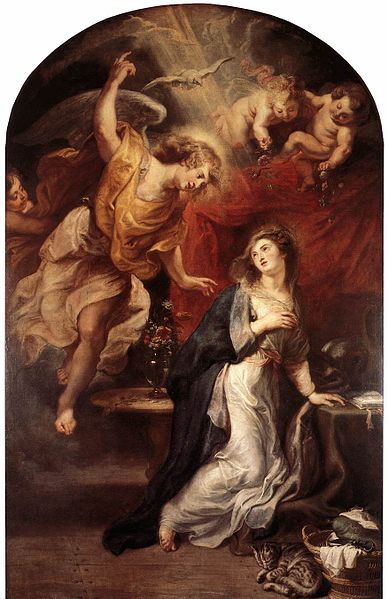
The Annunciation, by Peter Paul Rubens (1577-1640) [public domain / Wikimedia Commons]

* * *
This is from my first book, A Biblical Defense of Catholicism (1996), pp. 194-199.
* * * * *
Scriptural Evidence: The Perpetual Virginity of Mary
The Greek word for brother in the New Testament is adelphos. The well-known Protestant linguistic reference An Expository Dictionary of New Testament Words [by W. E. Vine], defines it as follows:
Adelphos: denotes a brother, or near kinsman; in the plural, a community based on identity of origin or life. It is used of:
1. male children of the same parents . . .
2. male descendants of the same parents, Acts 7:23, 26; Hebrews 7:5; . . .
4. people of the same nationality, Acts 3:17, 22; Romans 9:3 . . .
5. any man, a neighbour, Luke 10:29; Matthew 5:22, 7:3;
6. persons united by a common interest, Matthew 5:47;
7. persons united by a common calling, Revelation 22:9;
8. mankind, Matthew 25:40; Hebrews 2:17;
9. the disciples, and so, by implication, all believers, Matthew 28:10; John 20:17;
10. believers, apart from sex, Matthew 23:8; Acts 1:15; Romans 1:13; 1 Thessalonians 1:4; Revelation 19:10 (the word sisters is used of believers, only in 1 Timothy 5:2) . . . 202[202 Vine, An Expository Dictionary of New Testament Words, Vol. 1, 154-155.]
It is evident, therefore, from the range of possible definitions of adelphos, that Jesus’ “brothers” need not necessarily be siblings of Jesus on linguistic grounds, as many commentators, learned and unlearned, seem to assume uncritically. By examining the use of adelphos and related words in Hebrew, and by comparing Scripture with Scripture (“exegesis”), one can determine the most sensible explanation of all the biblical data taken collectively. Many examples prove that adelphos has a very wide variety of meanings:
In the King James Version, Jacob is called the “brother” of his Uncle Laban (Gen. 29:15; 29:10). The same thing occurs with regard to Lot and Abraham (Gen. 14:14 / 11:26-27). The Revised Standard Version uses “kinsman” at 29:15 and 14:14.
Use of brother or brethren for mere kinsmen: Deuteronomy 23:7, 2 Samuel 1:26, 1 Kings 9:13, 20:32, 2 Kings 10:13-14, Jeremiah 34:9, Amos 1:9.
Neither Hebrew nor Aramaic has a word for cousin. Although the New Testament was written in Greek, which does have such a word, the literal rendering of the Hebrew word ach, which was used by the first disciples and Jesus, is indeed adelphos, the literal equivalent of the English “brother.” But even in English, brother has multiple meanings as well.
Moving on to more direct biblical evidences of the perpetual virginity of Mary, we discover the following facts:
In Luke 2:41-51: the story of Mary and Joseph taking Jesus to the Temple at the age of twelve, it is fairly obvious that Jesus is the only child. Since everyone agrees he was the first child of Mary, if there were up to five or more siblings, as some maintain (arguing, for example, from Matthew 13:55), they were nowhere to be found at this time. This passage alone furnishes a strong argument for the implausibility of the “literal brothers” theory.
Jesus Himself uses brethren in the larger sense. In Matthew 23:8 He calls the “crowds” and His “disciples” (23:1) “brethren.” In other words, they are each other’s “brothers” (that is, the brotherhood of Christians). In Matthew 12:49-50 he calls his disciples and all who do the will of his Father “my brothers.”
By comparing Matthew 27:56, Mark 15:40, and John 19:25, we find that James and Joseph — mentioned in Matthew 13:55 with Simon and Jude as Jesus’ “brothers” — are also called sons of Mary, wife of Clopas. This other Mary (Matthew 27:61, 28:1) is called Our Lady’s adelphe in John 19:25 (it isn’t likely that there were two women named “Mary” in one family — thus even this usage apparently means “cousin” or more distant relative). Matthew 13:55-56 and Mark 6:3 mention Simon, Jude and “sisters” along with James and Joseph, calling all adelphoi. Since we know for sure that at least James and Joseph are not Jesus’ blood brothers, the most likely interpretation of Matthew 13:55 is that all these “brothers” are cousins, according to the linguistic conventions discussed above. At the very least, the term brother is not determinative in and of itself.
* Firstborn: the use of this term to assert that Mary had “second-borns” and “third-borns” proves nothing, since the primary meaning of the Greek prototokos is “pre-eminent”. To illustrate: David is described by God as the firstborn, the highest of the kings of the earth (Ps. 89:27). Likewise, God refers to Ephraim (Jeremiah 31:9) and the nation Israel (Exod. 4:22) as “my firstborn.” Jesus is called “the firstborn of all creation” in Colossians 1:15, meaning, according to all reputable Greek lexicons, that he was pre-eminent over creation, that is, the Creator. The Jewish rabbinical writers even called God the Father Bekorah Shelolam, meaning “firstborn”. Similarly, God is called the “first” in Scripture (Isa. 41:4; 44:6; 48:12; cf. Rev. 1:8; 21:6-7). Christians are called “the firstborn” in Hebrews 12:23. Literally speaking, however, among the Jews, the firstborn was ordinarily the child who was first to open the womb (Exod. 13:2), whether there were other children or not. This is probably the meaning of Matthew 1:25, in which case hypothetical younger children of Mary are not implied at all, contrary to the standard present-day Protestant assertions.
Mary is committed to the care of the Apostle John by Jesus from the Cross (John 19:26-27). Many Protestant interpreters agree with the Catholic view that Jesus likely would not have done this if he had brothers (who would all have been younger than he was). Many Church Fathers held this interpretation, including St. Athanasius, St. Epiphanius, St. Hilary, St. Jerome, and St. Ambrose, and used it in the defense of Mary’s perpetual virginity.
Catholics believe that Mary’s reply to the angel Gabriel’s announcement that she would bear the Messiah, at the Annunciation — “How can this be, since I have no husband?” (Luke 1:34) — indicates a prior vow of perpetual virginity. St. Augustine, in his work Holy Virginity (4, 4), wrote: “Surely, she would not say, ‘How shall this be?’ unless she had already vowed herself to God as a virgin . . . If she intended to have intercourse, she wouldn’t have asked this question!”
These conclusions are not merely the result of “Catholic bias” and special pleading, as many charge. For example, the prominent Protestant Commentary on the Whole Bible comments on Matthew 13:55:
An exceedingly difficult question here arises: What were these “brethren” and “sisters” to Jesus? Were they, first, His full brothers and sisters? Or, secondly, Were they His step-brothers and step-sisters, children of Joseph by a former marriage? Or, thirdly, were they His cousins, according to a common way of speaking among the Jews respecting persons of collateral descent? On this subject an immense deal has been written, nor are opinions yet by any means agreed . . . In addition to other objections, many of the best interpreters, . . . prefer the third opinion . . . Thus dubiously we prefer to leave this vexed question, encompassed as it is with difficulties. 203
[203 Commentary on the Whole Bible, Robert Jamieson, Andrew R. Fausset, & David Brown, editors, Grand Rapids, Michigan: Zondervan, 1961 (originally 1864), 928; emphasis added.]
Matthew 1:24-25: “Joseph . . . knew her not until she had borne a son.”
This verse has been used as an argument that Mary did not remain a virgin after the birth of Jesus, but the same Protestant source also comments:
The word till does not necessarily imply that they lived on a different footing afterward (as will be evident from the use of the same word in 1 Samuel 15:35; 2 Samuel 6:23; Matthew 12:20); nor does the word firstborn decide the much-disputed question, whether Mary had any children to Joseph after the birth of Christ; for, as Lightfoot says, “The law, in speaking of the firstborn, regarded not whether any were born after or no, but only that none were born before.” 204
[204 Ibid., 882; first emphasis added. Romans 8:22, 1 Timothy 4:13, 6:14, and Revelation 2:25 furnish four further examples of a similar meaning of until.]
John Calvin used this very argument to establish the fact of Mary’s perpetual virginity, which he believed (based primarily on Scripture alone), as did Luther, Zwingli, Bullinger, and many later prominent, theologically conservative, and scholarly Protestants (such as John Wesley). No one had ever denied this doctrine until the late 4th century, when one Helvidius tangled unsuccessfully with St. Jerome. Calvin appealed to St. Jerome in his own commentary on this issue, and the issue of Jesus’ supposed blood brothers did not come up again until the last few centuries, in which “higher criticism” has often been employed to question traditional interpretations of the Bible.
Previous Post

December 5, 2015
Bible Teaching: God's Glory Shared with His Creatures
Next Post
December 6, 2015 Kneeling for Communion and Worship (Reverent Posture)
Browse Our Archives
Select a Category & Last Things About Me Anti-Catholicism Atheism & Agnosticism Baptism and Sacramentalism Bible and Tradition Blessed Virgin Mary Books by Dave Armstrong C. S. Lewis Calvinism & General Protestantism Catholic Apologetics Catholic Apologists Catholic conversion Catholic converts Christmas Church (Ecclesiology) Church History Conversion and Converts Development of Doctrine Eastern Orthodoxy Ecumenism & Christian Unity Eucharist & Liturgy Fathers of the Church French Translations G. K. Chesterton Hell Hell & Satan Hell & Satan & Last Things Heresies & Comparative Religion Holistic Health Inquisition & Crusades & Scandals James White Jews & Judaism & Old Testament John Calvin John Henry Newman Liberal / Modernist Theology Life Issues Literary Resume Lutheranism Mariology Martin Luther Music Orthodoxy Papacy & Infallibility Personal Page Philosophy & Science Political & Ethical & Moral Issues Protestant Persecution & Intolerance Protestantism Purgatory Purgatory & Penance Romantic & Imaginative Theology Saints & Purgatory & Penance Salvation Salvation & Justification Satan & Last Things Sexuality and Gender Issues Spanish Translations Traditionalism vs. Radical Catholic Reactionaries Traducciones al español / tradução para português Trinitarianism & Christology Uncategorized Videos
Select a Month October 2026 September 2026 August 2026 July 2026 June 2026 May 2026 April 2026 March 2026 February 2026 January 2026 December 2025 November 2025 October 2025 September 2025 August 2025 July 2025 June 2025 May 2025 April 2025 March 2025 February 2025 January 2025 December 2024 November 2024 October 2024 September 2024 August 2024 July 2024 June 2024 May 2024 April 2024 March 2024 February 2024 January 2024 December 2023 November 2023 October 2023 September 2023 August 2023 July 2023 June 2023 May 2023 April 2023 March 2023 February 2023 January 2023 December 2022 November 2022 October 2022 September 2022 August 2022 July 2022 June 2022 May 2022 April 2022 March 2022 February 2022 January 2022 December 2021 November 2021 October 2021 September 2021 August 2021 July 2021 June 2021 May 2021 April 2021 March 2021 February 2021 January 2021 December 2020 November 2020 October 2020 September 2020 August 2020 July 2020 June 2020 May 2020 April 2020 March 2020 February 2020 January 2020 December 2019 November 2019 October 2019 September 2019 August 2019 July 2019 June 2019 May 2019 April 2019 March 2019 February 2019 January 2019 December 2018 November 2018 October 2018 September 2018 August 2018 July 2018 June 2018 May 2018 April 2018 March 2018 February 2018 January 2018 December 2017 November 2017 October 2017 September 2017 August 2017 July 2017 June 2017 May 2017 April 2017 March 2017 February 2017 January 2017 December 2016 November 2016 October 2016 September 2016 August 2016 July 2016 June 2016 May 2016 April 2016 March 2016 February 2016 January 2016 December 2015 November 2015 October 2015 September 2015 August 2015 July 2015 June 2015 May 2015 April 2015 March 2015 February 2015 January 2015 December 2014 November 2014 October 2014 September 2014 August 2014 July 2014 June 2014 April 2014 March 2014 February 2014 January 2014 December 2013 November 2013 October 2013 September 2013 August 2013 July 2013 June 2013 April 2013 March 2013 February 2013 January 2013 December 2012 November 2012 October 2012 September 2012 August 2012 July 2012 June 2012 May 2012 April 2012 March 2012 February 2012 January 2012 December 2011 November 2011 October 2011 September 2011 August 2011 July 2011 June 2011 April 2011 March 2011 February 2011 October 2010 September 2010 August 2010 July 2010 April 2010 March 2010 December 2009 October 2009 August 2009 July 2009 June 2009 May 2009 March 2009 February 2009 October 2008 September 2008 April 2008 March 2008 February 2008 January 2008 December 2007 November 2007 October 2007 May 2007 March 2007 February 2007 January 2007 November 2006 October 2006 September 2006 August 2006 July 2006 June 2006 May 2006 April 2006 March 2006 February 2006 October 2005 June 2005 April 2005 February 2005 July 2004 May 2004 April 2004
Follow Us!
TAKE THE
Religious Wisdom Quiz
Who urged Esther to approach the king, saying, "For such a time as this"?
Select your answer to see how you score.
Haggai Nehemiah Mordecai Ezra
Books by This Author Books by Dave Armstrong
Related posts from Biblical Evidence for Catholicism

Holy Ground: Why Mary Had NO Other Children...
Biblical Evidence for Catholicism
Protestant Confessions & "Ever-Virgin" Mary
Biblical Evidence for Catholicism

Mary Wife of Clopas (Jn 19:25): Mary's Sister-in-Law?
Biblical Evidence for Catholicism

Jesus Had Four Brothers? The Bible Sez No!
Biblical Evidence for Catholicism
TRENDING AT PATHEOS Catholic

In "Irreplaceable," our book on vocation and technology, Trevor Sutton and I...

I was strolling through the top floor of the brand new Parthenon...

What Does Gêvâh Mean For Kimberley Guifoyle &...
This week, a lot of the news is focused on Kimberly Guilfoyle....

INNER CIRCLE: Profound Mystery (Of Christ In All...
Ephesians 5:31-32 “For this reason, a man will leave his father and...

Do Not Rejoice When Your Enemy Falls: The...
Turning an execution into a public spectacle is a disturbing expression of...

'The Chosen' S6 Trailer: The Passion Gets Very...
Not many watching 'The Chosen' worry about spoilers, but just because they...
view all Catholic blogs
Ad-Free & Subscriber Log-In Subscription Support
- About Us
- 2026 Calendar
- Videos
- Podcasts
- Library of World Religions
- Faith In Media Tracker
- Advertise With Us
- Write for Us
- Privacy Policy
- Terms of Service
- Do Not Sell My Data
- Contact Us
- Radiant Digital
- Manage Newsletter Subscriptions
- Unsubscribe From Notifications
- Sitemap
Copyright 2008-2026, Patheos. All rights reserved.
Subscription Support Ad-Free & Subscriber Log-In
Follow Patheos