
BuddhistCatholicContemplativeEvangelicalGeneral ChristianHinduJewishLatter-day SaintMuslimNew VisionsProgressive Christian
Beliefs
- Buddhist
- Catholic
- Contemplative
- Evangelical
- General Christian
- Hindu
- Jewish
- Latter-day Saint
- More Voices
- Muslim
- New Visions
- Pagan
- Progressive Christian
Topics
- Religion News
- Food and Religion
- Sports and Religion
- Religious Art
- Religious Music and Entertainment
- Religious Events
- History and Religion
- Style and Religion
- Politics and Religion
- Women in Religion
- Recreation Outdoors and Religion
- Business Finance and Religion
- Careers Workplace and Religion
- Education and Religion
- Family Parenting and Religion
- Health Fitness and Religion
- Home and Religion
- Relationships and Religion
- Technology and Religion
- Travel and Religion
Columnists
- Buddhist Columnists
- Business Finance and Religion Columnists
- Careers Workplace and Religion Columnists
- Catholic Columnists
- Contemplative Columnists
- Education and Religion Columnists
- Evangelists Columnists
- Family Parenting and Religion Columnists
- General Christian Columnists
- Health Fitness and Religion Columnists
- Hindu Columnists
- History and Religion Columnists
- Home and Religion Columnists
- Jewish Columnists
- More Voices Columnists
- Latter Day Columnists
- Muslim Columnists
- New Visions Columnists
- Nonreligious Columnists
- Pagan Columnists
- Politics and Religion Columnists
- Progressive Columnists
- Recreation Outdoors and Religion Columnists
- Relationships and Religion Columnists
- Religion News Columnists
- Religious Art Columnists
- Religious Events Columnists
- Religious Music and Entertainment Columnists
- Sports and Religion Columnists
- Style and Religion Columnists
- Technology and Religion Columnists
- Travel and Religion Columnists
- Women in Religion Columnists
Resource Library
- 2026 Calendar
- Library of World Religions
- The 100 Most Holy Places on Earth
- Patheos Answers
- Podcasts
- Videos
- Faith Leaders Database
- Anglican Episcopalian
- Bahai
- Baptist
- Buddhism
- Christianity
- Confucianism
- Eastern Orthodoxy
- Hinduism
- Holiness and Pentecostal
- ISKCON
- Islam
- Judaism
- Lutheran
- Methodist
- The Church of Jesus Christ of Latter-day Saints
- New Age
- Paganism
- Presbytarian and Reformed
- Protestantism
- Religion Behind the Scenes
- Roman Catholic
- Scientology
- Shia Islam
- Sikhism
- Sufism
- Sunni Islam
- Taoism
- Zen
- See all religions
Research Tools
 Ad-Free & Subscriber Log-In Subscription Support
Ad-Free & Subscriber Log-In Subscription Support
Follow Patheos 

- Trending:
- Forgiveness
- |
- Marriage
- |
- Consciousness
- |
- Death Penalty
- |
- Election
- |
- Halloween

-
About
-
Catholic Apologetics
-
Church History
-
Great Apologists
-
Christian Worldview
-
Protestantism & Misc.
- Home
- Catholic
- History and Religion
- Annunciation: Was Mary Already Sublimely Graced?
Annunciation: Was Mary Already Sublimely Graced?
Last updated on: September 12, 2017 at 11:55 am by Dave Armstrong
Annunciation: Was Mary Already Sublimely Graced? 2017-09-12T11:55:03-04:00 Dave Armstrong
Patheos Explore the world's faith through different perspectives on religion and spirituality! Patheos has the views of the prevalent religions and spiritualities of the world.
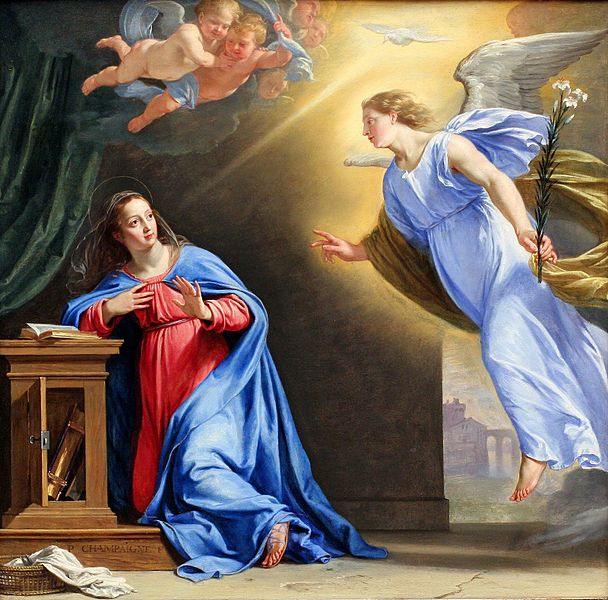
The Annunciation (1644), by Philippe de Champaigne (1602-1674) [public domain / Wikimedia Commons]

* * *
(10-8-11)
* * *
This dialogue occurred at Cranach: The Blog of Veith: a Lutheran site, in the combox for the post “Mariology,” in comment numbers 21, 25, 27, 186, 187, 188, 190, 191, 192, 193, 194, 195, 196, 198, 199, 201, 203, 206. I have arranged all these comments (no words changed or edited out!) in order to make it a coherent, flowing, back-and-forth dialogue.
* * *
Tom Hering’s words will be in blue.
* * * * *
Mary as an examplar is Law, accusing us of falling short in the humility and obedience departments. Though why she should be made an examplar is beyond me,
*
Why should the Apostle Paul be an exemplar: also being chosen by Grace alone as every Christian is? But he urged his followers to imitate him and follow his example (as I documented in #180 above).
as she was chosen by grace alone: “Greetings, favored one! The Lord is with you … Do not be afraid, Mary; for you have found favor with God.” No reason for this is given in the Annunciation, no deserving qualities in Mary are mentioned, just “God’s favor” – unmerited grace.
*
Exactly! Where’s the beef? You actually think that Catholics would deny this?
I do call Mary “blessed among women,” but for the sole reason that she bore Our Savior. Yes, she received God’s favor, but so have all of the elect – and they, too, because of grace alone.
*
I don’t know anyone else who has been “hailed” by an angel [Lk 1:28]. Do you?
The Greek word is chairo, “greetings, rejoice, be glad.” I definitely see how this greeting indicates God has favored Mary above all women, but I don’t see how it indicates He has favored her on account of special qualities.
*
Baptist Greek scholar A. T. Robertson writes about Luke 1:28:
“‘Highly favoured’” (kecharitomene). Perfect passive participle of charitoo and means endowed with grace (charis), enriched with grace as in Ephesians. 1:6, . . . The Vulgate gratiae plena ‘is right, if it means “full of grace which thou hast received“; wrong, if it means “full of grace which thou hast to bestow“‘ (Plummer).”
(Word Pictures in the New Testament, Nashville: Broadman Press, 1930, Vol. II, 13)
Greek scholar Marvin Vincent noted that even Wycliffe and Tyndale (no enthusiastic supporters of the Catholic Church) both rendered kecharitomene in Luke 1:28 as “full of grace” and that the literal meaning was “endued with grace” (Word Studies in the New Testament, Grand Rapids, Michigan: Eerdmans, 1946, 1887 edition [New York: Charles Scribner’s Sons], Vol. I, 259).
Likewise, well-known Protestant linguist W. E. Vine, defines it as “to endue with Divine favour or grace” (An Expository Dictionary of New Testament Words, Old Tappan, NJ: Fleming H. Revell Co., four volumes-in-one edition, 1940., Vol. II, 171).
All these men (except Wycliffe, who probably would have been, had he lived in the 16th century or after it) are Protestants, and so cannot be accused of Catholic translation bias. Even a severe critic of Catholicism like James White can’t avoid the fact that kecharitomene (however translated) cannot be divorced from the notion of grace, and stated that the term referred to “divine favor, that is, God’s grace” (The Roman Catholic Controversy, Minneapolis: Bethany House Publishers, 1996, 201).
Of course, Catholics agree that Mary has received grace. This is assumed in the doctrine of the Immaculate Conception: it was a grace from God which could not possibly have had anything to do with Mary’s personal merit, since it was granted by God at the moment of her conception, to preserve her from original sin (as appropriate for the one who would bear God Incarnate in her very body).
Thus, the angel favored Mary because she was full of grace, and being in that state was due to a special act of God. She had the special qualities; they came from God.
Gabriel had to tell Mary, “Do not be afraid.” What sinless person would fear the Lord, much less the Lord’s messenger?
Angels were universally feared, because they are extraordinary creatures, and out of the ordinary. I don’t see that Mary’s reaction would be any different from anyone else’s, whether she is sinless or not. One can be sinless, but still if one had no previous encounter with an angel, then they would tremble and fear. That’s not sin. It’s being a human being, responding to the extraordinary.
Nice generalization, but the verse doesn’t say, “Don’t be afraid. I know I’m an extraordinary visitor, but I’m a heck of a nice guy.” No, Gabriel tells Mary to be unafraid for a specific reason: “‘You have found favor with God.’” Which clearly indicates Gabriel knew that Mary, like any other sinful human, would be afraid she wasn’t in good standing with God. And rightly so. (Don’t you see how God’s grace toward Mary was amazing?)
*
Yes, it is. All grace is amazing, but the grace He gave to the Blessed Virgin Mary is more amazing, arguably, than any other instance, since He made her full of grace. God is so good! Isn’t God amazing, to use a human being in such an incredible way to bring about the incarnation of our savior and redeemer and Lord, Jesus Christ? God didn’t necessarily have to become man or even (theologians and spiritual masters have speculated) choose the cross and all the agony involved in Jesus’ passion.
He could have simply proclaimed that we were all saved, or that those who accepted His free grace were saved. But He didn’t do that. He chose to suffer and die for us, and He chose to use a created human being, Mary, to bear God Himself in her womb and to be the Mother of God. It is sublime beyond all words, how God does things like this. This is why we venerate Mary so highly: because she is a witness to and example of God’s grace and love for His creatures like no other human being.
Many millions of Protestants put out statues of Mary at Christmastime, because they can’t deny that the birth of Jesus was such an incredible event. And every birth I know of entails a mother, who is not exactly an insignificant player . . . We honor every mother of a baby, for all that she has done, and gone through.
Yet when it comes to honoring the mother of Jesus Christ: a created human being who had God Himself in her womb for nine months, and who lived with Jesus for about thirty years before He was known to the world, the Protestant balks, on the ridiculous grounds that this must be idolatry, or, at the very least, that it must somehow detract from our adoration and worship of God. This is an insufficient spirituality and insufficiently biblical as well.
You have yet to convince me from Scripture that Lutheranism (or Protestantism in general) is “insufficiently biblical.” Show me the verses and passages I asked you for. The ones that prove your not just adding your imaginings to God’s Word. As I said, I’m waiting.
* * *
Was Mary exceptionally humble and obedient? Sure. But what believer wouldn’t be in response to a supernatural visitation like that?
*
That doesn’t follow, either, since Satan and all the fallen angels were in the presence of God. That didn’t stop them from being disobedient, did it? You underestimate the strength of human (and demonic / angelic) free will by quite a wide margin.
What I carefully said @ 27 was (note the emphasis this time), “Was Mary exceptionally humble and obedient? Sure. But what believer wouldn’t be in response to a supernatural visitation like that?”
*
The thrust of this seems to be, “big wow: Mary was obedient. Who [of believers] wouldn’t be after an angelic visit?” But this is wrongheaded. We have free will. It is not a foregone conclusion at all that human beings will be obedient simply because an angel (or God) visits them.
For example, look at Jonah. The Bible says that “the Word of the Lord came to Jonah” (Jonah 1:1). He disobeyed: “But Jonah rose to flee to Tarshish from the presence of the Lord” (Jonah 1:3; cf. 1:10). Then when he finally did what God told him to do, he was “displeased” and “angry” at the good result (Jonah 4:1).
Adam and Eve had direct contact with God in Eden. Nevertheless they rebelled. So being with God (more more fabulous and wondrous than being with an angel) didn’t preclude the negative result and the rebellion. The first Eve said no to God; the second Eve said yes. What the Church fathers en masse marveled at and rejoiced over, you (and indeed many Protestants, for inexplicable reasons) regard as a ho-hum.
Thus, Mary is to be given credit for saying “yes” to God. That is the credit that can go to her, just as we are credited with all good and righteous acts, even though they are all ultimately due to God and His grace. As St. Augustine said (paraphrase), “merit is God rewarding His own gifts.”
I mentioned Satan’s rebellion, even though he had been in God’s presence. Satan was a “believer” at one point. How could he not be? He was with God, as His greatest angel! He was in a state even higher than we will be if we get to heaven. But he decided to rebel. How can someone rebel if they haven’t been in the camp from which they are rebelling? Therefore, your reiteration of your talking about a “believer” is irrelevant, since Satan was (just as Judas was). He used to be like the good angels now are.
“Big wow”? No, I consider it quite amazing that God puts a new heart into a believer, i.e., one who has received the gift of faith in Christ alone (the Christ that Mary looked forward to). And that this new heart responds spontaneously in humility and obedience. Amazing – full of grace indeed!
Satan and Judas were believers at one point? When did Satan or Judas ever trust in Christ for forgiveness?
*
When did Abraham, Joseph, Moses, Joshua, Samuel, David, Solomon, Isaiah, Jeremiah, Ezekiel, or Daniel ever trust in Christ for forgiveness? Were they not “believers”?
We’re talking about Mary. Are you going to address my questions and statements @193-194 directly, or are you going to continue to try to change the subject?
*
I did so, and am continuing to do so. My reply in #195 was exactly on-topic; dead on topic. It was a rhetorical question, based on the logical technique of reductio ad absurdum: not changing the subject at all. You just didn’t grasp the logic of it (and so ignored the burden of answering).
In this case, the logic was that you would be required to deny that Abraham, Joseph, Moses, Joshua, Samuel, David, Solomon, Isaiah, Jeremiah, Ezekiel, and Daniel were believers, by your definition of the term. Since that is patently absurd, and proves too much, your initial premise and definition collapse; hence you declined to answer, having been stewed in your own juice, so to speak, and chose rather to pretend that I was off-topic, rather than that you were off-logic and off-Scripture.
It’s literally a textbook example of illogical and non sequitur thinking: fit for a textbook in logic (I took that course in college).
Show me the Scripture that says she was full of grace before the annunciation.
Luke 1:28. Because she is already in this state (“O favored one” — RSV), the angel hails her as such.
Show me this special pre-annunciation act of God in Scripture.
*
It follows logically from Luke 1:28 and (especially) from what kecharitomene means. It’s a perfect passive participle, that shows a “completed action with permanent result” (Smyth), and denotes continuance of a completed action (H. W. Smyth, Greek Grammar, Harvard Univ Press, 1968, pp. 108-109, section 1852:b; also Friedrich Blass and Albert DeBrunner, Greek Grammar of the New Testament, Chicago: Univ. of Chicago Press, 1961, pp. 166, 175).
Show me the Scripture that says she received these before the annunciation.
*
Just did.
You can’t.
*
I not only can, but did. What can’t be shown in Scripture (if you want to play that game) is the foolish notion of sola Scriptura: that only the Bible is the infallible rule of faith, to the exclusion of an infallible Church.
Asking you to convince me of RC teachings from Scripture alone is not a “game” – not for a Lutheran. Besides, having looked at your website, and seeing that you present yourself as a biblical RC apologist, you should have no problem at all making your arguments from Scripture – at least primarily. I’m waiting.
* * *
So I would go further and argue her humility and obedience were not, in fact, special qualities.
*
Duly noted. Mary really threatens you, doesn’t she?
Threatened? Not in the least. I am, however, amused by the number of times you’ve claimed or suggested that Lutherans (or Protestants or Evangelicals) are afraid, or weak in faith.
The humble handmaiden of the Lord . . . We must flee from her in terror, lest our faith in God be imperiled!!! You must have a very weak faith, if you are so scared of losing it merely from venerating God’s greatest created human being, just as Scripture says we should honor the heroes of the faith (Hebrews 11), precisely because they reflect the work and glory of God.
Rather, they were the normal response of a believer – a saint and sinner who looked forward to the coming of her Savior – when (A.) faced with an angel and (B.) fear of condemnation was allayed.
*
Mary’s humility is exhibited throughout the biblical accounts where she appears. Many Protestants who deny every Catholic and traditional (patristic, apostolic, biblical) doctrine about her wouldn’t dream of denying that, of all things. But you will have no talk of any extraordinary qualities of Mary! She only bore God in her own womb. Nothing to write home about . . .
Seems to me you have to imagine an awful lot to support the idea of Mary’s immaculate conception.
*
I have several arguments from Scripture. It takes faith to believe, like all Christian doctrines. The Christian (and Catholic) faith is not merely philosophy and epistemology, but a religious faith: a spiritual thing. It can’t be reduced to logic (though it is never inconsistent with that). Faith is a supernatural gift granted by God’s grace. God will grant anyone the eyes to see the truths of Mariology, if they are willing to grant them at least as possibilities.
I considered them more than possibilities back when I was RC myself. The only thing about Mariology that God opened my eyes to was the absurdity of it.
* * *
I can’t “prove” the Immaculate Conception in some airtight sense, but there are a lot of things that can’t be proven in that sense. I think the Catholic can demonstrate enough to show that the doctrine is plausible and not opposed to Scripture or reason at all.
* * *
I have no doubt that Mr. Armstrong believes “Catholics need only to show the harmony of a doctrine with holy Scripture.” But that’s not going to cut it with me – not from an apostle to the Protestants who wants me to believe he’s truly biblical. More biblical than any non-Catholic. I know full well that anything – anything – can be “harmonized” with Scripture if you’re clever enough.
* * * * *
I also had the following brief exchange in the same combox (#10, #183) with a person (“Jerry”) of unknown denominational affiliation:
***
An additional insight from the Lutheran theology of the cross (vs the Roman Catholic and others theology of glory) is that Jesus in His complete humility was born to a big nobody. There is and was nothing in Mary to be adored, not even humility.
*
That’s interesting. Why in the world, then, does an angel say to Mary, “Hail, O favored one . . .” (Lk 1:28)? Since when does an angel “hail” a human being?
Why does Mary say “henceforth all generations will call me blessed” (Lk 1:48)? You certainly don’t do that. So is Mary a liar, writing inspired Scripture about how she shall be regarded by posterity? in addition to being a “big nobody” (only bearing God the Son, after all, a trifle if ever there was one . . . ).
I later wrote on my Facebook page more comments about this:
***
Well, if he meant (technically) by “adored” what we do (i.e., reserved for God alone), he may have been saying that we shouldn’t worship or adore anything in her, which we agree with, of course. But we venerate her and her attributes, because God made her what she is, and she said “yes” to Him.
Mary’s yes is to her credit. It came by God’s grace, but He grants us free will, so she could have said “no” just as Eve did.
If Mary had said no, God wouldn’t have chosen her in the first place; He would have simply chosen someone else whom He knew in His foreknowledge would say yes.
* * *
[see also the very extensive discussion on my old blog, including with some of the Lutherans in the thread above]
* * *
Previous Post
December 14, 2015
Justification is NOT by Faith Alone, and is Ongoing
Next Post
December 14, 2015 The Census, Jesus' Birth in Bethlehem, and History
Browse Our Archives
Select a Category & Last Things About Me Anti-Catholicism Atheism & Agnosticism Baptism and Sacramentalism Bible and Tradition Blessed Virgin Mary Books by Dave Armstrong C. S. Lewis Calvinism & General Protestantism Catholic Apologetics Catholic Apologists Catholic conversion Catholic converts Christmas Church (Ecclesiology) Church History Conversion and Converts Development of Doctrine Eastern Orthodoxy Ecumenism & Christian Unity Eucharist & Liturgy Fathers of the Church French Translations G. K. Chesterton Hell Hell & Satan Hell & Satan & Last Things Heresies & Comparative Religion Holistic Health Inquisition & Crusades & Scandals James White Jews & Judaism & Old Testament John Calvin John Henry Newman Liberal / Modernist Theology Life Issues Literary Resume Lutheranism Mariology Martin Luther Music Orthodoxy Papacy & Infallibility Personal Page Philosophy & Science Political & Ethical & Moral Issues Protestant Persecution & Intolerance Protestantism Purgatory Purgatory & Penance Romantic & Imaginative Theology Saints & Purgatory & Penance Salvation Salvation & Justification Satan & Last Things Sexuality and Gender Issues Spanish Translations Traditionalism vs. Radical Catholic Reactionaries Traducciones al español / tradução para português Trinitarianism & Christology Uncategorized Videos
Select a Month October 2026 September 2026 August 2026 July 2026 June 2026 May 2026 April 2026 March 2026 February 2026 January 2026 December 2025 November 2025 October 2025 September 2025 August 2025 July 2025 June 2025 May 2025 April 2025 March 2025 February 2025 January 2025 December 2024 November 2024 October 2024 September 2024 August 2024 July 2024 June 2024 May 2024 April 2024 March 2024 February 2024 January 2024 December 2023 November 2023 October 2023 September 2023 August 2023 July 2023 June 2023 May 2023 April 2023 March 2023 February 2023 January 2023 December 2022 November 2022 October 2022 September 2022 August 2022 July 2022 June 2022 May 2022 April 2022 March 2022 February 2022 January 2022 December 2021 November 2021 October 2021 September 2021 August 2021 July 2021 June 2021 May 2021 April 2021 March 2021 February 2021 January 2021 December 2020 November 2020 October 2020 September 2020 August 2020 July 2020 June 2020 May 2020 April 2020 March 2020 February 2020 January 2020 December 2019 November 2019 October 2019 September 2019 August 2019 July 2019 June 2019 May 2019 April 2019 March 2019 February 2019 January 2019 December 2018 November 2018 October 2018 September 2018 August 2018 July 2018 June 2018 May 2018 April 2018 March 2018 February 2018 January 2018 December 2017 November 2017 October 2017 September 2017 August 2017 July 2017 June 2017 May 2017 April 2017 March 2017 February 2017 January 2017 December 2016 November 2016 October 2016 September 2016 August 2016 July 2016 June 2016 May 2016 April 2016 March 2016 February 2016 January 2016 December 2015 November 2015 October 2015 September 2015 August 2015 July 2015 June 2015 May 2015 April 2015 March 2015 February 2015 January 2015 December 2014 November 2014 October 2014 September 2014 August 2014 July 2014 June 2014 April 2014 March 2014 February 2014 January 2014 December 2013 November 2013 October 2013 September 2013 August 2013 July 2013 June 2013 April 2013 March 2013 February 2013 January 2013 December 2012 November 2012 October 2012 September 2012 August 2012 July 2012 June 2012 May 2012 April 2012 March 2012 February 2012 January 2012 December 2011 November 2011 October 2011 September 2011 August 2011 July 2011 June 2011 April 2011 March 2011 February 2011 October 2010 September 2010 August 2010 July 2010 April 2010 March 2010 December 2009 October 2009 August 2009 July 2009 June 2009 May 2009 March 2009 February 2009 October 2008 September 2008 April 2008 March 2008 February 2008 January 2008 December 2007 November 2007 October 2007 May 2007 March 2007 February 2007 January 2007 November 2006 October 2006 September 2006 August 2006 July 2006 June 2006 May 2006 April 2006 March 2006 February 2006 October 2005 June 2005 April 2005 February 2005 July 2004 May 2004 April 2004
Follow Us!
TAKE THE
Religious Wisdom Quiz
Who asked Jesus, "What is truth?"
Select your answer to see how you score.
Caiaphas Pilate Nicodemus Herod
Books by This Author Books by Dave Armstrong
Related posts from Biblical Evidence for Catholicism

Holy Ground: Why Mary Had NO Other Children...
Biblical Evidence for Catholicism
Protestant Confessions & "Ever-Virgin" Mary
Biblical Evidence for Catholicism

Mary Wife of Clopas (Jn 19:25): Mary's Sister-in-Law?
Biblical Evidence for Catholicism

Jesus Had Four Brothers? The Bible Sez No!
Biblical Evidence for Catholicism
TRENDING AT PATHEOS Catholic

I was strolling through the top floor of the brand new Parthenon...

What Does Gêvâh Mean For Kimberley Guifoyle &...
This week, a lot of the news is focused on Kimberly Guilfoyle....

INNER CIRCLE: Profound Mystery (Of Christ In All...
Ephesians 5:31-32 “For this reason, a man will leave his father and...

Do Not Rejoice When Your Enemy Falls: The...
Turning an execution into a public spectacle is a disturbing expression of...

'The Chosen' S6 Trailer: The Passion Gets Very...
Not many watching 'The Chosen' worry about spoilers, but just because they...

The purpose-driven labor priest
A labor activist reads Rick Warren and it gets me wondering about...
view all Catholic blogs
Ad-Free & Subscriber Log-In Subscription Support
- About Us
- 2026 Calendar
- Videos
- Podcasts
- Library of World Religions
- Faith In Media Tracker
- Advertise With Us
- Write for Us
- Privacy Policy
- Terms of Service
- Do Not Sell My Data
- Contact Us
- Radiant Digital
- Manage Newsletter Subscriptions
- Unsubscribe From Notifications
- Sitemap
Copyright 2008-2026, Patheos. All rights reserved.
Subscription Support Ad-Free & Subscriber Log-In
Follow Patheos