
BuddhistCatholicContemplativeEvangelicalGeneral ChristianHinduJewishLatter-day SaintMuslimNew VisionsProgressive Christian
Beliefs
- Buddhist
- Catholic
- Contemplative
- Evangelical
- General Christian
- Hindu
- Jewish
- Latter-day Saint
- More Voices
- Muslim
- New Visions
- Pagan
- Progressive Christian
Topics
- Religion News
- Food and Religion
- Sports and Religion
- Religious Art
- Religious Music and Entertainment
- Religious Events
- History and Religion
- Style and Religion
- Politics and Religion
- Women in Religion
- Recreation Outdoors and Religion
- Business Finance and Religion
- Careers Workplace and Religion
- Education and Religion
- Family Parenting and Religion
- Health Fitness and Religion
- Home and Religion
- Relationships and Religion
- Technology and Religion
- Travel and Religion
Columnists
- Buddhist Columnists
- Business Finance and Religion Columnists
- Careers Workplace and Religion Columnists
- Catholic Columnists
- Contemplative Columnists
- Education and Religion Columnists
- Evangelists Columnists
- Family Parenting and Religion Columnists
- General Christian Columnists
- Health Fitness and Religion Columnists
- Hindu Columnists
- History and Religion Columnists
- Home and Religion Columnists
- Jewish Columnists
- More Voices Columnists
- Latter Day Columnists
- Muslim Columnists
- New Visions Columnists
- Nonreligious Columnists
- Pagan Columnists
- Politics and Religion Columnists
- Progressive Columnists
- Recreation Outdoors and Religion Columnists
- Relationships and Religion Columnists
- Religion News Columnists
- Religious Art Columnists
- Religious Events Columnists
- Religious Music and Entertainment Columnists
- Sports and Religion Columnists
- Style and Religion Columnists
- Technology and Religion Columnists
- Travel and Religion Columnists
- Women in Religion Columnists
Resource Library
- 2026 Calendar
- Library of World Religions
- The 100 Most Holy Places on Earth
- Patheos Answers
- Podcasts
- Videos
- Faith Leaders Database
- Anglican Episcopalian
- Bahai
- Baptist
- Buddhism
- Christianity
- Confucianism
- Eastern Orthodoxy
- Hinduism
- Holiness and Pentecostal
- ISKCON
- Islam
- Judaism
- Lutheran
- Methodist
- The Church of Jesus Christ of Latter-day Saints
- New Age
- Paganism
- Presbytarian and Reformed
- Protestantism
- Religion Behind the Scenes
- Roman Catholic
- Scientology
- Shia Islam
- Sikhism
- Sufism
- Sunni Islam
- Taoism
- Zen
- See all religions
Research Tools
 Ad-Free & Subscriber Log-In Subscription Support
Ad-Free & Subscriber Log-In Subscription Support
Follow Patheos 

- Trending:
- Forgiveness
- |
- Marriage
- |
- Consciousness
- |
- Death Penalty
- |
- Election
- |
- Halloween

-
About
-
Catholic Apologetics
-
Church History
-
Great Apologists
-
Christian Worldview
-
Protestantism & Misc.
- Home
- Catholic
- History and Religion
- Why Should We Believe in Mary’s Perpetual Virginity?
Why Should We Believe in Mary’s Perpetual Virginity?
Last updated on: April 27, 2017 at 1:17 pm by Dave Armstrong
Why Should We Believe in Mary’s Perpetual Virginity? 2017-04-27T13:17:07-04:00 Dave Armstrong
Patheos Explore the world's faith through different perspectives on religion and spirituality! Patheos has the views of the prevalent religions and spiritualities of the world.
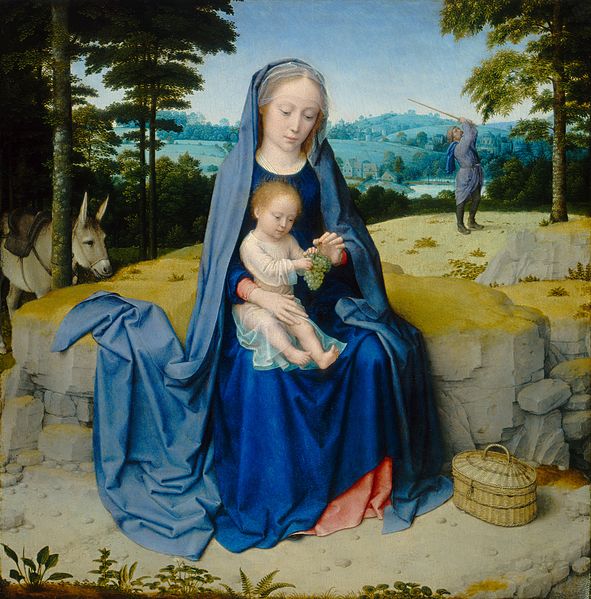
The Rest on the Flight Into Egypt (c. 1510), by Gerard David (bet. 1450-1460-1523) [public domain / Wikimedia Commons]

The following is based on a chat on a blog with two Protestants (both Presbyterian, I believe, and one a pastor). It is, therefore, written in the first person. Their thoughts are paraphrased in blue.
(2-28-04)
* * *
Nothing in the New Testament “even remotely suggests” the perpetual virginity of Mary.
But there is nothing in the Bible that even remotely suggests the biblical canon, either, yet you accept a tradition handed down to you by a local council, approved by the pope (excepting the “apocryphal books” which were also accepted by that council and never separated from the other books in Scripture until the 16th century).
This is the point: we all accept some traditions which are not, or may not be (arguably) explicitly biblical, or in the Bible at all. You haven’t answered my question yet (this is now my 3rd time asking — Ted Koppel style) about why Protestants have shifted away from this and why Luther and Calvin accepted it, but I am happy to answer your question (Why do I believe in this doctrine?). I believe it first of all because it is received Christian tradition; denied by virtually no one until liberal theology started becoming a force. That’s an argument in and of itself, of course, but we all accept received traditions in some manner.
You accept the Westminster Confession and TULIP and the Protestant canon, and so forth. A Catholic accepts the perpetual virginity of Mary, as it is a dogma, proclaimed early on by an ecumenical council (Ephesus, 431). That’s more than enough reason for us, given our epistemological presuppositions and our Rule of Faith.
But of course you are probing beyond that and want to know the biblical and theological “why’s”. That’s fine; that’s what I do as my profession: an apologist, and I appreciate the opportunity and your congeniality and graciousness to this Catholic guest on your blog.
The Catholic believes about this the same thing that he believes about the Immaculate Conception of Mary: neither doctrine is ontologically, intrinsically necessary. Rather, both are seen as “fitting” and the way things should properly be. I can’t think of a Protestant parallel to this offhand but I’m sure there are some.
It was fitting (but not absolutely necessary — where it couldn’t have been otherwise in any other world) for Mary to be without sin (actual and original) because she was the Mother of God (Theotokos). Likewise, we think it is altogether fitting that she remain a virgin after bearing Christ.
Partly this is because of the nature of the miracle itself: Mary was a virgin and we believe that even the birth was miraculous (that Mary’s virginity — without getting physiologically graphic — was retained even during and after the birth). This is traditional Catholic dogma (and, I believe, Orthodox, too).
It strengthens and supports the doctrine of the Virgin Birth (Mariology is always christocentric). It’s a miracle to have a virgin birth: a conception without the participation of a man. If Mary had had other children, and a normal sexual life after, people could always say, “well, how do we know that Jesus’ birth was before she started being sexually active? Why should we believe all this Holy Spirit ‘overshadowing’ foolishness?”
I believe that is part of the traditional theological reasoning on this, though I am basically speaking for myself here, not necessarily “officially” for what the Catholic Church would say. If we pursue this, of course I could look up what Aquinas and Augustine and others said about it.
The second thing is the appropriateness or propriety that the womb which bore the God-Man should not bear another child. One either grasps and accepts that notion or they don’t. It is not an argument from reason or Bible but from propriety (which is a very subjective thing and often culturally determined). It can’t and won’t be perceived or understood by the usual Protestant outlook of “everything must be fairly explicit in the Bible or else we reject it utterly.”
Traditional Catholic thought (particularly regarding Mary) does not operate along those lines. The Church ponders things for centuries. It did so with regard to christology (up to 451 and even after if we include the Monothelite controversies); it did with regard to the biblical canon (up to 397) and it did so with Mariology.
So that is the argument from tradition and “fittingness.” I know it sounds very foreign to Protestant ears, but I can’t help that, in explaining why we believe as we do, and how I understand the belief, in my apologetic, reason-loving mind. The biblical data is another matter; of a different nature. What we have would not require (and perhaps not even suggest) this belief on the surface, but I think that when we examine it closely, it at least suggests it, or at the very least shows us that the data we do know about is perfectly compatible with the notion. One can make many deductions from what we know: some of which rule out that blood brothers are being referred to in specific instances of adelphos.
There are other “situational” arguments from plausibility, such as: “where were Jesus’ siblings when He went to the Temple at age 12? If he had them, certainly they would have been around, no? — unless there was a 12-year gap between births. The narrative (Lk 2:41-52) gives not the slightest hint that there were any brothers involved. When Joseph and Mary were looking for Him, it doesn’t say they went to His supposed five brothers and four sisters (I would certainly do that first, as a parent); rather, “they sought him among their kinsfolk and acquaintances” (Lk 2:44; RSV). When they leave, it reads, “And he went down with them and came to Nazareth . . . ” (2:51).
Now, this doesn’t technically rule out siblings, true, but it sure doesn’t positively suggest them, does it? If I took my three sons and a daughter down to Cedar Point for a day of fun, would I talk about it as “I took my first son . . . ” without mentioning the other three? No, not likely. You could do that if you were talking about one child specifically in another context (“Joe’s a good kid; we have a lot of fun together; the other day I took him to the carnival . .,” etc.), but chances are if you were simply describing the day, you would mention all the children.
Why did Jesus ask John to in effect be Mary’s son after He died? Semitic custom would have dictated that He ask His blood brothers to do so. All you have to go by, on the other hand (that I can see) is mention of “brothers” — but this proves nothing because there is such a wide range of meaning for the word adelphos.
The Bible gives explicit reasons for not accepting perpetual virginity.
This I deny. It’s based on an interpretation of the meaning of adelphos in specific instances that is by no means necessary or certain (or even plausible, I would contend). Unless you have some new arguments I haven’t run across before . . .
Much of your biblical argument is merely an argument from silence.
I don’t see how. I gave two positive arguments: Jesus at the temple at age 12 and John taking Mary as his “mother” rather than all these supposed siblings running around everywhere. I also noted that there were deductive arguments that ruled out blood brothers in various specific instances. I have yet to present that, so all my cards aren’t on the table yet.
Tradition trumps the (current, not traditional) Protestant position on this one. The ancient Church was right when its councils proclaimed on things like the Holy Trinity and the canon of Scripture. I see no reason to believe that it erred with regard to the perpetual virginity of the Blessed Virgin in 431.
And what is the “positive” evidence to deny this? Interpreting adelphos literally as “blood brothers” when any lexicon will quickly show you that it has a very wide range of meanings.
Sometimes Protestants will say, “well then, why didn’t the Bible use the Greek term for “cousins”? The reason is simple. Adelphos and the Hebrew equivalent (I forget what it is) functioned much like our word “brother” in English. We have the word “cousin” too, but we use “brother” for friends, ethnic groups, religions (e.g., how Catholics say “separated brethren” and Protestants will say “my Catholic brother”). We say “brother in Christ,” “brothers” in terms of fellow soldiers, the “big brother” mentoring system where the man is not a sibling and functions like a father in some cases, etc. So the word can mean sibling, but it can also mean much else. In Semitic culture, extended family was much more important too, so a cousin could be called a “brother.”
The biblical evidence can be summarized as follows:
1. Many Protestants assume that whenever they read of Jesus’ “brothers,” this is referring to His siblings, other sons and daughters of Mary. But it is not that simple. Adelphos, the Gk. word for “brother” in the NT, has multiple meanings (like the English word), and they all appear frequently in Scripture. In addition to sibling, it can also denote
(1) those of the same nationality (Acts 3:17;
Rom 9:3);
(2) any man, or neighbor (Mt 5:22; Lk 10:29);
(3) persons with like interests (Mt 5:47);
(4) distant descendants of the same parents (Acts 7:23,26; Heb 7:5);
(5) persons united by a
common calling (Rev 22:9);
(6) mankind (Mt 25:40; Heb 2:17);
(7) the disciples (Mt 28:10; Jn
20:17);
(8) all believers (Mt 23:8; Acts 1:15; Rom 1:13; 1 Thess 1:4; Rev 19:10).
Clearly, then, this issue is not at all settled by the mere word “brother” / adelphos in the Bible, and a more in-depth examination of the biblical data will be necessary.
2. “Brethren” – Biblical Exegesis
A. By comparing Gen 14:14 with 11:26-7, we find that Lot, called Abraham’s “brother”, is actually his nephew.
B. Jacob is called the “brother” of his Uncle Laban (Gen 29:10,15).
C. Cis and Eleazar are described as “brethren”, whereas they are literally cousins (1 Chron 23:21-2).
D. “Brethren” as mere kinsmen: Deut 23:7; 2 Sam 1:26; 1 Ki 9:13; 2:32; 2 Ki 10:13-14; Jer 34:9; Amos 1:9.
E. Neither Hebrew or Aramaic has a word for “cousin.” The NT retains this Hebrew usage by using adelphos, even when non-siblings are being referred to.
F. In Lk 2:41-51, Joseph and Mary take Jesus to the Temple at the age of twelve, with no sign of any other siblings.
G. Jesus Himself uses “brethren” in the larger sense (Mt 23:1,8; 12:49).
H. By comparing Mt 27:56; Mk 15:40; and Jn 19:25, we find that James and Joseph – mentioned in Mt 13:55 with Simon and Jude as Jesus’ “brethren” – are also called sons of Mary, wife of Clopas. This other Mary (Mt 27:61; 28:1) is called Mary’s adelphe in Jn 19:25 (two Marys in one family?! – thus even this usage apparently means “cousins” or more distant relative). Mt 13:55 and Mk 6:3 mention Simon, Jude and “sisters” along with James and Joseph, calling all adelphoi. Since we know that James and Joseph are not Jesus’ blood brothers, it is likely that all these other “brethren” are cousins, according to the linguistic conventions discussed above.
I. Even standard evangelical Protestant commentaries such as Jamieson, Fausset & Brown admit that the question is not a simple one: “an exceedingly difficult question . . . nor are opinions yet by any means agreed . . . vexed question, encompassed with difficulties.” (commentary for Mt 13:55)
J. Some Protestant commentators maintain that Mt 1:24-5 (“Joseph knew her not till . . .”) implies that Mary had marital relations after the birth of Jesus. This does not follow, since “till” does not necessarily imply a change of behavior after the time to which it refers (cf. similar instances in 1 Sam 15:35; 2 Sam 6:23; Mt 12:20; Rom 8:22; 1 Tim 4:13; 6:14; Rev 2:25).
K. Likewise, “firstborn” (Mt 1:25) need not imply later children. A mother’s first child is her “firstborn” regardless if any follow or not (Ex 13:2). Also, in the Bible, “firstborn” often means “preeminent,” and even applies to those who are not literally the first child (Jer 31:9), or, metaphorically, to groups (Ex 4:22; Heb 12:23). Thus, “firstborn” in Mt 1:25 actually is more of an indication that Jesus is Mary’s only child, than that there were others. This position is held by many evangelical Protestant scholars on these criteria, rather than Catholic dogmatic grounds.
* * *
Previous Post

November 3, 2015
"Why Should Anyone Care About Early Protestant Mariology?"
Next Post

November 4, 2015 Two Forms of ONE Roman / Latin Rite (Pope Benedict XVI)
Browse Our Archives
Select a Category & Last Things About Me Anti-Catholicism Atheism & Agnosticism Baptism and Sacramentalism Bible and Tradition Blessed Virgin Mary Books by Dave Armstrong C. S. Lewis Calvinism & General Protestantism Catholic Apologetics Catholic Apologists Catholic conversion Catholic converts Christmas Church (Ecclesiology) Church History Conversion and Converts Development of Doctrine Eastern Orthodoxy Ecumenism & Christian Unity Eucharist & Liturgy Fathers of the Church French Translations G. K. Chesterton Hell Hell & Satan Hell & Satan & Last Things Heresies & Comparative Religion Holistic Health Inquisition & Crusades & Scandals James White Jews & Judaism & Old Testament John Calvin John Henry Newman Liberal / Modernist Theology Life Issues Literary Resume Lutheranism Mariology Martin Luther Music Orthodoxy Papacy & Infallibility Personal Page Philosophy & Science Political & Ethical & Moral Issues Protestant Persecution & Intolerance Protestantism Purgatory Purgatory & Penance Romantic & Imaginative Theology Saints & Purgatory & Penance Salvation Salvation & Justification Satan & Last Things Sexuality and Gender Issues Spanish Translations Traditionalism vs. Radical Catholic Reactionaries Traducciones al español / tradução para português Trinitarianism & Christology Uncategorized Videos
Select a Month October 2026 September 2026 August 2026 July 2026 June 2026 May 2026 April 2026 March 2026 February 2026 January 2026 December 2025 November 2025 October 2025 September 2025 August 2025 July 2025 June 2025 May 2025 April 2025 March 2025 February 2025 January 2025 December 2024 November 2024 October 2024 September 2024 August 2024 July 2024 June 2024 May 2024 April 2024 March 2024 February 2024 January 2024 December 2023 November 2023 October 2023 September 2023 August 2023 July 2023 June 2023 May 2023 April 2023 March 2023 February 2023 January 2023 December 2022 November 2022 October 2022 September 2022 August 2022 July 2022 June 2022 May 2022 April 2022 March 2022 February 2022 January 2022 December 2021 November 2021 October 2021 September 2021 August 2021 July 2021 June 2021 May 2021 April 2021 March 2021 February 2021 January 2021 December 2020 November 2020 October 2020 September 2020 August 2020 July 2020 June 2020 May 2020 April 2020 March 2020 February 2020 January 2020 December 2019 November 2019 October 2019 September 2019 August 2019 July 2019 June 2019 May 2019 April 2019 March 2019 February 2019 January 2019 December 2018 November 2018 October 2018 September 2018 August 2018 July 2018 June 2018 May 2018 April 2018 March 2018 February 2018 January 2018 December 2017 November 2017 October 2017 September 2017 August 2017 July 2017 June 2017 May 2017 April 2017 March 2017 February 2017 January 2017 December 2016 November 2016 October 2016 September 2016 August 2016 July 2016 June 2016 May 2016 April 2016 March 2016 February 2016 January 2016 December 2015 November 2015 October 2015 September 2015 August 2015 July 2015 June 2015 May 2015 April 2015 March 2015 February 2015 January 2015 December 2014 November 2014 October 2014 September 2014 August 2014 July 2014 June 2014 April 2014 March 2014 February 2014 January 2014 December 2013 November 2013 October 2013 September 2013 August 2013 July 2013 June 2013 April 2013 March 2013 February 2013 January 2013 December 2012 November 2012 October 2012 September 2012 August 2012 July 2012 June 2012 May 2012 April 2012 March 2012 February 2012 January 2012 December 2011 November 2011 October 2011 September 2011 August 2011 July 2011 June 2011 April 2011 March 2011 February 2011 October 2010 September 2010 August 2010 July 2010 April 2010 March 2010 December 2009 October 2009 August 2009 July 2009 June 2009 May 2009 March 2009 February 2009 October 2008 September 2008 April 2008 March 2008 February 2008 January 2008 December 2007 November 2007 October 2007 May 2007 March 2007 February 2007 January 2007 November 2006 October 2006 September 2006 August 2006 July 2006 June 2006 May 2006 April 2006 March 2006 February 2006 October 2005 June 2005 April 2005 February 2005 July 2004 May 2004 April 2004
Follow Us!
TAKE THE
Religious Wisdom Quiz
True or False: Paul taught the Galatians that circumcision is necessary for salvation.
Select your answer to see how you score.
FALSE TRUE
Books by This Author Books by Dave Armstrong
Related posts from Biblical Evidence for Catholicism

Holy Ground: Why Mary Had NO Other Children...
Biblical Evidence for Catholicism
Protestant Confessions & "Ever-Virgin" Mary
Biblical Evidence for Catholicism

Mary Wife of Clopas (Jn 19:25): Mary's Sister-in-Law?
Biblical Evidence for Catholicism

Jesus Had Four Brothers? The Bible Sez No!
Biblical Evidence for Catholicism
TRENDING AT PATHEOS Catholic

Janie Learns the Way of the Cross: A...
Teaching children about Jesus' Passion can be challenging. Many parents and educators...

Looking For Good Catholic Writing - October 2026
He alone extends the heavens, and he walks upon the waves of...

In "Irreplaceable," our book on vocation and technology, Trevor Sutton and I...

I was strolling through the top floor of the brand new Parthenon...

What Does Gêvâh Mean For Kimberley Guifoyle &...
This week, a lot of the news is focused on Kimberly Guilfoyle....

INNER CIRCLE: Profound Mystery (Of Christ In All...
Ephesians 5:31-32 “For this reason, a man will leave his father and...
view all Catholic blogs
Ad-Free & Subscriber Log-In Subscription Support
- About Us
- 2026 Calendar
- Videos
- Podcasts
- Library of World Religions
- Faith In Media Tracker
- Advertise With Us
- Write for Us
- Privacy Policy
- Terms of Service
- Do Not Sell My Data
- Contact Us
- Radiant Digital
- Manage Newsletter Subscriptions
- Unsubscribe From Notifications
- Sitemap
Copyright 2008-2026, Patheos. All rights reserved.
Subscription Support Ad-Free & Subscriber Log-In
Follow Patheos