
BuddhistCatholicContemplativeEvangelicalGeneral ChristianHinduJewishLatter-day SaintMuslimNew VisionsProgressive Christian
Beliefs
- Buddhist
- Catholic
- Contemplative
- Evangelical
- General Christian
- Hindu
- Jewish
- Latter-day Saint
- More Voices
- Muslim
- New Visions
- Pagan
- Progressive Christian
Topics
- Religion News
- Food and Religion
- Sports and Religion
- Religious Art
- Religious Music and Entertainment
- Religious Events
- History and Religion
- Style and Religion
- Politics and Religion
- Women in Religion
- Recreation Outdoors and Religion
- Business Finance and Religion
- Careers Workplace and Religion
- Education and Religion
- Family Parenting and Religion
- Health Fitness and Religion
- Home and Religion
- Relationships and Religion
- Technology and Religion
- Travel and Religion
Columnists
- Buddhist Columnists
- Business Finance and Religion Columnists
- Careers Workplace and Religion Columnists
- Catholic Columnists
- Contemplative Columnists
- Education and Religion Columnists
- Evangelists Columnists
- Family Parenting and Religion Columnists
- General Christian Columnists
- Health Fitness and Religion Columnists
- Hindu Columnists
- History and Religion Columnists
- Home and Religion Columnists
- Jewish Columnists
- More Voices Columnists
- Latter Day Columnists
- Muslim Columnists
- New Visions Columnists
- Nonreligious Columnists
- Pagan Columnists
- Politics and Religion Columnists
- Progressive Columnists
- Recreation Outdoors and Religion Columnists
- Relationships and Religion Columnists
- Religion News Columnists
- Religious Art Columnists
- Religious Events Columnists
- Religious Music and Entertainment Columnists
- Sports and Religion Columnists
- Style and Religion Columnists
- Technology and Religion Columnists
- Travel and Religion Columnists
- Women in Religion Columnists
Resource Library
- 2026 Calendar
- Library of World Religions
- The 100 Most Holy Places on Earth
- Patheos Answers
- Podcasts
- Videos
- Faith Leaders Database
- Anglican Episcopalian
- Bahai
- Baptist
- Buddhism
- Christianity
- Confucianism
- Eastern Orthodoxy
- Hinduism
- Holiness and Pentecostal
- ISKCON
- Islam
- Judaism
- Lutheran
- Methodist
- The Church of Jesus Christ of Latter-day Saints
- New Age
- Paganism
- Presbytarian and Reformed
- Protestantism
- Religion Behind the Scenes
- Roman Catholic
- Scientology
- Shia Islam
- Sikhism
- Sufism
- Sunni Islam
- Taoism
- Zen
- See all religions
Research Tools
 Ad-Free & Subscriber Log-In Subscription Support
Ad-Free & Subscriber Log-In Subscription Support
Follow Patheos 

- Trending:
- Forgiveness
- |
- Marriage
- |
- Consciousness
- |
- Death Penalty
- |
- Election
- |
- Halloween

-
About
-
Catholic Apologetics
-
Church History
-
Great Apologists
-
Christian Worldview
-
Protestantism & Misc.
- Home
- Catholic
- History and Religion
- “Vain Repetition”: Jesus Shows Us By Example What it is NOT
“Vain Repetition”: Jesus Shows Us By Example What it is NOT
Last updated on: June 6, 2026 at 12:28 am by Dave Armstrong
“Vain Repetition”: Jesus Shows Us By Example What it is NOT 2026-06-06T00:28:52-04:00 Dave Armstrong
Patheos Explore the world's faith through different perspectives on religion and spirituality! Patheos has the views of the prevalent religions and spiritualities of the world.
Did Jesus Condemn All Formal and/or Repetitious Prayers (Like the Rosary and the Mass)?
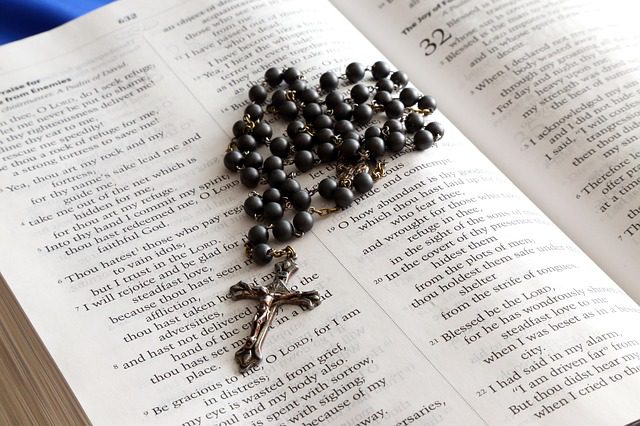
[public domain / Pixabay]
* * *
This is a chapter from my book, Biblical Catholic Apologetics (2013)
(7-22-10)
[all verses RSV]
* * * * *
Matthew 6:7 And in praying do not heap up empty phrases [KJV: “vain repetitions”] as the Gentiles [KJV: “heathen”] do; for they think that they will be heard for their many words.
Sirach 7:14 Do not prattle in the assembly of the elders, nor repeat yourself in your prayer.
But Jesus shows even in the immediate context that not all repetition in prayer whatsoever is precluded, because two verses later He instructs them how to pray by teaching them the Lord’s Prayer (the “Our Father”). Obviously, when He says, “Pray then like this,” He clearly doesn’t mean just one time. He means habitually — and indeed many church services (like the Mass) regularly pray the Lord’s Prayer: the most well-known Christian prayer of all.
The passage in Luke that contains the Our Father complements Matthew by making certain elements more clear. It shows us that Jesus is specifically teaching the disciples how to pray, by saying particular words. The phrase, “when you pray, say . . .” is almost like a formula for a regular practice of prayer. It’s also notable because here the prayer is not in the context of the Sermon on the Mount, as in Matthew, but on another occasion (yet more evidence of its repetitious nature):
Luke 11:1-4 He was praying in a certain place, and when he ceased, one of his disciples said to him, “Lord, teach us to pray, as John taught his disciples.” [2] And he said to them, “When you pray, say: “Father, hallowed be thy name. Thy kingdom come. [3] Give us each day our daily bread; [4] and forgive us our sins, for we ourselves forgive every one who is indebted to us; and lead us not into temptation.”
The intended repetition of the prayer is shown again by analogy in the same larger passage, with regard to the proper practice of fasting, where Jesus says, “when you fast, anoint your head and wash your face, that your fasting may not be seen by men but by your Father who is in secret; and your Father who sees in secret will reward you” (Matt 6:17-18a). This is obviously intended to be a regular practice as well: not a one-time thing.
Therefore, by direct analogy, if this practice regarding fasting is to be a regular habit, so also the Lord’s prayer is a regular habit, and so it is repetitious, but it is not an “empty phrase” or a “vain repetition.”
Protestants who argue that all formal prayer that repeats phrases (including, notably, the Rosary) are “empty” or “vain” in fact manage to overlook the entire deeper meaning and import of this biblical narrative, in context. Jesus is recommending and exhorting His hearers to a genuine, humble piety of the heart, as opposed to an empty, shell-like, merely external piety, intended to be seen by men in a spiritually prideful sense. It’s a classic case study of taking something completely out of context and absolutizing it, in gross violation of legitimate hermeneutical principles.
This theme of genuine vs. sham piety is seen throughout the first half of the chapter (part of the Sermon on the Mount):
Matthew 6:1-6, 16 “Beware of practicing your piety before men in order to be seen by them; for then you will have no reward from your Father who is in heaven. [2] “Thus, when you give alms, sound no trumpet before you, as the hypocrites do in the synagogues and in the streets, that they may be praised by men. Truly, I say to you, they have received their reward. [3] But when you give alms, do not let your left hand know what your right hand is doing, [4] so that your alms may be in secret; and your Father who sees in secret will reward you. [5] “And when you pray, you must not be like the hypocrites; for they love to stand and pray in the synagogues and at the street corners, that they may be seen by men. Truly, I say to you, they have received their reward. [6] But when you pray, go into your room and shut the door and pray to your Father who is in secret; and your Father who sees in secret will reward you. . . . [16] And when you fast, do not look dismal, like the hypocrites, for they disfigure their faces that their fasting may be seen by men. Truly, I say to you, they have received their reward.
The same general idea occurs again in Mark and Luke:
Mark 12:38-40 And in his teaching he said, “Beware of the scribes, who like to go about in long robes, and to have salutations in the market places [39] and the best seats in the synagogues and the places of honor at feasts, [40] who devour widows’ houses and for a pretense make long prayers. They will receive the greater condemnation.”
Luke 20:46-47 “Beware of the scribes, who like to go about in long robes, and love salutations in the market places and the best seats in the synagogues and the places of honor at feasts, [47] who devour widows’ houses and for a pretense make long prayers. They will receive the greater condemnation.”
It’s not that all long prayers are condemned, anymore than repetitious prayers are, but that prayers made with a pretentious, prideful spirit (showing off in front of men; making people think one is “super-pious”) are condemned.
Lastly, when Jesus states: “do not heap up empty phrases as the Gentiles do,” note that He is no longer talking about the Hebrew tradition of prayer (which quite obviously included much repetition, such as in the Psalms and priestly chants and prayers). He’s not even talking about the Pharisees, because they weren’t Gentiles. In other places (6:2, 5, and implied in context again in 6:16), He refers to practicing Jews, but now He mentions the Gentiles. Remember, this is before the Church was opened up to the Gentiles (after the day of Pentecost, after Jesus’ death) and spread beyond the Jews.
Therefore, Jesus was referring to people like the pagan Romans and Greeks, and other non-Jews; people who had a different religion altogether. Thus, the KJV, NKJV, NEB , and REB versions use the word “heathen,” and other translations (e.g., Phillips, TEV, Jerusalem, NIV) use the word “pagans” here.
It is not only a matter, then, of praying with “empty phrases” and “vain repetition” but also of praying “as the Gentiles / pagans / heathen do”: in other words, of praying like those who practice an ultimately false religion. That element and the aspect of interior piety take the passage to a far deeper place than merely a discussion of repetition: let alone all repetition, as if God is condemning that.
Jesus then illustrates that He Himself is not opposed to all repetition in prayer, by the example of His own practice:
Matthew 26:39, 42, 44 And going a little farther he fell on his face and prayed, “My Father, if it be possible, let this cup pass from me; nevertheless, not as I will, but as thou wilt.” . . . [42] Again, for the second time, he went away and prayed, “My Father, if this cannot pass unless I drink it, thy will be done.” . . . [44] So, leaving them again, he went away and prayed for the third time, saying the same words.
Mark 14:39 And again he went away and prayed, saying the same words.
The following passage suggests to me (though I wouldn’t make too much of it as an exegetical argument) formal, liturgical (hence, repetitious) prayers, by the phraseology “the prayers” rather than simply “prayer” (as in Acts 6:4) or “praying”:
Acts 2:42 And they devoted themselves to the apostles’ teaching and fellowship, to the breaking of bread and the prayers. (cf. Acts 3:1: “. . . going up to the temple at the hour of prayer, the ninth hour,” which may be related).
Moreover, further repetition occurs in repeated intercession for the same person or persons. For example:
Ephesians 1:16 I do not cease to give thanks for you, remembering you in my prayers,
Colossians 1:9 And so, from the day we heard of it, we have not ceased to pray for you, asking that you may be filled with the knowledge of his will in all spiritual wisdom and understanding,
Colossians 4:12 Ep’aphras, who is one of yourselves, a servant of Christ Jesus, greets you, always remembering you earnestly in his prayers, . . .
1 Thessalonians 1:2 We give thanks to God always for you all, constantly mentioning you in our prayers,
2 Thessalonians 1:11 To this end we always pray for you, that our God may make you worthy of his call, and may fulfil every good resolve and work of faith by his power,
2 Timothy 1:3 I thank God whom I serve with a clear conscience, as did my fathers, when I remember you constantly in my prayers.
Here are examples of relentlessly repeated prayer requests:
Luke 18:1-7 And he told them a parable, to the effect that they ought always to pray and not lose heart. [2] He said, “In a certain city there was a judge who neither feared God nor regarded man; [3] and there was a widow in that city who kept coming to him and saying, `Vindicate me against my adversary.’ [4] For a while he refused; but afterward he said to himself, `Though I neither fear God nor regard man, [5] yet because this widow bothers me, I will vindicate her, or she will wear me out by her continual coming.'” [6] And the Lord said, “Hear what the unrighteous judge says. [7] And will not God vindicate his elect, who cry to him day and night? Will he delay long over them?
(cf. Lk 2:37: “She did not depart from the temple, worshiping with fasting and prayer night and day”; also 1 Tim 5:5: “continues in supplications and prayers night and day“)
1 Thessalonians 3:10 praying earnestly night and day that we may see you face to face and supply what is lacking in your faith?
Two further examples from the Old Testament perhaps indicate (it’s not absolutely clear, I grant) a single prayer being used repeatedly in one instance of praying:
Nehemiah 1:4-6 When I heard these words I sat down and wept, and mourned for days; and I continued fasting and praying before the God of heaven. [5] And I said, “O LORD God of heaven, the great and terrible God who keeps covenant and steadfast love with those who love him and keep his commandments; [6] let thy ear be attentive, and thy eyes open, to hear the prayer [singular] of thy servant which I now pray before thee day and night for the people of Israel thy servants, confessing the sins of the people of Israel, which we have sinned against thee. Yea, I and my father’s house have sinned.
Psalm 141:5 . . . my prayer [singular] is continually against their wicked deeds.
* * *
Previous Post
November 12, 2015
Dialogues with Lutherans Regarding Three Luther Mary Quotes
Next Post
November 13, 2015 Does the Invocation of Mary at Death Ignore Jesus?
Browse Our Archives
Select a Category & Last Things About Me Anti-Catholicism Atheism & Agnosticism Baptism and Sacramentalism Bible and Tradition Blessed Virgin Mary Books by Dave Armstrong C. S. Lewis Calvinism & General Protestantism Catholic Apologetics Catholic Apologists Catholic conversion Catholic converts Christmas Church (Ecclesiology) Church History Conversion and Converts Development of Doctrine Eastern Orthodoxy Ecumenism & Christian Unity Eucharist & Liturgy Fathers of the Church French Translations G. K. Chesterton Hell Hell & Satan Hell & Satan & Last Things Heresies & Comparative Religion Holistic Health Inquisition & Crusades & Scandals James White Jews & Judaism & Old Testament John Calvin John Henry Newman Liberal / Modernist Theology Life Issues Literary Resume Lutheranism Mariology Martin Luther Music Orthodoxy Papacy & Infallibility Personal Page Philosophy & Science Political & Ethical & Moral Issues Protestant Persecution & Intolerance Protestantism Purgatory Purgatory & Penance Romantic & Imaginative Theology Saints & Purgatory & Penance Salvation Salvation & Justification Satan & Last Things Sexuality and Gender Issues Spanish Translations Traditionalism vs. Radical Catholic Reactionaries Traducciones al español / tradução para português Trinitarianism & Christology Uncategorized Videos
Select a Month October 2026 September 2026 August 2026 July 2026 June 2026 May 2026 April 2026 March 2026 February 2026 January 2026 December 2025 November 2025 October 2025 September 2025 August 2025 July 2025 June 2025 May 2025 April 2025 March 2025 February 2025 January 2025 December 2024 November 2024 October 2024 September 2024 August 2024 July 2024 June 2024 May 2024 April 2024 March 2024 February 2024 January 2024 December 2023 November 2023 October 2023 September 2023 August 2023 July 2023 June 2023 May 2023 April 2023 March 2023 February 2023 January 2023 December 2022 November 2022 October 2022 September 2022 August 2022 July 2022 June 2022 May 2022 April 2022 March 2022 February 2022 January 2022 December 2021 November 2021 October 2021 September 2021 August 2021 July 2021 June 2021 May 2021 April 2021 March 2021 February 2021 January 2021 December 2020 November 2020 October 2020 September 2020 August 2020 July 2020 June 2020 May 2020 April 2020 March 2020 February 2020 January 2020 December 2019 November 2019 October 2019 September 2019 August 2019 July 2019 June 2019 May 2019 April 2019 March 2019 February 2019 January 2019 December 2018 November 2018 October 2018 September 2018 August 2018 July 2018 June 2018 May 2018 April 2018 March 2018 February 2018 January 2018 December 2017 November 2017 October 2017 September 2017 August 2017 July 2017 June 2017 May 2017 April 2017 March 2017 February 2017 January 2017 December 2016 November 2016 October 2016 September 2016 August 2016 July 2016 June 2016 May 2016 April 2016 March 2016 February 2016 January 2016 December 2015 November 2015 October 2015 September 2015 August 2015 July 2015 June 2015 May 2015 April 2015 March 2015 February 2015 January 2015 December 2014 November 2014 October 2014 September 2014 August 2014 July 2014 June 2014 April 2014 March 2014 February 2014 January 2014 December 2013 November 2013 October 2013 September 2013 August 2013 July 2013 June 2013 April 2013 March 2013 February 2013 January 2013 December 2012 November 2012 October 2012 September 2012 August 2012 July 2012 June 2012 May 2012 April 2012 March 2012 February 2012 January 2012 December 2011 November 2011 October 2011 September 2011 August 2011 July 2011 June 2011 April 2011 March 2011 February 2011 October 2010 September 2010 August 2010 July 2010 April 2010 March 2010 December 2009 October 2009 August 2009 July 2009 June 2009 May 2009 March 2009 February 2009 October 2008 September 2008 April 2008 March 2008 February 2008 January 2008 December 2007 November 2007 October 2007 May 2007 March 2007 February 2007 January 2007 November 2006 October 2006 September 2006 August 2006 July 2006 June 2006 May 2006 April 2006 March 2006 February 2006 October 2005 June 2005 April 2005 February 2005 July 2004 May 2004 April 2004
Follow Us!
TAKE THE
Religious Wisdom Quiz
Who fell out of a window and was restored to life by Paul?
Select your answer to see how you score.
Silas Barnabas Eutychus Timothy
Books by This Author Books by Dave Armstrong
Related posts from Biblical Evidence for Catholicism

Holy Ground: Why Mary Had NO Other Children...
Biblical Evidence for Catholicism
Protestant Confessions & "Ever-Virgin" Mary
Biblical Evidence for Catholicism

Mary Wife of Clopas (Jn 19:25): Mary's Sister-in-Law?
Biblical Evidence for Catholicism

Jesus Had Four Brothers? The Bible Sez No!
Biblical Evidence for Catholicism
TRENDING AT PATHEOS Catholic

In "Irreplaceable," our book on vocation and technology, Trevor Sutton and I...

I was strolling through the top floor of the brand new Parthenon...

What Does Gêvâh Mean For Kimberley Guifoyle &...
This week, a lot of the news is focused on Kimberly Guilfoyle....

INNER CIRCLE: Profound Mystery (Of Christ In All...
Ephesians 5:31-32 “For this reason, a man will leave his father and...

Do Not Rejoice When Your Enemy Falls: The...
Turning an execution into a public spectacle is a disturbing expression of...

'The Chosen' S6 Trailer: The Passion Gets Very...
Not many watching 'The Chosen' worry about spoilers, but just because they...
view all Catholic blogs
Ad-Free & Subscriber Log-In Subscription Support
- About Us
- 2026 Calendar
- Videos
- Podcasts
- Library of World Religions
- Faith In Media Tracker
- Advertise With Us
- Write for Us
- Privacy Policy
- Terms of Service
- Do Not Sell My Data
- Contact Us
- Radiant Digital
- Manage Newsletter Subscriptions
- Unsubscribe From Notifications
- Sitemap
Copyright 2008-2026, Patheos. All rights reserved.
Subscription Support Ad-Free & Subscriber Log-In
Follow Patheos