
BuddhistCatholicContemplativeEvangelicalGeneral ChristianHinduJewishLatter-day SaintMuslimNew VisionsProgressive Christian
Beliefs
- Buddhist
- Catholic
- Contemplative
- Evangelical
- General Christian
- Hindu
- Jewish
- Latter-day Saint
- More Voices
- Muslim
- New Visions
- Pagan
- Progressive Christian
Topics
- Religion News
- Food and Religion
- Sports and Religion
- Religious Art
- Religious Music and Entertainment
- Religious Events
- History and Religion
- Style and Religion
- Politics and Religion
- Women in Religion
- Recreation Outdoors and Religion
- Business Finance and Religion
- Careers Workplace and Religion
- Education and Religion
- Family Parenting and Religion
- Health Fitness and Religion
- Home and Religion
- Relationships and Religion
- Technology and Religion
- Travel and Religion
Columnists
- Buddhist Columnists
- Business Finance and Religion Columnists
- Careers Workplace and Religion Columnists
- Catholic Columnists
- Contemplative Columnists
- Education and Religion Columnists
- Evangelists Columnists
- Family Parenting and Religion Columnists
- General Christian Columnists
- Health Fitness and Religion Columnists
- Hindu Columnists
- History and Religion Columnists
- Home and Religion Columnists
- Jewish Columnists
- More Voices Columnists
- Latter Day Columnists
- Muslim Columnists
- New Visions Columnists
- Nonreligious Columnists
- Pagan Columnists
- Politics and Religion Columnists
- Progressive Columnists
- Recreation Outdoors and Religion Columnists
- Relationships and Religion Columnists
- Religion News Columnists
- Religious Art Columnists
- Religious Events Columnists
- Religious Music and Entertainment Columnists
- Sports and Religion Columnists
- Style and Religion Columnists
- Technology and Religion Columnists
- Travel and Religion Columnists
- Women in Religion Columnists
Resource Library
- 2026 Calendar
- Library of World Religions
- The 100 Most Holy Places on Earth
- Patheos Answers
- Podcasts
- Videos
- Faith Leaders Database
- Anglican Episcopalian
- Bahai
- Baptist
- Buddhism
- Christianity
- Confucianism
- Eastern Orthodoxy
- Hinduism
- Holiness and Pentecostal
- ISKCON
- Islam
- Judaism
- Lutheran
- Methodist
- The Church of Jesus Christ of Latter-day Saints
- New Age
- Paganism
- Presbytarian and Reformed
- Protestantism
- Religion Behind the Scenes
- Roman Catholic
- Scientology
- Shia Islam
- Sikhism
- Sufism
- Sunni Islam
- Taoism
- Zen
- See all religions
Research Tools
 Ad-Free & Subscriber Log-In Subscription Support
Ad-Free & Subscriber Log-In Subscription Support
Follow Patheos 

- Trending:
- Forgiveness
- |
- Marriage
- |
- Consciousness
- |
- Death Penalty
- |
- Election
- |
- Halloween

-
About
-
Catholic Apologetics
-
Church History
-
Great Apologists
-
Christian Worldview
-
Protestantism & Misc.
- Home
- Catholic
- History and Religion
- Reply to Lutheran Gene Edward Veith on Mariology
Reply to Lutheran Gene Edward Veith on Mariology
Last updated on: June 6, 2026 at 12:28 am by Dave Armstrong
Reply to Lutheran Gene Edward Veith on Mariology 2026-06-06T00:28:52-04:00 Dave Armstrong
Patheos Explore the world's faith through different perspectives on religion and spirituality! Patheos has the views of the prevalent religions and spiritualities of the world.
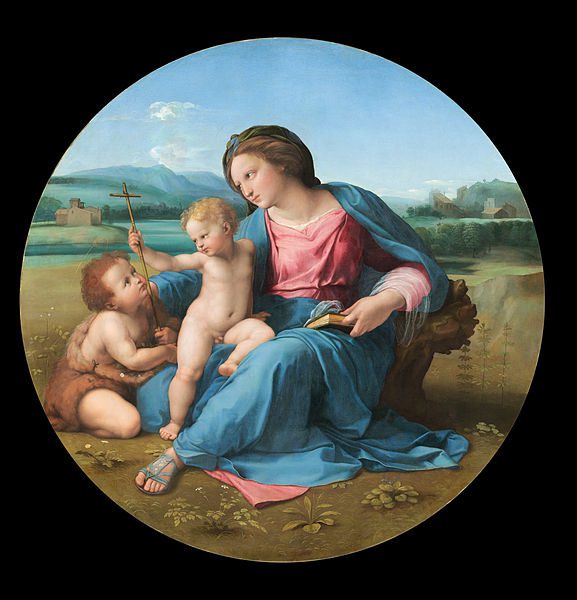
The Alba Madonna (c. 1510), by Raphael (1483-1520) [public domain / Wikimedia Commons]

(10-7-11)
This exchange occurred at Cranach: The Blog of Veith: a Lutheran site, in the combox for the post “Mariology.” I replied to the entire initial post by webmaster Gene Edward Veith, who is the Provost and Professor of Literature at Patrick Henry College, the Director of the Cranach Institute at Concordia Theological Seminary, a columnist for World Magazine and TableTalk, and the author of 18 books on different facets of Christianity and Culture. I reproduce his entire article and reply to each point in turn. His words will be in blue. I appreciate his hospitality in letting me speak freely on his site, and offer a different perspective.
* * * * *
The recent post on “The Pope on Luther” led to a discussion of Luther’s views of Mary, in which noted Catholic apologist Dave Armstrong weighed in. (I am continually amazed at who all reads this blog.) He cited evidence that Luther had a relatively “Catholic” view of Mary early in his career, though after the Diet of Worms, in 1521. (The source of that evidence was somewhat confused, though, which the discussion helped to sort out.)
Till his death, too, in many ways. As far as I know, he (along with virtually all early Protestant leaders) never ceased believing in Mary’s perpetual virginity, or the propriety of calling her Mother of God (Theotokos or Mater Dei). He held even later in life a modified version of what Catholics believe in the Immaculate Conception: that Mary was purged of original sin and was sinless at the birth of Christ and after. I have called this view, “Immaculate Purification.” It is like ours insofar as she was freed from original sin by God’s grace at some point; different in that it was not at her conception. The early Luther (as late as 1527 for sure and possibly later) even believed the latter.
I don’t think he ever denied that Mary’s Assumption was a perfectly permissible belief, either, though never required in his circles. All of that is far more “Marian” than (I’d venture to guess) maybe 95% of Lutherans today. A lot closer in spirit to us than to y’all, I dare say . . .
One of the issues was the “immaculate conception,” the Roman Catholic teaching that by a direct miracle of God the Virgin Mary was born without original sin.
Well, conceived without original sin, to be precise. Hence the use of “conception.”
This is an interesting example of the Roman Catholic theological method, as distinct from how virtually all Protestants “do” theology. The teaching is not arbitrary dogma, or the exaltation of tradition, or an extension of Mary-worship, or “popish superstition.”
Fair and ecumenical statement. Thanks!
Rather, it is a logical conclusion based on reason, as practiced by scholastic theology.
It involves reason, yes (as virtually all theology that I know of, does), but not without biblical argumentation.
The chain of reasoning goes like this: In order to redeem the world, Jesus Christ had to be without sin.
He couldn’t have ever sinned, being God, and (even in His human nature) because of the Hypostatic Union. He was impeccable.
He certainly lived a sinless life. But he also needed to be without original sin as inherited from Adam.
He couldn’t possibly have had original sin, either, since that was from the fall and rebellion of created human beings, of whom He was not one.
Jesus took His human nature from being born of the Virgin Mary, not having a human father. Somehow, though, He could not have inherited Adam’s fallen nature, with its inherent sinfulness, its genetic (we would say) disposition to sin, the accompanying curses of the Fall. Therefore, the mother of Jesus must not bear that fallen nature.
This is not Catholic reasoning (with all due respect). Theologian Ludwig Ott explains, in Fundamentals of Catholic Dogma:
As original sin is propagated by natural generation, and since Christ entered life in a supernatural manner through conception by the Holy Ghost (Mt. 1:18 et seq.; Luke 1:26 et seq.) it follows that He was not subject to the general law of original sin.
The Fathers and the theologians infer Christ’s freedom fro original sin from the Hypostatic Union, which being a most intimate connection with God, excludes the condition of separation from God implied by original sin. (p. 168)
This being the case, Mary’s state vis-a-vis original sin was irrelevant insofar as Jesus Christ was concerned. She didn’t have to necessarily be conceived immaculately, either for His sake or her own, as the Mother of God. Catholics believe that God performed this miracle because it was “fitting” or “appropriate”. Hence, if one reads the dogmatic proclamation of 1854 (Ineffabilis Deus), there is no trace of language about the Immaculate Conception being any kind of necessity in order for Christ to be sinless.
Mary’s being immaculate had more to do with the analogy to Eve. Mary was the second Eve, who said yes to God rather than no. She was restored to the state that an unfallen Eve would have remained in. Hence the fathers had a prominent motif of “second Eve” or “the new Eve.” The immaculate Eve rebelled against God and fell. The immaculate Mary said yes to God at the Annunciation and thus helped bring about the incarnation, leading to Christ’s atonement and redemption: that reversed the curse of the fall.
That Mary did not have original sin means that she also did not suffer under the curse of the Fall. This explains the tradition that she did not feel the pains of labor.
That doesn’t follow, either. Jesus Christ certainly suffered bodily, and He was without original or actual sin, and not fallen. He suffered in many ways before His passion; for example, in the Garden of Gethsemane, His betrayal by Judas, His lamenting over the sinfulness of Jerusalem; weeping over the dead Lazarus, even though He was about to raise Him, being misunderstood by Pharisees and scribes, etc.
Mary’s not having pains in childbirth isn’t due to that, but because it was an entirely miraculous childbirth and in accord with all the physical aspects of perpetual virginity (non-violation of the hymen in any fashion whatever). In other words, it followed from the nature of the Virgin Birth.
It also explains the bookend Catholic dogma the Assumption of the Virgin Mary. If she did not have original sin, she could not die, so must have been taken up bodily into Heaven.
There is that connection, yes. But again, Jesus lacked original sin, and was God, and He died. Most Catholics believe that Mary also died, by analogy to Jesus. But it is not required belief. She may have died; maybe not. I personally believe she did, because the analogy makes perfect sense to me, and she always sought to be like her Son. The dogmatic declaration in 1950 doesn’t say whether she died. It says, “the ever Virgin Mary, having completed the course of her earthly life, was assumed body and soul into heavenly glory”.
Nor would an Assumption to heaven (to be technical, but accurate, I think) necessarily follow from the absence of original sin, since if human beings hadn’t fallen, the result would have been immortality (no death), rather than Assumption.
The Assumption signified Mary being the first or among the first human beings to receive her resurrection body, due to the finished work of her Son Jesus on the cross. What better or more appropriate person to obtain that honor?
These notions sound strange to Protestant ears, but they grow out of the Roman Catholic approach to theology, which supports and extends revealed truth with flying buttresses of reason.
This is a better description because it is saying that we are utilizing the Bible also in our theological thinking. All Christian traditions apply reason to theology, or else they don’t do theology, period. They would have to sit on a mountaintop and ponder their belly button or become a Quaker, with his “inner light” — if not. We’re no different from anyone else in that fundamental sense. It’s only relative: how much reason is applied or valued in the overall scheme of things.
So you guys say we place it too high; we say you place it too low. Fundamentalist types place it way lower than you do. I happen to like reason, myself. I think it’s pretty cool. The Bible says that Paul reasoned and argued with Jews and Greeks alike. Jesus did it. Paul does it all through his letters. Melanchthon and Chemnitz and all the other great Lutheran theologians did. Even Luther occasionally lapsed and descended into reason (joke, folks!). We’re called to love God with our minds, etc. Reason cannot be separated.
Now one might believe these things of Mary without seeing her as a mediatrix between human beings and Christ, without praying to her, and without seeing her as a co-redemptrix.
That’s right. People manage to believe all kinds of things., in various and sundry combinations: consistently and inconsistently in varying degrees.
One could believe Mary was free of original sin and that she was received bodily into Heaven while still being evangelical, as Luther evidently did in 1521.
Yep. Heinrich Bullinger made a very explicit statement of belief in the Assumption, and he was Reformed.
But the Protestant theological method, which derived from Luther, uses not reason as the primary authority but the Word of God, which is held to be the only authority in theological issues.
The only infallible authority, according to classic sola Scriptura rule of faith . . . It is the authority for us, too, but we don’t pit it against authoritative tradition or Church, because the Bible itself doesn’t do that and upholds those things, too. Therefore, to do so would be to not accept scriptural authority in its fullness and widest scope.
The Bible does not mention any of this about Mary, which is presumably would, if, as Rome claims, the Immaculate Conception and the Assumption are fundamental and necessary dogmas of the Christian faith.
We contend that all Catholic doctrines (including even the dreaded Marian ones) are present in Scripture, explicitly, implicitly, or clearly able to be deduced from either sort of evidence (material sufficiency).
There are different levels of such evidence. The Virgin Birth has but a few support passages. Original sin also has only a few. Yet both are firmly believed by Christians of all stripes. Original sin isn’t even mentioned in the Nicene Creed, and Cardinal Newman noted that there was far more support for purgatory in the fathers than for original sin.
Other things have to be (mostly or largely) deduced. Under this category would come things like the Two Natures of Christ. It’s in Scripture, assuredly, but has to be “teased” out of it by an examination of many passages together. Even the Holy Trinity is mostly of that nature. I have papers giving many hundreds of biblical proofs for the Trinity, but they are not always evident at first glance. As a result, Christology developed in the early Church for about 600 years: with orthodoxy having to deal with (and condemn) Arianism, Gnosticism, Sabellianism (or modal monarchianism), Monophysitism, Nestorianism, and Monotheletism, each in turn.
Other things are totally absent in Scripture, yet believed by Protestants, who claim to be “Scripture Alone” (as infallible authority). The canon of the Bible is the best and most undeniable example of that. Protestants are forced to accept a “fallible list of infallible books” — as R. C. Sproul has candidly admitted. And they have to rely on the (Catholic) Church authority that proclaimed the canon (minus the deuterocanon). Sola Scriptura is another. It’s found nowhere in Scripture.
I just finished a book about this: 100 Biblical Arguments Against Sola Scriptura (and it is to be published by Catholic Answers, so it’s not merely self-published). Nowhere does it say in Holy Scripture that the Bible only is the infallible guide and rule of faith, to the exclusion of an infallible Church or infallible apostolic tradition (which is precisely what the Protestant contention is). And the Bible contradicts it all over the place. But that doesn’t stop Protestants from believing it and basing their entire system of authority and method of theology on it: castles made of sand, like the old Jimi Hendrix song . . .
Denominations are nowhere found in the New Testament, which everywhere refers to one Church with one solid set of beliefs, that are non-negotiable. This is beyond all dispute. Many Protestant thinkers readily concede this, and lament it. Yet all Protestants live with the tension of the very existence of denominations being dead-set against what the Bible teaches about ecclesiastical authority and belief-systems of theological truth. Doesn’t stop ‘em . . . There is no choice. Sola Scriptura and the enshrinement of a circular private judgment made all that inevitable, and there is no way to eliminate it by Protestant principles, which are severely flawed from the outset, and far too unbiblical.
Now, all that was my roundabout way of addressing the criticism that our Marian doctrines are supposedly not “in” the Bible. They certainly are: just not (usually) explicitly, or sometimes (as in the Assumption) not implicitly, either, and able only to be deduced from other things. But this shouldn’t pose any problem for the Protestant (unless we adopt double standards) because, as I’ve shown, they believe many things that are only infrequently indicated in the Bible or not at all. Neither the canon issue nor the denominational scandal ever seem to cause any Protestants to reject their own system.
So that is one reply: we reject the double standard whereby you guys believe all that (and other things, too) with small or no biblical support, while at the same time demanding hyper-biblical-support for every one of our doctrines, as if we don’t have it and you do for absolutely everything you believe and even make a “pillar” of your system.
The second answer is that explicit support is not required anyway, because the Bible never teaches that: that every doctrine must be explicitly indicated in the Bible and nowhere else. If we are fully “biblical” that notion is completely absent. So why follow it? Well, because it is an entrenched, arbitrary tradition of man, is what it amounts to.
That said, I contend that there is more than enough biblical support for every Marian doctrine, so that no one can accuse any of it of being “unbiblical” or “extrabiblical” or contradictory to what is in the Bible. I will demonstrate this as I proceed, because I have made biblical arguments for all of it. And I think they are pretty solid and can withstand scrutiny.
I (and other Catholics) have made four distinct biblical arguments for the Immaculate Conception (or at least fundamental aspects of it). The first launches off of Luke 1:28: “full of grace” or (less literally) “highly favored” (kecharitomene in Greek) and the implications of that in light of the fact that the Bible (esp. Paul) makes grace directly the antithesis and “overcomer” of sin. This argument supports Mary’s sinlessness, but not (directly or explicitly) her Immaculate Conception, which takes it a step further, and involved theological reasoning and speculation. Actual sinlessness is a key part of the belief, but not the entirety of it. Here are my papers where I delve into this biblical argument:
A Straightforward Biblical Argument For the Sinlessness of Mary
Luke 1:28 (Full of Grace) and the Immaculate Conception: Linguistic and Exegetical Considerations
The second is an analogical and “plausibility” argument that is less strong but still worthy of serious consideration, I submit. This one shows that God has specifically graced or blessed certain of his saints and servants from conception or from the womb. This is only in my book about Mary, so I’ll summarize it:
Neither the notion nor the fact of a sinless created being is impossible. The angels (excepting the fallen ones, or demons) are sinless and always have been. They never sinned. They never rebelled against God. They’re creatures as we are, with a free will to sin or not sin. Adam and Eve were originally sinless and could have remained so had they not rebelled against God’s commands.
We contend that the Immaculate Conception is a completely plausible act of God, and most fitting and proper and should not be at all “surprising,” in light of several analogous variables in Scripture.
Another biblical argument can be made from the “proximity to God”: in other words, “the closer one gets to God, the more holy one must be.” I developed this at some length in my first book, A Biblical Defense of Catholicism (pp. 178-185). The presence of God imparts holiness (Deuteronomy 7:6; 26:19; Jeremiah 2:3). The temple site was sacred and holy (Isaiah 11:9; 56:7; 64:10), and the Holy of Holies where God was specially present above the ark of the covenant (Exodus 25:22), was the holiest place of all within the temple. When we are ultimately with God in heaven, sin is abolished once and for all (1 John 3:3-9; Revelation 14:5; 21:27).
Now, the challenge at this point is to show how and why one would posit the Immaculate Conception, based on the biblical data alone. Is it possible to do that? Can some semblance of an argument be made from the Bible: if not directly (as we grant), at least from analogy, plausibility, and indirect deduction? I think so.
It’s fairly easy to find examples of holy people who have been sanctified or made righteous from the womb, and even (in terms of God’s foreordination or predestination) from before they were ever conceived. The Bible does refer to holiness being imparted even before birth; indeed, even before conception. Samson was one such person (Jud 16:17). So were Isaiah and Job:
Isaiah 49:1, 5 (RSV) . . . The LORD called me from the womb, . . . [5] And now the LORD says, who formed me from the womb to be his servant, to bring Jacob back to him, and that Israel might be gathered to him, for I am honored in the eyes of the LORD, and my God has become my strength –
Job 31:15, 18 Did not he who made me in the womb make him? And did not one fashion us in the womb? . . . (for from his youth I reared him as a father, and from his mother’s womb I guided him);
We also observe in Sacred Scripture that God has plans for His servants from even before they were conceived (God being out of time in the first place): e.g., Psalm 139:13-16. Thus, the idea that a person is somehow spiritually formed and molded by God and called from the very time of their conception (and before) is an explicit biblical concept. But we can produce even more than that: having to do also with holiness. The prophet Jeremiah reported the Lord’s revelation to him:
Jeremiah 1:5 “Before I formed you in the womb I knew you, and before you were born I consecrated you; I appointed you a prophet to the nations.” (KJV: “sanctified thee”)
“Consecrated” or “sanctified” in Jeremiah 1:5 is the Hebrew word quadash (Strong’s word #6942). According to Gesenius’ Hebrew-Chaldee Lexicon of the Old Testament (Grand Rapids, Michigan: Baker Book House, 1979 reprint, p. 725), in this instance it meant “to declare any one holy.”
Jeremiah was thus consecrated or sanctified from the womb; possibly from conception (the text is somewhat vague as to the exact time). This is fairly analogous to the doctrine of the Immaculate Conception. It approximates it. We know Jeremiah was a very holy man. Was he sinless, though? Perhaps he was. I don’t recall reading accounts of Jeremiah sinning. The retort at this point might be that there is a lack of such a notion in the New Testament. But that’s not true. We have the example of John the Baptist:
Luke 1:15 for he will be great before the Lord, and he shall drink no wine nor strong drink, and he will be filled with the Holy Spirit, even from his mother’s womb.
Luke 1:41, 44 And when Elizabeth heard the greeting of Mary, the babe leaped in her womb; and Elizabeth was filled with the Holy Spirit. . . For behold, when the voice of your greeting came to my ears, the babe in my womb leaped for joy.
We know that John the Baptist was also a very holy man. Was he sinless? We can’t know that for sure from the biblical data. I don’t recall any mention of a sin from John the Baptist, in Scripture. Lastly, St. Paul refers to being called before he was born:
Galatians 1:15 . . . he who had set me apart before I was born, and had called me through his grace,
Therefore, by analogy and plausibility, based on many biblical cross-references, we can and may conclude that it is “biblical” and reasonable to believe in faith that Mary was immaculately conceived. Nothing in the Bible contradicts this belief. And there is much that suggests various elements of it, as we have seen. It does require faith, of course, but based on the biblical data alone it is not an unreasonable or “unbiblical” belief at all.
If God calls and predestines people for a specific purpose from all eternity, from before they were ever born, as David states and as Jeremiah strongly implies, then what inherent difficulty is there in His sanctifying a very important person in salvation history, centrally involved in the Incarnation, from conception?
The possibility simply can’t be ruled out. And if God can call Jeremiah and John the Baptist from the womb and (possibly) from conception, why not Mary as well? The one case is no less plausible than the other, and so we believe it, by analogy.
It’s not foreign to biblical thinking, and makes perfect sense. According to the Catholic Church, God restored to Mary the innocence of Eve before the Fall, and filled her with grace, in order to prepare her for her unspeakably sublime, sanctified task as the Mother of God the Son. Why should He not do so?
The third biblical argument is the answer to the objection of the passage “all have sinned . . .” This is simply a matter of the nature of biblical language, and is easily disposed of:
“All Have Sinned . . . ” (Mary?)
The fourth is the patristic and biblical analogy of Mary and the ark of the covenant, based on several parallels (typology):
Biblical Evidence for the Patristic Analogy of Mary as the Ark of the (New) Covenant
I gave a concise biblical argument for Mary’s Assumption in my book, The One-Minute Apologist (pp. 114-115). Here is the bulk of it:
Adam and Eve were created without sin. They never had to sin, but they chose to rebel against God’s commands and authority, so consequently the human race fell and all human beings are ordinarily subject to death and decay as a result. (Gen.3:19; Ps.16:10) Mary, on the other had, was given the great gift of being conceived without the taint of Adam and Eve’s sin, so that she never committed actual sin. She received this gift because she was to be the mother of the Second Person of the Trinity, and God thought it was fitting to prepare a pure and unspoiled vessel for Him. Her condition represented what all human beings could and would have been, and what saved persons one day will be: without sin.
Since she was without sin, and thus didn’t have to die or undergo the decay of death, at the time of God’s choosing she was assumed bodily into heaven (which is different from ascending to heaven under one’s own power, as Jesus did). Jesus’ Resurrection made possible the eventual bodily resurrection of all of his followers, (1 Cor.15:13–16 ) and Mary was the first to enjoy the reward made available to all who would believe in Him. After all, what is more appropriate than that Jesus’ own mother should be blessed in such a way? She brought Him into this world, and so He brought her in a special way into the next world, body and soul. She represents the coming of the Kingdom, including new bodies and the end of death and sin. (1 Cor.15:26)
The early biblical figure Enoch was a particularly righteous man. It is written that he “walked with God” and that “he was not, for God took him.” (Gen.5:24) This description is somewhat mysterious, but New Testament revelation further explains it:
Hebrews 11:5: “By faith Enoch was taken up so that he should not see death; and he was not found, because God had taken him. Now before he was taken he was attested as having pleased God.”
Nor is this the only such instance. The Apostle Paul writes about being “caught up to the third heaven” before he died, (2 Cor.12:2–4) possibly bodily (“whether in the body or out of the body I do not know”). In 1 Thessalonians 4:15–17, Paul teaches that those who are alive when Jesus comes again to earth, will (apparently) not experience death: “We who are alive, who are left, shall be caught up together with them in the clouds to meet the Lord in the air; and so we shall always be with the Lord.”
Of course, the most extraordinary biblical example of an “entrance into the next life” is that of the great prophet Elijah:
2 Kings 2:11: “And as they still went on and talked, behold, a chariot of fire and horses of fire separated the two of them. And Eli’jah went up by a whirlwind into heaven.”
Protestant leader Heinrich Bullinger wrote the following extraordinary devotional statement:
Elijah was transported body and soul in a chariot of fire; he was not buried in any Church bearing his name, but mounted up to heaven, so that…we might know what immortality and recompense God prepares for his faithful prophets and for his most outstanding and incomparable creatures…It is for this reason, we believe, that the pure and immaculate embodiment of the Mother of God, the Virgin Mary, the Temple of the Holy Spirit, that is to say her saintly body, was carried up to heaven by the angels.
Even Mary as Mediatrix is easily supported by strong and repeated biblical analogy of God using vessels to distribute his grace and salvation (Paul talks about this a lot). I collect a host of such passages in my book, Bible Proofs for Catholic Truths: Rom 11:13-14 “thus save some of them,” 1 Cor 7:16 “you will save your husband . . . save your wife,” 1 Cor 9:22 “that I might by all means save some,” 2 Cor 1:6 “If we are afflicted, it is for your comfort and salvation,” Eph 3:2 “the stewardship of God’s grace that was given to me for you,” Eph 4:29 “that it may impart grace to those who hear,” 1 Tim 4:16 “you will save both yourself and your hearers,” 2 Tim 2:10 “I endure everything for the sake of the elect, that they also may obtain salvation,” Jas 5:20 “whoever brings back a sinner from the error of his way will save his soul from death,” 1 Peter 4:8-10 “As each has received a gift, employ it for one another, as good stewards of God’s varied grace.”
God uses His creatures to spread His grace and salvation. We simply extend that to Mary being involved in all the grace, as God’s chosen vessel.
Indeed, in the Magnificat, Mary’s song in Luke 1:46-55, the Mother of our Lord praises God as her “savior,” which implies that she too is in need of salvation.
Of course she is. God simply saved her by prevention rather than rescuing. By giving her the grace of the Immaculate Conception, before she knew anything (pure grace: all God), He saved her. She had to be saved from original sin like anyone else. This is the whole point of the grace! The Immaculate Conception presupposes it! So she can call God her savior. Whoever thinks Catholics believe any human being since the fall didn’t need a savior, and purely by grace, simply doesn’t understand Catholic theology, and must not have read Trent on justification, for starters.
And she certainly suffered, which Eve in her pre-fallen state did not, as Simeon prophesied to her: “And a sword will pierce through your own soul also” (Luke 2:35).
This proves nothing as to her being sinless or not, because Jesus suffered in Gethsemane and on the cross, and often in His life, in the non-physical fashion. He was sinless; He was God. If He can suffer, so can Mary or anyone else, and still be without sin.
Remember, Adam and Eve were in a “pre-fallen” world in Eden when they didn’t yet have to suffer. Mary, though brought back to the original sinless state, pre-fall, still exists in a fallen world, so the analogy there doesn’t hold. Jesus suffers for the same reason: because sin exists and causes suffering. It doesn’t follow that either Jesus or Mary had to partake of the sin themselves in order to suffer.
Further, we could argue that Christ’s incarnation and His redemptive work requires that He take upon Himself our fallen nature. He never sinned even though He shared our fallen flesh.
No we cannot say that. It is an impossible scenario. God cannot have a “fallen human nature” by definition, because that comes from the rebellion of the whole (created) human race against God; so that by so doing, He would be a hopelessly divided soul. How can God rebel against Himself? This is pure Nestorianism, and arguably (though I do not assert it myself) blasphemy.
Thus he became the Second Adam who freed us from the curse. (I know talking about the two natures of Christ can easily get heretical. Someone correct me if I’m wrong, and if I am, I recant.)
I think I just did. This particular notion is thoroughly opposed to Chalcedonian Christological orthodoxy.
The early Luther thought that Jesus went into the literal hell of fire (not just Hades) and was tormented there, but as far as I know, such blasphemy didn’t enter into the Lutheran Confessions. Maybe I’m wrong about that.
***
Previous Post

November 12, 2015
25 Brief Arguments on the Biblical Canon & Protestantism
Next Post
November 12, 2015 Dialogues with Lutherans Regarding Three Luther Mary Quotes
Browse Our Archives
Select a Category & Last Things About Me Anti-Catholicism Atheism & Agnosticism Baptism and Sacramentalism Bible and Tradition Blessed Virgin Mary Books by Dave Armstrong C. S. Lewis Calvinism & General Protestantism Catholic Apologetics Catholic Apologists Catholic conversion Catholic converts Christmas Church (Ecclesiology) Church History Conversion and Converts Development of Doctrine Eastern Orthodoxy Ecumenism & Christian Unity Eucharist & Liturgy Fathers of the Church French Translations G. K. Chesterton Hell Hell & Satan Hell & Satan & Last Things Heresies & Comparative Religion Holistic Health Inquisition & Crusades & Scandals James White Jews & Judaism & Old Testament John Calvin John Henry Newman Liberal / Modernist Theology Life Issues Literary Resume Lutheranism Mariology Martin Luther Music Orthodoxy Papacy & Infallibility Personal Page Philosophy & Science Political & Ethical & Moral Issues Protestant Persecution & Intolerance Protestantism Purgatory Purgatory & Penance Romantic & Imaginative Theology Saints & Purgatory & Penance Salvation Salvation & Justification Satan & Last Things Sexuality and Gender Issues Spanish Translations Traditionalism vs. Radical Catholic Reactionaries Traducciones al español / tradução para português Trinitarianism & Christology Uncategorized Videos
Select a Month October 2026 September 2026 August 2026 July 2026 June 2026 May 2026 April 2026 March 2026 February 2026 January 2026 December 2025 November 2025 October 2025 September 2025 August 2025 July 2025 June 2025 May 2025 April 2025 March 2025 February 2025 January 2025 December 2024 November 2024 October 2024 September 2024 August 2024 July 2024 June 2024 May 2024 April 2024 March 2024 February 2024 January 2024 December 2023 November 2023 October 2023 September 2023 August 2023 July 2023 June 2023 May 2023 April 2023 March 2023 February 2023 January 2023 December 2022 November 2022 October 2022 September 2022 August 2022 July 2022 June 2022 May 2022 April 2022 March 2022 February 2022 January 2022 December 2021 November 2021 October 2021 September 2021 August 2021 July 2021 June 2021 May 2021 April 2021 March 2021 February 2021 January 2021 December 2020 November 2020 October 2020 September 2020 August 2020 July 2020 June 2020 May 2020 April 2020 March 2020 February 2020 January 2020 December 2019 November 2019 October 2019 September 2019 August 2019 July 2019 June 2019 May 2019 April 2019 March 2019 February 2019 January 2019 December 2018 November 2018 October 2018 September 2018 August 2018 July 2018 June 2018 May 2018 April 2018 March 2018 February 2018 January 2018 December 2017 November 2017 October 2017 September 2017 August 2017 July 2017 June 2017 May 2017 April 2017 March 2017 February 2017 January 2017 December 2016 November 2016 October 2016 September 2016 August 2016 July 2016 June 2016 May 2016 April 2016 March 2016 February 2016 January 2016 December 2015 November 2015 October 2015 September 2015 August 2015 July 2015 June 2015 May 2015 April 2015 March 2015 February 2015 January 2015 December 2014 November 2014 October 2014 September 2014 August 2014 July 2014 June 2014 April 2014 March 2014 February 2014 January 2014 December 2013 November 2013 October 2013 September 2013 August 2013 July 2013 June 2013 April 2013 March 2013 February 2013 January 2013 December 2012 November 2012 October 2012 September 2012 August 2012 July 2012 June 2012 May 2012 April 2012 March 2012 February 2012 January 2012 December 2011 November 2011 October 2011 September 2011 August 2011 July 2011 June 2011 April 2011 March 2011 February 2011 October 2010 September 2010 August 2010 July 2010 April 2010 March 2010 December 2009 October 2009 August 2009 July 2009 June 2009 May 2009 March 2009 February 2009 October 2008 September 2008 April 2008 March 2008 February 2008 January 2008 December 2007 November 2007 October 2007 May 2007 March 2007 February 2007 January 2007 November 2006 October 2006 September 2006 August 2006 July 2006 June 2006 May 2006 April 2006 March 2006 February 2006 October 2005 June 2005 April 2005 February 2005 July 2004 May 2004 April 2004
Follow Us!
TAKE THE
Religious Wisdom Quiz
True or False: The apostles drew lots to choose Matthias to replace Judas.
Select your answer to see how you score.
TRUE FALSE
Books by This Author Books by Dave Armstrong
Related posts from Biblical Evidence for Catholicism

Does Catholic Intercession of Saints Require Omniscience?
Biblical Evidence for Catholicism

Holy Ground: Why Mary Had NO Other Children...
Biblical Evidence for Catholicism
Protestant Confessions & "Ever-Virgin" Mary
Biblical Evidence for Catholicism

Jesus Founded the [Catholic] Church. If Not Him,...
Biblical Evidence for Catholicism
TRENDING AT PATHEOS Catholic

Swimfan: Forgotten Aughts Pleasures
This is a recovery effort. In 2002, My Big Fat Greek Wedding...

Top Three Anti-Catholic Lies About Catholicism
This is my initial transcript for the video, "THE 3 WORST...

Pope Leo Celebrates Mass for Nurses & Docs...
I don't have any idea how he did it, but Pope Leo...

The Sermon on the Mount, Part I: Matthew...
The Sermon on the Mount, Part I (Matthew 4:12-5:12) St. Matthew moves...

What's up from Crossway: Reviewing some of their latest A few weeks...

Janie Learns the Way of the Cross: A...
Teaching children about Jesus' Passion can be challenging. Many parents and educators...
view all Catholic blogs
Ad-Free & Subscriber Log-In Subscription Support
- About Us
- 2026 Calendar
- Videos
- Podcasts
- Library of World Religions
- Faith In Media Tracker
- Advertise With Us
- Write for Us
- Privacy Policy
- Terms of Service
- Do Not Sell My Data
- Contact Us
- Radiant Digital
- Manage Newsletter Subscriptions
- Unsubscribe From Notifications
- Sitemap
Copyright 2008-2026, Patheos. All rights reserved.
Subscription Support Ad-Free & Subscriber Log-In
Follow Patheos