
BuddhistCatholicContemplativeEvangelicalGeneral ChristianHinduJewishLatter-day SaintMuslimNew VisionsProgressive Christian
Beliefs
- Buddhist
- Catholic
- Contemplative
- Evangelical
- General Christian
- Hindu
- Jewish
- Latter-day Saint
- More Voices
- Muslim
- New Visions
- Pagan
- Progressive Christian
Topics
- Religion News
- Food and Religion
- Sports and Religion
- Religious Art
- Religious Music and Entertainment
- Religious Events
- History and Religion
- Style and Religion
- Politics and Religion
- Women in Religion
- Recreation Outdoors and Religion
- Business Finance and Religion
- Careers Workplace and Religion
- Education and Religion
- Family Parenting and Religion
- Health Fitness and Religion
- Home and Religion
- Relationships and Religion
- Technology and Religion
- Travel and Religion
Columnists
- Buddhist Columnists
- Business Finance and Religion Columnists
- Careers Workplace and Religion Columnists
- Catholic Columnists
- Contemplative Columnists
- Education and Religion Columnists
- Evangelists Columnists
- Family Parenting and Religion Columnists
- General Christian Columnists
- Health Fitness and Religion Columnists
- Hindu Columnists
- History and Religion Columnists
- Home and Religion Columnists
- Jewish Columnists
- More Voices Columnists
- Latter Day Columnists
- Muslim Columnists
- New Visions Columnists
- Nonreligious Columnists
- Pagan Columnists
- Politics and Religion Columnists
- Progressive Columnists
- Recreation Outdoors and Religion Columnists
- Relationships and Religion Columnists
- Religion News Columnists
- Religious Art Columnists
- Religious Events Columnists
- Religious Music and Entertainment Columnists
- Sports and Religion Columnists
- Style and Religion Columnists
- Technology and Religion Columnists
- Travel and Religion Columnists
- Women in Religion Columnists
Resource Library
- 2026 Calendar
- Library of World Religions
- The 100 Most Holy Places on Earth
- Patheos Answers
- Podcasts
- Videos
- Faith Leaders Database
- Anglican Episcopalian
- Bahai
- Baptist
- Buddhism
- Christianity
- Confucianism
- Eastern Orthodoxy
- Hinduism
- Holiness and Pentecostal
- ISKCON
- Islam
- Judaism
- Lutheran
- Methodist
- The Church of Jesus Christ of Latter-day Saints
- New Age
- Paganism
- Presbytarian and Reformed
- Protestantism
- Religion Behind the Scenes
- Roman Catholic
- Scientology
- Shia Islam
- Sikhism
- Sufism
- Sunni Islam
- Taoism
- Zen
- See all religions
Research Tools
 Ad-Free & Subscriber Log-In Subscription Support
Ad-Free & Subscriber Log-In Subscription Support
Follow Patheos 

- Trending:
- Forgiveness
- |
- Marriage
- |
- Consciousness
- |
- Death Penalty
- |
- Election
- |
- Halloween

-
About
-
Catholic Apologetics
-
Church History
-
Great Apologists
-
Christian Worldview
-
Protestantism & Misc.
- Home
- Catholic
- History and Religion
- Michael Voris vs. the Ordinary Form Mass & Pope Benedict XVI
Michael Voris vs. the Ordinary Form Mass & Pope Benedict XVI
Last updated on: April 27, 2017 at 1:23 pm by Dave Armstrong
Michael Voris vs. the Ordinary Form Mass & Pope Benedict XVI 2017-04-27T13:23:26-04:00 Dave Armstrong
Patheos Explore the world's faith through different perspectives on religion and spirituality! Patheos has the views of the prevalent religions and spiritualities of the world.
Original Title: Michael Voris’ Denigration of the Ordinary Form of the Mass vs. Pope Benedict XVI’s 2007 Decrees
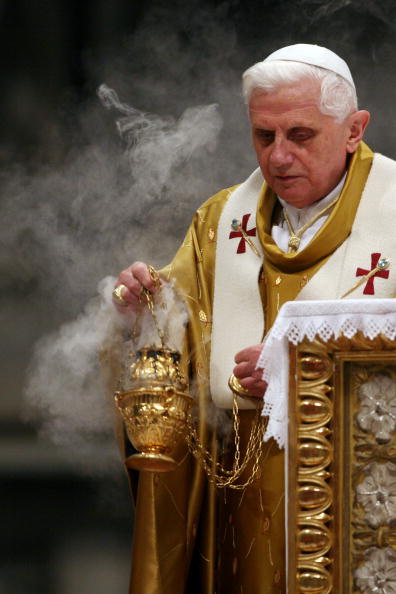
Pope Benedict XVI celebrating the Easter Vigil Mass on 7 April 2007 in St. Peter’s Basilica [Flickr / CC BY-ND 2.0 license]
(11-16-12)
The following is a critique of Michael Voris’ video, Weapons of Mass Destruction, Pt. 1. Excerpts follow, with his words in blue.
*** * * * ***
29:10 “In the meantime a New Mass is being engineered that almost totally downplays all Catholic worship in favor of a Protestant-friendly approach. This was what was going on in the Church in Rome.”
After making this objectionable statement, Voris then goes on to repeatedly stress that he thinks the New Mass is “valid.” Yes, fine; well and good, as far as it goes. But the above is an atrocious indictment of the worship in the ordinary form of the Roman Rite Mass. It bears false witness. Then he states:
30:07-30:43 “We’re not talking about the validity. We’re talking about: is this authentic Catholic worship? Is this how Catholics worship God? Is this a break from the past, that’s so violent, that you can’t really say this is authentic Catholic worship, as we have understood it? Has the theology behind the Mass been so manipulated and twisted and deformed, that Catholics going to this Mass miss something of the theology, compared to talking about the traditional Latin Mass: the Tridentine Mass? That’s what’s at issue: not, ‘is it valid or not?'”
This, of course, profoundly contradicts what the Church teaches: which is that the Novus Ordo is in continuity with past worship traditions; not a break from it. It’s a development, not a radical corruption. After stating about the Holy Eucharist (Novus Ordo), “it is Jesus,” Voris goes on to pontificate:
31:33 “Is the sacrament valid? Yes. Has your faith been damaged, on the other hand? Yes. . . . We’re talking about, is this authentic Catholic worship; is what’s going on behind the scenes a possible detriment to your faith? That’s the question! . . . is this a danger? What’s going on?”
This is a rather interesting scenario (to put it very mildly). The Catholic worshiper at a Novus Ordo Mass has just gone up to receive Jesus Himself in the Eucharist, yet somehow simultaneously this is not “authentic Catholic worship” and the same person’s faith has “been damaged” — and the entire surrounding (with nefarious “behind the scenes” shenanigans) is a “possible detriment” to his or her faith? This is as convoluted as it is outrageous. If Jesus is truly, substantially present and has been received by us, what in the world is “un-Catholic” about that? What is lacking?
I guess Voris thinks there are things more important than the Lord of the universe physically coming to us and becoming one with us in Holy Communion. Talk about messed-up priorities! He’s hung up on particular formulas and wording (that are fully, wholly accepted by Holy Mother Church), and in so doing misses the very essence of the whole thing: just like the Pharisees, about whom Jesus said: “you tithe mint and dill and cummin, and have neglected the weightier matters of the law, justice and mercy and faith” (Matthew 23:23) and “You blind guides, straining out a gnat and swallowing a camel!” (Matthew 23:24).
34:21 “In short, the prayer, the public worship of the New Mass; the question is: is it more Protestant or more Catholic? That is a very, very key question.”
Voris then presents dire observations about the decline in Catholic vocations and participation (attendance at Mass, etc.). But this all begs the question, of course, and is a classic, textbook example of the fallacy of post hoc ergo propter hoc (“after this, therefore because of this”): as if nothing except the New Mass has caused all these problems. Never mind rampant secularism, the sexual revolution, leftist political nonsense, bad catechesis, declining sexual mores of the general populace, increasingly broken homes, the removal of religion and God from public schools, and a host of other anti-traditional cultural trends.
All is traced to a change in liturgy: so Voris thinks (presupposes in his presentation). Many want to make Vatican II the boogie man for every ill in the Church and society. It sort of plays the role for many (of this mindset), that President George W. Bush plays in the politically liberal mind and mentality: the cause of every ill in the history of the universe. He concludes with a statement (entirely presupposing the post hoc ergo propter hoc fallacy) that is presented as a self-evident truth that no one could possibly object to:
39:51 “The faith has been eviscerated in these forty years, and the decline has coincided with the New Mass. How you pray, is how you live, is how you believe.”
50:21 “The New Mass stresses the nourishment and the sanctification of the faithful. Old Mass: worship and adoration to the Holy Trinity, the removal of sin. Here?: ‘hey, we’re all nourished and gettin’ along together!’ Two entirely different structures here. . . . The language used in the New Mass confuses nearly every aspect of the Mass: the idea of sacrifice; who’s actually offering the sacrifice . . . with all of these confusions, the very nature of the faith itself is undermined. . . . the former theology is largely dismissed. . . . The question is, what is it substituted with? When that old theology, the Catholic theology is gone, something else is brought in. What is the something else?”
In high contrast, the apostolic letter of Pope Benedict XVI (Voris cites him many times in his presentation), Summorum Pontificum (7 July 2007) stated:
. . . the Second Vatican Council expressed the desire that with due respect and reverence for divine worship it be restored and adapted to the needs of our age. Prompted by this desire, our Predecessor the Supreme Pontiff Paul VI in 1970 approved for the Latin Church liturgical books restored and partly renewed, and that throughout the world translated into many vernacular languages, have been welcomed by the Bishops and by the priests and faithful. . . .
Art. 1. The Roman Missal promulgated by Paul VI is to be regarded as the ordinary expression of the law of prayer (lex orandi) of the Catholic Church of Latin Rite, while the Roman Missal promulgated by St Pius V and published again by Blessed John XXIII as the extraordinary expression of the law of prayer (lex orandi) and on account of its venerable and ancient use let it enjoy due honor. These two expressions of the law of prayer (lex orandi) of the Church in no way lead to a division in the law of prayer (lex orandi) of the Church, for they are two uses of the one Roman Rite.
In his letter to the bishops on the same day, on the same topic, the Holy Father elaborated:
. . . it must first be said that the Missal published by Paul VI and then republished in two subsequent editions by John Paul II, obviously is and continues to be the normal Form – the Forma ordinaria – of the Eucharistic Liturgy. The last version of the Missale Romanum prior to the Council, which was published with the authority of Pope John XXIII in 1962 and used during the Council, will now be able to be used as a Forma extraordinaria of the liturgical celebration. It is not appropriate to speak of these two versions of the Roman Missal as if they were “two Rites”. Rather, it is a matter of a twofold use of one and the same rite.
. . . in many places celebrations were not faithful to the prescriptions of the new Missal, but the latter actually was understood as authorizing or even requiring creativity, which frequently led to deformations of the liturgy which were hard to bear. I am speaking from experience, since I too lived through that period with all its hopes and its confusion. And I have seen how arbitrary deformations of the liturgy caused deep pain to individuals totally rooted in the faith of the Church.
[in other words, the pope is careful to distinguish corruptions and abuses (“arbitrary deformations”) of the New Mass from the Mass itself, as promulgated by the Church, in a way that Voris does not do at all. For Voris, it is intrinsically corrupt and inauthentic. For Pope Benedict XVI it is as legitimate as the older Tridentine Mass]
. . . the two Forms of the usage of the Roman Rite can be mutually enriching . . .
The most sure guarantee that the Missal of Paul VI can unite parish communities and be loved by them consists in its being celebrated with great reverence in harmony with the liturgical directives. This will bring out the spiritual richness and the theological depth of this Missal.. . .
[again, it is disharmony with “liturgical directives” that is a problem, not the New Mass itself]
There is no contradiction between the two editions of the Roman Missal. In the history of the liturgy there is growth and progress, but no rupture. What earlier generations held as sacred, remains sacred and great for us too, and it cannot be all of a sudden entirely forbidden or even considered harmful. It behooves all of us to preserve the riches which have developed in the Church’s faith and prayer, and to give them their proper place. Needless to say, in order to experience full communion, the priests of the communities adhering to the former usage cannot, as a matter of principle, exclude celebrating according to the new books. The total exclusion of the new rite would not in fact be consistent with the recognition of its value and holiness.
We see nothing here of the stark contrast that Voris draws between the two forms of Mass. In fact, the pope decreed that they are “two uses of the one Roman Rite” (extraordinary and ordinary). What Voris separates into wonderful and traditional vs. something that is not “authentic Catholic worship” and “more Protestant” than Catholic: to the extent that the two forms of worship are “two entirely different structures,” the Holy Father regards as “two expressions of the law of prayer (lex orandi) of the Church.” The pope refers to the “spiritual richness” and “theological depth” and “holiness” of the New Mass. Voris, on the other hand, thinks (rather Luther-or Calvin-like) that the theology it exhibits is “manipulated and twisted and deformed.“
Two vastly different and utterly irreconcilable opinions indeed . . . Now whom shall the faithful Catholic believe?
I mentioned above that Voris cited Pope Benedict often during his presentation in this video (and frequently from his many pre-papal writings). But he distorts the pope’s beliefs by hyper-selective quotation, and doesn’t present its full scope. Dr. Jeff Mirus critiques a very similar attitude and modus operandi among radical Catholic reactionaries:
In recent weeks, several severe critics, opponents and denigrators of the Ordinary Form of the Roman Rite have claimed that they are simply following the lead of Pope Benedict XVI when he was a cardinal, and they have cited one or more writings of Joseph Ratzinger in which he expressed criticisms of certain aspects of the implementation of the new rite. I want to emphasize that he expressed these concerns in scholarly work, and that, taken in context, it is always clear that Ratzinger as a cardinal was not ill-disposed toward the Novus Ordo. Rather, he was interested in improvements which might be made (no liturgy is perfect) and, in particular, he was opposed to the free-wheeling manner in which some ignored the rubrics when saying Mass, . . .
First, it is absolutely critical to note that the mind of the Church or even of the Pope himself cannot be determined by looking at the writings of a future pope before he became pope. A cardinal’s election as pope does not in any way validate his earlier remarks, none of which were protected in the least by the grace of his later office. . . .
So even if some of Cardinal Ratzinger’s remarks seem very negative in isolation from his entire body of work—or indeed even if it were possible to argue that his whole outlook on the Novus Ordo was negative (which was not the case)—this would tell us nothing about the mind of the Church. No, to learn the mind of the Pope (and therefore something of the mind of the Church) on such matters as the liturgy, we need to look to what the Pope has said while in office.
Second, while in office, Pope Benedict XVI has made his approval of the Novus Ordo clear. He has also made clear that his serious criticisms do not apply to the rite itself but to the false interpretation of the Missal of Paul VI as something that requires constant experimentation and innovation, as if priests are to superimpose their own improvisations on the official liturgy and, in so doing, frequently substitute the banal for the sublime. . . .
My advice to those who seriously dislike the Novus Ordo is this: Admit your personal preference for the Extraordinary Form if you like; true Catholics should not criticize you for it, even if they prefer the Ordinary Form. Combat abuses of the Novus Ordo where you can; the Church will thank you for that. But do not denigrate the rite itself, as if it is something unworthy or profane, and never imply that the billion Catholics who use and have come to love it are somehow inferior in their Faith.
(“The Mind of the Church on the Novus Ordo,” Catholic Culture, 13 August 2010)
Precisely. We saw the same approach above in his decrees of 2007 regarding the renewed and encouraged use of the Tridentine Mass: concentration on corruptions of a good thing, rather than a thing (the New Mass) itself intrinsically corrupt (as in Voris’ erroneous view).
Revised somewhat and re-titled on 24 December 2012. Revised (terminology) on 12 August 2013.
* * * * *
Traditionalism vs. Radical Catholic Reactionaries
Previous Post
November 3, 2015
Science & Christianity (Copious Helpful Resources)
Next Post

November 3, 2015 "Why Should Anyone Care About Early Protestant Mariology?"
Browse Our Archives
Select a Category & Last Things About Me Anti-Catholicism Atheism & Agnosticism Baptism and Sacramentalism Bible and Tradition Blessed Virgin Mary Books by Dave Armstrong C. S. Lewis Calvinism & General Protestantism Catholic Apologetics Catholic Apologists Catholic conversion Catholic converts Christmas Church (Ecclesiology) Church History Conversion and Converts Development of Doctrine Eastern Orthodoxy Ecumenism & Christian Unity Eucharist & Liturgy Fathers of the Church French Translations G. K. Chesterton Hell Hell & Satan Hell & Satan & Last Things Heresies & Comparative Religion Holistic Health Inquisition & Crusades & Scandals James White Jews & Judaism & Old Testament John Calvin John Henry Newman Liberal / Modernist Theology Life Issues Literary Resume Lutheranism Mariology Martin Luther Music Orthodoxy Papacy & Infallibility Personal Page Philosophy & Science Political & Ethical & Moral Issues Protestant Persecution & Intolerance Protestantism Purgatory Purgatory & Penance Romantic & Imaginative Theology Saints & Purgatory & Penance Salvation Salvation & Justification Satan & Last Things Sexuality and Gender Issues Spanish Translations Traditionalism vs. Radical Catholic Reactionaries Traducciones al español / tradução para português Trinitarianism & Christology Uncategorized Videos
Select a Month October 2026 September 2026 August 2026 July 2026 June 2026 May 2026 April 2026 March 2026 February 2026 January 2026 December 2025 November 2025 October 2025 September 2025 August 2025 July 2025 June 2025 May 2025 April 2025 March 2025 February 2025 January 2025 December 2024 November 2024 October 2024 September 2024 August 2024 July 2024 June 2024 May 2024 April 2024 March 2024 February 2024 January 2024 December 2023 November 2023 October 2023 September 2023 August 2023 July 2023 June 2023 May 2023 April 2023 March 2023 February 2023 January 2023 December 2022 November 2022 October 2022 September 2022 August 2022 July 2022 June 2022 May 2022 April 2022 March 2022 February 2022 January 2022 December 2021 November 2021 October 2021 September 2021 August 2021 July 2021 June 2021 May 2021 April 2021 March 2021 February 2021 January 2021 December 2020 November 2020 October 2020 September 2020 August 2020 July 2020 June 2020 May 2020 April 2020 March 2020 February 2020 January 2020 December 2019 November 2019 October 2019 September 2019 August 2019 July 2019 June 2019 May 2019 April 2019 March 2019 February 2019 January 2019 December 2018 November 2018 October 2018 September 2018 August 2018 July 2018 June 2018 May 2018 April 2018 March 2018 February 2018 January 2018 December 2017 November 2017 October 2017 September 2017 August 2017 July 2017 June 2017 May 2017 April 2017 March 2017 February 2017 January 2017 December 2016 November 2016 October 2016 September 2016 August 2016 July 2016 June 2016 May 2016 April 2016 March 2016 February 2016 January 2016 December 2015 November 2015 October 2015 September 2015 August 2015 July 2015 June 2015 May 2015 April 2015 March 2015 February 2015 January 2015 December 2014 November 2014 October 2014 September 2014 August 2014 July 2014 June 2014 April 2014 March 2014 February 2014 January 2014 December 2013 November 2013 October 2013 September 2013 August 2013 July 2013 June 2013 April 2013 March 2013 February 2013 January 2013 December 2012 November 2012 October 2012 September 2012 August 2012 July 2012 June 2012 May 2012 April 2012 March 2012 February 2012 January 2012 December 2011 November 2011 October 2011 September 2011 August 2011 July 2011 June 2011 April 2011 March 2011 February 2011 October 2010 September 2010 August 2010 July 2010 April 2010 March 2010 December 2009 October 2009 August 2009 July 2009 June 2009 May 2009 March 2009 February 2009 October 2008 September 2008 April 2008 March 2008 February 2008 January 2008 December 2007 November 2007 October 2007 May 2007 March 2007 February 2007 January 2007 November 2006 October 2006 September 2006 August 2006 July 2006 June 2006 May 2006 April 2006 March 2006 February 2006 October 2005 June 2005 April 2005 February 2005 July 2004 May 2004 April 2004
Follow Us!
TAKE THE
Religious Wisdom Quiz
What does the Greek word 'Kurios' mean?
Select your answer to see how you score.
Messiah King Redeemer Lord
Books by This Author Books by Dave Armstrong
Related posts from Biblical Evidence for Catholicism

The Mass & Development of Doctrine (vs. Wes...
Biblical Evidence for Catholicism

Miraculous Eucharist (vs. Francois Turretin #4)
Biblical Evidence for Catholicism

God's Presence, the Ark, the Eucharist, & Death
Biblical Evidence for Catholicism
Protestant Eucharistic Objections Fail (Turretin)
Biblical Evidence for Catholicism
TRENDING AT PATHEOS Catholic

The First Eucharistic Controversy: Christ’s Real Presence
For Catholics, the Eucharist is the source and summit of the Christian...

What a Stop Sign Can Teach Us About...
How to Make a Decision When You Can't Hear God Main point:...

Archdiocese Hosts Military Marriage Retreat in Germany
RASTATT, Germany — The transient military lifestyle, with its frequent deployments and...

Nearly every morning, I make the drive to Detroit with my high-school-age...

The Real AI Story Is Adoption Without Trust
Artificial intelligence has crossed a political threshold. It is no longer a...

A new article, written by Jeff Lindsay and Gale L. Pooley,...
view all Catholic blogs
Ad-Free & Subscriber Log-In Subscription Support
- About Us
- 2026 Calendar
- Videos
- Podcasts
- Library of World Religions
- Faith In Media Tracker
- Advertise With Us
- Write for Us
- Privacy Policy
- Terms of Service
- Do Not Sell My Data
- Contact Us
- Radiant Digital
- Manage Newsletter Subscriptions
- Unsubscribe From Notifications
- Sitemap
Copyright 2008-2026, Patheos. All rights reserved.
Subscription Support Ad-Free & Subscriber Log-In
Follow Patheos