
BuddhistCatholicContemplativeEvangelicalGeneral ChristianHinduJewishLatter-day SaintMuslimNew VisionsProgressive Christian
Beliefs
- Buddhist
- Catholic
- Contemplative
- Evangelical
- General Christian
- Hindu
- Jewish
- Latter-day Saint
- More Voices
- Muslim
- New Visions
- Pagan
- Progressive Christian
Topics
- Religion News
- Food and Religion
- Sports and Religion
- Religious Art
- Religious Music and Entertainment
- Religious Events
- History and Religion
- Style and Religion
- Politics and Religion
- Women in Religion
- Recreation Outdoors and Religion
- Business Finance and Religion
- Careers Workplace and Religion
- Education and Religion
- Family Parenting and Religion
- Health Fitness and Religion
- Home and Religion
- Relationships and Religion
- Technology and Religion
- Travel and Religion
Columnists
- Buddhist Columnists
- Business Finance and Religion Columnists
- Careers Workplace and Religion Columnists
- Catholic Columnists
- Contemplative Columnists
- Education and Religion Columnists
- Evangelists Columnists
- Family Parenting and Religion Columnists
- General Christian Columnists
- Health Fitness and Religion Columnists
- Hindu Columnists
- History and Religion Columnists
- Home and Religion Columnists
- Jewish Columnists
- More Voices Columnists
- Latter Day Columnists
- Muslim Columnists
- New Visions Columnists
- Nonreligious Columnists
- Pagan Columnists
- Politics and Religion Columnists
- Progressive Columnists
- Recreation Outdoors and Religion Columnists
- Relationships and Religion Columnists
- Religion News Columnists
- Religious Art Columnists
- Religious Events Columnists
- Religious Music and Entertainment Columnists
- Sports and Religion Columnists
- Style and Religion Columnists
- Technology and Religion Columnists
- Travel and Religion Columnists
- Women in Religion Columnists
Resource Library
- 2026 Calendar
- Library of World Religions
- The 100 Most Holy Places on Earth
- Patheos Answers
- Podcasts
- Videos
- Faith Leaders Database
- Anglican Episcopalian
- Bahai
- Baptist
- Buddhism
- Christianity
- Confucianism
- Eastern Orthodoxy
- Hinduism
- Holiness and Pentecostal
- ISKCON
- Islam
- Judaism
- Lutheran
- Methodist
- The Church of Jesus Christ of Latter-day Saints
- New Age
- Paganism
- Presbytarian and Reformed
- Protestantism
- Religion Behind the Scenes
- Roman Catholic
- Scientology
- Shia Islam
- Sikhism
- Sufism
- Sunni Islam
- Taoism
- Zen
- See all religions
Research Tools
 Ad-Free & Subscriber Log-In Subscription Support
Ad-Free & Subscriber Log-In Subscription Support
Follow Patheos 

- Trending:
- Forgiveness
- |
- Marriage
- |
- Consciousness
- |
- Death Penalty
- |
- Election
- |
- Halloween

-
About
-
Catholic Apologetics
-
Church History
-
Great Apologists
-
Christian Worldview
-
Protestantism & Misc.
- Home
- Catholic
- History and Religion
- John 6 and Disciples’ Lack of Faith in the Real Presence
John 6 and Disciples’ Lack of Faith in the Real Presence
Last updated on: June 6, 2026 at 12:28 am by Dave Armstrong
John 6 and Disciples’ Lack of Faith in the Real Presence 2026-06-06T00:28:52-04:00 Dave Armstrong
Patheos Explore the world's faith through different perspectives on religion and spirituality! Patheos has the views of the prevalent religions and spiritualities of the world.
. . . of Jesus in the Eucharist as a Parallel to Doubting Disciples
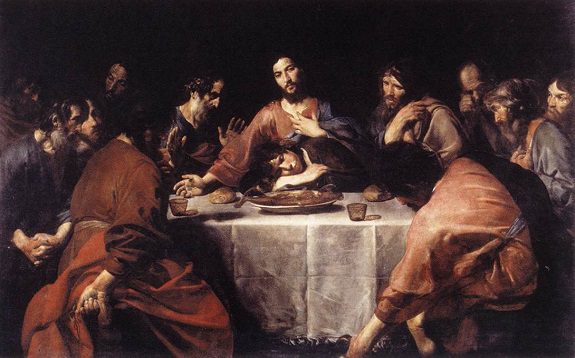
The Last Supper (1625-1626), by Valentin de Boulogne (1591-1632) [public domain / Wikimedia Commons]

* * * * *
(2-14-11)
[Chapter Four of my book, Biblical Catholic Eucharistic Theology]
St. Peter (before his transformation after Pentecost) lacked faith in Jesus’ power over the natural world (Luke 8:24-25) and so he couldn’t walk on the water like Jesus did (Matt 14:24-33). Many Protestants likewise stumble over the miracle of the Eucharist. “Doubting Thomas”: one of the twelve disciples, had trouble accepting what Jesus said about His Resurrection (a supernatural thing involving His Body).
Most Protestants have difficulty accepting in faith Jesus’ word in John 6 and at the Last Supper, regarding the Holy Eucharist (also a supernatural thing involving His Body). Likewise, the doubting disciples in John 6 said, “This is a hard saying; who can listen to it?” (6:60) They wouldn’t accept His teaching, because it was too “hard” for them. And so they “drew back and no longer went about with him” (6:66).
One of the best analyses I’ve seen about this “eucharistic unbelief” comes from the great Catholic writer Romano Guardini:
Should they have understood? Hardly. It is inconceivable that at any time anyone could have grasped intellectually the meaning of these words. But they should have believed. They should have clung to Christ blindly, wherever he led them. They should have sensed . . . that they were being directed toward something unspeakably huge, and simply said: we do not understand; show us what you mean. Instead they judge, and everything closes to them.
(The Lord, translated by Elinor C. Briefs, Chicago: Henry Regnery, 1954, 206)
Jesus’ closest followers are hard-pressed, but He does not help them. He forces them to a decision of life or death; are they ready to accept the fullness of revelation, which necessarily overthrows earthly wisdom, or do they insist on judging revelation, delimiting its ‘possibilities’ from their own perspective? . . . Jesus turns to the remaining hard core: ‘Do you also wish to go away?’ . . . Still not a word of help, only the hard, pure demand for a decision . . . They do not understand either, but struck by the power of the mystery, they surrender themselves to it. They are dumbfounded but trustful; at least most of them . . .
Apparently there is no genuine belief without battle. Every believer worthy of the name must sometime undergo the danger of scandal and its trial by fire . . . It was the shock that probably shattered Judas’ faith, the other eleven saving themselves only by a blind leap of trust to the Master’s feet . . . Here is the steepest, highest pinnacle of our faith (or the narrowest, most precipitous pass through which that faith must labor) . . . faith’s supreme test . . .
Jesus desires that men receive and make their own the gift of His vital essence, strength, His very Person as fully and intimately as they receive and assimilate the strength and nourishment of bread and wine. He even adds that the person who is not so nourished cannot possess ultimate life.
(Meditations Before Mass, translated by Elinor C. Briefs, Westminster, Maryland: Newman Press, 1955, 164-167)
This is faith. We don’t have to understand everything to the nth degree. Faith and spirituality are not science, where everything is mind and rationality and empiricism, and the supernatural is ruled out by definition and methodology and presupposition alike. There is always a leap (actually science requires many “leaps” as well, where absolute knowledge is lacking, but that is another story). Christianity in general is like that.
Christianity requires belief in a number of things difficult to grasp and accept, but we accept them based on the authority of revelation. Doubting Thomas didn’t believe that Jesus could rise from the dead, even though Our Lord had often predicted it in the presence of the disciples. He had to see it for himself.
It is striking how Jesus is merciful and understanding enough to appear for Thomas’ sake. He knew his faith was weak, and so He offered a little “extra” to help him along. Thomas had an overly empirical mindset (he had said he had to put his finger in Jesus’ side, then he would believe: John 20:25). So Jesus, condescending to the limitations of the overly skeptical mentality, allowed him to do that (20:27).
This results (rather dramatically) in Thomas calling Jesus “God”: one of the most remarkable instances of proclamation of the divinity of Jesus in the New Testament (20:28). But after all this, Jesus nevertheless says, “Have you believed because you have seen me? Blessed are those who have not seen and yet believe.” (20:29). He came to Thomas because he was weak, but at the same time He made it clear that this would not be the norm, and that believers would have to exercise faith and not demand empirical proof.
Some Protestants will argue that Jesus was frequently misunderstood, and usually didn’t correct people’s misperceptions. Thus, they contend that John 6 is an instance of this: that Jesus was merely speaking metaphorically and the hearers didn’t get it.
But it is simply untrue that Jesus didn’t correct misunderstandings. He did on many recorded occasions; for example: John 3:1-15 (Nicodemus and the meaning of “born again”), Matthew 13:36-51 (explanation of the parable of the tares), Matthew 15:10-20 (what defiles a man), Matthew 16:5-12 (metaphorical use of leaven), Matthew 17:9-13 (parallel of Elijah and John the Baptist), Matthew 19:24-26 (camel through the eye of a needle and rich men), Mark 4:33-34 and Luke 8:9-15 (meaning of parables in general), Luke 24:13-27 (Jesus’ teaching about Himself to the two disciples on the road to Emmaus), John 4:31-34 (metaphorical meaning of meat), John 8:21-32 (His own divinity), and John 11:8-15 (sleep as symbolic of death).
Let’s examine some examples of this theme of Jesus correcting misunderstandings, in more depth. In John 10:1-19, Jesus gives a parable of the sheep and the good shepherd (10:1-5). Then in verses 6 and 7b we read:
This figure [paroimia; “parable” in KJV] Jesus used with them, but they did not understand what he was saying to them. So Jesus again said to them, . . .
Jesus goes on to expound and clarify and elaborate (10:7b-18). He doesn’t merely repeat for emphasis, as in John 6. Therefore, this is a counter-example. Another one is the entire chapter 16 of John, where the disciples did not understand, and Jesus explained at length to clarify, and then they did understand (italics added to highlight my point):
John 16:1-33 “I have said all this to you to keep you from falling away. [2] They will put you out of the synagogues; indeed, the hour is coming when whoever kills you will think he is offering service to God. [3] And they will do this because they have not known the Father, nor me. [4] But I have said these things to you, that when their hour comes you may remember that I told you of them. “I did not say these things to you from the beginning, because I was with you. [5] But now I am going to him who sent me; yet none of you asks me, `Where are you going?’ [6] But because I have said these things to you, sorrow has filled your hearts. [7] Nevertheless I tell you the truth: it is to your advantage that I go away, for if I do not go away, the Counselor will not come to you; but if I go, I will send him to you. [8] And when he comes, he will convince the world concerning sin and righteousness and judgment: [9] concerning sin, because they do not believe in me; [10] concerning righteousness, because I go to the Father, and you will see me no more; [11] concerning judgment, because the ruler of this world is judged. [12] “I have yet many things to say to you, but you cannot bear them now. [13] When the Spirit of truth comes, he will guide you into all the truth; for he will not speak on his own authority, but whatever he hears he will speak, and he will declare to you the things that are to come. [14] He will glorify me, for he will take what is mine and declare it to you. [15] All that the Father has is mine; therefore I said that he will take what is mine and declare it to you. [16] “A little while, and you will see me no more; again a little while, and you will see me.” [17] Some of his disciples said to one another, “What is this that he says to us, `A little while, and you will not see me, and again a little while, and you will see me’; and, `because I go to the Father’?” [18] They said, “What does he mean by `a little while’? We do not know what he means.” [19] Jesus knew that they wanted to ask him; so he said to them, “Is this what you are asking yourselves, what I meant by saying, `A little while, and you will not see me, and again a little while, and you will see me’? [20] Truly, truly, I say to you, you will weep and lament, but the world will rejoice; you will be sorrowful, but your sorrow will turn into joy. [21] When a woman is in travail she has sorrow, because her hour has come; but when she is delivered of the child, she no longer remembers the anguish, for joy that a child is born into the world. [22] So you have sorrow now, but I will see you again and your hearts will rejoice, and no one will take your joy from you. [23] In that day you will ask nothing of me. Truly, truly, I say to you, if you ask anything of the Father, he will give it to you in my name. [24] Hitherto you have asked nothing in my name; ask, and you will receive, that your joy may be full. [25] “I have said this to you in figures; the hour is coming when I shall no longer speak to you in figures but tell you plainly of the Father. [26] In that day you will ask in my name; and I do not say to you that I shall pray the Father for you; [27] for the Father himself loves you, because you have loved me and have believed that I came from the Father. [28] I came from the Father and have come into the world; again, I am leaving the world and going to the Father.” [29] His disciples said, “Ah, now you are speaking plainly, not in any figure! [30] Now we know that you know all things, and need none to question you; by this we believe that you came from God.” [31] Jesus answered them, “Do you now believe? [32] The hour is coming, indeed it has come, when you will be scattered, every man to his home, and will leave me alone; yet I am not alone, for the Father is with me. [33] I have said this to you, that in me you may have peace. In the world you have tribulation; but be of good cheer, I have overcome the world.”
This is, then, a counter-instance of Jesus explaining to His disciples when they didn’t properly comprehend or were confused or troubled. With an entire chapter devoted to such an occurrence, we can hardly deny that the Gospel of John contains this motif. Jesus would explain things to His disciples (if not always to the masses or the hyper-skeptical Pharisees). And in John 6 it was disciples who were questioning:
John 6:60-61, 66 Many of his disciples, when they heard it, said, “This is a hard saying; who can listen to it?” [61] But Jesus, knowing in himself that his disciples murmured at it, said to them, “Do you take offense at this?. . .” [66] After this many of his disciples drew back and no longer went about with him.
Yet Jesus did not explain; He merely repeated with more “in your face” force. And it is the only recorded instance (other than Judas) of any of His disciples ceasing to follow Him. The plausible reason is because He knew that they were questioning and would not have accepted any further explanation anyway. We know this from hard evidence:
John 6:64 “But there are some of you that do not believe.” For Jesus knew from the first who those were that did not believe, and who it was that would betray him.
This theme appears elsewhere in John, too:
John 8:27, 43-47 They [the Pharisees] did not understand that he spoke to them of the Father. . . . [43] Why do you not understand what I say? It is because you cannot bear to hear my word. [44] You are of your father the devil, and your will is to do your father’s desires. He was a murderer from the beginning, and has nothing to do with the truth, because there is no truth in him. When he lies, he speaks according to his own nature, for he is a liar and the father of lies. [45] But, because I tell the truth, you do not believe me. [46] Which of you convicts me of sin? If I tell the truth, why do you not believe me? [47] He who is of God hears the words of God; the reason why you do not hear them is that you are not of God.
John 12:37-40 Though he had done so many signs before them, yet they did not believe in him; [38] it was that the word spoken by the prophet Isaiah might be fulfilled: “Lord, who has believed our report, and to whom has the arm of the Lord been revealed?” [39] Therefore they could not believe. For Isaiah again said, [40] “He has blinded their eyes and hardened their heart, lest they should see with their eyes and perceive with their heart, and turn for me to heal them.”
In other words, Jesus is emphasizing that some people don’t “understand” because they don’t want to: they lack faith; they can’t “bear” His word, and they are burdened with undue skepticism and led by the devil, the father of lies. This is what happened in John 6 with those disciples who left Him. It’s a theme in the Synoptic Gospels as well:
Matthew 13:13, 19 This is why I speak to them in parables, because seeing they do not see, and hearing they do not hear, nor do they understand. . . . When any one hears the word of the kingdom and does not understand it, the evil one comes and snatches away what is sown in his heart; this is what was sown along the path.
Luke 5:21-22 And the scribes and the Pharisees began to question, saying, “Who is this that speaks blasphemies? Who can forgive sins but God only?” [22] When Jesus perceived their questionings, he answered them, “Why do you question in your hearts?”
Jesus often explained and corrected His disciples who misunderstood and who were willing to listen. Therefore, John 6 makes sense only in terms of interpreting it as an instance where it was not an innocent misunderstanding (mistaking a supposed figurative discourse for a literal one), but rather, a deliberate refusal to believe (understanding but not accepting).
These were disciples who would have had the teaching explained to them in greater detail if only they were willing. They were not, and the difficulty of this teaching was enough to make them split for good. Many Protestants today believe the same thing that made these former disciples forsake the following of Jesus. And that ought to give them very serious pause indeed.
These former disciples left precisely because they refused to believe Jesus. If it had been a misunderstanding, Jesus certainly would have explained to them (as He did on many other occasions, as shown above), had they been open. His not explaining proves that it was a refusal to believe what was made quite plain (His literal Body and Blood in a eucharistic context).
The argument hinges on the clear distinction between how Jesus talked to open-minded and closed-minded people, and between how He talked to disciples and the masses. Jesus (like all good preachers and evangelists) would put people on the spot, demanding a profound, selfless allegiance:
John 10:34-39 Do not think that I have come to bring peace on earth; I have not come to bring peace, but a sword. [35] For I have come to set a man against his father, and a daughter against her mother, and a daughter-in-law against her mother-in-law; [36] and a man’s foes will be those of his own household. [37] He who loves father or mother more than me is not worthy of me; and he who loves son or daughter more than me is not worthy of me; [38] and he who does not take his cross and follow me is not worthy of me. [39] He who finds his life will lose it, and he who loses his life for my sake will find it.
John 12:30 He who is not with me is against me, and he who does not gather with me scatters.
John 19:21 Jesus said to him, “If you would be perfect, go, sell what you possess and give to the poor, and you will have treasure in heaven; and come, follow me.”
Catholic apologist Bertrand L. Conway elaborates:
We must remember that Christ, like every good teacher, made two sorts of answers to men who objected to His teaching. If they did not understand His meaning, He explained His doctrine more fully. In this way He explains . . . the possibility of the rich man being saved (Matthew 19:24-6), the fact of Lazarus’ death (John 11:11-14), the idea of freedom (John 8:32-4; cf. John 4:31-4; 8:21-23). When His hearers understood His teaching but refused to accept it, He repeated His teaching with even more emphasis. Thus, He insisted upon His power to forgive sins, when the Scribes accused Him of blasphemy (Matthew 9:2-7), and insisted on His being Eternal, when the Jews said He was not yet fifty years old (John 8:56-8).
(The Question Box, New York: Paulist Press, 1929, 251)
It’s beyond ludicrous to think that Jesus would have allowed anyone to stop being His disciple based on a misunderstanding of supposed figurative or symbolic language for literal. He would have corrected them and the problem would have been resolved. But instead He chose not to. That makes no sense. But not explaining because He knew it would be futile, makes perfect sense, is consistent with His behavior in other such scenarios, and is far more plausible than the alternative.
The disciples were constantly misunderstanding Jesus, and He corrected and educated them over and over. Why should this be any different, if in fact it were a misunderstanding? They were true disciples, who were stumbled by this particular teaching, since it was a difficult one (as all admit), and it made them turn hostile out of disenchantment.
We know that Jesus knew this about them because of what He said: “Do you take offense at this?” (John 6:61; meaning, of course, that they did, because He knew their hearts and was asking a pointed, provocative question). And isn’t it interesting how their questioning is described?:
John 6:64 “But there are some of you that do not believe.” For Jesus knew from the first who those were that did not believe, and who it was that would betray him.
Language of not believing and betrayal is not applicable to misunderstandings. Therefore, it makes no sense to think that He let them stop being His disciples based on a misunderstanding rather than hardness of heart. Neither Jesus nor John in giving details communicated in terms of “you do not understand” (a problem of comprehension or the mind), but rather, He said they “do not believe” and John says He knew who “would betray him,” which is referring to the will and faith and lack of belief in Jesus: very different things indeed.
Jesus tells His disciples what His parables mean, but not the larger crowds. This is explicitly stated in Matthew 13:10-11 and Luke 8:9-10. And note that the “disciples” were not just the Twelve, but included also at least the “seventy” mentioned in Luke 10:1 ff.: sent out to preach the gospel and heal the sick (10:9) and to cast out demons (10:17), by the express power of Jesus (10:19-20).
Jesus “rejoiced” upon their enthusiastic report and thanked His Father, “that thou hast hidden these things from the wise and understanding and revealed them to babes . . .” (10:21): language quite similar to the parables being understood by disciples and not all the masses at large.
If we “fast forward,” then, to John 6, who is being referred to? It is “His disciples” (three times: 6:60-61, 66). Jesus revealed the inner secrets and deeper teachings of the gospel of the kingdom to His disciples. That is who these people are.
Therefore, He would surely have revealed this teaching to these disciples who deserted Him if they had merely misunderstood it. But He did not.
Therefore, plainly it wasn’t a matter of His teaching not being understood or comprehended, but a matter of it being rejected (as the text expressly asserts in 6:61, 64), because He always explained the deeper meanings to His disciples, and these folks were His disciples.
He didn’t have to explain in this instance because it was a matter of not accepting what was understood, rather than not understanding what needed to be accepted. After all, being betrayed or abandoned even by the twelve didn’t stop Jesus from explaining all things to them, when in fact they misunderstood. Peter was the leader of the disciples all along, and Jesus knew he would deny Him, but that didn’t prevent Him from sharing more deeply with Peter than any other disciple.
Therefore, He would have gone on to explain things properly and in more detail (until they “got” it) to the disciples of John 6 who deserted Him because they couldn’t accept the Real Presence and eucharistic realism. But He didn’t, precisely because He knew that they understood and were hardhearted.
When Jesus knows that (speaking generally now), He explains no further, but challenges (e.g., Matthew 23 and the hypocrisy of the Pharisees), or falls silent (as in most of His trial). And that is what happened in this instance. The argument from parables against the Catholic interpretation of John 6 thus falls flat; it collapses in a heap.
These disciples refused to (willed not to) believe and exercise faith (as Abraham did, when he didn’t understand God’s purposes). They were like Doubting Thomases. And what they rejected was eucharistic realism: exactly as Protestants today do. It requires more faith than symbolism or mystical, spiritual presence. They didn’t yet have it, and they decided not to try to stick around in order to get it. They had had enough.
Often, belief in the Real, Substantial Presence of Jesus Christ in the Eucharist or transubstantiation, is the first thing a Catholic ditches, on the way out of the Catholic faith. Many, sadly, have the skeptical outlook of the former disciples of John 6. This flies against the Bible itself and the overwhelming consensus of the greatest teachers in the early Church.
Previous Post

November 13, 2015
Fairies, Atheism, God, and the Ad Populum Fallacy
Next Post
November 14, 2015 The Bible on Salvation via Baptism and the Eucharist
Browse Our Archives
Select a Category & Last Things About Me Anti-Catholicism Atheism & Agnosticism Baptism and Sacramentalism Bible and Tradition Blessed Virgin Mary Books by Dave Armstrong C. S. Lewis Calvinism & General Protestantism Catholic Apologetics Catholic Apologists Catholic conversion Catholic converts Christmas Church (Ecclesiology) Church History Conversion and Converts Development of Doctrine Eastern Orthodoxy Ecumenism & Christian Unity Eucharist & Liturgy Fathers of the Church French Translations G. K. Chesterton Hell Hell & Satan Hell & Satan & Last Things Heresies & Comparative Religion Holistic Health Inquisition & Crusades & Scandals James White Jews & Judaism & Old Testament John Calvin John Henry Newman Liberal / Modernist Theology Life Issues Literary Resume Lutheranism Mariology Martin Luther Music Orthodoxy Papacy & Infallibility Personal Page Philosophy & Science Political & Ethical & Moral Issues Protestant Persecution & Intolerance Protestantism Purgatory Purgatory & Penance Romantic & Imaginative Theology Saints & Purgatory & Penance Salvation Salvation & Justification Satan & Last Things Sexuality and Gender Issues Spanish Translations Traditionalism vs. Radical Catholic Reactionaries Traducciones al español / tradução para português Trinitarianism & Christology Uncategorized Videos
Select a Month October 2026 September 2026 August 2026 July 2026 June 2026 May 2026 April 2026 March 2026 February 2026 January 2026 December 2025 November 2025 October 2025 September 2025 August 2025 July 2025 June 2025 May 2025 April 2025 March 2025 February 2025 January 2025 December 2024 November 2024 October 2024 September 2024 August 2024 July 2024 June 2024 May 2024 April 2024 March 2024 February 2024 January 2024 December 2023 November 2023 October 2023 September 2023 August 2023 July 2023 June 2023 May 2023 April 2023 March 2023 February 2023 January 2023 December 2022 November 2022 October 2022 September 2022 August 2022 July 2022 June 2022 May 2022 April 2022 March 2022 February 2022 January 2022 December 2021 November 2021 October 2021 September 2021 August 2021 July 2021 June 2021 May 2021 April 2021 March 2021 February 2021 January 2021 December 2020 November 2020 October 2020 September 2020 August 2020 July 2020 June 2020 May 2020 April 2020 March 2020 February 2020 January 2020 December 2019 November 2019 October 2019 September 2019 August 2019 July 2019 June 2019 May 2019 April 2019 March 2019 February 2019 January 2019 December 2018 November 2018 October 2018 September 2018 August 2018 July 2018 June 2018 May 2018 April 2018 March 2018 February 2018 January 2018 December 2017 November 2017 October 2017 September 2017 August 2017 July 2017 June 2017 May 2017 April 2017 March 2017 February 2017 January 2017 December 2016 November 2016 October 2016 September 2016 August 2016 July 2016 June 2016 May 2016 April 2016 March 2016 February 2016 January 2016 December 2015 November 2015 October 2015 September 2015 August 2015 July 2015 June 2015 May 2015 April 2015 March 2015 February 2015 January 2015 December 2014 November 2014 October 2014 September 2014 August 2014 July 2014 June 2014 April 2014 March 2014 February 2014 January 2014 December 2013 November 2013 October 2013 September 2013 August 2013 July 2013 June 2013 April 2013 March 2013 February 2013 January 2013 December 2012 November 2012 October 2012 September 2012 August 2012 July 2012 June 2012 May 2012 April 2012 March 2012 February 2012 January 2012 December 2011 November 2011 October 2011 September 2011 August 2011 July 2011 June 2011 April 2011 March 2011 February 2011 October 2010 September 2010 August 2010 July 2010 April 2010 March 2010 December 2009 October 2009 August 2009 July 2009 June 2009 May 2009 March 2009 February 2009 October 2008 September 2008 April 2008 March 2008 February 2008 January 2008 December 2007 November 2007 October 2007 May 2007 March 2007 February 2007 January 2007 November 2006 October 2006 September 2006 August 2006 July 2006 June 2006 May 2006 April 2006 March 2006 February 2006 October 2005 June 2005 April 2005 February 2005 July 2004 May 2004 April 2004
Follow Us!
TAKE THE
Religious Wisdom Quiz
Who asked Jesus, "What is truth?"
Select your answer to see how you score.
Caiaphas Pilate Nicodemus Herod
Books by This Author Books by Dave Armstrong
Related posts from Biblical Evidence for Catholicism

Three More Anti-Catholic Lies About Catholicism (#6-4)
Biblical Evidence for Catholicism

Top Ten Anti-Catholic Lies (#10-7)
Biblical Evidence for Catholicism

The Mass & Development of Doctrine (vs. Wes...
Biblical Evidence for Catholicism

Miraculous Eucharist (vs. Francois Turretin #4)
Biblical Evidence for Catholicism
TRENDING AT PATHEOS Catholic

I was strolling through the top floor of the brand new Parthenon...

What Does Gêvâh Mean For Kimberley Guifoyle &...
This week, a lot of the news is focused on Kimberly Guilfoyle....

INNER CIRCLE: Profound Mystery (Of Christ In All...
Ephesians 5:31-32 “For this reason, a man will leave his father and...

Do Not Rejoice When Your Enemy Falls: The...
Turning an execution into a public spectacle is a disturbing expression of...

'The Chosen' S6 Trailer: The Passion Gets Very...
Not many watching 'The Chosen' worry about spoilers, but just because they...

The purpose-driven labor priest
A labor activist reads Rick Warren and it gets me wondering about...
view all Catholic blogs
Ad-Free & Subscriber Log-In Subscription Support
- About Us
- 2026 Calendar
- Videos
- Podcasts
- Library of World Religions
- Faith In Media Tracker
- Advertise With Us
- Write for Us
- Privacy Policy
- Terms of Service
- Do Not Sell My Data
- Contact Us
- Radiant Digital
- Manage Newsletter Subscriptions
- Unsubscribe From Notifications
- Sitemap
Copyright 2008-2026, Patheos. All rights reserved.
Subscription Support Ad-Free & Subscriber Log-In
Follow Patheos