
BuddhistCatholicContemplativeEvangelicalGeneral ChristianHinduJewishLatter-day SaintMuslimNew VisionsProgressive Christian
Beliefs
- Buddhist
- Catholic
- Contemplative
- Evangelical
- General Christian
- Hindu
- Jewish
- Latter-day Saint
- More Voices
- Muslim
- New Visions
- Pagan
- Progressive Christian
Topics
- Religion News
- Food and Religion
- Sports and Religion
- Religious Art
- Religious Music and Entertainment
- Religious Events
- History and Religion
- Style and Religion
- Politics and Religion
- Women in Religion
- Recreation Outdoors and Religion
- Business Finance and Religion
- Careers Workplace and Religion
- Education and Religion
- Family Parenting and Religion
- Health Fitness and Religion
- Home and Religion
- Relationships and Religion
- Technology and Religion
- Travel and Religion
Columnists
- Buddhist Columnists
- Business Finance and Religion Columnists
- Careers Workplace and Religion Columnists
- Catholic Columnists
- Contemplative Columnists
- Education and Religion Columnists
- Evangelists Columnists
- Family Parenting and Religion Columnists
- General Christian Columnists
- Health Fitness and Religion Columnists
- Hindu Columnists
- History and Religion Columnists
- Home and Religion Columnists
- Jewish Columnists
- More Voices Columnists
- Latter Day Columnists
- Muslim Columnists
- New Visions Columnists
- Nonreligious Columnists
- Pagan Columnists
- Politics and Religion Columnists
- Progressive Columnists
- Recreation Outdoors and Religion Columnists
- Relationships and Religion Columnists
- Religion News Columnists
- Religious Art Columnists
- Religious Events Columnists
- Religious Music and Entertainment Columnists
- Sports and Religion Columnists
- Style and Religion Columnists
- Technology and Religion Columnists
- Travel and Religion Columnists
- Women in Religion Columnists
Resource Library
- 2026 Calendar
- Library of World Religions
- The 100 Most Holy Places on Earth
- Patheos Answers
- Podcasts
- Videos
- Faith Leaders Database
- Anglican Episcopalian
- Bahai
- Baptist
- Buddhism
- Christianity
- Confucianism
- Eastern Orthodoxy
- Hinduism
- Holiness and Pentecostal
- ISKCON
- Islam
- Judaism
- Lutheran
- Methodist
- The Church of Jesus Christ of Latter-day Saints
- New Age
- Paganism
- Presbytarian and Reformed
- Protestantism
- Religion Behind the Scenes
- Roman Catholic
- Scientology
- Shia Islam
- Sikhism
- Sufism
- Sunni Islam
- Taoism
- Zen
- See all religions
Research Tools
 Ad-Free & Subscriber Log-In Subscription Support
Ad-Free & Subscriber Log-In Subscription Support
Follow Patheos 

- Trending:
- Forgiveness
- |
- Marriage
- |
- Consciousness
- |
- Death Penalty
- |
- Election
- |
- Halloween

-
About
-
Catholic Apologetics
-
Church History
-
Great Apologists
-
Christian Worldview
-
Protestantism & Misc.
- Home
- Catholic
- History and Religion
- G. K. Chesterton on Atheism, Skepticism, Secularism, Etc.
G. K. Chesterton on Atheism, Skepticism, Secularism, Etc.
Last updated on: June 6, 2026 at 12:29 am by Dave Armstrong
G. K. Chesterton on Atheism, Skepticism, Secularism, Etc. 2026-06-06T00:29:12-04:00 Dave Armstrong
Patheos Explore the world's faith through different perspectives on religion and spirituality! Patheos has the views of the prevalent religions and spiritualities of the world.
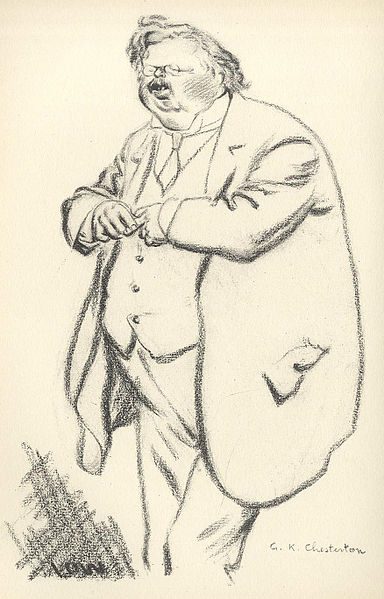
Caricature of G.K. Chesterton by David Low (1928) [public domain / Wikimedia Commons]

* * *
Quotations from my book, The Wisdom of Mr. Chesterton (2009)
* * * * *
Agnosticism
When he drops one doctrine after another in a refined scepticism, when he declines to tie himself to a system, when he says that he has outgrown definitions, when he says that he disbelieves in finality, when, in his own imagination, he sits as God, holding no form of creed but contemplating all, then he is by that very process sinking slowly backwards into the vagueness of the vagrant animals and the unconsciousness of the grass.
Trees have no dogmas. (H, ch. 20)
Many a magnanimous Moslem and chivalrous Crusader must have been nearer to each other, because they were both dogmatists, than any two homeless agnostics in a pew of Mr. Campbell’s chapel. (WWW, I-3)
It would be much truer to say that agnosticism is the origin of all religions.
That is true; the agnostic is at the beginning not the end of human progress. (AWD, “Something” [1910] )
The agnostics have been driven back on agnosticism; and are already recovering from the shock. (NJ, ch. 8)
It is the business of the agnostic to admit that he knows nothing; and he might the more gracefully admit it touching sciences about which he knows precious little. (ILN, “Mr Mencken and the New Physics,” 6-14-30)
We need not deny that modern doubt, like ancient doubt, does ask deep questions; we only deny that, as compared with our own philosophy, it gives any deeper answers. (WEL,“The Well and the Shallows” )
Atheism
But the materialist’s world is quite simple and solid, just as the madman is quite sure he is sane. (O, ch. 2)
An atheist and a theist only differ by a single letter; yet theologians are so subtle as to distinguish definitely between the two. (NJ, ch. 6)
The intellect exercises itself in discovering principles of design or pattern or proportion of some sort, and can find nothing to work on in the only really logical atheist cosmos – the fortuitous concourse of atoms of Lucretius. (ILN, “A Defense of Human Dignity,” 2-22-30)
Determinism
It is absurd to say that you are especially advancing freedom when you only use free thought to destroy free will.
The determinist makes the theory of causation quite clear, and then finds that he cannot say “if you please” to the housemaid. (O, ch. 2)
Intelligentsia, The; Scholars; The Learned
As I have pointed out elsewhere in this book, the expert is more aristocratic than the aristocrat, because the aristocrat is only the man who lives well, while the expert is the man who knows better. (H, ch. 16)
I think that you and I are quite justified in disagreeing with doctors, however extraordinary in their erudition, if they violate ordinary reason in their line of argument.
For I rebel against the man of learning when he suddenly, and in public, refuses to think.
But when learned men begin to use their reason, then I generally discover that they haven’t got any. (ILN, “Arguing With Erudition,” 10-31-08)
One does not need any learning to say that a man was killed or that a man was raised from the dead.
One does not need to be an astronomer to say that a star fell from heaven; or a botanist to say that a fig tree withered; or a chemist to say that one had seen water turned to wine; or a surgeon to say that one has seen wounds in the hands of St. Francis. (ILN, “Miracles and Scientific Method,” 4-17-09)
The third class is that of the Professors or Intellectuals; sometimes described as the thoughtful people; and these are a blight and a desolation both to their families and also to mankind.
The Prigs rise above the people by refusing to understand them: by saying that all their dim, strange preferences are prejudices and superstitions.
The Prigs make the people feel stupid; the Poets make the people feel wiser than they could have imagined that they were.
The Prigs who despise the people are often loaded with lands and crowned.
In the House of Commons, for instance, there are quite a number of prigs, but comparatively few poets.
He has not sufficient finesse and sensitiveness to sympathize with the mob.
His only notion is coarsely to contradict it, to cut across it, in accordance with some egotistical plan of his own; to tell himself that, whatever the ignorant say, they are probably wrong.
He forgets that ignorance often has the exquisite intuitions of innocence. (AD, ch. 23)
But the curious thing about the educated class is that exactly what it does not know is what it is talking about. (UTO, “The Empire of the Ignorant”)
Why is it that for the last two or three centuries the educated have been generally wrong and the uneducated relatively right?
What the educated man has generally done was to ram down everybody’s throat some premature and priggish theory which he himself afterwards discovered to be wrong; so wrong that he himself generally recoiled from it and went staggering to the opposite extreme. (ILN, “The Wisdom of the Ignorant,” 8-9-24)
The professor can preach any sectarian idea, not in the name of a sect, but in the name of a science. (ILN, “Compulsory Education
and the Monkey Trial,” 8-8-25)
And those who have been there will know what I mean when I say that, while there are stupid people everywhere, there is a particular minute and microcephalous idiocy which is only found in an intelligentsia.
I have sometimes fancied that, as chilly people like a warm room, silly people sometimes like a diffused atmosphere of intellectualism and long words. (ILN, “The Defense of the Unconventional,” 10-17-25)
So many people, especially learned people and even clever people, seem to be quite unable to see the upshot of a thing; or what the French call its reason of being. (ILN, “The Point – Getting It and Missing It,” 10-30-26)
I have frequently visited such societies, in the capacity of a common or normal fool, and I have almost always found there a few fools who were more foolish than I had imagined to be possible to man born of woman; people who had hardly enough brains to be called half-witted.
But it gave them a glow within to be in what they imagined to be the atmosphere of intellect; for they worshipped it like an unknown god.
Intelligence does exist even in the Intelligentsia.
Anyhow, it is in this intellectual world, with its many fools and few wits and fewer wise men, that there goes on perpetually a sort of ferment of fashionable revolt and negation. (TT, ch. 6)
But a large section of the Intelligentsia seemed wholly devoid of Intelligence.
As was perhaps natural, those who pontificated most pompously were often the most windy and hollow. (A, ch. 7)
Materialism (Scientific and Philosophical)
I have come into the country where men do definitely believe that the waving of the trees makes the wind.
That is to say, they believe that the material circumstances, however black and twisted, are more important than the spiritual realities, however powerful and pure.
By perpetually talking about environment and visible things, by perpetually talking about economics and physical necessity, painting and keeping repainted a perpetual picture of iron machinery and merciless engines, of rails of steel, and of towers of stone, modern materialism at last produces this tremendous impression in which the truth is stated upside down. (TRE, ch. 14)
It was the materialists who destroyed materialism, merely by studying matter.
We have been accused of hostility to the scientist, when we are merely hostile to the materialist.
The venerable Victorian materialist wanted the world to grow more and more scientific; but only on the strict condition that the science should grow more and more materialistic. (ILN, “Old Science and New Science,” 5-9-31)
If fifty years hence the electron is as entirely exploded as the atom, it will not affect us; for we have never founded our philosophy on the electron any more than on the atom. (WEL, “The Collapse of Materialism”)
Science, Scientists, and Popular Science
The telescope makes the world smaller; it is only the microscope that makes it larger. (H, ch. 3)
The only evil that science has ever attempted in our time has been that of dictating not only what should be known, but the spirit in which it should be regarded.
Science must not impose any philosophy, any more than the telephone must tell us what to say.
There is no objection to scientists splitting open the world like the uncle’s watch; in order to look at the works of it so long as those scientists feel like children. (ILN, “Science: Pro and Con,” 10-9-09)
The extreme doctrine of Science for Science’s Sake has proved just as impossible as Art for Art’s Sake. (ILN, “Evolution and Ethics,” 9-10-27)
They had no right to insist on men accepting the latest word of science as the last word of science.
Yet they were also insistently boasting that science had not concluded and would never conclude. (ILN, “The Bible and the Sceptics,” 4-20-29)
Quackery is false science; it is everywhere apparent in cheap and popular science; and the chief mark of it is that men who begin by boasting that they have cast away all dogma go on to be incessantly, impudently, and quite irrationally dogmatic. (ILN, “Quackery About the Family,” 7-12-30)
Science (and Religion)
The truths of religion are unprovable; the facts of science are unproved. (ILN, “Faith Healing and Medicine,” 11-5-10)
We in the West have “followed our reason as far as it would go,” and our reason has led us to things that nearly all the rationalists would have thought wildly irrational. (NJ, ch. 9)
The problem of Religion and Science is still presented in the narrow Victorian version of a quarrel between Darwin and Moses. (ILN, “The Younger Pagans,” 8-21-26)
But in the Victorian debates between Science and religion, about such a question as the Deluge, there was a double ignorance and an ambiguity on both sides. (ILN, “The Bible and the Sceptics,” 4-20-29)
The Electron, as now expounded, is much more of a mystery than the Trinity.
There were, indeed, venerable Victorians, of the agnostic sort, who would have been very much surprised to learn that science had not destroyed religion by A.D. 2030. (ILN, “Religion and the New Science,” 4-12-30)
It is amusing to think that even religious people may still be driven to abandon religion by a science which scientists have abandoned. (ILN, “The Place of Mysticism,” 5-24-30)
Secularism
The secularists have not wrecked divine things; but the secularists have wrecked secular things, if that is any comfort to them. (O, ch. 8)
Nearly all newspaper correspondences now revolve around religion, which we were told about fifty years ago had finally disappeared. (ILN, “Modern Doubts and Questioning,” 2-13-26)
Never until the nineteenth century was it supposed that the Church or Temple was a sort of side-show that had nothing to do with the State. (ILN, “The Guilt of the Churches,” 7-26-30)
For the word “secular” does not mean anything so sensible as “worldly.”
To be secular simply means to be of the age; that is, of the age which is passing; of the age which, in their case, is already passed.
There is one adequate equivalent of the word “secular”; and it is the word “dated.” (WEL, “The Well and the Shallows”)
What is totally intolerable is the idea that everybody must pretend, for the sake of peace and decorum, that moral inspiration only comes from secular things like Distributism, and cannot possibly come from spiritual things like Catholicism. (WEL, “The Don and the Cavalier”)
Skepticism (Religious); “Freethinkers”
Opponents of Christianity would believe anything except Christianity. (ILN, “The Neglect of Christmas,” 1-13-06)
For example, one can hardly count the number of times that Christianity has been destroyed or might have been destroyed if its enemies had known where it was or anything about it. (ILN, “Creed and Deed,” 2-2-07)
Nobody supposes that the best critic of music is the man who talks coldly about music.
But there is an idea that a man is a correct judge of religion because he looks down on religions. (ILN, “The History of Religions,” 10-10-08)
If you are merely a sceptic, you must sooner or later ask yourself the question, “Why should anything go right; even observation and deduction?
But the old sceptic, the complete sceptic, says, “I have no right to think for myself. I have no right to think at all.”
But the new sceptic is so humble that he doubts if he can even learn.
As a politician, he will cry out that war is a waste of life, and then, as a philosopher, that all life is waste of time. (O, ch. 3)
One rationalist had hardly done calling Christianity a nightmare before another began to call it a fool’s paradise.
It looked not so much as if Christianity was bad enough to include any vices, but rather as if any stick was good enough to beat Christianity with.
But if this mass of mad contradictions really existed, quakerish and bloodthirsty, too gorgeous and too thread-bare, austere, yet pandering preposterously to the lust of the eye, the enemy of women and their foolish refuge, a solemn pessimist and a silly optimist, if this evil existed, then there was in this evil something quite supreme and unique.
Perhaps, after all, it is Christianity that is sane and all its critics that are mad — in various ways. (O, ch. 6)
Men who begin to fight the Church for the sake of freedom and humanity end by flinging away freedom and humanity if only they may fight the Church. (O, ch. 8)
The sceptic is too credulous; he believes in newspapers or even in encyclopedias.
The sceptic may truly be said to be topsy-turvy; for his feet are dancing upwards in idle ecstacies, while his brain is in the abyss. (O, ch. 9)
Instead of trying to break up new fields with its plough, it simply tries to break up the plough. (ILN, “Hangmen and Capital Punishment,” 2-6-09)
I will not engage in verbal controversy with the sceptic, because long experience has taught me that the sceptic’s ultimate skepticism is about the use of his own words and the reliability of his own intelligence. (ILN, “Objections to Spiritualism,” 10-30-09)
It is the decisive people who have become civilised; it is the indecisive, otherwise called the higher sceptics, or the idealistic doubters, who have remained barbarians. (ILN, “Civilization and Progress,” 11-30-12)
Moreover, while it is rare for a great legend to grow out of nothing, it is much easier for a sceptical theory to be woven out of nothing, or next to nothing. (ILN, “The Legends of Merlin,” 9-8-23)
But the people now calling themselves freethinkers are of all thinkers the least free.
In order to explain the opinion of their opponents, they have to deny them the right to hold any opinion at all; and explain away all opinions by servile necessities of the hereditary mentality or the sub-conscious mind. (ILN, “The Reason For Fear,” 2-27-26)
What is now called free thought is valued, not because it is free thought, but because it is freedom from thought; because it is free thoughtlessness. (CCC, ch. 4)
The person whose position is perpetually growing shaky, shifting, sliding, and breaking away from under him, is the advanced sceptic who is attacking the tradition of orthodoxy. (ILN, “The Crumbling of the Creeds,” 11-26-27)
To begin with, we can hardly be surprised if the Bible-Smasher had never read the Bible, because the Bible-Reader had never read the Bible either. (ILN, “The Bible and the Sceptics,” 4-20-29)
What I think has really happened, in the case of the more sophisticated youth of to-day, is that they have become skeptical of everything, including skepticism. (ILN, “The Sophistication – and Simplicity – of the Young,” 5-18-29)
The sceptic, like the schoolboy with a penknife, is always ready to start making a small crack in some of the planks of the platform of civilization; but he has not really the courage to split it from end to end. (ILN, “Mr. Darrow on Divorce,” 10-19-29)
For what strikes me most about the skeptics, who are praised as daring and audacious, is that they dare not carry out any of their own acts of audacity. (ILN, “The Modern Recoil From the Modern,” 11-9-29)
The truth is that the first questions asked by the sceptic sometimes have an air of intelligence; but if the sceptic has no answer, or only a negative answer, the silence that follows soon becomes the very negation of intelligence.
In short, there came to be an entirely false association between intelligence and skepticism. (ILN, “A Defense of Human Dignity,” 2-22-30)
How much longer are we expected to put up with people who have no arguments whatever, beyond the assertion that religion requires them to believe “what no intelligent man can accept,” or “what thinking people can non longer regard as rational”?
But what are we to say of the superior philosophical sceptic, who can only begin the controversy by calling the other controversialist a fool, and in the same moment end the controversy because he need not controvert with fools? (ILN, “The Creeds and the Modernist,” 5-17-30)
There are very few sceptics in history who cannot be proved to have been instantly swallowed by some swollen convention or some hungry humbug of the hour, so that all their utterances about contemporary things now look to us almost pathetically contemporary. (WEL, “The Well and the Shallows”)
What has troubled me about sceptics all my life has been their extraordinary slowness in coming to the point; even to the point of their own position.
I have heard them denounced, as well as admired, for their headlong haste and reckless rush of innovation; but my difficulty has always been to get them to move a few inches and finish their own argument. (A, ch. 16)
Utopias
The skeptical theorist is allowed to throw off Utopia after Utopia, and is never reproached when they are contradicted by the facts, or contradicted by each other. (ILN, “Buddhism and Christianity,” 3-2-29)
Abbreviations
A Autobiography (London: Hutchinson, 1936)
AD Alarms And Discursions (London: Methuen & Co., 1911)
AWD The Apostle and the Wild Ducks (London: Paul Elek, 1975)
CCC The Catholic Church and Conversion (London: Burns, Oates & Washbourne, 1926)
H Heretics (New York: John Lane Co., 1905)
ILN The Collected Works of G. K. Chesterton: Volume XXVII: The Illustrated London News*: 1905-1907* (edited by Lawrence J. Clipper; San Francisco: Ignatius Press, 1986)
ILN The Collected Works of G. K. Chesterton: Volume XXVIII: The Illustrated London News*: 1908-1910* (edited by Lawrence J. Clipper; general editors: George J. Marlin, Richard P. Rabatin, and John L. Swan; San Francisco: Ignatius Press, 1987)
ILN The Collected Works of G. K. Chesterton: Volume XXIX: The Illustrated London News*: 1911-1913* (edited by Lawrence J. Clipper; general editors: George J. Marlin, Richard P. Rabatin, and John L. Swan; San Francisco: Ignatius Press, 1988)
ILN The Collected Works of G. K. Chesterton: Volume XXX: The Illustrated London News*: 1914-1916* (edited by Lawrence J. Clipper; general editors: George J. Marlin, Richard P. Rabatin, and John L. Swan; San Francisco: Ignatius Press, 1988)
ILN The Collected Works of G. K. Chesterton: Volume XXXIII: The Illustrated London News*: 1923-1925* (edited by Lawrence J. Clipper; general editors: George J. Marlin, Richard P. Rabatin, and John L. Swan; San Francisco: Ignatius Press, 1990)
ILN The Collected Works of G. K. Chesterton: Volume XXXIV: The Illustrated London News*: 1926-1928* (edited by Lawrence J. Clipper; general editors: George J. Marlin, Richard P. Rabatin, and John L. Swan; San Francisco: Ignatius Press, 1991)
ILN The Collected Works of G. K. Chesterton: Volume XXXV: The Illustrated London News*: 1929-1931* (edited by Lawrence J. Clipper; general editors: George J. Marlin, Richard P. Rabatin, and John L. Swan; San Francisco: Ignatius Press, 1991)
NJ The New Jerusalem (London: Hodder & Stoughton, 1920)
O Orthodoxy (New York: John Lane Co., 1908)
TRE Tremendous Trifles (London: Methuen & Co., 1909)
TT The Thing: Why I am a Catholic (New York: Sheed & Ward, 1929)
UTO Utopia of Usurers, and Other Essays (New York: Boni & Liveright, 1917)
WEL The Well and The Shallows (New York: Sheed & Ward, 1935)
WWW What’s Wrong With the World (London: Cassell, 1910)
Previous Post
November 24, 2015
Dead Saints: Playing Harps on Clouds or Interceding?
Next Post

November 24, 2015 St. Paul on Sinners in the Church: the Notorious Galatians
Browse Our Archives
Select a Category & Last Things About Me Anti-Catholicism Atheism & Agnosticism Baptism and Sacramentalism Bible and Tradition Blessed Virgin Mary Books by Dave Armstrong C. S. Lewis Calvinism & General Protestantism Catholic Apologetics Catholic Apologists Catholic conversion Catholic converts Christmas Church (Ecclesiology) Church History Conversion and Converts Development of Doctrine Eastern Orthodoxy Ecumenism & Christian Unity Eucharist & Liturgy Fathers of the Church French Translations G. K. Chesterton Hell Hell & Satan Hell & Satan & Last Things Heresies & Comparative Religion Holistic Health Inquisition & Crusades & Scandals James White Jews & Judaism & Old Testament John Calvin John Henry Newman Liberal / Modernist Theology Life Issues Literary Resume Lutheranism Mariology Martin Luther Music Orthodoxy Papacy & Infallibility Personal Page Philosophy & Science Political & Ethical & Moral Issues Protestant Persecution & Intolerance Protestantism Purgatory Purgatory & Penance Romantic & Imaginative Theology Saints & Purgatory & Penance Salvation Salvation & Justification Satan & Last Things Sexuality and Gender Issues Spanish Translations Traditionalism vs. Radical Catholic Reactionaries Traducciones al español / tradução para português Trinitarianism & Christology Uncategorized Videos
Select a Month October 2026 September 2026 August 2026 July 2026 June 2026 May 2026 April 2026 March 2026 February 2026 January 2026 December 2025 November 2025 October 2025 September 2025 August 2025 July 2025 June 2025 May 2025 April 2025 March 2025 February 2025 January 2025 December 2024 November 2024 October 2024 September 2024 August 2024 July 2024 June 2024 May 2024 April 2024 March 2024 February 2024 January 2024 December 2023 November 2023 October 2023 September 2023 August 2023 July 2023 June 2023 May 2023 April 2023 March 2023 February 2023 January 2023 December 2022 November 2022 October 2022 September 2022 August 2022 July 2022 June 2022 May 2022 April 2022 March 2022 February 2022 January 2022 December 2021 November 2021 October 2021 September 2021 August 2021 July 2021 June 2021 May 2021 April 2021 March 2021 February 2021 January 2021 December 2020 November 2020 October 2020 September 2020 August 2020 July 2020 June 2020 May 2020 April 2020 March 2020 February 2020 January 2020 December 2019 November 2019 October 2019 September 2019 August 2019 July 2019 June 2019 May 2019 April 2019 March 2019 February 2019 January 2019 December 2018 November 2018 October 2018 September 2018 August 2018 July 2018 June 2018 May 2018 April 2018 March 2018 February 2018 January 2018 December 2017 November 2017 October 2017 September 2017 August 2017 July 2017 June 2017 May 2017 April 2017 March 2017 February 2017 January 2017 December 2016 November 2016 October 2016 September 2016 August 2016 July 2016 June 2016 May 2016 April 2016 March 2016 February 2016 January 2016 December 2015 November 2015 October 2015 September 2015 August 2015 July 2015 June 2015 May 2015 April 2015 March 2015 February 2015 January 2015 December 2014 November 2014 October 2014 September 2014 August 2014 July 2014 June 2014 April 2014 March 2014 February 2014 January 2014 December 2013 November 2013 October 2013 September 2013 August 2013 July 2013 June 2013 April 2013 March 2013 February 2013 January 2013 December 2012 November 2012 October 2012 September 2012 August 2012 July 2012 June 2012 May 2012 April 2012 March 2012 February 2012 January 2012 December 2011 November 2011 October 2011 September 2011 August 2011 July 2011 June 2011 April 2011 March 2011 February 2011 October 2010 September 2010 August 2010 July 2010 April 2010 March 2010 December 2009 October 2009 August 2009 July 2009 June 2009 May 2009 March 2009 February 2009 October 2008 September 2008 April 2008 March 2008 February 2008 January 2008 December 2007 November 2007 October 2007 May 2007 March 2007 February 2007 January 2007 November 2006 October 2006 September 2006 August 2006 July 2006 June 2006 May 2006 April 2006 March 2006 February 2006 October 2005 June 2005 April 2005 February 2005 July 2004 May 2004 April 2004
Follow Us!
TAKE THE
Religious Wisdom Quiz
Who was stoned to death for preaching about Jesus?
Select your answer to see how you score.
Peter Paul Stephen James
Books by This Author Books by Dave Armstrong
Related posts from Biblical Evidence for Catholicism

God, Modern Physics, & Dark Energy: An Analogy
Biblical Evidence for Catholicism

General Debate on Christianity with an Atheist
Biblical Evidence for Catholicism

Can Atheists Be Saved? Surprising Biblical Data
Biblical Evidence for Catholicism
Can Atheists Be Saved? YES! (Possibly Some ....
Biblical Evidence for Catholicism
TRENDING AT PATHEOS Catholic

Janie Learns the Way of the Cross: A...
Teaching children about Jesus' Passion can be challenging. Many parents and educators...

Looking For Good Catholic Writing - October 2026
He alone extends the heavens, and he walks upon the waves of...

In "Irreplaceable," our book on vocation and technology, Trevor Sutton and I...

I was strolling through the top floor of the brand new Parthenon...

What Does Gêvâh Mean For Kimberley Guifoyle &...
This week, a lot of the news is focused on Kimberly Guilfoyle....

INNER CIRCLE: Profound Mystery (Of Christ In All...
Ephesians 5:31-32 “For this reason, a man will leave his father and...
view all Catholic blogs
Ad-Free & Subscriber Log-In Subscription Support
- About Us
- 2026 Calendar
- Videos
- Podcasts
- Library of World Religions
- Faith In Media Tracker
- Advertise With Us
- Write for Us
- Privacy Policy
- Terms of Service
- Do Not Sell My Data
- Contact Us
- Radiant Digital
- Manage Newsletter Subscriptions
- Unsubscribe From Notifications
- Sitemap
Copyright 2008-2026, Patheos. All rights reserved.
Subscription Support Ad-Free & Subscriber Log-In
Follow Patheos