
BuddhistCatholicContemplativeEvangelicalGeneral ChristianHinduJewishLatter-day SaintMuslimNew VisionsProgressive Christian
Beliefs
- Buddhist
- Catholic
- Contemplative
- Evangelical
- General Christian
- Hindu
- Jewish
- Latter-day Saint
- More Voices
- Muslim
- New Visions
- Pagan
- Progressive Christian
Topics
- Religion News
- Food and Religion
- Sports and Religion
- Religious Art
- Religious Music and Entertainment
- Religious Events
- History and Religion
- Style and Religion
- Politics and Religion
- Women in Religion
- Recreation Outdoors and Religion
- Business Finance and Religion
- Careers Workplace and Religion
- Education and Religion
- Family Parenting and Religion
- Health Fitness and Religion
- Home and Religion
- Relationships and Religion
- Technology and Religion
- Travel and Religion
Columnists
- Buddhist Columnists
- Business Finance and Religion Columnists
- Careers Workplace and Religion Columnists
- Catholic Columnists
- Contemplative Columnists
- Education and Religion Columnists
- Evangelists Columnists
- Family Parenting and Religion Columnists
- General Christian Columnists
- Health Fitness and Religion Columnists
- Hindu Columnists
- History and Religion Columnists
- Home and Religion Columnists
- Jewish Columnists
- More Voices Columnists
- Latter Day Columnists
- Muslim Columnists
- New Visions Columnists
- Nonreligious Columnists
- Pagan Columnists
- Politics and Religion Columnists
- Progressive Columnists
- Recreation Outdoors and Religion Columnists
- Relationships and Religion Columnists
- Religion News Columnists
- Religious Art Columnists
- Religious Events Columnists
- Religious Music and Entertainment Columnists
- Sports and Religion Columnists
- Style and Religion Columnists
- Technology and Religion Columnists
- Travel and Religion Columnists
- Women in Religion Columnists
Resource Library
- 2026 Calendar
- Library of World Religions
- The 100 Most Holy Places on Earth
- Patheos Answers
- Podcasts
- Videos
- Faith Leaders Database
- Anglican Episcopalian
- Bahai
- Baptist
- Buddhism
- Christianity
- Confucianism
- Eastern Orthodoxy
- Hinduism
- Holiness and Pentecostal
- ISKCON
- Islam
- Judaism
- Lutheran
- Methodist
- The Church of Jesus Christ of Latter-day Saints
- New Age
- Paganism
- Presbytarian and Reformed
- Protestantism
- Religion Behind the Scenes
- Roman Catholic
- Scientology
- Shia Islam
- Sikhism
- Sufism
- Sunni Islam
- Taoism
- Zen
- See all religions
Research Tools
 Ad-Free & Subscriber Log-In Subscription Support
Ad-Free & Subscriber Log-In Subscription Support
Follow Patheos 

- Trending:
- Forgiveness
- |
- Marriage
- |
- Consciousness
- |
- Death Penalty
- |
- Election
- |
- Halloween

-
About
-
Catholic Apologetics
-
Church History
-
Great Apologists
-
Christian Worldview
-
Protestantism & Misc.
- Home
- Catholic
- History and Religion
- Dialogues with Lutherans Regarding Three Luther Mary Quotes
Dialogues with Lutherans Regarding Three Luther Mary Quotes
Last updated on: April 26, 2017 at 5:34 pm by Dave Armstrong
Dialogues with Lutherans Regarding Three Luther Mary Quotes 2017-04-26T17:34:34-04:00 Dave Armstrong
Patheos Explore the world's faith through different perspectives on religion and spirituality! Patheos has the views of the prevalent religions and spiritualities of the world.
Original Title: “Challenged by Lutherans Regarding Three Luther Quotes on Mary: Read the Facts and Decide for Yourself”
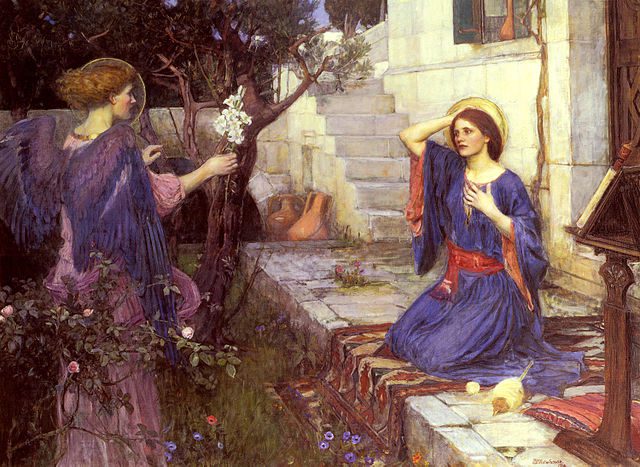
The Annunciation (1914), by John William Waterhouse (1849-1917) [public domain / Wikimedia Commons]

(10-6-11)
This exchange occurred at Cranach: The Blog of Veith: a Lutheran site, in the combox for the post “Mariology.” I was initially responding to the question of how “Catholic” Luther’s Mariology was, later in his life. I said it was relatively more so; others thought the opposite. I gave three quotes from one of my papers on the topic, which were then disputed. I was asked to give full documentation (which I had already done in my existing papers). Then folks started getting very angry about it when I thoroughly backed up my citations . . .
Color coding:
Dr. Gene Veith =blue
fws = green
He cited evidence that Luther had a relatively “Catholic” view of Mary early in his career,
Till his death, too, in many ways. As far as I know, he (along with virtually all early Protestant leaders) never ceased believing in Mary’s perpetual virginity, or the propriety of calling her Mother of God (Theotokos or Mater Dei). He held even later in life a modified version of what Catholics believe in the Immaculate Conception: that Mary was purged of original sin and was sinless at the birth of Christ and after. I have called this view, “Immaculate Purification.” It is like ours insofar as she was freed from original sin by God’s grace at some point; different in that it was not at her conception. The early Luther (as late as 1527 for sure and possibly later) even believed the latter.
Luther wrote in 1540:
In his conception all of Mary’s flesh and blood was purified so that nothing sinful remained. [1]
And in 1543:
. . . a holy virgin . . . freed of original sin and cleansed by the Holy Ghost . . . [2]
And in 1543-1544:
But in the moment of the Virgin’s conception the Holy Spirit purged and sanctified the sinful mass and wiped out the poison of the devil and death, which is sin. Although death remained in that flesh on our account, the leaven of sin was nevertheless purged out, and it became the purest flesh, purified by the Holy Spirit and united with the divine nature in one Person. . . . with the Holy Spirit overshadowing it, active in it, and purging it, in order that it might be fit for this most innocent conception . . .
But later, when the time for assuming the flesh in the womb of the Virgin came, it was purified and sanctified by the power of the Holy Spirit, according to Luke 1:35: “The Holy Spirit will come upon you and will overshadow you.” . . . this flesh He assumed later, after it had been purged, . . .[3]
I don’t think he ever denied that Mary’s Assumption was a perfectly permissible belief, either, though never required in his circles. All of that is far more “Marian” that (I’d venture to guess) maybe 95% of Lutherans today. A lot closer in spirit to us than to y’all, I dare say . . .
You listed a series of Luther quotes in post 31. Would you please do us the favor of giving us the references? Those quotes from Luther dated in the 1540s are really radical [sic] contradictory to Luther’s definition of Original Sin. Because of that fact, I simply don’t believe they are valid quotes. they are either mis translations [sic] or bogus Dave. (10-6-11)
I don’t believe that Luther, not even the Luther of 1521, believed that the Virgin Mary was without sin. Why not? This would have directly warred against the very foundation of his theology. And that theology was this: Only faith knows to be terrified at ALL its best and most virtuous works and so then only faith also knows that it needs to hide ALL those works in the Works of Another.
And it is THIS faith that is Original Righteousness and the Image of God that Adam lost and is now restored in the New Man only through Holy Baptism. So I am certain that Mary had this faith. I am also certain that Luther had no illusion that Mary also lacked an Old Adam. (10-6-11)
They are legitimate quotations. I already gave links where I documented them. Granted, it is work to find them, though, so I’m happy to do all the work.
Example One:
In his conception all of Mary’s flesh and blood was purified so that nothing sinful remained. (1540)
This is the translation of Lutheran scholar Eric W. Gritsch, who was a major translator involved in Luther’s Works, including, for example, the lengthy treatise, Against the Roman Papacy: An Institution of the Devil (vol. 41, 263-376). It comes from the following book:
The One Mediator, the Saints, and Mary, Lutherans and Catholics in Dialogue VIII, edited by H. George Anderson, J. Francis Stafford, Joseph A. Burgess, Minneapolis: Augsburg Fortress Press, 1992.
From Gritsch’s chapter 8, “The Views of Luther and Lutheranism on the Veneration of Mary” (pp. 235-238), but it is in a footnote on p. 381. Here is the fuller context (my bolding):
As Luther put it in 1540: “In his conception all of Mary’s flesh and blood was purified so that nothing sinful remained. Thus Isaiah is correct in saying, ‘There was no deceit in his mouth’ [53:9]. Each seed was corrupt, except that of Mary.”
[footnote 23; p. 381: “Disputation on the Divinity and Humanity of Christ,” February 28, 1540. WA 39/2:107.8-13.]
The primary source is available in its entirety online, translated from the Latin (WA) by Christopher B. Brown:
In that rendering, the same portion is as follows (my bolding and caps):
in conception the flesh and blood OF MARY were entirely purged, so that nothing of sin remained. Therefore Isaiah says rightly, ‘There was no guile found in his mouth’; otherwise, every seed except for Mary’s was corrupted.
Gritsch further observes (my bolding):
Luther’s views on Mary after 1521 are not substantially different from those he presented in the Magnificat. (p. 237)
In 1527 Luther dealt with the Immaculate Conception of Mary, advocating a middle position favored by a majority of theologians. Following Augustine, Luther told his congregation that Mary had been conceived in sin but had been purified by the infusion of her soul after conception. Her purification was complete due to a special intervention of the Holy Spirit, who preserved her from the taint of original sin in anticipation of the birth of Christ. (Ibid., p. 238)
Two scholars doubt whether Luther affirmed the doctrine of the Immaculate Conception of Mary: Preuss (n. 11 above came to the conclusion that Luther rejected the doctrine after 1528; O’Meara states that “it is likely, but not certain” that Luther rejected the doctrine (118 [n. 11 above]). But Tappolet (32 [n. 1 above]) demonstrated with the use of texts that Luther did not change his mind. The literary evidence from Luther’s works clearly supports the view that Luther affirmed the doctrine, but did not consider it necessary to impose it. (Ibid., footnote 43; p. 382)
Example Two:
. . . a holy virgin . . . freed of original sin and cleansed by the Holy Ghost . . . (1543)
This is from Gerhard Falk, in his book, The Jew in Christian Theology: Martin Luther’s Anti-Jewish Vom Schem Hamphoras (McFarland & Co.: 1992, p. 217). This can be viewed online.
See also, Beth Kreitzer, Reforming Mary: Changing Images of the Virgin Mary in Lutheran Sermons of the Sixteenth Century (Oxford University Press: 2004):
In a later writing Luther insists that Mary was ‘saved and purified from original sin through the Holy Spirit’ at some point before Christ’s incarnation, although he does not specify when this happened. [99] (p. 124)
[99] Vom Schem Hamphoras und vom Geschlecht Christi, 1543, WA 53, 640: “[Maria ist] ein heilige Jungfraw, die, von der Erbsunde erloset und gereiniget, durch den heiligen Geist.” Ebtener thinks that because this statement falls in the context of a defense of the incarnation, Luther means that Mary was purified at that point. Others (e.g., Schimmelpfennig) believe that this phrase still supports the immaculate conception. See Ebneter, “Martin Luthers Marienbild,” 78-79. [view online]
See also Bridget Heal, The Cult of the Virgin Mary in Early Modern Germany: Protestant and Catholic Piety, 1500-1648 (Cambridge University Press: 2007):
Yet he still, in 1543, felt able to write that Mary was ‘a holy virgin, who was saved and purified from Original Sin by the Holy Ghost’, although he no longer specified at what point this purification took place. [157] (pp. 58-59)
[157] WA, vol. 53, p. 640. [view online]
Example Three:
But in the moment of the Virgin’s conception the Holy Spirit purged and sanctified the sinful mass and wiped out the poison of the devil and death, which is sin. Although death remained in that flesh on our account, the leaven of sin was nevertheless purged out, and it became the purest flesh, purified by the Holy Spirit and united with the divine nature in one Person. . . . with the Holy Spirit overshadowing it, active in it, and purging it, in order that it might be fit for this most innocent conception . . .
But later, when the time for assuming the flesh in the womb of the Virgin came, it was purified and sanctified by the power of the Holy Spirit, according to Luke 1:35: “The Holy Spirit will come upon you and will overshadow you.” . . . this flesh He assumed later, after it had been purged, . . . (1543-1544)
This is from Luther’s Works (LW), vol. 7, Lectures on Genesis Chapters 38-44 (translated by Paul D. Pahl), excerpts from pp. 12-13 and p. 31. I have this volume (hardcover) in my library (I have some but not all of LW).
In Luther’s reference above to Lk 1:35, the “overshadowing” referred to Mary, not Christ (this is the Annunciation); and Luther tied that in to her flesh being purged and purified. Jesus’ flesh cannot be purged from sin because no sin was ever in it to begin with, based on the Hypostatic Union and His deity. To deny that is again Nestorian heresy and (insofar as Christ is said to be sinful in any sense), I submit, blasphemous.
This is the kind of Christological error that filled the movie, The Last Temptation of Christ. Heaven forbid that Lutherans fall into that. You can’t, according to your own confessions. E.g., Formula of Concord, Solid Declaration, Article I: Original Sin (43-44):
43] Secondly, in the article of Redemption the Scriptures testify forcibly that God’s Son assumed our human nature without sin, so that He was in all things, sin excepted, made like unto us, His brethren, Heb. 2:14. [omit Latin] That is: Hence all the old orthodox teachers have maintained that Christ, according to His assumed humanity, is of one essence with us, His brethren; for He has assumed His human nature, which in all respects (sin alone excepted) is like our human nature in its essence and all essential attributes; and they have condemned the contrary doctrine as manifest heresy.
44] Now, if there were no distinction between the nature or essence of corrupt man and original sin, it must follow that Christ either did not assume our nature, because He did not assume sin, or that, because He assumed our nature, He also assumed sin; both of which ideas are contrary to the Scriptures. But inasmuch as the Son of God assumed our nature, and not original sin, it is clear from this fact that human nature, even since the Fall, and original sin, are not one [and the same] thing, but must be distinguished.
Luther was referring to Mary’s flesh (not her “nature”) that Jesus then received, so that He had a human nature. And what we see in this work can be understood as in line with other similar utterances of Luther’s.
I list dozens of opinions of Lutheran scholars at length in my four papers on the topic.
Someone else objected when I protested at having to provide documentation that I had already provided in my papers. I replied (ticked off a bit at this point, but still in control of myself, as I always am):
I already DID. Past tense: D——I——D. It was all in my papers that I linked to (as I plainly stated). Why am I required to do all that work when I already did it? I’m not. We have search capacities now (Ctrl-F). Things can be located in one second. I have no such obligation to produce what I already have, online, for the record. I don’t have unlimited time.
But I did it anyway, so we can be rid of silly complaints. . . . in this case it was all thoroughly done already: documented to the nth degree, in existing papers. If anyone is able to read, they can find them, if they are so concerned about it and want to question their validity.
Links are wonderful. We can link now and say: “the sources are over there if you wanna see ‘em.” It’s like a high-tech footnote. But the Luther quotes ARE THERE! They exist! I pulled them out in a more convenient manner and now anyone can see for themselves. If they wanna pick a fight with Luther’s Works, Gritsch (one of the guys in LW) et al, questioning their translation and understanding of same (now Gritsch is in the business of offering “bogus” Luther quotes?), I would enjoy watching that.
***
Previous Post
November 12, 2015
Reply to Lutheran Gene Edward Veith on Mariology
Next Post
November 13, 2015 "Vain Repetition": Jesus Shows Us By Example What it is NOT
Browse Our Archives
Select a Category & Last Things About Me Anti-Catholicism Atheism & Agnosticism Baptism and Sacramentalism Bible and Tradition Blessed Virgin Mary Books by Dave Armstrong C. S. Lewis Calvinism & General Protestantism Catholic Apologetics Catholic Apologists Catholic conversion Catholic converts Christmas Church (Ecclesiology) Church History Conversion and Converts Development of Doctrine Eastern Orthodoxy Ecumenism & Christian Unity Eucharist & Liturgy Fathers of the Church French Translations G. K. Chesterton Hell Hell & Satan Hell & Satan & Last Things Heresies & Comparative Religion Holistic Health Inquisition & Crusades & Scandals James White Jews & Judaism & Old Testament John Calvin John Henry Newman Liberal / Modernist Theology Life Issues Literary Resume Lutheranism Mariology Martin Luther Music Orthodoxy Papacy & Infallibility Personal Page Philosophy & Science Political & Ethical & Moral Issues Protestant Persecution & Intolerance Protestantism Purgatory Purgatory & Penance Romantic & Imaginative Theology Saints & Purgatory & Penance Salvation Salvation & Justification Satan & Last Things Sexuality and Gender Issues Spanish Translations Traditionalism vs. Radical Catholic Reactionaries Traducciones al español / tradução para português Trinitarianism & Christology Uncategorized Videos
Select a Month October 2026 September 2026 August 2026 July 2026 June 2026 May 2026 April 2026 March 2026 February 2026 January 2026 December 2025 November 2025 October 2025 September 2025 August 2025 July 2025 June 2025 May 2025 April 2025 March 2025 February 2025 January 2025 December 2024 November 2024 October 2024 September 2024 August 2024 July 2024 June 2024 May 2024 April 2024 March 2024 February 2024 January 2024 December 2023 November 2023 October 2023 September 2023 August 2023 July 2023 June 2023 May 2023 April 2023 March 2023 February 2023 January 2023 December 2022 November 2022 October 2022 September 2022 August 2022 July 2022 June 2022 May 2022 April 2022 March 2022 February 2022 January 2022 December 2021 November 2021 October 2021 September 2021 August 2021 July 2021 June 2021 May 2021 April 2021 March 2021 February 2021 January 2021 December 2020 November 2020 October 2020 September 2020 August 2020 July 2020 June 2020 May 2020 April 2020 March 2020 February 2020 January 2020 December 2019 November 2019 October 2019 September 2019 August 2019 July 2019 June 2019 May 2019 April 2019 March 2019 February 2019 January 2019 December 2018 November 2018 October 2018 September 2018 August 2018 July 2018 June 2018 May 2018 April 2018 March 2018 February 2018 January 2018 December 2017 November 2017 October 2017 September 2017 August 2017 July 2017 June 2017 May 2017 April 2017 March 2017 February 2017 January 2017 December 2016 November 2016 October 2016 September 2016 August 2016 July 2016 June 2016 May 2016 April 2016 March 2016 February 2016 January 2016 December 2015 November 2015 October 2015 September 2015 August 2015 July 2015 June 2015 May 2015 April 2015 March 2015 February 2015 January 2015 December 2014 November 2014 October 2014 September 2014 August 2014 July 2014 June 2014 April 2014 March 2014 February 2014 January 2014 December 2013 November 2013 October 2013 September 2013 August 2013 July 2013 June 2013 April 2013 March 2013 February 2013 January 2013 December 2012 November 2012 October 2012 September 2012 August 2012 July 2012 June 2012 May 2012 April 2012 March 2012 February 2012 January 2012 December 2011 November 2011 October 2011 September 2011 August 2011 July 2011 June 2011 April 2011 March 2011 February 2011 October 2010 September 2010 August 2010 July 2010 April 2010 March 2010 December 2009 October 2009 August 2009 July 2009 June 2009 May 2009 March 2009 February 2009 October 2008 September 2008 April 2008 March 2008 February 2008 January 2008 December 2007 November 2007 October 2007 May 2007 March 2007 February 2007 January 2007 November 2006 October 2006 September 2006 August 2006 July 2006 June 2006 May 2006 April 2006 March 2006 February 2006 October 2005 June 2005 April 2005 February 2005 July 2004 May 2004 April 2004
Follow Us!
TAKE THE
Religious Wisdom Quiz
Where was Paul's hometown?
Select your answer to see how you score.
Damascus Tarsus Antioch Jerusalem
Books by This Author Books by Dave Armstrong
Related posts from Biblical Evidence for Catholicism

Does Catholic Intercession of Saints Require Omniscience?
Biblical Evidence for Catholicism

Holy Ground: Why Mary Had NO Other Children...
Biblical Evidence for Catholicism
Protestant Confessions & "Ever-Virgin" Mary
Biblical Evidence for Catholicism

Jesus Founded the [Catholic] Church. If Not Him,...
Biblical Evidence for Catholicism
TRENDING AT PATHEOS Catholic

The Sermon on the Mount, Part I: Matthew...
The Sermon on the Mount, Part I (Matthew 4:12-5:12) St. Matthew moves...

What's up from Crossway: Reviewing some of their latest A few weeks...

Janie Learns the Way of the Cross: A...
Teaching children about Jesus' Passion can be challenging. Many parents and educators...

Looking For Good Catholic Writing - October 2026
He alone extends the heavens, and he walks upon the waves of...

In "Irreplaceable," our book on vocation and technology, Trevor Sutton and I...

I was strolling through the top floor of the brand new Parthenon...
view all Catholic blogs
Ad-Free & Subscriber Log-In Subscription Support
- About Us
- 2026 Calendar
- Videos
- Podcasts
- Library of World Religions
- Faith In Media Tracker
- Advertise With Us
- Write for Us
- Privacy Policy
- Terms of Service
- Do Not Sell My Data
- Contact Us
- Radiant Digital
- Manage Newsletter Subscriptions
- Unsubscribe From Notifications
- Sitemap
Copyright 2008-2026, Patheos. All rights reserved.
Subscription Support Ad-Free & Subscriber Log-In
Follow Patheos