
BuddhistCatholicContemplativeEvangelicalGeneral ChristianHinduJewishLatter-day SaintMuslimNew VisionsProgressive Christian
Beliefs
- Buddhist
- Catholic
- Contemplative
- Evangelical
- General Christian
- Hindu
- Jewish
- Latter-day Saint
- More Voices
- Muslim
- New Visions
- Pagan
- Progressive Christian
Topics
- Religion News
- Food and Religion
- Sports and Religion
- Religious Art
- Religious Music and Entertainment
- Religious Events
- History and Religion
- Style and Religion
- Politics and Religion
- Women in Religion
- Recreation Outdoors and Religion
- Business Finance and Religion
- Careers Workplace and Religion
- Education and Religion
- Family Parenting and Religion
- Health Fitness and Religion
- Home and Religion
- Relationships and Religion
- Technology and Religion
- Travel and Religion
Columnists
- Buddhist Columnists
- Business Finance and Religion Columnists
- Careers Workplace and Religion Columnists
- Catholic Columnists
- Contemplative Columnists
- Education and Religion Columnists
- Evangelists Columnists
- Family Parenting and Religion Columnists
- General Christian Columnists
- Health Fitness and Religion Columnists
- Hindu Columnists
- History and Religion Columnists
- Home and Religion Columnists
- Jewish Columnists
- More Voices Columnists
- Latter Day Columnists
- Muslim Columnists
- New Visions Columnists
- Nonreligious Columnists
- Pagan Columnists
- Politics and Religion Columnists
- Progressive Columnists
- Recreation Outdoors and Religion Columnists
- Relationships and Religion Columnists
- Religion News Columnists
- Religious Art Columnists
- Religious Events Columnists
- Religious Music and Entertainment Columnists
- Sports and Religion Columnists
- Style and Religion Columnists
- Technology and Religion Columnists
- Travel and Religion Columnists
- Women in Religion Columnists
Resource Library
- 2026 Calendar
- Library of World Religions
- The 100 Most Holy Places on Earth
- Patheos Answers
- Podcasts
- Videos
- Faith Leaders Database
- Anglican Episcopalian
- Bahai
- Baptist
- Buddhism
- Christianity
- Confucianism
- Eastern Orthodoxy
- Hinduism
- Holiness and Pentecostal
- ISKCON
- Islam
- Judaism
- Lutheran
- Methodist
- The Church of Jesus Christ of Latter-day Saints
- New Age
- Paganism
- Presbytarian and Reformed
- Protestantism
- Religion Behind the Scenes
- Roman Catholic
- Scientology
- Shia Islam
- Sikhism
- Sufism
- Sunni Islam
- Taoism
- Zen
- See all religions
Research Tools
 Ad-Free & Subscriber Log-In Subscription Support
Ad-Free & Subscriber Log-In Subscription Support
Follow Patheos 

- Trending:
- Forgiveness
- |
- Marriage
- |
- Consciousness
- |
- Death Penalty
- |
- Election
- |
- Halloween

-
About
-
Catholic Apologetics
-
Church History
-
Great Apologists
-
Christian Worldview
-
Protestantism & Misc.
- Home
- Catholic
- History and Religion
- Is the Catholic Mass a “Re-Sacrifice” of Jesus Christ?
Is the Catholic Mass a “Re-Sacrifice” of Jesus Christ?
Last updated on: April 25, 2017 at 1:41 pm by Dave Armstrong
Is the Catholic Mass a “Re-Sacrifice” of Jesus Christ? 2017-04-25T13:41:49-04:00 Dave Armstrong
Patheos Explore the world's faith through different perspectives on religion and spirituality! Patheos has the views of the prevalent religions and spiritualities of the world.
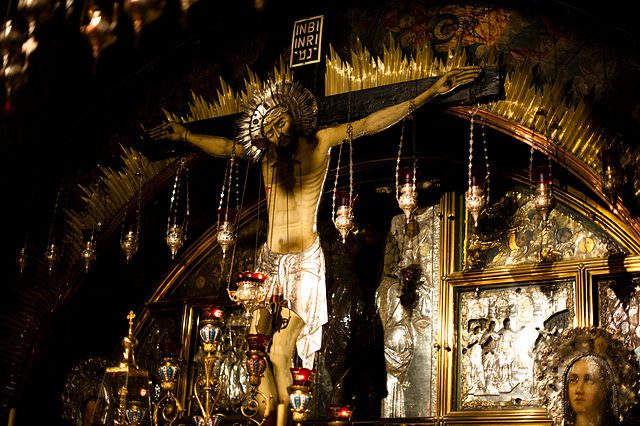
Golgotha, in Jerusalem: the actual spot where Jesus was crucified. The white rock is underneath. I worshiped there a year ago (October 2014), touched the rock, and went to Mass right next to the spot. The spiritual experience of that was unbelievably profound: scarcely able to be put into words. Photo by “Almonroth”: 7 August 2011 [Wikimedia Commons / Creative Commons Attribution-Share Alike 3.0 Unported license]

* * * * *
The Bible plainly rules out the notion of Jesus being “re-sacrificed”:
Hebrews 7:27 (RSV) He has no need, like those high priests, to offer sacrifices daily, first for his own sins and then for those of the people; he did this once for all when he offered up himself. (cf. 9:12)
Hebrews 9:24-26 For Christ has entered, not into a sanctuary made with hands, a copy of the true one, but into heaven itself, now to appear in the presence of God on our behalf. [25] Nor was it to offer himself repeatedly, as the high priest enters the Holy Place yearly with blood not his own; [26] for then he would have had to suffer repeatedly since the foundation of the world. But as it is, he has appeared once for all at the end of the age to put away sin by the sacrifice of himself. (cf. 9:27-28)
The crucifixion was a one-time historical event. We must keep in mind, however, that Jesus is God. He was subject to time in His human nature, but in His Divine Nature, He is outside of time. Jesus is called “a priest for ever”: not for six hours on the cross only:
Hebrews 5:6 as he says also in another place, “Thou art a priest for ever, after the order of Melchiz’edek.” (cf. 6:20; 7:24)
Thus, the Apostle John referred to Jesus in heaven (after His resurrection and ascension) as “a Lamb standing, as though it had been slain”:
Revelation 5:6 And between the throne and the four living creatures and among the elders, I saw a Lamb standing, as though it had been slain, with seven horns and with seven eyes, which are the seven spirits of God sent out into all the earth; (cf. Heb 8:1; 9:24 above)
In this sense, the one crucifixion is “eternally present” and supernaturally “brought to us” in the Sacrifice of the Mass. The texts refer to the definitive, end-all nature of the crucifixion, but not to some solely natural, timebound analysis of it. The Council of Trent (Session 22, Chapter II), stated:
And forasmuch as, in this divine sacrifice which is celebrated in the mass, that same Christ is contained and immolated in an unbloody manner, who once offered Himself in a bloody manner on the altar of the cross; the holy Synod teaches, that this sacrifice is truly propitiatory and that by means thereof this is effected, that we obtain mercy, and find grace in seasonable aid, . . . For the victim is one and the same, the same now offering by the ministry of priests, who then offered Himself on the cross, the manner alone of offering being different. The fruits indeed of which oblation, of that bloody one to wit, are received most plentifully through this unbloody one; so far is this (latter) from derogating in any way from that (former oblation).
First of all, there is the differentiation (first sentence) between “unbloody manner” and “once offered Himself in a bloody manner on the altar of the cross” – thus showing that the former is not regarded as the latter, repeated over and over again (as the contra-Catholic reasoning would claim), but rather, a different means of bringing the one sacrifice to us.
Secondly, there is the phrase, “the manner alone of offering being different,” thus showing that it is one sacrifice being re-presented (different “manner”).
Moreover, the phrase, “The fruits indeed of . . . that bloody one to wit, are received most plentifully through this unbloody one” shows that the reference was back to Calvary, whose benefits accrues to those partaking of Holy Communion, not to some imagined “repeated bloody sacrifice.”
To drive home the point in a different way, the council reiterates, “so far is this (latter) from derogating in any way from that (former oblation).” The plain language of Chapter I reiterates this:
He, therefore, our God and Lord, though He was about to offer Himself once on the altar of the cross unto God the Father, by means of his death, there to operate an eternal redemption; nevertheless, because that His priesthood was not to be extinguished by His death, in the last supper, on the night in which He was betrayed, – that He might leave, to His own beloved Spouse the Church, a visible sacrifice, such as the nature of man requires, whereby that bloody sacrifice, once to be accomplished on the cross, might be represented, . . . declaring Himself constituted a priest for ever, according to the order of Melchisedech, . . .
Perhaps the language of Trent was not as careful and precise as it should be (one can always argue about style and content of words), but I think a reasonable reading of it arrives at the conclusions that Catholics hold, and have always held.
Another important factor in all this is the lack of understanding of the patristic background. The notion of eucharistic sacrifice (in the Catholic sense) was common in the Church fathers’ writings. Thus, one might misinterpret what Trent expressed, and come up with the notion of “sacrificed again and again”. But if the patristic background is known, then it is seen as merely further development of what had been believed long since.
As a man, Jesus’ sacrifice was in time and history. As God, outside of time (from that perspective), it is not. His being God brings in a “supra-historical” aspect in which time is transcended. This is what Protestants often seem to neglect. If Jesus is our high priest forever He is still offering Himself, out of time, because that’s what priests do. Otherwise, what is the “pure offering” of Malachi 1:11?
If His Body and Blood are truly present in the Eucharist, then the sacrifice on the cross also must be present in some sense, since that is where the sacrifice took place, and why we talk about Body and Blood at all. One can’t be separated from the other.
Previous Post

November 19, 2015
Atheist Insulter Extraordinaire: Acid-Mouthed Pete Migdale
Next Post

November 19, 2015 Exchanges with Atheists on the Ultimate Origin of the Universe
Browse Our Archives
Select a Category & Last Things About Me Anti-Catholicism Atheism & Agnosticism Baptism and Sacramentalism Bible and Tradition Blessed Virgin Mary Books by Dave Armstrong C. S. Lewis Calvinism & General Protestantism Catholic Apologetics Catholic Apologists Catholic conversion Catholic converts Christmas Church (Ecclesiology) Church History Conversion and Converts Development of Doctrine Eastern Orthodoxy Ecumenism & Christian Unity Eucharist & Liturgy Fathers of the Church French Translations G. K. Chesterton Hell Hell & Satan Hell & Satan & Last Things Heresies & Comparative Religion Holistic Health Inquisition & Crusades & Scandals James White Jews & Judaism & Old Testament John Calvin John Henry Newman Liberal / Modernist Theology Life Issues Literary Resume Lutheranism Mariology Martin Luther Music Orthodoxy Papacy & Infallibility Personal Page Philosophy & Science Political & Ethical & Moral Issues Protestant Persecution & Intolerance Protestantism Purgatory Purgatory & Penance Romantic & Imaginative Theology Saints & Purgatory & Penance Salvation Salvation & Justification Satan & Last Things Sexuality and Gender Issues Spanish Translations Traditionalism vs. Radical Catholic Reactionaries Traducciones al español / tradução para português Trinitarianism & Christology Uncategorized Videos
Select a Month October 2026 September 2026 August 2026 July 2026 June 2026 May 2026 April 2026 March 2026 February 2026 January 2026 December 2025 November 2025 October 2025 September 2025 August 2025 July 2025 June 2025 May 2025 April 2025 March 2025 February 2025 January 2025 December 2024 November 2024 October 2024 September 2024 August 2024 July 2024 June 2024 May 2024 April 2024 March 2024 February 2024 January 2024 December 2023 November 2023 October 2023 September 2023 August 2023 July 2023 June 2023 May 2023 April 2023 March 2023 February 2023 January 2023 December 2022 November 2022 October 2022 September 2022 August 2022 July 2022 June 2022 May 2022 April 2022 March 2022 February 2022 January 2022 December 2021 November 2021 October 2021 September 2021 August 2021 July 2021 June 2021 May 2021 April 2021 March 2021 February 2021 January 2021 December 2020 November 2020 October 2020 September 2020 August 2020 July 2020 June 2020 May 2020 April 2020 March 2020 February 2020 January 2020 December 2019 November 2019 October 2019 September 2019 August 2019 July 2019 June 2019 May 2019 April 2019 March 2019 February 2019 January 2019 December 2018 November 2018 October 2018 September 2018 August 2018 July 2018 June 2018 May 2018 April 2018 March 2018 February 2018 January 2018 December 2017 November 2017 October 2017 September 2017 August 2017 July 2017 June 2017 May 2017 April 2017 March 2017 February 2017 January 2017 December 2016 November 2016 October 2016 September 2016 August 2016 July 2016 June 2016 May 2016 April 2016 March 2016 February 2016 January 2016 December 2015 November 2015 October 2015 September 2015 August 2015 July 2015 June 2015 May 2015 April 2015 March 2015 February 2015 January 2015 December 2014 November 2014 October 2014 September 2014 August 2014 July 2014 June 2014 April 2014 March 2014 February 2014 January 2014 December 2013 November 2013 October 2013 September 2013 August 2013 July 2013 June 2013 April 2013 March 2013 February 2013 January 2013 December 2012 November 2012 October 2012 September 2012 August 2012 July 2012 June 2012 May 2012 April 2012 March 2012 February 2012 January 2012 December 2011 November 2011 October 2011 September 2011 August 2011 July 2011 June 2011 April 2011 March 2011 February 2011 October 2010 September 2010 August 2010 July 2010 April 2010 March 2010 December 2009 October 2009 August 2009 July 2009 June 2009 May 2009 March 2009 February 2009 October 2008 September 2008 April 2008 March 2008 February 2008 January 2008 December 2007 November 2007 October 2007 May 2007 March 2007 February 2007 January 2007 November 2006 October 2006 September 2006 August 2006 July 2006 June 2006 May 2006 April 2006 March 2006 February 2006 October 2005 June 2005 April 2005 February 2005 July 2004 May 2004 April 2004
Follow Us!
TAKE THE
Religious Wisdom Quiz
What does "Pentateuch" mean?
Select your answer to see how you score.
Five Scrolls God's Law Sacred Teachings Holy Writings
Books by This Author Books by Dave Armstrong
Related posts from Biblical Evidence for Catholicism

Three More Anti-Catholic Lies About Catholicism (#6-4)
Biblical Evidence for Catholicism

Top Ten Anti-Catholic Lies (#10-7)
Biblical Evidence for Catholicism

The Mass & Development of Doctrine (vs. Wes...
Biblical Evidence for Catholicism

Miraculous Eucharist (vs. Francois Turretin #4)
Biblical Evidence for Catholicism
TRENDING AT PATHEOS Catholic

In "Irreplaceable," our book on vocation and technology, Trevor Sutton and I...

I was strolling through the top floor of the brand new Parthenon...

What Does Gêvâh Mean For Kimberley Guifoyle &...
This week, a lot of the news is focused on Kimberly Guilfoyle....

INNER CIRCLE: Profound Mystery (Of Christ In All...
Ephesians 5:31-32 “For this reason, a man will leave his father and...

Do Not Rejoice When Your Enemy Falls: The...
Turning an execution into a public spectacle is a disturbing expression of...

'The Chosen' S6 Trailer: The Passion Gets Very...
Not many watching 'The Chosen' worry about spoilers, but just because they...
view all Catholic blogs
Ad-Free & Subscriber Log-In Subscription Support
- About Us
- 2026 Calendar
- Videos
- Podcasts
- Library of World Religions
- Faith In Media Tracker
- Advertise With Us
- Write for Us
- Privacy Policy
- Terms of Service
- Do Not Sell My Data
- Contact Us
- Radiant Digital
- Manage Newsletter Subscriptions
- Unsubscribe From Notifications
- Sitemap
Copyright 2008-2026, Patheos. All rights reserved.
Subscription Support Ad-Free & Subscriber Log-In
Follow Patheos