
BuddhistCatholicContemplativeEvangelicalGeneral ChristianHinduJewishLatter-day SaintMuslimNew VisionsProgressive Christian
Beliefs
- Buddhist
- Catholic
- Contemplative
- Evangelical
- General Christian
- Hindu
- Jewish
- Latter-day Saint
- More Voices
- Muslim
- New Visions
- Pagan
- Progressive Christian
Topics
- Religion News
- Food and Religion
- Sports and Religion
- Religious Art
- Religious Music and Entertainment
- Religious Events
- History and Religion
- Style and Religion
- Politics and Religion
- Women in Religion
- Recreation Outdoors and Religion
- Business Finance and Religion
- Careers Workplace and Religion
- Education and Religion
- Family Parenting and Religion
- Health Fitness and Religion
- Home and Religion
- Relationships and Religion
- Technology and Religion
- Travel and Religion
Columnists
- Buddhist Columnists
- Business Finance and Religion Columnists
- Careers Workplace and Religion Columnists
- Catholic Columnists
- Contemplative Columnists
- Education and Religion Columnists
- Evangelists Columnists
- Family Parenting and Religion Columnists
- General Christian Columnists
- Health Fitness and Religion Columnists
- Hindu Columnists
- History and Religion Columnists
- Home and Religion Columnists
- Jewish Columnists
- More Voices Columnists
- Latter Day Columnists
- Muslim Columnists
- New Visions Columnists
- Nonreligious Columnists
- Pagan Columnists
- Politics and Religion Columnists
- Progressive Columnists
- Recreation Outdoors and Religion Columnists
- Relationships and Religion Columnists
- Religion News Columnists
- Religious Art Columnists
- Religious Events Columnists
- Religious Music and Entertainment Columnists
- Sports and Religion Columnists
- Style and Religion Columnists
- Technology and Religion Columnists
- Travel and Religion Columnists
- Women in Religion Columnists
Resource Library
- 2026 Calendar
- Library of World Religions
- The 100 Most Holy Places on Earth
- Patheos Answers
- Podcasts
- Videos
- Faith Leaders Database
- Anglican Episcopalian
- Bahai
- Baptist
- Buddhism
- Christianity
- Confucianism
- Eastern Orthodoxy
- Hinduism
- Holiness and Pentecostal
- ISKCON
- Islam
- Judaism
- Lutheran
- Methodist
- The Church of Jesus Christ of Latter-day Saints
- New Age
- Paganism
- Presbytarian and Reformed
- Protestantism
- Religion Behind the Scenes
- Roman Catholic
- Scientology
- Shia Islam
- Sikhism
- Sufism
- Sunni Islam
- Taoism
- Zen
- See all religions
Research Tools
 Ad-Free & Subscriber Log-In Subscription Support
Ad-Free & Subscriber Log-In Subscription Support
Follow Patheos 

- Trending:
- Forgiveness
- |
- Marriage
- |
- Consciousness
- |
- Death Penalty
- |
- Election
- |
- Halloween

-
About
-
Catholic Apologetics
-
Church History
-
Great Apologists
-
Christian Worldview
-
Protestantism & Misc.
- Home
- Catholic
- History and Religion
- “Catholic Justification” as Seen in James and Romans
“Catholic Justification” as Seen in James and Romans
Last updated on: April 25, 2017 at 2:01 pm by Dave Armstrong
“Catholic Justification” as Seen in James and Romans 2017-04-25T14:01:33-04:00 Dave Armstrong
Patheos Explore the world's faith through different perspectives on religion and spirituality! Patheos has the views of the prevalent religions and spiritualities of the world.
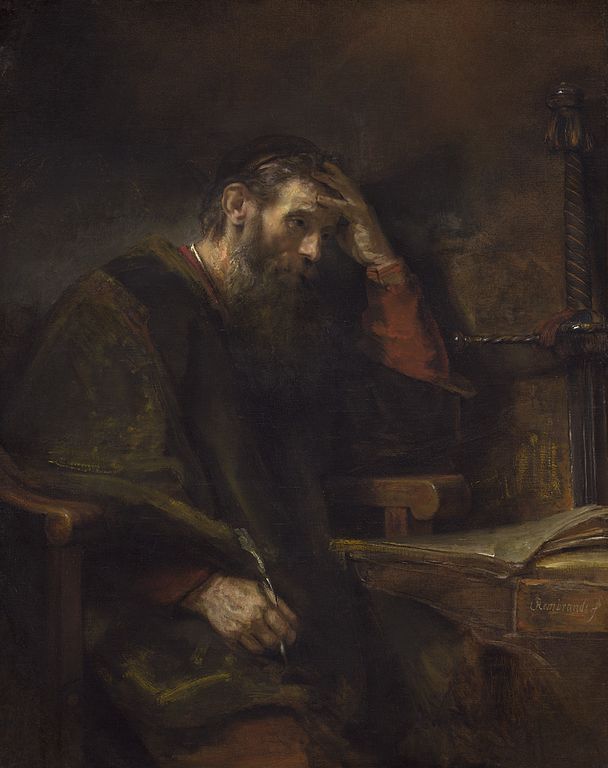
The Apostle Paul (c. 1657), by Rembrandt (1606-1669) [public domain / Wikimedia Commons]

* * * * *
Catholics believe in Jesus Christ and His all-sufficient saving work on the cross (ours to receive by Grace Alone), just as Protestants do. We only deny an extreme Faith Alone position (which does not deny Grace Alone, since they are distinct).
St. Paul opposes grace and/or faith to works in Scripture, only in a particular sense: the “works” of Jewish ritualism by which the Jews gained their unique identity (e.g., circumcision).
The Apostle Paul doesn’t oppose grace, faith, and works, and in fact, constantly puts them together, in harmony. Here are two typical examples:
1 Corinthians 15:10 (RSV, as throughout) But by the grace of God I am what I am, and his grace toward me was not in vain. On the contrary, I worked harder than any of them, though it was not I, but the grace of God which is with me.
2 Corinthians 6:1 Working together with him, then, we entreat you not to accept the grace of God in vain.
Grace and works are for Paul, quite hand-in-hand, just as faith and works are. We Catholics only pit grace against works insofar as we deny (with Protestants) that man can save himself. Trent is very clear on that. We vigorously deny works-salvation. Scripture doesn’t teach faith alone at all; nor do the Church fathers. In fact, the only time the phrase appears in the Bible, it is expressly denied:
James 2:24 You see that a man is justified by works and not by faith alone.
St. Paul states:
Romans 3:28 For we hold that a man is justified by faith apart from works of law. (cf. 3:20; 3:24: “justified by his grace as a gift”)
But “justified by faith” is different from “justified by faith alone”. The “works of the law” he refers to here are not all works, but things like circumcision. In other words, we are saved apart from Jewish rituals required under Mosaic Law. Paul makes clear that this is what he has in mind, in referencing circumcision in 3:1, asking rhetorically, “Are we Jews any better off? No, not at all” (3:9), multiple references to “the law” (3:19-21, 28, 31), and the following statement:
Romans 3:29-30 Or is God the God of Jews only? Is he not the God of Gentiles also? Yes, of Gentiles also, [30] since God is one; and he will justify the circumcised on the ground of their faith and the uncircumcised through their faith.
Paul is not against all “works” per se; he tied them directly to salvation, after all, in the previous chapter:
Romans 2:6-8 For he will render to every man according to his works: [7] to those who by patience in well-doing seek for glory and honor and immortality, he will give eternal life; [8] but for those who are factious and do not obey the truth, but obey wickedness, there will be wrath and fury.(cf. 2:13: “the doers of the law who will be justified”)
Paul uses the example of Abraham in Romans 4, in emphasizing faith, over against the Jewish works of circumcision as a supposed means of faith and justification (hence, he mentions circumcision in 4:9-12, and salvation to the Gentiles as well as Jews in 4:13-18).
Abraham’s justification is also discussed in James 2, and there it is explicitly tied in with works, thus providing a perfect complementary (very “Catholic”) balance with Romans 4:
James 2:20-26 Do you want to be shown, you shallow man, that faith apart from works is barren? [21] Was not Abraham our father justified by works, when he offered his son Isaac upon the altar? [22] You see that faith was active along with his works, and faith was completed by works, [23] and the scripture was fulfilled which says, “Abraham believed God, and it was reckoned to him as righteousness”; and he was called the friend of God. [24] You see that a man is justified by works and not by faith alone. [25] And in the same way was not also Rahab the harlot justified by works when she received the messengers and sent them out another way? [26] For as the body apart from the spirit is dead, so faith apart from works is dead.
This is a wonderful cross-reference to Romans 4 in another respect: both cite the same Old Testament passage (Gen 15:6: seen in Rom 4:3 and James 2:23; also Gal 3:6). James, however, gives an explicit interpretation of the Old Testament passage, by stating, “and the scripture was fulfilled which says, . . .” (2:23). The previous three verses were all about justification, faith, and works, all tied in together, and this is what James says “fulfilled” Genesis 15:6. The next verse then condemns the notion of “faith alone” in the clearest way imaginable.
Scripture has to be interpreted as a harmonious whole. We Catholics can easily do that with these two passages: Roman 4 shows that the specific works of the Law that Jews lived by were not absolutely necessary for salvation, and that Abraham’s faith was the key, while James 2 is discussing the organic connection between faith and works (in a general sense, using the willingness to sacrifice Issac as an example), thus showing how “faith alone” is a meaningless and unscriptural concept: faith can never be totally separated from works, except in initial justification, since (in Catholic teaching as well as Protestant) no work we do can bring us initially to justification: that is all God’s grace.
James 2 is usually applied by Protestants to sanctification, but that is not what the passage asserts. It mentions “justified” (dikaioo: Strong’s word #1344) three times (2:21, 24-25): the same Greek word used in Romans 4:2, as well as 2:13; 3:20, 24, 28; 5:1, 9; 8:30; 1 Corinthians 6:11; Galatians 2:16-17; 3:11, 24; 5:4; and Titus 3:7. If James actually meant sanctification, on the other hand, he could have used one of two Greek words ( hagiazo / hagiasmos: Strong’s #37-38) that appear (together) 38 times in the New Testament (the majority of times by Paul himself).
Previous Post

November 17, 2015
Dialogue on Religious Epistemology with an Agnostic
Next Post
November 18, 2015 The Biblical Evidence for Confession and Absolution
Browse Our Archives
Select a Category & Last Things About Me Anti-Catholicism Atheism & Agnosticism Baptism and Sacramentalism Bible and Tradition Blessed Virgin Mary Books by Dave Armstrong C. S. Lewis Calvinism & General Protestantism Catholic Apologetics Catholic Apologists Catholic conversion Catholic converts Christmas Church (Ecclesiology) Church History Conversion and Converts Development of Doctrine Eastern Orthodoxy Ecumenism & Christian Unity Eucharist & Liturgy Fathers of the Church French Translations G. K. Chesterton Hell Hell & Satan Hell & Satan & Last Things Heresies & Comparative Religion Holistic Health Inquisition & Crusades & Scandals James White Jews & Judaism & Old Testament John Calvin John Henry Newman Liberal / Modernist Theology Life Issues Literary Resume Lutheranism Mariology Martin Luther Music Orthodoxy Papacy & Infallibility Personal Page Philosophy & Science Political & Ethical & Moral Issues Protestant Persecution & Intolerance Protestantism Purgatory Purgatory & Penance Romantic & Imaginative Theology Saints & Purgatory & Penance Salvation Salvation & Justification Satan & Last Things Sexuality and Gender Issues Spanish Translations Traditionalism vs. Radical Catholic Reactionaries Traducciones al español / tradução para português Trinitarianism & Christology Uncategorized Videos
Select a Month October 2026 September 2026 August 2026 July 2026 June 2026 May 2026 April 2026 March 2026 February 2026 January 2026 December 2025 November 2025 October 2025 September 2025 August 2025 July 2025 June 2025 May 2025 April 2025 March 2025 February 2025 January 2025 December 2024 November 2024 October 2024 September 2024 August 2024 July 2024 June 2024 May 2024 April 2024 March 2024 February 2024 January 2024 December 2023 November 2023 October 2023 September 2023 August 2023 July 2023 June 2023 May 2023 April 2023 March 2023 February 2023 January 2023 December 2022 November 2022 October 2022 September 2022 August 2022 July 2022 June 2022 May 2022 April 2022 March 2022 February 2022 January 2022 December 2021 November 2021 October 2021 September 2021 August 2021 July 2021 June 2021 May 2021 April 2021 March 2021 February 2021 January 2021 December 2020 November 2020 October 2020 September 2020 August 2020 July 2020 June 2020 May 2020 April 2020 March 2020 February 2020 January 2020 December 2019 November 2019 October 2019 September 2019 August 2019 July 2019 June 2019 May 2019 April 2019 March 2019 February 2019 January 2019 December 2018 November 2018 October 2018 September 2018 August 2018 July 2018 June 2018 May 2018 April 2018 March 2018 February 2018 January 2018 December 2017 November 2017 October 2017 September 2017 August 2017 July 2017 June 2017 May 2017 April 2017 March 2017 February 2017 January 2017 December 2016 November 2016 October 2016 September 2016 August 2016 July 2016 June 2016 May 2016 April 2016 March 2016 February 2016 January 2016 December 2015 November 2015 October 2015 September 2015 August 2015 July 2015 June 2015 May 2015 April 2015 March 2015 February 2015 January 2015 December 2014 November 2014 October 2014 September 2014 August 2014 July 2014 June 2014 April 2014 March 2014 February 2014 January 2014 December 2013 November 2013 October 2013 September 2013 August 2013 July 2013 June 2013 April 2013 March 2013 February 2013 January 2013 December 2012 November 2012 October 2012 September 2012 August 2012 July 2012 June 2012 May 2012 April 2012 March 2012 February 2012 January 2012 December 2011 November 2011 October 2011 September 2011 August 2011 July 2011 June 2011 April 2011 March 2011 February 2011 October 2010 September 2010 August 2010 July 2010 April 2010 March 2010 December 2009 October 2009 August 2009 July 2009 June 2009 May 2009 March 2009 February 2009 October 2008 September 2008 April 2008 March 2008 February 2008 January 2008 December 2007 November 2007 October 2007 May 2007 March 2007 February 2007 January 2007 November 2006 October 2006 September 2006 August 2006 July 2006 June 2006 May 2006 April 2006 March 2006 February 2006 October 2005 June 2005 April 2005 February 2005 July 2004 May 2004 April 2004
Follow Us!
TAKE THE
Religious Wisdom Quiz
Who was Jacob's first wife?
Select your answer to see how you score.
Rachel Dinah Leah Rebekah
Books by This Author Books by Dave Armstrong
Related posts from Biblical Evidence for Catholicism

Bible & Catholicism on Mortal Sin (vs. John...
Biblical Evidence for Catholicism

Dialogue on Eternal Security / Absolute Assurance
Biblical Evidence for Catholicism

"Faith Alone" Dialogue with a Calvinist
Biblical Evidence for Catholicism

Exegesis of 75 NT Faith [Alone?] & Works...
Biblical Evidence for Catholicism
TRENDING AT PATHEOS Catholic

The Sermon on the Mount, Part I: Matthew...
The Sermon on the Mount, Part I (Matthew 4:12-5:12) St. Matthew moves...

What's up from Crossway: Reviewing some of their latest A few weeks...

Janie Learns the Way of the Cross: A...
Teaching children about Jesus' Passion can be challenging. Many parents and educators...

Looking For Good Catholic Writing - October 2026
He alone extends the heavens, and he walks upon the waves of...

In "Irreplaceable," our book on vocation and technology, Trevor Sutton and I...

I was strolling through the top floor of the brand new Parthenon...
view all Catholic blogs
Ad-Free & Subscriber Log-In Subscription Support
- About Us
- 2026 Calendar
- Videos
- Podcasts
- Library of World Religions
- Faith In Media Tracker
- Advertise With Us
- Write for Us
- Privacy Policy
- Terms of Service
- Do Not Sell My Data
- Contact Us
- Radiant Digital
- Manage Newsletter Subscriptions
- Unsubscribe From Notifications
- Sitemap
Copyright 2008-2026, Patheos. All rights reserved.
Subscription Support Ad-Free & Subscriber Log-In
Follow Patheos