
BuddhistCatholicContemplativeEvangelicalGeneral ChristianHinduJewishLatter-day SaintMuslimNew VisionsProgressive Christian
Beliefs
- Buddhist
- Catholic
- Contemplative
- Evangelical
- General Christian
- Hindu
- Jewish
- Latter-day Saint
- More Voices
- Muslim
- New Visions
- Pagan
- Progressive Christian
Topics
- Religion News
- Food and Religion
- Sports and Religion
- Religious Art
- Religious Music and Entertainment
- Religious Events
- History and Religion
- Style and Religion
- Politics and Religion
- Women in Religion
- Recreation Outdoors and Religion
- Business Finance and Religion
- Careers Workplace and Religion
- Education and Religion
- Family Parenting and Religion
- Health Fitness and Religion
- Home and Religion
- Relationships and Religion
- Technology and Religion
- Travel and Religion
Columnists
- Buddhist Columnists
- Business Finance and Religion Columnists
- Careers Workplace and Religion Columnists
- Catholic Columnists
- Contemplative Columnists
- Education and Religion Columnists
- Evangelists Columnists
- Family Parenting and Religion Columnists
- General Christian Columnists
- Health Fitness and Religion Columnists
- Hindu Columnists
- History and Religion Columnists
- Home and Religion Columnists
- Jewish Columnists
- More Voices Columnists
- Latter Day Columnists
- Muslim Columnists
- New Visions Columnists
- Nonreligious Columnists
- Pagan Columnists
- Politics and Religion Columnists
- Progressive Columnists
- Recreation Outdoors and Religion Columnists
- Relationships and Religion Columnists
- Religion News Columnists
- Religious Art Columnists
- Religious Events Columnists
- Religious Music and Entertainment Columnists
- Sports and Religion Columnists
- Style and Religion Columnists
- Technology and Religion Columnists
- Travel and Religion Columnists
- Women in Religion Columnists
Resource Library
- 2026 Calendar
- Library of World Religions
- The 100 Most Holy Places on Earth
- Patheos Answers
- Podcasts
- Videos
- Faith Leaders Database
- Anglican Episcopalian
- Bahai
- Baptist
- Buddhism
- Christianity
- Confucianism
- Eastern Orthodoxy
- Hinduism
- Holiness and Pentecostal
- ISKCON
- Islam
- Judaism
- Lutheran
- Methodist
- The Church of Jesus Christ of Latter-day Saints
- New Age
- Paganism
- Presbytarian and Reformed
- Protestantism
- Religion Behind the Scenes
- Roman Catholic
- Scientology
- Shia Islam
- Sikhism
- Sufism
- Sunni Islam
- Taoism
- Zen
- See all religions
Research Tools
 Ad-Free & Subscriber Log-In Subscription Support
Ad-Free & Subscriber Log-In Subscription Support
Follow Patheos 

- Trending:
- Forgiveness
- |
- Marriage
- |
- Consciousness
- |
- Death Penalty
- |
- Election
- |
- Halloween

-
About
-
Catholic Apologetics
-
Church History
-
Great Apologists
-
Christian Worldview
-
Protestantism & Misc.
- Home
- Catholic
- History and Religion
- 25 Brief Arguments on the Biblical Canon & Protestantism
25 Brief Arguments on the Biblical Canon & Protestantism
Last updated on: June 6, 2026 at 12:28 am by Dave Armstrong
25 Brief Arguments on the Biblical Canon & Protestantism 2026-06-06T00:28:52-04:00 Dave Armstrong
Patheos Explore the world's faith through different perspectives on religion and spirituality! Patheos has the views of the prevalent religions and spiritualities of the world.
Or, “Difficulties Posed to Protestants by the Determination of the Canon of Holy Scripture”
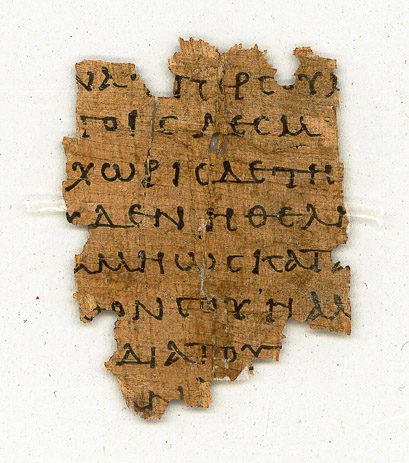
Papyrus 87 (Gregory-Aland), recto. The earliest known fragment of the Epistle to Philemon, with verses 13-15: dated late 2nd or early 3rd century [Wikimedia Commons / Creative Commons Attribution-Share Alike 3.0 Unported license]

* * *
From my discontinued book, 501 Biblical Arguments Against Sola Scriptura (2009). It was one of my several books in the style of Pascal’s Pensees (random individual thoughts [i.e., “pensees”] rather than continuous writing). In 2012, Catholic Answers (specifically Todd Aglialoro, my editor) convinced me to tighten it up and make it a conventional book, and so it was transformed into 100 Biblical Arguments Against Sola Scriptura. But the latter version is so vastly different from the original version, that they are really two separate books. Thus, I am happy to maintain some portions of the old version on my blog.
You’ll notice that the arguments keep getting longer and longer as they proceed. That’s a feature only in this book of mine, among all 49 of my titles.
* * * * *
1. The canon is obviously a crucial path to even get to sola Scriptura. One can’t have a sola who knows what it is? position.
2. If the Church could settle the issue of the canon, why should we not also look to it to figure out the true doctrine of something like baptism or the Eucharist?
3. The essence of the biblical books is that they are all inspired. But determining exactly which and how many books possess this characteristic, and why, is another matter entirely.
4. If no one till St. Athanasius (in 367) listed the 27 New Testament books, who was it that knew what he knew before a council finally settled the issue? We have no record of any such person who got it all “correct.”
5. The Church is necessary for Christians to have a definite understanding or framework of which books are biblical and which are not. To argue this is not in the slightest some sort of blast “against” the Bible.
6. Sola Scriptura could not be applied in the sense it is today, until almost 400 A.D., when Church authority and Tradition set the limits of the canon. Does this not strike one as an exceptionally odd and weird point of view?
7. Protestants implicitly accept Rome’s authority because they accept the canon (save seven books) that it gave them, as well as many other orthodox doctrinal formulations (e.g., Two Natures of Christ, Virgin Birth, etc.). [BCO, 20; modified]
8. Can Protestant apologists make an argument that the concept of biblical books is biblical? Yes, they can. But can they make a rational biblical argument for numbering the New Testament books at twenty-seven? No, they can’t.
9. Protestants, with the benefit of hindsight, may think it is quite easy to know what books are biblical, inspired books, and which are not, but the actual history of the development of the canon suggests otherwise (to put it very mildly).
10. I don’t deny all “self-attestation” of biblical books; I only deny that this alone was sufficient to establish a known canon with definite boundaries, or that it is as sweeping a characteristic of “all” the biblical books as some Protestants make out.
11. Deciding a canon is different from making Scripture what it is, because Scripture is inherently inspired. In other words, the canon is not identical with Scripture, anymore than a table of contents is identical with the book it describes by chapter.
12. Paul does not necessarily always know he is writing Scripture. He knows for sure, though, that it has authority as the message of an apostle, whether or not it is literally inspired, or inspired Scripture. He knows that simply from the knowledge that he is an apostle.
13. Some liberal Protestants today are calling for a re-opening of the canon issue. No evangelical Protestant can give a solid reason why they should not do so. And that is certainly a consideration serious enough to cause them to re-examine their first principles, including sola Scriptura.
14. It is not simply an easy matter of reading all the biblical books and “knowing” that they are inspired and canonical from internal evidence alone. Church authority was required, and it is foolish to maintain that Church authority was not necessary in the establishment of the canon.
15. The author of 1 John is also anonymous. I believe that all three epistles were written by the Apostle John, author also of the Gospel bearing that name, but this would not necessarily be immediately or easily apparent to a casual reader. “Elder” or “presbyter” is hardly a conclusive identification.
16. If a key criterion for canonicity was apostolicity (being written by an apostle: see, e.g., John 16:13-15; Acts 1:8; 1 Corinthians 12:28; 2 Peter 3:2), then how come no one in the early period seemed to know that the book of Acts was apostolic: written, as it was, by Luke, whose Gospel was accepted early on?
17. There are indeed several internal biblical evidences of inspiration and canonicity, yet (despite this fact), there were many significant disputes in the early Church regarding the books of the Bible. Many now-accepted books were questioned, and many non-biblical books were thought by some to be canonical. [OMA, 10; modified]
18. The Catholic Church’s proclamation of the canon was a recognition of a broad consensus; nevertheless the consensus was sufficiently uncertain to have required an authoritative pronouncement. Books, for example, such as James and Revelation were not accepted by many until the mid-4th century. [BCO, 18; modified]
19. Any Pauline reference to “inspiration” need not necessarily and always refer to Scripture. And even if he explicitly claimed inspiration for some piece of his writing, that still wouldn’t prove that he thought it was Scripture, as opposed to a sure word from an apostle or a prophecy (though it is obviously consistent with such a notion).
20. Luther, Calvin, and Protestant apologists today are engaging in pipe dreams, pure fantasy, when they speculate and pontificate on this “self-authenticating” and “perspicuity” mythology. In point of fact that wasn’t enough, because we have the historical record of the pre-canon opinions of Christians on the extent and parameters of Scripture. [PRO, 10-11]
21. It has been argued that the widespread belief of the early Church that Hebrews was written by St. Paul was the reason it could be accepted. But such a theory is not evident in the book itself. It can only be arrived at by complicated comparisons and internal analysis, which is, of course, beyond the average individual’s capacity to determine.
22. Catholics tend to overemphasize the Church in the canonization process and Protestants tend to minimize same and stress the self-authenticating nature of biblical books. I think the truth is somewhere in the middle, and that we can achieve significant common ground on this, if we could only more accurately understand each other, and the differing ecclesiologies, rules of faith, and epistemologies.
23. The biblical definition of apostle is somewhat fluid and flexible (as is the case with most biblical offices at their early stage of development), but if apostolicity and known authorship are two ways to easily identify a book as canonical, then Hebrews fails on both counts. The Church at length acknowledged its intrinsic status as Holy Scripture, but it would not have been so easy for an individual to determine this.
24. Even then, this Church authority with regard to the canon wasn’t good enough for Luther, Calvin, and their cohorts, since they decided to pick and choose from the previously “universally recognized” tradition of the canon, and discard seven books from the Old Testament. So once again we see the nonsensical tradition of “accepting tradition until one arbitrarily rejects particulars of that tradition.”
25. Though there was broad agreement in the early Church as to which books belonged in the Bible, it was not absolute. Some important Church Fathers regarded books currently in the canon of the Bible as unscriptural. Others (equally eminent) thought that books not now in the canon were part of the inspired revelation. The first Father to list the currently accepted 27 New Testament books was St. Athanasius, in 367. [CAB, 162]
SOURCES
Dave Armstrong, Bible Conversations: Catholic-Protestant Dialogues on the Bible, Tradition, and Salvation [BCO], Lulu, 2007.
Dave Armstrong, The Catholic Answer Bible [CAB], Huntington, Indiana: Our Sunday Visitor, 2002 [author of 44 apologetics inserts].
Dave Armstrong, The One-Minute Apologist [OMA], New Hampshire: Sophia Institute Press, 2007.
Dave Armstrong, Protestantism: Critical Reflections of an Ecumenical Catholic [PRO], Lulu, 2007.
Previous Post

November 12, 2015
25 Brief Arguments Regarding Biblical "Clearness" (Perspicuity)
Next Post
November 12, 2015 Reply to Lutheran Gene Edward Veith on Mariology
Browse Our Archives
Select a Category & Last Things About Me Anti-Catholicism Atheism & Agnosticism Baptism and Sacramentalism Bible and Tradition Blessed Virgin Mary Books by Dave Armstrong C. S. Lewis Calvinism & General Protestantism Catholic Apologetics Catholic Apologists Catholic conversion Catholic converts Christmas Church (Ecclesiology) Church History Conversion and Converts Development of Doctrine Eastern Orthodoxy Ecumenism & Christian Unity Eucharist & Liturgy Fathers of the Church French Translations G. K. Chesterton Hell Hell & Satan Hell & Satan & Last Things Heresies & Comparative Religion Holistic Health Inquisition & Crusades & Scandals James White Jews & Judaism & Old Testament John Calvin John Henry Newman Liberal / Modernist Theology Life Issues Literary Resume Lutheranism Mariology Martin Luther Music Orthodoxy Papacy & Infallibility Personal Page Philosophy & Science Political & Ethical & Moral Issues Protestant Persecution & Intolerance Protestantism Purgatory Purgatory & Penance Romantic & Imaginative Theology Saints & Purgatory & Penance Salvation Salvation & Justification Satan & Last Things Sexuality and Gender Issues Spanish Translations Traditionalism vs. Radical Catholic Reactionaries Traducciones al español / tradução para português Trinitarianism & Christology Uncategorized Videos
Select a Month October 2026 September 2026 August 2026 July 2026 June 2026 May 2026 April 2026 March 2026 February 2026 January 2026 December 2025 November 2025 October 2025 September 2025 August 2025 July 2025 June 2025 May 2025 April 2025 March 2025 February 2025 January 2025 December 2024 November 2024 October 2024 September 2024 August 2024 July 2024 June 2024 May 2024 April 2024 March 2024 February 2024 January 2024 December 2023 November 2023 October 2023 September 2023 August 2023 July 2023 June 2023 May 2023 April 2023 March 2023 February 2023 January 2023 December 2022 November 2022 October 2022 September 2022 August 2022 July 2022 June 2022 May 2022 April 2022 March 2022 February 2022 January 2022 December 2021 November 2021 October 2021 September 2021 August 2021 July 2021 June 2021 May 2021 April 2021 March 2021 February 2021 January 2021 December 2020 November 2020 October 2020 September 2020 August 2020 July 2020 June 2020 May 2020 April 2020 March 2020 February 2020 January 2020 December 2019 November 2019 October 2019 September 2019 August 2019 July 2019 June 2019 May 2019 April 2019 March 2019 February 2019 January 2019 December 2018 November 2018 October 2018 September 2018 August 2018 July 2018 June 2018 May 2018 April 2018 March 2018 February 2018 January 2018 December 2017 November 2017 October 2017 September 2017 August 2017 July 2017 June 2017 May 2017 April 2017 March 2017 February 2017 January 2017 December 2016 November 2016 October 2016 September 2016 August 2016 July 2016 June 2016 May 2016 April 2016 March 2016 February 2016 January 2016 December 2015 November 2015 October 2015 September 2015 August 2015 July 2015 June 2015 May 2015 April 2015 March 2015 February 2015 January 2015 December 2014 November 2014 October 2014 September 2014 August 2014 July 2014 June 2014 April 2014 March 2014 February 2014 January 2014 December 2013 November 2013 October 2013 September 2013 August 2013 July 2013 June 2013 April 2013 March 2013 February 2013 January 2013 December 2012 November 2012 October 2012 September 2012 August 2012 July 2012 June 2012 May 2012 April 2012 March 2012 February 2012 January 2012 December 2011 November 2011 October 2011 September 2011 August 2011 July 2011 June 2011 April 2011 March 2011 February 2011 October 2010 September 2010 August 2010 July 2010 April 2010 March 2010 December 2009 October 2009 August 2009 July 2009 June 2009 May 2009 March 2009 February 2009 October 2008 September 2008 April 2008 March 2008 February 2008 January 2008 December 2007 November 2007 October 2007 May 2007 March 2007 February 2007 January 2007 November 2006 October 2006 September 2006 August 2006 July 2006 June 2006 May 2006 April 2006 March 2006 February 2006 October 2005 June 2005 April 2005 February 2005 July 2004 May 2004 April 2004
Follow Us!
TAKE THE
Religious Wisdom Quiz
How many times does the Bible mention the word "love"?
Select your answer to see how you score.
100 Over 300 700 500
Books by This Author Books by Dave Armstrong
Related posts from Biblical Evidence for Catholicism

A Few "Worst" & "Best" Arguments vs. Protestantism
Biblical Evidence for Catholicism

Jerusalem Council vs. James White & Sola Scriptura
Biblical Evidence for Catholicism

Biblical Perspicuity: Absurd Anti-Catholic "Defense"
Biblical Evidence for Catholicism

50 Biblical Disproofs of "Evident Clearness" of the...
Biblical Evidence for Catholicism
TRENDING AT PATHEOS Catholic

How to Make a Decision When You Can't...
Main point: It’s much more valuable to stay close to God so...

Archdiocese Hosts Military Marriage Retreat in Germany
RASTATT, Germany — The transient military lifestyle, with its frequent deployments and...

Nearly every morning, I make the drive to Detroit with my high-school-age...

The Real AI Story Is Adoption Without Trust
Artificial intelligence has crossed a political threshold. It is no longer a...

A new article, written by Jeff Lindsay and Gale L. Pooley,...

Swimfan: Forgotten Aughts Pleasures
This is a recovery effort. In 2002, My Big Fat Greek Wedding...
view all Catholic blogs
Ad-Free & Subscriber Log-In Subscription Support
- About Us
- 2026 Calendar
- Videos
- Podcasts
- Library of World Religions
- Faith In Media Tracker
- Advertise With Us
- Write for Us
- Privacy Policy
- Terms of Service
- Do Not Sell My Data
- Contact Us
- Radiant Digital
- Manage Newsletter Subscriptions
- Unsubscribe From Notifications
- Sitemap
Copyright 2008-2026, Patheos. All rights reserved.
Subscription Support Ad-Free & Subscriber Log-In
Follow Patheos