
BuddhistCatholicContemplativeEvangelicalGeneral ChristianHinduJewishLatter-day SaintMuslimNew VisionsProgressive Christian
Beliefs
- Buddhist
- Catholic
- Contemplative
- Evangelical
- General Christian
- Hindu
- Jewish
- Latter-day Saint
- More Voices
- Muslim
- New Visions
- Pagan
- Progressive Christian
Topics
- Religion News
- Food and Religion
- Sports and Religion
- Religious Art
- Religious Music and Entertainment
- Religious Events
- History and Religion
- Style and Religion
- Politics and Religion
- Women in Religion
- Recreation Outdoors and Religion
- Business Finance and Religion
- Careers Workplace and Religion
- Education and Religion
- Family Parenting and Religion
- Health Fitness and Religion
- Home and Religion
- Relationships and Religion
- Technology and Religion
- Travel and Religion
Columnists
- Buddhist Columnists
- Business Finance and Religion Columnists
- Careers Workplace and Religion Columnists
- Catholic Columnists
- Contemplative Columnists
- Education and Religion Columnists
- Evangelists Columnists
- Family Parenting and Religion Columnists
- General Christian Columnists
- Health Fitness and Religion Columnists
- Hindu Columnists
- History and Religion Columnists
- Home and Religion Columnists
- Jewish Columnists
- More Voices Columnists
- Latter Day Columnists
- Muslim Columnists
- New Visions Columnists
- Nonreligious Columnists
- Pagan Columnists
- Politics and Religion Columnists
- Progressive Columnists
- Recreation Outdoors and Religion Columnists
- Relationships and Religion Columnists
- Religion News Columnists
- Religious Art Columnists
- Religious Events Columnists
- Religious Music and Entertainment Columnists
- Sports and Religion Columnists
- Style and Religion Columnists
- Technology and Religion Columnists
- Travel and Religion Columnists
- Women in Religion Columnists
Resource Library
- 2026 Calendar
- Library of World Religions
- The 100 Most Holy Places on Earth
- Patheos Answers
- Podcasts
- Videos
- Faith Leaders Database
- Anglican Episcopalian
- Bahai
- Baptist
- Buddhism
- Christianity
- Confucianism
- Eastern Orthodoxy
- Hinduism
- Holiness and Pentecostal
- ISKCON
- Islam
- Judaism
- Lutheran
- Methodist
- The Church of Jesus Christ of Latter-day Saints
- New Age
- Paganism
- Presbytarian and Reformed
- Protestantism
- Religion Behind the Scenes
- Roman Catholic
- Scientology
- Shia Islam
- Sikhism
- Sufism
- Sunni Islam
- Taoism
- Zen
- See all religions
Research Tools
 Ad-Free & Subscriber Log-In Subscription Support
Ad-Free & Subscriber Log-In Subscription Support
Follow Patheos 

- Trending:
- Forgiveness
- |
- Marriage
- |
- Consciousness
- |
- Death Penalty
- |
- Election
- |
- Halloween

-
About
-
Catholic Apologetics
-
Church History
-
Great Apologists
-
Christian Worldview
-
Protestantism & Misc.
- Home
- Catholic
- History and Religion
- Was Philosopher David Hume an Atheist? (Myths Debunked)
Was Philosopher David Hume an Atheist? (Myths Debunked)
Last updated on: November 22, 2021 at 3:57 pm by Dave Armstrong
Was Philosopher David Hume an Atheist? (Myths Debunked) 2021-11-22T15:57:06-04:00 Dave Armstrong
Patheos Explore the world's faith through different perspectives on religion and spirituality! Patheos has the views of the prevalent religions and spiritualities of the world.
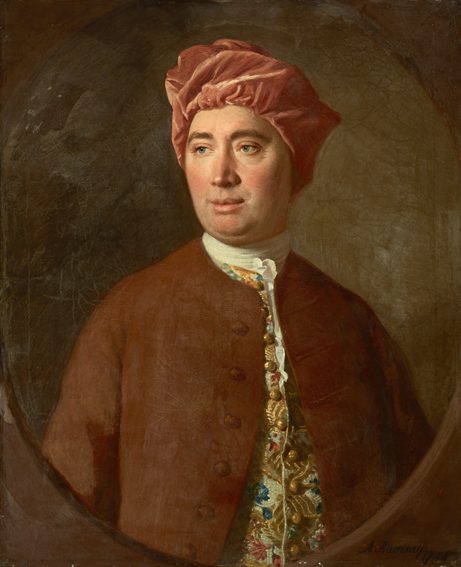
David Hume (1711-1776): portrait (1754) by Allan Ramsay (1713-1784) [public domain / Wikimedia Commons]

He was not, according to his own words, or in the opinion of many Hume scholars:
The order of the universe proves an omnipotent mind. (Treatise, 633n)
Wherever I see order, I infer from experience that there, there hath been Design and Contrivance . . . the same principle obliges me to infer an infinitely perfect Architect from the Infinite Art and Contrivance which is displayed in the whole fabric of the universe. (Letters, 25-26)
[Found in Capaldi, see below]
The whole frame of nature bespeaks an intelligent author; and no rational enquirer can, after serious reflection, suspend his belief a moment with regard to the primary principles of genuine Theism and Religion . . .
Were men led into the apprehension of invisible, intelligent power by a contemplation of the works of nature, they could never possibly entertain any conception but of one single being, who bestowed existence and order on this vast machine, and adjusted all its parts, according to one regular plan or connected system . . .
All things of the universe are evidently of a piece. Every thing is adjusted to every thing. One design prevails throughout the whole. And this uniformity leads the mind to acknowledge one author. (Natural History of Religion, 1757, ed. H.E. Root, London: 1956, 21, 26)
Philo and Cleanthes, in the Dialogues accept the argument from design. Hume scholar Nicholas Capaldi states that:
All of the characters in the Dialogues speak for Hume, and the message of the Dialogues is that morality is independent of religion. (David Hume, Boston: G.K. Hall & Co., 1975, ch. 9, 188-97; Capaldi is an internationally-known Hume expert and founder of the Hume Society)
Capaldi states in the above section:
Hume believed in the existence of God. He rejected the ontological argument. He accepted in one form the argument from design. God exists, but his properties are unknown and unknowable by us . . . In none of his writings does Hume say or imply that he does not accept the existence of God. On the contrary, Hume says in several places that he accepts the existence of God . . .
Guided by basic misunderstandings of Hume’s position on causality or at the very least the negative aspects of Hume’s skepticism, most readers assume that the central question is one concerning God’s existence.
Thus we have, e.g., Sir Isaiah Berlin of Oxford falsely assert:
In 1776 he died, as he had lived, an atheist . . . (The Age of Enlightenment: The 18th Century Philosophers, New York: Mentor, 1956, 163)
This shows that “experts” (this is from a very famous series on the history of philosophy) can often get things – in this case, straightforward factual matters – dead wrong by not examining closely enough a person’s thought, and by often extrapolating their own beliefs and premises onto the other person (long one of my own contentions in discourse). It’s also a function of the over-compartmentalization of knowledge, in my opinion.
Many atheists who write on Patheos (where my own blog is posted) fall prey to the same myth:
From: James Fieser: “Hume’s Concealed Attack on Religion and His Early Critics,” Journal of Philosophical Research, 1995, Vol. 20, pp. 83-101.
Fieser is a Professor of Philosophy at the University of Tennessee (see his publications):
Given Hume’s notorious reputation as an enemy of religion, it is interesting that questions remain about Hume’s precise views on the subject. Capaldi argues that Hume accepted the design argument for God’s existence.(2) O’Higgins and Gaskin argue that Hume was a qualified deist.(3) For Noxon, Hume is an agnostic.(4) Mossner and Livingston argue that Hume advanced his own humanistic religion.(5) Kemp Smith and Williams argue that Hume’s religion consisted of merely holding open the possibility of an intelligent creator.(6) Most of this debate traces back to passages in the Natural History of Religion, and the Dialogues Concerning Natural Religion in which Hume seems to endorse the design argument.(7)
. . . we can never show with certainty that Hume was a strict atheist: we have no record of a direct denial by Hume of God’s existence, either anecdotally or in his philosophical writings.
FOOTNOTES
Nicholas Capaldi, “Hume’s Philosophy of Religion: God Without Ethics,” International Journal for Philosophy of Religion, 1970, Vol. I, pp. 233-240.
For [James] O’Higgins, Hume accepted the rationality of the design argument, but remained skeptical about the entire enterprise of reasoning. Hume, then, reluctantly concedes to God’s existence, yet denies that God concerns himself with governing the world. See “Hume and the Deists: a Contrast in Religious Approaches,” Journal of Theological Studies, 1971, Vol. 23, pp. 479-501. In Hume’s Philosophy of Religion (Atlantic Highlands, 1988), J.C.A. Gaskin describes Hume’s attenuated deism as a weak probability that natural order results from an intelligence remotely analogous to our own. This unites with our subjective feeling that natural order springs from a designer, hence we assent to the existence of a designer (although this being has no moral claim on us).
James Noxon argues that no one of the characters speaks consistently for Hume, and this expresses Hume’s view about the limits of human understanding. For Noxon, this suggests that Hume was agnostic. “Hume’s Agnosticism,” in Hume: A Collection of Critical Essays, ed. V.C. Chappell (New York, 1966), and “In defence of ‘Hume’s Agnosticism,'” Journal of the History of Philosophy, 1976, Vol. 14, pp. 469-473.
Ernest C. Mossner argues that Hume denied all supernatural and conventional religion, but advanced a “religion of man” insofar as he optimistically believed that the enlightened determine the fate of humanity and are the measure of all things. See “The Religion of David Hume,” Journal of the History of Ideas, 1978, Vol. 39, pp. 653-663. Donald Livingston argues that Hume offers a “philosophical theism” which is an historically determined natural belief, yet one which eschews the writings and rituals of the theistic tradition. See “Hume’s Conception of True Religion,” in Hume’s Philosophy of Religion (Winston-Salem, 1986), pp. 33-73. Even if Mossner and Livingston have captured Hume’s views, it is difficult to see how this could qualify as a religion by 18th century standards, and it is hard to believe that Hume would want to classify it as such.
Norman Kemp Smith argues that religion for Hume consists exclusively in an intellectual assent to the proposition “God exists.” He concludes, though, that religion for Hume ought not to have any influence on human conduct (Dialogues concerning Natural Religion, p. 24). Kemp Smith bases his view on the conclusions to the “Natural History” and Dialogues, and Hume’s 1743 letter to William Mure. B.A.O. Williams argues that Hume did not reject the possibility of a creator with something like human intelligence; see “Hume on Religion,” in David Hume: A Symposium, e.d. D.F. Pears, London, 1963, pp. 77-88.
Although the “Natural History” is antagonistic to revealed and popular religious belief, in no less than nine passages Hume seems to defend the design argument. Although the Dialogues is antagonistic to natural religion, Cleanthes, the defender of natural religion, wins the debate, and Philo, the religious skeptic, eventually concedes that “the cause or causes of order in the universe probably bear some remote analogy to human intelligence.” Thus, at face value, both the “Natural History” and the Dialogues support the belief in God through the design argument, yet destroy all other aspects of religious belief.
In another article, “Hume’s Solution to the Necessitarian Problem of Evil,” Fieser states:
Although it is popular now in Hume scholarship to interpret Hume as a type of theist, I believe that we should resist this approach, principally because Hume’s contemporaries did not interpret him this way.
In the Oxford University Press publication, Introduction to Philosophy: Classical and Contemporary Readings, Third Edition, Edited by John Perry and Michael Bratman (both of Stanford), 1998, we find these remarks about Hume, in a section entitled “Hume’s Religious Orientation”:
If we take Philo’s pronouncements in Dialogues Concerning Natural Religion (1776) as a guide, the mature Hume was a theist, albeit of a vague and weak-kneed sort. He seems to have been convinced by the argument from design of the proposition “That the cause or causes of order in the universe probably bear some remote analogy to human intelligence”‘ (227). But he was also convinced that the argument does not permit this undefined intelligence to be given further shape or specificity, and certainly not the specificity that would be needed to support any inference “that affects human life, or can be the source of any action or forbearance.” Hume’s inconsequential theism was combined with an abhorrence of organized religion, which Hume saw as composed of superstitions that have had almost uniformly baneful effects for mankind.
In lecture notes from the Philosophy Dept. at the University of Durham (author not given), “Lecture 7: Interpreting the Dialogues,” we find the following analysis (completely reproduced):
THE PROBLEM OF INTERPRETATION
Two closely related textual questions can be raised with regard to theDialogues. Firstly, who speaks for Hume (and when)? Secondly, how do the Dialogues fit into Hume’s other published discussions of religion, and what do they tell us about the reasonableness or otherwise of religious belief? One source of evidence in answering both questions is to see who comes out as the ‘winner’ in theDialogues; another is to compare the claims of Philo, Cleanthes and Demea with Hume’s own philosophy.
WHO SPEAKS FOR HUME?
Commentators have taken different lines here. Let us weigh up the textual evidence for each of the main characters:
Demea puts forward relatively weak arguments, except when joining Philo in his criticism of Cleanthes. His main positive argument is thea priori demonstration of God’s existence set out in Part IX, which is swiftly demolished by Cleanthes. Cleanthes’ argument-that noparticular existence is necessary-strongly resembles a point made by Hume elsewhere, that no matter of fact is demonstrable a priori (see the Enquiry, Sections IV Part 1, and Section XII Part 3). Hume has Cleanthes quoting Samuel Clarke as the source of the kind of reasoning employed by Demea, which indicates that Demea’s argument is modelled on Clarke’s (although Demea is certainly not Clarke). The serious choice for Hume’s mouthpiece must either be Philo or Cleanthes.
Cleanthes puts forward the central argument of the Dialogues, and his views are proclaimed to approach nearest to the truth by Pamphilus in the last paragraph (note, however, that Pamphilus is Cleanthes’ pupil). Also, Cleanthes is the mouthpiece for Humean criticisms of Demea’s a priori argument (see above). Other commentators point out that although Philo consistently criticises Cleanthes’ argument, he never replies to Cleanthes’ basic point that the presence of order in the world causes the presence of a designer to ‘flow in upon you with the force like that of a sensation’ (Part III, para. 7). On these grounds, Noxon, for instance, argues that while the views of none of the interlocutors entirely represents Hume’s views, Hume intended Cleanthes to do so most closely.
Philo is the most common choice for Hume’s mouthpiece: Ayer (Hume, p.93) on the grounds that Philo says the most, Kemp Smith on the grounds that Philo’s criticisms of the design argument closely resemble Hume’s discussion in Section XI of the Enquiry, and elsewhere. Against this, we have Philo’s concession in Part XII that “A purpose, an intention, a design strikes everywhere the most careless, the most stupid thinker” (Part XII, para.2). Philo also suggests that his sceptical stance was adopted only for the sake of argument, and that he felt safe to do so only because on the subject of religion, he is never likely to ‘corrupt the principles of any man of common sense’ (Part XII, para.2). Noxon argues that Hume would not have the character representing his own views recant them in so flippant a way. Kemp Smith, however, put Philo’s admission-along with Hume’s own ritual profession of faith-down to Hume’s regard for the conventions of his time (there is evidence for this in Hume’s correspondence). Noxon replies that Hume was often happy to flout other conventions of his time, and in any case planned the Dialoguesfor posthumous publication. However, that Hume was sympathetic to Philo’s position is supported by his correspondence (see his letter of 10 March 1751).
WHAT SHOULD WE CONCLUDE FROM THE DIALOGUES?
It is unlikely that Hume’s intention was to convince readers to believe in the non-existence (or the existence) of God. Rather, Hume perhaps intended the Dialogues to invite us to reflect on the relation between our belief (either way) and: (i) any relevant evidence we have; (ii) our behaviour. Looking at the arguments presented in theDialogues (and elsewhere), it is evident (from the drubbing received by the design argument) that Hume contends that we don’t know(from the design argument) very much at all about the nature of God. We certainly should not conclude that the Designer with whom the ‘remote analogy’ of the design argument presents us can be identified with the God of any organised religion: given the available evidence, we cannot know that this Designer is omnipotent, or benevolent, for instance. Putting this together with Hume’s other arguments concerning religion: (i) his rejection of the argument a priori; and (ii) his rejection of miracles as a source of evidence for the truth of any revealed religion, we have a powerful critique of the role of reason in supporting religious belief, and a call for caution inacting on any such belief. Hume does, however, leave open the possibility that God might directly cause individual believers to have faith (see Noxon).
However, given Philo’s (and Hume’s) frequent protestations of the obviousness of God’s existence, perhaps we could (with Noxon and Penelhum) draw a parallel with Hume’s position on (for instance) induction (in the Enquiry, Sections IV and V). Reason cannot furnish us with a justification for believing: (i) that there is an external world that is independent of our perception; (ii) that past regularities of our experience will continue to hold in future; and (iii) that the senses are (usually) reliable sources of information about the world around us. However, Hume argues that only excessive (philosophical) scepticism could lead a reasonable enquirer to doubt these beliefs, for they are beliefs which underpin ordinary life, without which it would be impossible to act in the world. The parallel suggests that refusing to believe in God merely because this belief is not grounded in reason would be inconsistent (this is Penelhum’s ‘parity’ argument): belief in God just as naturally suggests itself to the human mind as belief in the external world. This interpretation is disputed by Gaskin. Firstly, belief in God is not in fact universal, and the mechanisms that produce belief in an external world and the other natural beliefs are quite different from the processes that produce belief in God (as investigated by Hume in the Natural History of Religion), for the latter belief is the product of fear of the unknown, and it may be absent in those who inhabit ‘civilised’ societies. Secondly (and crucially), belief in God is not a prerequisite for rational action in the world (see Gaskin chapters 6 and 7).
What we can conclude, however, is that it is quite wrong for religious beliefs to have the effects on behaviour, morals and politics that, according to Hume in the Natural History, they typically do have. ‘True religion’, for Hume, is plain philosophical assent, rather than self-denial or religious activism.
READING
J. Gaskin Hume’s Philosophy of Religion (Chs. 6, 7 and 12)
J. Gaskin ‘Hume on Religion’ in D.F. Norton (ed.) The Cambridge Companion to Hume
N. Kemp Smith Introduction to the Kemp Smith edition of theDialogues
G. Nathan ‘Hume’s Immanent God’ in V. Chappell (ed.) Hume
J. Noxon ‘Hume’s Agnosticism’ in V. Chappell (ed.) Hume
T. Penelhum God and Skepticism Chapters 2, 5 and 6
Mark G. Spencer, Ph.D. Candidate, Department of History, The University of Western Ontario, writes in his paper, “The Dialogues Concerning Natural Religion: Hume’s Response to the Dogmatic and Intolerant,” The Western Journal of Graduate Research 2000, Vol. 9 (1), 1-19:
Sorting through this ever-expanding mountain of commentary reveals that scholars have tended to read the Dialogues in two basic ways. The Dialogues is read either with the presupposition that Hume intended primarily to make a philosophical point about religion (2), or alternatively, it is read with the aim of showing that Hume’s intentions therein were primarily literary. (3)This distinct interpretive divide, moreover, is often commented on explicitly in the literature where it has become an entrenched characteristic. (4)
Proponents of both readings, however, have been of a single mind in their concern to ask one (seemingly) fundamental question: who in the Dialogues speaks for Hume? (5) In answer, most interpreters argue that Hume is represented by one of the characters in theDialogues. Many of Hume’s contemporaries and near contemporaries, for example, thought that Hume spoke through Cleanthes. As Dugald Stewart put it, “[i]t must always be remembered that Cleanthes is the hero of the Dialogues, and is to be considered as speaking Mr. Hume’s real opinions” (1854: I, 605). (6)
In 1935, Hume scholar Norman Kemp Smith challenged this “standard interpretation” of the time, arguing instead that “Philo, from start to finish, represents Hume”(1959: 47). Kemp Smith has often restated his interpretation which has remained influential, with many scholars following his lead but adding their own variations. (7) Others, however, have thought that Philo’s scepticism is different from Hume’s (Noxon, 1964). For others still, Hume is represented by Pamphilus, the Dialogues‘ narrator (Hendel, 1963). More recently, the trend is to argue that none of the characters wholly represents Hume — either because Hume is thought to be speaking wherever something intelligent is said (8), or because Hume meant the dialoguers to be “philosophical types” (Pakaluk, 1984), or because the Dialogues themselves are thought to speak for Hume (9), or finally, because the characters are thought to be part of Hume’s more basic concern with “the structures of consciousness” (Smitten, 1991; see also White, 1988).
FOOTNOTES
5 See almost any of the secondary literature. Basu (1978) sums up the concern of much of the literature in his title: “Who is the Real Hume in the Dialogues?”. The ubiquitous issue is also stated clearly by Noxon (1964: 248): “Who speaks for Hume? Unless this question can be answered, Hume’s last philosophical testament provides us with no clue to his own religious convictions”; and Mossner (1977: 4): “Who, then, represents Hume in the Dialogues?”
6 Many of Hume’s contemporaries also thought Hume spoke through Philo.
7 Mossner (1977): “Hume is Philo and Philo alone”(4), “Philo and Philo alone is Hume’s spokesman”(12); Penelhum (1979: 270): “I must state at the outset that I agree with those scholars, from Kemp Smith on, who identify Hume with Philo”; Wadia (1987: 211): “Incidentally, I will assume throughout the sequel that Kemp Smith’s identification of Hume with Philo is essentially correct”. See also Coleman (1989: 179): “I will support the traditional thesis that Philo represents Hume’s views on religious belief”. Some have also tried to identify the other speakers in the Dialogues. Mossner (1936) argued that Philo is Hume’s voice, Cleanthes represents Joseph Butler, and Demea is best thought of as Samuel Clarke.
8 Bricke (1975: 17): “one must assume that, no matter who the speaker, those arguments which are presented in the most persuasive and compelling way, those arguments which seem most cogent, are probably to be ascribed to Hume”. See also Gaskin (1978): “I shall take it that Hume in the Dialogues is any speaker who appears to be making a good philosophical point”.
9 Livingston (1984 :44): “No character may be taken to represent Hume’s views”. See also Yandell (1990: 37): “None of the actual participants in the Dialogues– Cleanthes, Philo, and Demea – always represents Hume. All of them sometimes represent him”. Tweyman (1993: 174) disagrees: “That the Dialogues is filled with dramatic and literary elements is beyond question. However, that these elements can be so construed as to reveal that, in addition to Demea, Cleanthes, and Philo, there is a fourth main speaker, Hume, is extremely doubtful”.
REFERENCES (selective)
Andre, Shane, 1993. Was Hume an Atheist?, Hume Studies 19: 141-166.
Austin, W. 1985. Philo’s Reversal. Philosophical Topics 13: 103-112.
Basu, D. K. 1978. Who is the Real Hume in the Dialogues? Indian Philosophical Quarterly 6: 21-28. Bricke, J. 1975. On the Interpretation of Hume’s Dialogues. Religious Studies 11: 1-18.
Clarke, B. L. 1980. The Argument from Design. American Journal of Theological Philosophy 1: 98-108.
Coleman, D. P. 1989. Interpreting Hume’s Dialogues. Religious Studies 25: 179-190.
Gaskin, J. C. 1993b. Hume on Religion. In D.F. Norton, ed. The Cambridge Companion to Hume: 313-344. New York: Cambridge University Press.
Gaskin, J. C. 1978. Hume’s Philosophy of Religion. London: MacMillan.
Hendel, C. 1963. Studies in the Philosophy of David Hume (1st ed. 1925). Princeton: Princeton University Press.
Kemp Smith, N. 1947. The Argument of the Dialogues Concerning Natural Religion. In N. Kemp Smith, ed., David Hume: Dialogues Concerning Natural Religion (1st ed. 1935). New York: Bobbs-Merrill Company.
Livingston, D. 1984. Hume’s Philosophy of Common Life. Chicago: University of Chicago Press. Mossner, E. C. 1936. The Enigma of Hume. Mind 14: 335-349.
Mossner, E. C. 1977. Hume and the Legacy of the Dialogues. In G. P. Morice, ed. David Hume: Bicentenary Papers. Edinburgh: Edinburgh University Press.
Mossner, E. C. 1954. The Life of David Hume. Austin, Texas: University of Texas Press.
Noxon, J. 1964. Hume’s Agnosticism. Philosophical Review 73: 248-261.
Pakaluk, M. 1984. Philosophical Types in Hume’s Dialogues. In V. Hope, ed. Philosopher of the Scottish Enlightenment, 116-132. Edinburgh: Edinburgh University Press.
Penelhum, T. 1979. Hume’s Skepticism and the Dialogues. In D.F. Norton, N. Capaldi, and W.L. Robison, eds. McGill Hume Studies: 253-278. San Diego, California: Austin Hill Press.
Smitten, J. R. 1991. Hume’s Dialogues Concerning Natural Religion as Social Discourse, in J. Dwyer and R. B. Sher, eds., Sociability and Society in Eighteenth-Century Scotland, 39-56. Baltimore: John Hopkins University Press, published in association with the Eighteenth-Century Scottish Studies Society.
Stewart, D. 1854. The Collected Works of Dugald Stewart. In W. Hamlton, ed. 1854-1860. Edinburgh: T. Constable and Co.
Tweyman, S. 1987. Hume’s Dialogues on Evil. Hume Studies 13: 74-85.
Tweyman, S. 1993. Hurlbutt, Hume, Newton and the Design Argument. Hume Studies 19: 167-176. Tweyman, S. 1986.Scepticism and Belief in Hume’s Dialogues Concerning Natural Religion. The Hague.
Wadia, P. S. 1987. Commentary on Professor Tweyman’s `Hume on Evil’. Hume Studies 13: 104-112.
Wadia, P. S. 1979. Philo Confounded. In. D.F. Norton, N. Capaldi, and W.L. Robison, eds. McGill Hume Studies: 279-290. San Diego, California: Austin Hill Press.
Wadia, P. S. 1978. Professor Pike on Part III of Hume’s Dialogues.Religious Studies 14: 325-342. White, R. 1988. Hume’s Dialogues and the Comedy of Religion. Hume Studies 14: 390-407.
Yandell, K. E. 1990. Hume’s ‘Inexplicable Mystery’: His Views on Religion. Philadelphia, Pennsylvania: Temple University Press.
***
*
Practical Matters: Perhaps some of my 3,900+ free online articles (the most comprehensive “one-stop” Catholic apologetics site) or fifty books have helped you (by God’s grace) to decide to become Catholic or to return to the Church, or better understand some doctrines and why we believe them.
*
Or you may believe my work is worthy to support for the purpose of apologetics and evangelism in general. If so, please seriously consider a much-needed financial contribution. I’m always in need of more funds: especially monthly support. “The laborer is worthy of his wages” (1 Tim 5:18, NKJV). 1 December 2021 was my 20th anniversary as a full-time Catholic apologist, and February 2022 marked the 25th anniversary of my blog.
*
PayPal donations are the easiest: just send to my email address: [email protected]. You’ll see the term “Catholic Used Book Service”, which is my old side-business. To learn about the different methods of contributing, including 100% tax deduction, etc., see my page: About Catholic Apologist Dave Armstrong / Donation Information. Thanks a million from the bottom of my heart!
*
***
Previous Post
October 6, 2015
Was Martin Luther a "Super-Pope"? ("De Facto" Infallibility)
Next Post

October 7, 2015 50 "Catholic" Views of Protestant Leader John Calvin
Browse Our Archives
Select a Category & Last Things About Me Anti-Catholicism Atheism & Agnosticism Baptism and Sacramentalism Bible and Tradition Blessed Virgin Mary Books by Dave Armstrong C. S. Lewis Calvinism & General Protestantism Catholic Apologetics Catholic Apologists Catholic conversion Catholic converts Christmas Church (Ecclesiology) Church History Conversion and Converts Development of Doctrine Eastern Orthodoxy Ecumenism & Christian Unity Eucharist & Liturgy Fathers of the Church French Translations G. K. Chesterton Hell Hell & Satan Hell & Satan & Last Things Heresies & Comparative Religion Holistic Health Inquisition & Crusades & Scandals James White Jews & Judaism & Old Testament John Calvin John Henry Newman Liberal / Modernist Theology Life Issues Literary Resume Lutheranism Mariology Martin Luther Music Orthodoxy Papacy & Infallibility Personal Page Philosophy & Science Political & Ethical & Moral Issues Protestant Persecution & Intolerance Protestantism Purgatory Purgatory & Penance Romantic & Imaginative Theology Saints & Purgatory & Penance Salvation Salvation & Justification Satan & Last Things Sexuality and Gender Issues Spanish Translations Traditionalism vs. Radical Catholic Reactionaries Traducciones al español / tradução para português Trinitarianism & Christology Uncategorized Videos
Select a Month October 2026 September 2026 August 2026 July 2026 June 2026 May 2026 April 2026 March 2026 February 2026 January 2026 December 2025 November 2025 October 2025 September 2025 August 2025 July 2025 June 2025 May 2025 April 2025 March 2025 February 2025 January 2025 December 2024 November 2024 October 2024 September 2024 August 2024 July 2024 June 2024 May 2024 April 2024 March 2024 February 2024 January 2024 December 2023 November 2023 October 2023 September 2023 August 2023 July 2023 June 2023 May 2023 April 2023 March 2023 February 2023 January 2023 December 2022 November 2022 October 2022 September 2022 August 2022 July 2022 June 2022 May 2022 April 2022 March 2022 February 2022 January 2022 December 2021 November 2021 October 2021 September 2021 August 2021 July 2021 June 2021 May 2021 April 2021 March 2021 February 2021 January 2021 December 2020 November 2020 October 2020 September 2020 August 2020 July 2020 June 2020 May 2020 April 2020 March 2020 February 2020 January 2020 December 2019 November 2019 October 2019 September 2019 August 2019 July 2019 June 2019 May 2019 April 2019 March 2019 February 2019 January 2019 December 2018 November 2018 October 2018 September 2018 August 2018 July 2018 June 2018 May 2018 April 2018 March 2018 February 2018 January 2018 December 2017 November 2017 October 2017 September 2017 August 2017 July 2017 June 2017 May 2017 April 2017 March 2017 February 2017 January 2017 December 2016 November 2016 October 2016 September 2016 August 2016 July 2016 June 2016 May 2016 April 2016 March 2016 February 2016 January 2016 December 2015 November 2015 October 2015 September 2015 August 2015 July 2015 June 2015 May 2015 April 2015 March 2015 February 2015 January 2015 December 2014 November 2014 October 2014 September 2014 August 2014 July 2014 June 2014 April 2014 March 2014 February 2014 January 2014 December 2013 November 2013 October 2013 September 2013 August 2013 July 2013 June 2013 April 2013 March 2013 February 2013 January 2013 December 2012 November 2012 October 2012 September 2012 August 2012 July 2012 June 2012 May 2012 April 2012 March 2012 February 2012 January 2012 December 2011 November 2011 October 2011 September 2011 August 2011 July 2011 June 2011 April 2011 March 2011 February 2011 October 2010 September 2010 August 2010 July 2010 April 2010 March 2010 December 2009 October 2009 August 2009 July 2009 June 2009 May 2009 March 2009 February 2009 October 2008 September 2008 April 2008 March 2008 February 2008 January 2008 December 2007 November 2007 October 2007 May 2007 March 2007 February 2007 January 2007 November 2006 October 2006 September 2006 August 2006 July 2006 June 2006 May 2006 April 2006 March 2006 February 2006 October 2005 June 2005 April 2005 February 2005 July 2004 May 2004 April 2004
Follow Us!
TAKE THE
Religious Wisdom Quiz
Who was the first Christian martyr?
Select your answer to see how you score.
Paul James Peter Stephen
Books by This Author Books by Dave Armstrong
Related posts from Biblical Evidence for Catholicism

God, Modern Physics, & Dark Energy: An Analogy
Biblical Evidence for Catholicism
C. S. Lewis’ Argument for God from Desire
Biblical Evidence for Catholicism

General Debate on Christianity with an Atheist
Biblical Evidence for Catholicism

Parting of the Red Sea & Lake Erie...
Biblical Evidence for Catholicism
TRENDING AT PATHEOS Catholic

The Sermon on the Mount, Part I: Matthew...
The Sermon on the Mount, Part I (Matthew 4:12-5:12) St. Matthew moves...

What's up from Crossway: Reviewing some of their latest A few weeks...

Janie Learns the Way of the Cross: A...
Teaching children about Jesus' Passion can be challenging. Many parents and educators...

Looking For Good Catholic Writing - October 2026
He alone extends the heavens, and he walks upon the waves of...

In "Irreplaceable," our book on vocation and technology, Trevor Sutton and I...

I was strolling through the top floor of the brand new Parthenon...
view all Catholic blogs
Ad-Free & Subscriber Log-In Subscription Support
- About Us
- 2026 Calendar
- Videos
- Podcasts
- Library of World Religions
- Faith In Media Tracker
- Advertise With Us
- Write for Us
- Privacy Policy
- Terms of Service
- Do Not Sell My Data
- Contact Us
- Radiant Digital
- Manage Newsletter Subscriptions
- Unsubscribe From Notifications
- Sitemap
Copyright 2008-2026, Patheos. All rights reserved.
Subscription Support Ad-Free & Subscriber Log-In
Follow Patheos