
BuddhistCatholicContemplativeEvangelicalGeneral ChristianHinduJewishLatter-day SaintMuslimNew VisionsProgressive Christian
Beliefs
- Buddhist
- Catholic
- Contemplative
- Evangelical
- General Christian
- Hindu
- Jewish
- Latter-day Saint
- More Voices
- Muslim
- New Visions
- Pagan
- Progressive Christian
Topics
- Religion News
- Food and Religion
- Sports and Religion
- Religious Art
- Religious Music and Entertainment
- Religious Events
- History and Religion
- Style and Religion
- Politics and Religion
- Women in Religion
- Recreation Outdoors and Religion
- Business Finance and Religion
- Careers Workplace and Religion
- Education and Religion
- Family Parenting and Religion
- Health Fitness and Religion
- Home and Religion
- Relationships and Religion
- Technology and Religion
- Travel and Religion
Columnists
- Buddhist Columnists
- Business Finance and Religion Columnists
- Careers Workplace and Religion Columnists
- Catholic Columnists
- Contemplative Columnists
- Education and Religion Columnists
- Evangelists Columnists
- Family Parenting and Religion Columnists
- General Christian Columnists
- Health Fitness and Religion Columnists
- Hindu Columnists
- History and Religion Columnists
- Home and Religion Columnists
- Jewish Columnists
- More Voices Columnists
- Latter Day Columnists
- Muslim Columnists
- New Visions Columnists
- Nonreligious Columnists
- Pagan Columnists
- Politics and Religion Columnists
- Progressive Columnists
- Recreation Outdoors and Religion Columnists
- Relationships and Religion Columnists
- Religion News Columnists
- Religious Art Columnists
- Religious Events Columnists
- Religious Music and Entertainment Columnists
- Sports and Religion Columnists
- Style and Religion Columnists
- Technology and Religion Columnists
- Travel and Religion Columnists
- Women in Religion Columnists
Resource Library
- 2026 Calendar
- Library of World Religions
- The 100 Most Holy Places on Earth
- Patheos Answers
- Podcasts
- Videos
- Faith Leaders Database
- Anglican Episcopalian
- Bahai
- Baptist
- Buddhism
- Christianity
- Confucianism
- Eastern Orthodoxy
- Hinduism
- Holiness and Pentecostal
- ISKCON
- Islam
- Judaism
- Lutheran
- Methodist
- The Church of Jesus Christ of Latter-day Saints
- New Age
- Paganism
- Presbytarian and Reformed
- Protestantism
- Religion Behind the Scenes
- Roman Catholic
- Scientology
- Shia Islam
- Sikhism
- Sufism
- Sunni Islam
- Taoism
- Zen
- See all religions
Research Tools
 Ad-Free & Subscriber Log-In Subscription Support
Ad-Free & Subscriber Log-In Subscription Support
Follow Patheos 

- Trending:
- Forgiveness
- |
- Marriage
- |
- Consciousness
- |
- Death Penalty
- |
- Election
- |
- Halloween

-
About
-
Catholic Apologetics
-
Church History
-
Great Apologists
-
Christian Worldview
-
Protestantism & Misc.
- Home
- Catholic
- History and Religion
- Dogmatic Materialist Scientists vs. Intelligent Design
Dogmatic Materialist Scientists vs. Intelligent Design
Last updated on: April 27, 2017 at 2:40 pm by Dave Armstrong
Dogmatic Materialist Scientists vs. Intelligent Design 2017-04-27T14:40:33-04:00 Dave Armstrong
Patheos Explore the world's faith through different perspectives on religion and spirituality! Patheos has the views of the prevalent religions and spiritualities of the world.
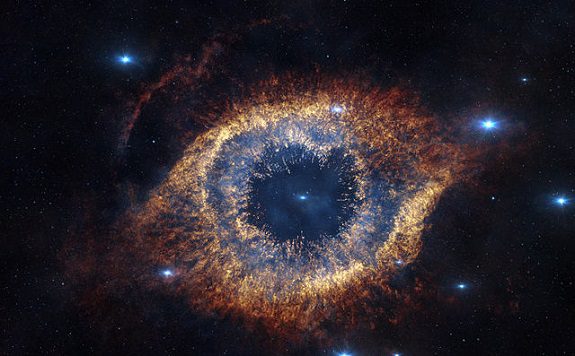
The Helix Nebula: 700 light-years away; photograph taken by European Southern Observatory’s VISTA Telescope (7-1-13). It was used in the Hidden Universe IMAX film [Wikimedia Commons / Creative Commons Attribution 4.0 International license]

* * *
This dialogue (myself against five atheists or agnostics, as usual) came from the combox of my post, Atheism: More Rational & Scientific than Christianity? The words of catfink will be in blue; those of JD Eveland (agnostic) in green, TheMarsCydonia in red, Brad Feaker in brown, and JGravelle in purple. “ID” = “intelligent design.”
* * * * *
Yes – the good old argument from ignorance. ‘Gee – I do not understand/believe this is possible – must be -insert god(s) here-
I know the feeling. The “atoms / time of the gaps” is the most amazing instance of this “gaps” stuff.
Indeed, because every time a phenomenon, like say rainbows, the tides, etc. was attributed to God, science always found that indeed God was responsible, not natural phenomena.
Hence why it is irrational to think there might be an natural explanation to any phenomenon and we should instead just say “God does it”.
As Bill O’Reilly said: “Tide comes in, tide comes out, you can’t explain that”.
Should I add /s or was it obvious enough?
You guys say, “God couldn’t have possibly done it. It has to be all natural causes.”
How is that less dogmatic than a primitive, scientifically unsophisticated Christian explaining natural phenomena by God? At least he is half-right, as all Christians believe that God not only set natural laws in motion (to run on their own) but also sustains the universe in some sense on an ongoing basis.
So if a Christian says that “God did it,” he is right. God simply did it (in most cases) via the laws that He made.
We like science; we love it; always have. We invented it. One day you’ll figure this out.
Please help me figure it out: Which Christian scientists ever inserted “God did it” as an explanation to phenomenon and turned out to be right?
I mean, if you are to continuously argue that “God did it” is rational and “natural mechanism” is irrational, there must be occurrences where the former rather than the later was proved to be true.
It’s not an either/or. Christians centuries ago still believed in creation ex nihilo, while atheists thought the universe was eternal.
Therefore, they may have said that God was the Creator, minus hard facts. Now the Big Bang comes along, which is perfectly consistent with that and refutes the eternal universe notion.
Michael Behe makes very elaborate biochemical arguments for irreducible complexity and dares to say that God designed it. None of his neo-Darwinist critics can show him a better explanation for how these structures evolved (but are awful good at a multitude of insults), so his conclusion remains the most rational one, in our present state of knowledge.
Seriously? Then why hasn’t the scientific community accepted Behe’s “most rational” conclusion? The answer is obvious: because his critics are correct.
The answer is because his critics are methodological or metaphysical naturalists and therefore don’t allow the word “God” or “design” to be considered at all.
Naturalism is the orthodoxy of the day, and we know that orthodoxy is not to be questioned, right? Behe dares to think out of the box, and so he is a pariah.
If, as you claim, Behe’s conclusion is “most rational,” why hasn’t the scientific community rejected “methodological or metaphysical naturalism” in favor of Behe’s conclusion?
Because that would be a “paradigm shift” (Kuhn) and those are fairly rare in science and huge changes of existing presuppositions.
Materialist scientists are also dreadfully fearful that any concession to design or God at all would lead inexorably to young earth creationism. It’s stupid, but that is how it is.
Same old same old . . . it’s all based on putting people into a box and refusing to recognize that science has boundaries and limitations, and that mere mention of God won’t overthrow science at all.
So you’re now claiming — without offering any argument to support your claim — that the basic paradigm of modern science is fatally flawed, and that the scientific community is somehow blind to this fundamental problem that you and Behe and a few other religiously-motivated critics have identified.
What were you saying about plausibility?
Methodological naturalism is flawed; not science itself. It doesn’t have much effect on actual scientific endeavor, since it deals with matter, anyway, but it does whenever we get to a place where science inadequately explains things: such as at the Big Bang, or some discussions in quantum mechanics or irreducible complexity.
I’m in the process right now of collecting good articles about this and many questions, precisely because of people like you who demand documentation at every turn (makes my job a lot easier, as I have not figured out how to obtain an infinite amount of time). So you wanna read about this, huh? Here you go: [1 ] [2] [3] [4] [5] [6] [7] [8] [9].
These are all philosophers, and some of the best Christian ones (Dembski also has a doctorate in mathematics).
From the judge’s ruling in Kitzmiller v. Dover, the case involving the teaching of intelligent design in public school science classes:
– A significant aspect of the IDM [intelligent design movement] is that despite Defendants’ protestations to the contrary, it describes ID as a religious argument. In that vein, the writings of leading ID proponents reveal that the designer postulated by their argument is the God of Christianity.
– The overwhelming evidence at trial established that ID is a religious view, a mere re-labeling of creationism, and not a scientific theory.
– We find that ID fails on three different levels, any one of which is sufficient to preclude a determination that ID is science. They are:
(1) ID violates the centuries-old ground rules of science by invoking and permitting supernatural causation;
(2) the argument of irreducible complexity, central to ID, employs the same flawed and illogical contrived dualism that doomed creation science in the 1980s; and
(3) ID’s negative attacks on evolution have been refuted by the scientific community.
Who cares what a judge thinks about the philosophy and nature of science, anyway? He has a legal mind, not a scientific or philosophical one.
Law is simply philosophy played for real money. Legal reasoning and philosophical inference (at least the logico-deductive versions thereof) are remarkably similar processes.Where these differ from religious reasoning is that they do not admit of supernatural causation. If an empirical cause remains murky, it’s consigned to the category of “we don’t understand it yet, but we ought to be able to sometime”; it’s not consigned to the supernatural. In practice, things we don’t understand are treated as “error variance”.
A judge certainly ought to be able to weigh in on this, particularly as there are significant issues of public policy at stake in the case. That’s why we have judges; they connect philosophy to practice.
Sure; he can weigh in, but he is not particularly an expert on issues having to do with science and philosophy. Neither am I, which is precisely why I massively cite philosophers and scientists in these areas.
Then I’m accused of merely throwing out links and being lazy, etc., and asked to summarize and dumb-down. :-)
One thing you said is incorrect as a generalization or purported statement of fact:
“philosophical inference (at least the logico-deductive versions thereof) . . . [does] not admit of supernatural causation.”
That only holds true, of course, for the atheist or agnostic philosopher. It’s not true at all of Christian and otherwise theistic philosophers, of whom there are many these days.
If it were true, no philosopher could argue for the existence of God, and you know that many do that, both now, and all through history. That’s the whole point of the cosmological and teleological arguments: about which I have recently compiled many, many links.
I ought to have said “…,certain kinds of philosophical inquiry”. Of course there are philosophical schools that do contain the supernatural. As I suggested, law represents the union of philosophy and applied economics.All legal reasoning is philosophical, although not all philosophies are included in the law.
I’d also suggest that the judge knows his own limitations as an expert; that’s why the opinion is chock full of references to scientific experts, including the large numbers that testified. Part of his responsibility was to determine who was and who was not a scientific expert. His criteria were pretty clear.
I don’t know if you’ve read the whole opinion; I have; it’s really quite tightly reasoned and well supported. I think the judge did a pretty good job of becoming as expert as he needed to be to resolve a case of applied public policy.
His ruling is based on expert testimony presented at trial. That evidence overwhelmingly refuted the claim that intelligent design is science.
Dogmaticians always defend dogma. This should surprise anyone?
As I said, there is hysteria that ID is merely creationism in a different guise. This is untrue.
Michael Behe, for example, has made it clear again and again, that he accepts evolution by common descent. Nor is it merely “religious.” This is real academic work by real scientists like Behe and philosophers like Dembski and Collins and Plantinga.
If science is defined as materialistic; that it can never mention God at all (though many scientists have done so, including Darwin), then yes, ID wouldn’t be science. But I deny that premise. The history of science also firmly denies it.
Creationism, intelligent design, and other claims of supernatural intervention in the origin of life or of species are not science because they are not testable by the methods of science. These claims subordinate observed data to statements based on authority, revelation, or religious belief. Documentation offered in support of these claims is typically limited to the special publications of their advocates. These publications do not offer hypotheses subject to change in light of new data, new interpretations, or demonstration of error. This contrasts with science, where any hypothesis or theory always remains subject to the possibility of rejection or modification in the light of new knowledge.
—Science and Creationism: A View from the National Academy of Sciences
Darwin was treated like dirt because he had a new theory. We all have heard of Galileo.
So we would expect that folks who have a few new ideas would be treated the same way today. It’s how it always is. Einstein was initially controversial, as was quantum mechanics. When punctuated equilibrium came along (1972), that was hugely controversial because it challenged neo-Darwinist gradualist orthodox dogma.
String theory is new and controversial today, etc.
Read Kuhn and Gould on the history of science and paradigm shifts.
You’re really grasping at straws now. The idea that Behe is some kind of modern-day Darwin or Galileo or Einstein is ludicrous. The work of Darwin and Galileo was resisted not because it lacked scientific merit but because it challenged religious orthodoxy. Einstein’s work on relativity was briefly controversial because it was such a radical revision of Newtonian mechanics. Intelligent design is just the most recent attempt to put a scientific veneer on religious creationism. As the quotes I provided make clear, ID is not science. It’s religion.
By the way, it is rather amusing that you attempt to recruit Gould for your cause as he was perhaps the single most famous critic of intelligent design and other forms of “creation science,” and is one of the authors of the National Academy of Sciences report I quote from above.
I didn’t technically equate him with those people. I merely noted that “we would expect that folks who have a few new ideas would be treated the same way today. It’s how it always is.”
It was an analogy, but analogies are not necessarily equivalent in every aspect. They can be partial, as this was. What is the same is the hostility to any “new” idea.
“The work of Darwin and Galileo was resisted not because it lacked scientific merit but because it challenged religious orthodoxy.”
Exactly! Now you’re starting to get it. Behe and ID generally are opposed because they challenge the present fashionable scientific orthodoxy (i.e., radical materialism or naturalism).
“Intelligent design is just the most recent attempt to put a scientific veneer on religious creationism.”
That’s hogwash, as I have already pointed out to you. The ID school contains some creationists, no doubt, but it doesn’t define the movement. Behe accepts evolution. I myself am agnostic about evolution. I have no intrinsic objection to it at all. I believe that if it is true, God had to be involved somehow, since present-day science has not adequately accounted for macroevolutionary change and creation of new anatomical structures.
My primary concern is regarding materialism, not evolution. God could very well have created in that way. No problem whatsoever (and this is official Catholic teaching as well).
Michael Denton is another ID advocate. He’s not a creationist, either:
Denton still accepts design and embraces a non-Darwinian evolutionary theory. He denies that randomness accounts for the biology of organisms, he has proposed an evolutionary theory which is a “directed evolution” in his book Nature’s Destiny (1998).
The same holds true for another prominent ID advocate, Robin Collins:
Regarding evolution, he accepts the claim that all life on earth came about by a process of evolution (descent with modification) from the first cell, but is open to the possibility that God might have guided this process at various points. He is skeptical of the claim that all the complex biological structures we find in living things can be fully explained by blind, unguided chance plus natural selection, and thus thinks that the issue of whether Darwinian evolution (without God’s guiding control) can adequately account for the structure of life should be vigorously explored.
His criticism of presently orthodox materialistic evolutionary theory there is exactly my own.
I cited Gould for the purpose that I explained. He writes about how scientists are persecuted when they come up with something against the currently accepted orthodoxy. It happened to him, too (punctuated equilibrium).
Gould wrote, e.g., about a guy like anthropologist and anatomist Raymond Dart, who first discovered a specimen of Australopithecus africanus, and how he was atrociously treated because he had a different theory. All of that analysis is perfectly consistent with my argument here. But you can’t receive it, because you are too dogmatic and set in your ways to even comprehend what I’m saying.
Gould also wrote similarly about geneticist Richard Goldschmidt, of “hopeful monsters” fame. His ideas went against the grain of fashion, and so Wikipedia notes:
Goldschmidt presented his hypothesis when neo-Darwinism was becoming dominant in the 1940s and 1950s, and strongly protested against the strict gradualism of neo-Darwinian theorists. His ideas were accordingly seen as highly unorthodox by most scientists and were subjected to ridicule and scorn. However, there has been a recent interest in the ideas of Goldschmidt in the field of evolutionary developmental biology, as some scientists are convinced he was not entirely wrong.
This goes on constantly in science, as Gould has documented in his marvelous writing, with many examples. Behe is just one instance of it. If Behe’s research is so poor, you are welcome to take it on and refute it (I won’t hold my breath). See several articles and descriptions of it.
For the reasons concisely stated in the quotes I gave you, the scientific community overwhelmingly rejects your position that “real” science includes claims of supernatural intervention.
Of course it does. The present orthodoxy and paranoia about ID demands that it does. If you know the history of science, this is nothing new. It’s a ho hum and has no relation to whether someone should hold any particular opinion.
I’m not constrained by (nor concerned with) the irrational dogmas of “science only” and scientific materialism. If even Einstein wasn’t, why should I be?
So you think the overwhelming view of the scientific community about the basic meaning of science is “irrational dogma and paranoia.”
I think this statement illustrates as well as anything you’ve written why your efforts to convert people to your belief system are so spectacularly unsuccessful.
Once again you show yourself unable to grasp basic (not to mention fine) distinctions. There is no dispute here over “the basic meaning of science”. My views wouldn’t have any effect on a single scientific experiment or study taking place.
Rather, the dispute has to do with the relationship of science to philosophy and to God, whether science is the only valid type of knowledge, and whether science must be construed in terms of materialism.
Thus I brought up Einstein. He didn’t look at it that way, and no one questions his scientific credentials.
Huh? How is a claim of supernatural intervention not a change in the basic meaning of science?
It’s ancillary or supplementary to science, and can relevantly be brought up as a philosophical / religious belief at the edge (or just off the edge) of science. Science intersects to some extent with philosophy (and is itself, in the final analysis, a philosophy (empiricism). And it even intersects with religious views (e.g., cosmological and teleological arguments, in the realm of philosophy of religion or religious epistemology)
Of course, if science is put into an exclusive box of materialism (or the somewhat less strong methodological materialism or naturalism), then it must disallow any mention of God whatever. But the theistic scientist is under no such constraints.
It’s all about edges of knowledge and fields and what is or is not permissible. Atheists are dogmatic about God not being allowed at all in science, in any sense whatever: not even in an ancillary sense.
We understand that some folks are limited and constrained by their dogmas, but we are not so constrained by how others deliberately limit their thinking and horizons (putting “chains” on it, so to speak). They can’t be imposed or forced onto us. Keep your dogmas to yourself!
[yes, I am fully aware of the high, and to me, very humorous irony here]
I think that you’re making Einstein into more of a Christian than his views really warrant. There was a recent exhaustive bio of Einstein that I read, and it contained a lot of analysis of his spiritual ideas. Certainly he was no closer to Christianity than a sort of vaguely defined deism; he was firmly committed to the proposition that there were natural laws that could be discovered and described mathematically. Certainly he never defined any “fundamental mystery” that could be comprehended only by faith..
Einstein wrote a lot of stuff, and it’s easy to find somewhere in his literary corpus a quote or two that would support almost any spiritual inference. That’s why it’s important to look analytically across a wide variety of his writing, to tease out the consistent themes – which were by no means conventionally Christian.
Not at all. Read exactly what I wrote. I cited Einstein in agreement with regard to “the irrational dogma of ‘science only’ and scientific materialism.”
Einstein acknowledged a great mystery behind the design, magnificence, and beauty behind the universe, much as, say, David Hume did, and he disavowed atheism. Therefore, he was not a scientific materialist (and this is why I brought him up, as “catfish” tries to marginalize my opinions as kooky and wacko and utterly unacceptable). I have much documentation to back up my contentions about Einstein.
Einstein refers to God when he reflects upon the marvelous design of the universe, though it is a vague pantheist god in his belief.
But it’s not atheism, and thus, at those points where he mentions God, he is saying that God brought about the whole ball of wax in some sense, and that those who didn’t see some sort of design in the whole thing were relative simpletons and deficient in their outlook, in a major way.
The myth that many atheists swallow is that science must be materialistic and can’t possibly ever include God (even most indirectly).
Yet half of scientists today remain theists, so obviously they see no inherent conflict.
* * *
Were you a food critic who defended his love of lasagna by telling us why chop suey sucked, I’d be just as befuddled, and for the same reason.
For the love of Yeshua man, I’ve offered several times now for the sake of argument to pretend that every objection you have to science and atheism is valid.
How have I objected to science? I was unaware that I ever did that. Please inform.
The food analogy doesn’t work. I oppose the guy who sez that chop suey is all there is, and lasagna is impermissible. Because that is irrational, I poke holes in the theory and defend lasagna. The Catholic view is both/and. Lasagna is great; so is chop suey. Faith is great; so is science. Religion is wonderful; so is reason. Etc.
You’ve argued against one ‘Steve Conifer’ and insisted the eye was too irreducibly complex to have evolved. [Armstrong vs Evolution]
You’ve argued the historicity of the Great Flood with a ‘Kevin Rice’. [Armstrong vs. Geology]
[he also claimed that I was a young-earther, but when I showed him this has never been the case, he retracted it]
Holding to irreducible complexity is not to be against science. It simply holds that science can’t explain some things, and we must admit this, in all honesty. All that is saying is that science isn’t the sum of all knowledge, which is a truism and uncontroversial.
I believe a Flood happened, but that it was local, not universal. I don’t see how that is “anti-science.” How is belief in a big flood anti-science, pray tell? One might try to argue against it as historical fact, but that would be the realm of history, not science.
So you have failed on all accounts in your ludicrous attempt to “prove” that I have anything against science itself at all.
Sir, if you are at odds with the science you, by definition, hold an objection to it.
Science is not dogma. There is no “IT” per se. There are different theories and hypotheses. If you regard them as absolutely final and not subject to revision or change, then you are the one who has bastardized science to a “pseudo [bad]-religious” dogma.
It’s not more anymore “anti-science” to acknowledge that science can’t answer absolutely all questions about the universe, than it is “anti-Christian” or “anti-biblical” to acknowledge that the Bible doesn’t even attempt to answer all questions about the material universe and science. All that is, is being a sane, conscious thinker.
The notion of irreducible complexity is un-falsifiable. Unfalsifiable claims are unscientific claims. Unscientific claims are by definition at odds with (thus in objection to) science.
If a case can be made for irreducible complexity, it should be made to the Nobel committee. A lucrative award awaits you for such a demonstration.
I’ll hold out hope that, for my part in encouraging you, a modest stipend might come my way when you collect…
Previous Post

October 28, 2015
Problem of Evil: Treatise on the Most Serious Objection
Next Post

October 29, 2015 Is Christianity to Blame for Allegedly "Christian" Lunatics?
Browse Our Archives
Select a Category & Last Things About Me Anti-Catholicism Atheism & Agnosticism Baptism and Sacramentalism Bible and Tradition Blessed Virgin Mary Books by Dave Armstrong C. S. Lewis Calvinism & General Protestantism Catholic Apologetics Catholic Apologists Catholic conversion Catholic converts Christmas Church (Ecclesiology) Church History Conversion and Converts Development of Doctrine Eastern Orthodoxy Ecumenism & Christian Unity Eucharist & Liturgy Fathers of the Church French Translations G. K. Chesterton Hell Hell & Satan Hell & Satan & Last Things Heresies & Comparative Religion Holistic Health Inquisition & Crusades & Scandals James White Jews & Judaism & Old Testament John Calvin John Henry Newman Liberal / Modernist Theology Life Issues Literary Resume Lutheranism Mariology Martin Luther Music Orthodoxy Papacy & Infallibility Personal Page Philosophy & Science Political & Ethical & Moral Issues Protestant Persecution & Intolerance Protestantism Purgatory Purgatory & Penance Romantic & Imaginative Theology Saints & Purgatory & Penance Salvation Salvation & Justification Satan & Last Things Sexuality and Gender Issues Spanish Translations Traditionalism vs. Radical Catholic Reactionaries Traducciones al español / tradução para português Trinitarianism & Christology Uncategorized Videos
Select a Month October 2026 September 2026 August 2026 July 2026 June 2026 May 2026 April 2026 March 2026 February 2026 January 2026 December 2025 November 2025 October 2025 September 2025 August 2025 July 2025 June 2025 May 2025 April 2025 March 2025 February 2025 January 2025 December 2024 November 2024 October 2024 September 2024 August 2024 July 2024 June 2024 May 2024 April 2024 March 2024 February 2024 January 2024 December 2023 November 2023 October 2023 September 2023 August 2023 July 2023 June 2023 May 2023 April 2023 March 2023 February 2023 January 2023 December 2022 November 2022 October 2022 September 2022 August 2022 July 2022 June 2022 May 2022 April 2022 March 2022 February 2022 January 2022 December 2021 November 2021 October 2021 September 2021 August 2021 July 2021 June 2021 May 2021 April 2021 March 2021 February 2021 January 2021 December 2020 November 2020 October 2020 September 2020 August 2020 July 2020 June 2020 May 2020 April 2020 March 2020 February 2020 January 2020 December 2019 November 2019 October 2019 September 2019 August 2019 July 2019 June 2019 May 2019 April 2019 March 2019 February 2019 January 2019 December 2018 November 2018 October 2018 September 2018 August 2018 July 2018 June 2018 May 2018 April 2018 March 2018 February 2018 January 2018 December 2017 November 2017 October 2017 September 2017 August 2017 July 2017 June 2017 May 2017 April 2017 March 2017 February 2017 January 2017 December 2016 November 2016 October 2016 September 2016 August 2016 July 2016 June 2016 May 2016 April 2016 March 2016 February 2016 January 2016 December 2015 November 2015 October 2015 September 2015 August 2015 July 2015 June 2015 May 2015 April 2015 March 2015 February 2015 January 2015 December 2014 November 2014 October 2014 September 2014 August 2014 July 2014 June 2014 April 2014 March 2014 February 2014 January 2014 December 2013 November 2013 October 2013 September 2013 August 2013 July 2013 June 2013 April 2013 March 2013 February 2013 January 2013 December 2012 November 2012 October 2012 September 2012 August 2012 July 2012 June 2012 May 2012 April 2012 March 2012 February 2012 January 2012 December 2011 November 2011 October 2011 September 2011 August 2011 July 2011 June 2011 April 2011 March 2011 February 2011 October 2010 September 2010 August 2010 July 2010 April 2010 March 2010 December 2009 October 2009 August 2009 July 2009 June 2009 May 2009 March 2009 February 2009 October 2008 September 2008 April 2008 March 2008 February 2008 January 2008 December 2007 November 2007 October 2007 May 2007 March 2007 February 2007 January 2007 November 2006 October 2006 September 2006 August 2006 July 2006 June 2006 May 2006 April 2006 March 2006 February 2006 October 2005 June 2005 April 2005 February 2005 July 2004 May 2004 April 2004
Follow Us!
TAKE THE
Religious Wisdom Quiz
What does "Pentateuch" mean?
Select your answer to see how you score.
Five Scrolls God's Law Sacred Teachings Holy Writings
Books by This Author Books by Dave Armstrong
Related posts from Biblical Evidence for Catholicism

God, Modern Physics, & Dark Energy: An Analogy
Biblical Evidence for Catholicism

General Debate on Christianity with an Atheist
Biblical Evidence for Catholicism

Parting of the Red Sea & Lake Erie...
Biblical Evidence for Catholicism

Can Atheists Be Saved? Surprising Biblical Data
Biblical Evidence for Catholicism
TRENDING AT PATHEOS Catholic

In "Irreplaceable," our book on vocation and technology, Trevor Sutton and I...

I was strolling through the top floor of the brand new Parthenon...

What Does Gêvâh Mean For Kimberley Guifoyle &...
This week, a lot of the news is focused on Kimberly Guilfoyle....

INNER CIRCLE: Profound Mystery (Of Christ In All...
Ephesians 5:31-32 “For this reason, a man will leave his father and...

Do Not Rejoice When Your Enemy Falls: The...
Turning an execution into a public spectacle is a disturbing expression of...

'The Chosen' S6 Trailer: The Passion Gets Very...
Not many watching 'The Chosen' worry about spoilers, but just because they...
view all Catholic blogs
Ad-Free & Subscriber Log-In Subscription Support
- About Us
- 2026 Calendar
- Videos
- Podcasts
- Library of World Religions
- Faith In Media Tracker
- Advertise With Us
- Write for Us
- Privacy Policy
- Terms of Service
- Do Not Sell My Data
- Contact Us
- Radiant Digital
- Manage Newsletter Subscriptions
- Unsubscribe From Notifications
- Sitemap
Copyright 2008-2026, Patheos. All rights reserved.
Subscription Support Ad-Free & Subscriber Log-In
Follow Patheos