
BuddhistCatholicContemplativeEvangelicalGeneral ChristianHinduJewishLatter-day SaintMuslimNew VisionsProgressive Christian
Beliefs
- Buddhist
- Catholic
- Contemplative
- Evangelical
- General Christian
- Hindu
- Jewish
- Latter-day Saint
- More Voices
- Muslim
- New Visions
- Pagan
- Progressive Christian
Topics
- Religion News
- Food and Religion
- Sports and Religion
- Religious Art
- Religious Music and Entertainment
- Religious Events
- History and Religion
- Style and Religion
- Politics and Religion
- Women in Religion
- Recreation Outdoors and Religion
- Business Finance and Religion
- Careers Workplace and Religion
- Education and Religion
- Family Parenting and Religion
- Health Fitness and Religion
- Home and Religion
- Relationships and Religion
- Technology and Religion
- Travel and Religion
Columnists
- Buddhist Columnists
- Business Finance and Religion Columnists
- Careers Workplace and Religion Columnists
- Catholic Columnists
- Contemplative Columnists
- Education and Religion Columnists
- Evangelists Columnists
- Family Parenting and Religion Columnists
- General Christian Columnists
- Health Fitness and Religion Columnists
- Hindu Columnists
- History and Religion Columnists
- Home and Religion Columnists
- Jewish Columnists
- More Voices Columnists
- Latter Day Columnists
- Muslim Columnists
- New Visions Columnists
- Nonreligious Columnists
- Pagan Columnists
- Politics and Religion Columnists
- Progressive Columnists
- Recreation Outdoors and Religion Columnists
- Relationships and Religion Columnists
- Religion News Columnists
- Religious Art Columnists
- Religious Events Columnists
- Religious Music and Entertainment Columnists
- Sports and Religion Columnists
- Style and Religion Columnists
- Technology and Religion Columnists
- Travel and Religion Columnists
- Women in Religion Columnists
Resource Library
- 2026 Calendar
- Library of World Religions
- The 100 Most Holy Places on Earth
- Patheos Answers
- Podcasts
- Videos
- Faith Leaders Database
- Anglican Episcopalian
- Bahai
- Baptist
- Buddhism
- Christianity
- Confucianism
- Eastern Orthodoxy
- Hinduism
- Holiness and Pentecostal
- ISKCON
- Islam
- Judaism
- Lutheran
- Methodist
- The Church of Jesus Christ of Latter-day Saints
- New Age
- Paganism
- Presbytarian and Reformed
- Protestantism
- Religion Behind the Scenes
- Roman Catholic
- Scientology
- Shia Islam
- Sikhism
- Sufism
- Sunni Islam
- Taoism
- Zen
- See all religions
Research Tools
 Ad-Free & Subscriber Log-In Subscription Support
Ad-Free & Subscriber Log-In Subscription Support
Follow Patheos 

- Trending:
- Forgiveness
- |
- Marriage
- |
- Consciousness
- |
- Death Penalty
- |
- Election
- |
- Halloween

-
About
-
Catholic Apologetics
-
Church History
-
Great Apologists
-
Christian Worldview
-
Protestantism & Misc.
- Home
- Catholic
- History and Religion
- Dialogue on the Rich Young Ruler and Good Works
Dialogue on the Rich Young Ruler and Good Works
Last updated on: May 17, 2017 at 3:50 pm by Dave Armstrong
Dialogue on the Rich Young Ruler and Good Works 2017-05-17T15:50:09-04:00 Dave Armstrong
Patheos Explore the world's faith through different perspectives on religion and spirituality! Patheos has the views of the prevalent religions and spiritualities of the world.
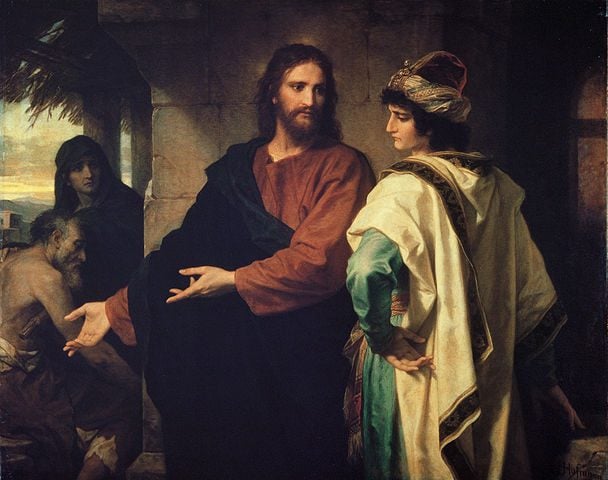
Christ and the Rich Young Ruler (1889), by Heinrich Hofmann (1824-1911) [public domain / Wikimedia Commons]

John and Cindy Taylor are members of the Orthodox Presbyterian Church. They are friends “in real life” and have been to our house several times. I also attended their wedding. This was an exchange about my post, Jesus vs. “Faith Alone” (Rich Young Ruler), on my Facebook page. John’s words will be in green; Cindy’s in blue.
* * * * *
The article mischaracterizes me. I’m not surprised. But I love you anyhow. You’re a dear friend.
I never mentioned you. :-) I took pains to note that Protestants are not saying, “don’t do good works”; only that works are not formally connected to salvation. This is all standard Protestant theology. It’s what “faith alone” means.
I understand. Did not say you mischaracterized me, only that the article mischaracterized me. The article does not represent a complete understanding of Protestant soteriology, but that is understandable in light of so many different views that are called “Protestant”.
1. It’s hard to be “complete” in 1500 words.
2. Feel free to fill in blanks you think are missing.
The James passage [James 2:14-26] is Christianity 101, along with Ephesians 2:8-10.
I wanna hear answers to my questions asked in the paper: why did Jesus talk only about works when the ruler asked him how one is saved? How does that fit with a sola fide view of salvation?
Jesus also said the work of God is to believe in the One Whom He has sent. None of us can be saved by any good works we do, because only Jesus did and could keep the commandments perfectly, so we are saved on the basis of His merits, not ours. That’s grace.
After my dad and I heard a sermon on James 2, he explained it thus: “Your sin is so great, no amount of good works will save you; only faith in Jesus Christ’s life, death, and resurrection will. Having said that, if good works do not follow your faith, your faith is probably counterfeit.”
I have no zeal to bat around the relationship between faith and works, when my dad explained it so clearly to me when I was ten years old.
Cindy,
I said both of those things in the paper. You still haven’t shown how I in any way distorted the “faith alone” teaching; nor answered why Jesus would mention only works with the rich young ruler.
St. Augustine said that our merit was merely God crowning His own graces. That’s what we Catholics believe. It doesn’t come from us, it comes from God, giving us the grace to do any good thing.
John,
Good to hear from both of you! Hope you are well.
I agreed in the paper with what you have added, too.
Maybe you’ll give it a shot: why did Jesus talk only about works when the ruler asked him how one is saved? How does that fit with a sola fide view of salvation?
It easily fits with our view. We think works aren’t separated from faith in the process of salvation, even though grace is what saves us. We don’t separate works into a separate non-salvific category of sanctification.
So we don’t have to deny any passage about faith or any about grace. The Bible mentions faith in conjunction with salvation in many places, and works in conjunction with salvation in many places, and both together in many places. Both are involved in salvation.
So we don’t have to ignore or explain away passages that talk about works being also centrally involved in the process of salvation, because we don’t deny that. What we deny is a “works alone” or “works salvation” doctrine (Pelagianism).
Dave, do you believe we must be sanctified in order to be justified (saved)? If so, what is sanctification, if it is not being conformed to the likeness of Christ? I’m not able to give an answer to satisfy you until I better understand your thinking. Right now my thought is that Jesus’ point with the rich young ruler was that all the good works in the world can’t save him. Reason is that the rich young ruler lacked the faith required to do what Jesus required of him. Faith in the One before Whom he stood. I quoted this verse earlier, here it is again, John 6:29: “Jesus answered them, ‘This is the work of God, that you believe in Him Whom He has sent.'” That is the only work required for justification. Apart from justification there can be no sanctification. Let me ask you one more question: If works are essential to salvation, what good work did the thief on the cross do to be saved? His confession of faith was what saved him. Romans 10:9-10 comes to mind. Another is Zacchaeus’ repentance and faith, demonstrated by his deeds being the fruit thereof. I think our differences lie in what we believe about the relationship of sanctification to justification and whether it is God or our works that justify us. The works prove us before men. The faith, a gift from God, justifies us before God.
Thanks for your reply.
Catholics believe that we must be free from mortal sin (serious, grave sins, which can keep one from heaven), and justified, and regenerated (which we place at baptism). All of us, pretty much, have venial sins. These can be purged away in purgatory and don’t bar a person from heaven or salvation.
If Jesus’ point was that works have nothing to do with salvation at all, then (it seems very likely and sensible) He would have spoken about faith and belief instead. But He didn’t do that. He brought up the commandments and named six of them. Therefore, Jesus clearly thought that that was part of salvation. It has something to do with it.
After that, He said the ruler lacked one thing. That would be faith, right? No! It was another work. He had to go and sell all he had to the poor. But he didn’t wanna do that, so Jesus observed that it was very difficult for a rich man to enter heaven.
The strong implication is that he placed his salvation in jeopardy by not doing the work that Jesus required him to do. I think we can all agree that he had made money his idol, which is serious sin; therefore, he couldn’t be saved as long as he had that idol in his heart.
I have written about how “belief” in Greek has also the component of obedience. It’s not merely assent. Works are not required if one can’t possibly do them. That was true of the thief on the cross. We also think he didn’t need to be baptized, and say that he had a “baptism of desire.”
I think our differences lie in what we believe about the relationship of sanctification to justification
That’s true. Catholics put them together, whereas Protestants make the first category a “non-salvific” one. We don’t believe that that is a biblical distinction.
and whether it is God or our works that justify us.
That’s not a difference. We believe in salvation by grace alone, just as you do. We believe that faith is necessary, as you do. Every good thing we do requires prior grace from God; otherwise, we couldn’t do anything good at all, ever. But what we believe differently from you, is a refusal to separate works from faith, as if it were totally a different category. If faith saves, and “faith without works is dead,” then obviously works are part of the whole equation, even though we agree with you that works alone save no one (the heresy of Pelagianism).
It’s not just this passage that talks about works. I have found 50 passages having to do with the final judgment. Not a single one talks about faith alone.
Dave, we “separate” them temporarily, and only to better understand the significance of each, but we realize they go together. Similarly, if there is “one baptism” (Eph. 4:5), we have to temporarily think of the role of the water apart from the Holy Spirit (and vice versa) and then put them together again as vital components to the Sacrament, to better understand it.
I’m glad you brought up the rich young ruler because it forced me to see the two different kinds of works mentioned. Anyone can avoid stealing and adultery, and honor his parents. But for a very wealthy man to follow a homeless rabbi who had no place to lay his head (Mt. 8:20, Lk. 9:58) after giving up all his wealth (so he couldn’t return to it) would have required a faith quite different from what he had.
Sadly, I meet many respectable people, both Catholics and Protestants, who think they are “good people” whose “good works” will get them into heaven. But the rich young ruler trumps them all, for he had a track record from his youth that impressed Christ Himself, but it still was insufficient for salvation without a supernatural work in his heart that would have given him the courage to forsake all.
I think our views are actually close, but there is a distinction of category. Both views think works are necessary as indicative of authentic faith.
There really isn’t a whole lot to fight over here. We believe in salvation by grace and by faith, and we deny works-salvation (Pelagianism and Semi-Pelagianism).
You guys agree that good works are necessary in a Christian life. You just put ’em in a separate sanctification box, whereas we include ’em in the justification box. :-)
Right. Catholics mix sanctification with justification. Protestants recognize that justification is a one-time act of God declaring us not guilty, whereas sanctification is a continual work of God conforming the believer to be like Christ over the years of the believer’s lifetime on earth.
So with the rich young ruler, who asked about salvation (justification), Jesus talked only about works, which is (in your view) only part of non-salvific sanctification.
That just doesn’t make sense to me. If salvation is being discussed, and if faith is front and center in that; — indeed “alone” — then I don’t see how Jesus could or would have avoided talking about it.
I think the best counter-answer Protestants can give was provided by a Lutheran in the combox of my post at Patheos. I still disagree with it, but he gave it a good (and detailed) shot, and I always admire zeal and passion.
You and John are good friends. I have a lot of respect and admiration for you. It’s great that we can talk and disagree amiably.
I still remember that legendary game of Bible trivia. Fun!
I’ll never forget Bible trivia games at your house on New Year’s Eve, Dave! You and your family are and always will be very special to us, no matter how far we live from you!
Well, that is awful sweet!
Dave, I see nothing either Cindy or I wrote that could lead anyone to think we believe that works is “…only part of non-salvific sanctification”.
Christ told the rich young ruler to perform an act that would be impossible apart from faith. Similarly, Zaccheus’ giving half of his wealth to the poor and reimbursing fourfold everyone he had cheated, eliciting Jesus’ verdict that salvation had come to his house.
I can point to multiple things I have done that the selfish, egotistical sorry specimen of the human race that I used to be would have never done apart from justifying faith. Do I believe I am saved because I did them? Well, yes and no. By themselves, they are filthy rags (Is. 64:6), but together they also give evidence of a heart that received Christ as Savior, by which faith God pronounced a very guilty sinner “Not guilty!”
I think the positions are close in many ways. It’s mostly an abstraction, where the difference lies (how to classify things). Practically speaking, it’s the same: we all need grace, always, to do any good thing and to be saved. We have to exercise faith, and we need to do good works, which don’t save us in and of themselves, but which — enabled and generated by God’s grace — prove the authenticity of our faith. Baptism (whatever we think it does) is necessary for all Christians.
We agree on all that! It’s far more than what we disagree about (more or less abstract definitions). I’ve always said that it’s a shame that the soteriology of Catholicism and classical Reformation Protestantism is in fact a lot closer than most on either side realize. And so the two sides end up slugging it out about stuff that is already agreed-upon, rightly-understood. We’re neither Pelagians nor semi-Pelagians, and you’re not antinomians or advocates of “cheap grace” (the stereotypes).
Our dialogue was great in that we didn’t have to reinvent the wheel, but could simply talk intelligently about the real differences, which are relatively minor. It was a pleasure, and a model, I think, of constructive, charitable, Catholic-Protestant dialogue.
Here are my replies to [what appears to be] a Lutheran [NServ] over in the combox for the post on Patheos. His lengthy comments and replies may be read there.
We know that works don’t save.
If faith alone is true, it doesn’t matter what the ruler asked; Jesus would have directed him to faith; not works.
Earlier in the chapter is irrelevant, too. I said in the post that faith was mentioned elsewhere. We know that. I wanna know why Jesus didn’t mention it to the rich young ruler.
That remains unanswered, because it seems to me that it is a difficulty in the Protestant position.
We need not deny that other discussions may have taken place. Of course.
But, this was a chance to present in the Bible, for our sakes, a simple doctrine of faith alone salvation. The man asks how he is to be saved. This was the chance to make “faith alone” crystal clear, in the inspired Bible, for all time; for our instruction. But instead, it was never mentioned.
You have put a lot of effort into your replies. Thanks for that. You’re a very educated Lutheran (I am judging by your link that you are a Wisconsin Synod Lutheran). I continue to believe, however, that the passage poses a big problem for Protestant “faith alone” views. It sure doesn’t seem like it would read the way it does, if faith alone is the truth of the matter.
This is, additionally, massively verified in 50 passages that I have collected about the last judgment. They all discuss works. Not a single one brings forth “faith alone”. Surely, this is quite odd and unexpected, given Protestant soteriology.
I already stated in the paper, “We believe (in agreement with Protestants) that we’re saved by God’s grace.” I guess you missed that.
You say, “It’s because the young ruler still has NOT been convinced that he is sinful by nature.”
So it’s your position that this also holds true for all 50 instances of works being the central issue at the last judgment: as I documented in my paper, linked [above]? That’s your standard answer every time works are brought up in conjunction with salvation, and faith isn’t?
Your theory completely falls apart there, because almost all the references are being spoken to believers. So, e.g., the seven Pauline references are from his letters to the Christians / churches at Rome, Corinth, and Thessalonika. He’s writing to Christians, but he’s still talking about works, with regard to the judgment.
According to your theory, he must switch over to faith alone. But he doesn’t. You wanna cite Romans 3:23-25 but ignore Romans 2:5-13, which is one in my collection about the judgment. Catholics have no problem incorporating both, but you guys have trouble with the works passages because they clash with the notion of faith alone.
Peter in three references does the same. He’s writing to Christians, too, who understand the basic law / grace thing you refer to. The writer of Hebrews and Jude (twice) also do the same thing. It’s all works. Jesus in Revelation talks about works again in writing to the seven churches:
Revelation 2:5 (RSV) Remember then from what you have fallen, repent and do the works you did at first. If not, I will come to you and remove your lampstand from its place, unless you repent.
Revelation 2:23 . . . I am he who searches mind and heart, and I will give to each of you as your works deserve.
Again and again, with all due respect, the Bible leads me to / is consistent with Catholic theology.
Previous Post
October 13, 2015
50 New Testament Proofs for Peter's Primacy & the Papacy
Next Post
October 14, 2015 My Apologetics Books (#2): "The Catholic Verses" (2004)
Browse Our Archives
Select a Category & Last Things About Me Anti-Catholicism Atheism & Agnosticism Baptism and Sacramentalism Bible and Tradition Blessed Virgin Mary Books by Dave Armstrong C. S. Lewis Calvinism & General Protestantism Catholic Apologetics Catholic Apologists Catholic conversion Catholic converts Christmas Church (Ecclesiology) Church History Conversion and Converts Development of Doctrine Eastern Orthodoxy Ecumenism & Christian Unity Eucharist & Liturgy Fathers of the Church French Translations G. K. Chesterton Hell Hell & Satan Hell & Satan & Last Things Heresies & Comparative Religion Holistic Health Inquisition & Crusades & Scandals James White Jews & Judaism & Old Testament John Calvin John Henry Newman Liberal / Modernist Theology Life Issues Literary Resume Lutheranism Mariology Martin Luther Music Orthodoxy Papacy & Infallibility Personal Page Philosophy & Science Political & Ethical & Moral Issues Protestant Persecution & Intolerance Protestantism Purgatory Purgatory & Penance Romantic & Imaginative Theology Saints & Purgatory & Penance Salvation Salvation & Justification Satan & Last Things Sexuality and Gender Issues Spanish Translations Traditionalism vs. Radical Catholic Reactionaries Traducciones al español / tradução para português Trinitarianism & Christology Uncategorized Videos
Select a Month October 2026 September 2026 August 2026 July 2026 June 2026 May 2026 April 2026 March 2026 February 2026 January 2026 December 2025 November 2025 October 2025 September 2025 August 2025 July 2025 June 2025 May 2025 April 2025 March 2025 February 2025 January 2025 December 2024 November 2024 October 2024 September 2024 August 2024 July 2024 June 2024 May 2024 April 2024 March 2024 February 2024 January 2024 December 2023 November 2023 October 2023 September 2023 August 2023 July 2023 June 2023 May 2023 April 2023 March 2023 February 2023 January 2023 December 2022 November 2022 October 2022 September 2022 August 2022 July 2022 June 2022 May 2022 April 2022 March 2022 February 2022 January 2022 December 2021 November 2021 October 2021 September 2021 August 2021 July 2021 June 2021 May 2021 April 2021 March 2021 February 2021 January 2021 December 2020 November 2020 October 2020 September 2020 August 2020 July 2020 June 2020 May 2020 April 2020 March 2020 February 2020 January 2020 December 2019 November 2019 October 2019 September 2019 August 2019 July 2019 June 2019 May 2019 April 2019 March 2019 February 2019 January 2019 December 2018 November 2018 October 2018 September 2018 August 2018 July 2018 June 2018 May 2018 April 2018 March 2018 February 2018 January 2018 December 2017 November 2017 October 2017 September 2017 August 2017 July 2017 June 2017 May 2017 April 2017 March 2017 February 2017 January 2017 December 2016 November 2016 October 2016 September 2016 August 2016 July 2016 June 2016 May 2016 April 2016 March 2016 February 2016 January 2016 December 2015 November 2015 October 2015 September 2015 August 2015 July 2015 June 2015 May 2015 April 2015 March 2015 February 2015 January 2015 December 2014 November 2014 October 2014 September 2014 August 2014 July 2014 June 2014 April 2014 March 2014 February 2014 January 2014 December 2013 November 2013 October 2013 September 2013 August 2013 July 2013 June 2013 April 2013 March 2013 February 2013 January 2013 December 2012 November 2012 October 2012 September 2012 August 2012 July 2012 June 2012 May 2012 April 2012 March 2012 February 2012 January 2012 December 2011 November 2011 October 2011 September 2011 August 2011 July 2011 June 2011 April 2011 March 2011 February 2011 October 2010 September 2010 August 2010 July 2010 April 2010 March 2010 December 2009 October 2009 August 2009 July 2009 June 2009 May 2009 March 2009 February 2009 October 2008 September 2008 April 2008 March 2008 February 2008 January 2008 December 2007 November 2007 October 2007 May 2007 March 2007 February 2007 January 2007 November 2006 October 2006 September 2006 August 2006 July 2006 June 2006 May 2006 April 2006 March 2006 February 2006 October 2005 June 2005 April 2005 February 2005 July 2004 May 2004 April 2004
Follow Us!
TAKE THE
Religious Wisdom Quiz
I am the resurrection and the life. Whoever believes in me will live, even though they do what?
Select your answer to see how you score.
Suffer Die Fall Sin
Books by This Author Books by Dave Armstrong
Related posts from Biblical Evidence for Catholicism

Bible & Catholicism on Mortal Sin (vs. John...
Biblical Evidence for Catholicism

Dialogue on Eternal Security / Absolute Assurance
Biblical Evidence for Catholicism

"Faith Alone" Dialogue with a Calvinist
Biblical Evidence for Catholicism

Exegesis of 75 NT Faith [Alone?] & Works...
Biblical Evidence for Catholicism
TRENDING AT PATHEOS Catholic

The First Eucharistic Controversy: Christ’s Real Presence
For Catholics, the Eucharist is the source and summit of the Christian...

How to Make a Decision When You Can't...
Main point: It’s much more valuable to stay close to God so...

Archdiocese Hosts Military Marriage Retreat in Germany
RASTATT, Germany — The transient military lifestyle, with its frequent deployments and...

Nearly every morning, I make the drive to Detroit with my high-school-age...

The Real AI Story Is Adoption Without Trust
Artificial intelligence has crossed a political threshold. It is no longer a...

A new article, written by Jeff Lindsay and Gale L. Pooley,...
view all Catholic blogs
Ad-Free & Subscriber Log-In Subscription Support
- About Us
- 2026 Calendar
- Videos
- Podcasts
- Library of World Religions
- Faith In Media Tracker
- Advertise With Us
- Write for Us
- Privacy Policy
- Terms of Service
- Do Not Sell My Data
- Contact Us
- Radiant Digital
- Manage Newsletter Subscriptions
- Unsubscribe From Notifications
- Sitemap
Copyright 2008-2026, Patheos. All rights reserved.
Subscription Support Ad-Free & Subscriber Log-In
Follow Patheos