
BuddhistCatholicContemplativeEvangelicalGeneral ChristianHinduJewishLatter-day SaintMuslimNew VisionsProgressive Christian
Beliefs
- Buddhist
- Catholic
- Contemplative
- Evangelical
- General Christian
- Hindu
- Jewish
- Latter-day Saint
- More Voices
- Muslim
- New Visions
- Pagan
- Progressive Christian
Topics
- Religion News
- Food and Religion
- Sports and Religion
- Religious Art
- Religious Music and Entertainment
- Religious Events
- History and Religion
- Style and Religion
- Politics and Religion
- Women in Religion
- Recreation Outdoors and Religion
- Business Finance and Religion
- Careers Workplace and Religion
- Education and Religion
- Family Parenting and Religion
- Health Fitness and Religion
- Home and Religion
- Relationships and Religion
- Technology and Religion
- Travel and Religion
Columnists
- Buddhist Columnists
- Business Finance and Religion Columnists
- Careers Workplace and Religion Columnists
- Catholic Columnists
- Contemplative Columnists
- Education and Religion Columnists
- Evangelists Columnists
- Family Parenting and Religion Columnists
- General Christian Columnists
- Health Fitness and Religion Columnists
- Hindu Columnists
- History and Religion Columnists
- Home and Religion Columnists
- Jewish Columnists
- More Voices Columnists
- Latter Day Columnists
- Muslim Columnists
- New Visions Columnists
- Nonreligious Columnists
- Pagan Columnists
- Politics and Religion Columnists
- Progressive Columnists
- Recreation Outdoors and Religion Columnists
- Relationships and Religion Columnists
- Religion News Columnists
- Religious Art Columnists
- Religious Events Columnists
- Religious Music and Entertainment Columnists
- Sports and Religion Columnists
- Style and Religion Columnists
- Technology and Religion Columnists
- Travel and Religion Columnists
- Women in Religion Columnists
Resource Library
- 2026 Calendar
- Library of World Religions
- The 100 Most Holy Places on Earth
- Patheos Answers
- Podcasts
- Videos
- Faith Leaders Database
- Anglican Episcopalian
- Bahai
- Baptist
- Buddhism
- Christianity
- Confucianism
- Eastern Orthodoxy
- Hinduism
- Holiness and Pentecostal
- ISKCON
- Islam
- Judaism
- Lutheran
- Methodist
- The Church of Jesus Christ of Latter-day Saints
- New Age
- Paganism
- Presbytarian and Reformed
- Protestantism
- Religion Behind the Scenes
- Roman Catholic
- Scientology
- Shia Islam
- Sikhism
- Sufism
- Sunni Islam
- Taoism
- Zen
- See all religions
Research Tools
 Ad-Free & Subscriber Log-In Subscription Support
Ad-Free & Subscriber Log-In Subscription Support
Follow Patheos 

- Trending:
- Forgiveness
- |
- Marriage
- |
- Consciousness
- |
- Death Penalty
- |
- Election
- |
- Halloween

-
About
-
Catholic Apologetics
-
Church History
-
Great Apologists
-
Christian Worldview
-
Protestantism & Misc.
- Home
- Catholic
- History and Religion
- Catholics & Justification by Faith Alone: Any Common Ground?
Catholics & Justification by Faith Alone: Any Common Ground?
Last updated on: May 17, 2017 at 4:06 pm by Dave Armstrong
Catholics & Justification by Faith Alone: Any Common Ground? 2017-05-17T16:06:00-04:00 Dave Armstrong
Patheos Explore the world's faith through different perspectives on religion and spirituality! Patheos has the views of the prevalent religions and spiritualities of the world.
Is There a Sense in Which Catholics Can Accept “Faith Alone” and/or Imputed Justification (with Proper Biblical Qualifications)?
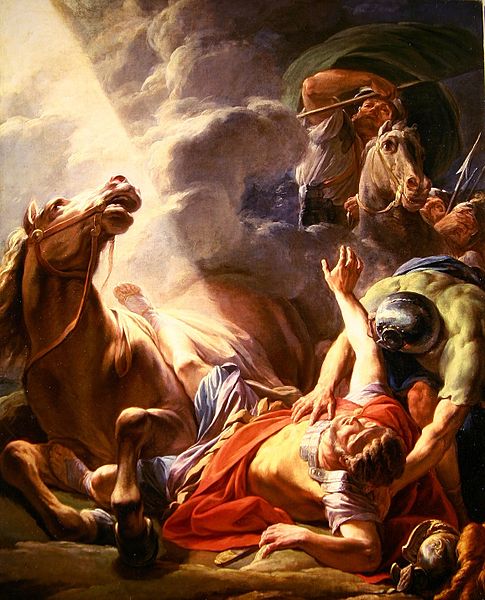
Conversion of St. Paul (1767) by Nicolas-Bernard Lépicié (1735-1784) [public domain / Wikimedia Commons]

(9-28-10)
The following is an excerpt from my book, Biblical Catholic Salvation: “Faith Working Through Love” — Chapter One.
* * * * *
Many Protestants (and Catholics) are unaware that the Council of Trent does not absolutely rule out all notions whatever of justification by faith alone or even of imputation of God’s righteousness. It condemns only extreme versions of these notions. For example:
Canon IX. If any one saith, that by faith alone the impious is justified; in such wise as to mean, that nothing else is required to co-operate in order to the obtaining the grace of Justification, and that it is not in any way necessary, that he be prepared and disposed by the movement of his own will; let him be anathema.
We observe, then, that Canon 9 anathematized not faith alone (in the sense of initial justification) per se, but a minimalist, absolute position on faith alone that excludes further necessary cooperation, or “outworking” of the same faith. The term “faith alone” is carefully qualified and defined, but it is not itself rejected (the key phrase being “in such wise as to mean”).
Another way of looking at this is to say that Canon 9 doesn’t absolutely forbid imputed justification, either, as an aspect of justification, but rather, only the notion that justification consists solely of imputation. The next canon makes it clear that there is indeed a proper sense of imputed justification or “extrinsic” or “declarative” or “external” righteousness:
Canon X. If any one saith, that men are just without the justice of Christ, whereby He merited for us to be justified; or that it is by that justice itself that they are formally just; let him be anathema.
Again, what is asserted is the denial of a minimalist view. The first clause espouses initial imputed, external justification (“the justice of Christ, whereby He merited for us”). But the second clause condemns the legalistic extreme of making this alone the cause of justification, as if there is no cooperation required (assuming the person proceeds on with his life after initial justification). Imputation is present (and indeed necessary) but not sufficient unto salvation, in and of itself. The next canon reiterates:
Canon XI. If any one saith, that men are justified, either by the sole imputation of the justice of Christ, or by the sole remission of sins, to the exclusion of the grace and the charity which is poured forth in their hearts by the Holy Ghost, and is inherent in them; or even that the grace, whereby we are justified, is only the favour of God; let him be anathema.
We are initially justified by “the justice of Christ” and “grace,” but we are not justified by a “sole imputation.” Imputation is, thus, a truth of Catholic soteriology, but it is not the “whole ball of wax” of salvation. In this sense, and this one alone, Catholics deny imputed justification and justification by faith alone. Canons 1-3, in their condemnation of Pelagianism and salvation by works, assert essentially the same notion from a different vantage-point: the initial grace and justification comes from God, and God alone.
Moreover, it is made clear elsewhere in this section of Tridentine decrees, that justification by faith is also a Catholic concept, and that even justification by faith alone is properly applied to the stage of initial justification:
Chapter VIII. (In what manner it is to be understood, that the impious is justified by faith, and gratuitously).
And whereas the Apostle saith, that man is justified by faith and freely, those words are to be understood in that sense which the perpetual consent of the Catholic Church hath held and expressed; to wit, that we are therefore said to be justified by faith, because faith is the beginning of human salvation, the foundation, and the root of all Justification; without which it is impossible to please God, and to come unto the fellowship of His sons: but we are therefore said to be justified freely, because that none of those things which precede justification-whether faith or works-merit the grace itself of justification. For, if it be a grace, it is not now by works, otherwise, as the same Apostle says, grace is no more grace.
Even the cause of the human faith, that brings about justification, is God’s grace: so that there is not the slightest hint or trace of Pelagianism or Semi-Pelagianism (yet Catholics, for some reason, are falsely accused of these heresies to this day). Chapter 5 concurs (“the beginning of the said Justification is to be derived from the prevenient grace of God, through Jesus Christ” / “disposed through His quickening and assisting grace” / “God touches the heart of man by the illumination of the Holy Ghost”).
Initial imputation and justification by faith alone in the first stages of justification are reiterated elsewhere in the same section:
Chapter VII. (What the justification of the impious is, and what are the causes thereof.)
Of this Justification the causes are these: the final cause indeed is the glory of God and of Jesus Christ, and life everlasting; while the efficient cause is a merciful God . . .
. . . the meritorious cause is His most beloved only-begotten, our Lord Jesus Christ, who, when we were enemies, for the exceeding charity wherewith he loved us, merited Justification for us by His most holy Passion on the wood of the cross, and made satisfaction for us unto God the Father . . .
. . . the alone formal cause is the justice of God, not that whereby He Himself is just, but that whereby He maketh us just . . .
. . . no one can be just, but he to whom the merits of the Passion of our Lord Jesus Christ are communicated, yet is this done in the said justification of the impious, when by the merit of that same most holy Passion, the charity of God is poured forth, by the Holy Spirit . . .
Chapter X. (On the increase of Justification received.)
Having, therefore, been thus justified, and made the friends and domestics of God, . . . they, through the observance of the commandments of God and of the Church, faith co-operating with good works, increase in that justice which they have received through the grace of Christ, and are still further justified, . . .
***
Previous Post
October 12, 2015
150 Reasons Why I Became (and Remain) a Catholic
Next Post

October 12, 2015 Who Killed Antoine Lavoisier: the "Father of Chemistry"?
Browse Our Archives
Select a Category & Last Things About Me Anti-Catholicism Atheism & Agnosticism Baptism and Sacramentalism Bible and Tradition Blessed Virgin Mary Books by Dave Armstrong C. S. Lewis Calvinism & General Protestantism Catholic Apologetics Catholic Apologists Catholic conversion Catholic converts Christmas Church (Ecclesiology) Church History Conversion and Converts Development of Doctrine Eastern Orthodoxy Ecumenism & Christian Unity Eucharist & Liturgy Fathers of the Church French Translations G. K. Chesterton Hell Hell & Satan Hell & Satan & Last Things Heresies & Comparative Religion Holistic Health Inquisition & Crusades & Scandals James White Jews & Judaism & Old Testament John Calvin John Henry Newman Liberal / Modernist Theology Life Issues Literary Resume Lutheranism Mariology Martin Luther Music Orthodoxy Papacy & Infallibility Personal Page Philosophy & Science Political & Ethical & Moral Issues Protestant Persecution & Intolerance Protestantism Purgatory Purgatory & Penance Romantic & Imaginative Theology Saints & Purgatory & Penance Salvation Salvation & Justification Satan & Last Things Sexuality and Gender Issues Spanish Translations Traditionalism vs. Radical Catholic Reactionaries Traducciones al español / tradução para português Trinitarianism & Christology Uncategorized Videos
Select a Month October 2026 September 2026 August 2026 July 2026 June 2026 May 2026 April 2026 March 2026 February 2026 January 2026 December 2025 November 2025 October 2025 September 2025 August 2025 July 2025 June 2025 May 2025 April 2025 March 2025 February 2025 January 2025 December 2024 November 2024 October 2024 September 2024 August 2024 July 2024 June 2024 May 2024 April 2024 March 2024 February 2024 January 2024 December 2023 November 2023 October 2023 September 2023 August 2023 July 2023 June 2023 May 2023 April 2023 March 2023 February 2023 January 2023 December 2022 November 2022 October 2022 September 2022 August 2022 July 2022 June 2022 May 2022 April 2022 March 2022 February 2022 January 2022 December 2021 November 2021 October 2021 September 2021 August 2021 July 2021 June 2021 May 2021 April 2021 March 2021 February 2021 January 2021 December 2020 November 2020 October 2020 September 2020 August 2020 July 2020 June 2020 May 2020 April 2020 March 2020 February 2020 January 2020 December 2019 November 2019 October 2019 September 2019 August 2019 July 2019 June 2019 May 2019 April 2019 March 2019 February 2019 January 2019 December 2018 November 2018 October 2018 September 2018 August 2018 July 2018 June 2018 May 2018 April 2018 March 2018 February 2018 January 2018 December 2017 November 2017 October 2017 September 2017 August 2017 July 2017 June 2017 May 2017 April 2017 March 2017 February 2017 January 2017 December 2016 November 2016 October 2016 September 2016 August 2016 July 2016 June 2016 May 2016 April 2016 March 2016 February 2016 January 2016 December 2015 November 2015 October 2015 September 2015 August 2015 July 2015 June 2015 May 2015 April 2015 March 2015 February 2015 January 2015 December 2014 November 2014 October 2014 September 2014 August 2014 July 2014 June 2014 April 2014 March 2014 February 2014 January 2014 December 2013 November 2013 October 2013 September 2013 August 2013 July 2013 June 2013 April 2013 March 2013 February 2013 January 2013 December 2012 November 2012 October 2012 September 2012 August 2012 July 2012 June 2012 May 2012 April 2012 March 2012 February 2012 January 2012 December 2011 November 2011 October 2011 September 2011 August 2011 July 2011 June 2011 April 2011 March 2011 February 2011 October 2010 September 2010 August 2010 July 2010 April 2010 March 2010 December 2009 October 2009 August 2009 July 2009 June 2009 May 2009 March 2009 February 2009 October 2008 September 2008 April 2008 March 2008 February 2008 January 2008 December 2007 November 2007 October 2007 May 2007 March 2007 February 2007 January 2007 November 2006 October 2006 September 2006 August 2006 July 2006 June 2006 May 2006 April 2006 March 2006 February 2006 October 2005 June 2005 April 2005 February 2005 July 2004 May 2004 April 2004
Follow Us!
TAKE THE
Religious Wisdom Quiz
Proverbs warns against what kind of woman as a symbol of temptation?
Select your answer to see how you score.
Widow Mother-in-law Queen Adulterous woman
Books by This Author Books by Dave Armstrong
Related posts from Biblical Evidence for Catholicism

Bible & Catholicism on Mortal Sin (vs. John...
Biblical Evidence for Catholicism

Dialogue on Eternal Security / Absolute Assurance
Biblical Evidence for Catholicism

"Faith Alone" Dialogue with a Calvinist
Biblical Evidence for Catholicism

Exegesis of 75 NT Faith [Alone?] & Works...
Biblical Evidence for Catholicism
TRENDING AT PATHEOS Catholic

The Sermon on the Mount, Part I: Matthew...
The Sermon on the Mount, Part I (Matthew 4:12-5:12) St. Matthew moves...

What's up from Crossway: Reviewing some of their latest A few weeks...

Janie Learns the Way of the Cross: A...
Teaching children about Jesus' Passion can be challenging. Many parents and educators...

Looking For Good Catholic Writing - October 2026
He alone extends the heavens, and he walks upon the waves of...

In "Irreplaceable," our book on vocation and technology, Trevor Sutton and I...

I was strolling through the top floor of the brand new Parthenon...
view all Catholic blogs
Ad-Free & Subscriber Log-In Subscription Support
- About Us
- 2026 Calendar
- Videos
- Podcasts
- Library of World Religions
- Faith In Media Tracker
- Advertise With Us
- Write for Us
- Privacy Policy
- Terms of Service
- Do Not Sell My Data
- Contact Us
- Radiant Digital
- Manage Newsletter Subscriptions
- Unsubscribe From Notifications
- Sitemap
Copyright 2008-2026, Patheos. All rights reserved.
Subscription Support Ad-Free & Subscriber Log-In
Follow Patheos