
BuddhistCatholicContemplativeEvangelicalGeneral ChristianHinduJewishLatter-day SaintMuslimNew VisionsProgressive Christian
Beliefs
- Buddhist
- Catholic
- Contemplative
- Evangelical
- General Christian
- Hindu
- Jewish
- Latter-day Saint
- More Voices
- Muslim
- New Visions
- Pagan
- Progressive Christian
Topics
- Religion News
- Food and Religion
- Sports and Religion
- Religious Art
- Religious Music and Entertainment
- Religious Events
- History and Religion
- Style and Religion
- Politics and Religion
- Women in Religion
- Recreation Outdoors and Religion
- Business Finance and Religion
- Careers Workplace and Religion
- Education and Religion
- Family Parenting and Religion
- Health Fitness and Religion
- Home and Religion
- Relationships and Religion
- Technology and Religion
- Travel and Religion
Columnists
- Buddhist Columnists
- Business Finance and Religion Columnists
- Careers Workplace and Religion Columnists
- Catholic Columnists
- Contemplative Columnists
- Education and Religion Columnists
- Evangelists Columnists
- Family Parenting and Religion Columnists
- General Christian Columnists
- Health Fitness and Religion Columnists
- Hindu Columnists
- History and Religion Columnists
- Home and Religion Columnists
- Jewish Columnists
- More Voices Columnists
- Latter Day Columnists
- Muslim Columnists
- New Visions Columnists
- Nonreligious Columnists
- Pagan Columnists
- Politics and Religion Columnists
- Progressive Columnists
- Recreation Outdoors and Religion Columnists
- Relationships and Religion Columnists
- Religion News Columnists
- Religious Art Columnists
- Religious Events Columnists
- Religious Music and Entertainment Columnists
- Sports and Religion Columnists
- Style and Religion Columnists
- Technology and Religion Columnists
- Travel and Religion Columnists
- Women in Religion Columnists
Resource Library
- 2026 Calendar
- Library of World Religions
- The 100 Most Holy Places on Earth
- Patheos Answers
- Podcasts
- Videos
- Faith Leaders Database
- Anglican Episcopalian
- Bahai
- Baptist
- Buddhism
- Christianity
- Confucianism
- Eastern Orthodoxy
- Hinduism
- Holiness and Pentecostal
- ISKCON
- Islam
- Judaism
- Lutheran
- Methodist
- The Church of Jesus Christ of Latter-day Saints
- New Age
- Paganism
- Presbytarian and Reformed
- Protestantism
- Religion Behind the Scenes
- Roman Catholic
- Scientology
- Shia Islam
- Sikhism
- Sufism
- Sunni Islam
- Taoism
- Zen
- See all religions
Research Tools
 Ad-Free & Subscriber Log-In Subscription Support
Ad-Free & Subscriber Log-In Subscription Support
Follow Patheos 

- Trending:
- Forgiveness
- |
- Marriage
- |
- Consciousness
- |
- Death Penalty
- |
- Election
- |
- Halloween

-
About
-
Catholic Apologetics
-
Church History
-
Great Apologists
-
Christian Worldview
-
Protestantism & Misc.
- Home
- Catholic
- History and Religion
- St. Peter’s House in Capernaum and Recent Archaeology
St. Peter’s House in Capernaum and Recent Archaeology
Last updated on: June 6, 2026 at 12:28 am by Dave Armstrong
St. Peter’s House in Capernaum and Recent Archaeology 2026-06-06T00:28:16-04:00 Dave Armstrong
Patheos Explore the world's faith through different perspectives on religion and spirituality! Patheos has the views of the prevalent religions and spiritualities of the world.
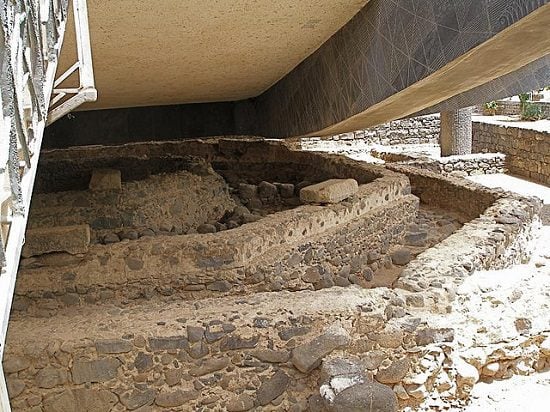
Octagonal remains of the Byzantine church built over St. Peter’s house at Capernaum (Seetheholyland.net) [Flickr / CC BY-SA 2.0 license]
*
(9-23-14)
*
[portion of a chapter in my book, Footsteps that Echo Forever: My Holy Land Pilgrimage]
***
It remains an indisputable fact of history, that Catholics from their earliest existence in the apostolic age, have commemorated important, holy sites in biblical and Catholic history: often by building churches or at least shrines of some sort where they happened. We know this is true, among many other reasons, because Catholics are frequently blasted for the supposed “idolatry” that (we are told) occurs I such places: whether it is a holy location or the relics of a saint.
*
Thus, archaeology (knowing this full well) often begins with the premise that the early Christians remembered where important events having to do with their religion took place. This was perhaps most notably true in the case of the Church of the Holy Sepulchre in Jerusalem, as we saw in another chapter. Archaeologists and historians largely agree that it encompasses the likely locations of Jesus’ crucifixion and His tomb.
*
The authenticity of this holiest of Christian churches is accepted because the earliest churches built on the spot were based on the collective memory of the local tradition of Christians. These things don’t proceed merely by happenstance or a good “guess.” They’re based on legitimate memories and traditions passed down.
*
Many analogies to every day life easily bring this point home. For example, a family might revere a house or some property where its ancestors had lived for hundreds of years. They generally don’t forget where it was unless many hundreds of years pass.
*
Americans know exactly where George Washington was born, or where Benjamin Franklin worked as an apprentice in a print shop in Philadelphia (I’ve been there). Those two things are at least 280 years ago. We know where the American nation began: Jamestown, Virginia in 1607 (I’ve been there, too). That’s more than 400 years ago, but has not been forgotten at all. Why would it be? It’s clear that very significant places will usually be remembered and documented.
*
It’s not difficult to remember particulars over many generations. This applies to Christians and their own history, just as it does to anyone else. One person, after all, can live for a period encompassing parts of three generations. My 89-year-old mother can remember things from the late 1920s, which is now over 85 years ago, or more than two biblical generations.
*
In other instances, it should also be noted, some things seem to be lost to history, as I have argued elsewhere in this book was the cases with the location of Jesus’ baptism and the Via Dolorosa. Yet the exceptions don’t disprove the rule (the latter was a late tradition to begin with, and so more speculation was in play). Because some things were forgotten or lost track of in the mists of history doesn’t mean that all things are.
*
In the case of what many believe to be St. Peter’s house in Capernaum, on the shores of the Sea of Galilee, the argument is very straightforward: an ancient church was built over what was formerly a house. The simplest explanation is that the house must have had some great significance in Christian history. St. Peter’s house fits that bill, and is the most reasonable explanation (though it remains unable to be proved – like nearly all things in archaeology – beyond any doubt whatsoever).
*
To acknowledge this doesn’t even require a personal Catholic belief. It’s just history, and how things were done by Christians, and even a secular archaeologist has no trouble accepting it.
*
The Bible History Daily website, from the Biblical Archaeology Society, provides a basic overview of the evidence involved here, in its article (3-29-11), “The House of Peter: The Home of Jesus in Capernaum?”:
*
It was here during the infancy of early Christianity that he began his ministry in the town synagogue (Mark 1:21), recruited his first disciples (Mark 1:16–20) and became renowned for his power to heal the sick and infirm (Mark 3:1–5).
*
. . . Where was the house of Peter, which the Bible suggests was the home of Jesus in Capernaum (Matthew 8:14–16)?
*
Italian excavators working in Capernaum may have actually uncovered the remnants of the humble house of Peter that Jesus called home while in Capernaum. . . .
*
Buried beneath the remains of an octagonal Byzantine martyrium church, excavators found the ruins of a rather mundane dwelling dating to the first century B.C.
*
Octagonal martyria were built to commemorate an important site, such as the original house of Peter that once stood here. The inner sanctum of the octagonal building was built directly above the remains of the very room of the first-century house that had formed the central hall of the earlier church.
*
. . . Were it not for its association with Jesus and Peter, why else would a run-of-the-mill first-century house in Capernaum have become a focal point of Christian worship and identity for centuries to come?
*
W. von Menden began the excavation of the remains of the octagonal church from 1906 to 1915. The Franciscan Gaudenzio Orfali continued this work from 1921 to 1925. Franciscan Fathers Virgilio Corbo and Stanislao Loffreda again excavated the area from 1968 to 1985.
*
This is the house where Jesus healed Peter’s mother-in-law (Mk 1:29-34), cured the paralytic lowered down from above (Mk 2:1-4), as well as many others near the door (Mk 1:33), and preached to the crowds (Mt 12:46-50). It has immense significance in Christian history. In the nearby synagogue He taught many times, including his magnificent eucharistic discourse recorded in John 6 (see Jn 6:59). Historical attestation of a church being built over Peter’s house also exists. The Spanish nun Egeria, wrote around 381 to 395:
*
And in Capernaum, what is more, the house of the prince of the apostles [Peter] has been transformed into a church, with its original walls still standing. Here the Lord healed the paralytic. There is also the synagogue where the Lord healed the man possessed by demons . . .
*
An unnamed pilgrim, writing around 560-570 noted the Byzantine basilica: “And so we came on to Capernaum to the house of Saint Peter, which is now a basilica.”
*
Raymond E. Marley, writing in the Jerusalem Christian Review in 1998 1, observed:
*
An open area between the street and the doorway, leading to the courtyard, makes the building unique among others found in the vicinity. This open area would have allowed space for a large number of people to “gather at the door” of Peter’s home to hear Jesus’ preaching. (Mark 1:33; 2:1-3)
*
. . . Inside the building, numerous coins, pottery and oil-lamps dating to the first century were discovered, along with artifacts which included several fish hooks.
*
Archaeologists also unearthed evidence of memorials built by later Christian generations around Peter’s home.
*
“Christians who lived in Capernaum during the second, third and fourth centuries highly venerated this site and showed great care not to destroy the house, but rather to add additional structures to it,” said Italian scholar, Virgilio Corbo, who excavated at the site.
*
Jesus regarded Capernaum as His home (Mt 9:1; Mk 2:1; 3:19; 10:10), and He likely lived in St. Peter’s house. He performed many miracles in the town (Mt 4:18-22; Mk 1:34), and there He chose his first four disciples (Peter, Andrew, James, and John); later also enlisting the tax-collector Matthew (Mt 9:9; Mk 2:14; Lk 5:27). This is also where He healed the centurion’s servant (Lk 7:1-10). His mother Mary visited (Mk 3:31). He explained His parables in greater depth to the disciples in Peter’s house (Mk 7:17). Here He embraced the little child and taught about humility and servanthood (Mk 9:33-37).
*
James H. Charlesworth, professor of New Testament Language and Literature at Princeton Theological Seminary, writing in the book he edited, Jesus and Archaeology 2, concluded about this matter:
*
Archaeological evidence is almost always hotly debated. What, then, is clear? The “house church” in Capernaum that is celebrated as Peter’s house may well be the house in which Jesus taught. It is certainly not a “synagogue,” but it seems to be Peter’s house. Thus, I fully agree with J. Murphy-O’Connor, who is unusually well informed of data related to Jesus and archaeology and astutely critical; notice his judgment: “The most reasonable assumption is the one attested by the Byzantine pilgrims, namely, that it was the house of Peter in which Jesus may have lodged (Mt 5:20). Certainly nothing in the excavations contradicts this identification. 3
*
John J. Rousseau reiterates my original point above:
*
Ancient peoples tended to build new sanctuaries over preexisting ones, even if they were dedicated to a different god. In this case, the Byzantine octagonal church was built exactly over the ancient large room. 4
*
And more specifically, on the same page:
*
Artifacts discovered there (Herodian coins and lamps, fish hooks) show that the house was occupied as early as the first century B.C.E. and that people involved in fishing lived in or around the house.
*
. . . The excavators’ conclusions are widely accepted today.
*
FOOTNOTES
*
1 “Is It the Home of Peter?: Miraculous Discoveries in the ‘City of Miracles’,” Vol. 9, Internet edition, Issue 1.
2 Grand Rapids, Michigan: Wm. B. Eerdmans Publishing Co., 2006, p. 50.
3 The Holy Land, 4th ed. (Oxford and New York: Oxford University Press, 1998), p. 220.
4 Jesus and His World: An Archaeological and Cultural Dictionary (Minneapolis: Augsburg Fortress Press, 1995); co-authored with Rami Arav, p. 40 (“Capernaum”).
* * * * *
Previous Post
October 2, 2015
Calvin Held to Mary's Perpetual Virginity (with Tim Staples)
Next Post
October 2, 2015 Archaeology and Jesus' Baptism "Beyond the Jordan"
Browse Our Archives
Select a Category & Last Things About Me Anti-Catholicism Atheism & Agnosticism Baptism and Sacramentalism Bible and Tradition Blessed Virgin Mary Books by Dave Armstrong C. S. Lewis Calvinism & General Protestantism Catholic Apologetics Catholic Apologists Catholic conversion Catholic converts Christmas Church (Ecclesiology) Church History Conversion and Converts Development of Doctrine Eastern Orthodoxy Ecumenism & Christian Unity Eucharist & Liturgy Fathers of the Church French Translations G. K. Chesterton Hell Hell & Satan Hell & Satan & Last Things Heresies & Comparative Religion Holistic Health Inquisition & Crusades & Scandals James White Jews & Judaism & Old Testament John Calvin John Henry Newman Liberal / Modernist Theology Life Issues Literary Resume Lutheranism Mariology Martin Luther Music Orthodoxy Papacy & Infallibility Personal Page Philosophy & Science Political & Ethical & Moral Issues Protestant Persecution & Intolerance Protestantism Purgatory Purgatory & Penance Romantic & Imaginative Theology Saints & Purgatory & Penance Salvation Salvation & Justification Satan & Last Things Sexuality and Gender Issues Spanish Translations Traditionalism vs. Radical Catholic Reactionaries Traducciones al español / tradução para português Trinitarianism & Christology Uncategorized Videos
Select a Month October 2026 September 2026 August 2026 July 2026 June 2026 May 2026 April 2026 March 2026 February 2026 January 2026 December 2025 November 2025 October 2025 September 2025 August 2025 July 2025 June 2025 May 2025 April 2025 March 2025 February 2025 January 2025 December 2024 November 2024 October 2024 September 2024 August 2024 July 2024 June 2024 May 2024 April 2024 March 2024 February 2024 January 2024 December 2023 November 2023 October 2023 September 2023 August 2023 July 2023 June 2023 May 2023 April 2023 March 2023 February 2023 January 2023 December 2022 November 2022 October 2022 September 2022 August 2022 July 2022 June 2022 May 2022 April 2022 March 2022 February 2022 January 2022 December 2021 November 2021 October 2021 September 2021 August 2021 July 2021 June 2021 May 2021 April 2021 March 2021 February 2021 January 2021 December 2020 November 2020 October 2020 September 2020 August 2020 July 2020 June 2020 May 2020 April 2020 March 2020 February 2020 January 2020 December 2019 November 2019 October 2019 September 2019 August 2019 July 2019 June 2019 May 2019 April 2019 March 2019 February 2019 January 2019 December 2018 November 2018 October 2018 September 2018 August 2018 July 2018 June 2018 May 2018 April 2018 March 2018 February 2018 January 2018 December 2017 November 2017 October 2017 September 2017 August 2017 July 2017 June 2017 May 2017 April 2017 March 2017 February 2017 January 2017 December 2016 November 2016 October 2016 September 2016 August 2016 July 2016 June 2016 May 2016 April 2016 March 2016 February 2016 January 2016 December 2015 November 2015 October 2015 September 2015 August 2015 July 2015 June 2015 May 2015 April 2015 March 2015 February 2015 January 2015 December 2014 November 2014 October 2014 September 2014 August 2014 July 2014 June 2014 April 2014 March 2014 February 2014 January 2014 December 2013 November 2013 October 2013 September 2013 August 2013 July 2013 June 2013 April 2013 March 2013 February 2013 January 2013 December 2012 November 2012 October 2012 September 2012 August 2012 July 2012 June 2012 May 2012 April 2012 March 2012 February 2012 January 2012 December 2011 November 2011 October 2011 September 2011 August 2011 July 2011 June 2011 April 2011 March 2011 February 2011 October 2010 September 2010 August 2010 July 2010 April 2010 March 2010 December 2009 October 2009 August 2009 July 2009 June 2009 May 2009 March 2009 February 2009 October 2008 September 2008 April 2008 March 2008 February 2008 January 2008 December 2007 November 2007 October 2007 May 2007 March 2007 February 2007 January 2007 November 2006 October 2006 September 2006 August 2006 July 2006 June 2006 May 2006 April 2006 March 2006 February 2006 October 2005 June 2005 April 2005 February 2005 July 2004 May 2004 April 2004
Follow Us!
TAKE THE
Religious Wisdom Quiz
Who fell out of a window and was restored to life by Paul?
Select your answer to see how you score.
Silas Barnabas Eutychus Timothy
Books by This Author Books by Dave Armstrong
Related posts from Biblical Evidence for Catholicism

A Few "Worst" & "Best" Arguments vs. Protestantism
Biblical Evidence for Catholicism

Jerusalem Council vs. James White & Sola Scriptura
Biblical Evidence for Catholicism

Biblical Perspicuity: Absurd Anti-Catholic "Defense"
Biblical Evidence for Catholicism

50 Biblical Disproofs of "Evident Clearness" of the...
Biblical Evidence for Catholicism
TRENDING AT PATHEOS Catholic

In "Irreplaceable," our book on vocation and technology, Trevor Sutton and I...

I was strolling through the top floor of the brand new Parthenon...

What Does Gêvâh Mean For Kimberley Guifoyle &...
This week, a lot of the news is focused on Kimberly Guilfoyle....

INNER CIRCLE: Profound Mystery (Of Christ In All...
Ephesians 5:31-32 “For this reason, a man will leave his father and...

Do Not Rejoice When Your Enemy Falls: The...
Turning an execution into a public spectacle is a disturbing expression of...

'The Chosen' S6 Trailer: The Passion Gets Very...
Not many watching 'The Chosen' worry about spoilers, but just because they...
view all Catholic blogs
Ad-Free & Subscriber Log-In Subscription Support
- About Us
- 2026 Calendar
- Videos
- Podcasts
- Library of World Religions
- Faith In Media Tracker
- Advertise With Us
- Write for Us
- Privacy Policy
- Terms of Service
- Do Not Sell My Data
- Contact Us
- Radiant Digital
- Manage Newsletter Subscriptions
- Unsubscribe From Notifications
- Sitemap
Copyright 2008-2026, Patheos. All rights reserved.
Subscription Support Ad-Free & Subscriber Log-In
Follow Patheos