
BuddhistCatholicContemplativeEvangelicalGeneral ChristianHinduJewishLatter-day SaintMuslimNew VisionsProgressive Christian
Beliefs
- Buddhist
- Catholic
- Contemplative
- Evangelical
- General Christian
- Hindu
- Jewish
- Latter-day Saint
- More Voices
- Muslim
- New Visions
- Pagan
- Progressive Christian
Topics
- Religion News
- Food and Religion
- Sports and Religion
- Religious Art
- Religious Music and Entertainment
- Religious Events
- History and Religion
- Style and Religion
- Politics and Religion
- Women in Religion
- Recreation Outdoors and Religion
- Business Finance and Religion
- Careers Workplace and Religion
- Education and Religion
- Family Parenting and Religion
- Health Fitness and Religion
- Home and Religion
- Relationships and Religion
- Technology and Religion
- Travel and Religion
Columnists
- Buddhist Columnists
- Business Finance and Religion Columnists
- Careers Workplace and Religion Columnists
- Catholic Columnists
- Contemplative Columnists
- Education and Religion Columnists
- Evangelists Columnists
- Family Parenting and Religion Columnists
- General Christian Columnists
- Health Fitness and Religion Columnists
- Hindu Columnists
- History and Religion Columnists
- Home and Religion Columnists
- Jewish Columnists
- More Voices Columnists
- Latter Day Columnists
- Muslim Columnists
- New Visions Columnists
- Nonreligious Columnists
- Pagan Columnists
- Politics and Religion Columnists
- Progressive Columnists
- Recreation Outdoors and Religion Columnists
- Relationships and Religion Columnists
- Religion News Columnists
- Religious Art Columnists
- Religious Events Columnists
- Religious Music and Entertainment Columnists
- Sports and Religion Columnists
- Style and Religion Columnists
- Technology and Religion Columnists
- Travel and Religion Columnists
- Women in Religion Columnists
Resource Library
- 2026 Calendar
- Library of World Religions
- The 100 Most Holy Places on Earth
- Patheos Answers
- Podcasts
- Videos
- Faith Leaders Database
- Anglican Episcopalian
- Bahai
- Baptist
- Buddhism
- Christianity
- Confucianism
- Eastern Orthodoxy
- Hinduism
- Holiness and Pentecostal
- ISKCON
- Islam
- Judaism
- Lutheran
- Methodist
- The Church of Jesus Christ of Latter-day Saints
- New Age
- Paganism
- Presbytarian and Reformed
- Protestantism
- Religion Behind the Scenes
- Roman Catholic
- Scientology
- Shia Islam
- Sikhism
- Sufism
- Sunni Islam
- Taoism
- Zen
- See all religions
Research Tools
 Ad-Free & Subscriber Log-In Subscription Support
Ad-Free & Subscriber Log-In Subscription Support
Follow Patheos 

- Trending:
- Forgiveness
- |
- Marriage
- |
- Consciousness
- |
- Death Penalty
- |
- Election
- |
- Halloween

-
About
-
Catholic Apologetics
-
Church History
-
Great Apologists
-
Christian Worldview
-
Protestantism & Misc.
- Home
- Catholic
- History and Religion
- Was Jesus Confused About His Mission and Identity?
Was Jesus Confused About His Mission and Identity?
Last updated on: May 20, 2017 at 7:15 pm by Dave Armstrong
Was Jesus Confused About His Mission and Identity? 2017-05-20T19:15:58-04:00 Dave Armstrong
Patheos Explore the world's faith through different perspectives on religion and spirituality! Patheos has the views of the prevalent religions and spiritualities of the world.
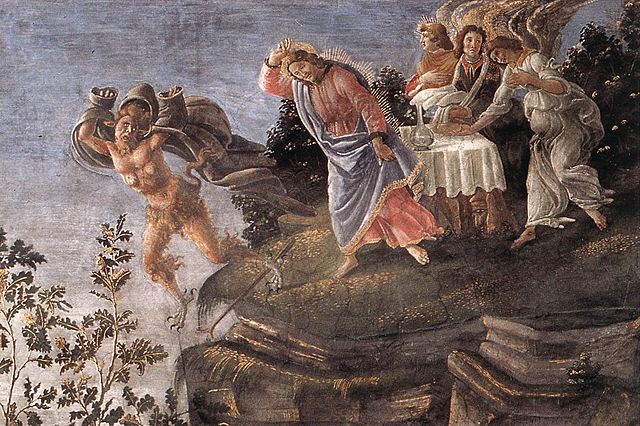
Jesus was neither “confused” nor did He wonder what His mission was at any time. The image is a detail from The Temptation of Christ, by Sandro Botticelli (1445-1510) [public domain / Wikimedia Commons]

An article caught my eye, entitled, “The Identity Crisis of Christ . . .”: over on the “Progressive Christian” channel at Patheos. It comes from David R. Henson, who received his Master of Arts from Graduate Theological Union in Berkeley, California. He is priest in the Episcopal Church, but he writes in his Bio: “This is a personal blog and does not necessarily reflect the views or opinions of the Episcopal church or any of its dioceses, parishes or ministries with which I am affiliated.” His words will be in blue.
* * * * *
David writes in his article:
Then there had been the encounter with the Gentile woman, whose response had completely rearranged his understanding of the breadth of his own ministry and purpose. It called into question things he had been taught his entire life by rabbis, his family, and his culture in general.
So in a relatively short span of time, Jesus had been called crazy by his family, publicly disowned them in response, been run out of his childhood home without honor, lost his foundational mentor to a state-sponsored execution, and had his missional identity turned upside-down by a non-Jewish woman.
It is against this backdrop that Jesus asks the question of his friends, his new family.
“Who am I?”
Set in this context and at a critical turning point in the gospel of Mark, this is a fundamental question of identity, if not outright crisis — not just for the disciples but for Jesus himself.
. . . like all humans, he was finite and limited.
Like us, Jesus didn’t have some a priori understanding of who he was. He had to discover who he was.
The Bible teaches that Jesus was omniscient; among His many other divine attributes. Most Christians throughout all history have believed that Jesus was omniscient. It’s only since the onset of theological liberalism in the 18th century that anyone started questioning this. For Catholics, the issue is a closed one. Fr. William Most wrote in his article, Jesus’s Knowledge:
Pope Pius XII, in his great Encyclical on the “Mystical Body,” on June 29, 1943, rejected all such charges. He taught: “By that blessed vision which He enjoyed when just received in the womb of the Mother of God, He has all the members of the Mystical Body continuously and perpetually present to Himself.” In other words: His human soul saw the vision of God at once, and in it all knowledge is at hand. In another Encyclical, “Sempiternus Rex,” in 1951, the same Pope complained many were not accepting his teaching. Then in still another Encyclical, “Haurietis aquas,” in 1956, he clearly repeated his earlier teaching. Further, on July 24,1966, the Congregation for the Doctrine of the Faith under Pope Paul VI, complained that many were still not accepting. Clearly, the repeated teaching shows the Church means to make this definite and definitive, namely, that the human soul of Jesus, from the first instant, saw the vision of God, in which all knowledge is accessible.
See also a much longer related article by Fr. Most: “Jesus Christ Yesterday, Today and Forever.” But it’s not just Catholics who believe these things: so do Orthodox and historic Protestants. I get into some of the intricacies of the Two Natures of Christ (the Hypostatic Union) — including the obligatory 50 cent theological terms like “communicatio idiomatum” — in the first chapter of my book, Theology of God. I used to have a version of that chapter online, and so I dug it up from Internet Archive for this post. As usual, I hand out the information for free, rather than requiring anyone to purchase a book (even if mine are available as e-books for just $1.99 or $2.99). I didn’t devote my life to Catholic apologetics in order to become a rich man.
With this background, here is the rest of the exchange. Our friend appears to not think very highly of apologists, judging by his parting sh, er comment.
[Me] If Jesus wasn’t God, as the New Testament plainly reveals Him to be (but ah; one has to believe that it is inspired revelation), then He would be a liar or lunatic, in which case I can see how He would have been very confused, or was deliberately confusing others (if a liar).
Nothing I’ve written here denies or argues against the divinity of Jesus.
But to be orthodox one must wrestle with his humanity and the intersection of that with his divinity. The suggestion that Jesus never experienced confusion is an odd one if we are to believe his full humanity.
This position that Jesus was supposedly “confused’ is Nestorianism at best. Chalcedonian Christology holds that Jesus had no such confusion. He always knew Whom He was because He remained 100% God just as He was 100% man.
Since He was God as well as man, He was omniscient, thus precluding the confusion that you refer to. But it was not required for Him to be “confused” in order to be human. He suffered as we do, and had our experiences in many ways, but concupiscence and confusion and sin were not among those common experiences.
These same sorts of errors were a large part of the plot of The Last Temptation of Christ. Many Protestant apologists / writers (e.g., the Lutherans Bob and Gretchen Passantino) noted at the time how it had a deficient Christology.
It’s not Nestorianism. I don’t suggest there are two different Jesuses. I’m saying most folks (see your comments) ignore the implications of his humanity, and by doing so, divorce Jesus of his humanity and thus become Nestorians. (See how easy it is to throw around heresy charges instead of stating one’s thoughts clearly?)
Jesus himself says his knowledge is limited (only the Father knows the day and hour, not even the Son) and Paul tells us he didn’t seek equality with God was possible. This is part of the self-emptying as it were that comes with being human and the Incarnation.
The pairing of confusion with sin and sexual desire is an oddity.
Mental suffering was very much part of his suffering if we believe the Scriptures.
This notion of the “limited knowledge” of the “human” Jesus (or, “confusion” in your article) was indeed an aspect of the historic debates over Nestorianism. E.g., New World Encyclopedia: “Nestorianism” (my bolding):
History
Nestorius (c. 386–c. 451) was a pupil of Theodore of Mopsuestia in Antioch, and later became Patriarch of Constantinople. He taught that the human and divine aspects of Christ were distinct natures, not unified. He preached against the use of the title Mother of God (Theotokos) for the Virgin Mary and would only call her Mother of Christ (Christotokos). He also argued that God could not suffer on the cross, as he is omnipotent. Therefore, the human part of Christ died on the cross, but not the divine.
His opponents accused him of dividing Christ into two persons: They claimed that proposing that God the Word did not suffer and die on the cross, while Jesus the man did, or that God the Word was omniscient, while Jesus the man had limited knowledge, implied two separate persons with separate experiences.
I didn’t pair confusion with sin and sex. I simply mentioned those things in passing because they (esp. concupiscence) are commonly asserted by those who also assert limitations of knowledge in Jesus.
I wrote about the passage you refer to and about the supposed “ignorance” of Jesus in a chapter of my book, Theology of God:
Matthew 24:36 [RSV] But of that day and hour no one knows, not even the angels of heaven, nor the Son, but the Father only. (cf. Mk 13:32)
. . . It had to do with a particular sense of “kingdom” and a manifestation of Jesus’ “coming” in some sort of extraordinary glorified fashion. His hyperbolic expressions, also mentioned, are, on the other hand, easily explained by Hebrew linguistic conventions.
But not knowing the day or hour,(Matthew 24:36), is indeed arguably an instance of His specifically speaking in His human nature (in one limited, specific
sense). But even so, He knew it in His divine nature. I would say it is the distinction between stating a falsehood and the limitations of human nature, even for the Son of God (the incarnation being a “lowering” in certain ways: cf. Heb 2:7, 9).
He could express the latter because it doesn’t contradict what He knows as God the Son, whereas the former (stating a demonstrable error) would be
in contradiction of the hypostatic union, since it would go against His knowing all things (as He does) in His divine nature. The two natures of Jesus preclude His uttering an error. Another option is expressed by some of the fathers:
St. Jerome: Having then shewn that the Son of God cannot be ignorant of the day of the consummation, we must now show a cause why He should be said to be ignorant. When after the resurrection He is demanded concerning this day by the Apostles, He answers more openly; “It is not for you to know the times or the seasons which the Father has put in his own power.” [Acts 1:7] Wherein He shews that Himself knows, but that it was not expedient for the Apostles to know, that being in uncertainty of the coming of their Judge, they should live every day as though they were to be judged that day.
St. Augustine, de Trin., i, 12: When He says here, “Knows not,” He means, ‘makes others not to know;’ i.e. He knew not then, so as to tell His disciples; as it was said to Abraham, “Now I know that thou fearest God;” [Gen 22:19] i.e. ‘Now have I caused that thou shouldest know,’ because by the temptation he came to know himself.
St. Augustine, Lib. 83, Quaest. Q60: That the Father alone knows may be well understood in the above-mentioned manner of knowing, that He
makes the Son to know; but the Son is said not to know, because be does not make men to know.
Lapide presents aspects of both explanations and adds an additional interesting possible interpretation:
You will say, Mark adds (13:32), neither the Son, for so it is in the Greek, Latin, Syriac, Arabic, Persian, Egyptian, Ethiopic. Various answers are given. The best is that which is common among the Fathers. It is that the Son, both as God and as man, by infused knowledge, knows the Day of Judgment and of the end of the world, for it pertains for Him to know this, inasmuch as He has been appointed the Judge of the world. But Christ denies that He knoweth this as man, and as He is God’s messenger to us, because He did not know it so that He could reveal it to us, or because He had not been commissioned by the Father to reveal it to us. As an ambassador who was questioned concerning the secrets of his prince would reply that he did not know them, although he did know them, because he did not know them as an ambassador. For an ambassador declares only those things which he has a commission to declare.
Christ’s meaning then is, “God only knows what year and day and hour the end of the world and the Judgment shall be. And although God has caused
Me, Christ, as I am man, to know the same, as I am that one man who is united to the WORD; yet as I am the Father’s ambassador to men, He has not willed Me to make known that day, but to keep it secret, and to stir them up continually to prepare themselves for it.” There is a like mode of expression in St. John 15:15.
There are some who explain thus: that Christ, qua man, knoweth not the Day of Judgment; but that He knoweth it as He is the God-man. That is to say, Christ as man knoweth it not by virtue of His humanity, but of His divinity. So St. Athanasius (Serm. 4, contra Arian.), Nazianzen (Orat. 4, de Theolog.), Cyril (lib. 9, Thesaur. c. 4), Ambrose (lib. 5, de Fide, c. 8).
Again, Nestorianism is about two separate Jesuses (humanity and divinity not in union), essentially splitting the human and divine into separate selves. What I’ve written here doesn’t suggest it either.
Nestorianism was rooted in the reluctance to understand God as being able to suffer and die (to experience the unpleasant bits of humanity). Your argument is an extrapolation of that Nestorian argument — i.e. that God cannot suffer mentally or emotionally, etc. Hence, the inability to see a God who suffers [above, I wrote in relpy, “He suffered as we do,” so such a conclusion about my supposed view is quite odd and curious; God the Father, however, experiences or “has” no emotions, which is the de fide dogma of impassibility] ” is at the very root of Nestorianism. One might well suggest your argument is little more than veiled docetism.
But we’re arguing about heretical labels at this point and not the actual content of the post above and what it means for Jesus to be fully human.
I noticed in your email address you consider yourself an apologist, which is another way of saying you have to have the last word, so I offer it you.
Previous Post

September 8, 2015
What it FEELS Like to Visit Golgotha
Next Post

September 9, 2015 Biblical Evidence & Defenses for Expensive Church Buildings
Browse Our Archives
Select a Category & Last Things About Me Anti-Catholicism Atheism & Agnosticism Baptism and Sacramentalism Bible and Tradition Blessed Virgin Mary Books by Dave Armstrong C. S. Lewis Calvinism & General Protestantism Catholic Apologetics Catholic Apologists Catholic conversion Catholic converts Christmas Church (Ecclesiology) Church History Conversion and Converts Development of Doctrine Eastern Orthodoxy Ecumenism & Christian Unity Eucharist & Liturgy Fathers of the Church French Translations G. K. Chesterton Hell Hell & Satan Hell & Satan & Last Things Heresies & Comparative Religion Holistic Health Inquisition & Crusades & Scandals James White Jews & Judaism & Old Testament John Calvin John Henry Newman Liberal / Modernist Theology Life Issues Literary Resume Lutheranism Mariology Martin Luther Music Orthodoxy Papacy & Infallibility Personal Page Philosophy & Science Political & Ethical & Moral Issues Protestant Persecution & Intolerance Protestantism Purgatory Purgatory & Penance Romantic & Imaginative Theology Saints & Purgatory & Penance Salvation Salvation & Justification Satan & Last Things Sexuality and Gender Issues Spanish Translations Traditionalism vs. Radical Catholic Reactionaries Traducciones al español / tradução para português Trinitarianism & Christology Uncategorized Videos
Select a Month October 2026 September 2026 August 2026 July 2026 June 2026 May 2026 April 2026 March 2026 February 2026 January 2026 December 2025 November 2025 October 2025 September 2025 August 2025 July 2025 June 2025 May 2025 April 2025 March 2025 February 2025 January 2025 December 2024 November 2024 October 2024 September 2024 August 2024 July 2024 June 2024 May 2024 April 2024 March 2024 February 2024 January 2024 December 2023 November 2023 October 2023 September 2023 August 2023 July 2023 June 2023 May 2023 April 2023 March 2023 February 2023 January 2023 December 2022 November 2022 October 2022 September 2022 August 2022 July 2022 June 2022 May 2022 April 2022 March 2022 February 2022 January 2022 December 2021 November 2021 October 2021 September 2021 August 2021 July 2021 June 2021 May 2021 April 2021 March 2021 February 2021 January 2021 December 2020 November 2020 October 2020 September 2020 August 2020 July 2020 June 2020 May 2020 April 2020 March 2020 February 2020 January 2020 December 2019 November 2019 October 2019 September 2019 August 2019 July 2019 June 2019 May 2019 April 2019 March 2019 February 2019 January 2019 December 2018 November 2018 October 2018 September 2018 August 2018 July 2018 June 2018 May 2018 April 2018 March 2018 February 2018 January 2018 December 2017 November 2017 October 2017 September 2017 August 2017 July 2017 June 2017 May 2017 April 2017 March 2017 February 2017 January 2017 December 2016 November 2016 October 2016 September 2016 August 2016 July 2016 June 2016 May 2016 April 2016 March 2016 February 2016 January 2016 December 2015 November 2015 October 2015 September 2015 August 2015 July 2015 June 2015 May 2015 April 2015 March 2015 February 2015 January 2015 December 2014 November 2014 October 2014 September 2014 August 2014 July 2014 June 2014 April 2014 March 2014 February 2014 January 2014 December 2013 November 2013 October 2013 September 2013 August 2013 July 2013 June 2013 April 2013 March 2013 February 2013 January 2013 December 2012 November 2012 October 2012 September 2012 August 2012 July 2012 June 2012 May 2012 April 2012 March 2012 February 2012 January 2012 December 2011 November 2011 October 2011 September 2011 August 2011 July 2011 June 2011 April 2011 March 2011 February 2011 October 2010 September 2010 August 2010 July 2010 April 2010 March 2010 December 2009 October 2009 August 2009 July 2009 June 2009 May 2009 March 2009 February 2009 October 2008 September 2008 April 2008 March 2008 February 2008 January 2008 December 2007 November 2007 October 2007 May 2007 March 2007 February 2007 January 2007 November 2006 October 2006 September 2006 August 2006 July 2006 June 2006 May 2006 April 2006 March 2006 February 2006 October 2005 June 2005 April 2005 February 2005 July 2004 May 2004 April 2004
Follow Us!
TAKE THE
Religious Wisdom Quiz
What is the meaning of the word "Golgotha"?
Select your answer to see how you score.
Peaceful Garden River of Blood City of Bread Place of the Skull
Books by This Author Books by Dave Armstrong
Related posts from Biblical Evidence for Catholicism
Mary Mother of God: Reply to Allie Beth...
Biblical Evidence for Catholicism

God, Modern Physics, & Dark Energy: An Analogy
Biblical Evidence for Catholicism
Jesus Proved He Was God in Six Ways...
Biblical Evidence for Catholicism
18-Month Family Nightmare Over / 20 Signs from...
Biblical Evidence for Catholicism
TRENDING AT PATHEOS Catholic

I was strolling through the top floor of the brand new Parthenon...

What Does Gêvâh Mean For Kimberley Guifoyle &...
This week, a lot of the news is focused on Kimberly Guilfoyle....

INNER CIRCLE: Profound Mystery (Of Christ In All...
Ephesians 5:31-32 “For this reason, a man will leave his father and...

Do Not Rejoice When Your Enemy Falls: The...
Turning an execution into a public spectacle is a disturbing expression of...

'The Chosen' S6 Trailer: The Passion Gets Very...
Not many watching 'The Chosen' worry about spoilers, but just because they...

The purpose-driven labor priest
A labor activist reads Rick Warren and it gets me wondering about...
view all Catholic blogs
Ad-Free & Subscriber Log-In Subscription Support
- About Us
- 2026 Calendar
- Videos
- Podcasts
- Library of World Religions
- Faith In Media Tracker
- Advertise With Us
- Write for Us
- Privacy Policy
- Terms of Service
- Do Not Sell My Data
- Contact Us
- Radiant Digital
- Manage Newsletter Subscriptions
- Unsubscribe From Notifications
- Sitemap
Copyright 2008-2026, Patheos. All rights reserved.
Subscription Support Ad-Free & Subscriber Log-In
Follow Patheos