
BuddhistCatholicContemplativeEvangelicalGeneral ChristianHinduJewishLatter-day SaintMuslimNew VisionsProgressive Christian
Beliefs
- Buddhist
- Catholic
- Contemplative
- Evangelical
- General Christian
- Hindu
- Jewish
- Latter-day Saint
- More Voices
- Muslim
- New Visions
- Pagan
- Progressive Christian
Topics
- Religion News
- Food and Religion
- Sports and Religion
- Religious Art
- Religious Music and Entertainment
- Religious Events
- History and Religion
- Style and Religion
- Politics and Religion
- Women in Religion
- Recreation Outdoors and Religion
- Business Finance and Religion
- Careers Workplace and Religion
- Education and Religion
- Family Parenting and Religion
- Health Fitness and Religion
- Home and Religion
- Relationships and Religion
- Technology and Religion
- Travel and Religion
Columnists
- Buddhist Columnists
- Business Finance and Religion Columnists
- Careers Workplace and Religion Columnists
- Catholic Columnists
- Contemplative Columnists
- Education and Religion Columnists
- Evangelists Columnists
- Family Parenting and Religion Columnists
- General Christian Columnists
- Health Fitness and Religion Columnists
- Hindu Columnists
- History and Religion Columnists
- Home and Religion Columnists
- Jewish Columnists
- More Voices Columnists
- Latter Day Columnists
- Muslim Columnists
- New Visions Columnists
- Nonreligious Columnists
- Pagan Columnists
- Politics and Religion Columnists
- Progressive Columnists
- Recreation Outdoors and Religion Columnists
- Relationships and Religion Columnists
- Religion News Columnists
- Religious Art Columnists
- Religious Events Columnists
- Religious Music and Entertainment Columnists
- Sports and Religion Columnists
- Style and Religion Columnists
- Technology and Religion Columnists
- Travel and Religion Columnists
- Women in Religion Columnists
Resource Library
- 2026 Calendar
- Library of World Religions
- The 100 Most Holy Places on Earth
- Patheos Answers
- Podcasts
- Videos
- Faith Leaders Database
- Anglican Episcopalian
- Bahai
- Baptist
- Buddhism
- Christianity
- Confucianism
- Eastern Orthodoxy
- Hinduism
- Holiness and Pentecostal
- ISKCON
- Islam
- Judaism
- Lutheran
- Methodist
- The Church of Jesus Christ of Latter-day Saints
- New Age
- Paganism
- Presbytarian and Reformed
- Protestantism
- Religion Behind the Scenes
- Roman Catholic
- Scientology
- Shia Islam
- Sikhism
- Sufism
- Sunni Islam
- Taoism
- Zen
- See all religions
Research Tools
 Ad-Free & Subscriber Log-In Subscription Support
Ad-Free & Subscriber Log-In Subscription Support
Follow Patheos 

- Trending:
- Forgiveness
- |
- Marriage
- |
- Consciousness
- |
- Death Penalty
- |
- Election
- |
- Halloween

-
About
-
Catholic Apologetics
-
Church History
-
Great Apologists
-
Christian Worldview
-
Protestantism & Misc.
- Home
- Catholic
- History and Religion
- Venerating & Bowing Before Angels & Men: Biblical?
Venerating & Bowing Before Angels & Men: Biblical?
Last updated on: November 20, 2021 at 2:07 pm by Dave Armstrong
Venerating & Bowing Before Angels & Men: Biblical? 2021-11-20T14:07:53-04:00 Dave Armstrong
Patheos Explore the world's faith through different perspectives on religion and spirituality! Patheos has the views of the prevalent religions and spiritualities of the world.
. . . Genesis ch. 18-19 and Revelation ch. 19, 22 [Etc.] (vs. Ken Temple)
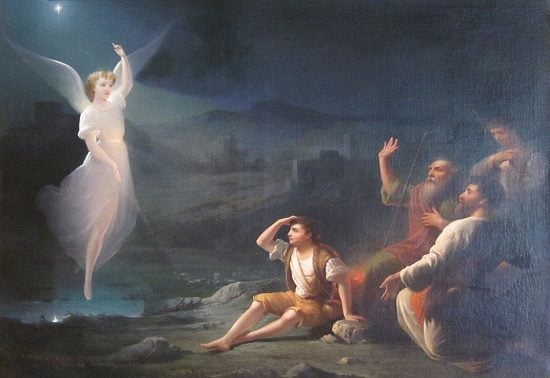
The Angel Appearing Before the Shepherds, by Thomas Buchanan Read (1822-1872) [public domain / Wikimedia Commons]

(11-10-14)
Pastor Ken Temple is a Reformed Protestant anti-Catholic polemicist, whom I have engaged numerous times. His words will be in blue.
* * * * *
I wrote, in the above dialogue:
Oftentimes, sadly, yes, because human beings have an endless capacity for self-deception, self-justification, and rationalization. What we need to remember regarding idolatry, is that it resides internally in the heart, first and foremost. One has to be consciously aware of what they are doing and what they believe. If a person is to replace God with a saint (as if the latter is equal to or higher than God), then they are consciously, deliberately doing so, or else it isn’t idolatry per se. It may be spiritual laxity or even gross negligence, but not idolatry.
Ken then asked:
Do you think the apostle John was consciously and deliberately committing idolatry when he bowed down to the angel and was rebuked for it in Revelation 19:10 and 22:8-9?
Revelation 19:10 Then I fell down at his feet to worship him, but he said to me, “You must not do that! I am a fellow servant with you and your brethren who hold the testimony of Jesus. Worship God.” For the testimony of Jesus is the spirit of prophecy.
Revelation 22:8-9 I John am he who heard and saw these things. And when I heard and saw them, I fell down to worship at the feet of the angel who showed them to me; [9] but he said to me, “You must not do that! I am a fellow servant with you and your brethren the prophets, and with those who keep the words of this book. Worship God.”
I replied:
Fair question. Here’s what I think about that:
It is the spontaneous reaction of human beings (seen throughout Scripture) to be awed by angelic appearances or theophanies or direct manifestations of God.
In the moment you don’t think “this is just an angel.” You react with awe, which is what John did. He wasn’t thinking theologically, as we have the luxury to do in our armchairs, but he was thinking, “this is a far greater Being than I!”
Moreover (and more to the point at hand), often in the Old Testament the Lord and His Angel (“angel of the Lord”) are virtually indistinguishable, to the extent that these angels are called angels in one second and God in the next, so it wouldn’t necessarily be clear which was the case.
Even in the burning bush, there is a reference to “the Angel of the Lord” (Ex 3:2) and yet two verses later, “God called to him out of the bush.” John may have very well thought that this was a direct manifestation of God, in that sense, but was mistaken and corrected by the angel.
That’s what I think was primarily going on, in which case it wasn’t idolatry at all, because he thought it was God, or such a direct communication from God through the angel that “worship” was the proper response.
My take apparently isn’t an isolated one. The old [Catholic] Haydock Commentary stated at 19:10:
St. Athanasius and St. Augustine think St. John took the angel to be Jesus Christ, and as such was desirous of paying him the supreme homage, or latria.
Not bad company or support for an exegetical opinion, but Ken is quite capable of blowing them off, if they don’t support his (anti-Catholic) line of reasoning. Ken then counter-replied (the blue print below). My original answer was as follows:
We can speculate all day what we think an angel or God or inspired writer coulda woulda shoulda said. I think my answer was quite sufficient. As usual with you, we could go round and round forever, . . . You disagree, huh? Another shocking revelation! The anti-Catholic disagrees with the Catholic take! Stop the presses!
But since Ken is pushing the issue with a new provocative post, I decided to expand upon my reply.
I appreciate the way you answered that.
So, why did the angel rebuke John for it?
Because (I think) he had mistaken him for Jesus. It was a category / identification mistake.
Since you say he was temporarily overwhelmed and/ or thought it was a Theophany – like in Genesis 16, or Gen. 18 or Joshua 5, etc. in which case it would not have been truly idolatry (In your opinion), why did the angel rebuke him for it?
See my last reply.
Since it does seem like it was sometimes Theophanies in the OT – and John is an apostle ( !!!)
Seems like if that was going on in John’s mind, the angel should have said, “that’s ok, I realize you think I am “the angel of the Lord” as in Genesis 16 or 18 or the Captain of the Lord’s host in Joshua 5 (Theophanies), but I am not; I am just a creature created by God; but since you have subjectively distinguished in your mind and heart; then that is ok, since you are sincere. “
But the angel did not do that – he said “don’t do that!” and “Worship God!”
Yes, and he said, “I am a fellow servant with you” (19:10). I don’t see any implausibility in believing as I do, with regard to the angel’s response. It makes perfect sense in that scenario. He just didn’t say as much as you thought he should. Big wow.
John sincerely thought it was God, in your opinion, or was just emotionally overwhelmed with “this being is mightier than me”
But in Roman Catholic Marian Piety, there is deliberate and planned and structured prayers and with flowering language of praise and many times descriptions that should only be reserved for God – ” I fly to you for refuge”, “I cast my anxieties to you, O Mother of God”; “save me in this hour”, etc. So, there is no suddenly being overwhelmed in RC Marian Piety. And in RC Marian Piety, they are supposed to know in their mind that this statue of a woman is not God nor a manifestation of God; and indeed they probably DO realize that.
That’s another topic entirely, and I don’t play the rabbit trail” game. But, nice try.
And John realizes that also, once the angel tells him that he is not a theophany as in Genesis 18 or Joshua 5. So why does the angel say, don’t do that, and only worship God?
See my 4th reply up, above.
I think it is obvious that it gives the appearance of idolatry, and no one can tell the difference between real idolatry and RC Marian piety. Only the devotee him or herself can testify as to the subjective experience in their heart and mind.
Now I will flesh out my argument here a bit. As to the sometimes “textual confusion” of the “angel of the Lord” and God Himself, see, for example:
Genesis 18:1-4, 22(RSV) And the LORD appeared to him by the oaks of Mamre, as he sat at the door of his tent in the heat of the day. [2] He lifted up his eyes and looked, and behold, three men stood in front of him. When he saw them, he ran from the tent door to meet them, and bowed himself [shachah]to the earth, [3] and said, “My lord, if I have found favor in your sight, do not pass by your servant. [4] Let a little water be brought, and wash your feet, and rest yourselves under the tree, . . . [22] So the men turned from there, and went toward Sodom; but Abraham still stood before the LORD. (cf. Heb 13:2: “Do not neglect to show hospitality to strangers, for thereby some have entertained angels unawares.”)
The text in-between goes back and forth, referring to “men” or “they” or “them” (18:9, 16) and “The LORD” or first-person address from God (18:10, 13-14, 17-21) interchangeably, for the same phenomenon and personal / physical / verbal encounter. But there are three men here; they can’t all plausibly be God. Two of them were angels (indicated by 18:22 and 19:1). Thus, Abraham venerated them, too. St. Augustine argued that all three men were angels, but this seems ruled out by the presence (twice) in the text, of “the LORD”.
A “man” is equated with God also in Genesis 32:24, 30. See the related passages Ex 3:2-6; Num 22:22-27, 31-35; Jud 6:12-16, 20-23. Here is a particularly striking and explicit example of this confusion:
Judges 13:15-22 Mano’ah said to the angel of the LORD, “Pray, let us detain you, and prepare a kid for you.” [16] And the angel of the LORD said to Mano’ah, “If you detain me, I will not eat of your food; but if you make ready a burnt offering, then offer it to the LORD.” (For Mano’ah did not know that he was the angel of the LORD.) [17] And Mano’ah said to the angel of the LORD, “What is your name, so that, when your words come true, we may honor you?” [18] And the angel of the LORD said to him, “Why do you ask my name, seeing it is wonderful?” [19] So Mano’ah took the kid with the cereal offering, and offered it upon the rock to the LORD, to him who works wonders. [20] And when the flame went up toward heaven from the altar, the angel of the LORD ascended in the flame of the altar while Mano’ah and his wife looked on; and they fell on their faces to the ground. [21] The angel of the LORD appeared no more to Mano’ah and to his wife. Then Mano’ah knew that he was the angel of the LORD. [22] And Mano’ah said to his wife, “We shall surely die, for we have seen God.”
This passage is remarkable in that it goes back and forth between God (13:16, 19, 22) and the angel of the Lord (or of God) as His direct representative (13:15-18, 20-21 and in the larger passage, 13:3, 6, 9, 13). The angel is honored (v. 17), they fall on their faces to worship (v. 20) and at length the angel is equated with God as His visible manifestation (v. 22). But the difference between the angel and God is highlighted by the angel being described as a “man of God” (13:6, 8) and “the man” (13:10-11).
The Angel of the Lord is also equated with God (theophany) in Gen 31:11-13; Jud 2:1; but differentiated from God as well, as a representative: (2 Sam 24:16; 1 Ki 19:6-7; 2 Ki 19:35; Dan 3:25, 28; 6:23; Zech 1:8-14).
Lot also clearly venerated two angels, who appear by the text (again, 18:22 cf. 19:1) to be the same angels whom Abraham had talked to and venerated:
Genesis 19:1 The two angels came to Sodom in the evening; and Lot was sitting in the gate of Sodom. When Lot saw them, he rose to meet them, and bowed himself with his face to the earth,
They distinguish themselves from the LORD:
Genesis 19:13 for we are about to destroy this place, because the outcry against its people has become great before the LORD, and the LORD has sent us to destroy it.”
All of this suggests that it was quite possible indeed that John could have mistaken the angel for Jesus. After all, Jesus had appeared to him earlier in the book, and when He saw Him, he “fell at his feet as though dead” (1:17; cf. 1:10-20). We also know that the post-Resurrection Jesus was not recognized for Who He was, several times (cf. Lk 24:16, 31; 36-39; Jn 20:14-18, 21:4).
In any event, since angels were venerated in the Bible in Genesis 18 and 19, by Abraham and Lot, without rebuke, we know that Revelation 19 and 22 cannot be seen as “proof” (as many hopeful Protestant commentaries claim) that such veneration is forbidden, and indeed, idolatry. Ken argues that any such veneration is too confusing, too easily descends into idolatry or is seen as such by observers; therefore, shouldn’t take place at all. Funny, then, that God in His inspired word (two times) sees it as perfectly acceptable (from Abraham, yet!) and doesn’t rebuke it in the slightest.
Moreover, angels are bowed to in the New Testament, with no rebuke at all:
Luke 24:4-5 While they were perplexed about this, behold, two men stood by them in dazzling apparel; [5] and as they were frightened and bowed their faces to the ground, the men said to them, “Why do you seek the living among the dead?”
Even men (apostles) are venerated in the New Testament:
Acts 16:25-31 But about midnight Paul and Silas were praying and singing hymns to God, and the prisoners were listening to them, [26] and suddenly there was a great earthquake, so that the foundations of the prison were shaken; and immediately all the doors were opened and every one’s fetters were unfastened. [27] When the jailer woke and saw that the prison doors were open, he drew his sword and was about to kill himself, supposing that the prisoners had escaped. [28] But Paul cried with a loud voice, “Do not harm yourself, for we are all here.” [29] And he called for lights and rushed in, and trembling with fear he fell down before Paul and Silas, [30] and brought them out and said, “Men, what must I do to be saved?” [31] And they said, “Believe in the Lord Jesus, and you will be saved, you and your household.”
No biggie. King David was venerated in the Old Testament, too:
1 Chronicles 29:20 Then David said to all the assembly, “Bless the LORD your God.” And all the assembly blessed the LORD, the God of their fathers, and bowed their heads, and worshiped [shachah] the LORD, and did obeisance [shachah] to the king. [KJV: “worshipped the LORD, and the king”]
So was Daniel (without rebuke from him):
Daniel 2:46-48 Then King Nebuchadnez’zar fell upon his face, and did homage to Daniel, and commanded that an offering and incense be offered up to him.[47] The king said to Daniel, “Truly, your God is God of gods and Lord of kings, and a revealer of mysteries, for you have been able to reveal this mystery.” [48] Then the king gave Daniel high honors and many great gifts,
The king was venerating or honoring God through Daniel, as is evident by his words. This is the sort of principle elaborated even by Martin Luther:
Thus, too, I would solve the question about adoring and invoking God dwelling in the saints. It is a matter of liberty, and it is not necessary either to do it or not to do it. To be sure, it is not so certain that God has His dwelling in many men as that He is present in the sacrament, but we do read in I Corinthians [footnote: 1 Cor 14:24-25] that an unbeliever will fall on his face and worship God in the saints, if he hears them prophesying; and Abraham saw three angels, and worshiped one Lord; and (to use your own illustration) what do we do when we “prefer one another in honor,” except honor and adore God in ourselves? Let it be free, then, to call upon God in man or out of man, in creatures or out of them, for “I fill heaven and earth,” saith the Lord. Here faith goes the safest way, for in all things it sees only God, but we cannot say enough of this to unbelievers, or prove it to them, because they are always worshiping themselves. (Letter to Paul Speratus, 13 June 1522)
Daniel venerates an angel (seemingly Gabriel) later in the chapter, without rebuke:
Daniel 8:15-17 When I, Daniel, had seen the vision, I sought to understand it; and behold, there stood before me one having the appearance of a man. [16] And I heard a man’s voice between the banks of the U’lai, and it called, “Gabriel, make this man understand the vision.” [17] So he came near where I stood; and when he came, I was frightened and fell upon my face. But he said to me, “Understand, O son of man, that the vision is for the time of the end.”
That’s now seven instances of permitted veneration of creatures: four towards angels, and three towards men; five from the Old Testament and two (one of each type) in the New Testament. The Greek for “fell down before” in Acts 16:29 is prospipto (Strong’s word # 4363). It is also used of worship towards Jesus in the following five passages:
Mark 3:11 And whenever the unclean spirits beheld him, they fell down before him and cried out, “You are the Son of God.”
Mark 5:33 But the woman, knowing what had been done to her, came in fear and trembling and fell down before him, and told him the whole truth.
Mark 7:25 But immediately a woman, whose little daughter was possessed by an unclean spirit, heard of him, and came and fell down at his feet.
Luke 8:28 When he saw Jesus, he cried out and fell down before him, and said with a loud voice, “What have you to do with me, Jesus, Son of the Most High God? I beseech you, do not torment me.”
Luke 8:47 And when the woman saw that she was not hidden, she came trembling, and falling down before him declared in the presence of all the people why she had touched him, and how she had been immediately healed.
So why didn’t Paul and Silas rebuke the jailer? I submit that it was because they perceived his act as one of veneration (which is permitted) as opposed to adoration or worship, which is not permitted to be directed towards creatures. Note that the word “worship” doesn’t appear in the above five passages, nor in Luke 24:5 or Acts 16:29, or most of the other passages above, in the RSV. When “worship” does appear in connection with a man or angel, it isn’t permitted:
Acts 10:25-26 When Peter entered, Cornelius met him and fell down at his feet and worshiped [proskuneo] him. [26] But Peter lifted him up, saying, “Stand up; I too am a man.”
Thus, we see the same in Revelation 19:10 and 22:8-9, because St. John mistakenly thought the angel was Jesus, and so tried to worship / adore the angel whom he thought was God. The same thing happens, of course, when men thought that Paul and Barnabas were Zeus and Hermes and “wanted to offer sacrifice.” They were rebuked, as mistaken (Acts 14:11-18).
Therefore, we conclude (as Catholics always have) that worship / adoration is reserved for God alone, while veneration / honor is encouraged to be offered to worthy, saintly men and the holy angels. All this is plainly seen in the Bible, in the examples above.
In the comments for his article, Ken kept up the litany of unbiblical falsehoods:
The problem is the statues and icons in a worship context. . . . I have no problem with pictures/icons for historical purposes or teaching purposes. The problem is when the RC or others bow in front of them and start talking to them and praying to them.
Once again, Ken has a huge problem with the Bible. As a pastor, he shouldn’t be so abominably ignorant of what it teaches.
The Jews were commanded to fashion the ark of the covenant (Ex 25: 8 ff.). God revealed to them that He was present in a special, profound sense above the mercy seat on top of it (Ex 25:22; 30:6; Lev 16:2; Num 7:89; 1 Sam 4:4; 2 Sam 6:2; 1 Chron 13:6). It even contained manna inside (Heb 9:2-4), and bread and wine were priestly offerings (Gen 14:18; Lev 23:3; Num 15:5, 7, 10). The Jews bowed towards the temple when they prayed and worshiped (2 Chron 7:3; Ps 5:7; 138:2), which was a physical object thought to be particularly holy precisely because God was “specially present” inside of it.
Now here is the “clincher” and where the point is established beyond any doubt: the Jews would not only bow down, but prostrate themselves before the ark of the covenant and pray and worship God. That’s already an inanimate object fashioned by mens’ hands, and people are bowing before it. This is gross idolatry, according to classical Calvinism. Here are the biblical proofs of all my assertions:
Joshua 7:6-7 Then Joshua rent his clothes, and fell to the earth upon his face before the ark of the LORD until the evening, he and the elders of Israel; and they put dust upon their heads. [7] And Joshua said,“Alas, O Lord GOD, why hast thou brought this people over the Jordan at all, to give us into the hands of the Amorites, to destroy us? Would that we had been content to dwell beyond the Jordan!” (cf. 1 Chron 16:1-4)
Thus, here are the Jews, by God’s permission and command, bowing before an “icon” made by human hands, and praying to God at the same time: exactly as Ken claimed shouldn’t be allowed, since he thinks it is “idolatry.”
But Ken might retort: “What has any of this to do with statues?” Well, the statues were the large cherubim that sat atop the ark of the covenant: representations of winged celestial beings, with feet and hands. God said that He was “enthroned” on the mercy seat on top of the ark, between the two cherubim with outstretched wings (see references above for the mercy seat; also the passage immediately above; Ps 80:1; 99:1; Is 37:16; Ezek 10:4; Heb 9:5). These were described in the detailed instructions for constructing the ark (Ex 25:18-22).
Therefore, whenever the Jews or the high priest alone or other important figures prayed and worshiped before the ark of the covenant, they were doing so also before two statues (of creatures) made by men. The objections above, from unbiblical traditions of men, are thus annihilated from explicit Scripture. God can’t command and condone in one place what He supposedly condemned and prohibited in another.
Moreover, it wasn’t just the ark of the covenant that had statues on it. The temple itself was filled with images and statues of cherubim (Ex 26:31; 2 Chron 3:7), so that every time worship took place in it, statues and other images were involved.
Herod’s temple didn’t have the statues, but rather, paintings of cherubim on the walls. The first Christians (and Jesus Himself) were still worshiping in the Temple (Acts 2:46; 3:1; 21:26; 22:7; 24:12, 17-18) and abiding by Jewish rituals. The sacrifices were still being made there.
No (desperate) objection can be made concerning the absence of literal statues in the third (Herod’s) Temple, however, because the ones in Solomon’s Temple (1 Kgs 6:23-35) had been approved by God (“I have consecrated this house which you have built” — 1 Kgs 9:3). God couldn’t say one thing at one time, and change His mind later on and say it was a grave sin (the omniscient God cannot change His mind, and that would overthrow His own morality, anyway, which is equally impossible). Therefore, having mere paintings later rather than statues is no indication of any fundamental change.
The Jews also worshiped God via the images of clouds (Ex 33:8-10) and fire (2 Chron 7:1-4): all expressly sanctioned by God and not condemned at all.
Ken’s assertions are, therefore, decisively refuted from Scripture at every turn.
[for further discussion see my cross-posting on Facebook]
***
Practical Matters: Perhaps some of my 3,900+ free online articles (the most comprehensive “one-stop” Catholic apologetics site) or fifty books have helped you (by God’s grace) to decide to become Catholic or to return to the Church, or better understand some doctrines and why we believe them.
*
Or you may believe my work is worthy to support for the purpose of apologetics and evangelism in general. If so, please seriously consider a much-needed financial contribution. I’m always in need of more funds: especially monthly support. “The laborer is worthy of his wages” (1 Tim 5:18, NKJV). 1 December 2021 was my 20th anniversary as a full-time Catholic apologist, and February 2022 marked the 25th anniversary of my blog.
*
PayPal donations are the easiest: just send to my email address: [email protected]. You’ll see the term “Catholic Used Book Service”, which is my old side-business. To learn about the different methods of contributing, including 100% tax deduction, etc., see my page: About Catholic Apologist Dave Armstrong / Donation Information. Thanks a million from the bottom of my heart!
*
***
Previous Post
September 22, 2015
"Is This God?" (Treatise on the Eucharist) [Envoy Magazine]
Next Post
September 22, 2015 Dialogue with an Anglican on "Praying to Mary," Patron Saints, Etc.
Browse Our Archives
Select a Category & Last Things About Me Anti-Catholicism Atheism & Agnosticism Baptism and Sacramentalism Bible and Tradition Blessed Virgin Mary Books by Dave Armstrong C. S. Lewis Calvinism & General Protestantism Catholic Apologetics Catholic Apologists Catholic conversion Catholic converts Christmas Church (Ecclesiology) Church History Conversion and Converts Development of Doctrine Eastern Orthodoxy Ecumenism & Christian Unity Eucharist & Liturgy Fathers of the Church French Translations G. K. Chesterton Hell Hell & Satan Hell & Satan & Last Things Heresies & Comparative Religion Holistic Health Inquisition & Crusades & Scandals James White Jews & Judaism & Old Testament John Calvin John Henry Newman Liberal / Modernist Theology Life Issues Literary Resume Lutheranism Mariology Martin Luther Music Orthodoxy Papacy & Infallibility Personal Page Philosophy & Science Political & Ethical & Moral Issues Protestant Persecution & Intolerance Protestantism Purgatory Purgatory & Penance Romantic & Imaginative Theology Saints & Purgatory & Penance Salvation Salvation & Justification Satan & Last Things Sexuality and Gender Issues Spanish Translations Traditionalism vs. Radical Catholic Reactionaries Traducciones al español / tradução para português Trinitarianism & Christology Uncategorized Videos
Select a Month October 2026 September 2026 August 2026 July 2026 June 2026 May 2026 April 2026 March 2026 February 2026 January 2026 December 2025 November 2025 October 2025 September 2025 August 2025 July 2025 June 2025 May 2025 April 2025 March 2025 February 2025 January 2025 December 2024 November 2024 October 2024 September 2024 August 2024 July 2024 June 2024 May 2024 April 2024 March 2024 February 2024 January 2024 December 2023 November 2023 October 2023 September 2023 August 2023 July 2023 June 2023 May 2023 April 2023 March 2023 February 2023 January 2023 December 2022 November 2022 October 2022 September 2022 August 2022 July 2022 June 2022 May 2022 April 2022 March 2022 February 2022 January 2022 December 2021 November 2021 October 2021 September 2021 August 2021 July 2021 June 2021 May 2021 April 2021 March 2021 February 2021 January 2021 December 2020 November 2020 October 2020 September 2020 August 2020 July 2020 June 2020 May 2020 April 2020 March 2020 February 2020 January 2020 December 2019 November 2019 October 2019 September 2019 August 2019 July 2019 June 2019 May 2019 April 2019 March 2019 February 2019 January 2019 December 2018 November 2018 October 2018 September 2018 August 2018 July 2018 June 2018 May 2018 April 2018 March 2018 February 2018 January 2018 December 2017 November 2017 October 2017 September 2017 August 2017 July 2017 June 2017 May 2017 April 2017 March 2017 February 2017 January 2017 December 2016 November 2016 October 2016 September 2016 August 2016 July 2016 June 2016 May 2016 April 2016 March 2016 February 2016 January 2016 December 2015 November 2015 October 2015 September 2015 August 2015 July 2015 June 2015 May 2015 April 2015 March 2015 February 2015 January 2015 December 2014 November 2014 October 2014 September 2014 August 2014 July 2014 June 2014 April 2014 March 2014 February 2014 January 2014 December 2013 November 2013 October 2013 September 2013 August 2013 July 2013 June 2013 April 2013 March 2013 February 2013 January 2013 December 2012 November 2012 October 2012 September 2012 August 2012 July 2012 June 2012 May 2012 April 2012 March 2012 February 2012 January 2012 December 2011 November 2011 October 2011 September 2011 August 2011 July 2011 June 2011 April 2011 March 2011 February 2011 October 2010 September 2010 August 2010 July 2010 April 2010 March 2010 December 2009 October 2009 August 2009 July 2009 June 2009 May 2009 March 2009 February 2009 October 2008 September 2008 April 2008 March 2008 February 2008 January 2008 December 2007 November 2007 October 2007 May 2007 March 2007 February 2007 January 2007 November 2006 October 2006 September 2006 August 2006 July 2006 June 2006 May 2006 April 2006 March 2006 February 2006 October 2005 June 2005 April 2005 February 2005 July 2004 May 2004 April 2004
Follow Us!
TAKE THE
Religious Wisdom Quiz
Proverbs warns against what kind of woman as a symbol of temptation?
Select your answer to see how you score.
Widow Mother-in-law Queen Adulterous woman
Books by This Author Books by Dave Armstrong
Related posts from Biblical Evidence for Catholicism

Bible & Catholicism on Mortal Sin (vs. John...
Biblical Evidence for Catholicism

Does Catholic Intercession of Saints Require Omniscience?
Biblical Evidence for Catholicism

Capabilities of Heavenly Saints: Protestant Commentaries
Biblical Evidence for Catholicism

Revelation 5 & 8 (Intercession of Saints &...
Biblical Evidence for Catholicism
TRENDING AT PATHEOS Catholic

The Sermon on the Mount, Part I: Matthew...
The Sermon on the Mount, Part I (Matthew 4:12-5:12) St. Matthew moves...

What's up from Crossway: Reviewing some of their latest A few weeks...

Janie Learns the Way of the Cross: A...
Teaching children about Jesus' Passion can be challenging. Many parents and educators...

Looking For Good Catholic Writing - October 2026
He alone extends the heavens, and he walks upon the waves of...

In "Irreplaceable," our book on vocation and technology, Trevor Sutton and I...

I was strolling through the top floor of the brand new Parthenon...
view all Catholic blogs
Ad-Free & Subscriber Log-In Subscription Support
- About Us
- 2026 Calendar
- Videos
- Podcasts
- Library of World Religions
- Faith In Media Tracker
- Advertise With Us
- Write for Us
- Privacy Policy
- Terms of Service
- Do Not Sell My Data
- Contact Us
- Radiant Digital
- Manage Newsletter Subscriptions
- Unsubscribe From Notifications
- Sitemap
Copyright 2008-2026, Patheos. All rights reserved.
Subscription Support Ad-Free & Subscriber Log-In
Follow Patheos