
BuddhistCatholicContemplativeEvangelicalGeneral ChristianHinduJewishLatter-day SaintMuslimNew VisionsProgressive Christian
Beliefs
- Buddhist
- Catholic
- Contemplative
- Evangelical
- General Christian
- Hindu
- Jewish
- Latter-day Saint
- More Voices
- Muslim
- New Visions
- Pagan
- Progressive Christian
Topics
- Religion News
- Food and Religion
- Sports and Religion
- Religious Art
- Religious Music and Entertainment
- Religious Events
- History and Religion
- Style and Religion
- Politics and Religion
- Women in Religion
- Recreation Outdoors and Religion
- Business Finance and Religion
- Careers Workplace and Religion
- Education and Religion
- Family Parenting and Religion
- Health Fitness and Religion
- Home and Religion
- Relationships and Religion
- Technology and Religion
- Travel and Religion
Columnists
- Buddhist Columnists
- Business Finance and Religion Columnists
- Careers Workplace and Religion Columnists
- Catholic Columnists
- Contemplative Columnists
- Education and Religion Columnists
- Evangelists Columnists
- Family Parenting and Religion Columnists
- General Christian Columnists
- Health Fitness and Religion Columnists
- Hindu Columnists
- History and Religion Columnists
- Home and Religion Columnists
- Jewish Columnists
- More Voices Columnists
- Latter Day Columnists
- Muslim Columnists
- New Visions Columnists
- Nonreligious Columnists
- Pagan Columnists
- Politics and Religion Columnists
- Progressive Columnists
- Recreation Outdoors and Religion Columnists
- Relationships and Religion Columnists
- Religion News Columnists
- Religious Art Columnists
- Religious Events Columnists
- Religious Music and Entertainment Columnists
- Sports and Religion Columnists
- Style and Religion Columnists
- Technology and Religion Columnists
- Travel and Religion Columnists
- Women in Religion Columnists
Resource Library
- 2026 Calendar
- Library of World Religions
- The 100 Most Holy Places on Earth
- Patheos Answers
- Podcasts
- Videos
- Faith Leaders Database
- Anglican Episcopalian
- Bahai
- Baptist
- Buddhism
- Christianity
- Confucianism
- Eastern Orthodoxy
- Hinduism
- Holiness and Pentecostal
- ISKCON
- Islam
- Judaism
- Lutheran
- Methodist
- The Church of Jesus Christ of Latter-day Saints
- New Age
- Paganism
- Presbytarian and Reformed
- Protestantism
- Religion Behind the Scenes
- Roman Catholic
- Scientology
- Shia Islam
- Sikhism
- Sufism
- Sunni Islam
- Taoism
- Zen
- See all religions
Research Tools
 Ad-Free & Subscriber Log-In Subscription Support
Ad-Free & Subscriber Log-In Subscription Support
Follow Patheos 

- Trending:
- Forgiveness
- |
- Marriage
- |
- Consciousness
- |
- Death Penalty
- |
- Election
- |
- Halloween

-
About
-
Catholic Apologetics
-
Church History
-
Great Apologists
-
Christian Worldview
-
Protestantism & Misc.
- Home
- Catholic
- History and Religion
- St. Peter Sinking (Faith, Doubt, and Jesus’ Expectations)
St. Peter Sinking (Faith, Doubt, and Jesus’ Expectations)
Last updated on: May 20, 2017 at 5:35 pm by Dave Armstrong
St. Peter Sinking (Faith, Doubt, and Jesus’ Expectations) 2017-05-20T17:35:06-04:00 Dave Armstrong
Patheos Explore the world's faith through different perspectives on religion and spirituality! Patheos has the views of the prevalent religions and spiritualities of the world.
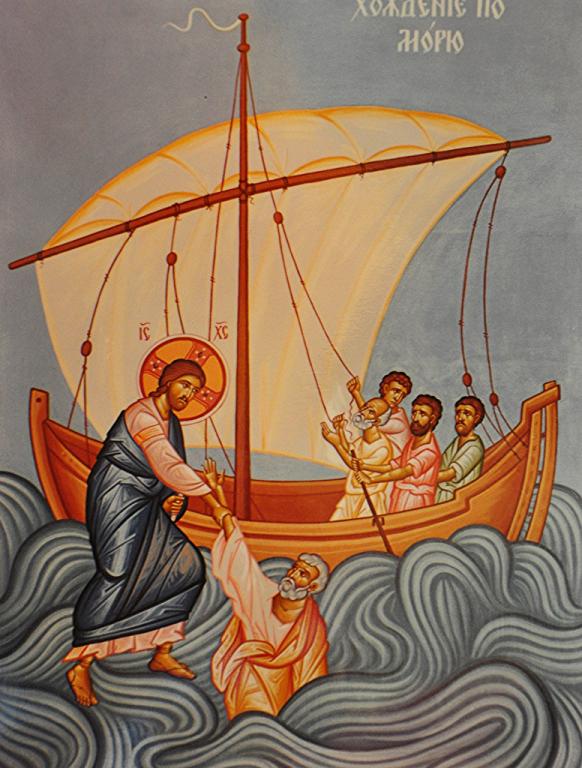
Peter sinking in the water after walking on it [Flickr / Creative Commons Attribution-ShareAlike 2.0 Generic license]
From an old Facebook post (dated 11 August 2014)
* * * * *
Matthew 14:28-31 (RSV) And Peter answered him, “Lord, if it is you, bid me come to you on the water.” [29] He said, “Come.” So Peter got out of the boat and walked on the water and came to Jesus; [30] but when he saw the wind, he was afraid, and beginning to sink he cried out, “Lord, save me.” [31] Jesus immediately reached out his hand and caught him, saying to him, “O man of little faith, why did you doubt?”
The point Jesus was making was that Peter was walking on the water. The miracle was already there (and was “proven”). Peter both anticipated the possibility by asking Jesus to let him walk to Him, and then experienced it himself.
Thus, whether miracles are rare (they certainly are, and it’s not a lack of faith to observe that) is irrelevant to that scenario, I would contend. Peter had faith to do it for a while, then he doubted and lacked faith. So Jesus asked him why he did.
Peter had the faith and expectation, but became afraid due to the wind. I think it is intended as a commentary on our lack of perseverance. We manage to believe and have faith by God’s grace, but find it tough to continue doing so over time (particularly when suffering and other difficulties arise).
A variation of this theme occurs here:
Matthew 8:24-26 And behold, there arose a great storm on the sea, so that the boat was being swamped by the waves; but he was asleep. [25] And they went and woke him, saying, “Save, Lord; we are perishing.” [26] And he said to them, “Why are you afraid, O men of little faith?” Then he rose and rebuked the winds and the sea; and there was a great calm.
I’ve always taken this to mean that Jesus was saying, in effect, “You have seen Me perform many miracles; you know I am the Messiah, so why are you worrying about these things having to do with the elements and provisions? Do you not believe that I can take care of all that, based on what you have often seen Me do?”
We can say that they lacked discernment before the Spirit came at Pentecost, etc. (and that’s true, too), but Jesus still seems to expect more from them; hence, several times He refers to them having “little faith.” And He rebukes the demand for more signs and for physical proofs. This was the case with Doubting Thomas. That also occurred before Pentecost, yet Jesus expected him to have enough faith to believe without the necessity of empirical evidence:
John 20:27-29 Then he said to Thomas, “Put your finger here, and see my hands; and put out your hand, and place it in my side; do not be faithless, but believing.” [28] Thomas answered him, “My Lord and my God!” [29] Jesus said to him, “Have you believed because you have seen me? Blessed are those who have not seen and yet believe.”
This also reminds me of Jesus’ words in Luke 16:31, citing Abraham: “He said to him, `If they do not hear Moses and the prophets, neither will they be convinced if some one should rise from the dead.'”
In a nutshell: “you guys have enough evidence to believe; even extraordinary miracles will not convince you if you reject that which is already revealed and manifest.” The lack of faith is already a rebellion; it seems to me to be Jesus’ point. It’s not mere lack of assent on a rational basis, due to a lack of sufficient evidence.
Some might say that Peter acted as he did because miracles are a rare thing, and as such, difficult to accept and believe (in particular cases). But the rarity of a miracle was irrelevant if Peter was doing the miraculous thing at the time. He was already there; he already believed. The defect came in perseverance or doubting how long the miracle could last, or in thinking that a stronger wind could overcome it. These are quite human and understandable responses.
No one denies that faith is difficult and that miracles are rare and difficult to accept even when they are right in front of us. Nevertheless, Jesus expects them to “get” it far more than they do, even before Pentecost (i.e., the indwelling of the Holy Spirit in all Christian believers). He is rebuking doubt; not mere lack of ability to believe, due to not yet having the fullness of the Spirit. The same dynamic is also present in John 6.
Jesus expected both the Jews in general and His disciples to know Who He was, based on the revelation that already existed (even prior to miracles). As one of many examples of this theme, we have recorded what Jesus said to the two disciples on the road to Emmaus:
Luke 24:25-27 “And he said to them, “O foolish men, and slow of heart to believe all that the prophets have spoken! [26] Was it not necessary that the Christ should suffer these things and enter into his glory?” [27] And beginning with Moses and all the prophets, he interpreted to them in all the scriptures the things concerning himself.
Yes, grace and faith are required (all agree on that). Jesus is rebuking them for not accepting this grace and faith, which would enable them to understand these things that they do not, which leads Jesus to call them “foolish” and “slow” to “believe.”
Jesus thought slowness to believe and to have faith was quite culpable, even before Pentecost, as we see by His reactions many times to it. If there was no (or little) culpability, then there would have been no rebuke from Him. He would have just said, I think, “Okay guys, I know this is very difficult to accept. No sweat. No problem . . . ” Instead He rebukes for lack of faith, for rebellion, for inability to accept what He says is fairly plain in Old Testament Scripture.
He didn’t act that way in John 6. After they complained that it was a “hard saying” (6:60), He didn’t respond by softening or sympathizing that it is so difficult to believe, as if that is normal and expected. Rather, He said, “Do you take offense at this?” (6:61) and “there are some of you that do not believe.” (6:64).
He also notes the absolute necessity of prior enabling grace: “This is why I told you that no one can come to me unless it is granted him by the Father.” (6:65). But what I find most interesting is that He still rebukes them: implying that they have guilt for not accepting the grace that would enable them to believe. They are still at fault, and so is anyone who rejects His grace and revealed teaching.
They were culpable every time, it seems to me (i.e. educated Jews of the first century, and Jesus’ disciples who repeatedly witnessed His miracles), there was a lack of faith or belief. If, in fact, Jesus thought they were not culpable in these instances, I really don’t understand why He said what it is recorded that He said (here is more of the same theme):
Matthew 6:30 But if God so clothes the grass of the field, which today is alive and tomorrow is thrown into the oven, will he not much more clothe you, O men of little faith? (cf. Lk 12:28)
Matthew 16:8 But Jesus, aware of this, said, “O men of little faith, why do you discuss among yourselves the fact that you have no bread?”
Matthew 17:20 He said to them, “Because of your little faith. For truly, I say to you, if you have faith as a grain of mustard seed, you will say to this mountain, `Move from here to there,’ and it will move; and nothing will be impossible to you.”
John 4:48 Jesus therefore said to him, “Unless you see signs and wonders you will not believe.”
He doesn’t say what it seems to me that He would say if there were little or no culpability: “you don’t understand because you don’t have enough grace / haven’t yet received the Spirit (so it’s way above your pay grade).” Etc. . . .
There is a little of that in a few places (because it’s a both / and scenario), but it doesn’t wipe out many more instances of human culpability and rebuke for same. We can never deny the necessity of faith and grace, but some want to deny almost all human culpability, and I don’t think that can be squared with Scripture. During the entire old covenant period, men were culpable for both sin and lack of faith. It isn’t like all that began with Pentecost, and everyone gets a big pass before that time.
With the disciples it is a weak faith in consideration: “I believe; help my unbelief!” (Mk 9:24). With the Pharisees it is outright unbelief brought about by pride.
My general point is that Jesus assumes that they should not have merely weak faith (and culpability exists, because they have the weakness). Otherwise, why would Jesus repeatedly rebuke the disciples for having “little faith” when, according to you, He would have understood full well that they could only have a weak faith by the nature of the case, and it couldn’t be otherwise till Pentecost? No one rebukes someone for what they can’t by nature do in the first place; what is impossible.
We don’t say to a five-year-old, “why couldn’t you pass the exam on calculus?” Or to an infant, “Have you read War and Peace?” These are meaningless questions.
But we can say that they had a weak faith and they moved to a position of realizing this and accepting the need for a greater faith by God’s grace. I was contending that Jesus’ comment, “why did you doubt?” presupposes that Peter was at a lower level of faith than he should have been at that time. Therefore, it was a rebuke; therefore he was culpable (since a rebuke presupposes fault and ability to have done better; or else it is, again, meaningless).
Since Jesus kept mentioning “little faith” as a shortcoming, He must have obviously assumed (unspoken premise) that they could and should have more of it than they did (at the time He issued the rebuke).
I readily agree that it would take time to develop such faith (since we all know that from our own experience of being stubborn, prideful sinners). I know that as much as anyone. God had to lay me out for six months with clinical depression and deep existential despair before I would cease my relentless rebellion against Him (or cease my apathy as to whether He had any claim whatever on my life).
* * * *
Jesus rebuked the Pharisees, on the other hand (a far more difficult case), not just for spiritual pride, but also for disbelief in Old Testament revelation. He argued with the Pharisees over and over, that His teaching and He Himself as Messiah were manifest in Scripture. That stands alongside His constant rebukes of their hypocrisy. Thus, their fault was for those two things, not just one.
This applies even to a “good Pharisee” like Nicodemus, whom Jesus mildly scolds for being ignorant of basic things: “Are you a teacher of Israel, and yet you do not understand this?” (John 3:10)
Jesus thought belief was already quite possible and justified by OT scriptural revelation:
Luke 16:27-31 And he said, `Then I beg you, father, to send him to my father’s house, [28] for I have five brothers, so that he may warn them, lest they also come into this place of torment.’ [29] But Abraham said, `They have Moses and the prophets; let them hear them.’ [30] And he said, `No, father Abraham; but if some one goes to them from the dead, they will repent.’ [31] He said to him, `If they do not hear Moses and the prophets, neither will they be convinced if some one should rise from the dead.'”
I could come up with all kinds of passages about this. Here’s one:
John 5:39-40, 44-47 You search the scriptures, because you think that in them you have eternal life; and it is they that bear witness to me; [40] yet you refuse to come to me that you may have life. . . . [44] How can you believe, who receive glory from one another and do not seek the glory that comes from the only God? [45] Do not think that I shall accuse you to the Father; it is Moses who accuses you, on whom you set your hope. [46] If you believed Moses, you would believe me, for he wrote of me. [47] But if you do not believe his writings, how will you believe my words?”
The Pharisees failed to accept what Jesus sure seems to assume (from what we see Him saying) was clear and manifest. This is much of the point, e.g., in OT prophecies being cited in the NT (esp. in Matthew). The argument there was that it was plain that Jesus was fulfilling these prophecies that all the Pharisees were quite familiar with. Even Herod’s advisors knew that the Messiah was to be born in Bethlehem. All Jews knew that.
Jews even knew something about a suffering Messiah, from Isaiah. They still did after Jesus (I’ve studied quite a bit about their views of the Messiah). That wasn’t completely unknown. They just didn’t like it or want it, because it’s natural to yearn for the conqueror and not the suffering servant.
Stubbornness and pride adversely affect logic, as anyone who does evangelism and apologetics is surely familiar with from a million examples. The late great Steven Jay Gould (himself an agnostic) used to write whole books about how pride and stubbornness and human bias and party affiliations affected good science and sometimes caused atrocious pseudo-science, like phrenology or the hoax of Piltdown Man.
It works the same way in religious matters! We can all see it in our own lives, in things we’ve had to learn the hard way (very much true in my case, as I am a stubborn Scotsman!).
I would contend that Jesus brings both these themes together, with regard to the Pharisees. He’s saying, in effect, “your stubborn spiritual pride blinds you to what is manifest in Scripture.” So He argues (paraphrase): “all you gotta do is go as far as Moses and He is already speaking about Me. Yet for some odd reason you (who fancy yourselves such masters of Scripture) reject Me.”
Unbelievers today are vastly more ignorant than educated Jews at the time of Jesus. Thus, they get a lot more of a pass for ignorance. For that very different theme, see Romans 2 or St. Paul’s discourse on Mars Hill in Athens (Acts 17:16-33).
I think there is a lot here in these Bible passages for us to ponder: about human pride, stubbornness, lack of faith, and unbelief.
* * * * *
Previous Post
September 12, 2015
A Defense of Allegedly "Idolatrous" Marian Devotions
Next Post

September 12, 2015 Biblical Evidence for "Holy Father" and "Vicar of Christ"
Browse Our Archives
Select a Category & Last Things About Me Anti-Catholicism Atheism & Agnosticism Baptism and Sacramentalism Bible and Tradition Blessed Virgin Mary Books by Dave Armstrong C. S. Lewis Calvinism & General Protestantism Catholic Apologetics Catholic Apologists Catholic conversion Catholic converts Christmas Church (Ecclesiology) Church History Conversion and Converts Development of Doctrine Eastern Orthodoxy Ecumenism & Christian Unity Eucharist & Liturgy Fathers of the Church French Translations G. K. Chesterton Hell Hell & Satan Hell & Satan & Last Things Heresies & Comparative Religion Holistic Health Inquisition & Crusades & Scandals James White Jews & Judaism & Old Testament John Calvin John Henry Newman Liberal / Modernist Theology Life Issues Literary Resume Lutheranism Mariology Martin Luther Music Orthodoxy Papacy & Infallibility Personal Page Philosophy & Science Political & Ethical & Moral Issues Protestant Persecution & Intolerance Protestantism Purgatory Purgatory & Penance Romantic & Imaginative Theology Saints & Purgatory & Penance Salvation Salvation & Justification Satan & Last Things Sexuality and Gender Issues Spanish Translations Traditionalism vs. Radical Catholic Reactionaries Traducciones al español / tradução para português Trinitarianism & Christology Uncategorized Videos
Select a Month October 2026 September 2026 August 2026 July 2026 June 2026 May 2026 April 2026 March 2026 February 2026 January 2026 December 2025 November 2025 October 2025 September 2025 August 2025 July 2025 June 2025 May 2025 April 2025 March 2025 February 2025 January 2025 December 2024 November 2024 October 2024 September 2024 August 2024 July 2024 June 2024 May 2024 April 2024 March 2024 February 2024 January 2024 December 2023 November 2023 October 2023 September 2023 August 2023 July 2023 June 2023 May 2023 April 2023 March 2023 February 2023 January 2023 December 2022 November 2022 October 2022 September 2022 August 2022 July 2022 June 2022 May 2022 April 2022 March 2022 February 2022 January 2022 December 2021 November 2021 October 2021 September 2021 August 2021 July 2021 June 2021 May 2021 April 2021 March 2021 February 2021 January 2021 December 2020 November 2020 October 2020 September 2020 August 2020 July 2020 June 2020 May 2020 April 2020 March 2020 February 2020 January 2020 December 2019 November 2019 October 2019 September 2019 August 2019 July 2019 June 2019 May 2019 April 2019 March 2019 February 2019 January 2019 December 2018 November 2018 October 2018 September 2018 August 2018 July 2018 June 2018 May 2018 April 2018 March 2018 February 2018 January 2018 December 2017 November 2017 October 2017 September 2017 August 2017 July 2017 June 2017 May 2017 April 2017 March 2017 February 2017 January 2017 December 2016 November 2016 October 2016 September 2016 August 2016 July 2016 June 2016 May 2016 April 2016 March 2016 February 2016 January 2016 December 2015 November 2015 October 2015 September 2015 August 2015 July 2015 June 2015 May 2015 April 2015 March 2015 February 2015 January 2015 December 2014 November 2014 October 2014 September 2014 August 2014 July 2014 June 2014 April 2014 March 2014 February 2014 January 2014 December 2013 November 2013 October 2013 September 2013 August 2013 July 2013 June 2013 April 2013 March 2013 February 2013 January 2013 December 2012 November 2012 October 2012 September 2012 August 2012 July 2012 June 2012 May 2012 April 2012 March 2012 February 2012 January 2012 December 2011 November 2011 October 2011 September 2011 August 2011 July 2011 June 2011 April 2011 March 2011 February 2011 October 2010 September 2010 August 2010 July 2010 April 2010 March 2010 December 2009 October 2009 August 2009 July 2009 June 2009 May 2009 March 2009 February 2009 October 2008 September 2008 April 2008 March 2008 February 2008 January 2008 December 2007 November 2007 October 2007 May 2007 March 2007 February 2007 January 2007 November 2006 October 2006 September 2006 August 2006 July 2006 June 2006 May 2006 April 2006 March 2006 February 2006 October 2005 June 2005 April 2005 February 2005 July 2004 May 2004 April 2004
Follow Us!
TAKE THE
Religious Wisdom Quiz
Who lived in Ur of the Chaldeans before God called him?
Select your answer to see how you score.
Jacob Abram Isaac Lot
Books by This Author Books by Dave Armstrong
Related posts from Biblical Evidence for Catholicism

Bible & Catholicism on Mortal Sin (vs. John...
Biblical Evidence for Catholicism

Dialogue on Eternal Security / Absolute Assurance
Biblical Evidence for Catholicism

"Faith Alone" Dialogue with a Calvinist
Biblical Evidence for Catholicism

Exegesis of 75 NT Faith [Alone?] & Works...
Biblical Evidence for Catholicism
TRENDING AT PATHEOS Catholic

In "Irreplaceable," our book on vocation and technology, Trevor Sutton and I...

I was strolling through the top floor of the brand new Parthenon...

What Does Gêvâh Mean For Kimberley Guifoyle &...
This week, a lot of the news is focused on Kimberly Guilfoyle....

INNER CIRCLE: Profound Mystery (Of Christ In All...
Ephesians 5:31-32 “For this reason, a man will leave his father and...

Do Not Rejoice When Your Enemy Falls: The...
Turning an execution into a public spectacle is a disturbing expression of...

'The Chosen' S6 Trailer: The Passion Gets Very...
Not many watching 'The Chosen' worry about spoilers, but just because they...
view all Catholic blogs
Ad-Free & Subscriber Log-In Subscription Support
- About Us
- 2026 Calendar
- Videos
- Podcasts
- Library of World Religions
- Faith In Media Tracker
- Advertise With Us
- Write for Us
- Privacy Policy
- Terms of Service
- Do Not Sell My Data
- Contact Us
- Radiant Digital
- Manage Newsletter Subscriptions
- Unsubscribe From Notifications
- Sitemap
Copyright 2008-2026, Patheos. All rights reserved.
Subscription Support Ad-Free & Subscriber Log-In
Follow Patheos