
BuddhistCatholicContemplativeEvangelicalGeneral ChristianHinduJewishLatter-day SaintMuslimNew VisionsProgressive Christian
Beliefs
- Buddhist
- Catholic
- Contemplative
- Evangelical
- General Christian
- Hindu
- Jewish
- Latter-day Saint
- More Voices
- Muslim
- New Visions
- Pagan
- Progressive Christian
Topics
- Religion News
- Food and Religion
- Sports and Religion
- Religious Art
- Religious Music and Entertainment
- Religious Events
- History and Religion
- Style and Religion
- Politics and Religion
- Women in Religion
- Recreation Outdoors and Religion
- Business Finance and Religion
- Careers Workplace and Religion
- Education and Religion
- Family Parenting and Religion
- Health Fitness and Religion
- Home and Religion
- Relationships and Religion
- Technology and Religion
- Travel and Religion
Columnists
- Buddhist Columnists
- Business Finance and Religion Columnists
- Careers Workplace and Religion Columnists
- Catholic Columnists
- Contemplative Columnists
- Education and Religion Columnists
- Evangelists Columnists
- Family Parenting and Religion Columnists
- General Christian Columnists
- Health Fitness and Religion Columnists
- Hindu Columnists
- History and Religion Columnists
- Home and Religion Columnists
- Jewish Columnists
- More Voices Columnists
- Latter Day Columnists
- Muslim Columnists
- New Visions Columnists
- Nonreligious Columnists
- Pagan Columnists
- Politics and Religion Columnists
- Progressive Columnists
- Recreation Outdoors and Religion Columnists
- Relationships and Religion Columnists
- Religion News Columnists
- Religious Art Columnists
- Religious Events Columnists
- Religious Music and Entertainment Columnists
- Sports and Religion Columnists
- Style and Religion Columnists
- Technology and Religion Columnists
- Travel and Religion Columnists
- Women in Religion Columnists
Resource Library
- 2026 Calendar
- Library of World Religions
- The 100 Most Holy Places on Earth
- Patheos Answers
- Podcasts
- Videos
- Faith Leaders Database
- Anglican Episcopalian
- Bahai
- Baptist
- Buddhism
- Christianity
- Confucianism
- Eastern Orthodoxy
- Hinduism
- Holiness and Pentecostal
- ISKCON
- Islam
- Judaism
- Lutheran
- Methodist
- The Church of Jesus Christ of Latter-day Saints
- New Age
- Paganism
- Presbytarian and Reformed
- Protestantism
- Religion Behind the Scenes
- Roman Catholic
- Scientology
- Shia Islam
- Sikhism
- Sufism
- Sunni Islam
- Taoism
- Zen
- See all religions
Research Tools
 Ad-Free & Subscriber Log-In Subscription Support
Ad-Free & Subscriber Log-In Subscription Support
Follow Patheos 

- Trending:
- Forgiveness
- |
- Marriage
- |
- Consciousness
- |
- Death Penalty
- |
- Election
- |
- Halloween

-
About
-
Catholic Apologetics
-
Church History
-
Great Apologists
-
Christian Worldview
-
Protestantism & Misc.
- Home
- Catholic
- History and Religion
- Mary’s Virginity During Childbirth: Ott’s Revision & Latin Analysis
Mary’s Virginity During Childbirth: Ott’s Revision & Latin Analysis
Last updated on: June 5, 2026 at 11:41 pm by Dave Armstrong
Mary’s Virginity During Childbirth: Ott’s Revision & Latin Analysis 2026-06-05T23:41:44-04:00 Dave Armstrong
Patheos Explore the world's faith through different perspectives on religion and spirituality! Patheos has the views of the prevalent religions and spiritualities of the world.
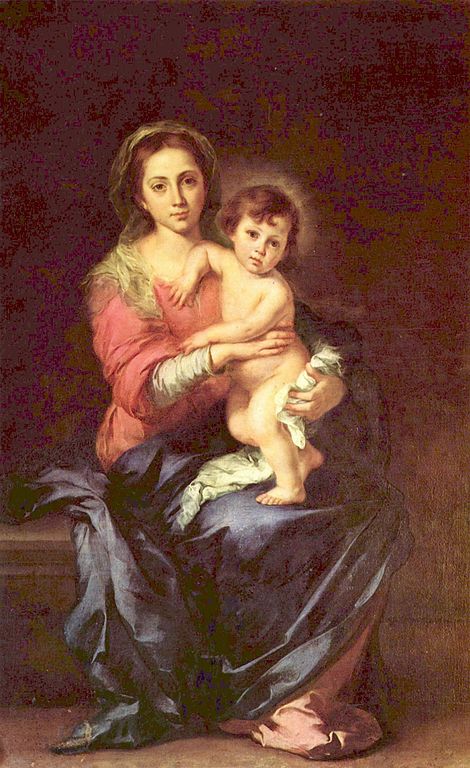
Madonna and Child (c. 1655-1660), by Bartolomé Esteban Murillo (1617-1682) [public domain / Wikimedia Commons]

* * * * *
I wrote a very extensive paper about this entire issue, entitled, Mary’s Perpetual Virginity “In Partu” (a Miraculous, Non-Natural Childbirth) is a Binding Catholic Dogma. As part of that, I cited relevant dogmatic statements of the Church, from the newest edition of Denzinger’s Enchiridion symbolorum: Compendium of Creeds, Definitions, and Declarations on Matters of Faith and Morals (Ignatius, 2012), in both English and Latin. This work was co-edited and co-translated by a good friend of mine, fellow Michigander, and great orthodox Catholic scholar, Dr. Robert Fastiggi.
Dr. Fastiggi is also co-editor and co-translator of a revised version of the great dogmatic work, Fundamentals of Catholic Dogma, by Dr. Ludwig Ott [see also a sizable online sample]. That is due to be published by the end of 2015. Dr. Ott was in error on this point of dogma in his 1952 edition (see pp. 205-206). Dr. Fastiggi informed me that Ott responded to warnings from the Holy Office in 1960 and the reiteration of the traditional doctrine by Vatican II (1962-1965), retracted his earlier opinion in 1969 and revised this section, which will be included in the new upcoming edition. Today he sent me the revised version of the section under consideration.
Here is Ott’s 1952 version of the section in question:
Virginity During the Birth of Jesus
Mary bore her Son without any violation of her virginal integrity.
(De fide on the ground of the general promulgation of doctrine.)
The dogma merely asserts the fact of the
continuance of Mary’s physical virginity without
determining more closely how this is to be
physiologically explained. In general the Fathers
and the Schoolmen conceived it as non-injury to
the hymen, and accordingly taught that Mary
gave birth in miraculous fashion without
opening of the womb and injury to the hymen,
and consequently also without pains (cf. S. th.
III 28, 2).
However, according to modern natural scientific
knowledge, the purely physical side of virginity
consists in the non-fulfilment of the sex act
(“sex-act virginity”) and in the non-contact of
the female egg by the male seed (“seed-act
virginity”) (A. Mitterer). Thus, injury to the
hymen in birth does not destroy virginity, while,
on the other hand, its rupture seems to belong to
complete natural motherhood. It follows from
this that from the concept of virginity alone the
miraculous character of the process of birth
cannot be inferred, if it cannot be, and must not
be derived from other facts of Revelation. Holy
Writ attests Mary’s active role in the act of birth
(Mt. I, 25; Luke 2, 7: “She brought forth”)
ThS 572 The Church in Consummation / Collection of Readings, 148
which does not seem to indicate a miraculous
process.
But the Fathers, with few exceptions, vouch for
the miraculous character of the birth. However,
the question is whether in so doing they attest a
truth of Revelation or whether they wrongly
interpret a truth of Revelation, that is, Mary’s
virginity, from an inadequate natural scientific
point of view. It seems hardly possible to
demonstrate that the dignity of the Son of God
or the dignity of the Mother of God demands a
miraculous birth.
Mary’s virginity during the birth of Jesus was
contested in the Early Church by Tertullian (De
carne Christi 23) and especially by Jovinian, an
opponent of the Church ideal of virginal purity ;
and in modern times by Rationalists (Harnack
calls it: “a Gnostic invention”).
Jovinian’s teaching (virgo concepit, sed non
virgo generavit) was rejected at a Synod at
Milan (390) under the presidency of St.
Ambrose (cf. Ep. 42), which recalled the
invocation of the Apostles’ Creed: Natus ex
Maria virgine. Her virginity during the birth of
Jesus is included in the title of honour “perpetual
virgin” (aeiparthenos), which was given to Mary
by the Fifth General Council at Constantinople
(553) (D 214, 218. 227). The doctrine is
expressly taught by Pope St. Leo I in the
Epistola Dogmatica ad Flavianum (Ep. 28, 2)
which was approved by the Council of
Chalcedon; it was taught also by the Lateran
Synod (649) and by Pope Pius IV (1555) (D
256, 993). Pope Pius XII in the Encyclical
“Mystici Corporis” says : “It was she who gave
miraculous birth to Christ our Lord (mirando
partu edidit ).” The Church’s general teaching is
expressed in her Liturgy also. Cf. the
Responsorium to the fifth Lesson of the Feast of
Christmas, and to the eighth Lesson of the Feast
of the Circumcision of Our Lord.
Is. 7. 14 announces that the maiden (as a virgin)
would give birth. The Fathers also, in a typical
sense, refer to the virgin birth of Our Lord the
words of the Prophet Ezechiel on the closed
gates (Ez. 44, 2; cf. St. Ambrose Ep. 42, 6; St.
Jerome, Ep. 49, 21); the words of the Prophe
Isaias on the painless birth (Is. 66, 7; cf. St.
Irenaeus, Epis. 54; St. John Damascene, De fide
orth. IV 14): and the words of the Song of Songs
on the closed garden and the scaled well (Hl. 4,
12; cf. St. Jerome, Adv. Jov. I 31. Ep. 49, 21).
St. Ignatius of Antioch characterises, not merely
Mary’s virginity, but also the bringing forth of
her Son as a “mystery which must be proclaimed
aloud” (Eph. 19, I). Christ’s virginal birth is
accepted without question in the apocryphal
writings of the second century (Odes of
Solomon, 19, 7 et seq.; Proto-Gospel of St.
James 19 et seq ; ascension into heaven of Isaias
11, 7 et seq.), and also by Church authors such
as St. Irenaeus (Epis. 54 ; adv. haer. III 21, 4–6)
; St. Clement of Alexandria (Strom. VII 16, 93) ;
Origen (In. Lev. hom. 8, 2; otherwise in Luc.
hom. 14). St. Ambrose (Ep. 42, 4–7), St. Jerome
(Adv. Jov. I 31 ; Ep. 49, 21) and St. Augustine
(Enchir. 34) defend the traditional Church
doctrine against Jovinian. For the illustration of
the mystery the Fathers and Theologians employ
various analogues—the emergence of Christ
from the sealed tomb, His going through closed
doors, the penetration of the ray of sun through
glass, the birth of the Logos from the bosom of
the rather, the going out of human thought from
the human spirit.
Christ’s miraculous emergence from the
unimpaired womb of the Virgin Mother finds its
ultimate explanation in the Omnipotence of God.
St. Augustine says : “in such things the whole
ground of the mystery is the might of Him who
permits it to happen” (Ep. 137, 2, 8). Cf. S. th.
111 28, 3.
Dr. Fastiggi noted in his personal letter to me today (which he gave permission to share):
In addition to these revisions, there is also the fact that the earlier English translated the German adjective allgemeinen as “general” rather than “universal.” Although allgemeinen can be translated as “general,” there is a big difference in English between a “general teaching” and a “universal teaching.” The fact that Fr. Ott sees the doctrine of Mary’s virginitas in partu as “de fide” argues in favor of translating allgemeinen Lehrverkündigung as “universal teaching.”
Now here is the revised 1969 version of this portion, translated into English: to be included in the upcoming 2015 edition of the work:
Virginity During the Birth of Jesus
Mary bore her Son without any injury to her virginal integrity. (De fide on the ground of the universal teaching of the doctrine.)
The dogma asserts that the bodily integrity of Mary was not injured in the act of giving birth. Just as in conception so also in giving birth her virginal integrity was preserved. The way and manner by which she gave birth was extraordinary in itself. The precise determination as to how Mary’s virginal integrity persisted in a physical manner in giving birth does not belong to the faith of the Church. In the declarations of the Church’s Magisterium and in the testimony of Tradition it is nevertheless firmly maintained that the virginity in giving birth is distinct from the virginity in conception and is a new factor added to her virginity. The theological explanation brings the bodily non-injury in giving birth into coherence with the freedom from disordered passions.
This freedom had a unique dominion of spiritual power over the bodily organs and the sequence of events. Hence it follows that Mary in giving birth to Jesus was completely active as Sacred Scripture implies (Lk 2, 7). In this way the absence of bodily pains and especially the absence of sexual passions can be taken into account. The bodily non-injury is the material element of the virginity in giving birth, while the absence of sexual passions is the formal element.
Mary’s virginity during the birth of Jesus was contested in the Early Church by Tertullian (De carne Christi 23) and especially by Jovinian, an opponent of the Church’s ideal of virginal purity; and in modern times by Rationalists (Harnack calls it: “a Gnostic invention”).
Jovinian’s teaching (virgo concepit, sed non virgo generavit) was rejected at a Synod at Milan (390) under the presidency of St. Ambrose (cf. Ep. 42), which recalled the invocation of the Apostles’ Creed: Natus ex Maria virgine. Her virginity during the birth of Jesus is included in the title of honour “perpetual virgin” (WWWW), which was given to Mary by the Fifth General Council at Constantinople (553) (DH 422, 427, 437). The doctrine is expressly taught by Pope St. Leo I in the Epistola Dogmatica ad Flavianum (Ep. 28, 2) which was approved by the Council of Chalcedon; it was taught also by the Lateran Synod (649) and by Pope Paul IV (1555) (DH 503, 1880). Pope Pius XII in the Encyclical “Mystici Corporis” says: “It was she who gave miraculous birth to Christ our Lord (mirando partu edidit; n. 110).” The Church’s universal teaching is expressed in her Liturgy also. Cf.
The preface to the Marian feasts (virginitatis gloria permanente) and the Responsorium to the fifth Lesson of the Feast of Christmas (cuius viscera intaca permanent), and to the eighth Lesson of the Feast of the Circumcision of Our Lord (peperit sine dolore).
Is. 7. 14 announces that the maiden (as a virgin) would give birth. The Fathers also, in a typical sense, refer to the virgin birth of Our Lord the words of the Prophet Ezechiel on the closed gates (Ez. 44, 2; cf. St. Ambrose Ep. 42, 6; St. Jerome, Ep. 49, 21); the words of the Prophet Isaiah on the painless birth (Is. 66, 7; cf. St. Irenaeus, Epis. 54; St. John Damascene, De fide orth. IV 14: and the words of the Song of Songs on the closed garden and the sealed well (Song of Songs 4, 12; cf. St. Jerome, Adv. Jov. I 31, Ep. 49, 21).
St. Ignatius of Antioch characterises, not merely Mary’s virginity, but also the bringing forth of her Son as a “mystery which must be proclaimed aloud” (Eph. 19, 1). Christ’s virginal birth is accepted without question in the apocryphal writings of the second century (Odes of Solomon, 19, 7 et seq.; Proto-Gospel of St. James 19 et seq.; The Ascension into Heaven of Isaiah 11, 7 et seq.), and also by Church authors such as St. Irenaeus (Epid. 54; Adv. haer. III 21, 4-6); St. Clement of Alexandria (Strom. VII 16, 93); Origen (In. Lev. hom. 8, 2; otherwise in Luc. hom. 14). St. Ambrose (Ep. 42, 4-7), St. Jerome (Adv. Jov. I 31; Ep. 49, 21) and St. Augustine (Enchir. 34) who defend the traditional Church doctrine against Jovinian. For the illustration of the mystery, the Fathers and Theologians employ various analogies—the emergence of Christ from the sealed tomb, His going through closed doors, the penetration of the ray of sun through glass, the birth of the Logos from the bosom of the Father, the going out of human thought from the human spirit.
Christ’s miraculous emergence from the unimpaired womb of the Virgin Mother finds its ultimate explanation in the Omnipotence of God. St. Augustine says: “in such things the whole ground of the mystery is the might of Him who permits it to happen” (Ep. 137, 2, 8). Cf. S.th. III 28, 2.
* * *
Now here are the English and Latin renderings of the dogmatic statements from Denzinger (2012 edition) having to do with Mary’s in partu virginity. Analysis is provided by Ryan Grant: an expert in Latin and its historic ecclesiastical use. He attended the Franciscan University of Steubenville and is a professional translator (A Small Catechism for Catholics, On the Roman Pontiff), and has been a Latin Instructor at a classical Christian academy (seven years as a Latin teacher). His words will be in blue.
Pope Leo the Great, in his famous letter to Flavian, or Tome (449), that was acclaimed and accepted by the Council of Chalcedon in 451, stated:
. . . the Virgin Mother, who gave birth to him in such a way that her virginity was undiminished. (Denzinger [DS] 291)
. . . quae illum ita salva virginitate edidit, quemadmodum salva virginitate concepit . . .
And:
“. . . his birth was miraculous” (DS 294)
. . . quia nativitas est mirabilis . . .
Letter of Leo to Julianus of Cos, 13 June 449 (Licet per nostros):
. . . he was brought forth from the womb of the Mother in such a way that her fertility gave birth while her virginity remained, . . . (DS 299)
. . . conceptus et natus, sive quod its visceribus matris est editus, ut et fecunditas pareret et virginitas permaneret . . .
Pope Hormisdas Letter Inter ea quae to Emperor Justinian, 26 March 521:
. . . opening the mother’s womb by his birth and yet not damaging the virginity of the Mother by the power of the Godhead. (DS 368)
. . . matris vulvam natus aperiens et virginitatem matris deitatis virtute non solvens.
The profession of faith of Pope Pelagius (AD 557) stated:
[H]e was born preserving the integrity of the Mother’s virginity: since she bore him while remaining a Virgin just as she conceived him as a Virgin. (DS 442)
. . . natum esse, servata integritate maternae virginitatis: quia sic eum Virgo permanens genuit, quemadmodum Virgo concepit.
One cannot remain a virgin in a biological sense if the hymen does not remain intact.
The Lateran Synod of AD 649, presided over by Pope St. Martin I, held that Mary:
gave birth to him without corruption, her virginity remaining equally inviolate after his birth . . . (DS 503)
. . . qui a Deo Patre ante omnia saecula natus est, in ultimis saeculorum absque semine concepisse ex Spiritu Sancto, et incorruptibiliter eam genuisse, indissolubili permanente et post partum eiusdem virginitate . . .
Here is the literal rendering, which is tricky because it uses a delayed antecedent:
“… Who was born from God the Father before all ages, in the last of the ages she conceived [Him] by the Holy Spirit without seed, and she gave birth incorruptibly, with the virginity of the same remaining unbroken even after birth.”
The adjective indissolubilis is the key here. It is the same word as is used to refer to the marital bond. It means imperishable, or something that cannot be untied, or broken. Likewise, the adverb incorruptibiliter which essentially means the same thing. Thus partum in this context is the fourth declension noun, partus, –us, which refers to the act of giving birth. Now someone could strictly point out that partus is not concerned with the hymen, because by the time a woman normally gives birth it is already broken. Yet with the blessed Virgin it is intact, so then partus does in fact involve the hymen, which normally would be broken. So the adjectives and adverbs here are indicating it is not so.
The Eleventh Council of Toledo (AD 675) includes the following doctrine in its Creed:
[36] . . . He was begotten from her in a new order and by a new birth: in a new order, because, invisible in his divinity, he is shown visible in the flesh; by a new birth, because an inviolate virginity, without knowing the contact of man, supplied the matter of his body, being made fruitful by the Holy Spirit. [37] This virgin birth is neither grasped by reason nor illustrated by example. Were it grasped by reason, it would not be wonderful; were it illustrated by example, it would not be unique. (DS 533)
[36] . . . nova autem nativitate est genitus, quia intacta virginitas et virilem coitum nescivit et foecundatam per spiritum Sanctum carnis materiam ministravit. [37] Qui partus Virginis nec ratione colligitur, nec exemplo monstratur; quod si ratione colligitur, non est mirabile; si exemplo monstratur, non erit singulare.
Intacta is the adjective describing virginity, and the translator has understood the sense, inviolate. Moreover, intacta is made up of the antecedent passive participle of tango tangere (to touch), which in Latin may be used to negate a word. Thus intacta has the sense of untouched. Among the standard definitions for this adjective one finds: “virgin”.
The Sixteenth Council of Toledo (AD 693) asserted:
As the Virgin, of course, preserved the purity of virginity before conception, accordingly after birth she experienced no corruption of her integrity; for she conceived as a virgin, she gave birth as a virgin, and after birth, she preserved the purity of incorruption without subtraction. (DS 571)
Quae scilicet virgo sicut ante conceptionem obtinuit virginitatis pudorem, ita post partum nullam sensit integritatis corruptionem; nam virgo concepit, virgo peperit, et post partum incorruptelae pudorem sine interceptione obtinuit.
Here we could say that, integritas, integritatis also means chastity in regard to the quality of a woman’s virginity, not integrity in a generic sense, in that regard it is a bit of a false friend. Thus this passage could read:
“The Virgin, who just as she indeed preserved the purity of virginity before the conception, also after the birth experienced no corruption of chastity; for a virgin she conceived, a virgin she gave birth, and after the birth she preserved the purity of incorruption without interruption.”
Additionally, the phrase “corruption” needs to be understood as it was used in later Latin and by Augustine, as the ceasing of the presence of something. The scholastics pick up on this usage when they speak of the corruption of a vice (meaning it ceases to adhere to the soul) or the corruption of a virtue (again, ceases to be). So when the Council says “without corruption of chastity”, it means without the loss of the wholeness of virginity.
Pope Alexander III: Letter Ex litteris tuis to the resident Sultan in Iconium, 1169: “. . . gave birth without pain, . . .” [“peperit sine dolore”] (DS 748)
In 1555 Pope Paul IV published a bull, Cum quorumdam. It includes this:
[condemning the following] . . . that the same most blessed Virgin Mary is not the true Mother of God and did not always persist in the integrity of virginity, namely, before giving birth, in giving birth, and perpetually after giving birth. (DS 1880)
. . . perstitisse semper in virginitatis integritate, ante partum scilicet, in partu et perpetuo post partum . . .
Here integritas is key again. Above it meant chastity, but here it can be understood more along the line of “integrity”, since chastity is often a synonym for virginity, but here it is used in the connection to the noun “virginity”, to indicate the fullness of virginity in particular, as opposed to meaning virginity in general above for which there was no corruption. That is to say, it is speaking of the particular fullness of virginity (the hymen) whereas above was referring to virginity.
Previous Post

September 28, 2015
The Biblical "Fool" & its Relation to Proverbial Literary Genre
Next Post
September 29, 2015 Sodom and Gomorrah & Archaeology: North of the Dead Sea?
Browse Our Archives
Select a Category & Last Things About Me Anti-Catholicism Atheism & Agnosticism Baptism and Sacramentalism Bible and Tradition Blessed Virgin Mary Books by Dave Armstrong C. S. Lewis Calvinism & General Protestantism Catholic Apologetics Catholic Apologists Catholic conversion Catholic converts Christmas Church (Ecclesiology) Church History Conversion and Converts Development of Doctrine Eastern Orthodoxy Ecumenism & Christian Unity Eucharist & Liturgy Fathers of the Church French Translations G. K. Chesterton Hell Hell & Satan Hell & Satan & Last Things Heresies & Comparative Religion Holistic Health Inquisition & Crusades & Scandals James White Jews & Judaism & Old Testament John Calvin John Henry Newman Liberal / Modernist Theology Life Issues Literary Resume Lutheranism Mariology Martin Luther Music Orthodoxy Papacy & Infallibility Personal Page Philosophy & Science Political & Ethical & Moral Issues Protestant Persecution & Intolerance Protestantism Purgatory Purgatory & Penance Romantic & Imaginative Theology Saints & Purgatory & Penance Salvation Salvation & Justification Satan & Last Things Sexuality and Gender Issues Spanish Translations Traditionalism vs. Radical Catholic Reactionaries Traducciones al español / tradução para português Trinitarianism & Christology Uncategorized Videos
Select a Month October 2026 September 2026 August 2026 July 2026 June 2026 May 2026 April 2026 March 2026 February 2026 January 2026 December 2025 November 2025 October 2025 September 2025 August 2025 July 2025 June 2025 May 2025 April 2025 March 2025 February 2025 January 2025 December 2024 November 2024 October 2024 September 2024 August 2024 July 2024 June 2024 May 2024 April 2024 March 2024 February 2024 January 2024 December 2023 November 2023 October 2023 September 2023 August 2023 July 2023 June 2023 May 2023 April 2023 March 2023 February 2023 January 2023 December 2022 November 2022 October 2022 September 2022 August 2022 July 2022 June 2022 May 2022 April 2022 March 2022 February 2022 January 2022 December 2021 November 2021 October 2021 September 2021 August 2021 July 2021 June 2021 May 2021 April 2021 March 2021 February 2021 January 2021 December 2020 November 2020 October 2020 September 2020 August 2020 July 2020 June 2020 May 2020 April 2020 March 2020 February 2020 January 2020 December 2019 November 2019 October 2019 September 2019 August 2019 July 2019 June 2019 May 2019 April 2019 March 2019 February 2019 January 2019 December 2018 November 2018 October 2018 September 2018 August 2018 July 2018 June 2018 May 2018 April 2018 March 2018 February 2018 January 2018 December 2017 November 2017 October 2017 September 2017 August 2017 July 2017 June 2017 May 2017 April 2017 March 2017 February 2017 January 2017 December 2016 November 2016 October 2016 September 2016 August 2016 July 2016 June 2016 May 2016 April 2016 March 2016 February 2016 January 2016 December 2015 November 2015 October 2015 September 2015 August 2015 July 2015 June 2015 May 2015 April 2015 March 2015 February 2015 January 2015 December 2014 November 2014 October 2014 September 2014 August 2014 July 2014 June 2014 April 2014 March 2014 February 2014 January 2014 December 2013 November 2013 October 2013 September 2013 August 2013 July 2013 June 2013 April 2013 March 2013 February 2013 January 2013 December 2012 November 2012 October 2012 September 2012 August 2012 July 2012 June 2012 May 2012 April 2012 March 2012 February 2012 January 2012 December 2011 November 2011 October 2011 September 2011 August 2011 July 2011 June 2011 April 2011 March 2011 February 2011 October 2010 September 2010 August 2010 July 2010 April 2010 March 2010 December 2009 October 2009 August 2009 July 2009 June 2009 May 2009 March 2009 February 2009 October 2008 September 2008 April 2008 March 2008 February 2008 January 2008 December 2007 November 2007 October 2007 May 2007 March 2007 February 2007 January 2007 November 2006 October 2006 September 2006 August 2006 July 2006 June 2006 May 2006 April 2006 March 2006 February 2006 October 2005 June 2005 April 2005 February 2005 July 2004 May 2004 April 2004
Follow Us!
TAKE THE
Religious Wisdom Quiz
What does the Greek word 'Kurios' mean?
Select your answer to see how you score.
Messiah King Redeemer Lord
Books by This Author Books by Dave Armstrong
Related posts from Biblical Evidence for Catholicism

Holy Ground: Why Mary Had NO Other Children...
Biblical Evidence for Catholicism
Protestant Confessions & "Ever-Virgin" Mary
Biblical Evidence for Catholicism

Mary Wife of Clopas (Jn 19:25): Mary's Sister-in-Law?
Biblical Evidence for Catholicism

Jesus Had Four Brothers? The Bible Sez No!
Biblical Evidence for Catholicism
TRENDING AT PATHEOS Catholic

The First Eucharistic Controversy: Christ’s Real Presence
For Catholics, the Eucharist is the source and summit of the Christian...

What a Stop Sign Can Teach Us About...
How to Make a Decision When You Can't Hear God Main point:...

Archdiocese Hosts Military Marriage Retreat in Germany
RASTATT, Germany — The transient military lifestyle, with its frequent deployments and...

Nearly every morning, I make the drive to Detroit with my high-school-age...

The Real AI Story Is Adoption Without Trust
Artificial intelligence has crossed a political threshold. It is no longer a...

A new article, written by Jeff Lindsay and Gale L. Pooley,...
view all Catholic blogs
Ad-Free & Subscriber Log-In Subscription Support
- About Us
- 2026 Calendar
- Videos
- Podcasts
- Library of World Religions
- Faith In Media Tracker
- Advertise With Us
- Write for Us
- Privacy Policy
- Terms of Service
- Do Not Sell My Data
- Contact Us
- Radiant Digital
- Manage Newsletter Subscriptions
- Unsubscribe From Notifications
- Sitemap
Copyright 2008-2026, Patheos. All rights reserved.
Subscription Support Ad-Free & Subscriber Log-In
Follow Patheos