
BuddhistCatholicContemplativeEvangelicalGeneral ChristianHinduJewishLatter-day SaintMuslimNew VisionsProgressive Christian
Beliefs
- Buddhist
- Catholic
- Contemplative
- Evangelical
- General Christian
- Hindu
- Jewish
- Latter-day Saint
- More Voices
- Muslim
- New Visions
- Pagan
- Progressive Christian
Topics
- Religion News
- Food and Religion
- Sports and Religion
- Religious Art
- Religious Music and Entertainment
- Religious Events
- History and Religion
- Style and Religion
- Politics and Religion
- Women in Religion
- Recreation Outdoors and Religion
- Business Finance and Religion
- Careers Workplace and Religion
- Education and Religion
- Family Parenting and Religion
- Health Fitness and Religion
- Home and Religion
- Relationships and Religion
- Technology and Religion
- Travel and Religion
Columnists
- Buddhist Columnists
- Business Finance and Religion Columnists
- Careers Workplace and Religion Columnists
- Catholic Columnists
- Contemplative Columnists
- Education and Religion Columnists
- Evangelists Columnists
- Family Parenting and Religion Columnists
- General Christian Columnists
- Health Fitness and Religion Columnists
- Hindu Columnists
- History and Religion Columnists
- Home and Religion Columnists
- Jewish Columnists
- More Voices Columnists
- Latter Day Columnists
- Muslim Columnists
- New Visions Columnists
- Nonreligious Columnists
- Pagan Columnists
- Politics and Religion Columnists
- Progressive Columnists
- Recreation Outdoors and Religion Columnists
- Relationships and Religion Columnists
- Religion News Columnists
- Religious Art Columnists
- Religious Events Columnists
- Religious Music and Entertainment Columnists
- Sports and Religion Columnists
- Style and Religion Columnists
- Technology and Religion Columnists
- Travel and Religion Columnists
- Women in Religion Columnists
Resource Library
- 2026 Calendar
- Library of World Religions
- The 100 Most Holy Places on Earth
- Patheos Answers
- Podcasts
- Videos
- Faith Leaders Database
- Anglican Episcopalian
- Bahai
- Baptist
- Buddhism
- Christianity
- Confucianism
- Eastern Orthodoxy
- Hinduism
- Holiness and Pentecostal
- ISKCON
- Islam
- Judaism
- Lutheran
- Methodist
- The Church of Jesus Christ of Latter-day Saints
- New Age
- Paganism
- Presbytarian and Reformed
- Protestantism
- Religion Behind the Scenes
- Roman Catholic
- Scientology
- Shia Islam
- Sikhism
- Sufism
- Sunni Islam
- Taoism
- Zen
- See all religions
Research Tools
 Ad-Free & Subscriber Log-In Subscription Support
Ad-Free & Subscriber Log-In Subscription Support
Follow Patheos 

- Trending:
- Forgiveness
- |
- Marriage
- |
- Consciousness
- |
- Death Penalty
- |
- Election
- |
- Halloween

-
About
-
Catholic Apologetics
-
Church History
-
Great Apologists
-
Christian Worldview
-
Protestantism & Misc.
- Home
- Catholic
- History and Religion
- Mary Mediatrix: A Biblical and Theological Introduction
Mary Mediatrix: A Biblical and Theological Introduction
Last updated on: January 25, 2025 at 12:25 pm by Dave Armstrong
Mary Mediatrix: A Biblical and Theological Introduction 2025-01-25T12:25:24-04:00 Dave Armstrong
Patheos Explore the world's faith through different perspectives on religion and spirituality! Patheos has the views of the prevalent religions and spiritualities of the world.
Including a Discussion of the Doctrine’s Dogmatic Status and Espousal of it by Nine Recent Popes and Vatican II
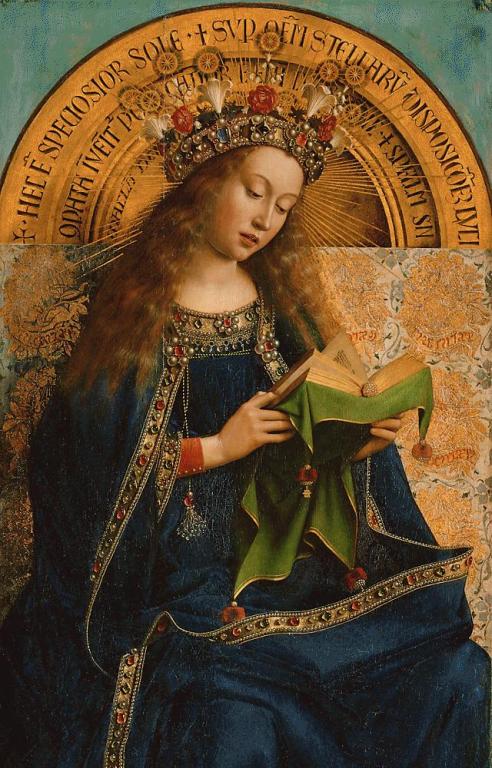
The Virgin Mary from the Ghent Altarpiece, 1432, by Jan van Eyck (c. 1390-1441) [public domain / Wikimedia Commons]

* * * * *
This topic is one of the most misunderstood areas of Catholic theology: not only by Protestants, but also by not a few Catholics. Human beings cannot fully understand many complex and deep areas of theology, because they are ultimately mysteries held in faith. But we can rationally understand a lot.
In becoming man, God chose to involve a human being, Mary. God didn’t have to do so. But He chose to “include” Mary and human reproductive biology Mary was a real mother, not just a biological “conduit,” so to speak. We “receive” Christ, the incarnate God-Man with a human nature, through Mary. He received His human body from her. Hence we honor Mary above all other creatures as the Theotokos – the “God-bearer”.
The Church fathers widely taught that Mary was the “Second Eve.” Eve said “no” to God and so caused (along with Adam, and indeed, all of us “in” them: 1 Cor 15:22) the fall of man. Mary, on the other hand, said “yes” to God at the Annunciation and so helped bring about (in an essentially lesser, and non-necessary, non-sufficient way) the redemption of humanity, that was brought about by the work of Christ on the cross. This is one of two major ways that Catholics understand the mediating work of Mary.
The Bible refers several times to what might be called “human distribution of divine grace” (which is the key premise behind the second meaning of Mary Mediatrix):
2 Corinthians 4:15 (RSV) For it [his many sufferings: 4:8-12, 17] is all for your sake, so that as grace extends to more and more people it may increase thanksgiving, to the glory of God.
Ephesians 3:2 assuming that you have heard of the stewardship of God’s grace that was given to me for you . . .
Ephesians 4:29 Let no evil talk come out of your mouths, but only such as is good for edifying, as fits the occasion, that it may impart grace to those who hear.
1 Peter 4:10 As each has received a gift, employ it for one another, as good stewards of God’s varied grace.
In fact, Paul is so gung-ho on the notion of his distributing grace to folks, that he mentions this at the beginning of practically every epistle that he wrote. When Paul and others use the common greeting of “grace to you” (e.g., Rom 1:7; 1 Cor 1:3; 2 Cor 1:2; Gal 1:3; Eph 1:2; Phil 1:2; Col 1:2; 1 Thess 1:1; 2 Thess 1:2; Phlm 1:3; Rev 1:4) it is in the sense of “may God give you more grace”; just as St. Peter writes, “May grace and peace be multiplied to you” (1 Pet 1:2; identical wording in 2 Pet 1:2).
Why wish, after all, that someone should have or receive what they already clearly possess? If “grace” only means “the free favor by which we are saved” (the Protestant view, by and large) then the Christians to whom Paul is writing his epistles already have this grace (since Protestants believe in a past salvation that is already accomplished). So why would Paul say “grace to you”? It seems fairly clear, I think, that St. Paul is stating that he hopes and prays that his readers will receive more grace from God, as in the sense of 2 Peter 3:18 (“grow in the grace”); Ephesians 4:7 (“grace was given to each of us according to the measure of Christ’s gift”); James 4:6 (“he gives more grace”); 2 Peter 1:2, etc. Angels spread grace, too: “Grace to you and peace from him who is and who was and who is to come, and from the seven spirits who are before his throne” (Rev 1:4).
This “delegated” grace even includes direct human participation in the salvation of others:
Psalm 51:13 Then I will teach transgressors thy ways, and sinners will return to thee.
Acts 11:12-14 And the Spirit told me to go with them, making no distinction. . . . [13] And he told us how he had seen the angel standing in his house and saying, ‘Send to Joppa and bring Simon called Peter; [14] he will declare to you a message by which you will be saved, you and all your household.’
Romans 11:13-14 Now I am speaking to you Gentiles. Inasmuch then as I am an apostle to the Gentiles, I magnify my ministry [14] in order to make my fellow Jews jealous, and thus save some of them.
Romans 15:17-18 In Christ Jesus, then, I have reason to be proud of my work for God. [18] For I will not venture to speak of anything except what Christ has wrought through me to win obedience from the Gentiles, by word and deed,
1 Corinthians 1:21 . . . it pleased God through the folly of what we preach to save those who believe.
1 Corinthians 3:5-6, 9 What then is Apol’los? What is Paul? Servants through whom you believed, as the Lord assigned to each. [6] I planted, Apollos watered, but God gave the growth. . . . [9] For we are God’s fellow workers . . . (KJV: “labourers together with God”)
1 Corinthians 9:22 I have become all things to all men, that I might by all means save some.
2 Corinthians 1:6 If we are afflicted, it is for your comfort and salvation; and if we are comforted, it is for your comfort, . . .
1 Timothy 4:16 Take heed to yourself and to your teaching: hold to that, for by so doing you will save both yourself and your hearers.
2 Timothy 2:10 Therefore I endure everything for the sake of the elect, that they also may obtain salvation in Christ Jesus with its eternal glory.
James 5:19-20 My brethren, if any one among you wanders from the truth and some one brings him back, [20] whoever brings back a sinner from the error of his way will save his soul from death and will cover a multitude of sins.
1 Peter 3:1 Likewise you wives, be submissive to your husbands, so that some, though they do not obey the word, may be won without a word by the behavior of their wives, (cf. 1 Cor 7:16)
***
“Please Hit ‘Subscribe’”! If you have received benefit from this or any of my other 5,000+ articles, please follow my blog by signing up (with your email address) on the sidebar to the right (you may have to scroll down a bit), above where there is an icon bar, “Sign Me Up!”: to receive notice when I post a new blog article. This is the equivalent of subscribing to a YouTube channel. My blog was rated #1 for Christian sites by leading AI tool, ChatGPT: endorsed by influential Protestant blogger Adrian Warnock. I partner with Kenny Burchard on the YouTube channel, Catholic Bible Highlights. Please subscribe there, too! Please also consider following me on Twitter / X and purchasing one or more of my 56 books. All of this helps me get more exposure, and (however little!) more income for my full-time apologetics work. Thanks so much and happy reading!
***
Mary is Mediatrix in this second sense also. God clearly uses many human beings as mediators. We pray for each other. Moses interceded and “atoned” for the Jews in the wilderness, and God decided not to destroy them (Ex 32:30). If Moses could successfully intercede on behalf of an entire sinful and disobedient group, and if Abraham’s prayer could spare his nephew Lot (and potentially Sodom and Gomorrah also, if enough righteous men had been found there: Gen 18:20-32), why is it regarded as impossible that God could possibly choose to involve the Blessed Virgin Mary in intercession and distribution of graces to an entire sinful and disobedient group (mankind)? If one thing can occur, so can the other (so one might make a biblical argument from analogy).
All of this being the case, it is nothing so unbelievable or extraordinary to believe in faith (in line with Catholic tradition) that God chose to involve Mary in intercession and the distribution of graces, even should He decide to do so in every case. God can do whatever He wants! It’s written in the Psalms and the prophets that God could raise up a rock or a tree to sing His praises, if stubborn men refuse to do so. God used a donkey (Balaam’s ass) to speak and express His will once. He can use babies, or infants, and the most “unlikely,” unexpected human beings. He appeared in a burning bush and in a cloud. He chose to come to earth as a baby!
Why should anything He does or chooses to do surprise us, or make us wonder in befuddlement? The ending of Job makes this clear enough. His thoughts are as far above ours as the stars are above the earth (Isaiah 55:8-9).
We were all meant to be sinless and immaculate. Now we are to believe that God couldn’t or wouldn’t raise one solitary human being to a sinless state before they get to heaven (where sin has no entrance), or to help redeem the human race (as a non-necessary “co-worker” of God, chosen by Him)? Mary, being immaculately sinless and utterly unique as the Theotokos, can obtain far more than any of us from God, on the basis of the Scripture, “The prayer of a righteous man has great power in its effects” (James 5:16). We participate secondarily in our own salvation by consent and obedience; Mary intercedes for the salvation of all and helps distribute God’s graces for that purpose.
God is the Redeemer. Mary is simply a helper or chosen vessel, just as Moses or John the Baptist or Elijah or Paul or Peter or John or anyone else was. In no way does this impinge upon God’s sole prerogatives because He is simply using one of His creatures for His divine purposes. Just as we are allowed the unfathomable privilege of participating in our own redemption, likewise God willed that the Blessed Virgin Mary, the Theotokos, the Immaculate one, the perpetual Virgin, the Second Eve, would play a part in the redemption of all. She doesn’t (solely and sufficiently) cause the redemption any more than we (solely and sufficiently) cause our own redemption.
The idea is not that Mary is involved in every single intercession (from us to God); we can pray as we choose: directly to God, or asking saints to intercede for us. Rather, it is that God chose her as the vessel to distribute His graces to mankind, and she always intercedes for us. To use an analogy, He is the lake; the water is His grace. Mary serves as the conduit to get the water / grace to us. We believe that this is how God designed it. He could do anything He wanted to do. We know from revelation that He likes to involve His creatures in the redemptive process. He became a Man after all.
God is the only source of grace. He’s the sole cause. It is only for Him to give, because He is God; He’s the one who forgives us and enables us to become more holy. He simply chooses to distribute it with Mary’s participation. He chooses to involve men and women. He always does this. He gave us the Bible through men. He gave the Ten Commandments through Moses. The gospel was promulgated by the apostles. He gave His message to the Hebrews through the prophets, and announced the coming of Jesus and the New Covenant through John the Baptist. Jesus was born of Mary. He could have simply appeared as a 30-year-old man if He so chose (like the theophanies in the Old Testament, where God appeared as a man). But God wanted to involve human beings! It shows how highly He loves and values us.
God is in complete control. He gives all the grace, and it was Jesus’ death on the Cross that makes salvation possible for us. Period. All Mary does is assist her Son in that process and God the Father. God does it, using Mary as a means of application. In no sense is He sitting back on His heavenly rocking chair (as the stereotype would have it; stroking His long white beard) and delegating this job to Mary as if that means He does nothing in that regard.
This was God’s marvelous plan – to involve a creature and a woman at every step of the way. Eve brought down the human race, acting with Adam; Mary helped to raise it, acting in concert with Jesus Christ, her Son, the second Adam (as Paul describes Him). There is nothing intrinsically impossible, excessive, idolatrous, or unbiblical in these beliefs: held by Catholics through the centuries and firmly entrenched in Sacred Tradition. It is not an a priori impossible or implausible belief to hold, from a biblical perspective. It’s completely harmonious with Scripture.
***
With regard to the “dogmatic status” of the doctrine of Mary Mediatrix: it’s not at the highest, de fide level of infallibility, as are the dogmas concerning her Immaculate Conception, Assumption, perpetual virginity, and unique status of being the Mother of God (Theotokos). Some people are pushing for this to be made the fifth Marian dogma. I believe in the doctrine, and I’ve defended it for over 25 years online. But I don’t think it’s time to define it de fide yet. I’m what is called an “inopportunist” in that respect.
The belief that Mary cooperates with God in a non-necessary, secondary, “assisting” sense in the distribution of all graces, by her intercession, is classified as a “pious” and “probable” opinion: one that is in harmony with Catholic theology. One can’t say as a Catholic, therefore, that it’s a heresy or inconsistent with Catholic theology. And in fact it’s very firmly entrenched in the Catholic magisterium, by means of many affirmations of recent popes (which should carry a lot of weight with any orthodox Catholic) and Vatican II. This is not some fringe or extreme opinion. It’s “mainstream.” Here are some of the clearest statements along these lines:
Blessed Pope Pius IX, in Ineffabilis Deus (1854): the same encyclical in which he defined the Immaculate Conception at the highest level of infallibility, referred to Mary as “the most powerful Mediatrix . . . in the whole world.”
Pope Leo XIII wrote in his encyclical, Octobri mense (1891):
The eternal Son of God, about to take upon himself our nature for the saving and ennobling of man and about to consummate thus a mystical union between himself and all mankind, did not accomplish his design without adding there the free consent of the elect Mother, who acted in some way in the role of the human race itself, . . .
It may be affirmed with no less truth and justice that absolutely nothing from this immense treasury of all the graces brought forth by the Lord — inasmuch as “grace and truth have come from Jesus Christ” [Jn 1:17] — is imparted to us, by the will of God, except through Mary. (sections 4-5; Denzinger #3274; p. 653 in the 2012 edition: I use that translation; the rendering on the Vatican website, linked above, states, “Mary is the intermediary through whom is distributed unto us this immense treasure of mercies”)
Likewise, Pope St. Pius X declared in his encyclical, Ad Diem Illum Laetissimum (On the Immaculate Conception) (1904) that Mary was the “Dispensatrix of all the gifts that Our Savior purchased for us by His Death and by His Blood” (13) and continued:
It cannot, of course, be denied that the dispensation of these treasures is the particular and peculiar right of Jesus Christ, for they are the exclusive fruit of His Death, who by His nature is the mediator between God and man. Nevertheless, by this companionship in sorrow and suffering already mentioned between the Mother and the Son, it has been allowed to the august Virgin to be the most powerful mediatrix and advocate of the whole world with her Divine Son (Pius IX. Ineffabilis). The source, then, is Jesus Christ “of whose fullness we have all received” (John i., 16), . . . But Mary, as St. Bernard [of Clairvaux, 1090-1153] justly remarks, is the channel [Denzinger, 2012: “aqueduct”] (Serm. de temp on the Nativ. B. V. De Aquaeductu n. 4); or, if you will, the connecting portion the function of which is to join the body to the head and to transmit to the body the influences and volitions of the head — We mean the neck. Yes, says St. Bernardine of Sienna [1380-1444], “she is the neck of Our Head, by which He communicates to His mystical body all spiritual gifts” (Quadrag. de Evangel. aetern. Serm. x., a. 3, c. iii.).
We are then, it will be seen, very far from attributing to the Mother of God a productive power of grace — a power which belongs to God alone. Yet, . . . she is the supreme Minister of the distribution of graces. . . .
. . . the distributor, by right of her Motherhood, of the treasures of His merits, . . . [Denzinger (2012 43rd edition) #3370, pp. 682-683]
Pope Pius XI, in his encyclical, Miserentissimus Redemptor (1928) stated that “Christ, who whereas He is the “one mediator of God and men” (1 Timothy ii, 5), chose to make His Mother the advocate of sinners, and the minister and mediatress of grace . . . ” (21).
*
Venerable Pope Pius XII, in his encyclical, Mediator Dei (1947) also cites St. Bernard’s teaching that God “wished us to have everything through Mary” (section 169). Again in his encyclical, Ad Ceili Reginam (Proclaiming the Queenship of Mary), he described Mary as “the Mediatrix of peace” (51) and wrote:
Another of Our Predecessors of happy memory, Leo XIII, has said that an “almost immeasurable” power has been given Mary in the distribution of graces; [Adiumcem populi, 1896] . . . (section 42)
Vatican II stated in Lumen Gentium (Dogmatic Constitution on the Church) (1964, §62):
Taken up to heaven she did not lay aside this saving office but by her manifold intercession continues to bring us the gifts of eternal salvation. By her maternal charity, she cares for the brethren of her Son, who still journey on earth surrounded by dangers and difficulties, until they are led into their blessed home. Therefore the Blessed Virgin is invoked in the Church under the titles of Advocate, Helper, Benefactress, and Mediatrix. This, however, is so understood that it neither takes away anything from nor adds anything to the dignity and efficacy of Christ the one Mediator.
No creature could ever be counted along with the Incarnate Word and Redeemer; but just as the priesthood of Christ is shared in various ways both by his ministers and the faithful, and as the one goodness of God is radiated in different ways among his creatures, so also the unique mediation of the Redeemer does not exclude but rather gives rise to a manifold cooperation which is but a sharing in this one source.
The Church does not hesitate to profess this subordinate role of Mary, which it constantly experiences and recommends to the heartfelt attention of the faithful, so that encouraged by this maternal help they may the more closely adhere to the Mediator and Redeemer. (cited by the Catechism of the Catholic Church in #969)
Pope St. Paul VI continued this long line of papal Marian teachings on Mary Mediatrix in his Letter to the bishops, Signum Magnum (1967), where he referred to “the cooperation of the Mother of the Church in the development of the divine life of the souls” and elaborated:
The blessed Virgin Mary . . . now continues to fulfill from heaven her maternal function as the cooperator in the birth and development of divine life in the individual souls of redeemed men. This is a most consoling truth which, by the free consent of God the All-Wise, is an integrating part of the mystery of human salvation; therefore it must be held as faith by all Christians.
But in what way does Mary cooperate in the growth of the members of the Mystical Body in the life of grace? First of all, by her unceasing prayers inspired by a most ardent charity. The Holy Virgin, . . . contemplating them in God and clearly seeing their necessities, in communion with Jesus Christ, “who continues forever and is therefore able at all times to intercede for them,” [Heb 7:25] she makes herself their Advocate, Auxiliatrix, Adjutrix and Mediatrix. Of this intercession of hers for the People of God with the Son, the Church has been persuaded, ever since the first centuries, . . . Nor should anyone believe that the maternal intervention of Mary would prejudice the predominant and irreplaceable efficacy of Christ, our Savior. On the contrary, it draws its strength from the mediation of Christ of which it is the luminous proof.
Pope St. John Paul II was quite explicit about his support for the doctrine in his encyclical of 25 March 1987, Redemptoris Mater (Mother of the Redeemer):
- The Church knows and teaches with Saint Paul that there is only one mediator: “For there is one God, and there is one mediator between God and men, the man Christ Jesus, who gave himself as a ransom for all” (1 Tim. 2:5-6). “The maternal role of Mary towards people in no way obscures or diminishes the unique mediation of Christ, but rather shows its power”: it is mediation in Christ. . . .
- . . . Mary, who from the beginning had given herself without reserve to the person and work of her Son, could not but pour out upon the Church, from the very beginning, her maternal self-giving. After her Son’s departure, her motherhood remains in the Church as maternal mediation: interceding for all her children, the Mother cooperates in the saving work of her Son, the Redeemer of the world. In fact the Council teaches that the “motherhood of Mary in the order of grace…will last without interruption until the eternal fulfilment of all the elect.”[103] With the redeeming death of her Son, the maternal mediation of the handmaid of the Lord took on a universal dimension, for the work of redemption embraces the whole of humanity. Thus there is manifested in a singular way the efficacy of the one and universal mediation of Christ “between God and men.” Mary’s cooperation shares, in its subordinate character, in the universality of the mediation of the Redeemer, the one Mediator. . . .
With this character of “intercession,” first manifested at Cana in Galilee, Mary’s mediation continues in the history of the Church and the world.
In an address on 1 December 1978, Pope John Paul the Great stated: “We cannot conclude without addressing the Blessed Virgin, so loved and venerated by Murialdo, who had recourse to her as the Universal Mediatrix of all grace.”
Pope Benedict XVI used the description, “Mary, Mediatrix and Cooperator of Christ” in a homily on 1 January 2007. In a homily on 11 May 2007, he stated:
Mary, Mother of God and our Mother, stands particularly close to us at this moment. . . . [she] wishes to be the definitive seal of our encounter with God our Savior. There is no fruit of grace in the history of salvation that does not have as its necessary instrument the mediation of Our Lady.
Moreover, he prayed the following words at Fatima on 12 May 2010: “Advocate and Mediatrix of grace, you who are fully immersed in the one universal mediation of Christ, . . .” And in an Angelus on 21 March 2010, he referred to “the holy Mother of God, free from all sin, who is the mediatrix of grace for every repentant sinner”.
Pope Francis has made a number of similar statements also:
Let us invoke Mary Auxiliatrix . . . ” (6-21-15; this term seems to have been used as a synonym of “Mediatrix” in Lumen Gentium, [III, 62])
. . . Mother of grace and mercy . . . Grant that we too, especially in trials and in temptation, may fix our gaze on your open hands,
which let the Lord’s grace come down to the earth” (12-8-17)This is why the faithful come to ask the Holy Mother of God for a blessing, for she is the mediatrix of the grace that always and only flows through Jesus Christ, by the action of the Holy Spirit. (8-5-24)
*
***
*
Practical Matters: I run the most comprehensive “one-stop” Catholic apologetics site: rated #1 for Christian sites by leading AI tool, ChatGPT — endorsed by popular Protestant blogger Adrian Warnock. Perhaps some of my 5,000+ free online articles or fifty-six books have helped you (by God’s grace) to decide to become Catholic or to return to the Church, or better understand some doctrines and why we believe them.
*
Or you may believe my work is worthy to support for the purpose of apologetics and evangelism in general. If so, please seriously consider a much-needed financial contribution. I’m always in need of more funds: especially monthly support. “The laborer is worthy of his wages” (1 Tim 5:18, NKJV). 1 December 2021 was my 20th anniversary as a full-time Catholic apologist, and February 2022 marked the 25th anniversary of my blog.
*
PayPal donations are the easiest: just send to my email address: [email protected]. Here’s also a second page to get to PayPal. You’ll see the term “Catholic Used Book Service”, which is my old side-business. To learn about the different methods of contributing (including Zelle and 100% tax-deductible donations if desired), see my page: About Catholic Apologist Dave Armstrong / Donation Information. Thanks a million from the bottom of my heart!
*
***
*
Summary: It’s not unthinkable or unbiblical that God would choose to use Mary Mediatrix in intercession and distribution of graces, just as He used Moses and Paul and many others.
Previous Post

September 15, 2015
St. Paul was a Priest, According to the Evidence of Holy Scripture
Next Post

September 16, 2015 God: Is He No More Believable than Santa Claus?
Browse Our Archives
Select a Category & Last Things About Me Anti-Catholicism Atheism & Agnosticism Baptism and Sacramentalism Bible and Tradition Blessed Virgin Mary Books by Dave Armstrong C. S. Lewis Calvinism & General Protestantism Catholic Apologetics Catholic Apologists Catholic conversion Catholic converts Christmas Church (Ecclesiology) Church History Conversion and Converts Development of Doctrine Eastern Orthodoxy Ecumenism & Christian Unity Eucharist & Liturgy Fathers of the Church French Translations G. K. Chesterton Hell Hell & Satan Hell & Satan & Last Things Heresies & Comparative Religion Holistic Health Inquisition & Crusades & Scandals James White Jews & Judaism & Old Testament John Calvin John Henry Newman Liberal / Modernist Theology Life Issues Literary Resume Lutheranism Mariology Martin Luther Music Orthodoxy Papacy & Infallibility Personal Page Philosophy & Science Political & Ethical & Moral Issues Protestant Persecution & Intolerance Protestantism Purgatory Purgatory & Penance Romantic & Imaginative Theology Saints & Purgatory & Penance Salvation Salvation & Justification Satan & Last Things Sexuality and Gender Issues Spanish Translations Traditionalism vs. Radical Catholic Reactionaries Traducciones al español / tradução para português Trinitarianism & Christology Uncategorized Videos
Select a Month October 2026 September 2026 August 2026 July 2026 June 2026 May 2026 April 2026 March 2026 February 2026 January 2026 December 2025 November 2025 October 2025 September 2025 August 2025 July 2025 June 2025 May 2025 April 2025 March 2025 February 2025 January 2025 December 2024 November 2024 October 2024 September 2024 August 2024 July 2024 June 2024 May 2024 April 2024 March 2024 February 2024 January 2024 December 2023 November 2023 October 2023 September 2023 August 2023 July 2023 June 2023 May 2023 April 2023 March 2023 February 2023 January 2023 December 2022 November 2022 October 2022 September 2022 August 2022 July 2022 June 2022 May 2022 April 2022 March 2022 February 2022 January 2022 December 2021 November 2021 October 2021 September 2021 August 2021 July 2021 June 2021 May 2021 April 2021 March 2021 February 2021 January 2021 December 2020 November 2020 October 2020 September 2020 August 2020 July 2020 June 2020 May 2020 April 2020 March 2020 February 2020 January 2020 December 2019 November 2019 October 2019 September 2019 August 2019 July 2019 June 2019 May 2019 April 2019 March 2019 February 2019 January 2019 December 2018 November 2018 October 2018 September 2018 August 2018 July 2018 June 2018 May 2018 April 2018 March 2018 February 2018 January 2018 December 2017 November 2017 October 2017 September 2017 August 2017 July 2017 June 2017 May 2017 April 2017 March 2017 February 2017 January 2017 December 2016 November 2016 October 2016 September 2016 August 2016 July 2016 June 2016 May 2016 April 2016 March 2016 February 2016 January 2016 December 2015 November 2015 October 2015 September 2015 August 2015 July 2015 June 2015 May 2015 April 2015 March 2015 February 2015 January 2015 December 2014 November 2014 October 2014 September 2014 August 2014 July 2014 June 2014 April 2014 March 2014 February 2014 January 2014 December 2013 November 2013 October 2013 September 2013 August 2013 July 2013 June 2013 April 2013 March 2013 February 2013 January 2013 December 2012 November 2012 October 2012 September 2012 August 2012 July 2012 June 2012 May 2012 April 2012 March 2012 February 2012 January 2012 December 2011 November 2011 October 2011 September 2011 August 2011 July 2011 June 2011 April 2011 March 2011 February 2011 October 2010 September 2010 August 2010 July 2010 April 2010 March 2010 December 2009 October 2009 August 2009 July 2009 June 2009 May 2009 March 2009 February 2009 October 2008 September 2008 April 2008 March 2008 February 2008 January 2008 December 2007 November 2007 October 2007 May 2007 March 2007 February 2007 January 2007 November 2006 October 2006 September 2006 August 2006 July 2006 June 2006 May 2006 April 2006 March 2006 February 2006 October 2005 June 2005 April 2005 February 2005 July 2004 May 2004 April 2004
Follow Us!
TAKE THE
Religious Wisdom Quiz
What was the purpose of the Ark of the Covenant?
Select your answer to see how you score.
To store sacrifices To be carried in battle To hold the Ten Commandments To serve as a throne for Moses
Books by This Author Books by Dave Armstrong
Related posts from Biblical Evidence for Catholicism

Holy Ground: Why Mary Had NO Other Children...
Biblical Evidence for Catholicism
Protestant Confessions & "Ever-Virgin" Mary
Biblical Evidence for Catholicism

Mary Wife of Clopas (Jn 19:25): Mary's Sister-in-Law?
Biblical Evidence for Catholicism

Jesus Had Four Brothers? The Bible Sez No!
Biblical Evidence for Catholicism
TRENDING AT PATHEOS Catholic

Janie Learns the Way of the Cross: A...
Teaching children about Jesus' Passion can be challenging. Many parents and educators...

Looking For Good Catholic Writing - October 2026
He alone extends the heavens, and he walks upon the waves of...

In "Irreplaceable," our book on vocation and technology, Trevor Sutton and I...

I was strolling through the top floor of the brand new Parthenon...

What Does Gêvâh Mean For Kimberley Guifoyle &...
This week, a lot of the news is focused on Kimberly Guilfoyle....

INNER CIRCLE: Profound Mystery (Of Christ In All...
Ephesians 5:31-32 “For this reason, a man will leave his father and...
view all Catholic blogs
Ad-Free & Subscriber Log-In Subscription Support
- About Us
- 2026 Calendar
- Videos
- Podcasts
- Library of World Religions
- Faith In Media Tracker
- Advertise With Us
- Write for Us
- Privacy Policy
- Terms of Service
- Do Not Sell My Data
- Contact Us
- Radiant Digital
- Manage Newsletter Subscriptions
- Unsubscribe From Notifications
- Sitemap
Copyright 2008-2026, Patheos. All rights reserved.
Subscription Support Ad-Free & Subscriber Log-In
Follow Patheos