
BuddhistCatholicContemplativeEvangelicalGeneral ChristianHinduJewishLatter-day SaintMuslimNew VisionsProgressive Christian
Beliefs
- Buddhist
- Catholic
- Contemplative
- Evangelical
- General Christian
- Hindu
- Jewish
- Latter-day Saint
- More Voices
- Muslim
- New Visions
- Pagan
- Progressive Christian
Topics
- Religion News
- Food and Religion
- Sports and Religion
- Religious Art
- Religious Music and Entertainment
- Religious Events
- History and Religion
- Style and Religion
- Politics and Religion
- Women in Religion
- Recreation Outdoors and Religion
- Business Finance and Religion
- Careers Workplace and Religion
- Education and Religion
- Family Parenting and Religion
- Health Fitness and Religion
- Home and Religion
- Relationships and Religion
- Technology and Religion
- Travel and Religion
Columnists
- Buddhist Columnists
- Business Finance and Religion Columnists
- Careers Workplace and Religion Columnists
- Catholic Columnists
- Contemplative Columnists
- Education and Religion Columnists
- Evangelists Columnists
- Family Parenting and Religion Columnists
- General Christian Columnists
- Health Fitness and Religion Columnists
- Hindu Columnists
- History and Religion Columnists
- Home and Religion Columnists
- Jewish Columnists
- More Voices Columnists
- Latter Day Columnists
- Muslim Columnists
- New Visions Columnists
- Nonreligious Columnists
- Pagan Columnists
- Politics and Religion Columnists
- Progressive Columnists
- Recreation Outdoors and Religion Columnists
- Relationships and Religion Columnists
- Religion News Columnists
- Religious Art Columnists
- Religious Events Columnists
- Religious Music and Entertainment Columnists
- Sports and Religion Columnists
- Style and Religion Columnists
- Technology and Religion Columnists
- Travel and Religion Columnists
- Women in Religion Columnists
Resource Library
- 2026 Calendar
- Library of World Religions
- The 100 Most Holy Places on Earth
- Patheos Answers
- Podcasts
- Videos
- Faith Leaders Database
- Anglican Episcopalian
- Bahai
- Baptist
- Buddhism
- Christianity
- Confucianism
- Eastern Orthodoxy
- Hinduism
- Holiness and Pentecostal
- ISKCON
- Islam
- Judaism
- Lutheran
- Methodist
- The Church of Jesus Christ of Latter-day Saints
- New Age
- Paganism
- Presbytarian and Reformed
- Protestantism
- Religion Behind the Scenes
- Roman Catholic
- Scientology
- Shia Islam
- Sikhism
- Sufism
- Sunni Islam
- Taoism
- Zen
- See all religions
Research Tools
 Ad-Free & Subscriber Log-In Subscription Support
Ad-Free & Subscriber Log-In Subscription Support
Follow Patheos 

- Trending:
- Forgiveness
- |
- Marriage
- |
- Consciousness
- |
- Death Penalty
- |
- Election
- |
- Halloween

-
About
-
Catholic Apologetics
-
Church History
-
Great Apologists
-
Christian Worldview
-
Protestantism & Misc.
- Home
- Catholic
- History and Religion
- Martin Luther’s Belief in the “Immaculate Purification” of Mary
Martin Luther’s Belief in the “Immaculate Purification” of Mary
Last updated on: June 5, 2026 at 11:41 pm by Dave Armstrong
Martin Luther’s Belief in the “Immaculate Purification” of Mary 2026-06-05T23:41:24-04:00 Dave Armstrong
Patheos Explore the world's faith through different perspectives on religion and spirituality! Patheos has the views of the prevalent religions and spiritualities of the world.
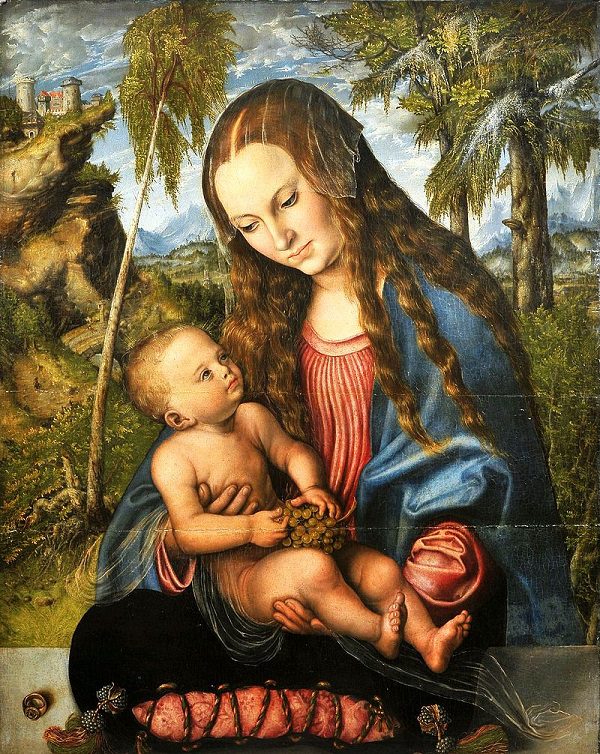
Lucas Cranach the Elder, Madonna under the fir tree (1509) [pubic domain / Wikimedia Commons]

(10-2-10)
Martin Luther’s words will be in blue.
* * * * *
Luther in a 1532 sermon (second sermon on Luke 2:41-52) stated (my italics):
32. This should shut the mouths of vain babblers who exalt the holy Virgin Mary and other saints as if they knew everything and could not err; for you can see here how they err and falter, not only in this that they seek Christ and know not where to find him until they accidentally come to the temple, but also that they could not understand these words with which he censured their ignorance and is compelled to say to them: “Knew ye not, that I must be in the things of my Father?” . . .
39. To this we should reply as is taught in this Gospel: Be they called holy, learned, fathers, councils, or any other name, even though they were Mary, Joseph and all the saints it does not follow that they could not have erred and made mistakes. For here you learn that the mother of Christ though she possessed great intelligence and enlightenment, showed great ignorance in that she did not know where to find Christ, and in consequence was censured by him because she did not know what she should have known. If she failed and through her ignorance was brought to such anxiety and sorrow that she thought she had lost Christ, is it a wonder that other saints should often have erred and stumbled, when they followed their own notions, without the guidance of Scripture, or put their own notions into Scripture.
46. You say further: Yea, the church and the fathers were endowed with the Holy Spirit, who kept them from error. The answer to this is not difficult: The church and councils may have been ever so holy, they did not have the Holy Spirit in greater measure than Mary, the mother of Christ, who was also a member, yea, at the time, the most eminent member of the Church. And although she had been sanctified by the Holy Spirit; yet he permitted her at times to err, even in the important matters of faith. From this it does not follow, that the saints, who were endowed with the Spirit, could on this account not err, nor that everything they said would have to be correct. Great weakness and ignorance may be found to exist even in the most eminent people and hence we cannot judge concerning doctrines and matters of faith on the basis of personal holiness, for all this can fail. But here you come to the Word of God which is sure and infallible, where you shall certainly find Christ and the Holy Spirit, and can be and remain firmly fortified against sin, death, and the devil.
Source: Complete Sermons of Martin Luther (Volume 1) [Michigan: Baker Books, 2000] (First Sunday After Epiphany, Volume 1.2, pages 31-53).
In a Christmas 1532 sermon (erroneously thought to be from 1544 by some scholars and myself, following their lead; more on that below), Luther proclaimed:
[H]ow great an honor was conferred upon us in that the Son of God became man; not like Eve nor Adam, who was made of the earth; but He is still more nearly related to us, since He was born of the flesh and blood of the Virgin Mary, like other men, except that the virgin was alone, and being sanctified by the Holy Spirit, conceived this blessed fruit without sin and by the Holy Spirit. In other respects He is like unto us, and a natural Son of a woman.
Adam and Eve were not born, but created. God made Adam out of the dust of the earth, and the woman of his rib. How much nearer is Christ to us than Eve to her husband Adam, since He is truly our flesh and blood. Such honor we should highly esteem and well take to heart, that the Son of God became flesh, and that there is no difference at all between His and our flesh, only that His flesh is without sin. For He was so conceived of the Holy Ghost, and God poured out so richly His Holy Spirit into the soul and body of the Virgin Mary that without any sin she conceived and bore our Lord Jesus. Aside from this, in all other respects, He was like other men; He ate, drank, was hungry, thirsty, cold like other men. Such and similar natural infirmities, which have descended upon us by reason of sin, He, who was without sin, bore and had like unto us, as St. Paul says: “He was made in the likeness of men, and found in fashion as a man.”
(Hauspostille of 1544 [House Postil]; sermon from Christmas 1532; from the German WA 52:39; my bolded highlighting)
One fully expects to find contradictions, vacillations, or changes in Luther. I had already noted this in my 2003 treatise on Luther’s Mariology, where I cited Lutheran scholar Arthur Carl Piepkorn:
Martin Luther’s personal adherence to the Immaculate Conception of the Mother of God (barring two lapses) seems to have been life-long . . .
(“Mary’s Place within the people of God according to Non-Roman Catholics,” Marian Studies 18 [1967]: 46-83; quotation from p. 76)
I also mentioned this conclusion in my first book, A Biblical Defense of Catholicism (completed in 1996, and published by Sophia Institute Press in 2003). I noted Piepkorn’s opinion on p. 206, including the “lapses” in Luther’s opinion. So this is nothing new; I knew of it as least as early as 1996.
The same Piepkorn journal paper (as I also noted in my 2003 paper), was cited approvingly (“splendid and learned summary”) in footnote 25 (for chapter 11 [p. 157], on p. 249), in the great Lutheran scholar Jaroslav Pelikan’s book, Mary Through The Ages (New Haven: Yale University Press, 1996), that has been in my own personal library for years. In my 2003 Internet treatise, I freely noted the dissenting opinion, citing Grisar and Preuss, and Catholic Thomas A. O’Meara, O. P., who regarded the opinion of Luther’s later change of mind, “likely, but not certain.”
In yet another 1532 sermon from Luther takes the position he usually did:
Mother Mary, like us, was born in sin of sinful parents, but the Holy Spirit covered her, sanctified and purified her so that this child was born of flesh and blood, but not with sinful flesh and blood. The Holy Spirit permitted the Virgin Mary to remain a true, natural human being of flesh and blood, just as we. However, he warded off sin from her flesh and blood so that she became the mother of a pure child, not poisoned by sin as we are . . . For in that moment when she conceived, she was a holy mother filled with the Holy Spirit and her fruit is a holy pure fruit, at once God and truly man, in one person.
(Martin Luther, Sermons of Martin Luther, Vol. 3, ed. John Nicholas Lenker. [Grand Rapids: Baker Books, 1996], 291)
This exhibits the common notion of that time, of a “first” and “second” conception, because it was believed that the soul didn’t enter the body at biological (“first”) conception, but later (“animation”). That issue has been addressed several times in my other papers on the topic.
There is further “late” historical evidence of Luther’s belief in the Immaculate Conception of Mary (in some form), from Luther’s 1543 work, Vom Schem Hamphoras und vom Geschlecht Christi, that was mentioned by Luther scholars as corroborating evidence (as noted in my 2003 paper), but without direct citation. After more research, I have located the relevant citation, in English (in three versions):
Yet he still, in 1543, felt able to write that Mary was ‘a holy virgin, who was saved and purified from Original Sin by the Holy Ghost’, although he no longer specified at what point this purification took place. [157]
[157] WA, vol. 53, p. 640.
(Bridget Heal, The Cult of the Virgin Mary in Early Modern Germany: Protestant and Catholic Piety, 1500-1648 [Cambridge University Press: 2007], p. 59)
In a later writing Luther insists that Mary was “saved and purified from original sin through the Holy Spirit” at some point before Christ’s incarnation, although he does not specify when this happened. [99]
[99] Vom Schem Hamphoras und vom Geschlecht Christi, 1543, WA 53, 640: “[Maria ist] ein heilige Jungfraw, die, von der Erbsunde erloset und gereiniget, durch den heiligen Geist.” Ebtener thinks that because this statement falls in the context of a defense of the incarnation, Luther means that Mary was purified at that point. Others (e.g., Schimmelpfennig) believe that this phrase still supports the immaculate conception. See Ebneter, “Martin Luthers Marienbild,” 78-79.
(Beth Kreitzer, Reforming Mary: Changing Images of the Virgin Mary in Lutheran Sermons of the Sixteenth Century [Oxford University Press: 2004], p. 124)
I also ran down, myself, a third English translation:
“. . . a holy virgin . . . freed of original sin and cleansed by the Holy Ghost . . .”
(Gerhard Falk, The Jew in Christian Theology: Martin Luther’s Anti-Jewish Vom Schem Hamphoras [McFarland & Co.: 1992], p. 217)
Thus, we have three English translations of the 1543 utterance (take your pick), with the German thrown in for good measure:
Falk (1992): “a holy virgin . . . freed of original sin and cleansed by the Holy Ghost”
Kreitzer (2004): “saved and purified from original sin through the Holy Spirit”
Heal (2007): “a holy virgin, who was saved and purified from Original Sin by the Holy Ghost”
All three mention original sin, so there is no doubt that Luther had it in mind. Therefore, Luther stated that Mary was purified from original sin in 1543, three years before his death. The only question that scholars debate is the exact time that Luther thinks this occurred. I think the evidence from 1544 conclusively shows that Luther believed (at that time) that it was at or near Christ‘s conception.
A 1545 Luther quote shows that Luther believed Mary was sinless:
What is the use of spending such great pains and effort on a council if the pope has decided beforehand that anything done in the council should be subjected to him, that nothing should be done unless it pleased him very much, and that he wants the power to condemn everything? To avoid all this trouble it would be better to say, “Most Hellish Father, since it makes no difference at all what is or will be decided before or in or after the council, we would rather (without any council) believe in and worship Your Hellishness. Just tell us beforehand what we must do; “Good Teacher, what shall I do?” [ Mark 10:17 ]. Then we shall sing the glad hymn to Your Hellishness, “Virgin before, in, and after childbearing,” since you are the pure Virgin Mary, who has not sinned and cannot sin for ever more. If not, then tell us, for God’s sake, what need or use there is in councils, since Your Hellishness has such great power over them that they are to be nothing, if it does not please Your Hellishness. Or prove to us poor, obedient “simple Christians” whence Your Hellishness has such power. Where are the seals and letters from your superior that grant such things to you? Where is written evidence which will make us believe this? Won’t Your Hellishness show us these things? Well then, we shall diligently search for them ourselves, and with God’s help we shall certainly find them shortly.”
(LW [Luther’s Works] 41:263-264; my bolding)
Simply because Luther was in one of his frequent mocking, sarcastic moods doesn’t mean that the reference to Mary is to be regarded as not indicative of his views. That doesn’t follow. It certainly doesn’t follow necessarily. In fact, the opposite is far more plausible. The very mocking has to do with Luther saying, in effect, “O, holy pope, so you think you’re so pure and holy and infallible; let’s mockingly call you, then, the pure, perpetually Virgin Mary, who not only has not sinned, but cannot ever sin.”
The Marian doctrines that Luther believes were used to mock the pope, whom, Luther thinks, is exalted far beyond measure; so that he mocks him by comparing him to someone who is indeed exalted. Otherwise, the mocking has no force, if the strong contrast between a sinless person and the pope isn’t part of it. We know that Luther did certainly believe in the perpetual virginity of Mary (even in partu); that is disputed by virtually no scholars or anyone else who knows anything about Luther’s Mariology.
Therefore, if Luther uses the example of her perpetual virginity in the course of mocking, and we know that he literally believed that, then it is likely that he also believed in Mary’s sinlessness, if not her Immaculate Conception, by analogy. The majority of Luther scholars hold that he continued to believe the latter (i.e., in its essentials: more on that below), up to his death (with a few exceptions of earlier statements, as noted).
Evidence from Luther’s opinion in 1543-1544 explicitly tied in the timing of this “purification” event at Christ‘s conception, not Mary‘s. Thus, I have changed my mind about the 1540 statement from “leaning to its meaning Mary’s conception” to “most likely Christ‘s conception,” based on the explicit 1544 evidence and a comparison of similar Luther utterances.
Does this mean that Luther, later in his life, opposed the Immaculate Conception? If we mean the dogma as it is believed by the Catholic Church, and the timing of God’s special act of grace, yes, but if we mean “removal of original sin,” which is the essence and heart of the doctrine, then he did not deny it. I discuss this at some length near the end of this paper.
Technically, Luther never believed that the act occurred at Mary’s conception, because he originally thought it occurred at ensoulment, which he separated from conception (as most people still did in the late Middle Ages). So the timing in his view was always different; it simply shifted from the time of ensoulment, to the time of Christ’s conception (or, as some think, possibly in the interim period). The common ground in his views is the removal of original sin: whenever it happened.
In 1540 Luther wrote (my bolding):
Every man is corrupted by original sin and has concupiscence. Christ had neither concupiscence nor original sin. Therefore he is not a man: Response: I make a distinction with regard to the major premise. Every man is corrupted by original sin, with the exception of Christ. Every man who is not a divine Person [personaliter Deus], as is Christ, has concupiscence, but the man Christ has none, because he is a divine Person, and in conception the flesh and blood of Mary were entirely purged, so that nothing of sin remained. Therefore Isaiah says rightly, “There was no guile found in his mouth”; otherwise, every seed except for Mary’s was corrupted.”
The source of this fuller citation (that omits the “his”) is from Disputation On the Divinity and Humanity of Christ (February 27, 1540); “translated from the Latin text WA 39/2,.92-121” by Christopher B. Brown, and available online (see also a much snazzier PDF version). “His” is not in this translation because (presumably) it wasn’t in the original (it is definitely not in the later German version).
Some translations insert it, probably on the basis of concluding that the meaning is referring to Christ’s conception rather than Mary’s (and so clarifying that with the addition). Without the “his” it appears to be most plausibly referring to Mary‘s conception. With it, it appears to refer to Christ’s. It is an added word, but I now think that immediate context and the context of related Luther statements justifies the interpretive inclusion. Another scholar, Dr. Bonnie Noble, adds input to the discussion with a third rendering:
Mary’s flesh and blood was purified in [his] conception, so that nothing sinful remained.
[footnote 61] My translation of [German then provided; accessible from Google Books] . . . (Disputation on the Humanity of Christ [1540, originally in Latin]; Tappolet, Marienlob, 32; WA, vol. 39, part 2, p. 107, lines 4-13).
(Lucas Cranach the Elder: Art and Devotion of the German Reformation [University Press of America: 2009], p. 178; footnote 61 from p. 194)
We know that Latin was the original language of Luther’s treatise, since Noble states this, and Brown also translated from Latin. Both mention the same source of that: “WA” (Weimar Ausgabe: the standard German edition of Luther’s works), vol. 39. Latin is, therefore, the most primary source. The German version came later.
But it is not impossible that Luther was referring to Christ’s conception, either, since it is possible that he was following a certain line of thought that St. Thomas Aquinas had expressed almost three centuries earlier:
Reply to Objection 3. The Holy Ghost effected a twofold purification in the Blessed Virgin. The first was, as it were, preparatory to Christ’s conception: which did not cleanse her from the stain of sin or fomes, but rather gave her mind a unity of purpose and disengaged it from a multiplicity of things (Cf. Dionysius, Div. Nom. iv), since even the angels are said to be purified, in whom there is no stain, as Dionysius says (Eccl. Hier. vi). The second purification effected in her by the Holy Ghost was by means of the conception of Christ which was the operation of the Holy Ghost. And in respect of this, it may be said that He purified her entirely from the fomes.
(Summa Theologica, Third Part, Q. 27: “The Sanctification of the Blessed Virgin,” Article 3: “Whether the Blessed Virgin was cleansed from the infection of the fomes?”)
[later note: the above two paragraphs were in my paper before I changed my mind about the 1540 quote; hence it is seen that my position wasn’t absolute on this, and I allowed the possibility of the other scenario being the fact of the matter: as indeed I am now persuaded is the actual state of affairs.]
We do also know, however, that although Luther scholar Eric Gritsch includes the “his” in his rendering, he does not go on to deny (or even doubt) that Luther accepted the Immaculate Conception of Mary his entire life, since he is on record in a 1992 book (in footnote 43, p. 382), stating:
But Tappolet . . . demonstrated with the use of texts that Luther did not change his mind. The literary evidence from Luther’s works clearly supports the view that Luther affirmed the doctrine [immaculate conception of Mary], but did not consider it necessary to impose it.
Thus, he doesn’t see this particular quote, even if it is referring to the conception of Christ, as a slam dunk against his position at all. He sees no conflict.
I changed my mind. I didn’t have to “recant” because I wasn’t dogmatic on the issue of timing, anyway, as I noted not far above. This is why I provided the quote from St. Thomas Aquinas, because it was always a possibility. This is what the mind who cares about truth and that weighs evidence does, after all.
* * *
Moreover, Luther’s Lectures on Genesis (38), from Luther’s Works, vol. 7 (St. Louis: Concordia Publishing House: 1965; edited by Jaroslav Pelikan, and translated by Paul D. Pahl), offers strong proof that Luther (at this point) was definitely placing the special work of God in freeing Mary from all sin, at the time of Christ’s conception, not her own.
The 1540 citation was not totally clear about that (hence scholars have stated that the timing of what he intended was not certain), but there is no such lack of clarity in these remarks, dated somewhere between November 1543 through to 1544. This has caused me to revise my prior inclination in the interpretation of the 1540 comment.
I have maintained all along (for years now), in my writings on the topic, that Luther’s position was not identical to the Catholic dogma, so this is no bombshell revelation for me. But it is helpful clarifying evidence for the precise nature of Luther’s late position (the vexing question of chronology and timing).
Very few scholars think that Luther agreed with the 1854 Catholic dogma, his whole life (even if it is possible to argue that he nearly did, at the time of his 1527 remarks). Almost all of them have noted the differences, including the “first conception” and “second conception” aspect, and the timing according to Luther. Given Luther’s usual waffling and self-contradictions, the subject is more than a little difficult.
Lastly, one could note that there are several related but distinct aspects of the Immaculate Conception:
Mary’s (actual) sinlessness.
The removal of original sin from Mary by a special act of God’s grace.
When this removal occurred: at Mary’s own conception, or at Christ’s conception, or some point of time in-between the two (with necessary consideration of the antiquated medieval notion of two conceptions: body and soul; the second being “animation”).
Luther waffled the most with regard to #1, saying at times that Mary sinned. But apart from those seemingly anomalous instances (that some scholars, such as Piepkorn, regard as “lapses” from his usual position), he generally taught #1. #1 and #2 are both of the essence of the Immaculate Conception: freedom from original sin and absence of actual sin: both made possible by the reception of God’s grace.
Catholics hold that it occurred at her conception (hence the very title), yet it might be argued that the timing of the special act (removal of original sin and restoration to the pre-fall state of Adam and Eve) is not part of the essence of the doctrine, just as the element of when Jesus was born was not at all the essential part of His Incarnation per se: it was the fact that He became Man at all (whenever that blessed event occurred).
#2 is the least disputed point in Luther’s mind. He reiterates it in 1540 and 1543, and again, in a different manner, but still most definitely, in the presently considered document, from 1543-1544. #3 is the most complex determination to make: in 1527, Luther believed that the purification or purging occurred at her ensoulment (which he placed later than conception, in accord with the primitive biology of his time). As soon as Mary had both a body and soul, she was freed from original sin by God (which is identical to the Catholic dogma, when expressed in that fashion).
In his 1532 statement, he is vague as to the time of that blessed event. The 1540 statement has some ambiguity (as evidenced by the textual dispute over the inserted word “his”). His 1543 utterance specifically refers to “original sin” but is again vague as to when Mary was purified from it. The nature of what he thought took place was much more clear than when it did.
Thus, this evidence from 1543-1544 is important and quite significant because it refers both to original sin (as a concept if not with those words) and making the timing (in Luther’s opinion) clear once and for all (at Christ’s conception). Therefore, we may reasonably conclude, I think, that Luther likely gave up his belief that this act of grace in Mary occurred earlier: as soon as she had a soul, sometime after 1527.
In light of all the relevant evidence considered as a whole, I think it would be wise to refer to Luther’s post-1527 position in a different manner. I have coined a new term: Immaculate Purification: as seen in my revised title for this post. This preserves the “immaculate” aspect (i.e., removal of original sin) but doesn’t place the timing at conception.
Using a different term immediately clarifies that we acknowledge (as most scholars always have) that there are important differences between Luther’s view and the Catholic dogma of 1854: though (crucially to the discussion) not essential ones. It decreases the possibility of unhelpful misunderstanding and neglect of the many nuances in this discussion.
Luther continued (most of the time) to assert that Mary was without actual sin, and that she was freed from original sin (the latter being the most constant aspect of his evolving beliefs on the matter). Since those are the two essential elements of the Immaculate Conception (and vastly different from the opinions of almost all Protestants today), then we are quite justified in continuing to say that he held the doctrine “in some form” (as I expressed it in my 2003 paper) until his death: he held to Immaculate Purification. It’s not identical to the Catholic position (which wasn’t yet a dogma during his lifetime, anyway, so that folks were free to disagree a bit), but it is far closer to the Catholic position than any denominational or creedal Protestant position today.
* * *
There is no contradiction here (sorry to bring up fine points of Logic 0101), since I have always acknowledged (at least since 1996 and my first book) that Luther’s view was not identical to the Catholic one.
My change of opinion has to do with the degree of difference, and some of the particulars of Luther’s later view, which is not a contradiction. As I already noted, I was already saying that the view I take now was a possibility. I was citing scholars who argued the same thing (that I discovered and documented in 2003).
I have argued that the substance or essence of Luther’s views remained the same, insofar as he held that Mary was purified of original sin. That didn’t change. That’s the essence of the immaculate conception. When it happened is a different issue, but not of its essence.
I grant that continued use of the word “conception” in describing Luther’s views is unfortunate and confusing; hence I suggested the use of a new term, “immaculate purification” for his post-1527 position. But none of this means that Luther ever denied (as far as we know) that Mary was purged of original sin.
Luther still believed Mary was purged of original sin in 1543, and he reiterated it in Lectures on Genesis in 1543-1544, though without using the words “original sin”: I would contend that the concept was clearly there.
Let’s now look at Luther’s Lectures on Genesis (chapter 38) [words referring to Mary italicized]:
Judah, the very eminent patriarch, a father of Christ, committed this unspeakable act of incest in order that Christ might be born from a flesh outstandingly sinful and contaminated by a most disgraceful sin. For he begets twins by an incestuous harlot, his own daughter-in-law, and from this source the line of the Savior is later derived. Here Christ must become a sinner in His flesh, as disgraceful as He ever can become. The flesh of Christ comes forth from an incestuous union; likewise, the flesh of the Virgin, His mother, and of all the descendants of Judah, in such a way that the ineffable plan of God’s mercy may be pointed out, because He assumed the flesh or the human nature from flesh that was contaminated and horribly polluted. (LW, 7:12)
The scholastic doctors argue about whether Christ was born from sinful or clean flesh, or whether from the foundation of the world God preserved a pure bit of flesh from which Christ was to be born. I reply, therefore, that Christ was truly born from true and natural flesh and human blood which was corrupted by original sin in Adam, but in such a way that it could be healed. Thus we, who are encompassed by sinful flesh, believe and hope that on the day of our redemption the flesh will be purged of and separated from all infirmities, from death, and from disgrace; for sin and death are separable evils. Accordingly, when it came to the Virgin and that drop of virginal blood, what the angel said was fulfilled: “The Holy Spirit will come upon you and overshadow you” (Luke 1:35). To be sure, the Messiah was not born by the power of flesh and blood, as is stated in John ( cf. 1:13): “Not of blood nor of the will of a man, etc.” Nevertheless, He wanted to be born from the mass of the flesh and from that corrupted blood. But in the moment of the Virgin’s conception the Holy Spirit purged and sanctified the sinful mass and wiped out the poison of the devil and death, which is sin. Although death remained in that flesh on our account, the leaven of sin was nevertheless purged out, and it became the purest flesh, purified by the Holy Spirit and united with the divine nature in one Person. Therefore it is truly human nature no different from what it is in us. And Christ is the Son of Adam and of his seed and flesh, but, as has been stated, with the Holy Spirit overshadowing it, active in it, and purging it, in order that it might be fit for this most innocent conception and the pure and holy birth by which we were to be purged and freed from sin. (LW, 7:12-13)
In the italicized statements, Luther reaffirms that God purged Mary of original sin (something entirely harmonious with Catholic dogma, as far as it goes). He even asserts the “fittingness” of Mary being pure, rather than necessity, which is also exactly the Catholic perspective (“in order that it might be fit . . .”). Blessedly, I have Luther’s Works, vol. 7 in my own library, and here is the next section:
Therefore these things are written for Christ’s sake. The Holy Spirit wanted Him to sink into sin as deeply as possible. Consequently, He had to be besmirched with incest and born from incestuous blood. (LW, 7:13)
Isn’t that a lovely sentiment? The conscientious Protestant apologist can never be too careful in protecting the unknowing flock from some of Luther’s more outrageous statements, can he?
Christ alone is a son of the flesh without the sin of the flesh. (LW 7:18)
This doesn’t necessarily contradict Mary being without sin, because of Luther’s own expressed distinction between the first and second conceptions. Luther held that Mary inherited original sin in her body before she received a soul (and thus was in the “middle” of Christ and the rest of humanity), whereas he says that this was not the case for Jesus Christ.
But Judah begs that he may be permitted to go in to Tamar, that is, to have intercourse with her . . . she was made pregnant by the most shameful act of incest, and the flesh from which Christ was to be born was poured from the loins of Judah and was propagated, carried about, and contaminated with sin right up to the conception of Christ. That is how our Lord God treats our Savior. God allows Him to be conceived in most disgraceful incest, in order that He may assume the truest flesh, just as our flesh is poured forth, conceived, and nourished in sins. But later, when the time for assuming the flesh in the womb of the Virgin came, it was purified and sanctified by the power of the Holy Spirit, according to Luke 1:35: “The Holy Spirit will come upon you and will overshadow you.” Nevertheless, it was truly flesh polluted from Judah and Tamar.
Therefore all these things have been described for Christ’s sake, in order that it might be certain that He really had to be born from sinful flesh, but without sin. Accordingly, David says this of himself in Ps. 51:5: “Behold, I was brought forth in iniquity.” This is said correctly also of the flesh of Christ as it was in the womb of Tamar, before it was assumed and purged. But this flesh He assumed later, after it had been purged, in order that He might be able to bear the punishment for sin in His own body. (LW, 7:31; references to Mary italicized)
This is hopelessly muddled Christological thought. Christ was born of sinful flesh, but He wasn’t, but maybe He was, or perhaps not. This is Luther: Orwellian doublethink and doublespeak. A=A, but it is not a, at the same time, just as in the nonsensical, unbiblical Protestant soteriological notion of purely imputed justification that he championed.
He applies sinfulness to Christ (that which is impossible) in some remote, bizarre sense, yet on the other hand He separates Christ from sin by saying, “this flesh He assumed later, after it had been purged,” and then claims that this had to happen, “in order that” Jesus could carry through His mission. Jesus was Who He was. Nothing was needed at all in His case. Since He could never inherit original sin in the first place, because that category doesn’t apply to Him, there was no necessity at all to purge Mary of original sin for His sake. It was only “fitting.” And that is what the Catholic Church teaches.
Here, therefore, the Blessed Seed is described. It is descended from the accursed, lost, and condemned seed and flesh. Nevertheless, It Itself is without sin and corruption. According to nature, Christ has the same flesh that we have; but in His conception the Holy Spirit came and overshadowed and purified the mass which He received from the Virgin that He might be united with the divine nature. In Christ, therefore, there is the holiest, purest, and cleanest flesh; but in us and in all human beings it is altogether corrupt, except insofar as it is restored in Christ. (LW, 7:36)
Luther, then, still believes that Mary was purified and sanctified (implying removal of original sin, as he had explicitly stated in 1543, in the same year or year before this writing. But he places the time at (far as we can tell) just before Christ’s conception. Where Luther errs is in how he relates Mary’s sanctification to Jesus Christ and His incarnation.
Whenever he implies that Jesus actually partook of sin in any real way, in any sense, it is at least semi-Nestorian heresy and blasphemy. Hints of the same quasi-Nestorianism can be found in Luther’s 1532 utterances as well (excepted above), if one looks closely enough. And they were most obvious in His remarks earlier on in his career about Jesus’ visit to hell:
He found Himself in a state of condemnation and abandonment . . . He actually and in truth offered Himself to the eternal Father to be consigned to eternal damnation for us. His human nature did not behave differently from that of a man who is to be condemned eternally to hell. On account of this love of God, God at once raised Him from death and hell, and so He overcame hell.
(Hartmann Grisar, Luther, translated by E.M. Lamond, edited by Luigi Capadelta, London: Kegan Paul, Trench, Trubner and Co., 2nd edition, 1914, vol. 1 of 6, 239-240; from Commentary on Romans [1515-1516]; edition of J. Ficker, Leipzig: 1908, 218 ff.)
It’s not just my judgment that this is heretical theology (present even before he forsook Catholicism); it was also the conclusion of Luther’s best friend and successor, Philip Melanchthon, the Lutheran Confessions, and Paul Althaus, in his widely used book, The Theology of Martin Luther. I’m not the only one objecting to it, by any means.
The Catholic Encyclopedia describes one of the key errors of Nestorianism, that is in full display in Luther’s remarks above:
Two things are certain: first, that, whether or no they believed in the unity of the subject in the Incarnate Word, at least they explained that unity wrongly; secondly, that they used most unfortunate and misleading language when they spoke of the union of the manhood with the Godhead — language which is objectively heretical, even were the intention of its authors good.
Revised, Expanded Chronological Summary of Luther’s (Affirmative) Utterances on the Immaculate Conception and/or Mary’s Sinlessness
1521 [Hartmann Grisar, 1917] received so much grace that she was quite filled with it, as we believe (Rationis Latomiance confutatio [WA 8:56]; from Luther, vol. 4, p. 238)
1522 [William J. Cole, 1970] She is full of grace; so that she may be recognized as without any sin. That is a high and great thing, for God’s grace fills her with all gifts and frees her from all evil. (Little Prayer Book)
[Eric W. Gritsch, 1992] full of grace [voll Gnaden] . . . graced [begnadet]
1527 [Hilda Graef, 1965] the grace of God makes her full of all that is good and empty of all evil. (WA 17,409 / Sermon on the Annunciation, 1527)
1527 [Abp. William Ullathorne, 1905] And the other conception, that is to say, the infusion of the soul, is piously believed to have been accomplished without original sin. So that, in that very infusing of the soul, the body was simultaneously purified from original sin, and endowed with divine gifts to receive that holy soul which was infused into it from God. And thus in the first moment it began to live, it was exempt from all sin . . . the Virgin Mary was, according to the first conception, without grace, yet according to the second conception, she was full of grace. . . . the Virgin Mary was conceived, according to the body, indeed without grace, but according to the soul, full of grace. . . . Again, it was just and meet that that person should be preserved from original sin from whom Christ received the flesh by which He overcame all sins. And that, indeed, is properly called blessed which is endowed with divine grace, that is, which is free from sin.
[Hartmann Grisar, 1917] It is a sweet and pious belief that the infusion of Mary’s soul was effected without original sin; so that in the very infusion of her soul she was also purified from original sin and adorned with God’s gifts, receiving a pure soul infused by God; thus from the first moment she began to live she was free from all sin. (Luther, vol. 4, p. 238)
[Hilda Graef, 1965] one believes blessedly that at the very infusion of her soul she was also purified from original sin
[Thomas A. O’Meara, 1966] the other conception, namely the infusion of the soul . . . it is believed that it took place without contacting original sin. . . . her first conception was without grace, but the second was full of grace . . . Mary the Virgin is conceived according to the body without grace, but according to the soul she is full of grace
[Eric W. Gritsch, 1992] the Virgin Mary, though without grace in the first conception, was full of grace in the second . . . . the Virgin Mary was conceived in body without grace but in soul full of grace.
[Beth Kreitzer, 2003] purified from original sin and decorated with God’s gifts[von der erbsunnde sey gerainneget worden] . . . . from the first moment that she began to live, she was without all sin
1532 [J. T. Isensee, 1871] the virgin was alone, and being sanctified by the Holy Spirit, conceived this blessed fruit without sin and by the Holy Spirit . . . God poured out so richly His Holy Spirit into the soul and body of the Virgin Mary that without any sin she conceived and bore our Lord Jesus
[Thomas A. O’Meara, 1966] God has formed the soul and body of the Virgin Mary full of the Holy Spirit, so that she is without all sins, for she has conceived and borne the Lord Jesus.
[Beth Kreitzer, 2004] she was without all sin [das sie ohne alle Sund gewesen ist]
1532 [John Nicholas Lenker, 1996] Mother Mary, like us, was born in sin of sinful parents, but the Holy Spirit covered her, sanctified and purified her . . . he warded off sin from her flesh and blood . . . For in that moment when she conceived, she was a holy mother filled with the Holy Spirit
1537 [Smalcald Articles; Tappert, 1959] born of the pure, holy, and virgin Mary [ex Maria pura, sancta, Semper Virgine]
1540 [Eric W. Gritsch, 1992, presumably from Latin, since he mentions only WA, where this piece is in Latin] In his conception all of Mary’s flesh and blood was purified so that nothing sinful remained.
[Christopher B. Brown, 1995?; from original Latin] in conception the flesh and blood of Mary were entirely purged, so that nothing of sin remained. . . . every seed except for Mary’s was corrupted.
[Bonnie Noble, 2009; from the secondary German Tappolet translation] Mary’s flesh and blood was purified in [his] conception, so that nothing sinful remained.
1543 [Gerhard Falk, 1992] a holy virgin . . . freed of original sin and cleansed by the Holy Ghost
[Beth Kreitzer, 2004]saved and purified from original sin through the Holy Spirit [Maria ist] ein heilige Jungfraw, die, von der Erbsunde erloset und gereiniget, durch den heiligen Geist]
[Bridget Heal, 2007] a holy virgin, who was saved and purified from Original Sin by the Holy Ghost
1543-1544 [Paul D. Pahl, 1965] But in the moment of the Virgin’s conception the Holy Spirit purged and sanctified the sinful mass and wiped out the poison of the devil and death, which is sin. Although death remained in that flesh on our account, the leaven of sin was nevertheless purged out, and it became the purest flesh, purified by the Holy Spirit and united with the divine nature in one Person. . . . with the Holy Spirit overshadowing it, active in it, and purging it, in order that it might be fit for this most innocent conception . . .
But later, when the time for assuming the flesh in the womb of the Virgin came, it was purified and sanctified by the power of the Holy Spirit, according to Luke 1:35: “The Holy Spirit will come upon you and will overshadow you.” . . . this flesh He assumed later, after it had been purged, . . .
1544 [H. George Anderson et al, 1992] Mary being “immaculate” is “a pious and pleasing thought” [haec pia cogitatio et placet] (Exposition of the Ninth Chapter of Isaiah, 1543/44. WA 40/3:680.31-32).
1545 [Eric W. Gritsch, 1966] Then we shall sing the glad hymn to Your Hellishness, “Virgin before, in, and after childbearing,” since you are the pure Virgin Mary, who has not sinned and cannot sin for ever more.
***
Previous Post
September 21, 2015
The Imitation of the Blessed Virgin Mary (Our Model)
Next Post
September 21, 2015 50 Heterodox Beliefs of Luther in 1520
Browse Our Archives
Select a Category & Last Things About Me Anti-Catholicism Atheism & Agnosticism Baptism and Sacramentalism Bible and Tradition Blessed Virgin Mary Books by Dave Armstrong C. S. Lewis Calvinism & General Protestantism Catholic Apologetics Catholic Apologists Catholic conversion Catholic converts Christmas Church (Ecclesiology) Church History Conversion and Converts Development of Doctrine Eastern Orthodoxy Ecumenism & Christian Unity Eucharist & Liturgy Fathers of the Church French Translations G. K. Chesterton Hell Hell & Satan Hell & Satan & Last Things Heresies & Comparative Religion Holistic Health Inquisition & Crusades & Scandals James White Jews & Judaism & Old Testament John Calvin John Henry Newman Liberal / Modernist Theology Life Issues Literary Resume Lutheranism Mariology Martin Luther Music Orthodoxy Papacy & Infallibility Personal Page Philosophy & Science Political & Ethical & Moral Issues Protestant Persecution & Intolerance Protestantism Purgatory Purgatory & Penance Romantic & Imaginative Theology Saints & Purgatory & Penance Salvation Salvation & Justification Satan & Last Things Sexuality and Gender Issues Spanish Translations Traditionalism vs. Radical Catholic Reactionaries Traducciones al español / tradução para português Trinitarianism & Christology Uncategorized Videos
Select a Month October 2026 September 2026 August 2026 July 2026 June 2026 May 2026 April 2026 March 2026 February 2026 January 2026 December 2025 November 2025 October 2025 September 2025 August 2025 July 2025 June 2025 May 2025 April 2025 March 2025 February 2025 January 2025 December 2024 November 2024 October 2024 September 2024 August 2024 July 2024 June 2024 May 2024 April 2024 March 2024 February 2024 January 2024 December 2023 November 2023 October 2023 September 2023 August 2023 July 2023 June 2023 May 2023 April 2023 March 2023 February 2023 January 2023 December 2022 November 2022 October 2022 September 2022 August 2022 July 2022 June 2022 May 2022 April 2022 March 2022 February 2022 January 2022 December 2021 November 2021 October 2021 September 2021 August 2021 July 2021 June 2021 May 2021 April 2021 March 2021 February 2021 January 2021 December 2020 November 2020 October 2020 September 2020 August 2020 July 2020 June 2020 May 2020 April 2020 March 2020 February 2020 January 2020 December 2019 November 2019 October 2019 September 2019 August 2019 July 2019 June 2019 May 2019 April 2019 March 2019 February 2019 January 2019 December 2018 November 2018 October 2018 September 2018 August 2018 July 2018 June 2018 May 2018 April 2018 March 2018 February 2018 January 2018 December 2017 November 2017 October 2017 September 2017 August 2017 July 2017 June 2017 May 2017 April 2017 March 2017 February 2017 January 2017 December 2016 November 2016 October 2016 September 2016 August 2016 July 2016 June 2016 May 2016 April 2016 March 2016 February 2016 January 2016 December 2015 November 2015 October 2015 September 2015 August 2015 July 2015 June 2015 May 2015 April 2015 March 2015 February 2015 January 2015 December 2014 November 2014 October 2014 September 2014 August 2014 July 2014 June 2014 April 2014 March 2014 February 2014 January 2014 December 2013 November 2013 October 2013 September 2013 August 2013 July 2013 June 2013 April 2013 March 2013 February 2013 January 2013 December 2012 November 2012 October 2012 September 2012 August 2012 July 2012 June 2012 May 2012 April 2012 March 2012 February 2012 January 2012 December 2011 November 2011 October 2011 September 2011 August 2011 July 2011 June 2011 April 2011 March 2011 February 2011 October 2010 September 2010 August 2010 July 2010 April 2010 March 2010 December 2009 October 2009 August 2009 July 2009 June 2009 May 2009 March 2009 February 2009 October 2008 September 2008 April 2008 March 2008 February 2008 January 2008 December 2007 November 2007 October 2007 May 2007 March 2007 February 2007 January 2007 November 2006 October 2006 September 2006 August 2006 July 2006 June 2006 May 2006 April 2006 March 2006 February 2006 October 2005 June 2005 April 2005 February 2005 July 2004 May 2004 April 2004
Follow Us!
TAKE THE
Religious Wisdom Quiz
Who denied Jesus three times before the rooster crowed?
Select your answer to see how you score.
Paul John Peter Judas
Books by This Author Books by Dave Armstrong
Related posts from Biblical Evidence for Catholicism

Holy Ground: Why Mary Had NO Other Children...
Biblical Evidence for Catholicism
Protestant Confessions & "Ever-Virgin" Mary
Biblical Evidence for Catholicism

Mary Wife of Clopas (Jn 19:25): Mary's Sister-in-Law?
Biblical Evidence for Catholicism

Jesus Had Four Brothers? The Bible Sez No!
Biblical Evidence for Catholicism
TRENDING AT PATHEOS Catholic

The Sermon on the Mount, Part I: Matthew...
The Sermon on the Mount, Part I (Matthew 4:12-5:12) St. Matthew moves...

What's up from Crossway: Reviewing some of their latest A few weeks...

Janie Learns the Way of the Cross: A...
Teaching children about Jesus' Passion can be challenging. Many parents and educators...

Looking For Good Catholic Writing - October 2026
He alone extends the heavens, and he walks upon the waves of...

In "Irreplaceable," our book on vocation and technology, Trevor Sutton and I...

I was strolling through the top floor of the brand new Parthenon...
view all Catholic blogs
Ad-Free & Subscriber Log-In Subscription Support
- About Us
- 2026 Calendar
- Videos
- Podcasts
- Library of World Religions
- Faith In Media Tracker
- Advertise With Us
- Write for Us
- Privacy Policy
- Terms of Service
- Do Not Sell My Data
- Contact Us
- Radiant Digital
- Manage Newsletter Subscriptions
- Unsubscribe From Notifications
- Sitemap
Copyright 2008-2026, Patheos. All rights reserved.
Subscription Support Ad-Free & Subscriber Log-In
Follow Patheos