
BuddhistCatholicContemplativeEvangelicalGeneral ChristianHinduJewishLatter-day SaintMuslimNew VisionsProgressive Christian
Beliefs
- Buddhist
- Catholic
- Contemplative
- Evangelical
- General Christian
- Hindu
- Jewish
- Latter-day Saint
- More Voices
- Muslim
- New Visions
- Pagan
- Progressive Christian
Topics
- Religion News
- Food and Religion
- Sports and Religion
- Religious Art
- Religious Music and Entertainment
- Religious Events
- History and Religion
- Style and Religion
- Politics and Religion
- Women in Religion
- Recreation Outdoors and Religion
- Business Finance and Religion
- Careers Workplace and Religion
- Education and Religion
- Family Parenting and Religion
- Health Fitness and Religion
- Home and Religion
- Relationships and Religion
- Technology and Religion
- Travel and Religion
Columnists
- Buddhist Columnists
- Business Finance and Religion Columnists
- Careers Workplace and Religion Columnists
- Catholic Columnists
- Contemplative Columnists
- Education and Religion Columnists
- Evangelists Columnists
- Family Parenting and Religion Columnists
- General Christian Columnists
- Health Fitness and Religion Columnists
- Hindu Columnists
- History and Religion Columnists
- Home and Religion Columnists
- Jewish Columnists
- More Voices Columnists
- Latter Day Columnists
- Muslim Columnists
- New Visions Columnists
- Nonreligious Columnists
- Pagan Columnists
- Politics and Religion Columnists
- Progressive Columnists
- Recreation Outdoors and Religion Columnists
- Relationships and Religion Columnists
- Religion News Columnists
- Religious Art Columnists
- Religious Events Columnists
- Religious Music and Entertainment Columnists
- Sports and Religion Columnists
- Style and Religion Columnists
- Technology and Religion Columnists
- Travel and Religion Columnists
- Women in Religion Columnists
Resource Library
- 2026 Calendar
- Library of World Religions
- The 100 Most Holy Places on Earth
- Patheos Answers
- Podcasts
- Videos
- Faith Leaders Database
- Anglican Episcopalian
- Bahai
- Baptist
- Buddhism
- Christianity
- Confucianism
- Eastern Orthodoxy
- Hinduism
- Holiness and Pentecostal
- ISKCON
- Islam
- Judaism
- Lutheran
- Methodist
- The Church of Jesus Christ of Latter-day Saints
- New Age
- Paganism
- Presbytarian and Reformed
- Protestantism
- Religion Behind the Scenes
- Roman Catholic
- Scientology
- Shia Islam
- Sikhism
- Sufism
- Sunni Islam
- Taoism
- Zen
- See all religions
Research Tools
 Ad-Free & Subscriber Log-In Subscription Support
Ad-Free & Subscriber Log-In Subscription Support
Follow Patheos 

- Trending:
- Forgiveness
- |
- Marriage
- |
- Consciousness
- |
- Death Penalty
- |
- Election
- |
- Halloween

-
About
-
Catholic Apologetics
-
Church History
-
Great Apologists
-
Christian Worldview
-
Protestantism & Misc.
- Home
- Catholic
- History and Religion
- “Is This God?” (Treatise on the Eucharist) [Envoy Magazine]
“Is This God?” (Treatise on the Eucharist) [Envoy Magazine]
Last updated on: May 20, 2017 at 2:28 pm by Dave Armstrong
“Is This God?” (Treatise on the Eucharist) [Envoy Magazine] 2017-05-20T14:28:56-04:00 Dave Armstrong
Patheos Explore the world's faith through different perspectives on religion and spirituality! Patheos has the views of the prevalent religions and spiritualities of the world.
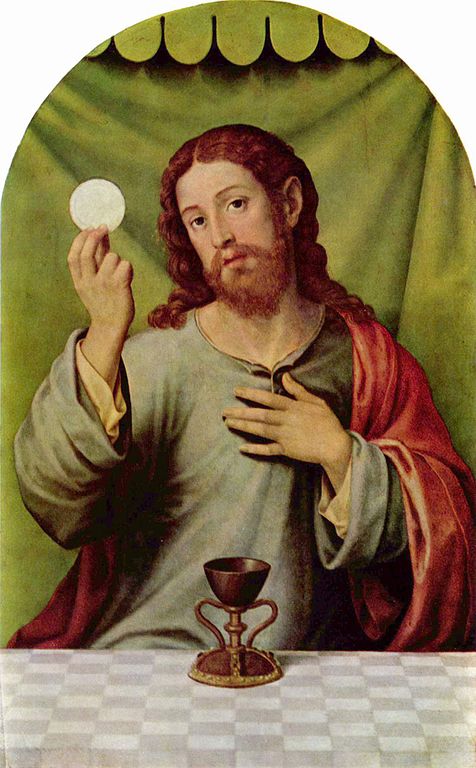
Christ with the Eucharist, late 16th century, by Joan de Joanes (1510-1579) [public domain / Wikimedia Commons]

This article was the cover story in Patrick Madrid’s Envoy Magazine, Jan/Feb 2000 issue. Here it is presented in my own original version (before editing).
[originally uploaded on 26 June 2000]
*****
I held aloft with both my hands the golden chalice, gazing upwards at it, performing one of the central liturgical rituals of the Mass, in which the consecration of the wine takes place. My attitude, however, was not one of reverence or solemnity. I possessed neither the eyes of faith, nor the traditional Christian understanding of the Blessed Eucharist. I was not standing at an altar, let alone in a church. My friend and frequent evangelistic partner, nearby, was neither kneeling, nor bowing his head, nor crossing himself. He was chuckling, and I myself had a mocking, sarcastic scowl, as I wore a makeshift priestly robe, looking as ridiculous as the cowardly lion in The Wizard of Oz, in his “king’s robe.”
For I was not a priest, or ordained clergyman of any sort. I was a non-denominational evangelical Protestant lay missionary, and my former Catholic friend and I were making light of the gestures and rituals of a priest as he performs the Mass. This was in the late 1980s, several years away from my own surprising conversion to Catholicism, in 1990. I still have the shameful photograph of this mock liturgy – taken by my friend. It remains an absurd testament to my former rather dim comprehension of liturgy and sacramentalism – as well as a certain adolescent silliness when it came to Things Catholic, just as we oftentimes see in many anti-Catholic “ministries” and individuals today.
The interesting thing to ponder in retrospect is the question of how I – a serious evangelical Christian, who had a well above average knowledge of, and appreciation for, Church history – could have had such an insufficient understanding of the Holy Eucharist: the central focus of Christian worship for 1500 years up to the advent of Protestantism? How is it that I could somehow manage to regard liturgy itself as a stale, boring, non-essential “extra” which was by no means necessary to Christian communal fellowship?
Despite this (which makes it fascinating to think about now), I actually had a fairly high respect – relatively speaking – for the Lord’s Supper, or Holy Communion, or Holy Eucharist. My belief was somewhat akin to John Calvin’s “mystical presence,” which was a “step higher” than the purely symbolic view which many Protestants today hold. Nor did I for a moment believe that what was taking place at the Last Supper was merely empty ritual, or its re-creation a bare “remembrance.” Furthermore, I wasn’t “anti-Catholic” in the sense that I would ever have denied that the Catholic Church was Christian, or that it had commendably preserved the Bible and what I then called “central Christian doctrine” throughout all the centuries prior to the 16th.
To understand how such an odd state of affairs could happen at all requires one to delve a bit into past Church history, especially the course of Protestant doctrinal history. My friend and I – as is characteristic of so many non-Catholics – thought, in the final analysis, that the Eucharist was an accretion, an optional part of the Church service, because we were simply being good evangelical low-church Protestants (albeit without much reflection on this particular point). Most Protestant denominations have elevated the sermon to the primary position and climax of the Sunday service. Everything builds up to it. For many attendees (including, formerly, myself – very much so), the sermon was the thing to look forward to, and the drawing card (especially if one’s particular pastor was especially skilled at oratory and homiletics). It was the means by which one got “fired up,” exhorted, and charged to go out and make a difference in the world, as a Christian disciple (things which aren’t bad, in and of themselves).
Don’t get me wrong. I still appreciate a good sermon (including many non-Catholic ones), and I wish more stirring preaching could be had in the Catholic Church. I passionately love, for example, Cardinal Newman’s collected sermons (most from his Anglican period), which contain far more “spiritual meat” for reflection than any Protestant sermonizing I am aware of. But much of Protestantism has transformed church almost exclusively into a prolonged liturgy of the Word – that is, the first half of the Catholic Mass -, with usually far less actual Bible reading, and a sermon many times longer than the average ten-minute Catholic homily. I speak mainly of low-church evangelicalism, but it is not too far-fetched to apply this observation to Protestantism as a whole.
Groups like the Anglicans, Methodists, and Lutherans retain the weekly Eucharist as the central aspect of their worship service, but other denominations, such as Presbyterians, Baptists, pentecostals, and the many non-denominational groups, tend to have Communion once a month. Most Mennonites observe Holy Communion only twice a year; Quakers and the Salvation Army – amazingly enough – not at all. The latter two groups don’t practice any sacraments, or “ordinances” or “rites,” including even baptism.
Behind this sort of thinking lies an antipathy to sacramentalism itself, in which it is held that matter can convey grace. Accordingly, Protestants who place less emphasis on the Eucharist tend to also regard baptism as basically a symbolic ritual also, without the regenerating power which Catholics believe it inherently possesses. And we must ask ourselves why this is; how vast portions of Christianity can today deny what was accepted without question by virtually all Christians right up to the time of Martin Luther (who also retained the doctrine of the Real Presence in slightly-diluted form, and baptismal regeneration as well)?
The first Christian leader of any consequence and lasting historical importance and influence to deny the Real Presence was Huldreich Zwingli (1484-1531), the Swiss Protestant “Reformer.” He dissented from not only received Catholic doctrine, but also from the Lutheran doctrine of consubstantiation, which gained him Martin Luther’s considerable hostility and inveterate opposition (the Founder of Protestantism regarded him as “damned” and “out of the Church” for precisely this reason). We shall briefly examine some of the rationale Zwingli gives for adopting this novel, radical position, which set the tone for all subsequent Protestant symbolic viewpoints:
A sacrament is the sign of a holy thing. When I say: The sacrament of the Lord’s body, I am simply referring to that bread which is the symbol of the body of Christ who was put to death for our sakes. The papists all know perfectly well that the word sacrament means a sign and nothing more, for this is the sense in which it has always been used by Christian doctors . . . the sign and the thing signified cannot be one and the same. Therefore the sacrament of the body of Christ cannot be the body itself.
(On the Lord’s Supper, 1526, translated by G. W. Bromiley; in Zwingli and Bullinger, edited, with introductions and notes, by G. W. Bromiley, Philadelphia: Westminster Press, 1953, 176-238; this excerpt from p. 188)
First of all, it is simply untrue that Christian doctors “always” denied the “reality” aspect of the sacraments, particularly concerning the Eucharist. This matter is so well-documented as to seriously bring into question Zwingli’s credibility as a student of Christian doctrinal history. Literally hundreds of counter-examples could be brought forth, but suffice it to say that the evidence for the Real Presence in the Eucharist in the Church Fathers is among the most compelling of any of the doctrines or dogmas which Protestants now dispute. As proof of this, I shall cite just one standard Protestant reference work, The Oxford Dictionary of the Christian Church (Second edition, edited by F.L. Cross and E.A. Livingstone, Oxford University Press, 1983, 475-476: “Eucharist”):
That the Eucharist conveyed to the believer the Body and Blood of Christ was universally accepted from the first, and language was very commonly used which referred to the Eucharistic elements as themselves the Body and Blood . . . From the fourth century, the language about the transformation of the elements began to become general . . . The first controversies on the nature of the Eucharistic Presence date from the earlier Middle Ages.
Secondly, “sign” and “reality” need not be opposed to each other. Later in his essay Zwingli attempts to enlist St. Augustine as espousing his views, by exploiting this false dichotomy. But Augustine accepted the Real Presence as well as a conception of the Eucharist in which it is also a “sign” (just as the Catholic Church does today). In popular terms, this argument doesn’t fly! The Bible itself confirms this. For example, Jesus refers to the “sign of Jonah,” comparing Jonah’s time in the belly of the fish to His own burial (Mt 12:38-40). In other words, both events, although described as “signs,” were literally real events. Jesus also uses the same terminology in connection with His Second Coming (Mt 24:30-31), which is, of course, believed by all Christians to be a literal, not a symbolic occurrence.
J.N.D. Kelly, a highly-respected Protestant scholar of early Church doctrine and development, writing about patristic views in the fourth and fifth centuries, concurs:
It must not be supposed, of course, that this ‘symbolical’ language implied that the bread and wine were regarded as mere pointers to, or tokens of, absent realities. Rather were they accepted as signs of realities which were somehow actually present though apprehended by faith alone.
(Early Christian Doctrines, revised edition, 1978, San Francisco: Harper Collins, 442)
About St. Augustine in particular, Kelly concludes:
. . . There are certainly passages in his writings which give a superficial justification to all these interpretations, but a balanced verdict must agree that he accepted the current realism . . . One could multiply texts . . . which show Augustine taking for granted the traditional identification of the elements with the sacred body and blood. There can be no doubt that he shared the realism held by almost all his contemporaries and predecessors.
(Ibid., 446-447)
Likewise, The Oxford Dictionary of the Christian Church makes the same point about allusions to “symbolism” with regard to the general teaching of the Church Fathers:
Even where the elements were spoken of as ‘symbols’ or ‘antitypes’ there was no intention of denying the reality of the Presence in the gifts.
(Ibid., 475)
Zwingli gets down to brass tacks in the following blast against Catholic eucharistic doctrine, and it is here where I believe we begin to clearly see the philosophical and skeptical roots of his false belief:
The manna which came down from heaven was of the same size and shape as coriander seed, but its taste was quite different. Here the case is otherwise, for what we see and what we taste are exactly the same, bread and wine. And how can we say that it is flesh when we do not perceive it to be such? If the body were there miraculously, the bread would not be bread, but we should perceive it to be flesh. Since, however, we see and perceive bread, it is evident that we are ascribing to God a miracle which he himself neither wills nor approves: for he does not work miracles which cannot be perceived.
(in Bromiley, ibid., 196)
I answer Zwingli as follows:
The Eucharist was intended by God as a different kind of miracle from the outset, requiring more profound faith, as opposed to the “proof” of tangible, empirical miracles. But in this it was certainly not unique among Christian doctrines and traditional beliefs – many fully shared by our Protestant brethren. The Virgin Birth, for example, cannot be observed or proven, and is the utter opposite of a demonstrable miracle, yet it is indeed a miracle of the most extraordinary sort. Likewise, in the Atonement of Jesus the world sees a wretch of a beaten and tortured man being put to death on a cross. The Christian, on the other hand, sees there the great miracle of Redemption and the means of the salvation of mankind – an unspeakably sublime miracle, yet who but those with the eyes of faith can see or believe it? In fact, the disciples (with the possible exception of St. John, the only one present) didn’t even know what was happening at the time.
Baptism, according to most Christians, imparts real grace of some sort to those who receive it. But this is rarely evident or tangible, especially in infants. Lastly, the Incarnation itself was not able to be perceived as an outward miracle, though it might be considered the most incredible miracle ever. Jesus appeared as a man like any other man. He ate, drank, slept, had to wash, experienced emotion, suffered, etc. He performed miracles and foretold the future, and ultimately raised Himself from the dead, and ascended into heaven in full view, but the Incarnation – strictly viewed in and of itself -, was not visible or manifest in the tangible, concrete way to which Herr Zwingli seems to foolishly think God would or must restrict Himself.
To summarize, Jesus looked, felt, and sounded like a man; no one but those possessing faith would know (from simply observing Him) that He was also God, an uncreated Person who had made everything upon which He stood, who was the Sovereign and Judge of every man with whom He came in contact (and also of those He never met). Therefore, Zwingli’s argument proves too much and must be rejected. If the Eucharist is abolished by this supposed “biblical reasoning,” then the Incarnation (and by implication, the Trinity) must be discarded along with it.
Besides all that, did not Jesus habitually call us on to a more sublime faith? For instance, in Matthew 12:38-39, Jesus had one of His frequent run-ins with the Pharisees, who requested of Him:
Teacher, we wish to see a sign from you.’ But he answered them, ‘An evil and adulterous generation asks for a sign, but no sign will be given to it except the sign of the prophet Jonah.’
(cf. Matthew 16:1-4, Luke 11:29-30, John 2:18-22; NRSV)
Note that He does implicitly appeal to the sign of His Resurrection, but look how He regards the seeking of signs! (see also Mark 8:11-12). In fact, in the eucharistic passage of John 6 our Lord Jesus seems to emphasize the same point by the thrust of His dialogue. He mentions “signs” in 6:26 in reference to the feeding of the five thousand the previous day, but then when they ask Him for a “sign” (6:30), He spurs them on to the more profound faith required with regard to the eucharistic miracle.
Furthermore, we have the example of Doubting Thomas (John 20:24-29). Jesus appeared to Thomas, after His Resurrection, apparently for the express purpose of demonstrating graphically to him that He was raised from the dead. But then what does He say?:
Have you believed because you have seen me? Blessed are those who have not seen and yet have come to believe.
Signs, wonders, and miracles (that is, in the empirical, outward sense which Zwingli demands for the Eucharist) do not suffice for many hard-hearted people anyway:
. . . If they do not listen to Moses and the prophets, neither will they be convinced even if someone rises from the dead.
(Luke 16:31)
For Jews demand signs and Greeks desire wisdom, but we proclaim Christ crucified, a stumbling block to Jews and foolishness to Gentiles……For God’s foolishness is wiser than human wisdom, and God’s weakness is stronger than human strength.
(1 Corinthians 1:22-23,25)
Likewise, when He was explaining the Eucharist, Jesus said:
Does this offend you?. . . among you there are some who do not believe . . .
(John 6:61,64)
This is why Jesus merely reiterated His teaching in John 6 in ever-more forceful terms, rather than explain it in a different way, or reveal the meaning of the alleged symbolic language, as many Protestants would have it. He repeated it because He knew that the problem was flat-out unbelief, not lack of comprehension. The Eucharist is no less “foolish” than Christ crucified. People will disbelieve both because they are difficult to grasp with the natural mind, whereas the mind of faith can see and believe them. Romano Guardini, the great Catholic writer, stated about John 6:
Should they have understood? Hardly. It is inconceivable that at any time anyone could have grasped intellectually the meaning of these words. But they should have believed. They should have clung to Christ blindly, wherever he led them . . . and simply said: we do not understand; show us what you mean. Instead they judge, and
everything closes to them.(The Lord, Chicago: Henry Regnery, 1954, 206)
Jesus could walk through walls after His Resurrection (John 20:26), and even a mere man, Philip, could be “caught away” and transported to another place by God (Acts 8:39-40). So Zwingli, and Protestants who follow his reasoning, think God “couldn’t” or “wouldn’t” have performed the miracle of the Real Presence and Transubstantiation (which means, literally, “change of substance”)? I don’t find this line of thought convincing in the least, and no one should rashly attempt to “tie” God’s hands by such arguments of alleged implausibility. The fact remains that God clearly can perform any miracle He so chooses.
Many Christian beliefs require a great deal of faith, even relatively “blind” faith. Protestants manage to believe in a number of such doctrines (such as the Trinity, God’s eternal existence, omnipotence, angels, the power of prayer, instantaneous justification, the Second Coming, etc.). Why should the Real Presence be singled out for excessive skepticism and unchecked rationalism? I contend that it is due to a preconceived bias against both sacramentalism and matter as a conveyor of grace, which hearkens back to the heresies of Docetism and even Gnosticism, which looked down upon matter, and regarded spirit as inherently superior to matter (following Greek philosophy, particularly Platonism).
The ancient heresy of Docetism held that the sufferings of Christ were apparent rather than real. It is thought by many (based on St. Irenaeus: Against Heresies, 3,11,1, and Eusebius: Church History, 3,28,6) that St. John wrote his Gospel with his Gnostic/Docetic opponent, one Cerinthus (fl. 100 A.D.), in mind, thus accounting for his strong emphasis on Jesus’ “flesh” and “blood” – as in John 6. Many Protestants believe that the Eucharist is apparent and not real. But the Eucharist is an extension of the Incarnation of Christ, just as the Church is (most obviously seen in Paul’s title of the “Body of Christ”). A denial of the Real Presence might, therefore, be regarded as an anti-incarnational strain of thought.
The prior Catholic assumption of sacramentalism (which lies behind the Real Presence) has a sound biblical basis. The Incarnation, which made the Atonement possible, raised matter to previously unknown heights. God took on human flesh! All created matter was “good” in God’s opinion from the start (Genesis 1:25). Most non-sacramental Protestants wouldn’t deny the goodness of matter per se, but then – that being the case – their beliefs regarding sacraments are all the more puzzling.
This pervasive anti-eucharistic bias smacks of an analogy to the Jewish and Muslim belief that the Incarnation as an unthinkable (impossible?) task for God to undertake. They view the Incarnation in the same way as the majority of Protestants regard the Eucharist. For them God wouldn’t or couldn’t or shouldn’t become a man. For evangelicals God wouldn’t or couldn’t or shouldn’t become substantially, sacramentally present under the outward forms of bread and wine. I think the dynamic is the same. “Coulda woulda shoulda” theology is not biblical theology. Every Christian exercises faith in things which are very difficult to grasp with the natural mind, because they are revealed to be true by God in the Bible. I have attempted to show why I think Protestants inconsistently require a higher criterion of “proof” where the Holy Eucharist is concerned.
The New Testament is filled with incarnational and sacramental indications: instances of matter conveying grace. The Church is the “Body” of Christ (1 Corinthians 12:27, Ephesians 1:22-3, 5:30). Jesus even seems to literally equate Himself in some sense with the Church, saying He was “persecuted” by Paul, after the Resurrection (Acts 9:5). Baptism confers regeneration: Acts 2:38, 22:16, 1 Peter 3:21 (cf. Mark 16:16, Romans 6:3-4), 1 Corinthians 6:11, Titus 3:5. Paul’s “handkerchiefs” healed the sick (Acts 19:12), as did even Peter’s shadow (Acts 5:15), and of course, Jesus’ garment (Matthew 9:20-22) and saliva mixed with dirt (John 9:5 ff., Mark 8:22-25), as well as water from the pool of Siloam (John 9:7). Anointing with oil for healing is encouraged (James 5:14). Then there is the laying on of hands for the purpose of ordination and commissioning (Acts 6:6, 1 Timothy 4:14, 2 Timothy 1:6) and to facilitate the initial outpouring of the Holy Spirit (Acts 8:17-19, 13:3, 19:6), and for healing (Mark 6:5, Luke 13:13, Acts 9:17-18). Even under the Old Covenant, a dead man was raised simply by coming in contact with the bones of Elisha (2 Kings 13:21) – which is – incidentally – a biblical proof text for relics.
No a priori biblical or logical case can be made against a literal Eucharist on the grounds that matter is inferior to spirit and/or indicative of a stunted, primitive, “pagan” spirituality or some such similar negative judgment. If Christ could become Man, He can surely will to become actually and truly present in every sense in what continues to appear as bread and wine, once consecrated. If Protestants wish to argue against the Real Presence, they must do it on scriptural, exegetical grounds, not Docetic, philosophical ones.
The classic biblical texts which Catholics utilize in support of their position are John 6:47-66, Luke 22:19-20 (cf. Matthew 26:26-28, Mark 14:22-24), 1 Corinthians 10:16, and 1 Corinthians 11:23-30. Zwingli attacks each of these in turn, but with invalid and insubstantial reasoning such as that seen above, spawned from the same false premises and unbiblical philosophical assumptions. I shall now briefly explain why I believe that the standard Protestant objections (following Zwingli) to all these proof texts fail.
As for John 6 and Jesus repeatedly commanding the hearers to “eat my flesh and drink my blood,” it is known that such metaphors were synonymous with doing someone grievous injury, in the Jewish mind at that time (see, e.g., Job 19:22, Psalms 27:2, Ecclesiastes 4:5, Isaiah 9:20, 49:26, Micah 3:1-3, Revelation 16:6). Therefore, it isn’t plausible to assert that Jesus was speaking metaphorically, according to the standard Protestant hermeneutic of interpreting Scripture in light of the contemporary usages and customs and idioms. We Catholics are often accused of reading our own prior beliefs into the biblical texts, – of special pleading, as it were. With regard to the present question, I submit that non-sacramental Protestants are the ones committing that error.
When His hearers didn’t understand what He was saying, the Lord always explained it more fully (e.g., Matthew 19:24-26, John 11:11-14, 8:32-34; cf. 4:31-34, 8:21-23). But when they refused to accept some teaching, He merely repeated it with more emphasis (e.g., Matthew 9:2-7, John 8:56-58). By analogy, then, we conclude that John 6 was an instance of willful rejection (see John 6:63-65; cf. Matthew 13:10-23). Only here in the New Testament do we see followers of Christ abandoning Him for theological reasons (John 6:66). Surely, if their exodus was due to a simple misunderstanding, Jesus would have rectified their miscomprehension. But He did no such thing. Quite the contrary; He continually repeated the same teaching, using even stronger terms (as indicated by different terms in the Greek New Testament). All of this squares with the Catholic interpretation, and is inconsistent with a symbolic exegesis.
Furthermore, Protestants often (ironically) interpret John 6:63 literally, when in fact it was intended metaphorically:
It is the spirit that gives life, the flesh is of no avail; the words that I have spoken to you are spirit and life. (RSV)
Protestants claim that this establishes the symbolic and metaphorical nature of the whole discourse. What they fail to realize is that when the words “flesh” and “spirit” are opposed to each other in the New Testament, it is always a figurative use, in the sense of sinful human nature (“flesh”) contrasted with humanity enriched by God’s grace (“spirit”). This can be clearly seen in passages such as Matthew 26:41, Romans 7:5-6,25, 8:1-14, 1 Corinthians 5:5, 2 Corinthians 7:1, Galatians 3:3, 4:29, 5:13-26, and 1 Peter 3:18, 4:6. In other words, Jesus is saying that His words can only be received by men endowed with supernatural grace. Those who interpret them in a wooden, carnal way (equating His teaching here with a sort of gross cannibalism) are way off the mark.
Likewise, in the Last Supper passages (Luke 22:19-20; cf. Matthew 26:26-28, Mark 14:22-24), nothing in the actual text supports a metaphorical interpretation. When the word “is” is meant to be figurative, it is readily apparent (Matthew 13:38, John 10:7, 15:1, 1 Corinthians 10:4), whereas here it is not. The Last Supper was the Jewish feast of Passover, which involved a sacrificial lamb. The disciples could hardly have missed the significance of what Jesus was saying. Before and after this passage, He spoke of His imminent suffering (Luke 22:15-16,18,21-22). John the Baptist had already referred to Him as the “Lamb of God” (John 1:29).
The two Pauline eucharistic passages (1 Corinthians 10:16 and 11:23-30) are also on their face intended quite literally. How can one be guilty of profaning the “body and blood of the Lord” by engaging in a merely symbolic act (1 Corinthians 11:27)? Furthermore, the whole thrust of the contextual passage of 1 Corinthians 10: 14-22 is to contrast Christian eucharistic sacrifice with pagan sacrifice. St. Paul writes in 10:18:
Consider the people of Israel; are not those who eat the sacrifices partners in the altar?
He had just stated two verses earlier,
The cup of blessing which we bless, is it not a participation in the blood of Christ? The bread which we break, is it not a participation in the body of Christ?
As the Jewish sacrifices were literal and not symbolic, so is the Christian Sacrifice of the Mass – this is the entire thrust of Paul’s argument. Following this line of analogical thought, Paul contrasts the pagan “sacrifice” to the Christian one (10:19-20), and the pagan “table of demons” to the “table [i.e., altar] of the Lord” (10:21). It is inescapable. The Catholic literal interpretation requires no twisting of the text into preconceived notions (which is called “eisegesis”).
In conclusion, let’s take a moment to look at the actual nature of what occurs in the miracle of transubstantiation. The fully-developed Catholic doctrine drew upon the Aristotelian philosophical categories of “substance” and “accidents” (even though the kernels of the notion of a more undefined Real Presence – and even of transformation – were there all along in Christian Tradition). “Accidental” change occurs when non-essential outward properties are changed in some fashion. For example, water can take on the properties of solidity (ice) and vapor (steam), all the while remaining chemically the same. “Substantial” change, on the other hand, produces something entirely different. One example would be the metabolism of food, which literally becomes part of our bodies as a result of chemical and biological processes brought about by digestion. In our everyday, natural experience, a change of substance is always accompanied by a corresponding transformation of accidents, or properties.
But the Eucharist is a supernatural transformation, in which substantial change occurs without accidental alteration. Thus, the properties of bread and wine continue after consecration, but their essence and substance cease to exist, replaced by the substance of the true and actual Body and Blood of Christ. This is what requires faith, and what causes many to stumble, because it is a miracle of a very sophisticated nature, not amenable to empirical or scientific “proof.” But in a sense, it is no more difficult to believe than the changing of water to ice, in which the accidents change, while the substance (molecular structure) doesn’t. The Eucharist merely involves the opposite scenario: the substance changes while the accidents don’t. Can anyone reasonably contend that one process is any more intrinsically implausible than the other, where an omnipotent God – particularly One who took on human flesh and became Man – is concerned?
Jesus, after His Resurrection, could walk through walls while remaining in His physical (glorified) body (John 20:26-27). How, then, can the Real Presence be regarded as impossible or implausible by many Protestants, who accept numerous other supernatural and mysterious events in Christian theology? We have seen the strong biblical indications of the Real Presence in the Eucharist, and also the equally compelling historical record of the Church for 1500 years, prior to Protestantism. We have even delved into some philosophical background and influences, and related theological ones, such as the Incarnation and sacramentalism. All of these point to the Catholic belief in the Real Presence of Jesus Christ in the Holy Eucharist.
Blessed John Henry Cardinal Newman, a truly towering intellect, whom few would accuse of being unreasonable, gullible, or philosophically naive, put it this way, and with this I shall conclude:
People say that the doctrine of Transubstantiation is difficult to believe . . . It is difficult, impossible to imagine, I grant – but how is it difficult to believe? . . . For myself, I cannot, indeed prove it, I cannot tell how it is; but I say, ‘ Why should it not be? What’s to hinder it? What do I know of substance or matter? Just as much as the greatest philosophers, and that is nothing at all.’
(Apologia pro vita Sua, Garden City, New York: Doubleday Image, 1956; originally 1864; 318: part 7: “General Answer to Mr. Kingsley”)
Previous Post
September 22, 2015
Redemptive Suffering (For the Benefit of Other Persons)
Next Post
September 22, 2015 Venerating & Bowing Before Angels & Men: Biblical?
Browse Our Archives
Select a Category & Last Things About Me Anti-Catholicism Atheism & Agnosticism Baptism and Sacramentalism Bible and Tradition Blessed Virgin Mary Books by Dave Armstrong C. S. Lewis Calvinism & General Protestantism Catholic Apologetics Catholic Apologists Catholic conversion Catholic converts Christmas Church (Ecclesiology) Church History Conversion and Converts Development of Doctrine Eastern Orthodoxy Ecumenism & Christian Unity Eucharist & Liturgy Fathers of the Church French Translations G. K. Chesterton Hell Hell & Satan Hell & Satan & Last Things Heresies & Comparative Religion Holistic Health Inquisition & Crusades & Scandals James White Jews & Judaism & Old Testament John Calvin John Henry Newman Liberal / Modernist Theology Life Issues Literary Resume Lutheranism Mariology Martin Luther Music Orthodoxy Papacy & Infallibility Personal Page Philosophy & Science Political & Ethical & Moral Issues Protestant Persecution & Intolerance Protestantism Purgatory Purgatory & Penance Romantic & Imaginative Theology Saints & Purgatory & Penance Salvation Salvation & Justification Satan & Last Things Sexuality and Gender Issues Spanish Translations Traditionalism vs. Radical Catholic Reactionaries Traducciones al español / tradução para português Trinitarianism & Christology Uncategorized Videos
Select a Month October 2026 September 2026 August 2026 July 2026 June 2026 May 2026 April 2026 March 2026 February 2026 January 2026 December 2025 November 2025 October 2025 September 2025 August 2025 July 2025 June 2025 May 2025 April 2025 March 2025 February 2025 January 2025 December 2024 November 2024 October 2024 September 2024 August 2024 July 2024 June 2024 May 2024 April 2024 March 2024 February 2024 January 2024 December 2023 November 2023 October 2023 September 2023 August 2023 July 2023 June 2023 May 2023 April 2023 March 2023 February 2023 January 2023 December 2022 November 2022 October 2022 September 2022 August 2022 July 2022 June 2022 May 2022 April 2022 March 2022 February 2022 January 2022 December 2021 November 2021 October 2021 September 2021 August 2021 July 2021 June 2021 May 2021 April 2021 March 2021 February 2021 January 2021 December 2020 November 2020 October 2020 September 2020 August 2020 July 2020 June 2020 May 2020 April 2020 March 2020 February 2020 January 2020 December 2019 November 2019 October 2019 September 2019 August 2019 July 2019 June 2019 May 2019 April 2019 March 2019 February 2019 January 2019 December 2018 November 2018 October 2018 September 2018 August 2018 July 2018 June 2018 May 2018 April 2018 March 2018 February 2018 January 2018 December 2017 November 2017 October 2017 September 2017 August 2017 July 2017 June 2017 May 2017 April 2017 March 2017 February 2017 January 2017 December 2016 November 2016 October 2016 September 2016 August 2016 July 2016 June 2016 May 2016 April 2016 March 2016 February 2016 January 2016 December 2015 November 2015 October 2015 September 2015 August 2015 July 2015 June 2015 May 2015 April 2015 March 2015 February 2015 January 2015 December 2014 November 2014 October 2014 September 2014 August 2014 July 2014 June 2014 April 2014 March 2014 February 2014 January 2014 December 2013 November 2013 October 2013 September 2013 August 2013 July 2013 June 2013 April 2013 March 2013 February 2013 January 2013 December 2012 November 2012 October 2012 September 2012 August 2012 July 2012 June 2012 May 2012 April 2012 March 2012 February 2012 January 2012 December 2011 November 2011 October 2011 September 2011 August 2011 July 2011 June 2011 April 2011 March 2011 February 2011 October 2010 September 2010 August 2010 July 2010 April 2010 March 2010 December 2009 October 2009 August 2009 July 2009 June 2009 May 2009 March 2009 February 2009 October 2008 September 2008 April 2008 March 2008 February 2008 January 2008 December 2007 November 2007 October 2007 May 2007 March 2007 February 2007 January 2007 November 2006 October 2006 September 2006 August 2006 July 2006 June 2006 May 2006 April 2006 March 2006 February 2006 October 2005 June 2005 April 2005 February 2005 July 2004 May 2004 April 2004
Follow Us!
TAKE THE
Religious Wisdom Quiz
What does "Pentateuch" mean?
Select your answer to see how you score.
Five Scrolls God's Law Sacred Teachings Holy Writings
Books by This Author Books by Dave Armstrong
Related posts from Biblical Evidence for Catholicism

Three More Anti-Catholic Lies About Catholicism (#6-4)
Biblical Evidence for Catholicism

Top Ten Anti-Catholic Lies (#10-7)
Biblical Evidence for Catholicism

The Mass & Development of Doctrine (vs. Wes...
Biblical Evidence for Catholicism

Miraculous Eucharist (vs. Francois Turretin #4)
Biblical Evidence for Catholicism
TRENDING AT PATHEOS Catholic

In "Irreplaceable," our book on vocation and technology, Trevor Sutton and I...

I was strolling through the top floor of the brand new Parthenon...

What Does Gêvâh Mean For Kimberley Guifoyle &...
This week, a lot of the news is focused on Kimberly Guilfoyle....

INNER CIRCLE: Profound Mystery (Of Christ In All...
Ephesians 5:31-32 “For this reason, a man will leave his father and...

Do Not Rejoice When Your Enemy Falls: The...
Turning an execution into a public spectacle is a disturbing expression of...

'The Chosen' S6 Trailer: The Passion Gets Very...
Not many watching 'The Chosen' worry about spoilers, but just because they...
view all Catholic blogs
Ad-Free & Subscriber Log-In Subscription Support
- About Us
- 2026 Calendar
- Videos
- Podcasts
- Library of World Religions
- Faith In Media Tracker
- Advertise With Us
- Write for Us
- Privacy Policy
- Terms of Service
- Do Not Sell My Data
- Contact Us
- Radiant Digital
- Manage Newsletter Subscriptions
- Unsubscribe From Notifications
- Sitemap
Copyright 2008-2026, Patheos. All rights reserved.
Subscription Support Ad-Free & Subscriber Log-In
Follow Patheos