
BuddhistCatholicContemplativeEvangelicalGeneral ChristianHinduJewishLatter-day SaintMuslimNew VisionsProgressive Christian
Beliefs
- Buddhist
- Catholic
- Contemplative
- Evangelical
- General Christian
- Hindu
- Jewish
- Latter-day Saint
- More Voices
- Muslim
- New Visions
- Pagan
- Progressive Christian
Topics
- Religion News
- Food and Religion
- Sports and Religion
- Religious Art
- Religious Music and Entertainment
- Religious Events
- History and Religion
- Style and Religion
- Politics and Religion
- Women in Religion
- Recreation Outdoors and Religion
- Business Finance and Religion
- Careers Workplace and Religion
- Education and Religion
- Family Parenting and Religion
- Health Fitness and Religion
- Home and Religion
- Relationships and Religion
- Technology and Religion
- Travel and Religion
Columnists
- Buddhist Columnists
- Business Finance and Religion Columnists
- Careers Workplace and Religion Columnists
- Catholic Columnists
- Contemplative Columnists
- Education and Religion Columnists
- Evangelists Columnists
- Family Parenting and Religion Columnists
- General Christian Columnists
- Health Fitness and Religion Columnists
- Hindu Columnists
- History and Religion Columnists
- Home and Religion Columnists
- Jewish Columnists
- More Voices Columnists
- Latter Day Columnists
- Muslim Columnists
- New Visions Columnists
- Nonreligious Columnists
- Pagan Columnists
- Politics and Religion Columnists
- Progressive Columnists
- Recreation Outdoors and Religion Columnists
- Relationships and Religion Columnists
- Religion News Columnists
- Religious Art Columnists
- Religious Events Columnists
- Religious Music and Entertainment Columnists
- Sports and Religion Columnists
- Style and Religion Columnists
- Technology and Religion Columnists
- Travel and Religion Columnists
- Women in Religion Columnists
Resource Library
- 2026 Calendar
- Library of World Religions
- The 100 Most Holy Places on Earth
- Patheos Answers
- Podcasts
- Videos
- Faith Leaders Database
- Anglican Episcopalian
- Bahai
- Baptist
- Buddhism
- Christianity
- Confucianism
- Eastern Orthodoxy
- Hinduism
- Holiness and Pentecostal
- ISKCON
- Islam
- Judaism
- Lutheran
- Methodist
- The Church of Jesus Christ of Latter-day Saints
- New Age
- Paganism
- Presbytarian and Reformed
- Protestantism
- Religion Behind the Scenes
- Roman Catholic
- Scientology
- Shia Islam
- Sikhism
- Sufism
- Sunni Islam
- Taoism
- Zen
- See all religions
Research Tools
 Ad-Free & Subscriber Log-In Subscription Support
Ad-Free & Subscriber Log-In Subscription Support
Follow Patheos 

- Trending:
- Forgiveness
- |
- Marriage
- |
- Consciousness
- |
- Death Penalty
- |
- Election
- |
- Halloween

-
About
-
Catholic Apologetics
-
Church History
-
Great Apologists
-
Christian Worldview
-
Protestantism & Misc.
- Home
- Catholic
- History and Religion
- Dialogue on Why C. S. Lewis Didn’t “Pope” (Become a Catholic)
Dialogue on Why C. S. Lewis Didn’t “Pope” (Become a Catholic)
Last updated on: September 14, 2019 at 10:40 pm by Dave Armstrong
Dialogue on Why C. S. Lewis Didn’t “Pope” (Become a Catholic) 2019-09-14T22:40:52-04:00 Dave Armstrong
Patheos Explore the world's faith through different perspectives on religion and spirituality! Patheos has the views of the prevalent religions and spiritualities of the world.
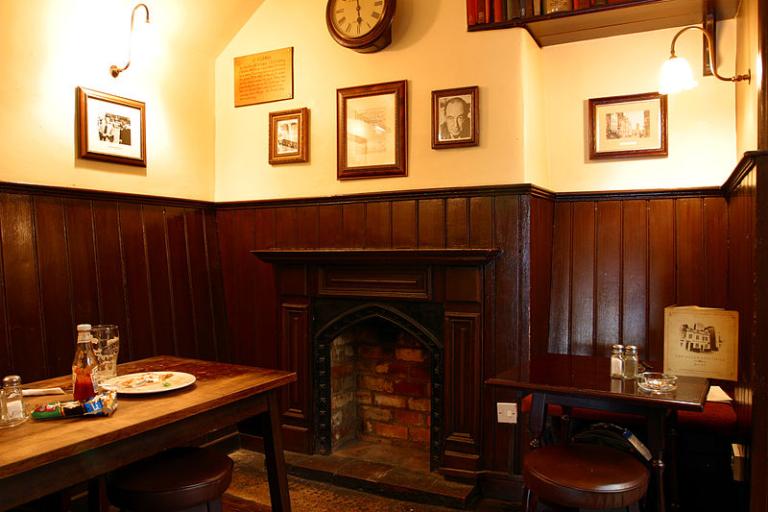
Corner of the Eagle and Child (“Bird and baby”) pub in Oxford, where the Inklings (a group of Oxford friends, centering around Lewis) met from 1930-1950. Photograph by Tom Murphy VII, 25 August 2005. [Wikimedia Commons / Creative Commons Attribution-Share Alike 3.0 Unported license] J.R.R. Tolkien, author of Lord of the Rings and The Hobbit, was a close Lewis friend and one of the Inklings. He thought that Lewis didn’t become Catholic largely or mainly because of a residual Belfast prejudice from his upbringing. Many Lewis biographers agree.
This is a friendly exchange with Rob Corzine (Catholic), a friend for many years and fellow Michigander, from my Facebook page. Rob works closely with Dr. Scott Hahn. His words will be in blue. This discussion was a follow-up to my post, Why Didn’t C. S. Lewis Become a Catholic? I begin with a little preamble: an exchange with my friend Dr. Edwin Tait, who is an Anglican church historian (his words in green).
* * * * *
Why ask the question in the first place? I think Catholics need to lay bare the assumptions that lead them to pose this question so repeatedly.
I can only speak for myself.
1. I’m interested in all things Lewis, he being my favorite writer.
2. The question comes up because there are reports that he was very close to conversion (around 1950).
3. #2 being the case, my curiosity leads me (especially as a convert, myself) to look into why he remained Anglican.
Lewis never gave any indication that he was close to conversion that I know of. I don’t know what the evidence is for 1950 in particular.
Rob Corzine on my Facebook page cross-link of this post is making a similar extended argument: that the “prejudice” hypothesis is insufficient. He thinks Lewis was simply a good Protestant who was never convinced of Catholicism because of theological factors alone. He may be right. Or (as I suspect) both factors were in play.
I agree. I’m not arguing that Ulster prejudices played no role. But I’m uncomfortable with reductionistic explanations, especially when they start from the assumption “of course any reasonable person, much less someone whose thinking I admire so much, would naturally see things the way I do.” I’ve heard conservative evangelicals and fundamentalists “explain away” Lewis’ acceptance of evolution and higher criticism similarly.
Well, it looks like we agree that both factors played a role.
Lewis’ “Ulsterior Motives” would be a more credible explanation were it not for the relationships and the correspondences we have of his with Catholics. I am thinking not just of the close Friendships like Tolkien but also the correspondence with Blessed Don Giovanni Calabria, and the Letters to an American Lady. You are left having to posit a pretty rarefied form of anti-Catholic prejudice: one that doesn’t reject the Church’s Sacraments, seeks the intercession of Catholic priests, reads Catholic theologians and respects the simple faith of a Catholic lay woman.
The sad reality is that Lewis was not a proto-Catholic in any meaningful sense. He was a Protestant who agreed with the Church on a number of issues and has been a help to many converts in thinking through those issues. He was a great teacher to me.
The most glaring problem in Lewis’ writing though is his ecclesiology. He rarely addresses it directly, but when it comes up, it becomes clear that he is simply wrong: biblically, historically, and logically. When the question of the authority of the Church was directly posed to him, he replied with the sort of nonsense you would not thought have thought such a normally clear thinker capable of. I’m thinking in particular of his 1945 letter to H. Lyman Stebbins.
If you want to say that the anti-Catholic prejudices of his youth (which he consciously rejected) were subconsciously keeping him from really addressing the question of the Church, I suppose you can go there. I personally cannot repose much confidence in such subtle psychoanalysis even of people I know well, much less those I only know through their writing. I’m even less comfortable with the counter-factual speculation about what CS Lewis would do if he were alive today. I don’t see any evidence that he was super-impressed with the Anglican bishops of his own day or would have been greatly shocked at their subsequent craziness and unbelief. At the end of the day, the great man was a Protestant and that was a bad thing. He is not one now. That is the most important thing.
It’s not merely “subtle psychoanalysis” if the argument in the post is based on his own report and that of several close friends of his.
I can easily imagine Lewis deflecting a question, declining to discuss the topic by a jocular reference to his birthplace. I have some difficulty imagining that he was publicly confessing an irrational and sinful animosity or prejudice, an unwillingness to seek the truth. Much less that he was completely aware of and stubbornly insistent on retaining the prejudice of his Ulster roots. If you think that describes Lewis’ state of mind, then you are certainly absolved of any charge of subtlety and I completely withdraw it. But we have a very different appreciation of the man. I do not think he was a bigot, just a Protestant.
I wouldn’t call him a bigot! That word never appears in the piece. “Prejudice[s]” does twice, used by Kreeft and Sayer (not myself) in reference to Lewis’ views. Kreeft says that both Derrick and Pearce, who wrote books specifically about Lewis and Catholicism, believed that he retained this residual prejudice.
George Sayer states flat-out: “He attributed his prejudice against the Roman church to his upbringing in Northern Ireland.” He’s the renowned Lewis biographer and close friend. Why should we doubt his appraisal (and that of the other three men?). That doesn’t make him a “bigot” per se. We all are affected by “what we eat,” so to speak.
I don’t take a back seat to anyone in terms of appreciation for Lewis. He’s been my favorite writer for some 38 years now. I’ve had a web page about him up since 1997. But he wasn’t perfect. No one is, so this is no big shock. On this issue, something other than rationality seems to be the leading influence.
I grant that you did not use the word bigot. I would represent, however, that “bigot” could almost be defined as “a man who refuses to examine a difficult truth because he knowingly allows his biases to have ‘an irrational but profound effect on his position’.”
It is surely honesty to recognize that you have biases and that sometimes even irrational prejudices influence you. But he is not guiltless who chooses prejudice or defends irrationality as his own position. I don’t think Lewis did this.
The alternative is that he was telling the truth in the long quote from Sayers that you include in your post: namely, that he really never was tempted to become Catholic. This passage seems not to confirm but rather to rebut the residual Ulster prejudice theory. Lewis replies to Havard with 1) a heretical and facile ecclesiology and 2) a clear statement of just which Catholic teachings that he thought were heretical.
‘Why didn’t CS Lewis become Catholic?’ seems like a good question to us primarily because he did not share our own reasons for not being Catholic. Indeed, he helped us overcome them. But I know of no reason to suppose that Lewis himself ever asked it. If we are trying to speculate about the subconscious factors at work that kept him from ever wrestling with the question of the Church, Ulster is as good a guess as Oxford I suppose. But I don’t think we can presume to know and I don’t choose to guess.
That’s fine, Rob. I don’t deny the possibility that your view may in fact be the truth. For myself, I am deferring to the biographers of Lewis (and close friends like Tolkien and Sayer) who know their subject far better than admirers like you and I do. Christopher Derrick was also his student, I believe. [I also replied to someone else: “Why do so many of his biographers and close friends (e.g., Sayer, Havard, Derrick, Tolkien) disagree with you in this regard, then? They must have some reason (rightly or wrongly) for thinking as they do.]
If it weren’t for their statements, I wouldn’t have the slightest opinion on the subject. It probably would have never crossed my mind in any serious fashion. You have to interpret the fact that they are all in essential agreement on this point. Why is that? Do they all have some terrible desire to paint Lewis as a bigot or nearly so? I don’t think so.
It seems to me that it is much more plausible that they saw this tendency in Lewis and so felt that it was notable and substantiated enough to report as a key factor in his non-conversion to Catholicism.
I believe you are misreading the reliable sources (perhaps under the influence of the less reliable ones). Sayer does not say what Pearce does if you read carefully. They report how Lewis himself used to avoid continuing the discussion but they do not take that deflection as the real cause of his not becoming Catholic. In fact, they deny it. This is much more consistent with the significant amount of external evidence we have in his writings themselves. Pearce is excellent on Belloc, though.
How do they differ? Sayer states: “He attributed his prejudice against the Roman church to his upbringing in Northern Ireland.”
That’s right. Sayer’s first statement is straight reportage: “But he refused to discuss them. He attributed his prejudice against the Roman church to his upbringing in Northern Ireland.” These two sentences belong together. Standard British politesse. But later in the same paragraph, we get Sayer’s own personal judgment, his personal witness. To wit, “All the time I knew him, Jack was about as nonsectarian as it is possible for a devout Christian to be.”
Sayer’s judgment concurs with how we see Lewis interacting with many Catholics, both in personal relationships and in letters. He really accepts them as fellow Christians, expects to see them in heaven, but is not the least bit tempted to become one of them. It isn’t a question of closed-minded prejudice; he’s just a Protestant.
If you want to say that deep down, at some subconscious level its the old Ulster revulsion, you may. But the simpler explanation, based on what he actually said and wrote in unquestionable earnest seems to me to be that his really anemic ecclesiology defended him from ever really seriously engaging the question.
Why could we not posit both things: standard Protestant objections in principle, and some residual Belfast incipient anti-Catholicism or at least dislike, at some level, of Catholicism? I usually go for “both / and” . . . We may both be partially right here.
One could be perfectly respectful and ecumenical, but still retain a gut-level reaction against becoming a Catholic (I know several people personally who would fit such a description). There is no necessary contradiction in those two things.
Surely, the repulsion would be there. The distaste especially for low, peasant piety. Foreign. Superstitious. Priest-ridden. And surely, there could be–almost certainly was–a Belfast as well as an Oxford element in it. But the point is that Lewis was aware of it, would be wary of making decisions based on it, would not think of defending a position based merely on such a repulsion (significantly, he found the local Anglican parish fairly repellent in some of the same ways). I don’t think it can help to explain his not becoming Catholic himself.
There is a revealing passage in his address to Anglican Divinity students that shows what he thought of Catholicism: “A theology which denies the historicity of nearly everything in the Gospels to which Christian life and affections and thought have been fastened for nearly two millennia – which either denies the miraculous altogether or, more strangely, after swallowing the camel of the Resurrection strains at such gnats as the feeding of the multitudes – if offered to the uneducated man can produce only one or other of two effects. It will make him a Roman Catholic or an atheist. What you offer him he will not recognize as Christianity. If he holds to what he calls Christianity he will leave a Church in which it is no longer taught and look for one where it is. If he agrees with your version he will no longer call himself a Christian and no longer come to church.”
For Lewis, then, the Catholic Church is A CHURCH and one that teaches all of the fundamental doctrines (along with what he thought were accretions). But the Anglican church was also merely A CHURCH, and not only quite fallible but in imminent danger of actually failing. I know of no evidence that it gave him a moment’s pause about continuing to be an Anglican (though he was choosy about his clergy and when his confessor died he dropped the practice of going to confession). If there IS no visible, teaching Church, why go looking for it? Pick one you like or (better) bloom where you’re planted. The question of why he never became Catholic doesn’t really arise from what we know of his life and work. It is our question.
Joshua Schwartz: Great discussion Robert and Dave! One of the more enjoyable dialogues I’ve seen on FB. Well done!
Thanks. I have enjoyed it a lot, too, and Rob has argued so well that he has half-convinced me!
***
Related Reading:
C. S. Lewis’ Views on Christian Unity & Ecumenism [6-16-03]
C. S. Lewis’ Childhood in Belfast & Contra-Catholicism (Biographers and/or Friends Kreeft, Pearce, Derrick, and Possibly Tolkien Think This is Why Lewis Never Became a Catholic) [6-26-12]
Why Didn’t C. S. Lewis Become a Catholic? [8-29-14]
C. S. Lewis vs. St. Paul on Future Binding Church Authority [National Catholic Register, 1-22-17]
Why C. S. Lewis Never Became a Catholic [National Catholic Register, 3-5-17]
C. S. Lewis on Catholicism (Correspondence: 1934-1947) [9-13-19]
***
Previous Post
September 1, 2015
Dialogue with a Polymath Agnostic on Root Premises
Next Post
September 1, 2015 Win a Few, Lose a Few (Atheists / Agnostics and Me)
Browse Our Archives
Select a Category & Last Things About Me Anti-Catholicism Atheism & Agnosticism Baptism and Sacramentalism Bible and Tradition Blessed Virgin Mary Books by Dave Armstrong C. S. Lewis Calvinism & General Protestantism Catholic Apologetics Catholic Apologists Catholic conversion Catholic converts Christmas Church (Ecclesiology) Church History Conversion and Converts Development of Doctrine Eastern Orthodoxy Ecumenism & Christian Unity Eucharist & Liturgy Fathers of the Church French Translations G. K. Chesterton Hell Hell & Satan Hell & Satan & Last Things Heresies & Comparative Religion Holistic Health Inquisition & Crusades & Scandals James White Jews & Judaism & Old Testament John Calvin John Henry Newman Liberal / Modernist Theology Life Issues Literary Resume Lutheranism Mariology Martin Luther Music Orthodoxy Papacy & Infallibility Personal Page Philosophy & Science Political & Ethical & Moral Issues Protestant Persecution & Intolerance Protestantism Purgatory Purgatory & Penance Romantic & Imaginative Theology Saints & Purgatory & Penance Salvation Salvation & Justification Satan & Last Things Sexuality and Gender Issues Spanish Translations Traditionalism vs. Radical Catholic Reactionaries Traducciones al español / tradução para português Trinitarianism & Christology Uncategorized Videos
Select a Month October 2026 September 2026 August 2026 July 2026 June 2026 May 2026 April 2026 March 2026 February 2026 January 2026 December 2025 November 2025 October 2025 September 2025 August 2025 July 2025 June 2025 May 2025 April 2025 March 2025 February 2025 January 2025 December 2024 November 2024 October 2024 September 2024 August 2024 July 2024 June 2024 May 2024 April 2024 March 2024 February 2024 January 2024 December 2023 November 2023 October 2023 September 2023 August 2023 July 2023 June 2023 May 2023 April 2023 March 2023 February 2023 January 2023 December 2022 November 2022 October 2022 September 2022 August 2022 July 2022 June 2022 May 2022 April 2022 March 2022 February 2022 January 2022 December 2021 November 2021 October 2021 September 2021 August 2021 July 2021 June 2021 May 2021 April 2021 March 2021 February 2021 January 2021 December 2020 November 2020 October 2020 September 2020 August 2020 July 2020 June 2020 May 2020 April 2020 March 2020 February 2020 January 2020 December 2019 November 2019 October 2019 September 2019 August 2019 July 2019 June 2019 May 2019 April 2019 March 2019 February 2019 January 2019 December 2018 November 2018 October 2018 September 2018 August 2018 July 2018 June 2018 May 2018 April 2018 March 2018 February 2018 January 2018 December 2017 November 2017 October 2017 September 2017 August 2017 July 2017 June 2017 May 2017 April 2017 March 2017 February 2017 January 2017 December 2016 November 2016 October 2016 September 2016 August 2016 July 2016 June 2016 May 2016 April 2016 March 2016 February 2016 January 2016 December 2015 November 2015 October 2015 September 2015 August 2015 July 2015 June 2015 May 2015 April 2015 March 2015 February 2015 January 2015 December 2014 November 2014 October 2014 September 2014 August 2014 July 2014 June 2014 April 2014 March 2014 February 2014 January 2014 December 2013 November 2013 October 2013 September 2013 August 2013 July 2013 June 2013 April 2013 March 2013 February 2013 January 2013 December 2012 November 2012 October 2012 September 2012 August 2012 July 2012 June 2012 May 2012 April 2012 March 2012 February 2012 January 2012 December 2011 November 2011 October 2011 September 2011 August 2011 July 2011 June 2011 April 2011 March 2011 February 2011 October 2010 September 2010 August 2010 July 2010 April 2010 March 2010 December 2009 October 2009 August 2009 July 2009 June 2009 May 2009 March 2009 February 2009 October 2008 September 2008 April 2008 March 2008 February 2008 January 2008 December 2007 November 2007 October 2007 May 2007 March 2007 February 2007 January 2007 November 2006 October 2006 September 2006 August 2006 July 2006 June 2006 May 2006 April 2006 March 2006 February 2006 October 2005 June 2005 April 2005 February 2005 July 2004 May 2004 April 2004
Follow Us!
TAKE THE
Religious Wisdom Quiz
Who built the ark to survive the flood?
Select your answer to see how you score.
Elijah Noah Abraham Moses
Books by This Author Books by Dave Armstrong
Related posts from Biblical Evidence for Catholicism

On Protestant Explanations of Catholic Conversion
Biblical Evidence for Catholicism
C. S. Lewis’ Argument for God from Desire
Biblical Evidence for Catholicism
C. S. Lewis: More Evidences of Anti-Catholic Prejudice
Biblical Evidence for Catholicism
C. S. Lewis: Biggest Cheerleader for "Lord of...
Biblical Evidence for Catholicism
TRENDING AT PATHEOS Catholic

I was strolling through the top floor of the brand new Parthenon...

What Does Gêvâh Mean For Kimberley Guifoyle &...
This week, a lot of the news is focused on Kimberly Guilfoyle....

INNER CIRCLE: Profound Mystery (Of Christ In All...
Ephesians 5:31-32 “For this reason, a man will leave his father and...

Do Not Rejoice When Your Enemy Falls: The...
Turning an execution into a public spectacle is a disturbing expression of...

'The Chosen' S6 Trailer: The Passion Gets Very...
Not many watching 'The Chosen' worry about spoilers, but just because they...

The purpose-driven labor priest
A labor activist reads Rick Warren and it gets me wondering about...
view all Catholic blogs
Ad-Free & Subscriber Log-In Subscription Support
- About Us
- 2026 Calendar
- Videos
- Podcasts
- Library of World Religions
- Faith In Media Tracker
- Advertise With Us
- Write for Us
- Privacy Policy
- Terms of Service
- Do Not Sell My Data
- Contact Us
- Radiant Digital
- Manage Newsletter Subscriptions
- Unsubscribe From Notifications
- Sitemap
Copyright 2008-2026, Patheos. All rights reserved.
Subscription Support Ad-Free & Subscriber Log-In
Follow Patheos