
BuddhistCatholicContemplativeEvangelicalGeneral ChristianHinduJewishLatter-day SaintMuslimNew VisionsProgressive Christian
Beliefs
- Buddhist
- Catholic
- Contemplative
- Evangelical
- General Christian
- Hindu
- Jewish
- Latter-day Saint
- More Voices
- Muslim
- New Visions
- Pagan
- Progressive Christian
Topics
- Religion News
- Food and Religion
- Sports and Religion
- Religious Art
- Religious Music and Entertainment
- Religious Events
- History and Religion
- Style and Religion
- Politics and Religion
- Women in Religion
- Recreation Outdoors and Religion
- Business Finance and Religion
- Careers Workplace and Religion
- Education and Religion
- Family Parenting and Religion
- Health Fitness and Religion
- Home and Religion
- Relationships and Religion
- Technology and Religion
- Travel and Religion
Columnists
- Buddhist Columnists
- Business Finance and Religion Columnists
- Careers Workplace and Religion Columnists
- Catholic Columnists
- Contemplative Columnists
- Education and Religion Columnists
- Evangelists Columnists
- Family Parenting and Religion Columnists
- General Christian Columnists
- Health Fitness and Religion Columnists
- Hindu Columnists
- History and Religion Columnists
- Home and Religion Columnists
- Jewish Columnists
- More Voices Columnists
- Latter Day Columnists
- Muslim Columnists
- New Visions Columnists
- Nonreligious Columnists
- Pagan Columnists
- Politics and Religion Columnists
- Progressive Columnists
- Recreation Outdoors and Religion Columnists
- Relationships and Religion Columnists
- Religion News Columnists
- Religious Art Columnists
- Religious Events Columnists
- Religious Music and Entertainment Columnists
- Sports and Religion Columnists
- Style and Religion Columnists
- Technology and Religion Columnists
- Travel and Religion Columnists
- Women in Religion Columnists
Resource Library
- 2026 Calendar
- Library of World Religions
- The 100 Most Holy Places on Earth
- Patheos Answers
- Podcasts
- Videos
- Faith Leaders Database
- Anglican Episcopalian
- Bahai
- Baptist
- Buddhism
- Christianity
- Confucianism
- Eastern Orthodoxy
- Hinduism
- Holiness and Pentecostal
- ISKCON
- Islam
- Judaism
- Lutheran
- Methodist
- The Church of Jesus Christ of Latter-day Saints
- New Age
- Paganism
- Presbytarian and Reformed
- Protestantism
- Religion Behind the Scenes
- Roman Catholic
- Scientology
- Shia Islam
- Sikhism
- Sufism
- Sunni Islam
- Taoism
- Zen
- See all religions
Research Tools
 Ad-Free & Subscriber Log-In Subscription Support
Ad-Free & Subscriber Log-In Subscription Support
Follow Patheos 

- Trending:
- Forgiveness
- |
- Marriage
- |
- Consciousness
- |
- Death Penalty
- |
- Election
- |
- Halloween

-
About
-
Catholic Apologetics
-
Church History
-
Great Apologists
-
Christian Worldview
-
Protestantism & Misc.
- Home
- Catholic
- History and Religion
- Biblical Evidence & Defenses for Expensive Church Buildings
Biblical Evidence & Defenses for Expensive Church Buildings
Last updated on: May 20, 2017 at 7:07 pm by Dave Armstrong
Biblical Evidence & Defenses for Expensive Church Buildings 2017-05-20T19:07:35-04:00 Dave Armstrong
Patheos Explore the world's faith through different perspectives on religion and spirituality! Patheos has the views of the prevalent religions and spiritualities of the world.
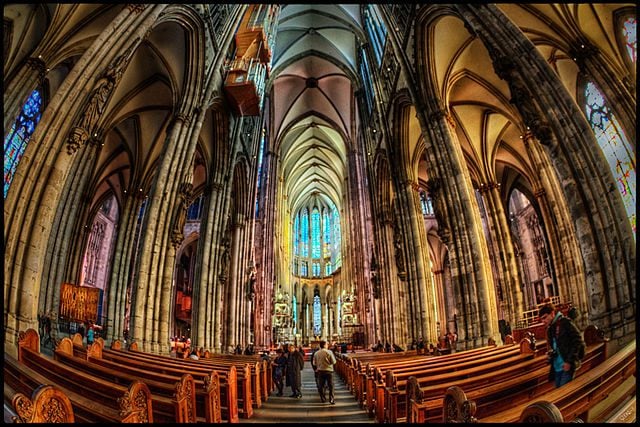
Interior of Cologne Cathedral (photo by Pedro Szekely, 10-28-11) [Wikimedia Commons / Creative Commons Attribution-Share Alike 2.0 Generic license]

(3-18-08)
This is a rather common complaint of Protestants of a certain sort (usually “low church”). Here are some comments made by “Grubb”: a friendly Baptist regular of this forum, in an older discussion thread (here and here), and my response. He also makes more “positive” statements about churches in the same context, and admits some ambiguity and nuances in his own position, and decries excesses of materialism (much as I argue below), but I am responding primarily to sentiments such as the following (and using his comments as a “springboard” to larger concerns of mine, as I often do):
* * * * *
The early Christian churches were often outside or in people’s homes. Were they less holy, because they didn’t have statues and stained glass? Obviously not. One’s surroundings can impact how he feels and may even impact his ability to worship well, but the building isn’t more holy because of the statues or stained glass. It may seem more reverent, but the presence of God makes a place holy, so any place the body of Christ gathers together is holy.
* * *
I’m pretty sure you can’t have fancy ornaments, statues, and stained glass and be “without excess” and “without ornament”. “Austere” and fancy ornaments are mutually exclusive. While I’ve been in beautiful churches and worshipped well, I’ve also been in simple churches and worshipped equally well. While a beautiful cathedral may display some of God’s glory, it can’t hold a candle to an autumn sunset, an ocean sunrise, a blooming dogwood, a summer rain, a giant oak tree, a simple rose, a field of daffodils, or any of God’s other wonderful, marvelous, and beautiful creations that attest to his magnificence more than any church building ever could. Maybe we should look to nature rather than a building to see God’s brilliance on earth. It’s a lot cheaper too.
* * *
First of all, I am a virtual nature-mystic (in the Romantic, Lewis-Tolkien sense), so you need not convince me of the beauty of the natural world. I would be a lot more inclined to accept your reasoning if indeed with all the riches we have built up, we didn’t lavish them on ourselves in houses (veritable mansions for richer folks, yet few children to fill them up) and in countless wonderful, expensive structures (including automobiles, yachts, personal jets, etc.) devoted to the glory of capitalism.
*
Since we do that, I say it is all the more appropriate to devote some of our ingenuity and riches to building beautiful buildings devoted to God and the worship of God (rather than of mammon), and receiving Him and hearing His Word taught. If you spoke out against all buildings whatever (at least “fancy” and “excessive” ones) as materialistic and unnecessary, you might have a decent point. Somehow I don’t expect that to happen anytime soon.
*
So we have a scenario where it is perfectly acceptable to build mansions to the glory of man and mammon, but not (beautiful) churches to the glory of God. We must give God our aesthetic mediocrity and worst efforts rather than our best. We can personally live in luxury in fine mansions in idyllic settings, but must worship in “gymnasiums” or “glorified barns”. Really makes a lot of sense . . . Nuh-uh. I don’t buy it.
*
I’m willing to tolerate men’s love of money and what it results in, architecturally-speaking (actually, I am very fond of good architecture of many “old-fashioned” types), but when people start going after church buildings as excessive and unnecessary, I cannot accept the glaring double standard.
*
And then you would have to explain away the Temple as a waste of resources too. Why did God command that? Did He not know that all that money could have gone to feeding the poor? God obviously was not a bleeding-heart liberal Democrat . . .
*
At least King Solomon had the sense of proportion and priority to think of building a temple for God at the same time he was building his own royal palace (2 Chronicles 2:1,12). Likewise, King David gave graciously out of his own riches, to the Temple (1 Chronicles 29:1-5) and urged others to do the same (29:6-13) and knew from Whom all riches derived in the first place (29:12,14,16), and recognized that the Temple is at least as important as a palace: “the work is great; for the palace will not be for man but for the Lord God” (1 Chron 29:1). The prophet Hosea saw something like the selfish, materialistic hypocrisy that I discuss above, too:
For Israel has forgotten his Maker, and built palaces . . . (Hosea 8:14)
* * * * *
Good to hear from you.
And you, my friend.
Have you read The Treasure Principle? This is one of the items God is using to help me view money and stuff in a more Godly sense. I agree with you on the things you speak against: luxurious houses, expensive cars, jewelry, and a posh life style.
I haven’t read the book you cite, but I’ve read Ronald Sider (Rich Christians in an Age of Hunger) and other works that advocate a simple lifestyle, and make a critique of modern-day attitudes towards money and riches. Many go too far and get legalistic. I’ve advocated and lived a simple lifestyle for many years (mostly by necessity, given my non-lucrative profession!), but I try to avoid the legalistic excesses of condemning capitalism altogether (as Sider and certain similar groups and guys like Jim Wallis tend to do, or come close to doing).
There is a difference between THE Temple that Solomon built and David helped fund and the church building of the New Testament. The Temple Solomon built was actually God’s house. God in some form was in the Ark, and the Ark was to be in the Temple.
Every Catholic and Orthodox church is “actually God’s house” too, since Jesus is present Body, Blood, Soul, and Divinity. Thus, today’s churches (i.e., the ones that preserve apostolic succession) have God present in a way that goes beyond even the Holy of Holies, because God is physically present, as a result of the incarnation, where God took on flesh. This is one reason why we have very ornate churches and altars, because God is present. It’s exactly the same principle of the Temple: if God is present, then it is clearly appropriate to be ornate, so as to celebrate His presence, just as we do every earthly king.
You, denying the Real, Physical, Substantial Presence, obviously would see no need to build a beautiful church because you deny that special presence of God. And that’s why your brand of Christianity (I used to argue exactly the same way) denies the notion of “sacred space” or “holy places.” It’s the anti-sacramental and quasi-Docetic, semi-Gnostic “anti-matter” mentality. These churches are holy precisely because Jesus is there, not just spiritually (as He is everywhere, in His omnipresence) but physically.
That’s the crucial difference. That’s why we believe in sacred space, and act accordingly when present in it. Since you reject this Substantial Presence of God, for you, one church is as good as another, and (as a straightforward logical deduction, though virtually no Protestants would admit this or feel comfortable with it) there is no essential distinction between worship in a pig sty or city dump, and worship at Chartres Cathedral. We both believe God is everywhere; that is not at issue.
Every synagogue wasn’t commanded or intended to be as lavish as the Temple of the Ark.
I didn’t say they should be. It was an analogy: if a gorgeous, ornate Temple was commanded to be built by God, by the same token, we can make beautiful buildings for God as well. It’s not a “waste” or mere materialism. We certainly have the resources to do so, but we prefer to spend our money on other things.
What is the Temple of God in the NT era? Anyone who follows Jesus whole-heartedly. Paul said, “Don’t you know that you yourselves are God’s temple and that God’s Spirit lives in you? If anyone destroys God’s temple, God will destroy him; for God’s temple is sacred, and you are that temple.” (I Cor 3:16-17) and again, “Do you not know that your body is a temple of the Holy Spirit, who is in you.” (I Cor 6:19a)
That continues the Old Testament temple concept in the sense that God is now spiritually inside of us through the indwelling, just as He was in the Shekinah cloud and in the Tabernacle and Temple in the Old Covenant. But eucharistic physical presence takes it a step further and continues the Temple concept and develops and expands it, making God’s presence even more profound for us than it was then, for them.
Every time a Catholic or Orthodox receives the Eucharist, we are closer to God in a tangible way than even the high priest was in his yearly visit to the Holy of Holies. The second fallacy in your argument is that it presupposes that an earthy, physical Temple and ourselves as temples of the Holy Spirit are mutually exclusive, with one replacing the other. But this is untrue and unbiblical, as I already showed in a past dialogue between you and I.
After Pentecost (i.e., after they became themselves the “temples of the Holy Spirit”), the Bible informs us that “Peter and John were going up to the temple at the hour of prayer, the ninth hour” (Acts 3:1). So now you have two temples, not mutually exclusive (secondly, Jesus referred to His Body as a “temple” when standing before the Temple building: John 2:19-21).
The only reasons that this worship ceased were: 1) the split between Judaism and Christianity and subsequent ill relations, 2) the destruction of the Temple by the Romans in 70 A.D., and 3) the inclusion of Gentiles in Christianity. But there was nothing intrinsically improper in a (Jewish) Christian worshiping there. I added in our last dialogue:
The notes in my RSV explain that the ninth hour was 3 PM “when sacrifice was offered with prayer (Ex 29.39; Lev. 6.20; Josephus, Ant. xiv.4.3).”
Acts 2:46 described the early Christians:
And day by day, attending the temple together and breaking bread in their homes, they partook of food with glad and generous hearts,
The “biblical evidence for church buildings” was originally presented elsewhere. As far as I know, these aren’t mentioned in the New Testament. The early Christians continued to worship at the Temple, and in their own homes. So why do we have our own church buildings when it is not a NT concept? Well (as in the present case) it is a straightforward deduction from what we know. One could argue it as follows:
Biblical Evidence for Church Buildings
1) The Jews, from whom Christianity derived, worshiped in synagogues.
2) The Jews, from whom Christianity derived, worshiped in the Temple.
3) The early Christians worshiped in their homes, and clandestinely in caves or catacombs, as the case may be.
4) These are not buildings expressly constructed for Christian worship.
5) However, it stands to reason (by analogy) that Christians, whose belief-system developed from Judaism, would also eventually (especially after official persecution ceased) have buildings of worship, just as the Jews did.
6) Therefore, deductively and analogically, the Bible sanctions Christian church buildings, and the “biblical evidence” for same is the above.
Political & Ethical & Moral Issues
Previous Post
September 8, 2015
Was Jesus Confused About His Mission and Identity?
Next Post

September 9, 2015 Do Only Ignoramuses & Simpletons Believe in Adam & Eve?
Browse Our Archives
Select a Category & Last Things About Me Anti-Catholicism Atheism & Agnosticism Baptism and Sacramentalism Bible and Tradition Blessed Virgin Mary Books by Dave Armstrong C. S. Lewis Calvinism & General Protestantism Catholic Apologetics Catholic Apologists Catholic conversion Catholic converts Christmas Church (Ecclesiology) Church History Conversion and Converts Development of Doctrine Eastern Orthodoxy Ecumenism & Christian Unity Eucharist & Liturgy Fathers of the Church French Translations G. K. Chesterton Hell Hell & Satan Hell & Satan & Last Things Heresies & Comparative Religion Holistic Health Inquisition & Crusades & Scandals James White Jews & Judaism & Old Testament John Calvin John Henry Newman Liberal / Modernist Theology Life Issues Literary Resume Lutheranism Mariology Martin Luther Music Orthodoxy Papacy & Infallibility Personal Page Philosophy & Science Political & Ethical & Moral Issues Protestant Persecution & Intolerance Protestantism Purgatory Purgatory & Penance Romantic & Imaginative Theology Saints & Purgatory & Penance Salvation Salvation & Justification Satan & Last Things Sexuality and Gender Issues Spanish Translations Traditionalism vs. Radical Catholic Reactionaries Traducciones al español / tradução para português Trinitarianism & Christology Uncategorized Videos
Select a Month October 2026 September 2026 August 2026 July 2026 June 2026 May 2026 April 2026 March 2026 February 2026 January 2026 December 2025 November 2025 October 2025 September 2025 August 2025 July 2025 June 2025 May 2025 April 2025 March 2025 February 2025 January 2025 December 2024 November 2024 October 2024 September 2024 August 2024 July 2024 June 2024 May 2024 April 2024 March 2024 February 2024 January 2024 December 2023 November 2023 October 2023 September 2023 August 2023 July 2023 June 2023 May 2023 April 2023 March 2023 February 2023 January 2023 December 2022 November 2022 October 2022 September 2022 August 2022 July 2022 June 2022 May 2022 April 2022 March 2022 February 2022 January 2022 December 2021 November 2021 October 2021 September 2021 August 2021 July 2021 June 2021 May 2021 April 2021 March 2021 February 2021 January 2021 December 2020 November 2020 October 2020 September 2020 August 2020 July 2020 June 2020 May 2020 April 2020 March 2020 February 2020 January 2020 December 2019 November 2019 October 2019 September 2019 August 2019 July 2019 June 2019 May 2019 April 2019 March 2019 February 2019 January 2019 December 2018 November 2018 October 2018 September 2018 August 2018 July 2018 June 2018 May 2018 April 2018 March 2018 February 2018 January 2018 December 2017 November 2017 October 2017 September 2017 August 2017 July 2017 June 2017 May 2017 April 2017 March 2017 February 2017 January 2017 December 2016 November 2016 October 2016 September 2016 August 2016 July 2016 June 2016 May 2016 April 2016 March 2016 February 2016 January 2016 December 2015 November 2015 October 2015 September 2015 August 2015 July 2015 June 2015 May 2015 April 2015 March 2015 February 2015 January 2015 December 2014 November 2014 October 2014 September 2014 August 2014 July 2014 June 2014 April 2014 March 2014 February 2014 January 2014 December 2013 November 2013 October 2013 September 2013 August 2013 July 2013 June 2013 April 2013 March 2013 February 2013 January 2013 December 2012 November 2012 October 2012 September 2012 August 2012 July 2012 June 2012 May 2012 April 2012 March 2012 February 2012 January 2012 December 2011 November 2011 October 2011 September 2011 August 2011 July 2011 June 2011 April 2011 March 2011 February 2011 October 2010 September 2010 August 2010 July 2010 April 2010 March 2010 December 2009 October 2009 August 2009 July 2009 June 2009 May 2009 March 2009 February 2009 October 2008 September 2008 April 2008 March 2008 February 2008 January 2008 December 2007 November 2007 October 2007 May 2007 March 2007 February 2007 January 2007 November 2006 October 2006 September 2006 August 2006 July 2006 June 2006 May 2006 April 2006 March 2006 February 2006 October 2005 June 2005 April 2005 February 2005 July 2004 May 2004 April 2004
Follow Us!
TAKE THE
Religious Wisdom Quiz
Who asked Jesus, "What is truth?"
Select your answer to see how you score.
Caiaphas Pilate Nicodemus Herod
Books by This Author Books by Dave Armstrong
Related posts from Biblical Evidence for Catholicism

Jesus Founded the [Catholic] Church. If Not Him,...
Biblical Evidence for Catholicism

Jerusalem Council vs. James White & Sola Scriptura
Biblical Evidence for Catholicism

Apostolic Succession: 40 Biblical Arguments
Biblical Evidence for Catholicism

God, Modern Physics, & Dark Energy: An Analogy
Biblical Evidence for Catholicism
TRENDING AT PATHEOS Catholic

I was strolling through the top floor of the brand new Parthenon...

What Does Gêvâh Mean For Kimberley Guifoyle &...
This week, a lot of the news is focused on Kimberly Guilfoyle....

INNER CIRCLE: Profound Mystery (Of Christ In All...
Ephesians 5:31-32 “For this reason, a man will leave his father and...

Do Not Rejoice When Your Enemy Falls: The...
Turning an execution into a public spectacle is a disturbing expression of...

'The Chosen' S6 Trailer: The Passion Gets Very...
Not many watching 'The Chosen' worry about spoilers, but just because they...

The purpose-driven labor priest
A labor activist reads Rick Warren and it gets me wondering about...
view all Catholic blogs
Ad-Free & Subscriber Log-In Subscription Support
- About Us
- 2026 Calendar
- Videos
- Podcasts
- Library of World Religions
- Faith In Media Tracker
- Advertise With Us
- Write for Us
- Privacy Policy
- Terms of Service
- Do Not Sell My Data
- Contact Us
- Radiant Digital
- Manage Newsletter Subscriptions
- Unsubscribe From Notifications
- Sitemap
Copyright 2008-2026, Patheos. All rights reserved.
Subscription Support Ad-Free & Subscriber Log-In
Follow Patheos