
BuddhistCatholicContemplativeEvangelicalGeneral ChristianHinduJewishLatter-day SaintMuslimNew VisionsProgressive Christian
Beliefs
- Buddhist
- Catholic
- Contemplative
- Evangelical
- General Christian
- Hindu
- Jewish
- Latter-day Saint
- More Voices
- Muslim
- New Visions
- Pagan
- Progressive Christian
Topics
- Religion News
- Food and Religion
- Sports and Religion
- Religious Art
- Religious Music and Entertainment
- Religious Events
- History and Religion
- Style and Religion
- Politics and Religion
- Women in Religion
- Recreation Outdoors and Religion
- Business Finance and Religion
- Careers Workplace and Religion
- Education and Religion
- Family Parenting and Religion
- Health Fitness and Religion
- Home and Religion
- Relationships and Religion
- Technology and Religion
- Travel and Religion
Columnists
- Buddhist Columnists
- Business Finance and Religion Columnists
- Careers Workplace and Religion Columnists
- Catholic Columnists
- Contemplative Columnists
- Education and Religion Columnists
- Evangelists Columnists
- Family Parenting and Religion Columnists
- General Christian Columnists
- Health Fitness and Religion Columnists
- Hindu Columnists
- History and Religion Columnists
- Home and Religion Columnists
- Jewish Columnists
- More Voices Columnists
- Latter Day Columnists
- Muslim Columnists
- New Visions Columnists
- Nonreligious Columnists
- Pagan Columnists
- Politics and Religion Columnists
- Progressive Columnists
- Recreation Outdoors and Religion Columnists
- Relationships and Religion Columnists
- Religion News Columnists
- Religious Art Columnists
- Religious Events Columnists
- Religious Music and Entertainment Columnists
- Sports and Religion Columnists
- Style and Religion Columnists
- Technology and Religion Columnists
- Travel and Religion Columnists
- Women in Religion Columnists
Resource Library
- 2026 Calendar
- Library of World Religions
- The 100 Most Holy Places on Earth
- Patheos Answers
- Podcasts
- Videos
- Faith Leaders Database
- Anglican Episcopalian
- Bahai
- Baptist
- Buddhism
- Christianity
- Confucianism
- Eastern Orthodoxy
- Hinduism
- Holiness and Pentecostal
- ISKCON
- Islam
- Judaism
- Lutheran
- Methodist
- The Church of Jesus Christ of Latter-day Saints
- New Age
- Paganism
- Presbytarian and Reformed
- Protestantism
- Religion Behind the Scenes
- Roman Catholic
- Scientology
- Shia Islam
- Sikhism
- Sufism
- Sunni Islam
- Taoism
- Zen
- See all religions
Research Tools
 Ad-Free & Subscriber Log-In Subscription Support
Ad-Free & Subscriber Log-In Subscription Support
Follow Patheos 

- Trending:
- Forgiveness
- |
- Marriage
- |
- Consciousness
- |
- Death Penalty
- |
- Election
- |
- Halloween

-
About
-
Catholic Apologetics
-
Church History
-
Great Apologists
-
Christian Worldview
-
Protestantism & Misc.
- Home
- Catholic
- History and Religion
- “Personal Relationship with Jesus”: Good Catholic Phrase and Piety?
“Personal Relationship with Jesus”: Good Catholic Phrase and Piety?
Last updated on: June 5, 2026 at 11:41 pm by Dave Armstrong
“Personal Relationship with Jesus”: Good Catholic Phrase and Piety? 2026-06-05T23:41:07-04:00 Dave Armstrong
Patheos Explore the world's faith through different perspectives on religion and spirituality! Patheos has the views of the prevalent religions and spiritualities of the world.
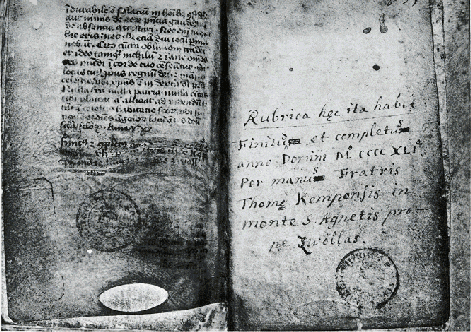
Manuscript of Thomas à Kempis’ Imitation of Christ [public domain / Wikimedia Commons]

***
Catholic bloggers on Patheos (we call ourselves “Patheosi”) are having a good discussion about this issue right now in our private forum.
It started with someone noting the article, “The Problem with ‘A Personal Relationship with Jesus'” (Dr. Jay Boyd, Homiletic & Pastoral Review, July 10, 2014). The Catholic author took a negative view of the phrase; also taking issue with Patheos blogger Sherry Weddell’s 2012 book, Forming Intentional Disciples: The Path to Knowing and Following Jesus (OSV).
I recalled an old article of mine on this topic that I had (ironically) deleted in preparing to migrate here, because it had too many quotes. I quickly resurrected it on Internet Archive and will bring back some of it in this post.
I think that any term can be abused or limited, or given a lot of baggage, as some Protestants do, but the notion itself is not essentially foreign to Catholicism. It’s good to find common ground with Protestants (per Vatican II and St. Paul’s “I have become all things to all men”) and in my opinion, it’s not a worthwhile fight, to sound as if we neglect this aspect, by warring against a phrase. When I edited a book about the Catholic Mystics, I observed far more truly “personal” and deeper relationship with Jesus than I ever saw in evangelical ranks. Similarly, I defended the hymn Amazing Grace against criticism from “muckraking” Catholic broadcaster and You Tube phenom Michael Voris, who claimed it was “anti-Catholic.”
Fr. John Riccardo (a wonderful priest in metro Detroit who has a radio show) once recounted a story where a devout Protestant asked him if he had a personal relationship with Jesus. He replied that he received Jesus’ flesh and blood into his body every day (the Eucharist) and stated, “I don’t know how much more personal it can get than that.”
Catholics have this same relationship in their own way, couched in different terms, and Catholicism teaches its adherents to renew their commitment to God not just once in an “altar call” but daily (hence the daily Mass).
As but one example of many that could be produced, The Imitation of Christ is a spiritual classic, written by was written by Thomas à Kempis (c. 1380 – 1471), sometime between 1418 and 1427. I read it (probably an edited version) as a Protestant many years ago, and ever since have regarded it as the work closest in spirit and nature to the Bible of any book I’ve ever read. This book is typical of many dozens of such meditations by pious Catholics and Catholic mystics through the ages. Here are just a few portions that would relate to the question of a “personal relationship with Jesus,” as many Protestants would put it. This communion with God is not at all foreign to authentic Catholic practice and tradition and devotion:
Christ will come to you offering His consolation, if you prepare a fit dwelling for Him in your heart, whose beauty and glory, wherein He takes delight, are all from within. His visits with the inward man are frequent, His communion sweet and full of consolation, His peace great, and His intimacy wonderful indeed.
Love Him, then; keep Him as a friend. He will not leave you as others do, or let you suffer lasting death. Sometime, whether you will or not, you will have to part with everything. Cling, therefore, to Jesus in life and death; trust yourself to the glory of Him who alone can help you when all others fail.
Your Beloved is such that He will not accept what belongs to another—He wants your heart for Himself alone, to be enthroned therein as King in His own right. If you but knew how to free yourself entirely from all creatures, Jesus would gladly dwell within you.
It is a great art to know how to converse with Jesus, and great wisdom to know how to keep Him. Be humble and peaceful, and Jesus will be with you. Be devout and calm, and He will remain with you. You may quickly drive Him away and lose His grace, if you turn back to the outside world. And, if you drive Him away and lose Him, to whom will you go and whom will you then seek as a friend? You cannot live well without a friend, and if Jesus be not your friend above all else, you will be very sad and desolate.
I can see both sides of the question, though. As an analogy to the view I am not taking presently, I never call myself a “Roman Catholic”: not because it is intrinsically incorrect (rightly understood) but because of the baggage of the original Anglican anti-Catholic use of it, in a futile effort to pretend that they were “Catholics” also: just not those wicked “Roman [papist] Catholics.” As one familiar with that history, I don’t use it because I don’t wish to be a pawn in that word game. “Catholic” is perfectly adequate on its own.
But there is a legitimate use of “Roman Catholic,” too, and even one as great and eminent as John Henry Cardinal Newman (my own hero) used it. I’m not sure why (because he knew the Anglican anti-Catholic history very well), but he did; so I don’t get too legalistic against its use. If it is used, I think it must be explained, to overcome false conceptions of the Catholic Church.
It also implies an exclusion of Eastern Catholics, which is unfair and uncalled-for. The Catechism never, to my knowledge, uses it.
This question is similar. The phrase in dispute clearly comes from a Protestant milieu, so the issue is whether we ought to use it. I say we should, provided we always make clear what we mean and don’t mean by it. I believe that the good achieved by common ground in this regard is more important than possible misunderstandings: which we can clear up by clarification, anyway. Thus we can have the “best of both worlds.”
In any event, “personal relationship with Jesus” is always profoundly sacramental for us (beyond the indwelling which all Christians believe in) in a way that is not true of most Protestants. This is the heart (no pun intended) of the Catholic conception of it.
Personal relationship with Jesus
Previous Post

August 15, 2015
My Comments Policy: Thoughts on Amiable and Constructive Dialogue
Next Post
August 16, 2015 Jesus' Use of Socratic Method in His Teaching & Dialogues
Browse Our Archives
Select a Category & Last Things About Me Anti-Catholicism Atheism & Agnosticism Baptism and Sacramentalism Bible and Tradition Blessed Virgin Mary Books by Dave Armstrong C. S. Lewis Calvinism & General Protestantism Catholic Apologetics Catholic Apologists Catholic conversion Catholic converts Christmas Church (Ecclesiology) Church History Conversion and Converts Development of Doctrine Eastern Orthodoxy Ecumenism & Christian Unity Eucharist & Liturgy Fathers of the Church French Translations G. K. Chesterton Hell Hell & Satan Hell & Satan & Last Things Heresies & Comparative Religion Holistic Health Inquisition & Crusades & Scandals James White Jews & Judaism & Old Testament John Calvin John Henry Newman Liberal / Modernist Theology Life Issues Literary Resume Lutheranism Mariology Martin Luther Music Orthodoxy Papacy & Infallibility Personal Page Philosophy & Science Political & Ethical & Moral Issues Protestant Persecution & Intolerance Protestantism Purgatory Purgatory & Penance Romantic & Imaginative Theology Saints & Purgatory & Penance Salvation Salvation & Justification Satan & Last Things Sexuality and Gender Issues Spanish Translations Traditionalism vs. Radical Catholic Reactionaries Traducciones al español / tradução para português Trinitarianism & Christology Uncategorized Videos
Select a Month October 2026 September 2026 August 2026 July 2026 June 2026 May 2026 April 2026 March 2026 February 2026 January 2026 December 2025 November 2025 October 2025 September 2025 August 2025 July 2025 June 2025 May 2025 April 2025 March 2025 February 2025 January 2025 December 2024 November 2024 October 2024 September 2024 August 2024 July 2024 June 2024 May 2024 April 2024 March 2024 February 2024 January 2024 December 2023 November 2023 October 2023 September 2023 August 2023 July 2023 June 2023 May 2023 April 2023 March 2023 February 2023 January 2023 December 2022 November 2022 October 2022 September 2022 August 2022 July 2022 June 2022 May 2022 April 2022 March 2022 February 2022 January 2022 December 2021 November 2021 October 2021 September 2021 August 2021 July 2021 June 2021 May 2021 April 2021 March 2021 February 2021 January 2021 December 2020 November 2020 October 2020 September 2020 August 2020 July 2020 June 2020 May 2020 April 2020 March 2020 February 2020 January 2020 December 2019 November 2019 October 2019 September 2019 August 2019 July 2019 June 2019 May 2019 April 2019 March 2019 February 2019 January 2019 December 2018 November 2018 October 2018 September 2018 August 2018 July 2018 June 2018 May 2018 April 2018 March 2018 February 2018 January 2018 December 2017 November 2017 October 2017 September 2017 August 2017 July 2017 June 2017 May 2017 April 2017 March 2017 February 2017 January 2017 December 2016 November 2016 October 2016 September 2016 August 2016 July 2016 June 2016 May 2016 April 2016 March 2016 February 2016 January 2016 December 2015 November 2015 October 2015 September 2015 August 2015 July 2015 June 2015 May 2015 April 2015 March 2015 February 2015 January 2015 December 2014 November 2014 October 2014 September 2014 August 2014 July 2014 June 2014 April 2014 March 2014 February 2014 January 2014 December 2013 November 2013 October 2013 September 2013 August 2013 July 2013 June 2013 April 2013 March 2013 February 2013 January 2013 December 2012 November 2012 October 2012 September 2012 August 2012 July 2012 June 2012 May 2012 April 2012 March 2012 February 2012 January 2012 December 2011 November 2011 October 2011 September 2011 August 2011 July 2011 June 2011 April 2011 March 2011 February 2011 October 2010 September 2010 August 2010 July 2010 April 2010 March 2010 December 2009 October 2009 August 2009 July 2009 June 2009 May 2009 March 2009 February 2009 October 2008 September 2008 April 2008 March 2008 February 2008 January 2008 December 2007 November 2007 October 2007 May 2007 March 2007 February 2007 January 2007 November 2006 October 2006 September 2006 August 2006 July 2006 June 2006 May 2006 April 2006 March 2006 February 2006 October 2005 June 2005 April 2005 February 2005 July 2004 May 2004 April 2004
Follow Us!
TAKE THE
Religious Wisdom Quiz
What was the name of the field bought with Judas' betrayal money?
Select your answer to see how you score.
Aceldama Potter's Field Golgotha Field of Blood
Books by This Author Books by Dave Armstrong
Related posts from Biblical Evidence for Catholicism

Bible & Catholicism on Mortal Sin (vs. John...
Biblical Evidence for Catholicism

Dialogue on Eternal Security / Absolute Assurance
Biblical Evidence for Catholicism

"Faith Alone" Dialogue with a Calvinist
Biblical Evidence for Catholicism

Exegesis of 75 NT Faith [Alone?] & Works...
Biblical Evidence for Catholicism
TRENDING AT PATHEOS Catholic

Swimfan: Forgotten Aughts Pleasures
This is a recovery effort. In 2002, My Big Fat Greek Wedding...

Top Three Anti-Catholic Lies About Catholicism
This is my initial transcript for the video, "THE 3 WORST...

Pope Leo Celebrates Mass for Nurses & Docs...
I don't have any idea how he did it, but Pope Leo...

The Sermon on the Mount, Part I: Matthew...
The Sermon on the Mount, Part I (Matthew 4:12-5:12) St. Matthew moves...

What's up from Crossway: Reviewing some of their latest A few weeks...

Janie Learns the Way of the Cross: A...
Teaching children about Jesus' Passion can be challenging. Many parents and educators...
view all Catholic blogs
Ad-Free & Subscriber Log-In Subscription Support
- About Us
- 2026 Calendar
- Videos
- Podcasts
- Library of World Religions
- Faith In Media Tracker
- Advertise With Us
- Write for Us
- Privacy Policy
- Terms of Service
- Do Not Sell My Data
- Contact Us
- Radiant Digital
- Manage Newsletter Subscriptions
- Unsubscribe From Notifications
- Sitemap
Copyright 2008-2026, Patheos. All rights reserved.
Subscription Support Ad-Free & Subscriber Log-In
Follow Patheos