
BuddhistCatholicContemplativeEvangelicalGeneral ChristianHinduJewishLatter-day SaintMuslimNew VisionsProgressive Christian
Beliefs
- Buddhist
- Catholic
- Contemplative
- Evangelical
- General Christian
- Hindu
- Jewish
- Latter-day Saint
- More Voices
- Muslim
- New Visions
- Pagan
- Progressive Christian
Topics
- Religion News
- Food and Religion
- Sports and Religion
- Religious Art
- Religious Music and Entertainment
- Religious Events
- History and Religion
- Style and Religion
- Politics and Religion
- Women in Religion
- Recreation Outdoors and Religion
- Business Finance and Religion
- Careers Workplace and Religion
- Education and Religion
- Family Parenting and Religion
- Health Fitness and Religion
- Home and Religion
- Relationships and Religion
- Technology and Religion
- Travel and Religion
Columnists
- Buddhist Columnists
- Business Finance and Religion Columnists
- Careers Workplace and Religion Columnists
- Catholic Columnists
- Contemplative Columnists
- Education and Religion Columnists
- Evangelists Columnists
- Family Parenting and Religion Columnists
- General Christian Columnists
- Health Fitness and Religion Columnists
- Hindu Columnists
- History and Religion Columnists
- Home and Religion Columnists
- Jewish Columnists
- More Voices Columnists
- Latter Day Columnists
- Muslim Columnists
- New Visions Columnists
- Nonreligious Columnists
- Pagan Columnists
- Politics and Religion Columnists
- Progressive Columnists
- Recreation Outdoors and Religion Columnists
- Relationships and Religion Columnists
- Religion News Columnists
- Religious Art Columnists
- Religious Events Columnists
- Religious Music and Entertainment Columnists
- Sports and Religion Columnists
- Style and Religion Columnists
- Technology and Religion Columnists
- Travel and Religion Columnists
- Women in Religion Columnists
Resource Library
- 2026 Calendar
- Library of World Religions
- The 100 Most Holy Places on Earth
- Patheos Answers
- Podcasts
- Videos
- Faith Leaders Database
- Anglican Episcopalian
- Bahai
- Baptist
- Buddhism
- Christianity
- Confucianism
- Eastern Orthodoxy
- Hinduism
- Holiness and Pentecostal
- ISKCON
- Islam
- Judaism
- Lutheran
- Methodist
- The Church of Jesus Christ of Latter-day Saints
- New Age
- Paganism
- Presbytarian and Reformed
- Protestantism
- Religion Behind the Scenes
- Roman Catholic
- Scientology
- Shia Islam
- Sikhism
- Sufism
- Sunni Islam
- Taoism
- Zen
- See all religions
Research Tools
 Ad-Free & Subscriber Log-In Subscription Support
Ad-Free & Subscriber Log-In Subscription Support
Follow Patheos 

- Trending:
- Forgiveness
- |
- Marriage
- |
- Consciousness
- |
- Death Penalty
- |
- Election
- |
- Halloween

-
About
-
Catholic Apologetics
-
Church History
-
Great Apologists
-
Christian Worldview
-
Protestantism & Misc.
- Home
- Catholic
- History and Religion
- Noah’s Flood and Catholicism: Important Basic Facts
Noah’s Flood and Catholicism: Important Basic Facts
Last updated on: November 20, 2021 at 1:59 pm by Dave Armstrong
Noah’s Flood and Catholicism: Important Basic Facts 2021-11-20T13:59:42-04:00 Dave Armstrong
Patheos Explore the world's faith through different perspectives on religion and spirituality! Patheos has the views of the prevalent religions and spiritualities of the world.
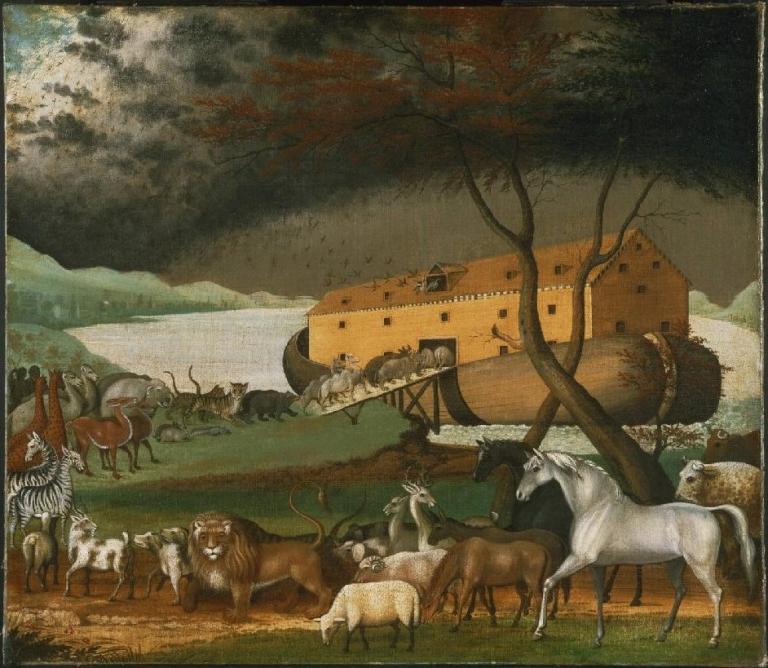
Noah’s Ark (1846), a painting by the American folk painter Edward Hicks [public domain / Wikimedia Commons]

***
I received the following question on my Facebook Author page:
I am not convinced that the belief in a world-wide deluge is supported by any kind of balanced, rational evaluation of the material evidence. How do you, as an apologist, reconcile the Biblical account of the Deluge with the many empirical evidences which support conventional geology, and oppose the possibility of a cataclysmic, worldwide flood?
You assume that I have to “reconcile” all this stuff. I need not do any such thing. The biblical text doesn’t require that; nor does the Church. The Church doesn’t require belief in flood geology or catastrophism, and it doesn’t require an absolute rejection of evolutionary theory (only the strictly materialistic version of it; and it requires belief in Adam and Eve as the primal human pair who fell, etc.). Nor does it require a young earth.
Lastly, the Bible doesn’t require the Flood (an actual historical event, as indicated several times in the NT) to have been literally global, as we see in the treatment of the Flood in The Catholic Encyclopedia of 1913.
The Flood was historical. Neither the Bible nor the Catholic Church require one to believe that it was literally global in nature, and legitimate science would indicate that it was not as well. The New Testament (including Jesus) casually assumes that Noah and the Flood were historical:
Matthew 24:37-19 (RSV) As were the days of Noah, so will be the coming of the Son of man. [38] For as in those days before the flood they were eating and drinking, marrying and giving in marriage, until the day when Noah entered the ark, [39] and they did not know until the flood came and swept them all away, so will be the coming of the Son of man. (cf. Lk 17:26-27)
Hebrews 11:7 By faith Noah, being warned by God concerning events as yet unseen, took heed and constructed an ark for the saving of his household; by this he condemned the world and became an heir of the righteousness which comes by faith. [Abraham is mentioned in the next verse]
1 Peter 3:18-21 For Christ also died for sins once for all, the righteous for the unrighteous, that he might bring us to God, being put to death in the flesh but made alive in the spirit; [19] in which he went and preached to the spirits in prison, [20] who formerly did not obey, when God’s patience waited in the days of Noah, during the building of the ark, in which a few, that is, eight persons, were saved through water. [21] Baptism, which corresponds to this, now saves you, not as a removal of dirt from the body but as an appeal to God for a clear conscience, through the resurrection of Jesus Christ,
2 Peter 2:4-9 For if God did not spare the angels when they sinned, but cast them into hell and committed them to pits of nether gloom to be kept until the judgment; [5] if he did not spare the ancient world, but preserved Noah, a herald of righteousness, with seven other persons, when he brought a flood upon the world of the ungodly; [6] if by turning the cities of Sodom and Gomor’rah to ashes he condemned them to extinction and made them an example to those who were to be ungodly; [7] and if he rescued righteous Lot, greatly distressed by the licentiousness of the wicked [8] (for by what that righteous man saw and heard as he lived among them, he was vexed in his righteous soul day after day with their lawless deeds), [9] then the Lord knows how to rescue the godly from trial, and to keep the unrighteous under punishment until the day of judgment,
The text in the Second Epistle of Peter passage moves from the fallen angels to Noah, and then to Lot (2:7), who lived in the time of Abraham, and was his nephew, to the time he was writing. St. Peter is arguing by analogy: “God rescued Noah and Lot; He can do the same for you today.” This makes absolutely no sense if the earlier people are imaginary, because you would have the real fallen angels (demons), then the imaginary Noah, then back to reality with Lot and the early Christians. This utterly violates the tenor and nature of the passage.
Some people get hung up on the word “all” as pertaining to the Flood; e.g., Genesis 6:17: “For behold, I will bring a flood of waters upon the earth, to destroy all flesh in which is the breath of life from under heaven; everything that is on the earth shall die.”
One must understand the biblical (Hebraic / ancient Near Eastern or Mesopotamian) use of language: often not intended to be absolutely literal. For example, by the following passages — referring to saving “all men” or “the world” — one might conclude (falsely; and many do) that the Bible teaches universalism. But it does not. Other passages speak of hell and those who are damned and end up there for eternity:
John 12:32 and I, when I am lifted up from the earth, will draw all men to myself. (cf. Lk 3:6; Jn 3:17; 4:42; 6:33; 12:47; 1 Jn 4:14)
Romans 5:18 Then as one man’s trespass led to condemnation for all men, so one man’s act of righteousness leads to acquittal and life for all men. (cf. 2 Cor 5:19)
Ephesians 1:9-10 For he has made known to us in all wisdom and insight the mystery of his will, according to his purpose which he set forth in Christ [10] as a plan for the fulness of time, to unite all things in him, things in heaven and things on earth.
1 Timothy 4:10 For to this end we toil and strive, because we have our hope set on the living God, who is the Savior of all men, especially of those who believe.
Titus 2:11 For the grace of God has appeared for the salvation of all men,
2 Peter 3:9 The Lord is not slow about his promise as some count slowness, but is forbearing toward you, not wishing that any should perish, but that all should reach repentance.
1 Timothy 4:10 perfectly illustrates the complexity of biblical language and thought. God is the “Savior of all men” (i.e., He is potentially so; desires that all men should be saved [1 Tim 2:4; 2 Pet 3:9]; made it possible for all men; what is called in theology, “universal atonement”). Then St. Paul the same passage states, “especially of those who believe” (i.e., the ones who are actually saved in the end and go to heaven, are those who appropriate or accept God’s grace for salvation, which they can reject in their free will, should they choose to do so).
It’s always supremely important to compare Bible passage with other related ones and to understand biblical language and styles and idioms, in context, and in accordance with the culture of the time.
This is why truly grasping the Bible in all its magnificent aspects and endless spiritual treasure, takes considerable time and study. Many refuse to do that, and so (if of a skeptical / hyper-rationalist bent) they approach God’s inspired Word as a butcher approaches a hog, and invariably arrive at erroneous interpretations. I’ve met dozens of atheists who think they are experts on the Bible. Trust me, they’re almost invariably not, and I have plainly proven that in many dialogues: exposing very basic or inexcusable mistakes and flat-out whoppers. Or (if more innocent and open-minded) folks come to wrong conclusions out of ignorance.
Related Reading:
Old Earth, Flood Geology, Local Flood, & Uniformitarianism (vs. Kevin Rice) [5-25-04; many defunct links removed and new ones added: 5-10-17]
Adam & Eve, Cain, Abel, & Noah: Historical Figures [2-20-08]
Do Carnivores on the Ark Disprove Christianity? [9-10-15]
New Testament Evidence for Noah’s Existence [National Catholic Register, 3-11-18]
Modernism vs. History in Genesis & Biblical Inspiration [7-23-18]
***
***
Practical Matters: Perhaps some of my 3,900+ free online articles (the most comprehensive “one-stop” Catholic apologetics site) or fifty books have helped you (by God’s grace) to decide to become Catholic or to return to the Church, or better understand some doctrines and why we believe them.
*
Or you may believe my work is worthy to support for the purpose of apologetics and evangelism in general. If so, please seriously consider a much-needed financial contribution. I’m always in need of more funds: especially monthly support. “The laborer is worthy of his wages” (1 Tim 5:18, NKJV). 1 December 2021 was my 20th anniversary as a full-time Catholic apologist, and February 2022 marked the 25th anniversary of my blog.
*
PayPal donations are the easiest: just send to my email address: [email protected]. You’ll see the term “Catholic Used Book Service”, which is my old side-business. To learn about the different methods of contributing, including 100% tax deduction, etc., see my page: About Catholic Apologist Dave Armstrong / Donation Information. Thanks a million from the bottom of my heart!
*
***
Previous Post
August 18, 2015
"Once Saved, Always Saved" / Eternal Security: Is it Biblical?
Next Post
August 18, 2015 Why Did a Perfect God Create an Imperfect World?
Browse Our Archives
Select a Category & Last Things About Me Anti-Catholicism Atheism & Agnosticism Baptism and Sacramentalism Bible and Tradition Blessed Virgin Mary Books by Dave Armstrong C. S. Lewis Calvinism & General Protestantism Catholic Apologetics Catholic Apologists Catholic conversion Catholic converts Christmas Church (Ecclesiology) Church History Conversion and Converts Development of Doctrine Eastern Orthodoxy Ecumenism & Christian Unity Eucharist & Liturgy Fathers of the Church French Translations G. K. Chesterton Hell Hell & Satan Hell & Satan & Last Things Heresies & Comparative Religion Holistic Health Inquisition & Crusades & Scandals James White Jews & Judaism & Old Testament John Calvin John Henry Newman Liberal / Modernist Theology Life Issues Literary Resume Lutheranism Mariology Martin Luther Music Orthodoxy Papacy & Infallibility Personal Page Philosophy & Science Political & Ethical & Moral Issues Protestant Persecution & Intolerance Protestantism Purgatory Purgatory & Penance Romantic & Imaginative Theology Saints & Purgatory & Penance Salvation Salvation & Justification Satan & Last Things Sexuality and Gender Issues Spanish Translations Traditionalism vs. Radical Catholic Reactionaries Traducciones al español / tradução para português Trinitarianism & Christology Uncategorized Videos
Select a Month October 2026 September 2026 August 2026 July 2026 June 2026 May 2026 April 2026 March 2026 February 2026 January 2026 December 2025 November 2025 October 2025 September 2025 August 2025 July 2025 June 2025 May 2025 April 2025 March 2025 February 2025 January 2025 December 2024 November 2024 October 2024 September 2024 August 2024 July 2024 June 2024 May 2024 April 2024 March 2024 February 2024 January 2024 December 2023 November 2023 October 2023 September 2023 August 2023 July 2023 June 2023 May 2023 April 2023 March 2023 February 2023 January 2023 December 2022 November 2022 October 2022 September 2022 August 2022 July 2022 June 2022 May 2022 April 2022 March 2022 February 2022 January 2022 December 2021 November 2021 October 2021 September 2021 August 2021 July 2021 June 2021 May 2021 April 2021 March 2021 February 2021 January 2021 December 2020 November 2020 October 2020 September 2020 August 2020 July 2020 June 2020 May 2020 April 2020 March 2020 February 2020 January 2020 December 2019 November 2019 October 2019 September 2019 August 2019 July 2019 June 2019 May 2019 April 2019 March 2019 February 2019 January 2019 December 2018 November 2018 October 2018 September 2018 August 2018 July 2018 June 2018 May 2018 April 2018 March 2018 February 2018 January 2018 December 2017 November 2017 October 2017 September 2017 August 2017 July 2017 June 2017 May 2017 April 2017 March 2017 February 2017 January 2017 December 2016 November 2016 October 2016 September 2016 August 2016 July 2016 June 2016 May 2016 April 2016 March 2016 February 2016 January 2016 December 2015 November 2015 October 2015 September 2015 August 2015 July 2015 June 2015 May 2015 April 2015 March 2015 February 2015 January 2015 December 2014 November 2014 October 2014 September 2014 August 2014 July 2014 June 2014 April 2014 March 2014 February 2014 January 2014 December 2013 November 2013 October 2013 September 2013 August 2013 July 2013 June 2013 April 2013 March 2013 February 2013 January 2013 December 2012 November 2012 October 2012 September 2012 August 2012 July 2012 June 2012 May 2012 April 2012 March 2012 February 2012 January 2012 December 2011 November 2011 October 2011 September 2011 August 2011 July 2011 June 2011 April 2011 March 2011 February 2011 October 2010 September 2010 August 2010 July 2010 April 2010 March 2010 December 2009 October 2009 August 2009 July 2009 June 2009 May 2009 March 2009 February 2009 October 2008 September 2008 April 2008 March 2008 February 2008 January 2008 December 2007 November 2007 October 2007 May 2007 March 2007 February 2007 January 2007 November 2006 October 2006 September 2006 August 2006 July 2006 June 2006 May 2006 April 2006 March 2006 February 2006 October 2005 June 2005 April 2005 February 2005 July 2004 May 2004 April 2004
Follow Us!
TAKE THE
Religious Wisdom Quiz
Which Psalm begins with the words, "My God, my God, why have you forsaken me?", later quoted by Jesus?
Select your answer to see how you score.
Psalm 46 Psalm 110 Psalm 1 Psalm 22
Books by This Author Books by Dave Armstrong
Related posts from Biblical Evidence for Catholicism

A Few "Worst" & "Best" Arguments vs. Protestantism
Biblical Evidence for Catholicism

Jerusalem Council vs. James White & Sola Scriptura
Biblical Evidence for Catholicism

Biblical Perspicuity: Absurd Anti-Catholic "Defense"
Biblical Evidence for Catholicism

50 Biblical Disproofs of "Evident Clearness" of the...
Biblical Evidence for Catholicism
TRENDING AT PATHEOS Catholic

I was strolling through the top floor of the brand new Parthenon...

What Does Gêvâh Mean For Kimberley Guifoyle &...
This week, a lot of the news is focused on Kimberly Guilfoyle....

INNER CIRCLE: Profound Mystery (Of Christ In All...
Ephesians 5:31-32 “For this reason, a man will leave his father and...

Do Not Rejoice When Your Enemy Falls: The...
Turning an execution into a public spectacle is a disturbing expression of...

'The Chosen' S6 Trailer: The Passion Gets Very...
Not many watching 'The Chosen' worry about spoilers, but just because they...

The purpose-driven labor priest
A labor activist reads Rick Warren and it gets me wondering about...
view all Catholic blogs
Ad-Free & Subscriber Log-In Subscription Support
- About Us
- 2026 Calendar
- Videos
- Podcasts
- Library of World Religions
- Faith In Media Tracker
- Advertise With Us
- Write for Us
- Privacy Policy
- Terms of Service
- Do Not Sell My Data
- Contact Us
- Radiant Digital
- Manage Newsletter Subscriptions
- Unsubscribe From Notifications
- Sitemap
Copyright 2008-2026, Patheos. All rights reserved.
Subscription Support Ad-Free & Subscriber Log-In
Follow Patheos