
BuddhistCatholicContemplativeEvangelicalGeneral ChristianHinduJewishLatter-day SaintMuslimNew VisionsProgressive Christian
Beliefs
- Buddhist
- Catholic
- Contemplative
- Evangelical
- General Christian
- Hindu
- Jewish
- Latter-day Saint
- More Voices
- Muslim
- New Visions
- Pagan
- Progressive Christian
Topics
- Religion News
- Food and Religion
- Sports and Religion
- Religious Art
- Religious Music and Entertainment
- Religious Events
- History and Religion
- Style and Religion
- Politics and Religion
- Women in Religion
- Recreation Outdoors and Religion
- Business Finance and Religion
- Careers Workplace and Religion
- Education and Religion
- Family Parenting and Religion
- Health Fitness and Religion
- Home and Religion
- Relationships and Religion
- Technology and Religion
- Travel and Religion
Columnists
- Buddhist Columnists
- Business Finance and Religion Columnists
- Careers Workplace and Religion Columnists
- Catholic Columnists
- Contemplative Columnists
- Education and Religion Columnists
- Evangelists Columnists
- Family Parenting and Religion Columnists
- General Christian Columnists
- Health Fitness and Religion Columnists
- Hindu Columnists
- History and Religion Columnists
- Home and Religion Columnists
- Jewish Columnists
- More Voices Columnists
- Latter Day Columnists
- Muslim Columnists
- New Visions Columnists
- Nonreligious Columnists
- Pagan Columnists
- Politics and Religion Columnists
- Progressive Columnists
- Recreation Outdoors and Religion Columnists
- Relationships and Religion Columnists
- Religion News Columnists
- Religious Art Columnists
- Religious Events Columnists
- Religious Music and Entertainment Columnists
- Sports and Religion Columnists
- Style and Religion Columnists
- Technology and Religion Columnists
- Travel and Religion Columnists
- Women in Religion Columnists
Resource Library
- 2026 Calendar
- Library of World Religions
- The 100 Most Holy Places on Earth
- Patheos Answers
- Podcasts
- Videos
- Faith Leaders Database
- Anglican Episcopalian
- Bahai
- Baptist
- Buddhism
- Christianity
- Confucianism
- Eastern Orthodoxy
- Hinduism
- Holiness and Pentecostal
- ISKCON
- Islam
- Judaism
- Lutheran
- Methodist
- The Church of Jesus Christ of Latter-day Saints
- New Age
- Paganism
- Presbytarian and Reformed
- Protestantism
- Religion Behind the Scenes
- Roman Catholic
- Scientology
- Shia Islam
- Sikhism
- Sufism
- Sunni Islam
- Taoism
- Zen
- See all religions
Research Tools
 Ad-Free & Subscriber Log-In Subscription Support
Ad-Free & Subscriber Log-In Subscription Support
Follow Patheos 

- Trending:
- Forgiveness
- |
- Marriage
- |
- Consciousness
- |
- Death Penalty
- |
- Election
- |
- Halloween

-
About
-
Catholic Apologetics
-
Church History
-
Great Apologists
-
Christian Worldview
-
Protestantism & Misc.
- Home
- Catholic
- History and Religion
- Argument for Veneration of Saints & Angels from Prohibition of Blasphemy
Argument for Veneration of Saints & Angels from Prohibition of Blasphemy
Last updated on: May 24, 2017 at 1:50 pm by Dave Armstrong
Argument for Veneration of Saints & Angels from Prohibition of Blasphemy 2017-05-24T13:50:51-04:00 Dave Armstrong
Patheos Explore the world's faith through different perspectives on religion and spirituality! Patheos has the views of the prevalent religions and spiritualities of the world.
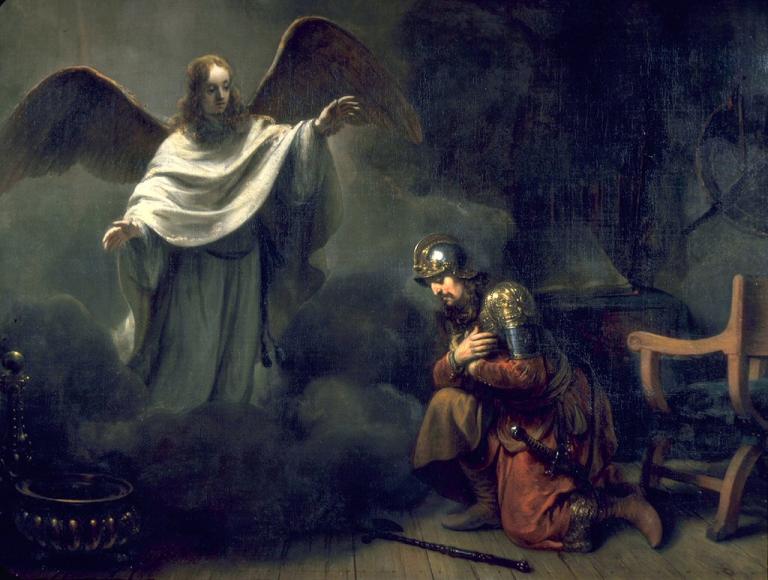
Vision of Cornelius the Centurion (1664) by Gerbrand van den Eeckhout (1621-1674) [public domain / Wikimedia Commons]

***
(8-8-15)
***
The Bible looks negatively on what it describes as “blasphemy” — not just against God, but against holy persons or those set apart for His purposes (Moses: Acts 6:11; St. Paul: Acts 13:45; 18:6; saints in heaven: Rev 13:6; Christians in general: 1 Pet 4:4), and against angels (2 Pet 2:10; Jude 8; Rev 13:6). The same words for blasphemy are used for men, angels, and God.
This is because these men and angels serve as His messengers (2 Cor 8:23), direct representatives (Matt 10:40; Lk 10:16; Jn 13:20), ambassadors (2 Cor 5:20; Eph 6:20; Phlm 1:9), or witnesses (Jn 15:27; 19:35; 21:24; Acts 1:8; 2:32; 3:15; 10:39-41; 23:11; 1 Pet 5:1; Rev 1:2; 6:9). Indeed, Christians are even described as “fellow workers” with Him (1 Cor 3:9; 2 Cor 6:1; Phil 2:12-13). The Church is equated with Jesus Himself (both being persecuted in the same actions: Acts 26:11, 14-15), and there is also an identification of the Church “Body of Christ” with Christ Himself (1 Cor 12:27; Eph 1:22-23; 5:30; Col 1:24).
The aspect of divinization, or theosis, is a biblical motif of very close identification and union with God:
Acts 17:28 (RSV) for ‘In him we live and move and have our being‘: . . .
2 Corinthians 3:18 And we all, with unveiled face, beholding the glory of the Lord, are being changed into his likeness from one degree of glory to another; for this comes from the Lord who is the Spirit. (2 Corinthians 3:18)
Ephesians 3:19 . . . to know the love of Christ which surpasses knowledge, that you may be filled with all the fulness of God.
Ephesians 4:13 . . . mature manhood, to the measure of the stature of the fulness of Christ.
2 Peter 1:3-4 His divine power has granted to us all things that pertain to life and godliness, through the knowledge of him who called us to his own glory and excellence, [4] by which he has granted to us his precious and very great promises, that through these you may escape from the corruption that is in the world because of passion, and become partakers of the divine nature.
In other words, the key is affinity with, or closeness; proximity to God. Just as God can be blasphemed, in a lesser but still very real sense, so can His ambassadors and witnesses. There is the primary Being: God, and the secondary ones: His vessels. They reflect and represent God; therefore, as such, people can scorn and reject and blaspheme them just as they do God.
It seems to straightforwardly follow, then, by analogy, that if a rejection or blasphemy of God can be expressed via an essentially lesser but connected rejection or blasphemy of His ambassadors (the lesser vessel being in close affinity with the greater source), by the same token and principle and logic, conversely, the worship of God can be expressed via an essentially lesser but connected veneration of His ambassadors.
In this manner, the wider application of blasphemy in Scripture to creatures suggests by symmetrical analogy, a wider application of honoring: expressed in veneration of creatures, which is distinct (but not altogether disconnected) from the adoration that God alone is entitled to, as Creator. The creatures reflect the Creator like the painting reflects the painter, or moonlight, the sunlight that is the source of it.
Moreover, we see that the Bible refers blasphemy of men almost solely to the most eminent of God’s followers (Paul, Moses, and perfected saints in heaven): and angels even higher in the scale of things. Thus, by analogy, the relatively greater veneration would be towards those who had attained a higher holiness and sanctity; hence in the Bible we see a differential “system” of blasphemy / veneration not unlike how the Catholic Church ranks lesser and greater saints, with the greater receiving more veneration.
Lastly, the biblical data about blasphemy of immaterial holy things (the gospel, Christian doctrine, the law, the Temple) leads to the opposite analogy of reverence of those same holy things and places (“The Holy Bible”: as even Protestants call it; the Holy Land, icons, Church sanctuaries, statues representing saints, etc.). The essential and fundamental, presuppositional principles of all these things are clearly laid down in the Bible, if not explicitly in every jot and tittle.
***
Previous Post

July 10, 2015
Dialogue with an Atheist on My Semi-Satirical Critique of Atheism
Next Post

August 9, 2015 “Who is Dave Armstrong and Why Should I Read His Stuff?”
Browse Our Archives
Select a Category & Last Things About Me Anti-Catholicism Atheism & Agnosticism Baptism and Sacramentalism Bible and Tradition Blessed Virgin Mary Books by Dave Armstrong C. S. Lewis Calvinism & General Protestantism Catholic Apologetics Catholic Apologists Catholic conversion Catholic converts Christmas Church (Ecclesiology) Church History Conversion and Converts Development of Doctrine Eastern Orthodoxy Ecumenism & Christian Unity Eucharist & Liturgy Fathers of the Church French Translations G. K. Chesterton Hell Hell & Satan Hell & Satan & Last Things Heresies & Comparative Religion Holistic Health Inquisition & Crusades & Scandals James White Jews & Judaism & Old Testament John Calvin John Henry Newman Liberal / Modernist Theology Life Issues Literary Resume Lutheranism Mariology Martin Luther Music Orthodoxy Papacy & Infallibility Personal Page Philosophy & Science Political & Ethical & Moral Issues Protestant Persecution & Intolerance Protestantism Purgatory Purgatory & Penance Romantic & Imaginative Theology Saints & Purgatory & Penance Salvation Salvation & Justification Satan & Last Things Sexuality and Gender Issues Spanish Translations Traditionalism vs. Radical Catholic Reactionaries Traducciones al español / tradução para português Trinitarianism & Christology Uncategorized Videos
Select a Month October 2026 September 2026 August 2026 July 2026 June 2026 May 2026 April 2026 March 2026 February 2026 January 2026 December 2025 November 2025 October 2025 September 2025 August 2025 July 2025 June 2025 May 2025 April 2025 March 2025 February 2025 January 2025 December 2024 November 2024 October 2024 September 2024 August 2024 July 2024 June 2024 May 2024 April 2024 March 2024 February 2024 January 2024 December 2023 November 2023 October 2023 September 2023 August 2023 July 2023 June 2023 May 2023 April 2023 March 2023 February 2023 January 2023 December 2022 November 2022 October 2022 September 2022 August 2022 July 2022 June 2022 May 2022 April 2022 March 2022 February 2022 January 2022 December 2021 November 2021 October 2021 September 2021 August 2021 July 2021 June 2021 May 2021 April 2021 March 2021 February 2021 January 2021 December 2020 November 2020 October 2020 September 2020 August 2020 July 2020 June 2020 May 2020 April 2020 March 2020 February 2020 January 2020 December 2019 November 2019 October 2019 September 2019 August 2019 July 2019 June 2019 May 2019 April 2019 March 2019 February 2019 January 2019 December 2018 November 2018 October 2018 September 2018 August 2018 July 2018 June 2018 May 2018 April 2018 March 2018 February 2018 January 2018 December 2017 November 2017 October 2017 September 2017 August 2017 July 2017 June 2017 May 2017 April 2017 March 2017 February 2017 January 2017 December 2016 November 2016 October 2016 September 2016 August 2016 July 2016 June 2016 May 2016 April 2016 March 2016 February 2016 January 2016 December 2015 November 2015 October 2015 September 2015 August 2015 July 2015 June 2015 May 2015 April 2015 March 2015 February 2015 January 2015 December 2014 November 2014 October 2014 September 2014 August 2014 July 2014 June 2014 April 2014 March 2014 February 2014 January 2014 December 2013 November 2013 October 2013 September 2013 August 2013 July 2013 June 2013 April 2013 March 2013 February 2013 January 2013 December 2012 November 2012 October 2012 September 2012 August 2012 July 2012 June 2012 May 2012 April 2012 March 2012 February 2012 January 2012 December 2011 November 2011 October 2011 September 2011 August 2011 July 2011 June 2011 April 2011 March 2011 February 2011 October 2010 September 2010 August 2010 July 2010 April 2010 March 2010 December 2009 October 2009 August 2009 July 2009 June 2009 May 2009 March 2009 February 2009 October 2008 September 2008 April 2008 March 2008 February 2008 January 2008 December 2007 November 2007 October 2007 May 2007 March 2007 February 2007 January 2007 November 2006 October 2006 September 2006 August 2006 July 2006 June 2006 May 2006 April 2006 March 2006 February 2006 October 2005 June 2005 April 2005 February 2005 July 2004 May 2004 April 2004
Follow Us!
TAKE THE
Religious Wisdom Quiz
What did God create on the first day according to Genesis?
Select your answer to see how you score.
Animals Man Plants Light
Books by This Author Books by Dave Armstrong
Related posts from Biblical Evidence for Catholicism

Bible & Catholicism on Mortal Sin (vs. John...
Biblical Evidence for Catholicism

Does Catholic Intercession of Saints Require Omniscience?
Biblical Evidence for Catholicism

Capabilities of Heavenly Saints: Protestant Commentaries
Biblical Evidence for Catholicism

Revelation 5 & 8 (Intercession of Saints &...
Biblical Evidence for Catholicism
TRENDING AT PATHEOS Catholic

The Sermon on the Mount, Part I: Matthew...
The Sermon on the Mount, Part I (Matthew 4:12-5:12) St. Matthew moves...

What's up from Crossway: Reviewing some of their latest A few weeks...

Janie Learns the Way of the Cross: A...
Teaching children about Jesus' Passion can be challenging. Many parents and educators...

Looking For Good Catholic Writing - October 2026
He alone extends the heavens, and he walks upon the waves of...

In "Irreplaceable," our book on vocation and technology, Trevor Sutton and I...

I was strolling through the top floor of the brand new Parthenon...
view all Catholic blogs
Ad-Free & Subscriber Log-In Subscription Support
- About Us
- 2026 Calendar
- Videos
- Podcasts
- Library of World Religions
- Faith In Media Tracker
- Advertise With Us
- Write for Us
- Privacy Policy
- Terms of Service
- Do Not Sell My Data
- Contact Us
- Radiant Digital
- Manage Newsletter Subscriptions
- Unsubscribe From Notifications
- Sitemap
Copyright 2008-2026, Patheos. All rights reserved.
Subscription Support Ad-Free & Subscriber Log-In
Follow Patheos