
BuddhistCatholicContemplativeEvangelicalGeneral ChristianHinduJewishLatter-day SaintMuslimNew VisionsProgressive Christian
Beliefs
- Buddhist
- Catholic
- Contemplative
- Evangelical
- General Christian
- Hindu
- Jewish
- Latter-day Saint
- More Voices
- Muslim
- New Visions
- Pagan
- Progressive Christian
Topics
- Religion News
- Food and Religion
- Sports and Religion
- Religious Art
- Religious Music and Entertainment
- Religious Events
- History and Religion
- Style and Religion
- Politics and Religion
- Women in Religion
- Recreation Outdoors and Religion
- Business Finance and Religion
- Careers Workplace and Religion
- Education and Religion
- Family Parenting and Religion
- Health Fitness and Religion
- Home and Religion
- Relationships and Religion
- Technology and Religion
- Travel and Religion
Columnists
- Buddhist Columnists
- Business Finance and Religion Columnists
- Careers Workplace and Religion Columnists
- Catholic Columnists
- Contemplative Columnists
- Education and Religion Columnists
- Evangelists Columnists
- Family Parenting and Religion Columnists
- General Christian Columnists
- Health Fitness and Religion Columnists
- Hindu Columnists
- History and Religion Columnists
- Home and Religion Columnists
- Jewish Columnists
- More Voices Columnists
- Latter Day Columnists
- Muslim Columnists
- New Visions Columnists
- Nonreligious Columnists
- Pagan Columnists
- Politics and Religion Columnists
- Progressive Columnists
- Recreation Outdoors and Religion Columnists
- Relationships and Religion Columnists
- Religion News Columnists
- Religious Art Columnists
- Religious Events Columnists
- Religious Music and Entertainment Columnists
- Sports and Religion Columnists
- Style and Religion Columnists
- Technology and Religion Columnists
- Travel and Religion Columnists
- Women in Religion Columnists
Resource Library
- 2026 Calendar
- Library of World Religions
- The 100 Most Holy Places on Earth
- Patheos Answers
- Podcasts
- Videos
- Faith Leaders Database
- Anglican Episcopalian
- Bahai
- Baptist
- Buddhism
- Christianity
- Confucianism
- Eastern Orthodoxy
- Hinduism
- Holiness and Pentecostal
- ISKCON
- Islam
- Judaism
- Lutheran
- Methodist
- The Church of Jesus Christ of Latter-day Saints
- New Age
- Paganism
- Presbytarian and Reformed
- Protestantism
- Religion Behind the Scenes
- Roman Catholic
- Scientology
- Shia Islam
- Sikhism
- Sufism
- Sunni Islam
- Taoism
- Zen
- See all religions
Research Tools
 Ad-Free & Subscriber Log-In Subscription Support
Ad-Free & Subscriber Log-In Subscription Support
Follow Patheos 

- Trending:
- Forgiveness
- |
- Marriage
- |
- Consciousness
- |
- Death Penalty
- |
- Election
- |
- Halloween

-
About
-
Catholic Apologetics
-
Church History
-
Great Apologists
-
Christian Worldview
-
Protestantism & Misc.
- Home
- Catholic
- History and Religion
- Are There Folks in Hell Because We Didn’t Pray Enough?
Are There Folks in Hell Because We Didn’t Pray Enough?
Last updated on: June 3, 2017 at 1:06 pm by Dave Armstrong
Are There Folks in Hell Because We Didn’t Pray Enough? 2017-06-03T13:06:12-04:00 Dave Armstrong
Patheos Explore the world's faith through different perspectives on religion and spirituality! Patheos has the views of the prevalent religions and spiritualities of the world.
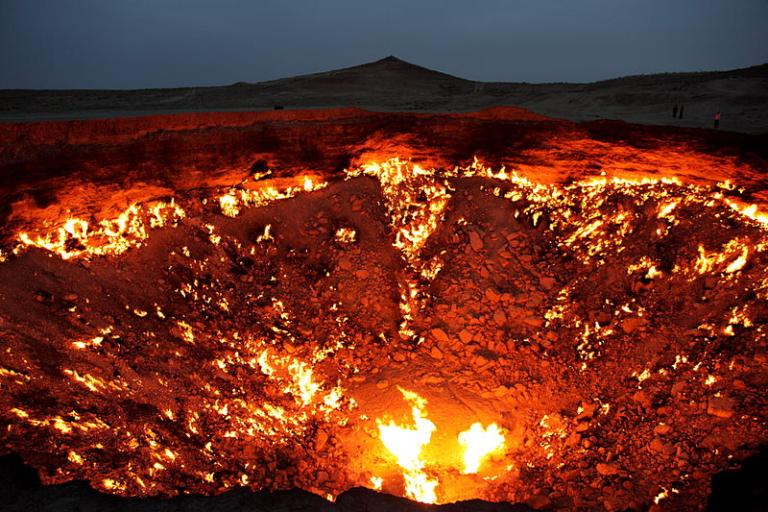
“The Door to Hell” in Turkmenistan, Darvaza [Wikimedia Commons /Creative Commons Attribution-Share Alike 2.0 Generic license]

Someone wrote on my Facebook page:
I don’t like when Mary said to the children at Fatima that people are going there because they have no one to pray for them. It just really bothers me. The thought is awful. How shall Christ be all in all when so many of his members are eternally damned? Lord please have mercy on a soul destined to be damned tonight because of my failure to pray. Your mercy is boundless You say and you are willing if I but ask. I beg you in the name of your Son’s death to have mercy on every human that will die tonight. Forgive them for they didn’t know what they were doing.
Everyone who goes to hell has had every chance to repent. God gives grace enough to all for them to repent, but some (many, apparently) choose not to. It’s their fault in the end. Prayer and penance and love assuredly help them along the road, but ultimately each individual decides and each stands before God, accountable for their actions and beliefs. God’s grace is sufficient to save them. They choose not to avail themselves of it.
Mary, however, does say that many go to hell because they have no one to pray for them.
I think it’s two truths that we must hold simultaneously (as so often in the Bible and Catholicism):
1. It’s always better to be the recipient of more intercessory prayer (and/or love or penance or God’s grace, etc.) rather than less.
2. Each individual is ultimately responsible for the fate of his or her own soul.
It would be like a scenario in which a husband or wife abandoned their spouse. We could say, “if only the one abandoned had been more loving or did more acts of kindness [or mutual friends had positively intervened more], maybe the other wouldn’t have left.” Well, maybe (that can always be said, can’t it?), yet the person is still responsible for leaving, and bears the primary blame.
The Blessed Virgin Mary wants to communicate to us (without doubt) that it’s always good and crucial that we pray for souls. We have to love them and be compassionate and merciful; to evangelize and share! I’ve devoted my life to sharing and defending the gospel and the message of the fullness of Christianity in the Catholic Church, so obviously I recognize its supreme importance. With more prayer and other spiritual aids, some of them could be turned to repentance and be saved, yes. God wants to include us in the whole process of redemption.
But each (ultimately damned) person already has enough grace to be saved from the outset and has chosen not to receive it. They ultimately have only themselves to blame if they are condemned to [i.e., choose] hell in the end. If they want to point to others and say, “They didn’t do a, b, c, so I could be saved,” that becomes mere blame-shifting on their part. God can always reply with, “But that’s no excuse for you. I sent you x, y, and z, and situations 1, 2, 3 where you had more than ample opportunity to receive My grace and repent, but you [using your free will that I gave you as a gift] steadfastly refused . . .”
Jesus notes in one parable that even if a person is raised from the dead as a witness, some folks won’t believe anyway. Thus, if even the greatest miracles can’t break through such profound unbelief and rebellion, our prayers won’t be able to, either, in those cases. They’ve hardened their hearts.
The reprobate can always attempt to blame others, and God can always reply as above: that His grace was more than sufficient in each case, but was spurned and rejected. We will all stand accountable for our actions and our lives, regardless of what others did or didn’t do (this is solid biblical and Catholic teaching). We’ve all fallen short and rebelled against God, and all must rely wholly on His free offer of grace, made possible by our Lord and Savior Jesus’ death on the cross, to be saved in the end.
Much of Catholic thought, I’ve found, involves “both/and” thinking. Things exist together in complementarity, that are often wrongly thought to be opposed to each other. I said, pray for folks. I didn’t say not to. I emphasized its extreme importance. It’s the distinction between sufficient and efficient grace. Every soul is provided sufficient grace by God. But the reprobate spurn it. Prayer can help make the sufficient grace become efficient, so that they actually repent. But not always; it’s not automatic. Free will dictates that there are souls who will be lost no matter what.
After all, Satan himself was with God. He had everything any being could conceivably want: except that he wasn’t God, and he couldn’t handle that. He managed to rebel, right from heaven, with God. No being could have any more “spiritual advantage” than that. But it wasn’t efficient, to prevent his fall.
Free will means that the grace can always be rejected, and also that it comes down to the individual in the end. That’s why Calvinism, in order to bolster its double predestination, had to deny human free will and assert irresistible grace. The Catholic position is the contrary on both counts (though we do believe that God predestines the elect, while not superseding their free will).
I can affirm that we ought to fervently pray for souls, while denying that it leads to a scenario where I am responsible in some profound way for a soul going to hell because I didn’t pray hard enough for him or her. We can always do more in any situation. That can become “overscrupulous” in a sense and drive us crazy if we ponder it too much. That will become Satan’s guilt trip and zap our spiritual energy. We have to take a larger view.
Each person ultimately is responsible for his or her own decision with regard to God and salvation. If we don’t do our “duty” towards them, God in His mercy will surely send someone else or some other situation, to give the person every chance to repent and make it to heaven. So we need not feel guilty about them: to the extent that we are in a crisis or suffering greatly: because that affects our spiritual life for ill in the long run.
But we should absolutely pray and do penance for others and anything that will help them. I assert both things and hold them together; semi-paradoxically, but consistently. Nor does my assertion of one somehow reduce the other, like a zero-sum game. Both/and . . . This is biblical and Catholic thinking, again and again: neither one extreme nor the other.
Previous Post

August 19, 2015
Atheism: A Remarkably Strong, Impervious Faith in “Atomism”
Next Post

August 19, 2015 St. Paul Prayed for a Dead Man: Onesiphorus (Yes He Did!)
Browse Our Archives
Select a Category & Last Things About Me Anti-Catholicism Atheism & Agnosticism Baptism and Sacramentalism Bible and Tradition Blessed Virgin Mary Books by Dave Armstrong C. S. Lewis Calvinism & General Protestantism Catholic Apologetics Catholic Apologists Catholic conversion Catholic converts Christmas Church (Ecclesiology) Church History Conversion and Converts Development of Doctrine Eastern Orthodoxy Ecumenism & Christian Unity Eucharist & Liturgy Fathers of the Church French Translations G. K. Chesterton Hell Hell & Satan Hell & Satan & Last Things Heresies & Comparative Religion Holistic Health Inquisition & Crusades & Scandals James White Jews & Judaism & Old Testament John Calvin John Henry Newman Liberal / Modernist Theology Life Issues Literary Resume Lutheranism Mariology Martin Luther Music Orthodoxy Papacy & Infallibility Personal Page Philosophy & Science Political & Ethical & Moral Issues Protestant Persecution & Intolerance Protestantism Purgatory Purgatory & Penance Romantic & Imaginative Theology Saints & Purgatory & Penance Salvation Salvation & Justification Satan & Last Things Sexuality and Gender Issues Spanish Translations Traditionalism vs. Radical Catholic Reactionaries Traducciones al español / tradução para português Trinitarianism & Christology Uncategorized Videos
Select a Month October 2026 September 2026 August 2026 July 2026 June 2026 May 2026 April 2026 March 2026 February 2026 January 2026 December 2025 November 2025 October 2025 September 2025 August 2025 July 2025 June 2025 May 2025 April 2025 March 2025 February 2025 January 2025 December 2024 November 2024 October 2024 September 2024 August 2024 July 2024 June 2024 May 2024 April 2024 March 2024 February 2024 January 2024 December 2023 November 2023 October 2023 September 2023 August 2023 July 2023 June 2023 May 2023 April 2023 March 2023 February 2023 January 2023 December 2022 November 2022 October 2022 September 2022 August 2022 July 2022 June 2022 May 2022 April 2022 March 2022 February 2022 January 2022 December 2021 November 2021 October 2021 September 2021 August 2021 July 2021 June 2021 May 2021 April 2021 March 2021 February 2021 January 2021 December 2020 November 2020 October 2020 September 2020 August 2020 July 2020 June 2020 May 2020 April 2020 March 2020 February 2020 January 2020 December 2019 November 2019 October 2019 September 2019 August 2019 July 2019 June 2019 May 2019 April 2019 March 2019 February 2019 January 2019 December 2018 November 2018 October 2018 September 2018 August 2018 July 2018 June 2018 May 2018 April 2018 March 2018 February 2018 January 2018 December 2017 November 2017 October 2017 September 2017 August 2017 July 2017 June 2017 May 2017 April 2017 March 2017 February 2017 January 2017 December 2016 November 2016 October 2016 September 2016 August 2016 July 2016 June 2016 May 2016 April 2016 March 2016 February 2016 January 2016 December 2015 November 2015 October 2015 September 2015 August 2015 July 2015 June 2015 May 2015 April 2015 March 2015 February 2015 January 2015 December 2014 November 2014 October 2014 September 2014 August 2014 July 2014 June 2014 April 2014 March 2014 February 2014 January 2014 December 2013 November 2013 October 2013 September 2013 August 2013 July 2013 June 2013 April 2013 March 2013 February 2013 January 2013 December 2012 November 2012 October 2012 September 2012 August 2012 July 2012 June 2012 May 2012 April 2012 March 2012 February 2012 January 2012 December 2011 November 2011 October 2011 September 2011 August 2011 July 2011 June 2011 April 2011 March 2011 February 2011 October 2010 September 2010 August 2010 July 2010 April 2010 March 2010 December 2009 October 2009 August 2009 July 2009 June 2009 May 2009 March 2009 February 2009 October 2008 September 2008 April 2008 March 2008 February 2008 January 2008 December 2007 November 2007 October 2007 May 2007 March 2007 February 2007 January 2007 November 2006 October 2006 September 2006 August 2006 July 2006 June 2006 May 2006 April 2006 March 2006 February 2006 October 2005 June 2005 April 2005 February 2005 July 2004 May 2004 April 2004
Follow Us!
TAKE THE
Religious Wisdom Quiz
Proverbs warns against what kind of woman as a symbol of temptation?
Select your answer to see how you score.
Widow Mother-in-law Queen Adulterous woman
Books by This Author Books by Dave Armstrong
Related posts from Biblical Evidence for Catholicism

Bible & Catholicism on Mortal Sin (vs. John...
Biblical Evidence for Catholicism

Does Catholic Intercession of Saints Require Omniscience?
Biblical Evidence for Catholicism

Capabilities of Heavenly Saints: Protestant Commentaries
Biblical Evidence for Catholicism

Revelation 5 & 8 (Intercession of Saints &...
Biblical Evidence for Catholicism
TRENDING AT PATHEOS Catholic

The Sermon on the Mount, Part I: Matthew...
The Sermon on the Mount, Part I (Matthew 4:12-5:12) St. Matthew moves...

What's up from Crossway: Reviewing some of their latest A few weeks...

Janie Learns the Way of the Cross: A...
Teaching children about Jesus' Passion can be challenging. Many parents and educators...

Looking For Good Catholic Writing - October 2026
He alone extends the heavens, and he walks upon the waves of...

In "Irreplaceable," our book on vocation and technology, Trevor Sutton and I...

I was strolling through the top floor of the brand new Parthenon...
view all Catholic blogs
Ad-Free & Subscriber Log-In Subscription Support
- About Us
- 2026 Calendar
- Videos
- Podcasts
- Library of World Religions
- Faith In Media Tracker
- Advertise With Us
- Write for Us
- Privacy Policy
- Terms of Service
- Do Not Sell My Data
- Contact Us
- Radiant Digital
- Manage Newsletter Subscriptions
- Unsubscribe From Notifications
- Sitemap
Copyright 2008-2026, Patheos. All rights reserved.
Subscription Support Ad-Free & Subscriber Log-In
Follow Patheos